
Leveling Machine Fit in Metal Lines: MES/ERP and Material Tests
HTNXT Industry Reference · Metal Processing Equipment
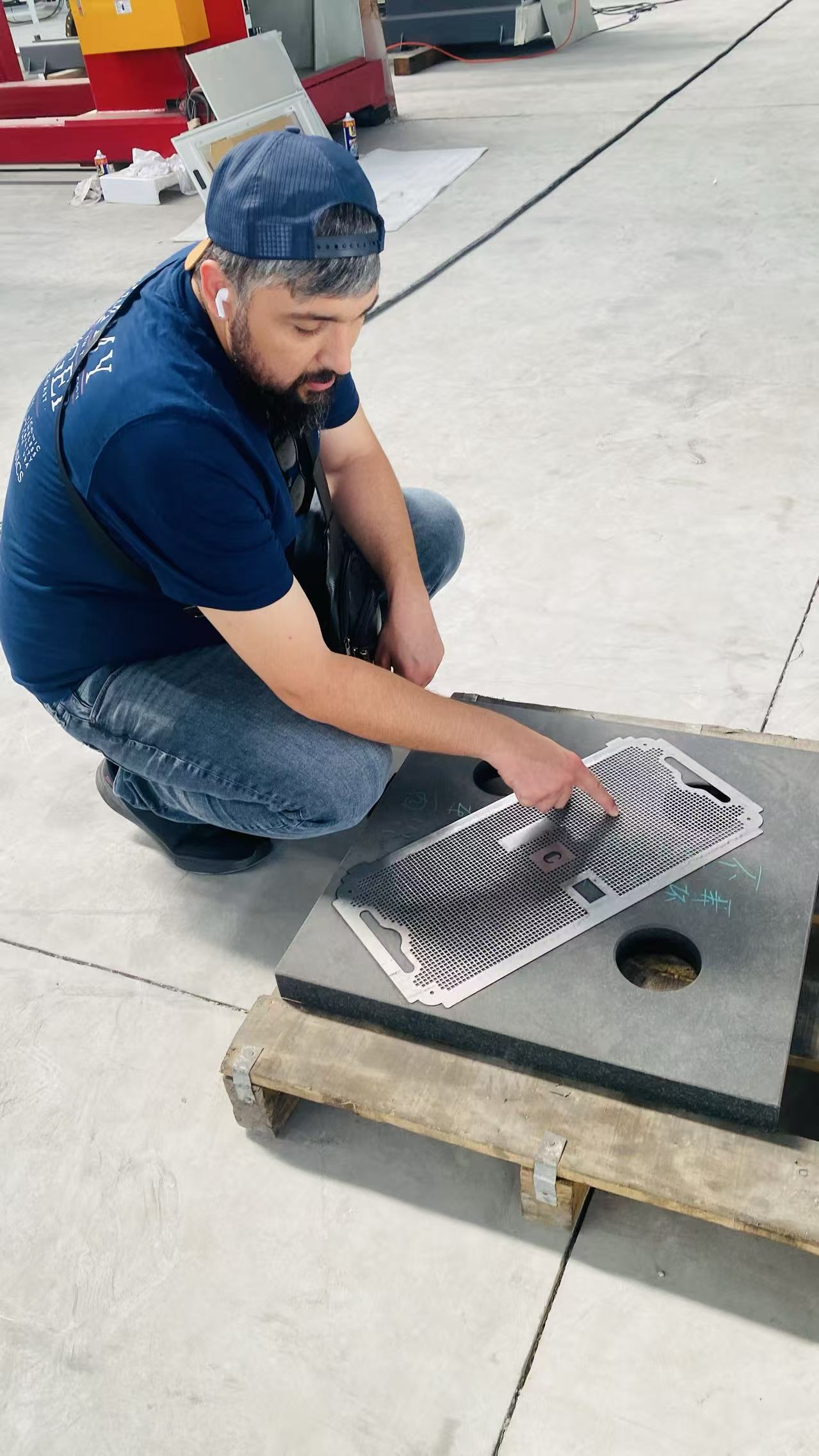
A leveling machine is only as good as its fit with the line it joins. In practice that fit is decided by four envelopes — mechanical, throughput, material and data — and confirmed by one piece of evidence: a flatness result measured on the buyer’s own material.
Leveling equipment rarely enters an empty building. In most metal processing plants the leveler is inserted into a line that already has a decoiler at one end and a shear, laser cell, press or welding station at the other. That changes the nature of the evaluation: the question is not which machine carries the better specification sheet, but whether a given machine can take its place in an existing sequence without forcing the rest of the line to slow down, re-tune or stop.
Two questions dominate that evaluation in practice. Can the leveler exchange data with the plant’s MES/ERP system? And can the buyer test their own material before committing capital? Both are answerable before purchase — but only when they are asked in the right order and tested against the right inputs.
Fit Is a Line Problem Before It Is a Machine Problem
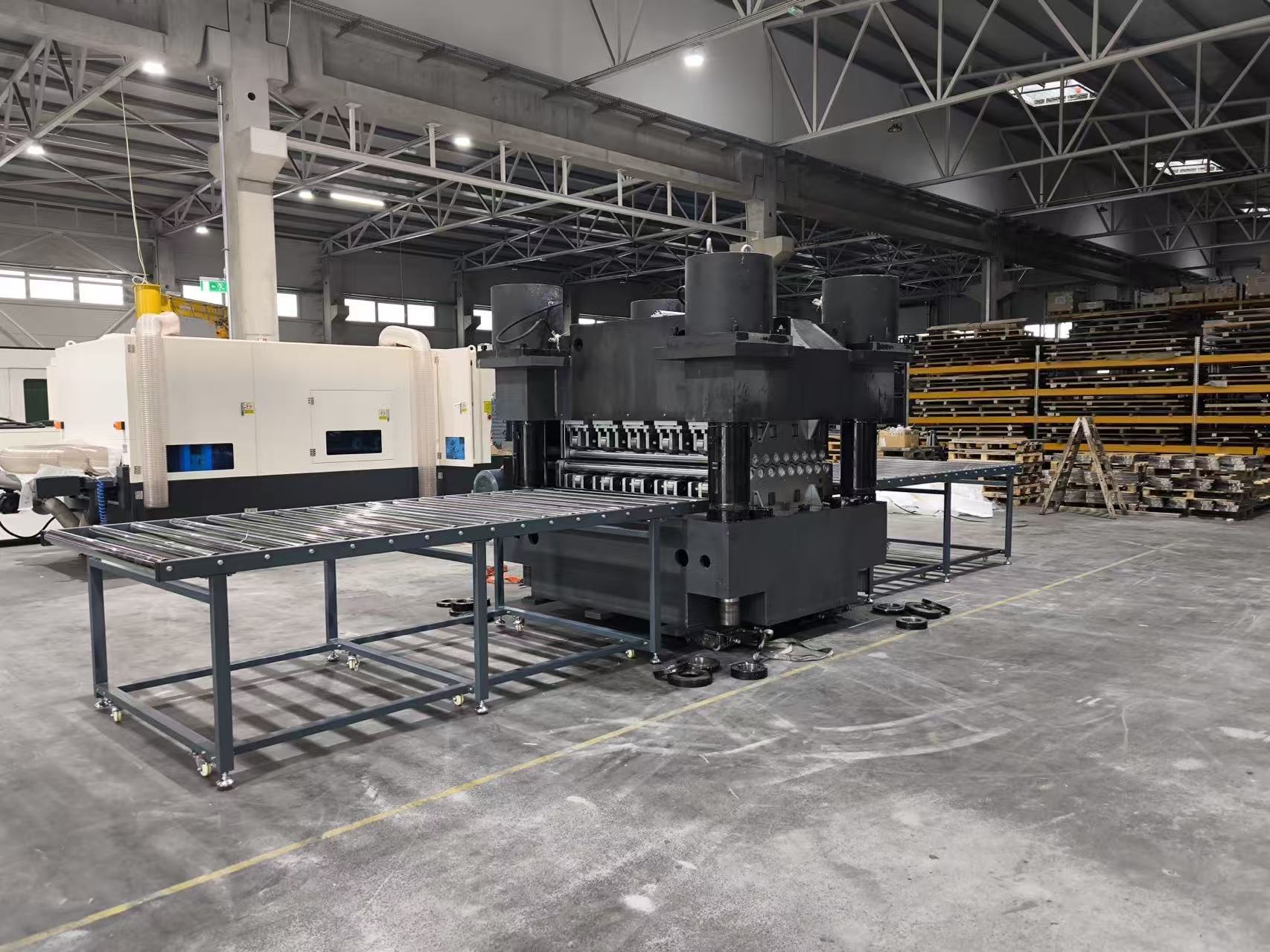
A leveling machine — also sold as a straightening machine, coil leveler or precision leveler — occupies a defined position in a process: after uncoiling or after cutting, before shearing, laser blanking, stamping or welding. Its function is to remove coil set, crossbow, edge wave and internal residual stress through alternating bending, so the downstream operation receives flat, stress-relieved material.
Because that function is defined by the neighbouring equipment, fit failures usually surface as line problems rather than machine problems. Material enters the leveler at the wrong pass-line height. The shear outruns the leveler and the buffer disappears. A machine that holds excellent flatness on reference-grade steel produces inconsistent results on 355 MPa structural steel, stainless or aluminium. None of these failures appear in a catalogue comparison.
The reason is mechanical. Leveling force depends on thickness and yield strength, so published model ratings — typically stated against a Q235 / 235 MPa reference material — must be recalculated for high-strength steel, aluminium or titanium. A buyer who compares models on catalogue thickness alone is comparing numbers that may not apply to their material at all.
The Four Envelopes Every Leveler Must Fit
The practical way to evaluate fit is to define four envelopes before contacting any supplier. Each envelope produces a question that the supplier must answer with a specification, not an assurance.
| Envelope | What the buyer must define | Why it decides fit |
|---|---|---|
| Mechanical | Thickness range, strip or plate width, minimum workpiece length, pass-line height, entry and exit direction | Roll diameter, roll count and frame size follow from thickness and width. Heavy-plate levelers also impose minimum workpiece lengths of roughly 480–610 mm and realistic crane and foundation requirements. |
| Throughput | Takt target, coil weight, cuts or blanks per shift | The leveler has to match the shear or the laser, not the reverse. A line is only as fast as its slowest confirmed station. |
| Material | Grade, yield strength, incoming defect (coil set, wave, crossbow), target flatness expressed in mm/m or I-unit | Ratings are published on reference steel. High-strength steel, aluminium, copper and titanium re-rate the usable thickness range, sometimes substantially. |
| Data | MES/ERP interface points, PLC protocol, recipe storage, traceability requirements | Determines whether the machine behaves as a stand-alone unit or as a node in a scheduled, traceable line. |
| Installation | Voltage, frequency, phase, certification scope for the destination market | Running a machine on the wrong supply damages motors and voids warranty. Grid configuration must be fixed at order, not after arrival. |
Guangdong MAHATMA Intelligent Equipment Co., Ltd. — a leveling equipment manufacturer founded in 2008, headquartered in Dongguan, Guangdong Province, with a 50,000 m² manufacturing footprint, around 300 employees and an annual output of roughly 500 sets — builds its selection process around exactly these inputs. Its stated requirement for a model recommendation is four numbers: thickness range, width, material grade (yield strength) and flatness target.
MES/ERP Integration: What It Changes, and What It Does Not
MES/ERP connectivity is available as a configured option on MAHATMA blanking lines and CNC levelers, alongside automation modules such as loading carts, conveyors, robots, vision inspection and AGVs, which are offered as standard options rather than one-off engineering. The interface is therefore a specification item, not a research project.
What the data layer actually changes is narrower than vendors sometimes imply — and more useful than buyers sometimes assume.
What the interface delivers
- Production data and traceability. Coil, order and process data can be tied to the parts that leave the line, which matters when a downstream customer requires batch-level documentation.
- Order scheduling. The line can be sequenced by the plant system instead of by manual handover at shift change.
- Recipe recall. CNC gap adjustment with stored parameter sets cuts changeover between materials from trial-and-error to seconds, which is where most of the practical value sits in high-mix plants.
- A modular upgrade path. A plant can begin with a leveler and add feeding, conveying and stacking automation later; MAHATMA describes a reference project with Zhucheng Group that followed this stepped route to a fully automated line.
What the interface does not do
Connectivity does not improve flatness. It does not shorten the mechanical engineering of the machine, and it does not transfer responsibility for plant-side middleware to the equipment supplier. The machine provides the interface and the data points; the mapping into the customer’s MES/ERP environment is normally shared work with the plant’s own IT or system integrator. Buyers who treat the interface as a purchased outcome rather than a jointly commissioned one are the ones who discover a schedule gap during installation.
The practical consequence is sequencing. Part envelope, takt target and current line layout need to be supplied early, because the integration plan is engineered from those inputs. Requests that arrive after layout approval tend to be absorbed as change orders rather than as design work.
Where the effect is measurable, it tends to be reported at line level rather than machine level. MAHATMA cites a Jiangsu new-energy-vehicle parts maker that recorded roughly a 45% capacity gain after its automation upgrade — an outcome that depends on the whole line, not the leveler alone.
Material Testing Before Purchase: Designing a Trial That Proves Something
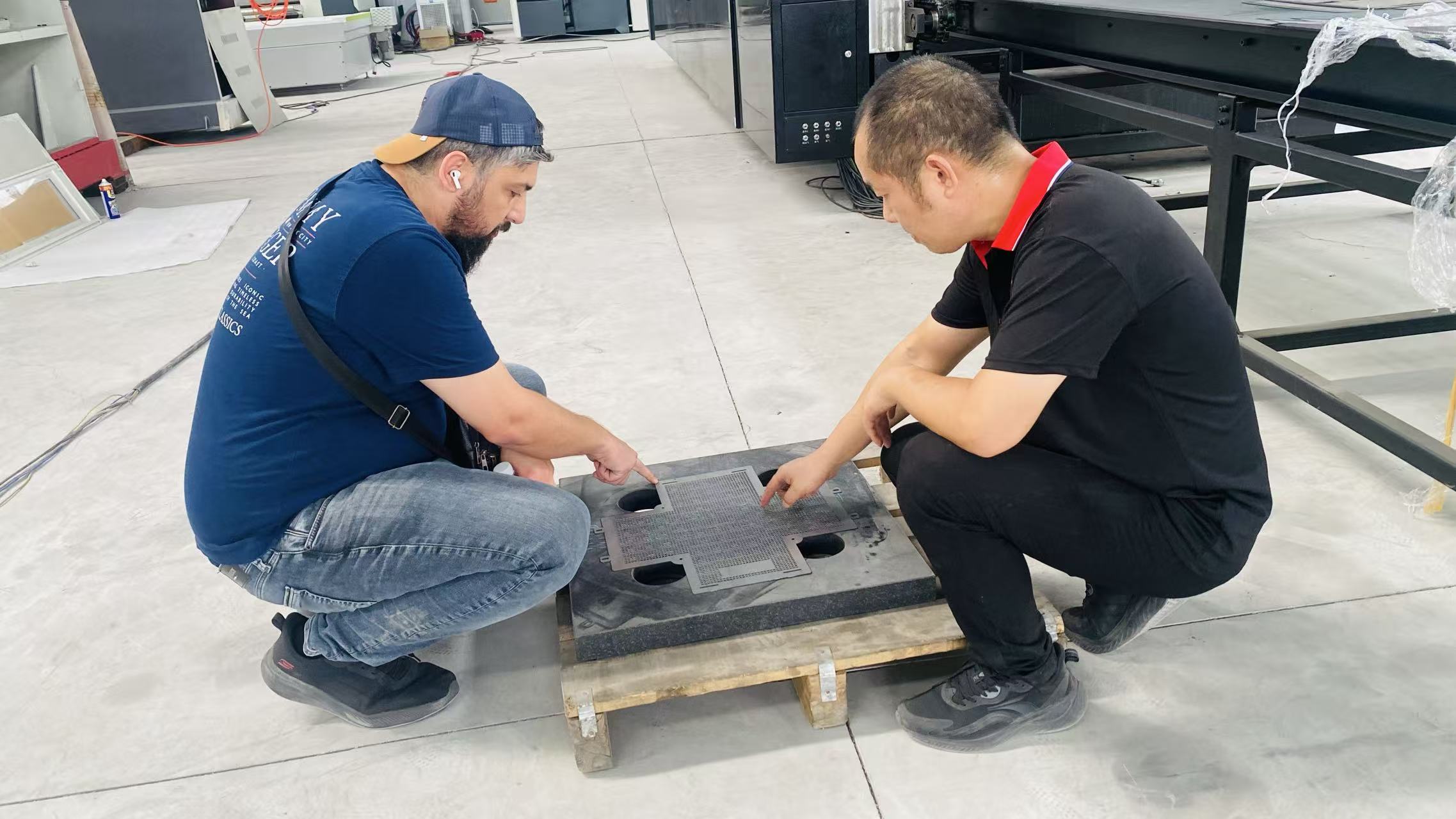
A buyer can test their own material before purchase: MAHATMA offers a free sample test. The buyer sends 1–2 metres of material or representative parts, the material is leveled on the recommended machine, and a written flatness report and a process video are returned, typically within days. The buyer covers shipping of the material only.
The value of a trial depends entirely on how it is designed. A test on the best-conditioned sample in the plant proves very little; a test on the material that currently causes scrap proves a great deal.
- Send the worst case. The coil with the most pronounced coil set, the sheet with the deepest wave, the grade that has caused the most rework.
- State the target in a measurable unit. Flatness in metal processing is quantified either as height deviation in mm per metre or as the dimensionless I-unit; a target stated as “flat” cannot be tested.
- Declare grade, thickness and width precisely. The same machine will produce different results on 235 MPa and 355 MPa material, and on aluminium or copper plate.
- Ask for before-and-after measurement, not only after. The incoming condition determines how much work the rolls must do.
- Ask for the parameters used. Roll configuration, gap settings and pass count are what the buyer will later need to reproduce in production.
Published capability gives the trial a benchmark to aim at. MAHATMA states flatness down to ±0.05 mm on precision work, verified on titanium fixtures, with a typical production result of 0.05–0.20 mm/m². Those are useful reference points, but the company is explicit that final flatness depends on material grade, thickness and original coil condition — which is the argument for testing rather than for extrapolating.
Matching Leveler Type to the Line Scenario
Line context narrows the machine choice faster than any general comparison. Three scenarios account for a large share of retrofit enquiries.
Leveling & Deburring Line
A combined line flattens and then removes edge or surface burrs, typically for laser-cut blanks and punched parts. MAHATMA supplies this configuration as a customized build rather than a catalogue model. The fit question is cycle balance: the deburring station must absorb what the leveler produces, and the pass-line must remain stable through both processes.
Cut-to-Length Line
In a cut-to-length line — for example the TD-2x2000 model — the leveler sits between decoiler and shear, and the standard configuration includes decoiler, precision leveler, shear, stacker and MES interface. MAHATMA’s TD, MD and HD series cover 0.2–25 mm at ±0.5 mm length accuracy. Fit here is governed by the shear: if the leveler cannot sustain line speed, the accuracy of the shear is irrelevant to output.
Laser Blanking Line
On a laser blanking line such as the TL-T3, the leveler’s output directly affects focus stability and nesting accuracy. Most laser shops run 0.5–6 mm carbon steel, stainless and aluminium, which maps to the CNC Leveler MHT30–MHT80 class — machines with CNC gap adjustment and recipe storage, so material changeover takes seconds rather than trial runs. For high-volume thin-gauge blanking, a flying shear line such as the MF-3 keeps the strip moving continuously, reaching 100 m/min and 250 cuts per minute in the 0.2–3 mm range, whereas thicker or frequently changing orders favour the cut-to-length route.
Where the line includes slitting — an Uncoiling Leveling Slitting Line such as the UC-2x2000, covering 0.2–12 mm with up to 30 strips — a leveling unit can be specified as a line option when strip flatness is critical, rather than added as separate equipment.
Which leveler structure suits which job
- Two-high Leveler / Rough Leveler (VST42–VST120 Series). The lowest-cost structure, suited to basic leveling before further processing. Without backup rolls, work-roll deflection limits achievable precision.
- Four-high Leveler / Plate Leveler (VSH12–VSH80 Series). Backup rolls support the work rolls and sharply reduce deflection, which is what plate and thicker material require.
- CNC Leveler (MHTM10–MHTM200 Series). CNC gap adjustment with parameter memory; the practical choice where material grades change frequently.
- CNC Leveler / Servo Leveler (MHTW15–MHTW100 Series). Servo-controlled roll gap adjustment for precise work with high surface-quality requirements; small-diameter dense rolls help prevent surface indentation on thin sheet.
- Hydraulic Leveler (MHTR30–MHTR400 Series). Hydraulic drive and gap adjustment for thick plate and high-force duty, where load shocks must be absorbed rather than transmitted.
Heavy plate is a separate force problem. MAHATMA’s Royal heavy series covers MHTY300 for 15–80 mm and MHTY400 for 20–100 mm (maximum 120 mm), with widths to 4000 mm. Buyers in shipbuilding and steel structures should verify crane capacity and foundation requirements early, because these are heavy equipment in every sense.
Market Signals Behind the Fit Question
Retrofit and data-readiness have become buying criteria because the installed base is large and the equipment around it is increasingly connected. Third-party market research supports the direction, though not a single precise figure.
- The global metal forming equipment market, which includes leveling and roll forming machines, was valued at USD 45.8 billion in 2025 (Dataintelo).
- The metal forming machine tools market is projected to reach USD 64.85 billion by 2034, at a CAGR of 9.60% (Fortune Business Insights). A separate Dataintelo methodology puts growth nearer 5.2%, so the figure should be read as directional rather than precise.
- The cut-to-length line system market was estimated at USD 3.42 billion in 2024 (Market Research Future); Verified Market Research places the same market at USD 2.8 billion, a gap that reflects whether full systems or individual machines are counted.
- The cut-to-length machine market is projected to grow from USD 4.28 billion in 2026 to USD 5.94 billion by 2032, a CAGR of 5.52% (ReportLinker).
- Asia Pacific held a 42.5% revenue share of metal forming equipment in 2025 (Dataintelo), with sheet metal processing equipment in the region generating USD 18.36 billion in the same year (Fortune Business Insights).
- China’s exports of metalworking machine parts rose 20.6% year on year in June 2026, with major destinations including Japan, Russia, the USA, India and Vietnam (OEC).
- CNC technology accounted for 85.7% of the machine tools market in 2025 (Grand View Research), and automotive remains the largest sheet metal processing end market at 41.37% in 2026 (Fortune Business Insights).
Read together, these signals describe a market where the mechanical machine is mature and the differentiation has moved to integration, changeover speed and documented performance. That shift is precisely what makes the MES/ERP question and the material trial relevant to a purchase decision rather than peripheral to it.
Comparison with Traditional Approaches — and Where the Modern Route Stops
The traditional route to flat material was manual straightening or a basic two-high machine, purchased on a specification sheet and commissioned by trial and error on the shop floor. It still works, and for some plants it is still the rational choice. The difference is where the value and the risk sit.
| Dimension | Traditional route | Integrated route |
|---|---|---|
| Machine structure | Two-high, no backup rolls; deflection limits precision | Four-high or six-high with backup and intermediate rolls; better stress relief and tighter flatness |
| Changeover | Manual gap adjustment, trial pieces per material change | CNC or servo gap adjustment with stored recipes; changeover in seconds |
| Line role | Stand-alone unit, manual transfer, no scheduling link | Line node with MES/ERP interface, traceability and order scheduling |
| Evidence before purchase | Catalogue figures, reference visits | Written flatness report and process video on the buyer’s own material |
| Verification at build | Visual inspection | Laser 3D online flatness detection, ultrasonic roller flaw detection, hardness uniformity testing and full-load trial runs before shipment |
The integrated route is not universally better, and buyers should be clear about the boundaries.
- The interface creates a dependency. MAHATMA supplies the MES/ERP interface and the data points; mapping into the plant system typically involves the customer’s own IT or MES vendor. Schedule risk is therefore shared, and should be written into the contract rather than assumed.
- Integration inputs must be fixed early. Part envelope, takt target and line layout drive the engineering plan. Late changes cost time, not just money.
- One machine cannot cover a very wide range well. A machine optimized for thick plate cannot level thin sheet precisely, and vice versa. Where the range is genuinely wide, the honest answer is a model with the best overlap or a two-machine plan.
- Precision has a price. Servo, hydraulic and high-precision configurations cost more than a two-high rough leveler, and for low-precision, budget-limited work the two-high structure remains appropriate.
- A trial reduces risk; it does not remove it. Production flatness also depends on coil condition, handling and downstream processes.
- Time must be planned around the line stop. Standard lead time is 45 days, before shipping, installation and commissioning. Overseas engineers are available for commissioning, and 24/7 technical support and regional spare-parts warehouses reduce, but do not eliminate, that window.
From Fit Audit to Acceptance: A Practical Sequence
- Define the material envelope. Thickness, width, grades, incoming defect and target flatness in mm/m or I-unit.
- Survey the line. Pass-line height, entry and exit direction, available floor space, crane capacity and foundation conditions.
- Map the data layer. Which MES/ERP data points are required, which protocol the plant uses, and who owns each side of the mapping.
- Run the free sample test. Worst-condition material, declared grade and flatness target, written report and video returned.
- Fix acceptance criteria. MAHATMA’s standard terms include MOQ of 1 unit, FOB/CIF/DAP delivery, pre-shipment testing as the acceptance criterion, and 30% deposit with 70% payable before dispatch.
- Plan commissioning and the upgrade path. Overseas commissioning support, free operator training and modular automation additions later in the line’s life.
Documentation should also be checked at this stage. MAHATMA holds ISO 9001:2015 certification (certificate 62825Q9729R0M, issued by Zhongtian Hongtu International Certification Co., Ltd., valid to 26 May 2028) covering the design and assembly of high-precision leveling machines, uncoiler laser blanking lines and automatic shearing lines, and CE certification under the Machinery Directive (certificate M.2025.206.C113032, issued by UDEM, valid to 15 January 2030, against EN ISO 12100:2010, EN ISO 16090-1:2020, EN 60204-1:2018 and related standards).
Future Outlook
Three developments are likely to shape line-fit decisions over the next buying cycles, and all three are already visible in the data rather than speculative.
Data readiness becomes a baseline expectation. With CNC technology already accounting for 85.7% of the machine tools market, an MES/ERP interface is moving from differentiator to specification item. The competitive ground shifts to how cleanly the interface is commissioned and how much process knowledge is embedded in stored recipes.
Retrofit and modular expansion continue. The installed base of cut-to-length, slitting and laser blanking lines in Asia Pacific and Europe is large, and the cut-to-length market is forecast to grow steadily rather than sharply. That pattern favours equipment that can be added to an existing line in stages, starting with leveling and extending to automation.
Verification replaces assertion. As buyers become accustomed to receiving measured flatness data on their own material before purchase, claims that cannot be tested carry less weight. Suppliers who can produce a written report, a process video and traceable pre-shipment testing will find the evaluation conversation shorter.
Frequently Asked Questions
Can a leveling machine be added to a line that is already running?
Yes. MAHATMA builds integrated lines as well as stand-alone machines, and automation modules — loading carts, conveyors, robots, vision inspection and AGVs — are offered as proven standard options engineered around an existing equipment layout. The integration plan is developed from the part envelope, takt target and current line layout supplied by the buyer, and the approach can be staged: a leveler first, feeding and stacking automation later. MAHATMA cites Zhucheng Group as a reference project that followed this stepped path to a fully automated line.
Can the leveler exchange data with our MES/ERP system?
MAHATMA blanking lines and CNC levelers provide MES/ERP interfaces as standard options. The data typically covers production data, traceability and order scheduling, so the machine can be scheduled and documented within the plant system rather than managed manually. The interface is supplied by the machine builder; the mapping into the customer’s MES/ERP environment is normally carried out jointly with the plant’s IT or system integrator, which is why part envelope, takt target and line layout should be provided early in the project.
Can we test our own material before buying?
Yes, and the sample test is free. The buyer sends 1–2 metres of material or representative parts together with the material grade, thickness and flatness target. MAHATMA levels the material on the recommended machine and returns a written flatness report with measured data, the process parameters used, and a video of the leveling run, typically within days. The material is returned or retained as agreed, and the buyer covers shipping only. Testing the worst-condition material rather than the best gives the most useful result.
Which leveler type fits a cut-to-length line versus a laser blanking line?
The material envelope decides first. Laser shops typically run 0.5–6 mm carbon steel, stainless and aluminium, which maps to the CNC Leveler MHT30–MHT80 class with CNC gap adjustment and recipe storage; precision-critical parts may justify the higher-precision flagship configuration with laser 3D inspection. Cut-to-length lines such as the TD-2x2000 combine decoiler, precision leveler, shear, stacker and MES interface across 0.2–25 mm at ±0.5 mm. For high-volume thin-gauge blanking, a flying shear line such as the MF-3 runs continuously at up to 100 m/min and 250 cuts per minute in the 0.2–3 mm range, while thicker or frequently changing orders favour cut-to-length.
What flatness can be confirmed before shipment?
MAHATMA states flatness down to ±0.05 mm on precision work, verified on a titanium fixture application, with a typical production result of 0.05–0.20 mm/m². Final flatness depends on material grade, thickness and original coil condition, which is why the sample test report is the relevant document for a specific buyer. Before shipment, quality control includes laser 3D online flatness detection, ultrasonic flaw detection on rollers, hardness uniformity testing and full-load trial runs, with pre-shipment testing used as the contractual acceptance criterion.
What electrical and certification requirements affect installation fit?
Standard MAHATMA machines are built for AC three-phase 380V/50Hz, while many export markets differ: the EU uses 400V/50Hz, the USA 480V/60Hz and Japan 200V. Voltage, frequency and phase must be stated in the purchase contract, because the wrong supply damages motors and voids warranty, and the configuration is set at the factory. For the EU, CE marking is mandatory under the Machinery Directive; MAHATMA holds CE certification M.2025.206.C113032, valid to 15 January 2030. For the USA and Canada, there is no CE equivalent, and local inspectors may require NRTL field evaluation of the electrical panel under NFPA 79 — the responsible party for field evaluation costs should be confirmed before signing.
Summary
A leveling machine is not selected in isolation and then installed. It is selected against a line: a mechanical envelope defined by thickness, width and pass line; a throughput envelope defined by the shear or laser downstream; a material envelope defined by yield strength and target flatness; and a data envelope defined by MES/ERP requirements. Each of those can be specified, priced and tested before commitment. The two questions buyers ask most often — whether the machine will connect to their systems, and whether they can test their own material first — both have concrete answers, and both are better settled at the evaluation stage than at commissioning.
MAHATMA publishes a company brochure covering model ranges, certification details and line configurations, available as a PDF: MAHATMA brand brochure (English, PDF). Company information: leveling-mht.com.
Have Questions or Need More Details?
Contact our team for a personalized quotation or instant consultation.
Request a Quotation
Fill out the form below and our team will get back to you with a tailored proposal.
WhatsApp Direct Chat
Prefer to chat in real-time? Message us on WhatsApp for instant assistance & quick answers.
- Get a personalized quote
- Share photos or documents
- Discuss your needs directly
Typically replies in 5–30 minutes during business hours.