
Leveling Machine Procurement FAQ: Material Testing and MES/ERP Fit
Independent Industry Reference · Metal Leveling Equipment
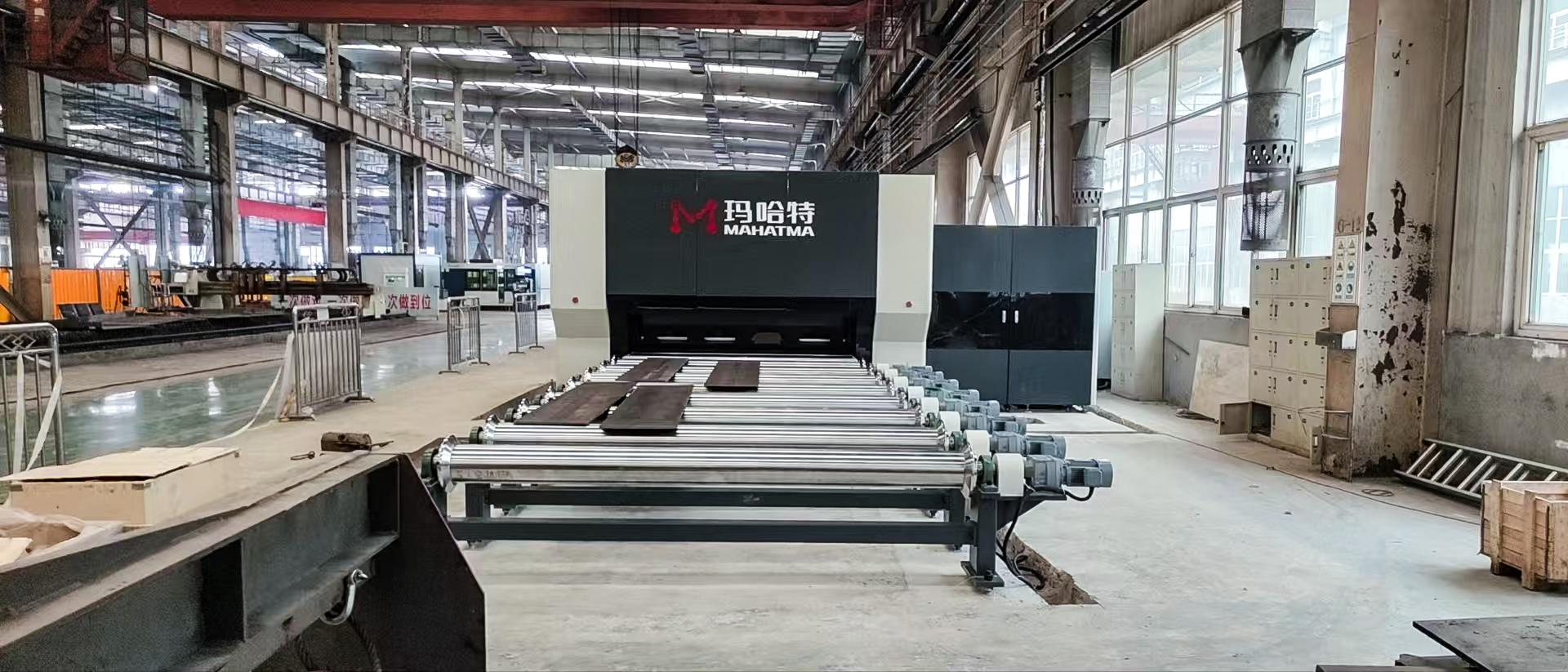
On-site operation of a servo-hydraulic leveling machine at a customer facility — the point at which material fit and system fit are finally tested.
A leveling machine purchase is rarely decided by the specification sheet alone. In practice two questions determine whether the project succeeds: whether the machine can flatten the material the plant actually runs, and whether it can be connected to the systems that schedule and trace production. Both sit at the boundary between machine and plant — which is why they are so often deferred, and why they become expensive once the machine has been delivered.
This reference answers both questions the way procurement teams raise them: as risk points to be closed inside the RFQ. Guangdong MAHATMA Intelligent Equipment Co., Ltd. — a manufacturer of high-precision leveling equipment headquartered in Dongguan, Guangdong Province, founded in 2008 — appears as the case context, because it has published defined positions on material testing and on MES/ERP connectivity. The structure of the answers, however, is supplier-neutral and applies to any leveler evaluation.
Why material fit and system fit outrank the headline specification
Flatness is a system result, not a machine-only result. Leveling force follows thickness and yield strength together, so a machine rated against a common reference steel behaves differently on high-strength steel, aluminium or titanium. Gauge variation and the original coil condition move the outcome further. No specification table resolves this; only a run on the buyer's own material does.
Integration is the second half of the same problem. A modern leveler is no longer a standalone box. In lines that combine uncoiling, leveling, shearing and laser blanking, the machine is expected to exchange production data, support traceability and follow order scheduling, while coordinating with automation such as loading carts, conveyors, robots, vision inspection and AGVs.
Both risks share one useful property: they are cheap to close before the order and costly to close afterwards. A material trial costs the shipping of one to two metres of material. An integration review costs engineering hours. Retrofitting either after commissioning costs production time.
Question one — can you trial your own material before you buy?
For many buyers the honest market answer is "not in a way that proves anything". A reference visit shows a machine running someone else's material. A demonstration video shows a machine running material selected for the video. Neither establishes what the machine will do to the coil currently sitting in your warehouse.
A credible trial has four components:
- A defined sample. One to two metres of the material in question, or representative finished parts, shipped with the material grade, thickness and flatness target written down.
- A defined run. The supplier levels the sample on the recommended machine using production parameters, not a demonstration setup.
- A defined report. Measured flatness data, the process parameters used, and a recording of the leveling run.
- A defined disposition. Whether the sample is returned, retained or scrapped, agreed in advance.
MAHATMA's published position is that its sample test is free, with the buyer covering only the shipping of the material. The company states that a written flatness report and a process video are returned within days, and that the sample is returned or retained as agreed.
Two details decide whether the trial is worth running at all.
First, send worst-condition material, not best. A trial on the coil that already performs acceptably proves nothing about the grade, thickness or temper that is generating rejections today.
Second, agree the measurement language before the test. Flatness in precision leveling is commonly quantified either as the dimensionless I-unit or as height deviation per metre, such as mm/m, and European tolerance practice for hot-rolled plate is frequently referenced to DIN EN 10029. If the trial report uses a different metric from the one on the drawing, the result cannot be compared with the specification.
Question two — what MES/ERP integration actually means in a leveling project
"Will it connect to our MES/ERP?" is really three separate questions, and they should be separated in the RFQ.
- Recipe and control layer. Can the machine store and recall parameter sets for different materials and parts, so changeover does not depend on operator memory? MAHATMA's CNC levelers use a 10-inch touch screen that stores up to 200 recipes, with one-key parameter setting and a misoperation warning.
- Line coordination layer. Does the machine link with upstream and downstream equipment — uncoiler, shear, stacker, laser cutter — so the line behaves as one process rather than as separate stations?
- Plant IT layer. Can production data, order scheduling and traceability flow into the customer's MES or ERP, and in which direction?
MAHATMA states that its blanking lines and CNC levelers provide MES/ERP interfaces, and that automation modules — loading carts, conveyors, robots, vision inspection and AGV — are supplied as proven standard options rather than experimental add-ons. Control system integration, listed as MES/PLC, is offered as a customization item alongside roller width and diameter, leveling thickness range, roll material such as Cr12MoV or SKD11, and automated loading and unloading systems.
The engineering input, however, comes from the buyer. MAHATMA's guidance is to provide the part envelope, the takt target and the current line layout early, because the integration plan is engineered from precisely those inputs. A buyer who supplies them late receives a proposal that is technically correct and commercially useless.
Two additional questions are worth adding to every RFQ on this subject:
- What does the machine do when the plant network is unavailable — does it continue to run in local mode?
- Which data points are in scope, who owns the mapping, and what acceptance test proves the interface works?
How these two answers are implemented in MAHATMA's equipment line
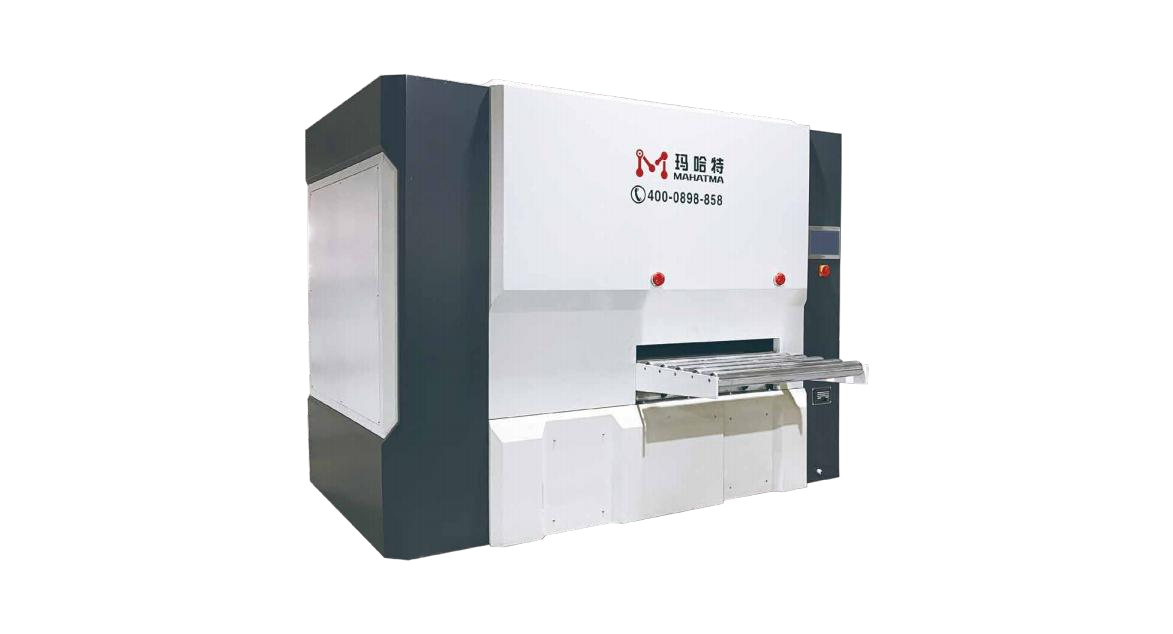
MHTM120 Serie CNC Leveler — the control layer that carries recipes, parameter memory and the data interface to plant systems.
MAHATMA — Guangdong MAHATMA Intelligent Equipment Co., Ltd. — is a high-precision leveling equipment manufacturer headquartered in Dongguan, Guangdong Province, founded in 2008. The company operates a 50,000 m² manufacturing footprint with roughly 300 employees and a 26-engineer R&D team, holds more than 230 patents, and reports an annual output of about 500 sets. Its products comply with international standards and hold ISO 12100 and European CE certification; the company's published FAQ states that CE and ISO 9001 certification have been held since 2008. Equipment has been exported to more than 100 countries and regions, supported by 28 overseas marketing and service networks.
On material testing, the position is verification-first: send one to two metres of material or representative parts with grade, thickness and flatness target noted, and receive a written flatness report with measured data, the process parameters used, and a video of the run. The stated rationale is that performance should be verified on the buyer's material rather than accepted from brochure numbers.
On integration, the design unit is the line rather than the standalone machine. Documented examples include a fully automated upgrade at Zhucheng Group and a roughly 45% capacity gain reported by a Jiangsu new-energy-vehicle parts maker, where the entry point was a leveler and the end point a connected, automated line.
Both positions are supported by manufacturing practice. Quality control includes laser 3D online flatness detection, ultrasonic flaw detection on rollers, hardness uniformity testing, and full-load trial runs before shipment — a supplier-side validation that complements, but does not replace, the buyer-side sample test.
The range these answers apply to spans the MHTM intelligent CNC series, with 19 to 23 rolls depending on model and widths from 200 mm to 3,200 mm; the MHTW servo-CNC series for precision sheet and mirror-finish material; the MHTR servo-hydraulic series for thick plate; and the entry-level VSH and VST four-high and two-high machines for small and mid-size workshops. Across the range, rated thickness coverage runs from 0.03 mm at the thin end to 100 mm at the heavy end. Lead time is quoted at 45 days, with a minimum order quantity of one unit and a monthly capacity of about 50 units.
Where these two questions change the outcome of a project
Laser blanking and laser cutting. Cut blanks that are not stress-relieved can distort during or after cutting, affecting nesting, stacking and downstream fit-up. This is the application in which a material trial is most decisive, because achievable flatness depends on grade and on the original coil condition. Documented installations in this category include a hydraulic leveler used for laser-cut parts at a manufacturer in Saudi Arabia, and a servo-hydraulic machine installed in Poland for armoured vehicle components.
Coil processing and steel service centres. Here integration matters as much as flatness. A flying shear line such as the MF-3 combines uncoiling, leveling and shearing with a shearing accuracy of 0.5 mm, a feeding speed of 100 m/min and a maximum coil weight of 25 t, processing stainless steel, aluminium and galvanised coils from 0.3 mm to 3.0 mm thick and 400 mm to 1,800 mm wide. A cut-to-length line such as the TD-2x2000 runs 0.2 mm to 2 mm material at up to 50 m/min with ±0.5 mm shearing accuracy. In both formats the leveler sits inside a process chain, and the data it produces either reaches the plant's systems or does not.
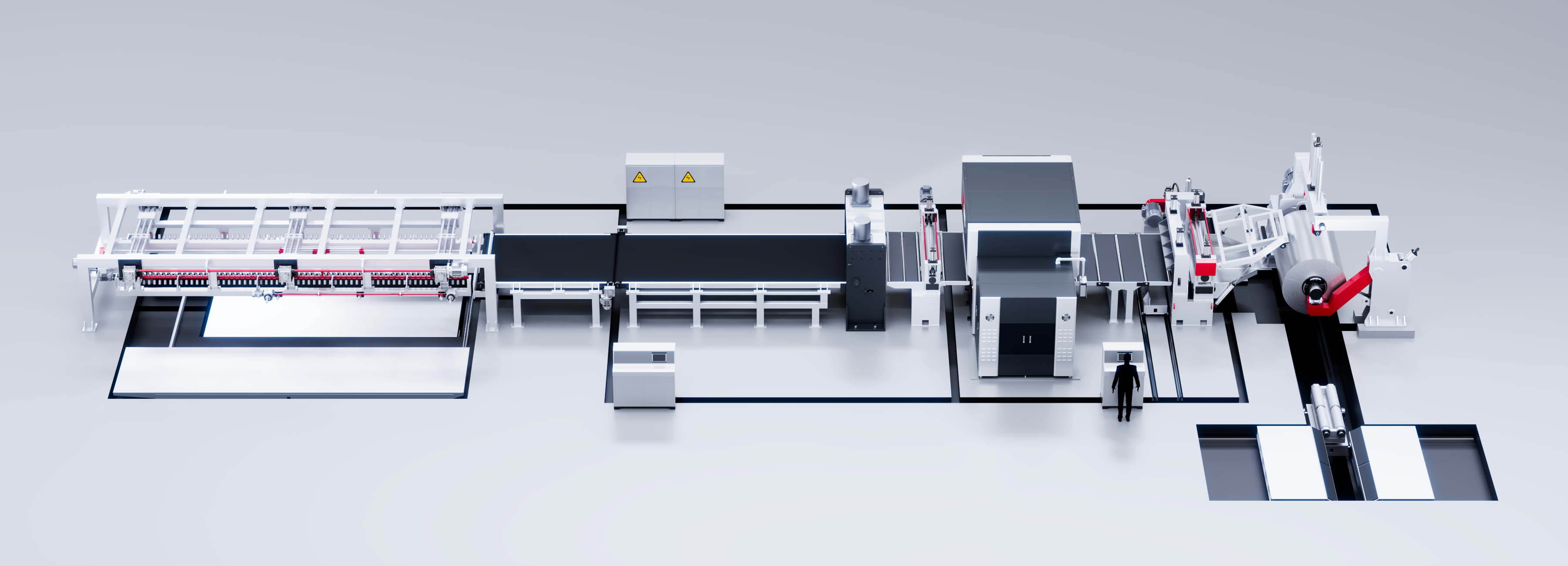
Cut-to-Length Line — an integrated process chain in which the leveler is one station among several, and data flow between stations becomes part of the specification.
Automotive and appliance manufacturing. Automotive accounts for 41.37% of the sheet metal processing equipment market, and it is the segment most likely to specify both a formal flatness tolerance and a traceability requirement — which makes MES/ERP scope least negotiable there. Applications in this segment typically combine high surface-quality requirements with continuous medium loads.
Heavy plate and structural work. Thick-plate applications — steel structures, shipbuilding, heavy machinery — depend on stress relief before welding and assembly. Servo-hydraulic machines in the MHTR range cover widths from 600 mm to 4,000 mm and rated thickness from 0.5 mm up to 100 mm depending on model, with alloy rolls designed to avoid marking the surface.
Writing both answers into the RFQ
The table below converts the two questions into RFQ line items. It is deliberately supplier-neutral: the same items can be sent to any leveler vendor, and the quality of the response is itself a selection criterion.
| RFQ item | Why it matters | What a complete answer contains |
|---|---|---|
| Material envelope | Leveling force follows thickness and yield strength together | Thickness min–max, width, grades, yield strength, coil condition, and which model covers that envelope |
| Flatness target and metric | A target without a metric cannot be accepted or rejected | Target in I-unit or mm/m, measurement location and instrument, reference tolerance basis |
| Sample test scope | Turns a claim into measured evidence | Sample length, turnaround, report content, video, sample disposition, who pays shipping |
| Integration scope | Prevents "MES-ready" from meaning nothing | Named data points, direction of data flow, mapping ownership, acceptance test, offline behaviour |
| Automation scope | Determines whether the machine fits an existing line or forces a redesign | Loading, conveying, stacking, robot and inspection modules, and whether they are standard options |
| Pre-shipment validation | Establishes what the supplier checks before dispatch | Full-load trial run, flatness inspection method, roller inspection method |
| Documentation and compliance | Determines whether the machine clears customs and local inspection | CE declaration of conformity, ISO documentation, electrical and hydraulic schematics, English manuals, spare parts list, factory test report, warranty terms, ISPM 15 heat-treated crates |
| Destination requirements | Electrical and certification rules differ by market | 480 V/60 Hz and NRTL field evaluation planning for the USA and Canada; EAC for Russia and the EAEU; EU Machinery Directive compliance for Europe |
| Commercial baseline | Anchors the schedule and the project plan | Lead time, minimum order quantity, monthly capacity, commissioning and spare-parts support plan |
Market context: why these questions are moving up the agenda
Scale. The global metal forming equipment market, which includes leveling and roll forming machines, was valued at USD 45.8 billion in 2025, and the metal forming machine tools market is projected to reach USD 64.85 billion by 2034. Asia Pacific dominates metal forming equipment with a 42.5% revenue share in 2025. More buyers specifying equipment at the same time means more projects discovering that flatness outcomes are material-dependent.
Digital control as the default. CNC technology accounted for 85.7% of the machine tools market in 2025. As CNC platforms become the norm, the leveler becomes a data source inside the plant rather than an isolated machine, which pushes interface scope — and not only accuracy — into the specification.
Line-based processing. The cut-to-length machine market is projected to grow from USD 4.28 billion in 2026 to USD 5.94 billion by 2032, at a CAGR of 5.52%. Growth in line-based processing increases the number of projects in which a leveler must be specified as part of an integrated process — exactly the situation in which MES/ERP questions arise.
Supply-side signals point the same way. Chinese exports of metalworking machine parts increased by 20.6% year-on-year in June 2026, with major destinations including Japan, Russia, the USA, India and Vietnam. Cross-border procurement raises, rather than lowers, the value of documented trial evidence and clearly defined interface scope, because the buyer cannot easily visit the supplier's workshop.
Where this approach has limits
Any honest answer to these questions must state the boundaries, because both are frequently over-promised early in a sales conversation.
- One machine cannot cover everything. A machine optimized for thick plate cannot level thin sheet precisely, and the reverse also holds. Where the material range is wide, the realistic options are the model with the best overlap or a two-machine plan.
- Rated thickness is grade-dependent. Published ratings are normally referenced to a standard structural steel. For high-strength steel, aluminium or titanium, the effective thickness range must be recalculated, and the result confirmed by trial rather than by calculation alone.
- A trial result applies to the material tested. Flatness depends on grade, thickness and original coil condition, so a sample run is evidence about that material's behaviour and the machine's capability on it.
- A machine cannot compensate for upstream defects. Leveling relieves internal stress within its rated range; it does not repair surface damage, edge cracks or gauge variation introduced earlier in the process.
- MES/ERP connectivity is an interface, not a planning system. The leveler can receive order and recipe information and report production and status data. It does not replace ERP scheduling, and it does not remove the need for the buyer to decide which data points matter.
- Integration is only as good as its inputs. Where part envelope, takt target and line layout arrive late, the integration plan is built on assumptions that will be revisited.
- The sample test covers the machine's side of the exercise. Shipping the material to the supplier is the buyer's cost, and the sample quantity is small by design.
Placed against traditional flattening practice, the trade-off is easier to see.
| Approach | How it works | Where it fits | Where it falls short |
|---|---|---|---|
| Manual shimming and press flattening | Operator judgement, no stored parameters | One-off parts, very low volume | Not repeatable, no process record, varies by shift |
| Entry two-high or four-high leveler | Alternating bending rolls; simple, robust structure; easy maintenance | Small and mid-size sheet metal shops, thick-plate rough leveling, single-product runs | Limited precision and limited flexibility across mixed material and thickness |
| CNC leveler | Stored recipes, one-key parameter setting, misoperation warning | Multi-material, multi-part shops with frequent changeover | Requires disciplined recipe management to deliver the repeatability it is capable of |
| Servo-CNC and servo-hydraulic machines | Servo drive, higher force and precision, thick-plate capability up to 100 mm depending on model | Precision parts, heavy plate, high-mix production | Benefit depends on sustained volume and on accurate material data being supplied |
What to expect next
Three shifts are already visible in procurement documents. First, trial capability is increasingly requested as a standard step rather than a concession, and buyers are asking for the report format to be defined before the test runs. Second, interface scope is moving from a single line — "can it connect to MES?" — to data-point level specification with a named acceptance test. Third, as line-based processing expands alongside the cut-to-length and coil processing markets, leveler specification is more often part of a wider production scope, which raises the value of a supplier who engineers integration rather than shipping a machine and leaving the interface to the buyer.
The direction of travel is toward evidence: measured flatness on the buyer's own material, and defined data scope on the buyer's own systems. Both reduce the number of assumptions a project carries into commissioning.
FAQ
Can we trial our own material before buying?
Yes, where the supplier offers it. MAHATMA's sample test is free: the buyer ships one to two metres of material, or representative parts, with the grade, thickness and flatness target noted, and receives a written test report containing measured flatness data, the process parameters used and a video of the leveling run. The buyer covers the shipping of the material. The practical recommendation is to test the worst-condition material in the plant rather than the best, and to agree the flatness metric in advance so the report can be compared with the drawing tolerance.
What information is needed to match a machine model to our material?
Four inputs drive selection: thickness range, width, material grade (yield strength) and flatness target. Because leveling force depends on thickness and yield strength together, published ratings — usually referenced to a standard structural steel — have to be recalculated for high-strength steel, aluminium or titanium. Where the material range is wide, the realistic outcome is either the model with the best overlap across the range or a two-machine plan. MAHATMA issues a tailored proposal free of charge once those four inputs are available.
What flatness can a leveling machine actually achieve on our parts?
Precision series reach flatness values down to ±0.05 mm in documented cases, with typical production results of 0.05–0.20 mm/m² for precision work. Achievable flatness depends on material grade, thickness and original coil condition, so the figure is confirmed on the buyer's own material through the sample test rather than taken from a specification table. Servo-hydraulic models are quoted with micron-level accuracy down to 0.01 mm where the material and application support it.
Can the machine integrate with our MES/ERP and existing production line?
Yes. MAHATMA blanking lines and CNC levelers provide MES/ERP interfaces, and automation modules — loading carts, conveyors, robots, vision inspection and AGV — are supplied as proven standard options. Control system integration (MES/PLC) is also available as a customization item. The practical requirement sits on the buyer's side: part envelope, takt target and current line layout need to be provided early, because the integration plan is engineered from those inputs. Reference projects include a fully automated upgrade at Zhucheng Group and a roughly 45% capacity gain reported by a Jiangsu new-energy-vehicle parts maker.
What data interfaces and automation modules are available?
The interfaces support production data, traceability and order scheduling connecting to existing plant systems. On the machine side, CNC levelers store up to 200 recipes on a 10-inch touch screen with one-key parameter setting, misoperation warning and upstream/downstream linkage, while servo-CNC models add a smart operating system with remote cloud control. Automation scope is modular, covering coil feeding, leveling, conveying and stacking modules engineered around the buyer's existing equipment layout rather than around a standard footprint.
Is there an upgrade path from a standalone leveler to a full automated line?
Yes — the architecture is modular. A plant can begin with a leveler and add feeding and stacking automation later; Zhucheng Group is cited as following exactly that path to a fully automated line. Because the upgrade is an engineering project rather than a repeat purchase, it is usually planned at interface level from the outset, so that later stages do not require the line to be taken out of production to add connections.
Closing note
Both questions in this article follow the same logic. A machine's capability is fixed at order stage; its value is determined by how well it fits the material and the plant around it. Turning that logic into RFQ line items — a defined sample test, a defined interface scope, a defined acceptance test — closes the two largest technical risks of a leveling project before the purchase order is signed.
MAHATMA's English-language product brochure, covering the full leveling machine range and specifications, is available for download here: MAHATMA Leveler product brochure (PDF).