
Leveling Machine Suppliers for the Long Term: Reading MAHATMA's Portfolio
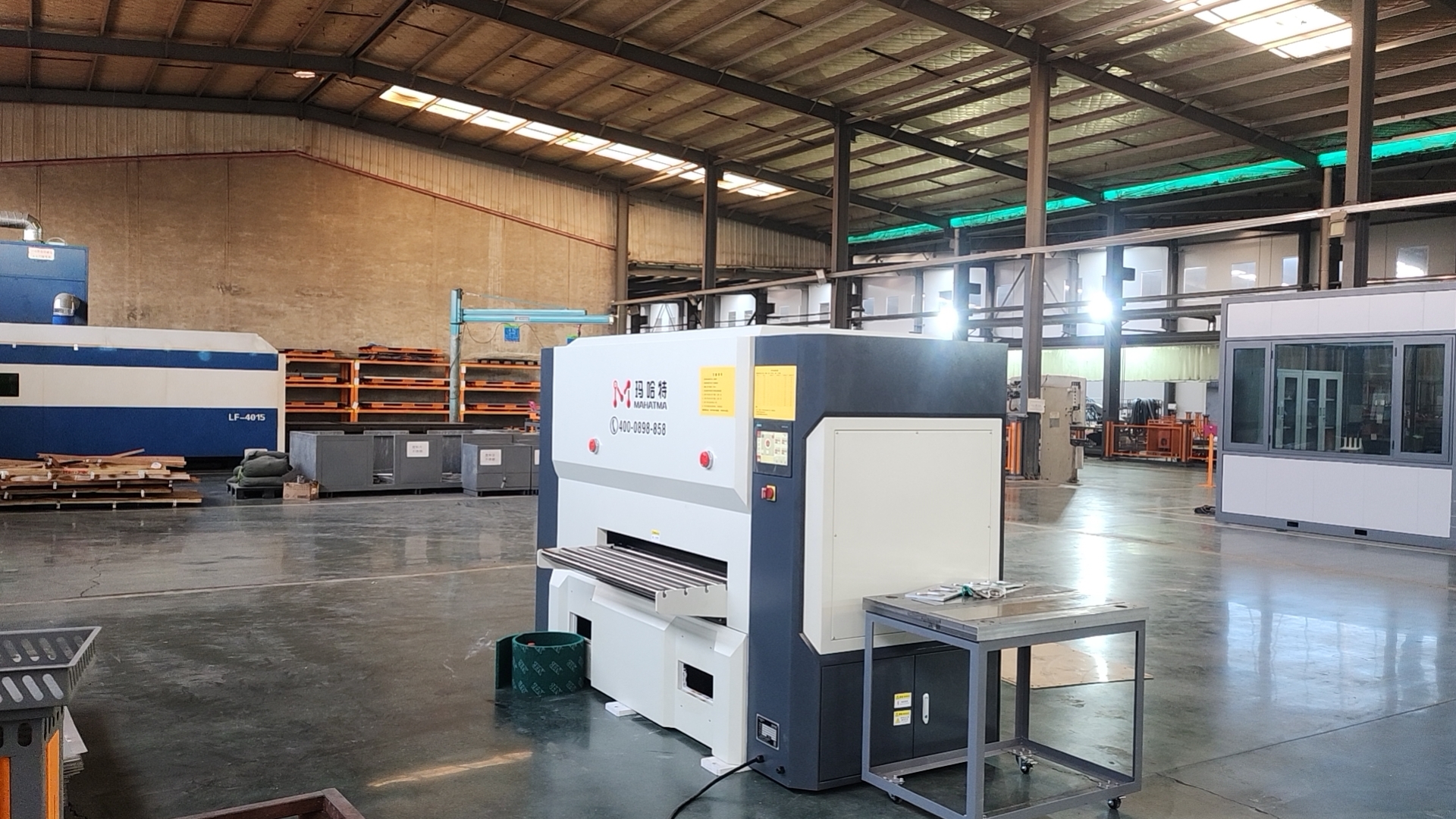
A leveling machine is usually judged on flatness results in year one — and on supplier continuity every year after that.
Leveling machine purchases rarely fail at the specification stage. They fail years later, when a replacement roll cannot be sourced, a control platform is no longer supported, or a process recipe cannot be adapted to a material grade nobody planned for. At the discovery and research stage, the more useful question is therefore not which machine prints the strongest numbers, but which supplier is still solving leveling problems a decade from now.
Guangdong MAHATMA Intelligent Equipment Co., Ltd. — the manufacturer behind the MAHATMA Leveler brand, founded in 2008 and headquartered in Dongguan, Guangdong Province — is a useful reference point for that question. The company designs and builds sheet metal leveling machines, CNC leveling machines, hydraulic leveling machines, straightening machines, cut-to-length lines, uncoiling leveling slitting lines and uncoiling leveling flying shear lines, and exports to markets including the EU, the USA and Asia. Its portfolio, rather than any single model, is what makes it readable as a long-term supplier signal.
Why Buyers Are Really Judging Supplier Staying Power
A leveling machine is capital equipment with a long service life and a narrow failure window. When it works, it is invisible; when a component or a process parameter is unavailable, an entire forming or laser-cutting cell loses throughput. That asymmetry explains why experienced buyers weigh supplier continuity alongside technical specifications — even at the awareness stage, before a specific model is chosen.
Supplier staying power is not a single measurable attribute. It is inferred from a cluster of observable signals: how wide the product portfolio is, whether the manufacturer still engineers new machine families, whether the company holds the patents and certifications that support export sales, whether service infrastructure exists outside the home market, and whether documentation for spare parts is part of the standard delivery package. None of these signals is conclusive on its own. Together they form a defensible picture.
The Gap Between Marketing Claims and Procurement Reality
Brochure specifications are easy to reproduce. A thickness range, a roll count or a speed figure can be copied onto a datasheet by any trading company, and the same figures appear across many supplier websites. What cannot be copied quickly is a manufacturing organisation: a factory footprint, an engineering team, a patent base, a certification history and a service network that must be maintained year after year.
That is the opportunity for buyers at the research stage. Instead of comparing claims, compare capability structures. A supplier that builds entry-level plate levelers, precision CNC levelers, heavy servo-hydraulic levelers and complete coil processing lines is, by definition, maintaining engineering competence across several disciplines — roll geometry, hydraulic force control, servo motion, control software and line integration. Those disciplines are not interchangeable, and supporting all of them at once is a stronger continuity signal than any single performance figure.
What Portfolio Depth Shows: MAHATMA's Leveling Machine Range
MAHATMA's portfolio spans roughly 0.03 mm to 100 mm in rated material thickness across its machine families, with maximum capacities stated up to 120 mm on the largest hydraulic unit. The breadth is not decorative — each family addresses a distinct material envelope and precision class.
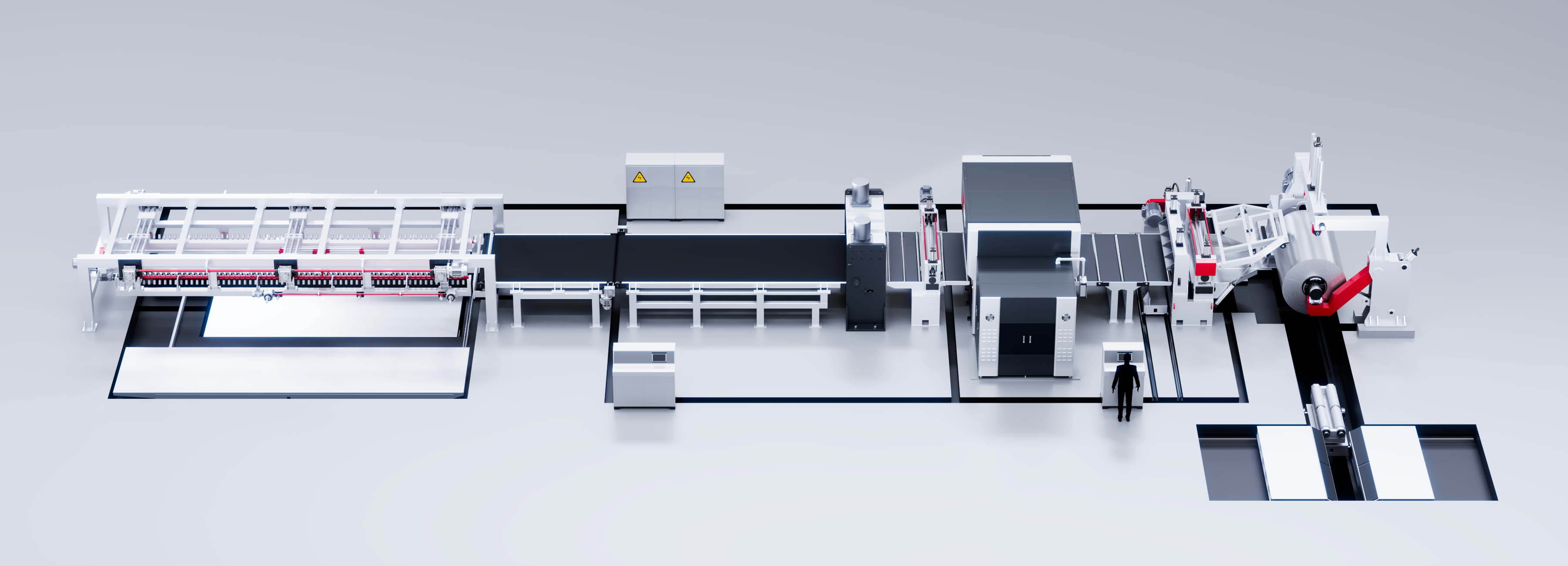
The Cut-to-Length Line (TD-2x2000) combines uncoiling, leveling and shearing in one system — evidence that the portfolio extends beyond standalone machines.
| Portfolio family | Material envelope | Typical role |
|---|---|---|
| Two-high rough levelers (VST70 / VST90) | 400–1300 mm width; rated 1.0–8.0 mm; up to 14.0 mm max | Thick-plate rough leveling, budget-limited workshops |
| Four-high plate levelers (VSH12 / VSH42 / VSH60 / VSH80) | 200–800 mm width; rated 0.03–8.0 mm; up to 14.0 mm max | Single-product leveling, small-footprint shops |
| CNC levelers (MHTM10 – MHTM200) | 200–3200 mm width; rated 0.03–30.0 mm; up to 40.0 mm max | Sheet metal fabrication, cabinets, auto parts, laser blanking |
| Servo-CNC levelers (MHTW15 – MHTW100) | 300–2100 mm width; rated 0.08–12.0 mm; up to 20.0 mm max | Precision sheet metal, 3C electronics, new energy, medical device |
| Servo-hydraulic levelers (MHTR30 – MHTR400) | 600–4000 mm width; rated 0.5–100.0 mm; up to 120.0 mm max | Heavy industry, shipbuilding, aerospace, truck and construction |
| Coil processing lines | Cut-to-length line: 900–1800 mm width, 0.2–2 mm thickness, ±0.5 mm shearing accuracy, up to 50 m/min | Automotive, appliance, steel service centres |
The manufacturing base behind that range is stated as a 50,000 m² facility, approximately 300 employees, an annual output of 500 sets and a 26-engineer R&D team. The company reports more than 230 patents, research partnerships with institutions including Tsinghua University, and compliance with ISO 12100 together with European CE certification. Export activity accounts for about 30% of output, with main markets in the EU, the USA and Asia, supported by a stated 28 overseas marketing and service networks.
Technical Explanation: How an Integrated Portfolio Changes Leveling Outcomes
Leveling works by repeated alternating bending: the sheet is cycled through overlapping rolls so that surface and core fibres are stressed past yield in both directions. This exploits the Bauschinger effect, relaxing internal residual stress rather than merely pressing the sheet flat. Industry references, including DIN EN 10029 for hot-rolled plate tolerances, describe the same underlying principle for precision leveling.
The consequence for buyers is that roll count, roll diameter and structural rigidity are not marketing details — they determine whether a machine suits a material envelope at all. Thin, surface-critical sheet generally requires smaller-diameter, closely spaced rolls to avoid indentation, which is why MAHATMA's thin-gauge models carry roll counts up to 33 on the MHTW15 and 25 on the MHTM10. Thick plate demands the opposite: fewer, larger rolls and far higher separating force, which is why the MHTR300 uses nine rolls and the MHTR400 nine rolls for stock up to 120 mm.
A supplier who engineers both ends of that spectrum must maintain capability in areas that do not transfer automatically. On the precision side, MAHATMA's CNC family is described with one-key parameter setting on a 10-inch touch screen storing 200 recipes, misoperation warnings and upstream/downstream linkage; the servo-CNC family is described with all-servo drive, a mortise-tenon style rigid frame, laser 3D online inspection and remote cloud control. On the heavy side, the servo-hydraulic family is described with a hybrid drive, alloy rolls designed to avoid marking, anti-collapse dynamic compensation and micron-level accuracy up to 0.01 mm, with the company stating energy savings of about 70% against conventional hydraulic designs.
These are manufacturer-stated figures, and they matter less as performance promises than as evidence of active engineering programmes. A trading intermediary can quote a thickness range; it cannot independently maintain servo motion control, hydraulic force compensation, laser inspection software and line automation interfaces in parallel.
Application Scenarios: Where Range Matters
Precision sheet and laser blanking environments
In automotive parts, appliance manufacturing and elevator production, leveling is applied to cold-rolled and stainless sheet under continuous medium load, with the specific goal of relieving stress so that blanks hold flatness through stamping or laser cutting. The documented requirements in that environment include small-diameter dense rolls to prevent surface indentation and a dust removal system, with machines integrated alongside uncoilers, laser cutting machines, stamping presses and robotic arms.
Heavy fabrication and structural steel
In steel structure fabrication, shipbuilding, heavy construction machinery and bridge construction, the input is thick carbon steel plate with high yield strength and significant welding deformation. The stated requirements there include ISO 9001:2015 quality management, CE marking for EU projects, noise levels at or below 75 dB(A), safety interlocks and emergency stop systems, plus optional IoT connectivity for remote monitoring and predictive maintenance.
Buyers should read these scenarios as a compatibility map, not a recommendation. If your material envelope sits in neither zone — for example, mixed thin and thick work on one machine — the portfolio is useful because it allows a supplier to disclose honestly that a single unit cannot serve both ends of the range.
Market Context: A Forming Equipment Sector With Long Replacement Cycles
Portfolio-based supplier evaluation is worth the effort because the underlying market is large and slow-moving. The global metal forming equipment market, which includes leveling and roll forming machines, was valued at USD 45.8 billion in 2025 by Dataintelo, with Asia Pacific reported at a 42.5% revenue share in the same year. Fortune Business Insights estimates the metal forming machine tools market will reach USD 64.85 billion by 2034 at a 9.60% CAGR, and reports the Asia Pacific sheet metal processing equipment market at USD 18.36 billion in 2025.
Within that, coil processing is expanding at a steadier pace. ReportLinker projects the cut-to-length machine market growing from USD 4.28 billion in 2026 to USD 5.94 billion by 2032 at a 5.52% CAGR, while Market Research Future estimated the cut-to-length line system market at USD 3.42 billion in 2024.
Two further signals support the continuity argument. The CNC technology segment accounted for 85.7% of the machine tools market in 2025 according to Grand View Research, and the automotive segment represented 41.37% of sheet metal processing equipment market share in 2026 per Fortune Business Insights. On the supply side, China's exports of metalworking machine parts rose 20.6% year-on-year in June 2026, with major destinations including Japan, Russia, the USA, India and Vietnam according to the Observatory of Economic Complexity. A supplier operating in a growing, CNC-centric, export-driven segment has a fundamentally different continuity profile from one serving a static domestic niche.
Where the Portfolio Argument Has Limits
Breadth is a signal, not a guarantee, and there are real boundaries buyers should test.
- Range is not suitability. A machine optimised for thick plate cannot level thin sheet precisely, and vice versa. Rated thickness ranges are typically calculated against a reference material such as Q235 at approximately 235 MPa; high-strength steel, aluminium and titanium require derating and recalculation. Portfolio breadth tells you a supplier can match your envelope — not that any single model will.
- Export share is concentrated. MAHATMA states roughly 30% export activity with main markets in the EU, the USA and Asia. Buyers outside those regions should verify actual service coverage against the stated 28 overseas networks before treating local support as a given.
- Continuity benchmarks exist elsewhere. In precision leveling, ARKU Maschinenbau GmbH was recognised among the top 500 'hidden world market leaders' for 2025, and KOHLER Maschinenbau GmbH reports more than 6,700 reference projects in leveling technology as of late 2023. Those track records reflect a different strategy — extreme narrow specialisation — and represent a legitimate alternative to the multi-family portfolio approach.
- Signals reduce risk, they do not remove it. A supplier assessment predicts a probability of continuity. It does not replace contractual spare-parts terms or a documented service agreement.
A Buyer's Checklist for Long-Term Supplier Evaluation
The checklist below converts portfolio observations into verification steps. It applies to any leveling machine supplier, not only to MAHATMA.
| Signal to assess | What to verify | Why it predicts continuity |
|---|---|---|
| Portfolio depth | Does the supplier offer entry, precision and heavy-duty families, and complete coil lines, or a single machine type? | Multi-family engineering requires sustained investment in mechanics, hydraulics, servo control and software. |
| Manufacturing focus | Factory footprint, headcount, annual output, dedicated R&D engineers | Owned production capacity is harder to exit than a trading relationship. |
| Innovation pipeline | Patent count, university or research partnerships, recent model releases and control-platform generations | An active pipeline suggests the supplier will still be updating software and tooling when your machine is ten years old. |
| Compliance history | Certification scope and duration (for example, CE and ISO 9001), declaration of conformity availability | Certification is recurring cost; it signals that export markets remain a commitment. |
| Service geography | Actual overseas service points relative to your location, not the headline network count | Response time in year six depends on proximity, not brochure reach. |
| Spare-parts continuity | Is a spare parts list part of the standard delivery package? Are rolls, bearings and control components specified by standard designation? Is roll-box access designed for maintenance? | Repairability determines whether a machine is serviced or written off after the first major failure. |
| Diagnostics and maintenance model | Availability of IoT or remote monitoring, predictive maintenance options, remote parameter support | Remote diagnostics reduce dependence on on-site visits in later years. |
| Documentation quality | English operating and maintenance manuals, electrical and hydraulic schematics, factory test report | Documentation is the difference between an independently serviceable machine and a dependent one. |
| Validation willingness | Whether the supplier will run your material and issue a written flatness report before order | A supplier confident in its process will let the material speak. |
MAHATMA's stated documentation practice includes a declaration of conformity, electrical and hydraulic schematics, English operating and maintenance manuals, a spare parts list, factory test report and warranty terms with export machines, and ISPM 15 heat-treated crating. The company also offers a free sample test: buyers send one to two metres of their material with grade, thickness and flatness target noted, and receive a written flatness report, the process parameters used and a video of the leveling run.
Future Outlook
Three trends will shape how supplier continuity is assessed over the next several years. First, CNC penetration is already dominant at 85.7% of the machine tools market, which shifts competition from mechanical capability toward control software, recipe management and inspection integration. Second, automation interfaces — MES/ERP connectivity, loading and stacking modules, vision inspection, AGVs — are increasingly specified as standard options on coil lines rather than bespoke projects, which favours suppliers with in-house integration engineering. Third, export flows from Asian manufacturing bases continue to expand, as reflected in the 20.6% June 2026 year-on-year growth in Chinese metalworking machine parts exports.
For buyers, the practical implication is that a supplier's portfolio should be assessed as a platform rather than a catalogue: can existing machine families accept new control generations, new inspection modules and new automation interfaces without replacing the mechanical base? That question is answerable at the research stage, long before a quotation is requested.
FAQ
Which MAHATMA model should I choose for my material?
Four inputs determine the answer: thickness range, material width, material grade expressed as yield strength, and the required flatness target. Because leveling force depends on thickness as well as yield strength, rated model ranges — typically calculated against a Q235 reference at approximately 235 MPa — must be recalculated for high-strength steel, aluminium or titanium. The portfolio map is a starting point: two-high rough levelers (VST70, VST90) for thick-plate rough leveling, VSH four-high plate levelers for small single-product work, MHTM CNC levelers from 0.03 mm to 30 mm rated, MHTW servo-CNC levelers from 0.08 mm to 12 mm, and MHTR servo-hydraulic levelers from 0.5 mm to 100 mm rated. One machine can only cover both thin and thick material within its rated range; if your envelope is wide, the supplier should propose either the best-overlapping model or a two-machine plan.
Can I test my own material before buying?
Yes. The sample test is offered free of charge: the buyer sends one to two metres of material, or representative parts, together with the material grade, thickness and the required flatness target. The material is leveled on the recommended machine and the buyer receives a written report with measured flatness data, the process parameters used, and a video of the leveling run, with the material returned or retained as agreed. The rationale is that leveling performance depends on the specific material grade, thickness and original coil condition, so a test on the buyer's own material is more informative than brochure figures.
Do MAHATMA machines carry CE certification, and can they be exported to the EU and the US?
MAHATMA states CE certification and ISO 9001 compliance, and the company profile lists compliance with ISO 12100 and European CE certification. CE marking is mandatory for machinery entering the European market, so the relevant document for a buyer is the Declaration of Conformity, which should be requested before final payment. Machines exported with documentation typically include electrical and hydraulic schematics, English operating and maintenance manuals, a spare parts list, a factory test report and warranty terms; export crates are stated as ISPM 15 heat-treated and stamped to avoid customs fumigation or rejection. MAHATMA reports equipment exported to more than 100 countries and regions, with main markets in the EU, the USA and Asia.
Can the equipment integrate with our MES/ERP and existing production line?
Blanking lines and CNC levelers in the MAHATMA range are described as providing MES/ERP interfaces, with automation modules — loading carts, conveyors, robots, vision inspection and AGVs — added as standard options rather than one-off engineering. That means production data, traceability and order scheduling can be connected to existing systems, and coil feeding, leveling, conveying and stacking modules can be engineered around an existing laser cutter or press layout. The practical requirement is to provide the part envelope, takt target and current line layout early, because integration planning is built from those inputs. Scaling from a standalone machine to a full line is described as modular rather than a replacement purchase.
What flatness can a MAHATMA leveling machine actually achieve?
The company states that precision series can reach flatness down to ±0.05 mm on suitable parts, with typical production results in the 0.05–0.20 mm/m² range. The mechanism is multi-roll alternating bending based on the Bauschinger effect, supported by 4-high and 6-high full-support roll structures, with laser 3D inspection and closed-loop correction described on flagship servo-CNC models. Achievable flatness nevertheless depends on material grade, thickness and the original condition of the coil, which is why the stated practice is to confirm results through a sample test on the buyer's own material and to record proven stress-relief recipes in the machine controller for repeat production. Hydraulic models are additionally described with micron-level accuracy up to 0.01 mm.
For readers who want the full technical reference behind this portfolio overview, MAHATMA's English product brochure is available here: MAHATMA product brochure (PDF).
Have Questions or Need More Details?
Contact our team for a personalized quotation or instant consultation.
Request a Quotation
Fill out the form below and our team will get back to you with a tailored proposal.
WhatsApp Direct Chat
Prefer to chat in real-time? Message us on WhatsApp for instant assistance & quick answers.
- Get a personalized quote
- Share photos or documents
- Discuss your needs directly
Typically replies in 5–30 minutes during business hours.