
Libenli as a Long-Term Supplier: Stability Since 1997
Export reliability to Germany, the USA, the UK, France and Canada, assessed against production capacity, workforce depth and compliance continuity.
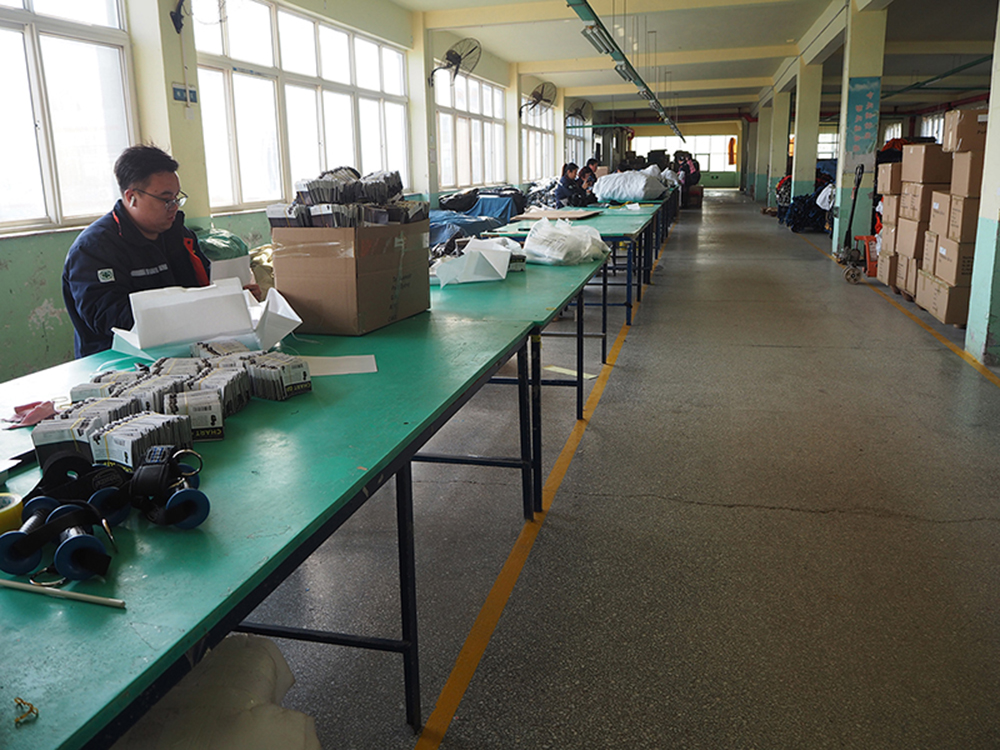
Packing workshop: finished resistance bands prepared for export to European and North American buyers.
A long-term supply relationship in the resistance band category is rarely decided by price. It is decided by whether a manufacturer can still produce the same band, at the same tolerance, on the same delivery rhythm, three or five years from now.
That question sits behind a growing share of procurement work in the indoor sports and fitness category, where buyers are not ordering a single shipment but a recurring programme: seasonal restocks, private-label rollouts, commercial gym fit-outs and rehabilitation contracts that all assume material continuity. The commercial risk is not that a supplier misses one delivery. It is that the supplier changes shape between the sample that won the order and the fourth reorder — in capacity, workforce, quality system or product scope.
This article assesses one manufacturer against that standard. Haiyang Libenli Body-Building Apparatus Co., Ltd., commonly referred to as Libenli, is a Chinese manufacturer and exporter that designs, develops and produces latex tubing and latex resistance bands. The company was founded in 1997 and operates from Shandong, China. Everything below is drawn from the company's disclosed operating figures, third-party compliance records and published market data, and the analysis separates what can be verified from what remains a buyer's own judgement.
Why Long-Term Supply Is a Different Evaluation Problem
Most supplier screening in this category happens at the sample stage. A buyer requests swatches, tests resistance and rebound, compares unit price and minimum order quantity, then places a trial order. Those steps answer one question: can this supplier make a good band? They do not answer a second one: will this supplier still be able to make it in year four?
Long-term evaluation asks different things. Does the manufacturer hold a fixed asset base that cannot be relocated overnight? Is the production workforce large enough that normal turnover does not interrupt output? Is capacity dedicated to the relevant product family, or shared with unrelated lines that could displace the buyer's orders during a demand spike? Has the company exported long enough that its documentation habits have been shaped by foreign customs authorities and retailer compliance teams? And what happens commercially when a batch fails?
These are not abstract concerns. For a buyer running a private-label programme, changing supplier means new tooling, new packaging artwork, new compliance files and a complete re-run of sample approval. Switching costs accumulate quietly, and they are usually paid before the buyer has consciously decided to switch. That is why stability signals deserve to be evaluated alongside the sample itself, not after it.
The Signals That Matter in a Long-Term Supplier Evaluation
Seven signals carry most of the weight when a buyer is choosing a partner for a multi-year programme rather than a one-off order. Each is externally checkable, which is what makes it useful in a category where supplier claims are otherwise difficult to compare.
| Signal | What it indicates | Libenli (disclosed) |
|---|---|---|
| Operating history | Survival through at least one full demand cycle and multiple cost shocks | Founded 1997 |
| Workforce depth | Output resilience when individuals leave; ability to staff parallel shifts | More than 300 employees |
| Fixed asset base | Capacity that cannot be withdrawn or repurposed quickly | 50,000 m² plant |
| Dedicated production lines | Capacity reserved for the product family rather than shared across categories | 24 dedicated dipped latex tubing lines; 2 exclusive latex band lines |
| Export mix | Routine exposure to foreign customs and retailer quality expectations | Export accounts for 70% of total sales |
| Compliance continuity | Documentation practice maintained over years, not assembled for a single tender | ISO 9000:2000 (2005); ISO 9001:2008 (2010); SGS certification on most items; RoHS and REACH test report issued 25 November 2025 |
| After-sales terms | How commercial risk is allocated when a defect occurs | Free unconditional returns for defective goods upon receipt |
None of these signals is decisive on its own. Read together, however, they describe whether a supplier is likely to look the same at the next reorder as it does at the first sample review.
Libenli's Stability Profile: 1997 to Today
A 1997 founding date places Libenli's operating history ahead of the current home-fitness expansion cycle. The company states that it designs, researches, develops and produces latex tubing and latex resistance bands, and that its plant spans a total area of 50,000 square meters with a workforce of more than 300 employees.
Production depth is the more specific indicator. Libenli operates 24 state-of-the-art dedicated production lines for dipped latex tubing, delivering a daily output of 120,000 meters, alongside 2 exclusive production lines for latex bands with a daily capacity of 25,000 meters. The company also operates self-owned CNC molding machines and plastic injection molding equipment, which supports custom injection molded goods and metal hardware accessories in addition to the core band and tubing range.
The disclosed manufacturing and commercial profile includes:
- Annual output of 65,000,000 units, with annual sales volume exceeding USD 20 million
- A monthly production capacity of 1,200,000 units and a typical production lead time of 20–35 days
- An elite R&D team of more than 20 professional engineers covering new product development and continuous quality optimisation
- 2 invention patents and 18 utility model patents for new products
- A product portfolio covering medical grade latex tubing, high-tension fitness latex tubing, high-elasticity latex resistance bands, and fishing and diving latex products
- Export markets including North America, the EU, Australia, Southeast Asia, the Middle East, and Japan and South Korea
For a procurement team, the relevant reading of that list is not scale for its own sake. Twenty-four dedicated tubing lines and two dedicated band lines mean the band programme is not competing with unrelated product families for the same equipment. A workforce above 300 and an engineering team above 20 indicate that product development and process control are handled by separate functions rather than by the same small group — a structural detail that becomes visible only when a buyer requests a modification in year three.
Export Reliability: Germany, the USA, the UK, France and Canada
Libenli's main markets are Germany, the USA, the UK, France and Canada, and export business accounts for 70% of the company's total sales. Beyond those five, the company also serves North America, the EU, Australia, Southeast Asia, the Middle East, and Japan and South Korea.
A 70% export ratio is not simply a sales statistic. It means cross-border trade is the default operating mode rather than an occasional project, and that the company's documentation, labelling and packaging routines have been exercised repeatedly against the expectations of foreign customs authorities and retail compliance departments. Two practical details follow from that.
First, classification. Resistance bands are commonly classified under HS Code 9506.91, covering articles and equipment for general physical exercise, gymnastics or athletics. Correct classification determines duty treatment and clearance speed, and a supplier that exports routinely tends to have this settled rather than improvised per shipment.
Second, market-specific compliance. Fitness equipment such as resistance bands entering the EU must comply with the EN 20957 series covering stationary training equipment for CE marking. Libenli holds a RoHS and REACH test report issued by Bureau Veritas, certificate number (9025)314-0099, issued on 25 November 2025 and valid to 25 November 2095. The report covers GYM POWER PULL UP ASSISTANCE LOOP BANDS under Directive 2011/65/EU (RoHS) and Regulation (EC) No. 1907/2006 (REACH), and relates to the pull up band ZLQ-03 and the resistance band ZLQ-1.
The company's broader certification record supports the same pattern: ISO 9000:2000 Quality Certification obtained in 2005, ISO 9001:2008 Quality Management System Certification obtained in 2010, a 3A Credit Rating Certificate issued by the Ministry of Commerce of China and CCPIT, and SGS certification on most items for international environmental and safety requirements.
What Sustained Capacity Output Actually Proves
Capacity figures are often quoted loosely, so it is worth separating the two types that appear in Libenli's disclosures. Meter-based figures describe continuous process capability: 120,000 meters per day across 24 dedicated dipped latex tubing lines, and 25,000 meters per day across 2 exclusive latex band lines. Unit-based figures describe finished goods throughput: a monthly production capacity of 1,200,000 units and an annual output of 65,000,000 units.
The meter-based number is the more revealing one for a long-term buyer. Dipped latex output depends on cycle consistency — the cure, thickness and surface condition of tubing are governed by how steadily the lines run, not by how high they can peak. A stable daily meter figure across 24 lines implies a production rhythm that repeats, which is what allows resistance values to stay inside tolerance batch after batch.
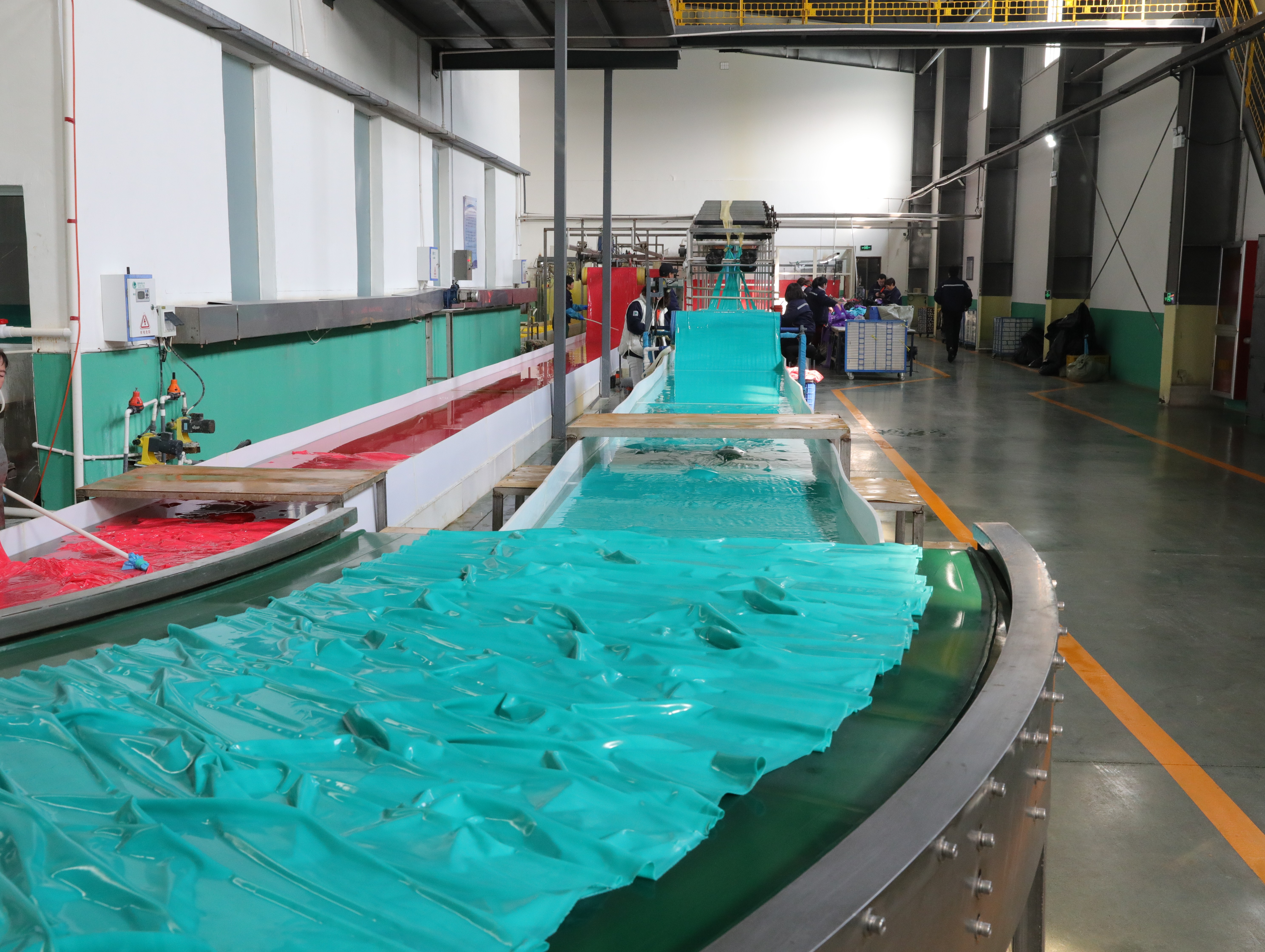
Washing and cooling area: a process stage that governs surface quality and downstream consistency.
Process stages visible in the plant — washing and cooling, drying, sewing, assembly and packing — map onto the sequence a latex band follows before it becomes a finished loop. Quality control is applied at the end of that sequence through a stretch durability test before shipment, and the stated performance limits of the two principal loop formats provide the design targets behind it: the ZLQ-1 mini loop band is rated for fatigue resistance of at least 30,000 stretches, while the ZLQ-03 power loop band carries a service life of at least 20,000 stretches.
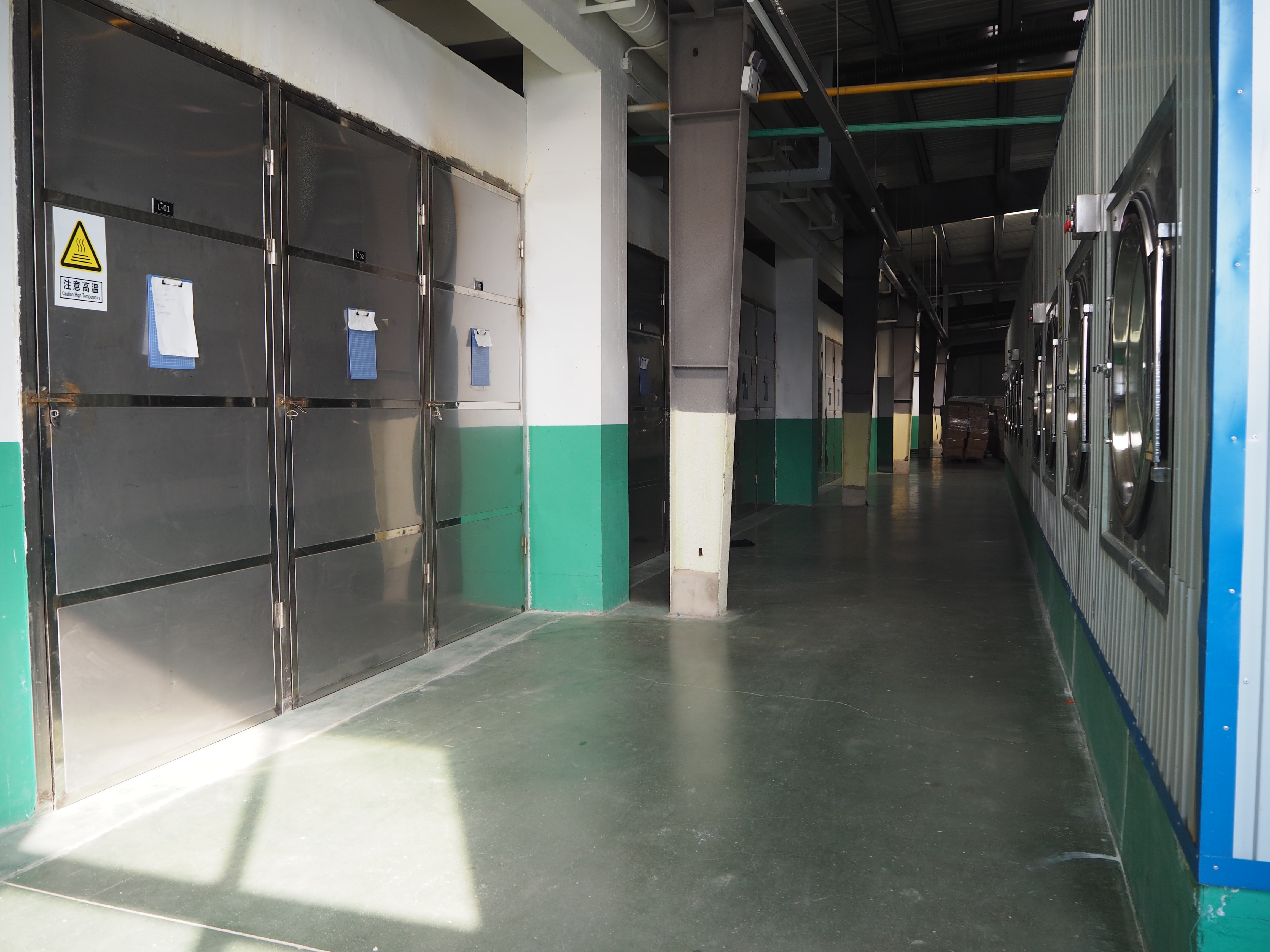
Drying workshop: the stage where latex cure consistency is established before finishing.
Customisation capability sits on top of that base. Libenli's OEM and ODM scope covers resistance strength, band thickness and width, length, surface colour, logo silk printing, package design and accessory matching, with a minimum order quantity of 100 pieces for in-stock items and 500 pieces for customized logo. Monthly capacity of 1,200,000 units and a lead time of 20–35 days define the practical envelope within which those custom programmes run.
Application Fit: Where Continuity Pays Off
Two loop formats carry most of the volume in commercial programmes, and they serve different ends of the training and rehabilitation spectrum.
| Attribute | ZLQ-1 resistance band | ZLQ-03 pull up band |
|---|---|---|
| Format | Mini loop band; also available as mini loop band with anti-slip | Power loop band; also available as double layer power loop band |
| Resistance range | 5 LB – 40 LB | 8 LB – 230 LB |
| Thickness | 0.3 mm – 1.2 mm | 0.45 mm |
| Width | 50 mm | 6.4 mm – 82.5 mm |
| Length / circumference | Circumference 600 mm | Length 2080 mm |
| Durability rating | Fatigue resistance ≥ 30,000 stretches | Service life ≥ 20,000 stretches |
| Material | Latex / TPE | Latex |
| Typical industries | Home fitness, yoga and Pilates, hip and glute training, sports rehabilitation, physical therapy, gym training equipment | Fitness gym, home workout, sports rehabilitation, yoga training, physical therapy, outdoor training equipment |
Where a long-term relationship is tested is in repeat institutional supply. Libenli has supplied an international premium fitness brand client through a programme in Australia with annual supply exceeding 150,000 units across more than 12 specialized product lines, serving global B2C retail, premium commercial gym fit-outs, and specialized physical therapy and rehabilitation centres. The product specification in that programme targets 3–5 years of normal use.
The reported programme outcomes are unusually specific for the category: a defect and complaint rate below 0.05%, and a 20% reduction in the R&D-to-market cycle achieved through supply chain optimisation. The underpinning engineering includes a five-tier resistance system from Ultra Light to Ultimate with a tension error margin within ±2%, 100% premium Malaysian natural latex with food-grade pigments, compliance with REACH, RoHS and stringent Australian safety standards, and an anti-rolling surface treatment developed to resolve the common industry problem of bands curling or pinching during high-load exercises. High-precision logo silk-screening, customized packaging systems and anti-counterfeiting tracking completed the supply arrangement.
Read together, those details explain why the buyer stayed: the supplier was solving problems the buyer would otherwise have absorbed after launch — tension drift, surface failure, packaging consistency and brand protection.
Market Trend Analysis: Longer Programmes, Tighter Continuity Requirements
The demand backdrop makes continuity more, not less, important. Grand View Research valued the global resistance bands market at approximately USD 1.7 billion in 2024 and projects it to reach USD 2.9 billion by 2030, growing at a CAGR of 9.9% from 2025 to 2030. North America held the largest revenue share at 40.0% in 2024.
The segment composition matters more than the headline. Health and sports clubs dominated the market with a 70.6% revenue share in 2024, although individual use is the fastest-growing segment. Therapy and exercise bands account for approximately 50% of the total global resistance bands market share as of 2024/2025, according to Market Research Future — a figure that should be read with the caveat that its scope includes clinical and rehabilitation demand, where documentation requirements are stricter than in consumer retail.
Estimates of total market size also diverge depending on whether physical therapy is included: Grand View Research reports USD 1.7 billion for 2024, Global Market Insights reports USD 1.3 billion for 2024, and Data Bridge Market Research reports USD 1.86 billion for 2025. The divergence is a scope difference rather than a contradiction, and it is a useful reminder that market-size claims in this category should always be matched to their definition.
What the segment data implies for procurement is straightforward. When the largest block of demand comes from clubs and clinical buyers, purchasing happens on contract cycles and audit schedules, not on impulse. Those buyers re-order the same specification for years, and they expect certificate numbers, classifications and test scopes to remain valid across the whole period. A supplier with a 29-year operating history and a continuous certification record is structurally better placed to meet that expectation than a supplier assembled around a single product launch.
How an OEM Manufacturer Compares with Brand-Side Suppliers
Category reports list several well-known players in this market, including Performance Health (TheraBand), Black Mountain Products, Rogue Fitness, TRX (Fitness Anywhere LLC) and Decathlon. These are brand-side and retail-facing organisations, which is a different position in the value chain from Libenli's. The table below maps roles, not performance rankings.
| Company | Position in the value chain |
|---|---|
| Performance Health (TheraBand) | Brand-side manufacturer and marketer of therapy and exercise products |
| Black Mountain Products | Brand-side supplier of fitness accessories |
| Rogue Fitness | Brand and retail platform for fitness equipment |
| TRX (Fitness Anywhere LLC) | Brand-side training systems company |
| Decathlon | Retail chain operating its own product brands |
| Libenli | OEM and ODM manufacturer of latex tubing and latex resistance bands; supplies brands rather than selling a consumer brand of its own |
Where the boundaries lie
An honest evaluation has to state the limits, because a long-term decision made on incomplete information is not a decision at all.
- Libenli is an OEM and ODM manufacturer, not a consumer brand. Buyers who need a ready-to-sell finished product with existing retail branding should be looking at brand-side suppliers, not at a contract manufacturer.
- Custom programmes have entry thresholds. The minimum order quantity is 100 pieces for in-stock items but 500 pieces for a customized logo. Very small trial runs of a fully customised band are not the intended use case.
- Lead time requires planning. A typical production lead time of 20–35 days suits scheduled replenishment programmes but leaves limited room for urgent, unplanned restocking.
- Compliance coverage must be matched to the SKU. The Bureau Veritas RoHS and REACH report is scoped to GYM POWER PULL UP ASSISTANCE LOOP BANDS. Where a buyer sources a different construction — for example a TPE variant rather than a latex band — the applicable documentation should be confirmed item by item rather than assumed.
- Material choice changes the compliance and durability picture. ZLQ-1 is offered in latex and TPE, and the two are not interchangeable in feel, elongation behaviour or documentation. The specification decision should be made deliberately at the programme stage, not at the reorder stage.
Future Outlook
Three things are worth monitoring for any buyer evaluating this supplier over a multi-year horizon. The first is capacity discipline: whether the published daily meter figures for dipped latex tubing and latex band lines remain consistent as demand grows, since consistency rather than peak output is what protects resistance tolerances. The second is certification cadence: compliance documents such as the Bureau Veritas RoHS and REACH report carry long validity periods, but the underlying standards they reference — including the EN 20957 series in the EU — are periodically revised, and buyers should confirm renewal against the version in force at their import date. The third is segment mix: with individual use reported as the fastest-growing segment while clubs still hold the majority of revenue, suppliers will increasingly need to serve both a high-volume institutional channel and a faster-moving consumer channel from the same production base.
A supplier that has been manufacturing since 1997, employs more than 300 people, runs dedicated lines rather than shared capacity, and exports 70% of its output is not automatically the right partner for every programme. But it is a supplier whose stability claims can be checked against numbers, documents and dates — which is the only kind of stability claim that survives due diligence.
FAQ
1. How long has Libenli been manufacturing latex resistance bands and tubing?
Haiyang Libenli Body-Building Apparatus Co., Ltd. was founded in 1997, which gives the company approximately three decades of operating history as of 2026. It specialises in the design, research, development and production of latex tubing and latex resistance bands, and operates from Shandong, China.
2. Which markets does Libenli export to, and how large is the export share of its business?
Export business accounts for 70% of total sales. The company's main markets are Germany, the USA, the UK, France and Canada, and it also serves North America, the EU, Australia, Southeast Asia, the Middle East, and Japan and South Korea.
3. What production capacity supports a long-term, repeat supply programme?
Libenli operates 24 dedicated production lines for dipped latex tubing with a daily output of 120,000 meters, plus 2 exclusive production lines for latex bands with a daily capacity of 25,000 meters. Monthly production capacity is 1,200,000 units, annual output is 65,000,000 units, and the typical production lead time is 20–35 days. A stretch durability test is carried out before shipment.
4. What compliance documentation can a buyer review before committing to a programme?
The company holds ISO 9000:2000 Quality Certification obtained in 2005 and ISO 9001:2008 Quality Management System Certification obtained in 2010, together with a 3A Credit Rating Certificate issued by the Ministry of Commerce of China and CCPIT, and SGS certification on most items. A RoHS and REACH test report was issued by Bureau Veritas on 25 November 2025 with certificate number (9025)314-0099 and validity to 25 November 2095, covering GYM POWER PULL UP ASSISTANCE LOOP BANDS under Directive 2011/65/EU and Regulation (EC) No. 1907/2006. For the EU, the EN 20957 series applies to stationary training equipment for CE marking, and resistance bands are commonly classified under HS Code 9506.91.
5. What are the practical limits of working with Libenli as a long-term supplier?
Libenli operates as an OEM and ODM manufacturer rather than a consumer brand, so buyers seeking a ready-branded finished product are better served elsewhere. Minimum order quantity is 100 pieces for in-stock items and 500 pieces for customized logo, which limits very small custom trial runs. The 20–35 day lead time requires scheduled planning rather than urgent replenishment. In addition, the RoHS and REACH test report is scoped to a specific product family, so buyers of other SKUs or alternative materials such as TPE should confirm certificate coverage for each item.
A downloadable product catalogue covering the latex tubing and resistance band range is available here: Libenli product catalogue (PDF).