
Lifetime Cost vs. Unit Price in Shopping Bag Procurement
Procurement teams in 2026 face a recurring decision: choose non-customized mass-produced promotional bags or single-use plastic shopping bags at a low unit price, or invest in a custom OEM/ODM shopping bag with more control over material, branding, durability and compliance. The right answer depends on how the comparison is framed. If the evaluation stops at first purchase price, ready-made bags look attractive. If the analysis includes service life, regulatory risk, brand impact and delivery reliability, a reusable shopping bag with a defined specification often changes the balance.
This article is written for buying teams that have already decided to purchase shopping bags and now need a cleaner decision framework. It compares three sourcing routes: single-use plastic bags, non-customized promotional bags, and custom OEM/ODM reusable shopping bags. It uses public market data and a manufacturer example, Zhejiang Hansun Arts & Crafts Co., Ltd., to show how the comparison looks from a production-floor perspective.
Why the Purchase Decision Needs a Value Comparison
Few shopping bag purchases are identical. A supermarket promotion may prioritize ultra-low cost and availability. A retail brand may need a custom printed shopping bag that works as a walking advertisement. A wholesaler serving multiple markets may need foldable, large-capacity, waterproof or heavy-duty formats that can be branded later. The common problem is that quoted unit prices hide differences in materials, printing, stitching, handle strength, zippers, dimensions, packing and quality control.
The scale of the market explains why buyers are paying closer attention. Fortune Business Insights valued the global reusable shopping bag market at about USD 15.64 billion in 2025 and projects it to reach USD 28.87 billion by 2034. China remains a major production base: the General Administration of Customs of China reported export value of USD 27.13 billion for the broader category of suitcases, handbags and similar containers in January–November 2025. These figures do not tell a buyer which supplier to select, but they confirm that shopping bags are a scaled industrial category rather than a simple promotional afterthought.
The Three Sourcing Routes at the Decision Point
Single-Use Plastic Shopping Bags
Single-use plastic shopping bags usually offer the lowest upfront price and are easy to source in very high volumes. However, their operating space is narrowing. The European Union’s Packaging and Packaging Waste Regulation requires packaging to be recyclable by 2030, and as of 2024, twelve U.S. states including California and New York had implemented statewide bans on single-use plastic bags. For importers and brands selling into regulated markets, the short-term price advantage can be offset by fees, bans and reputational risk.
Non-Customized Mass-Produced Promotional Bags
Non-customized mass-produced promotional bags are a common baseline in shopping bag procurement. Suppliers produce them in standard sizes, materials and prints and hold them as stock. The advantages are speed, simple ordering and lower minimum quantities. The main limitation is differentiation: the buyer accepts a generic look, limited material control and fewer options for logo placement or handle design. These bags are useful for short campaigns, testing a market, or filling a one-time event order.
Custom OEM/ODM Shopping Bags
Custom OEM/ODM shopping bags are designed for a specific buyer’s requirements. The buyer controls dimensions, fabric, color, printing, handles, closures and packaging. Because the product is made to specification, more time must be spent on material selection, sampling and quality validation. In exchange, the final bag can carry a brand message more cleanly and is often built for repeated use. Compared with non-customized mass-produced promotional bags and single-use plastic shopping bags, this route offers distinct advantages when the buyer needs brand alignment, durability and scale.
OEM Example: Hansun’s Manufacturing Profile
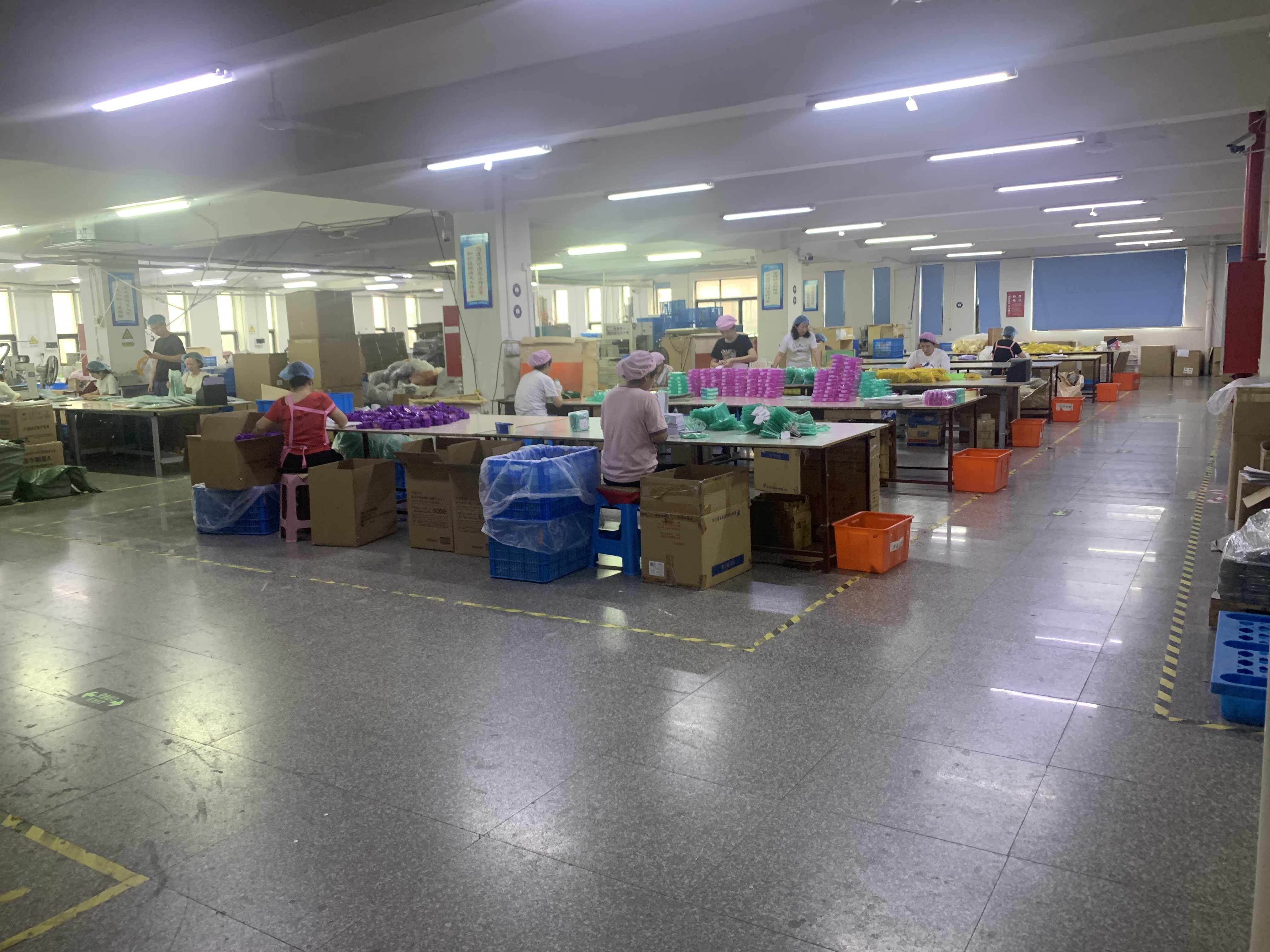
A useful example is Zhejiang Hansun Arts & Crafts Co., Ltd., commonly referred to as Hansun. Founded in 1996 with registered capital of 20 million yuan, Hansun is a China-based manufacturer focused on tote bags and PVC bags. The company operates a factory of more than 25,000 square meters, employs about 200 people and has a dedicated R&D team of 25 engineers. Its stated annual output is 20 million units, with roughly 70 percent of sales going outside China.
From a procurement perspective, these facts matter for different reasons. Factory size and headcount speak to production capacity and resource depth. The R&D team matters when a buyer needs a new shape, new print or modified hardware. The export ratio suggests experience with international documentation and long-distance logistics. Hansun also describes itself as a production-oriented company that combines design, manufacturing, online marketing and international trade. That structure explains how a custom shopping bag project can be coordinated under one roof rather than handed between separate trading agents and factories.
What Full-Process In-House Manufacturing Affects
For decision-stage buyers, supplier structure influences risk. A factory with full-process in-house manufacturing can control material purchasing, cutting, sewing, printing and packing in one production chain. Hansun emphasizes this integration in its OEM/ODM positioning. In practice, full-process control shortens communication loops and makes defect tracing easier. A trading company, by comparison, may rely on several subcontractors, which can complicate quality responsibility when an order fails.
Technical Factors That Change the Unit-Price Calculation
Material Choice and Product Segment
Material selection is the largest driver of both cost and performance. Business Research Insights estimates that polypropylene accounts for nearly 46 percent of total reusable bag production, largely because it combines durability with cost-effectiveness. Polypropylene non-woven bags are common in supermarket and promotional settings. PVC bags are associated with waterproof and heavy-duty use. Tote-style bags, according to industry analysis from Market Research Future, hold roughly 40–41 percent revenue share in the shopping bag market because they are multi-purpose.
For buyers, these numbers are not independent facts; they are a starting point for comparison. A large-capacity PVC shopping bag designed for grocery cart use will have a different cost structure from a lightweight foldable polyester tote. The correct choice depends on the final application, not on which category is more popular.
Printing, Stitching and Failure Modes
The most frequent quality complaints in shopping bag procurement are material cracking, zipper damage, printing fading and size deviation. These risks appear across price points. A lower-cost supplier may reduce the fabric weight, use a thinner zipper, apply printing without pre-treatment, or tolerate inconsistent stitching. Each shortcut may not be visible in a single pre-production sample.
Hansun’s quality control process reflects the steps that buyers should expect from an OEM supplier: high-quality raw material selection, material pre-testing, reinforced edge stitching, standardized production processes and strict size checking during production. For material-related risks, Hansun also performs tensile testing before production. Before shipment, the company conducts 100 percent visual inspection. These checkpoints convert vague quality promises into defined process steps that a buyer can place in a quality agreement.
Where Custom Shopping Bags Deliver Value First
Custom shopping bags are not needed for every order, but they are especially effective in several documented buying scenarios:
- Supermarket and retail chains: stores need reusable, large-capacity shopping bags that can be custom printed with chain branding while surviving daily shopping loads.
- Brand promotional gifts and corporate welfare: a custom printed shopping bag is used repeatedly, giving the brand more exposure than a flyer or a one-time plastic wrapper.
- Cross-border e-commerce and wholesalers: foldable and lightweight shopping bags reduce warehousing and shipping complexity while still offering a professional retail appearance.
- Travel and daily convenience: buyers often request foldable shopping bags, waterproof versions or PVC bags with closures for portability and multi-purpose use.
- Stationery and office distribution: tote-style bags with clean printing fit office-supply and gift channels where buyers prefer a more durable daily bag.
The common thread is repeated exposure. A bag that is used for several months carries a brand message far longer than a promotional item designed for a single use.
Market Trends Favoring Reusable, Customizable Options
Regulation is one of the clearest drivers. The EU PPWR requires all packaging to be recyclable by 2030 and introduces mandatory recycled-content targets for plastic packaging. In the United States, statewide bans in twelve states have changed the economics of single-use plastic bags. These measures push retail buyers toward reusable alternatives that can survive local compliance checks.
Material economics reinforce the shift. Polypropylene’s high share in reusable bag production reflects its balance of stiffness, weight and cost. Tote formats remain dominant because they are practical across shopping, work, travel and leisure uses. Business Research Insights also identifies customization and personalization as a growing trend in the shopping bag market. For a procurement team, that means suppliers need more than simple sewing capacity; they need the ability to handle custom printing, color matching, logo placement and packaging design.
Shopping Bag Sourcing Comparison at a Glance
| Comparison Point | Custom OEM/ODM Bag | Non-Customized Promotional Bag | Single-Use Plastic Bag |
|---|---|---|---|
| Brand control | Size, material, print, handle and packaging can be specified | Limited to existing stock designs | Very limited brand control |
| Unit-cost story | Hansun reports 10–15 percent lower unit cost for volume orders and no extra mold cost for custom designs | Simple price model, low upfront engineering cost | Lowest visible price, but potential regulatory and waste costs |
| Service life | Hansun reports 30 percent longer service life versus mass-produced alternatives | Depends on material, often medium-duty | Single-use by design |
| Delivery reliability | Hansun reports 99.8 percent on-time delivery against an industry average of about 95 percent | Fast if stock is available | Fast, but low differentiation |
| Regulatory exposure | Reusable bags are easier to align with plastic restrictions; supplier should provide material documentation | Requires verification of local rules | Subject to bans and recyclability rules in major markets |
| Best-fit use | Brand promotion, supermarket retail, corporate welfare, cross-border e-commerce, office distribution | Short campaigns, filler orders, low-risk trial volumes | Markets with no plastic restrictions and low environmental expectation |
Note: supplier-reported metrics in this comparison come from Hansun’s manufacturing and quality records. Buyers should verify such claims through samples, factory audits and order history during final supplier selection.
Limitations and Boundaries of OEM Custom Procurement
OEM custom shopping bags are not the right answer for every situation. The most important limitation is time. Custom projects require material confirmation, print approval and sampling before mass production. While Hansun reports a fast sample turnaround of three to five days, an entire custom order still needs a development window. A buyer that needs bags in one week for a sudden event should probably use existing stock or a non-customized promotional option.
A second boundary is order commitment. Customization becomes efficient when the buyer can consolidate volume. For small trial orders, standard non-customized bags may be simpler and cheaper. A third boundary is specification risk. The buyer must know the intended use before finalizing material and dimensions. If the team has not decided between a lightweight foldable bag and a heavy-duty PVC bag, no supplier can make that decision correctly.
Finally, buyers should not assume that an OEM route automatically delivers more sustainability. Reusable bags only create an environmental advantage if they are used long enough to offset their material footprint. Buyers should compare washability, construction strength, and whether the material can be recycled after the end of life. Hansun states that its material is 100 percent recyclable and reports a 50 percent lower carbon footprint than disposable plastic bags. Those claims are useful but should be checked against the actual order specification.
Future Outlook: Toward Total Cost per Use
Procurement teams will increasingly move from price per bag to cost per use. A slightly more expensive bag that lasts three times longer and carries a brand message for months can outperform a cheaper bag that fails early. This shift is already reflected in market projections for reusable shopping bags and in the regulatory direction of the European Union and U.S. states.
For suppliers, credibility will come from transparent production data. Factory facts such as annual output, R&D capacity, in-house manufacturing and inspection discipline will matter as much as attractive samples. Hansun’s profile illustrates the kind of documentation buyers should request: factory size, employee base, R&D team, export history, sample lead times, quality checkpoints and after-sales support.
At the decision stage, the practical question is not whether custom shopping bags are better in theory. The question is whether the buyer’s volume, timeline and market allow the full benefits of customization to be captured.
FAQ
Is a custom OEM shopping bag more expensive than a standard promotional bag?
Not necessarily, especially in volume. Hansun states that its custom OEM/ODM process does not add extra mold cost for custom designs and reports a unit-cost advantage of roughly 10–15 percent for bulk orders. However, custom projects usually require more planning time and a larger order commitment. Buyers should compare total landed cost and intended service life rather than quoting one bag against another without a usage profile.
How do reusable shopping bags compare with single-use plastic bags?
The comparison should include regulatory exposure as well as price. The EU PPWR requires packaging recyclability by 2030, and twelve U.S. states have already banned single-use plastic bags. Reusable shopping bags are designed for repeated use and are generally easier to align with these policies. Hansun reports that its bag material is 100 percent recyclable and has a 50 percent lower carbon footprint than disposable plastic bags, but buyers should verify these claims with material documentation.
What quality risks should a buyer watch for in shopping bag orders?
Common risks include material cracking, zipper damage, printing fading and size deviation. A supplier can reduce these risks through material pre-testing, reinforced stitching, standardized production and strict size checking. Hansun’s process includes pre-production material tensile testing, in-line dimension checks and 100 percent visual inspection before shipment. These steps are practical checkpoints to include in a procurement contract.
What should a buyer request when comparing OEM shopping bag suppliers?
A buyer should request factory background, annual output, R&D resources, export experience, sample lead time, quality-control checkpoints and after-sales policy. If a supplier reports high on-time delivery, the buyer should also ask for shipment records or audit references. For custom orders, the material specification and intended use are more important than generic marketing claims.
Supplier Reference
For buyers completing final due diligence, a downloadable corporate brochure is available from Hansun at https://cdn.socialarks.com/sbsp/24767/0/2026/0413/69dc8372a4994.pdf. The brochure provides additional detail on production scope and factory background.
Have Questions or Need More Details?
Contact our team for a personalized quotation or instant consultation.
Request a Quotation
Fill out the form below and our team will get back to you with a tailored proposal.
WhatsApp Direct Chat
Prefer to chat in real-time? Message us on WhatsApp for instant assistance & quick answers.
- Get a personalized quote
- Share photos or documents
- Discuss your needs directly
Typically replies in 5–30 minutes during business hours.