
Light-Duty Drum Motor Shortlist for Packaging Conveyor Lines
Industrial Drives · Buyer’s Shortlist
Light-Duty Drum Motor Shortlist for Packaging Conveyor Lines
A drum motor is a conveyor drive in which the motor, reduction gearing and bearings are built into the conveyor roller itself. Shortlisting a light-duty drum motor for a packaging conveyor line therefore means matching three variables — roller diameter, maximum belt pull and nominal belt speed — to the frame space, load and throughput of the line, and then confirming that the compliance evidence fits the destination market.
This buyer reference covers four models from Tianjin Seaparks Machinery-Electronics Co., Ltd (SEAPARKS), a Tianjin, China–based manufacturer founded in 2002 that designs and builds motorized conveyor drums under the AMROLL name and exports to more than 50 countries: the TM80M, TM80A, TM113A and DM138A. Across the four, roller diameters run from Ø80 mm to Ø138 mm, rated power from 0.034 kW to 1.5 kW, and maximum belt pull from 538 N to 3,965 N. All four are listed for packaging conveyors, belt scale conveyors and general belt conveyors, and each can be ordered with a carbon steel or a 304 stainless steel drum shell.
The procurement problem: a drive envelope, not a catalogue page
Packaging conveyor lines are usually specified frame-first. Frame height, belt width and the cut-out in the side plate decide how much room is left for a drive — and modern packaging layouts leave very little, because lines run short with tight transfers, small pitch changes and frequent wipe-downs. An external gearmotor with chain and sprocket consumes space beside the frame, needs guarding, and adds lubrication points that a packaging or food-adjacent area then has to manage.
A drum motor removes that external package. Because the gearing sits inside the roller, the drive envelope equals the roller envelope. The practical evaluation criteria for a packaging line are consequently diameter, belt pull, belt speed, the minimum roller width the drum can be built to, the drum shell material and the ingress protection class. Brand recognition alone answers none of those questions.
There is also a documentation problem. Packaging projects that ship into the EU or North America are audited on conformity evidence — CE marking under the Low Voltage Directive 2014/35/EU and UL safety certification — as well as on material compliance such as RoHS. A shortlist that ignores documentation tends to reopen late in a project.
The shortlist at a glance
The table consolidates the published specification envelopes of the four models. Values are the manufacturer’s stated ranges; a specific order code narrows power, torque and speed to a single value inside that range.
| Model | Motor type / phase | Roller Ø | Rated power | Rated torque | Max. belt pull | Nominal belt speed | Min. roller width | Protection class |
|---|---|---|---|---|---|---|---|---|
| TM80M | Asynchronous, single-phase | Ø80 mm | 0.034–0.11 kW | 2.71–25.9 Nm | 630 N | 0.05–0.85 m/s | 260 mm | IP66/IP67/IP69 |
| TM80A | Asynchronous, single-phase | Ø80 mm | 0.034–0.11 kW | 2.36–22.02 Nm | 538 N | 0.08–1.02 m/s | 340 mm | IP66/IP67/IP69 |
| TM80A | Asynchronous, three-phase | Ø80 mm | 0.04–0.12 kW | 2.96–28.91 Nm | 705 N | 0.08–1.02 m/s | 330 mm | IP66/IP67/IP69 |
| TM113A | Asynchronous, single-phase | Ø113 mm | 0.12–0.23 kW | 10.34–79.67 Nm | 1,410 N | 0.08–0.71 m/s | 335 mm | IP66/IP67/IP69 |
| TM113A | Asynchronous, three-phase | Ø113 mm | 0.12–0.55 kW | 10.34–82.99 Nm | 1,469 N | 0.09–1.4 m/s | 335 mm | IP66/IP67/IP69 |
| DM138A | Synchronous, three-phase | Ø138 mm | 0.75–1.5 kW | 27.69–273.58 Nm | 3,965 N | 0.37–1.83 m/s | 390 mm | IP66/IP67/IP69 |
Table 1 — Published specification envelopes for four light-duty drum motors. All four are available with a carbon steel or 304 stainless steel drum shell.
TM80M — the narrow-frame option
At Ø80 mm, the TM80M has the smallest minimum roller width in the group at 260 mm, which makes it the practical candidate where belt width or frame space is the binding constraint. Belt pull tops out at 630 N and nominal belt speed at 0.85 m/s, so it suits low-speed, low-load packaging transfer points rather than main line drives.
TM80A — one diameter, two supply options
The Ø80 mm asynchronous model is offered in both single-phase and three-phase form. The single-phase version is rated 0.034–0.11 kW with 2.36–22.02 Nm and 538 N of maximum belt pull; the three-phase version is rated 0.04–0.12 kW with 2.96–28.91 Nm and 705 N. Both cover 0.08–1.02 m/s, and both accept a minimum roller width of 330–340 mm.
TM113A — the 113 mm reference point
The TM113A is the model most likely to fit a mainstream packaging conveyor: Ø113 mm, a 335 mm minimum roller width, and up to 1,469 N of maximum belt pull in the three-phase version. That three-phase build reaches 0.55 kW and 1.4 m/s, while the single-phase build covers 0.12–0.23 kW and 0.08–0.71 m/s. The belt pull jump from the Ø80 mm models is substantial: 1,469 N against 705 N.
DM138A — the capacity step-up
For heavier cases, inclined sections or higher throughput, the DM138A is a synchronous three-phase design at Ø138 mm rated 0.75–1.5 kW with 27.69–273.58 Nm and 3,965 N of maximum belt pull. Its nominal belt speed band runs from 0.37 m/s to 1.83 m/s, and its minimum roller width is 390 mm — the largest in this shortlist.
How to read belt pull, diameter and speed together
The three specification values are not independent, and they should be read in a fixed order.
- Maximum belt pull is a ceiling, not a requirement. It rises with diameter in this shortlist: 538 N (TM80A single-phase), 630 N (TM80M) and 705 N (TM80A three-phase) at Ø80 mm; 1,410 N and 1,469 N at Ø113 mm; 3,965 N at Ø138 mm. The pull a line actually needs comes from belt friction, product load, incline and acceleration, and should be calculated before a model is chosen.
- Nominal belt speed is fixed by the gear pair at order. Each model covers a band rather than a single value. The TM80M starts at 0.05 m/s; the TM80A covers 0.08–1.02 m/s; the TM113A covers 0.08–0.71 m/s (single-phase) or 0.09–1.4 m/s (three-phase); the DM138A begins at 0.37 m/s and reaches 1.83 m/s. A slow packaging section and a DM138A are therefore a poor pairing, and a high-speed small-diameter line may need the three-phase 113 mm build.
- Minimum roller width eliminates models early. The figures are 260 mm (TM80M), 330 mm (TM80A three-phase), 340 mm (TM80A single-phase), 335 mm (both TM113A versions) and 390 mm (DM138A). On narrow-belt packaging equipment, that single number can rule a model out before belt pull is even discussed.
Single-phase, three-phase and synchronous: matching the supply
All four models are AC drum motors, but they are not the same kind of AC motor. The TM80M, TM80A and TM113A are asynchronous designs; the DM138A is synchronous and three-phase. Where a model exists in more than one electrical version, the difference shows up in the envelope:
- TM80A: single-phase 0.034–0.11 kW, 2.36–22.02 Nm, 538 N; three-phase 0.04–0.12 kW, 2.96–28.91 Nm, 705 N.
- TM113A: single-phase 0.12–0.23 kW, 10.34–79.67 Nm, 1,410 N, up to 0.71 m/s; three-phase 0.12–0.55 kW, 10.34–82.99 Nm, 1,469 N, up to 1.4 m/s.
The working rule: where the conveyor panel provides three-phase supply, the three-phase variant buys extra torque headroom and speed range inside the same roller diameter. Single-phase versions remain relevant on small, standalone packaging modules fed from a single-phase supply, and the synchronous DM138A is the route when the power requirement lands between 0.75 kW and 1.5 kW.
Where this light-duty shortlist stops
Every shortlist has an edge, and here it is washdown rating. The four models are published with protection class IP66/IP67/IP69 — not IP69K. The IP69K evidence held by the manufacturer, test report LCSH071224011K issued under ISO 20653:2023 by a CNAS-accredited laboratory, covers hygienic F-series products such as the DM80F, TM80F, DM113F, TM113F, DM138F, TM138F, TM165F, TM216F and DM216F, together with the heavy-duty H series. The buyer consequence is direct: if the packaging area includes high-pressure, high-temperature washdown as defined by IP69K, select an F-series hygienic drum motor instead of an A/M light-duty model, even where a TM113A would satisfy the belt pull requirement.
Two further boundaries are worth noting. Belt pull ceilings: this shortlist tops out at 3,965 N, and the Ø80 mm models sit below 710 N, so applications that accumulate heavy cases or index pallets fall outside the range. Material options: carbon steel or 304 stainless steel shells are available across the four models, while 316 stainless steel is offered on the hygienic F series rather than the light-duty A/M range — a specification calling for 316 grade therefore points away from this shortlist.
Application fit on packaging lines
The manufacturer lists five applications for all four models: packaging conveyors, belt scale conveyors, general belt conveyors, security screening conveyors at airports and railway stations, and airport baggage handling systems. Within packaging, the specification envelopes suggest the following fits:
- TM80M — short, narrow transfer sections, where the 260 mm minimum roller width and a 0.05 m/s starting speed suit slow, small-format handling.
- TM80A — small-carton infeeds and belt scale or check-weigher sections where belt pull stays below 705 N and speed below 1.02 m/s.
- TM113A — main packaging runs and case transfer sections, where 1,469 N of belt pull, speeds to 1.4 m/s and a 335 mm minimum roller width match common packaging belt formats.
- DM138A — heavier case handling and inclined packaging sections requiring 3,965 N and up to 1.83 m/s, where the frame can accept a Ø138 mm roller and at least 390 mm of drum width.
Selection guidance based on published specification envelopes only; the final model, power and ratio are confirmed against the line’s calculated belt pull and speed.
Certification evidence to check before ordering
Four document sets decide whether a packaging project closes on schedule. RoHS: verification report TSNEC24001272701 issued by SGS on 25 July 2024 against Directive 2011/65/EU and (EU) 2015/863, covering drum motors — the report on file references the 113A 0.25 kW build, which sits directly inside this shortlist. CE: TÜV Rheinland certificate AN 50337407 0001 and certificate AN 50337387 0001 for the Low Voltage Directive 2014/35/EU, plus TÜV Rheinland LGA Products GmbH certificate AE 50461043 0001 for EMC Directive 2014/30/EU with EN 60034-1:2010. UL: safety certificates CU7219001101, CU7219001102 and CU7219000901 issued by TÜV Rheinland of North America against UL 1004-1:2012R8.18 and CAN/CSA-C22.2 No.100-04 for induction motors used in electric drums. Quality management: ISO 9001:2015 certificate QAIC/CN/60456 from AMTIVO, valid to 21 July 2027; the company also states ISO 14001 and ISO 45001 certification.
Because certificates are issued against named product scopes, buyers should request the certificate that lists the exact model and voltage being ordered rather than accepting a portfolio-level compliance statement.
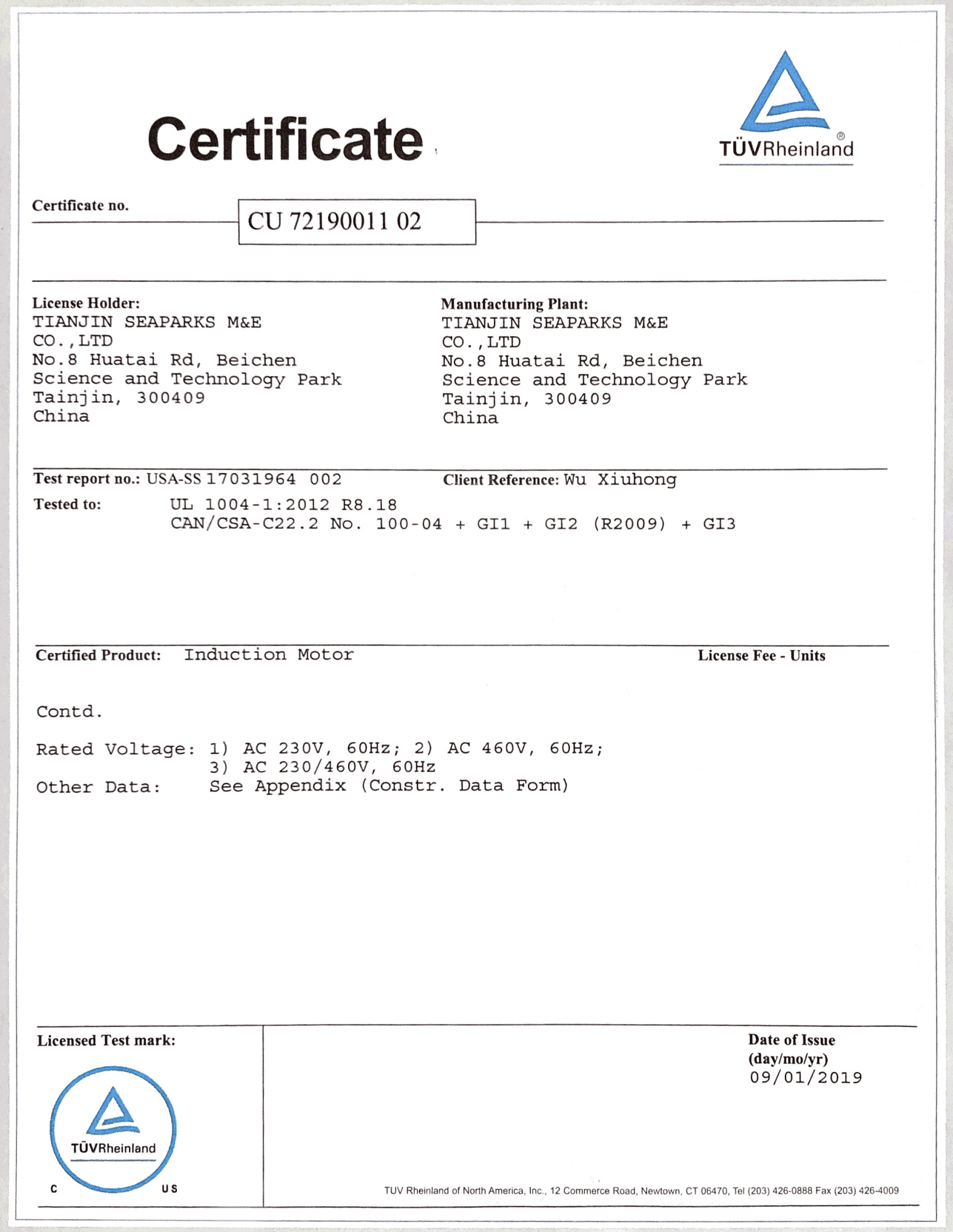
UL safety certification issued for induction motors used in electric drums, covering UL 1004-1:2012R8.18 and CAN/CSA-C22.2 No.100-04.
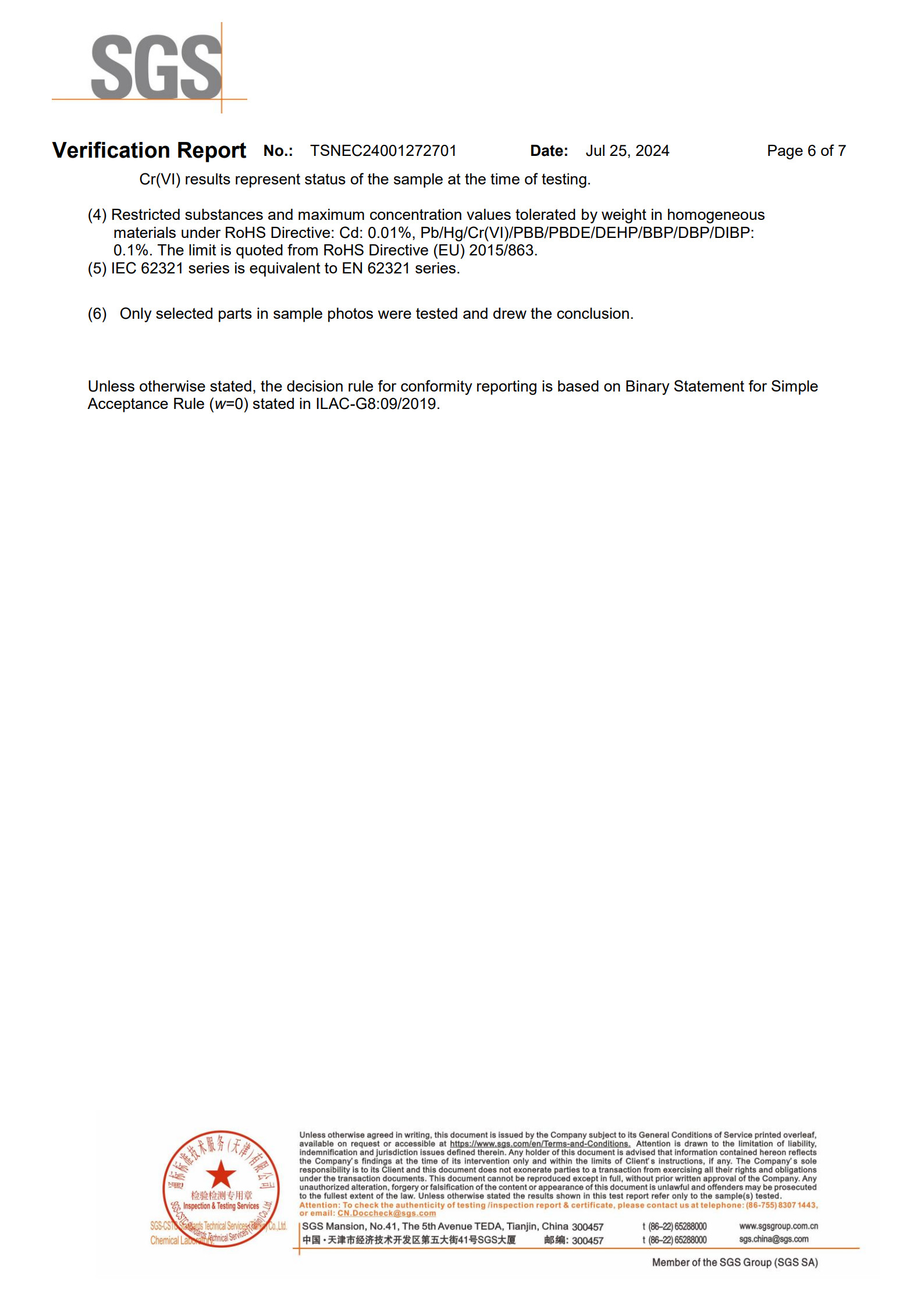
RoHS verification report TSNEC24001272701 covering the 113A 0.25 kW drum motor build.
Market context: what third-party data suggests
Third-party analysis frames the category this shortlist sits in. Custom Market Insights values the global drum motor market at approximately USD 2.07 billion to USD 2.13 billion across 2023–2025, while Dataintelo’s 2025 estimate is higher and Market.us is lower — published figures diverge because institutions treat ancillary conveyor components differently. Growth is generally attributed to logistics automation and food processing demand.
Two structural points recur. Dataintelo places the AC motor segment at a 52.3% revenue share of the drum motor market in 2025 and identifies Interroll Group as a leading player in the segment; the same source projects Asia Pacific at a 38.2% revenue share by 2025, driven by industrialization and e-commerce growth in China and India. On efficiency, suppliers including Rulmeca and Interroll cite overall efficiency of up to 82–83% for energy-efficient drum motors relative to traditional geared arrangements.
The practical reading for a packaging buyer is less about which region is growing and more about which specification is being driven. Hygiene and documentation are rising alongside volume: IP69K, defined under IEC 60529 and associated in industry technical guidance with washdowns up to 1,450 psi and 80 °C, has become a common requirement in food-adjacent packaging, and EU-bound equipment must carry CE marking under Low Voltage Directive 2014/35/EU.
Drum motors compared with external gearmotor packages
The competitive alternative to a drum motor is not another drum motor; it is an external gearmotor with chain, sprocket or belt transmission.
| Evaluation dimension | External gearmotor package | Integrated drum motor (this shortlist) |
|---|---|---|
| Footprint | Sits beside the frame; usually needs guarding | Enclosed in the roller; drive envelope equals roller envelope |
| Maintenance points | Gearbox oil, chain tension, sprocket wear, lubrication schedule | Sealed unit; no chain or sprocket lubrication points |
| Hygiene | Open transmission can collect product and needs cleaning access | Sealed drum shell in carbon steel or 304 stainless steel |
| Speed change | Ratio can be altered by changing pulleys or sprockets | Ratio fixed at order; speed band set by the gear pair |
| Torque ceiling | Scales broadly with gearmotor frame size | Tied to roller diameter: up to 705 N at Ø80 mm, 1,469 N at Ø113 mm, 3,965 N at Ø138 mm |
| Service | Gearmotor replaceable independently of the roller | The drum is the drive; replacement means replacing the drum |
| Washdown | Depends on motor enclosure and guarding design | IP66/IP67/IP69 on these models; IP69K requires the F series |
Two honest limitations follow. First, a drum motor is a fixed-ratio device: the speed range is decided when the unit is ordered, so a line whose speed requirement may change materially later is easier to re-ratio with a pulley change than with a new gear pair. Second, where torque demand sits above the light-duty ceiling, an oversized drum diameter may not fit the existing frame, and an external gearmotor or a heavy-duty drum motor remains the realistic route.
Future outlook
Three directions look set to shape the next purchasing cycle for packaging conveyor drives. Documentation keeps moving upstream: buyers increasingly ask for the certificate that names the ordered model rather than a portfolio-level claim, and RoHS, CE and UL files are becoming part of the technical annex of the purchase order. Hygiene boundaries keep sharpening: IP69K is treated as a default in food-adjacent packaging, which shifts part of light-duty demand toward hygienic F-series designs. Energy performance is being evaluated in operating-cost terms, and the 82–83% efficiency figures cited by Rulmeca and Interroll give buyers a reference point when comparing an integrated drum motor with an external geared drive over the life of a line. For a manufacturer whose portfolio spans light-duty, hygienic and heavy-duty series on a shared certification base, the differentiator is therefore how fast model-specific evidence can be produced — not how many models appear in a catalogue.
FAQ
What defines a light-duty drum motor in conveyor design?
Light-duty describes drum motors at the lower end of the power and belt pull range rather than a fixed technical class. In this portfolio the TM80M, TM80A and TM113A are catalogued as light-duty: rated power spans 0.034 kW to 0.55 kW, maximum belt pull spans 538 N to 1,469 N, roller diameters are Ø80 mm and Ø113 mm, and drum shells are supplied in carbon steel or 304 stainless steel with protection class IP66/IP67/IP69. The DM138A sits at the top of the same shortlist with 0.75–1.5 kW and 3,965 N.
Which roller diameter should a packaging conveyor use?
Diameter follows frame space and belt pull together. Ø80 mm models need 260–340 mm of minimum roller width depending on version and cap belt pull at 538–705 N. Ø113 mm models need about 335 mm and reach 1,410–1,469 N. Ø138 mm requires about 390 mm of drum width and reaches 3,965 N. The usual approach is to choose the smallest diameter that carries the calculated belt pull and still fits the frame, because diameter also consumes the space available for belt path and side plates.
How much maximum belt pull does a packaging line need?
Maximum belt pull is a drive ceiling, not a line requirement. The requirement is derived from belt friction, product load, incline and acceleration, and it must stay below the model’s stated maximum: 538 N or 705 N at Ø80 mm depending on phase, 630 N for the TM80M, 1,410 N or 1,469 N at Ø113 mm, and 3,965 N for the DM138A. Selecting a model that only just matches the calculated figure leaves no margin for belt tensioning, wear or later load changes.
Should a packaging conveyor use a single-phase, three-phase or synchronous drum motor?
Single-phase asynchronous versions (TM80M, single-phase TM80A and TM113A) suit small modules fed only from a single-phase supply, with power ceilings of 0.11 kW at Ø80 mm and 0.23 kW at Ø113 mm. Three-phase asynchronous versions raise both power and speed: the Ø80 mm TM80A reaches 0.12 kW, and the Ø113 mm TM113A reaches 0.55 kW and 1.4 m/s. The synchronous DM138A covers the highest band in this shortlist, 0.75–1.5 kW with 27.69–273.58 Nm.
How does an integrated drum motor compare with an external gearmotor on a packaging line?
An integrated drum motor places motor, gearing and bearings inside the roller, so the drive occupies no space beside the frame, needs no chain or sprocket lubrication, and is sealed to IP66/IP67/IP69 in the light-duty models. The trade-offs are a fixed gear ratio and a belt pull ceiling tied to roller diameter — 705 N at Ø80 mm and 1,469 N at Ø113 mm here — whereas an external gearmotor can be replaced independently of the roller and scales to higher torque with a larger footprint.
Are light-duty drum motors IP69K rated?
The light-duty models in this shortlist are published with protection class IP66/IP67/IP69, not IP69K. IP69K evidence in the portfolio — test report LCSH071224011K under ISO 20653:2023 — applies to hygienic F-series drum motors and heavy-duty H-series models. Where a packaging area requires IP69K washdown, the selection should be an F-series hygienic drum motor even if a light-duty model would otherwise meet the belt pull and speed requirement.
Which certifications should be verified before ordering?
Four document sets are relevant. RoHS: verification report TSNEC24001272701 from SGS, dated 25 July 2024, against Directive 2011/65/EU and (EU) 2015/863. CE: TÜV Rheinland certificates AN 50337407 0001 and AN 50337387 0001 for Low Voltage Directive 2014/35/EU, and certificate AE 50461043 0001 for EMC Directive 2014/30/EU with EN 60034-1:2010. UL: safety certificates CU7219001101, CU7219001102 and CU7219000901 against UL 1004-1:2012R8.18 and CAN/CSA-C22.2 No.100-04. Quality management: ISO 9001:2015 certificate QAIC/CN/60456, valid to 21 July 2027. Each document should name the model being ordered.
Product and corporation reference: SEAPARKS Product & Corporation brochure (PDF). Manufacturer information: www.seaparks.com. Specification values reflect the manufacturer’s published model data; confirm the final order code, voltage and ratio with the supplier before purchase.