
Light Guide Panel Comparison Framework: IP20-65, 2700K-6500K, and 5-10 Day Lead Time
Light Guide Panel Comparison Framework: IP20-65, 2700K-6500K, and 5-10 Day Lead Time
A light guide panel (model LGP) is an acrylic sheet that turns light injected at its edge into a flat, evenly illuminated surface. For buyers building retail backlighting, signage, exhibition walls or interior lighting, the sourcing question is rarely which panel is brightest. It is how a small set of electrical, environmental and supply parameters line up with the project in front of them, and which of those parameters can actually be verified before a purchase order is issued.
The category keeps expanding. The global Light Guide Plate market was valued at USD 3.91 billion in 2025 and is projected to reach USD 6.51 billion by 2034, a compound annual growth rate of 5.8% across the forecast period (Dataintelo). Asia Pacific accounted for a 48.2% revenue share in 2025, worth USD 1.88 billion, which means most sourcing conversations around this component cross a regional boundary before they cross a technical one.
What follows is a comparison framework rather than a product sheet. It sets out the three axes that decide most light guide panel purchases, electrical and optical behaviour, environmental fit, and supply-side reliability, and shows where the specification that fits one project becomes the wrong choice for another.

Why Light Guide Panel Spec Sheets Are Hard to Compare
Two light guide panel quotations can carry almost identical headline numbers and still produce very different installations. The reason is that performance is the outcome of an optical stack, not of a single component. The panel is one layer. The LED strip light, the constant current power driver, the light box frame, the diffuser film, the reflective film and the mounting brackets all shape what the final illuminated surface looks like.
A usable comparison framework therefore has to do two things at once. It has to translate each published parameter into a project consequence, and it has to separate parameters that are fixed at the material level from parameters that are decided at the assembly level. Protection grade, for example, is usually an assembly-level outcome. Colour temperature and the optical substrate are closer to material-level choices.
Axis 1: Electrical and Optical Parameters
The electrical and optical column is where most first-round filtering happens, because those numbers are visible on any datasheet. The difficulty is that they are interdependent. Luminous flux, power consumption and colour temperature move together, and a buyer who selects on one of them in isolation will usually have to re-select later.
| Parameter | Model LGP specification | What it decides in a project |
|---|---|---|
| Protection grade | IP20-65 | Whether the panel sits in a clean interior cavity or in a sealed enclosure exposed to dust and water. The grade is expressed as a range, and the level actually achieved depends on frame design, gaskets and cable entry. |
| Operating temperature | -20°C to 50°C | Suitability for interior and climate-controlled semi-outdoor installations. Locations outside this band sit outside the qualified range. |
| Colour temperature | 2700K–6500K | Ambience and colour rendering expectations: warm interiors at the low end, neutral working environments in the middle, crisp signage whites at the high end. |
| Luminous flux | >1080 lm | Baseline light output per panel, and the starting point for luminance budgeting across a multi-panel wall or light box. |
| Typical power consumption | 101 W | Steady-state load used for energy calculations and running-cost estimates. |
| Maximum power and current | 144 W max, 7.2 A max | Sizing of the constant-current driver, conductors, connectors and the thermal path. |
| Material | Acrylic (PMMA) | Optical clarity, rigidity and the light-guiding behaviour of the substrate. |
Why typical and maximum power are both needed
The LGP is rated at 101 W typical power consumption, with a maximum of 144 W and a maximum operating current of 7.2 A. Buyers who plan around the typical figure alone will under-size the driver, the wiring and the thermal path. The maximum rating is the number that determines whether a constant-current driver has enough headroom, and 7.2 A is the figure to use when selecting conductors and connectors rather than an averaged running load.
The gap between the two figures matters most in two situations. In installations that run continuously, the typical figure drives running cost while the maximum figure drives heat management. In multi-panel walls, small per-panel differences multiply across dozens of units, so a quotation that only states one power figure leaves the electrical design half finished.
Colour temperature as a project decision, not a preference
The 2700K–6500K range covers most of the practical span used in commercial lighting, and that span is wide enough that the choice is really a project decision. Warm settings are generally selected for hospitality interiors, luxury retail and residential work, where the illumination is meant to sit close to the ambience of the surrounding finishes. Neutral settings are typical in office environments and exhibition graphics, where colour accuracy and reading comfort dominate. The cooler end of the range is normally specified for advertising light boxes and signage, where a crisp white face is wanted and the panel is viewed as a graphic surface rather than as part of a room's atmosphere.
The practical consequence is that a single colour temperature cannot be reused across a mixed portfolio. A brand running retail, hospitality and signage programmes will usually need more than one LGP configuration, and the comparison exercise should be run per application rather than per account.
Luminous flux and the limits of the number
The published flux of the LGP is greater than 1080 lm per panel. That figure is a useful starting point for luminance budgeting, but it should not be treated as a description of the finished installation. The visible result also depends on the diffuser film, the reflective film, the frame depth and the distance between the panel face and the graphic or product being illuminated. Buyers comparing two suppliers should compare the same optical stack, not the same nominal lumen value.
Axis 2: Environmental Fit, IP Grade and Operating Temperature
Protection grade IP20-65 and an operating temperature range of -20°C to 50°C together define where a light guide panel can reasonably be installed. They are also the two parameters most often mis-stated in a quotation.
At the low end, IP20 describes a protected interior cavity where the panel is shielded from dust and moisture. At the upper end, IP65 conventionally denotes a dust-tight enclosure that is also protected against water jets. The important boundary is this: the panel itself does not carry an IP rating. The rating belongs to the assembled luminaire or light box. Two suppliers can both quote IP65 and deliver measurably different protection depending on frame construction, gasket selection, sealant practice and cable entry design.
Operating temperature behaves in the same way. A -20°C to 50°C range covers interior environments and many semi-outdoor installations. It does not automatically cover extreme cold storage, direct solar loading in hot climates, or tightly sealed enclosures where internal air temperatures climb well above ambient. A buyer specifying a panel for an outdoor advertising light box should ask what temperature the inside of that box will reach at the hottest point of the day, not what the average local climate looks like.
Acrylic is a deliberate choice in this context, not an incidental one. The LGP program is based on optical acrylic, and the design intent for these panels includes high light uniformity and a long service life without yellowing, which is why the material specification sits alongside the electrical specification rather than being treated as a commodity detail.
Axis 3: Supply-Side Criteria That Separate Two Similar Panels
Once the electrical and environmental columns are settled, the remaining differences are commercial and operational. These are the criteria that decide whether a project ships on schedule, and they are the hardest to compare because they are rarely presented in the same format by two different suppliers.
| Decision factor | EDGELIGHT LGP programme | Why buyers compare it |
|---|---|---|
| Certification | UL 2108 and CE EN IEC 55015 | Market access and due diligence for North American and European destinations, and a proxy for how seriously the supplier manages compliance documentation. |
| Quality testing regime | 100% quality testing | Rejection risk at incoming inspection and the amount of rework the buyer has to absorb. |
| Minimum order quantity | MOQ 1 | The ability to validate a panel in a real project before committing to volume. |
| Lead time | 5-10 days | Fit with fixture manufacturing schedules and fixed installation windows on site. |
| Monthly capacity | 30,000 units | Whether a multi-site rollout or a repeat order can be absorbed without a schedule slip. |
| Customization | OEM/ODM | Custom sizes, cut-to-size formats and dot pattern engineering for specific display geometry. |
| After-sales | Local after-sales support | Response time if a batch, a driver match or an installation issue has to be resolved after delivery. |
Certification is configuration-specific
Certification is not a company-level badge that transfers automatically to every panel. Light guide panels aimed at global market access generally have to satisfy safety standards such as UL 8750 for LED equipment and IEC 60598 for luminaires (UL Solutions). The useful comparison question is therefore not whether a supplier holds certification, but which exact configuration, driver pairing and enclosure the certificate names. A certificate issued for a different build than the one being quoted provides less assurance than it appears to.
Testing regimes change the economics of the buyer's own inspection
A 100% quality testing regime and a sampling-based regime can produce identical nominal specifications and very different experiences at the receiving dock. Buyers who operate lean incoming inspection should weigh the supplier's testing claim against the cost of their own receiving checks, especially on large multi-panel orders where a single non-conforming unit can hold up an entire installation.
MOQ and lead time work together
An MOQ of 1 unit makes sample validation realistic, which matters because colour temperature and uniformity are difficult to judge from a datasheet alone. A 5-10 day lead time is significant for the production stage that follows validation. The two figures should be read as a sequence: validate a single panel, then move into volume with a known turnaround. A buyer should still confirm what that lead time covers, for example whether it applies to a repeat of an approved dot pattern and an established size, or also to a first-time optical design.
Capacity, customization and support
Monthly capacity of 30,000 units indicates the scale at which repeat orders and multi-site rollouts can be planned. OEM and ODM capability indicates whether the supplier can work to a buyer's drawing rather than only to a catalogue. Local after-sales support determines what happens when something goes wrong after delivery. Taken together, these three criteria describe a supplier's ability to behave like a manufacturing partner rather than a transaction counter.
EDGELIGHT, formally Shanghai Edgelight Industry Co., Ltd. and founded in 2004, is a manufacturer of LED products and intelligent control products based in Songjiang District, Shanghai. The company employs approximately 500 staff, operates a manufacturing facility covering 33,000 square meters, and runs an R&D team of 25 engineers, with an annual production capacity of 120,000 units. Beyond light guide panels, its product range includes edgelux panels, SEG light boxes, LED strips and power supplies for advertising light boxes, LED displays and LED advertising products, which is relevant to buyers who would rather integrate an illuminated assembly than source the panel, driver and frame separately.
Technical Explanation: How an Edge-Lit Panel Produces Uniform Illumination
An edge-lit light guide panel works by controlling where light is allowed to escape. Light from the LED strip enters the acrylic sheet through a polished edge. Because of the optical properties of the acrylic, most of that light continues to travel through the sheet rather than passing straight through its faces. Extraction features on one face, either a printed pattern or a laser-dotted pattern, interrupt that internal travel locally and release light across the panel surface.
The dot pattern is the single most important design element in the finished result. Denser extraction near the far edge of a panel and sparser extraction near the illuminated edge is the usual approach, because light intensity falls as it travels away from the source. This is why a dot pattern light guide panel is a designed part rather than a cut sheet, and why the pattern for a small shelf backlight and the pattern for a large signage face are not interchangeable.
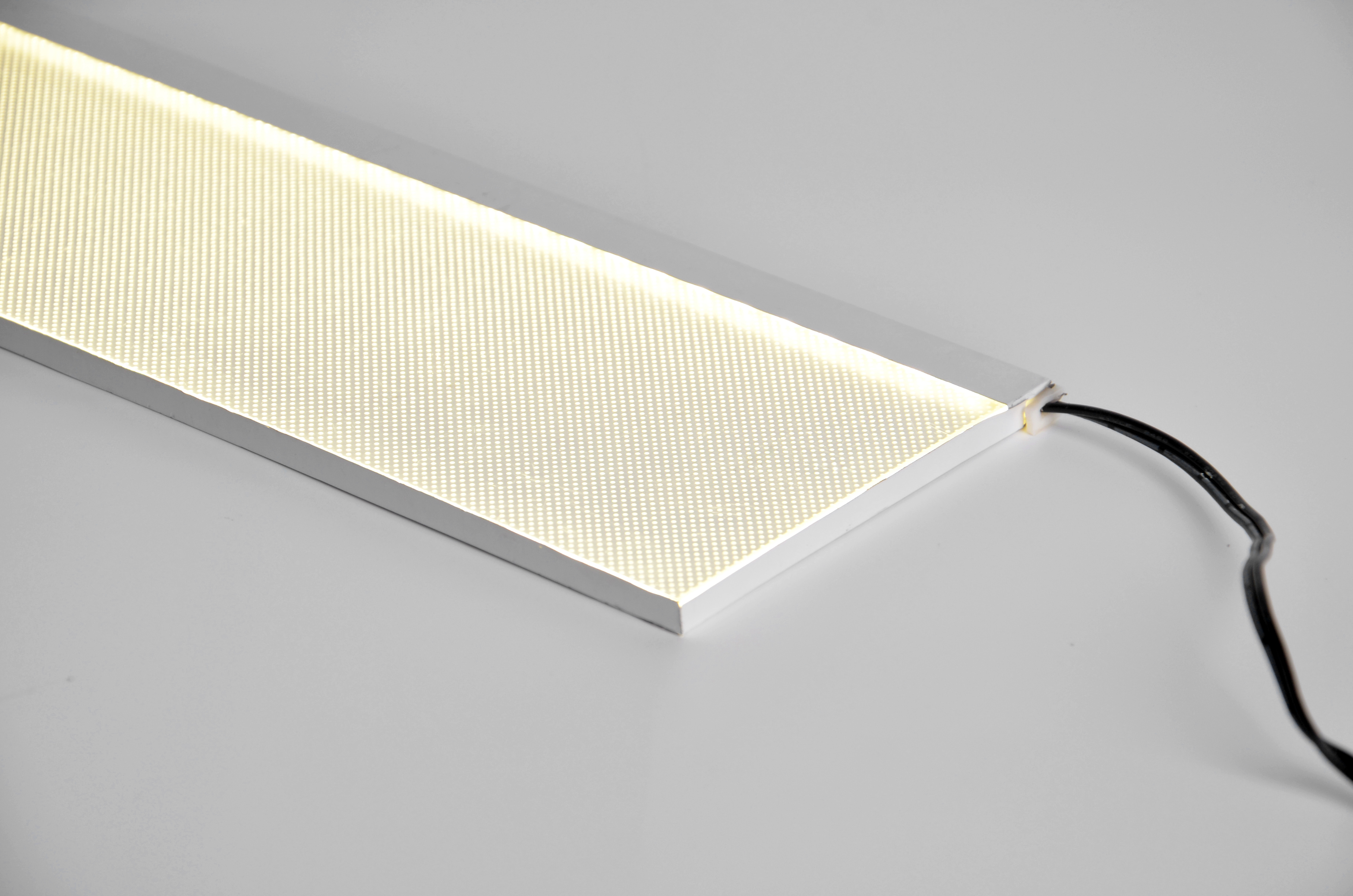
The second thing buyers should understand is that the panel is not the finished product. A complete edge-lit assembly pairs the panel with an LED strip light, a constant-current power driver, a light box frame, diffuser film, reflective film and mounting brackets. Quotations should be checked against that list, because a panel-only price and an integrated-assembly price are not comparable line items even when they describe the same panel.
Where edge-lit construction differs from direct-lit construction
Direct-lit or backlit assemblies place the light source behind the diffusing surface rather than at its edge. That approach is simpler to build but requires more depth, and the light source can remain visible as structure if diffusion is not handled carefully. Edge-lit construction, including the ultra-thin format used in slim light boxes, concentrates the light source at the perimeter and uses the acrylic panel itself as the distribution medium. The trade-off is depth against optical design effort: edge-lit panels achieve thinner profiles but depend on a correctly engineered dot pattern to reach even illumination.
Application Mapping: Retail, Hospitality, Office, Signage and Exhibition
The LGP platform is specified for Retail & Luxury Display, Hospitality & Commercial Interiors, Exhibition & Museum, Elevator Decoration, Advertising Light Boxes & Signage, Office & High-end Residential, Transportation & Public Spaces and Consumer Electronics Backlighting. Those are not eight versions of the same requirement. They are eight different weighting decisions across the three axes described above.
Retail and luxury display
Showcase and shelf backlighting is the application where uniformity matters most, because the illuminated surface sits directly behind merchandise and any unevenness becomes visible as a gradient on the product edge. Retail projects typically favour the warm half of the colour temperature range, and because these displays are often run continuously, the typical power figure of 101 W is the more relevant number for day-to-day energy calculations.
Hospitality and commercial interiors
Ceiling light panels in lobbies, corridors and lounges require a large, glare-free luminous surface rather than a bright point source. Here the -20°C to 50°C operating range and the acrylic substrate are the primary selection criteria, with colour temperature set to match the interior finishes.
Advertising light boxes and signage
Signage is the application where the ultra-thin property of edge-lit construction is most commercially valuable. Slim light boxes allow graphics to be mounted flush against walls and ceilings where a conventional box would be too deep. This segment is also the one most likely to push towards IP55 or above, since some signage installations sit in semi-outdoor conditions.
Exhibition, museum, office and public space
Exhibition and museum backlighting prioritises colour consistency across large graphic panels, since adjacent panels with slightly different colour temperature are immediately noticeable on a wall. Office and high-end residential installations favour neutral colour temperatures and even illumination. Elevator decoration, transportation and public space projects add a durability dimension, because the installed panel is expected to remain in place for years without visible degradation.
Consumer electronics backlighting
Consumer electronics remains the largest single application segment of the light guide plate market, holding a 42.5% share in 2025 (Dataintelo). That share explains why so much of the material and process development in this category happens around display backlighting, and why display-grade supply capacity influences availability in the commercial and architectural segments as well.
Light Guide Panels Compared with Traditional Illuminated Signage
| Approach | How light reaches the surface | Where it fits | Where it struggles |
|---|---|---|---|
| Edge-lit light guide panel | LED strip at the panel edge, dot pattern extracts light across the face | Slim profiles, large uniform surfaces, retail, signage and interior panels | Uniformity depends on correct dot pattern design, and the panel needs a frame carrying the strip, driver and optical films |
| Direct-lit or backlit assembly | LED array positioned behind a diffusing surface | Straightforward construction where depth is available | Greater overall depth, and visible light-source structure if diffusion is inadequate |
| Printed acrylic signage | No internal illumination, relies on ambient or external light | Low-cost flat graphics in well-lit locations | Not luminous, and unreadable in low ambient light |
Edge-lit construction is not universally the better answer, and buyers should understand its boundaries before standardising on it. Three limitations are worth stating plainly.
- Environmental limits are real. The qualified operating range of -20°C to 50°C does not extend to extreme cold storage or to enclosures that accumulate heat. Projects outside that band need a different thermal strategy, not a different quotation.
- IP rating is an assembly property. The IP20-65 span is achieved through the enclosure, not through the panel alone. A panel supplied for an IP65 project can still underperform if the frame and sealing are not engineered to match.
- The system carries integration work. Panel, LED strip, constant-current driver, frame, diffuser film, reflective film and mounting brackets have to work as one stack. A buyer who only prices the panel has priced part of the project.
There is also a schedule boundary worth understanding. Fast lead times are most meaningful for sizes and patterns that have already been validated. A first-time optical design for an unusual format involves a design and validation step, and buyers should confirm explicitly whether a quoted lead time covers that step or assumes an approved pattern.
Market Trend Analysis
Four verified signals shape how light guide panel sourcing is likely to develop over the next several years.
Steady market growth. The global Light Guide Plate market moves from USD 3.91 billion in 2025 to a projected USD 6.51 billion by 2034 at a 5.8% CAGR (Dataintelo). Growth of this order is not a surge, and it suggests capacity will remain available to buyers rather than becoming constrained.
Thinner substrates. PMMA, the primary material for light guide panels, is itself a USD 5.4 billion market in 2024 growing at 5.6% CAGR (USD Analytics). Within that material market, thin PMMA substrates below 2 mm accounted for over 60% of display-grade shipments for major manufacturers in 2024 (Fact.MR). Edge-lit panels have been produced at thicknesses as low as 2.0 mm via injection moulding and around 3.0 mm via laser dotting (Lightpanel). The direction of travel is towards thinner panels and tighter optical control.
Energy regulation as a design input. The 2024 International Energy Conservation Code reduces lighting power allowances in the United States (International Code Council). Because a luminaire-level power budget is now a compliance matter rather than a preference, the difference between a light guide panel's typical consumption and its maximum consumption becomes a documented design consideration rather than an engineering footnote.
A concentrated but not closed supply base. Mitsubishi Chemical Corporation is identified as a leading player in the light guide plate competitive landscape (Dataintelo), while Asia Pacific holds a 48.2% revenue share of the market. For buyers, the practical implication is a supply base with a small number of large material players and a larger number of panel fabricators, which raises the value of comparing fabrication, testing and support capabilities rather than material origin alone.
Future Outlook
Three shifts are likely to define the next procurement cycle for light guide panels. The first is the continued thinning of the optical substrate, which will keep pushing panel design towards laser-dotted and precision-moulded extraction patterns rather than simple printed ones. The second is the tightening link between energy code compliance and product specification, which favours suppliers who can present both typical and maximum power figures clearly and consistently across a product range. The third is integration: as buyers look for fewer vendors and shorter assembly chains, the ability to supply a panel together with its driver, frame and optical films becomes part of the product comparison rather than a separate commercial conversation.
For buyers, the practical response is to keep the comparison framework stable across projects. Fix the three axes, electrical and optical, environmental, and supply-side, and re-run the weighting for each application rather than each order. That approach makes it possible to compare a retail shelf backlight and an outdoor signage face with the same discipline, and it makes supplier claims falsifiable at the point where they matter.
FAQ
What does an IP20-65 protection grade mean for a light guide panel?
IP20 describes protection against solid objects in a dry, dust-controlled interior cavity. IP65 conventionally denotes a dust-tight enclosure that is also protected against water jets. The LGP model is specified across an IP20-65 range, but the rating is achieved by the assembled luminaire or light box rather than by the acrylic panel on its own. Frame construction, gaskets, sealant practice and cable entry determine which end of that range a finished unit actually reaches.
How should a buyer choose between 2700K and 6500K?
The model LGP covers a 2700K–6500K colour temperature range. Warm settings at the low end are typically specified for hospitality interiors, luxury retail and residential environments where the lighting should complement the surrounding finishes. Neutral settings are common in offices and exhibition graphics, where colour accuracy and reading comfort dominate. The cooler end of the range is normally used for advertising light boxes and signage, where a crisp white face is wanted. Because the range spans several distinct application profiles, a mixed portfolio usually requires more than one configuration.
What is the difference between typical power consumption and maximum power?
The LGP is rated at 101 W typical power consumption, 144 W maximum power and 7.2 A maximum operating current. The typical figure describes steady-state running load and is used for energy and running-cost estimates. The maximum figures describe the design envelope and are used to size the constant-current driver, the conductors, the connectors and the thermal path. Planning electrical infrastructure around the typical figure alone leaves the design under-specified.
What certifications should be verified when sourcing light guide panels?
Light guide panel programmes intended for global market access typically reference standards such as UL 8750 for LED equipment and IEC 60598 for luminaires (UL Solutions). The EDGELIGHT LGP programme is associated with UL 2108 and CE EN IEC 55015 certification. The relevant verification question is which exact configuration each certificate names, including the driver pairing and enclosure, because a certificate issued for a different build does not automatically apply to the panel being quoted.
Is a short lead time realistic for custom light guide panel sizes?
Lead time depends on whether a size and dot pattern have already been validated. The published supply-side profile for the EDGELIGHT LGP programme states a 5-10 day lead time, MOQ 1, OEM/ODM customization and a monthly capacity of 30,000 units. For repeat orders of an approved pattern and size, the sequence of sample validation followed by volume production is straightforward. For a first-time optical design in an unusual format, buyers should confirm explicitly whether the quoted lead time includes the design and validation step or assumes an already-approved pattern.
Is an edge-lit light guide panel always preferable to a direct-lit or backlit assembly?
No. Edge-lit construction allows much thinner profiles because the light source sits at the panel perimeter, which is why it is used in ultra-thin advertising light boxes and slim shelf backlighting. Direct-lit or backlit assemblies are simpler to build but require more depth behind the diffusing surface, and the light source can remain visible as structure if diffusion is inadequate. The choice depends on the depth available in the fixture, the uniformity requirement, and whether the project can support the optical design work that edge-lit construction requires.
Further Reference
Buyers who want the full product range alongside the light guide panel platform, including edgelux panels, SEG light boxes, LED strips and power supplies for advertising light boxes, and LED display products, can review the manufacturer's product catalogue here: EDGELIGHT LED product catalogue (PDF).
Product and company facts in this article refer to the light guide panel, model LGP, manufactured by Shanghai Edgelight Industry Co., Ltd. (EDGELIGHT), founded in 2004, with a 33,000 square meter manufacturing facility, approximately 500 staff, a 25-engineer R&D team and an annual production capacity of 120,000 units. Contact: No.218 Shenshen Road, Songjiang District, Shanghai; info@edgelight.com.
Market data cited: Dataintelo (Light Guide Plate market, 2025), USD Analytics (PMMA market, 2024), Fact.MR (thin PMMA substrate shipments, 2024), Lightpanel (edge-lit panel thickness, 2024), UL Solutions (lighting safety standards), International Code Council (IECC 2024).