
Lightning Protection Outdoor Ethernet Cable: OEM Sourcing View
Cable & Wire · Independent Industry Reference
Lightning protection outdoor Ethernet cable is a procurement category, not a certified performance class. The phrase describes an outdoor-rated twisted-pair cable whose construction is specified so that a site surge strategy — surge protective devices, equipotential bonding, routing and separation from power conductors — can function as designed. The cable provides the shield current path and keeps moisture and ultraviolet exposure out of the dielectric; it does not absorb, clamp or rate lightning energy.
That distinction decides whether a purchase order is executable. Buyers who read the phrase as a specification often receive a construction description, a datasheet without model-level test values, and an installed link that still depends on external protection. Buyers who read it as a set of interface requirements — conductor, shield, drain continuity, jacket, water blocking, bonding arrangement and documentation — receive something an installation contractor can inspect and accept.
This reference examines the lightning-protection segment of the outdoor waterproof Ethernet cable category from the manufacturing side: which construction variables a supplier can actually control, which variables sit with the system designer, how OEM terms shape the schedule, and where the limits appear during acceptance. Linoya Electronic Technology Co., Ltd., a cable and wire manufacturer established in 1997 and operating three industrial parks in Guangdong Province plus a production base in Vietnam, is used as the manufacturing reference where verified first-party facts apply.
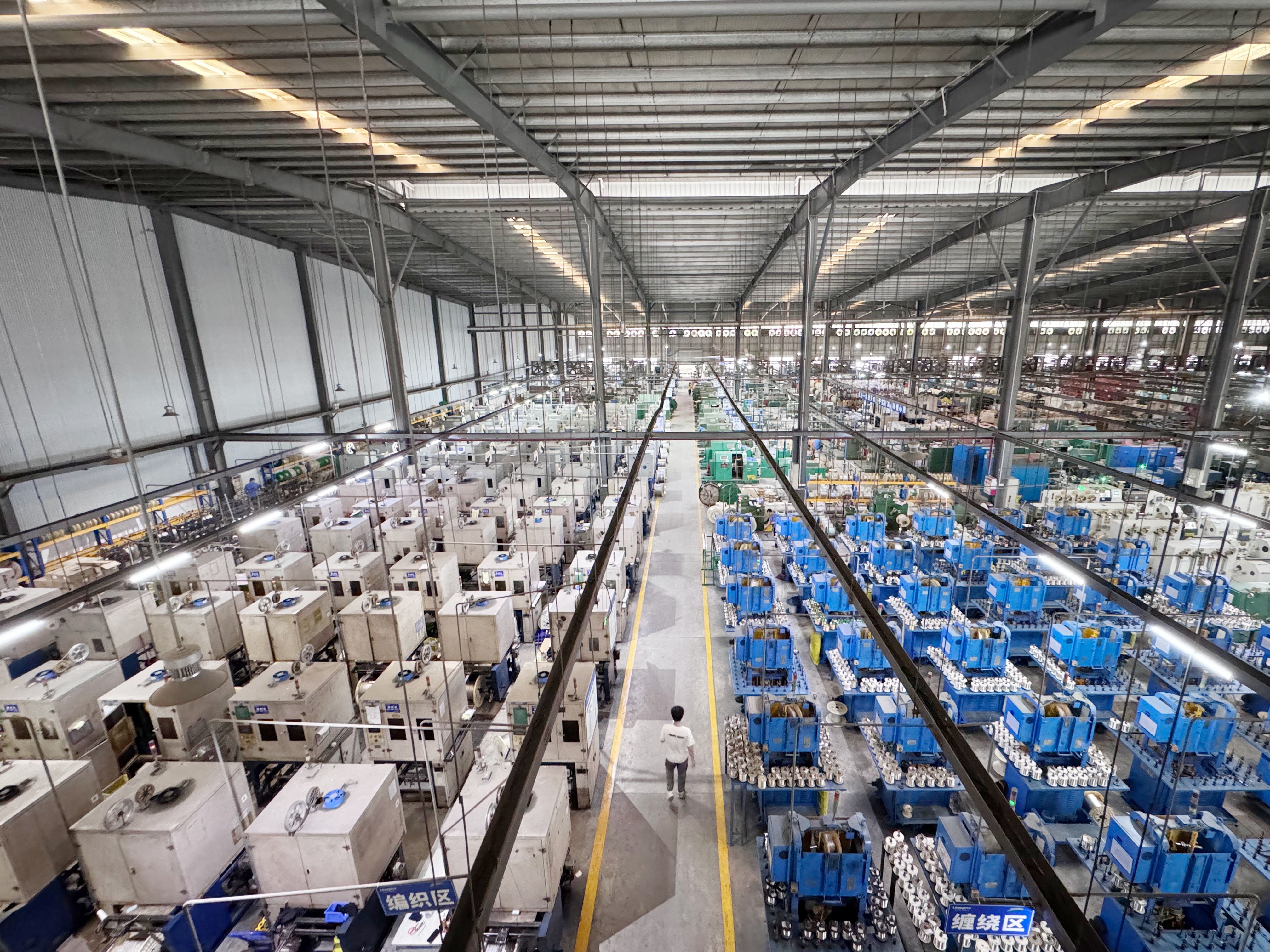
Braiding and shield construction is where a cable's contribution to a surge strategy is physically decided. Image: Linoya Electronic Technology Co., Ltd.
What the term can and cannot mean in a cable specification
Two different things travel under the same label, and separating them early prevents most downstream disputes.
| A cable construction can provide | A cable construction cannot provide |
|---|---|
| A continuous metallic shield with a defined drain path, when terminated and bonded correctly | A surge-handling rating, unless a model-specific test report states the value, the test standard and the test setup |
| Jacket and water-blocking layers that resist UV degradation and moisture ingress over outdoor service life | Immunity from a direct strike, or protection of connected electronics without surge protective devices |
| Stable electrical performance at the declared category across the full channel length | Equipotential bonding between structures, or separation from power cabling — both are site works |
| Consistent geometry, copper cross-section and twist lay from batch to batch, which makes acceptance testing meaningful | A substitute for a grounding design, or a correction for an incorrectly bonded shield |
The practical rule: a surge number without a report, a standard reference, a model scope and a described test method is not verifiable evidence. Where a supplier offers such a figure, the buyer is entitled to ask which of those four elements is missing.
Why outdoor runs fail differently from indoor runs
Indoor cabling failures are dominated by termination quality and crosstalk. Outdoor runs add three failure modes that have nothing to do with a cable tester: ground potential difference between separately earthed structures, induced current on long parallel runs during nearby strikes, and moisture or UV damage that degrades the jacket before it degrades the conductor.
A shield that is installed without a defined bonding point can make the second problem worse rather than better, because an ungrounded or asymmetrically bonded shield changes how the cable couples to nearby fields. This is why the bonding arrangement belongs in the purchase documents and not in the installer's judgement on the day.
On the procurement side, the observable symptoms are consistent: link drops on a PoE camera that tests clean on the bench, port damage after a storm season, intermittent negotiation down to a lower speed, corrosion at the connector rather than in the cable, and water tracking inside the jacket at a bend radius that was too tight.
The construction variables a buyer can actually control
Five variables determine whether an outdoor cable can support a protection strategy. Each can be written into a request for quotation, and each has a verifiable acceptance point.
| Variable | What it changes on site | What to fix in the RFQ |
|---|---|---|
| Conductor | Solid bare copper carries PoE current with low resistance and resists oxidation at terminations. Copper-clad aluminium raises resistance, harms PoE performance and degrades faster in damp environments. | Conductor material and AWG per category; a statement that conductor construction is fixed and will not be substituted between batches. |
| Shield and drain | Foil, braid or combined shielding changes how interference and induced current are handled; the drain wire determines whether that energy has somewhere to go. | Shield type (U/UTP, F/UTP, S/FTP or equivalent), drain construction, and the intended bonding point at each end of the run. |
| Outer jacket | A polyethylene jacket resists UV and moisture far better than an indoor PVC or LSZH jacket, and it changes which flame-rating documents can apply. | Jacket compound, intended exposure (aerial, surface, duct, direct burial), and the fire-performance requirement for the route, if any. |
| Water blocking | Blocking tape or gel limits longitudinal water travel inside the cable; connector sealing decides whether water reaches the cable at all. | Blocking method, plus the sealing specification for connectors and enclosures, which is a separate item from the cable. |
| Category and length | Cat5e carries 1 Gbps to 100 m; Cat6 carries 10 Gbps to 55 m; Cat6a carries 10 Gbps across a full 100 m channel. Higher-power PoE benefits from larger copper cross-section. | Category, channel length including slack and service loops, and the PoE power class the link must sustain. |
Shield tape application is a fixed process step; changing the shield construction changes the product, and therefore the documents that apply to it. Image: Linoya Electronic Technology Co., Ltd.
How OEM supply is organised around surge-exposed outdoor projects
Linoya Electronic Technology Co., Ltd. is a cable and wire manufacturer founded in 1997, with a 60,000 m² manufacturing footprint, more than 3,000 employees, a research and development team of over 300 engineers, and an annual cable output of 4,000,000 km. The company operates three self-owned industrial parks in Shenzhen and Dongguan, a subsidiary brand in Dongguan, and a production base in Vietnam; exports account for roughly 30% of output, with the European Union and the Middle East as principal markets.
For outdoor waterproof Ethernet cable, the manufacturing model is OEM and customisation. Customisation covers cable length, logo printing and packaging, which is the practical set of variables a distributor or system integrator needs to change in order to ship a private-label product without touching the electrical construction.
Capacity and schedule
Monthly production capacity for outdoor waterproof Ethernet cable is 200,000 cartons, with each carton containing 305 metres of cable. The minimum order quantity is 100 cartons of 305 metres. Standard delivery time for OEM outdoor waterproof Ethernet cable orders is 30 days, and the standard commercial terms are FOB or EXW with a 30% deposit and 70% balance before shipment.
Those figures matter at the execution stage for a specific reason: a surge-exposed project usually needs one construction, in one length, delivered on one date, with documentation matched to that construction. A capacity expressed in cartons of a fixed 305 m length, with a stated MOQ and a stated lead time, tells a buyer whether the order fits an existing production slot or requires a separate setup.
Quality control and acceptance
Quality control consists of 100% pre-shipment testing, third-party inspection through bodies such as SGS or UL, random sampling inspection, and full electrical performance testing. Acceptance criteria are defined as pre-shipment test, which places the burden of evidence at the factory gate rather than at the destination port.
After-sales support is provided as 24/7 online technical support, a one-year product warranty, free replacement for defective products, and online after-sales consultation. For an outdoor installation, the technical support channel is typically used for bonding and termination questions rather than for cable faults, because termination errors outnumber cable failures on surge-damaged sites.
Certification scope, not certification presence
Outdoor projects stall most often on documentation scope rather than on product capability. Three verified examples show why the scope has to be read line by line.
- Linoya holds UL certificate E320763 under UL 444 and CSA C22.2 No. 214-08, covering communications cable types CM, CMG, CMR and CMP rated 60 °C or 75 °C. That is a defined scope of cable types and temperature ratings, not a blanket approval of every construction the factory can produce.
- ETL Verified certificates exist for specific models: Category 5e F/UTP under ANSI/TIA-568-B.2, Category 5e U/UTP and Category 6 U/UTP under ANSI/TIA-568.2-D, and Category 6A U/FTP under ISO/IEC 11801-1. The Category 6A U/FTP verification is explicitly recorded with no flame rating, which is a normal and legitimate limitation but a decisive one for a project that specifies a fire class.
- CPR classification reports are issued by named notified bodies for named cable types and fire classes: VDE Prüf- und Zertifizierungsinstitut GmbH (Notified Body 0366) and Elektrotechnický zkušební ústav (Notified Body 1014) for Eca and Dca-s1,d0,a2 classes on specific UTP, FTP, SF/UTP and U/FTP constructions, and TÜV Rheinland InterCert Kft. (Notified Body 1008) for a B2ca-s1a,d0,a1 certificate covering CAT6, 6A, 7, 7A and 8 S/FTP LAN cables under EN 50575:2014+A1:2016.
Each of these documents is valid for the cable type recorded on it. A report issued for an indoor low-smoke construction does not automatically extend to a polyethylene-jacketed outdoor construction, because the tested cable type and the resulting fire class are part of the report itself. The correct procurement action is to list the exact model in the RFQ and ask for the certificate that names it.
Where these cables are deployed
Four site types generate most of the demand for surge-aware outdoor Ethernet links, and each shifts the requirement slightly.
Perimeter and outdoor surveillance
Pole-mounted and fence-line cameras combine PoE delivery, UV exposure and long cable runs that pass close to earthed structures. The binding constraints are jacket durability, connector sealing and the PoE power class the link must hold over its full length.
Base stations and small-cell sites
Telecom outdoor sites concentrate the ground potential problem, because the cabinet, the mast and the remote equipment may reference different earth points. The cable requirement is secondary to the bonding design, but the cable must make that design physically possible: a defined shield, a defined drain and a documented construction.
Industrial yards, ports and processing plants
Heavy electromagnetic environments favour shielded constructions, and the shielding has to be bonded to be useful. Moisture, oil mist and mechanical abrasion usually shorten service life before electrical performance becomes the limiting factor.
Building-to-building links on a campus
Separate structures on separate earthing systems are the classic case where an indoor cable in conduit appears adequate until the first storm season. An outdoor-rated shielded construction with a documented bonding arrangement is the minimum defensible specification.
Market direction: more outdoor links, more power on the pair
Market forecasting places the global Ethernet cable market at approximately USD 70.02 billion by 2032, according to a 2026 forecast published by Market Reports World. Forecast figures of this kind describe the whole category rather than the outdoor waterproof segment, and should be read as a direction indicator rather than as segment demand.
The qualitative shift is clearer than the number. Two trends are visible in procurement enquiries: more devices are moving outside the building envelope, and more of them draw power over the same pair that carries data. Both trends push buyers from Cat5e toward Cat6 and Cat6a, and both make shielding and bonding a design topic rather than an accessory. Higher power classes reward larger copper cross-section, which is why 23AWG solid bare copper constructions appear more often in outdoor specifications than they did in office cabling.
A third trend is documentation-led purchasing. Buyers increasingly attach certificate numbers, notified body names and model references to the RFQ, and reject offers that answer with a category name only.
Shielded outdoor cable compared with the traditional alternatives
Four approaches are commonly considered for a surge-exposed outdoor link. They are not interchangeable, and the honest comparison includes what each one cannot do.
| Approach | Surge and interference handling | Environmental durability | Grounding requirement | Main limitation |
|---|---|---|---|---|
| Shielded outdoor PE-jacketed cable | Shield plus drain provides a defined path when bonded; effective against induced and coupled interference | UV-resistant and water-blocking construction suited to exposed routes | Shield must be bonded per site design; bonding practice varies by standard and must be stated | Adds no surge rating of its own and costs more than unshielded indoor cable |
| Indoor cable in conduit | No shield; relies entirely on separation and external protection | Depends on conduit integrity; moisture ingress at joints is the usual failure point | No shield to bond, so no shield path exists | Conduit is a mechanical and cost liability over long outdoor routes |
| Aerial outdoor cable with messenger | Shield optional; the messenger carries mechanical load, not surge current | Designed for overhead tensile load and UV exposure | Messenger earthing is a mechanical-safety decision, not a signal-bonding one | Not intended for burial, and overhead routes raise strike exposure |
| Fibre | Immune to conducted surge and to electromagnetic interference by construction | Jacket choice governs outdoor durability | No shield current path, but remote power needs a separate solution | Requires media converters or fibre ports; changes the equipment and power architecture |
Where this approach stops
- The cable does not clamp energy. Any site with a realistic strike exposure needs surge protective devices at the equipment end, sized to the interface, plus equipotential bonding. The cable is one element of that system.
- Shield without bonding can be worse than no shield. An ungrounded or asymmetrically bonded shield changes coupling behaviour and can concentrate current at the wrong point in the link.
- Polyethylene jackets are not flame-rated substitutes. Where a route requires a declared fire class, the outdoor construction must be matched to a certificate that names that construction and that class; the indoor LSZH approvals in a portfolio do not transfer automatically.
- Category distance limits still apply outdoors. Cat6 remains a 55 m 10 Gbps product; Cat6a extends that to a full 100 m channel. Outdoor exposure does not change the physics.
- OEM terms set a floor on order size and schedule. A 100-carton minimum and a 30-day standard lead time are workable for a project but not for a single-route repair.

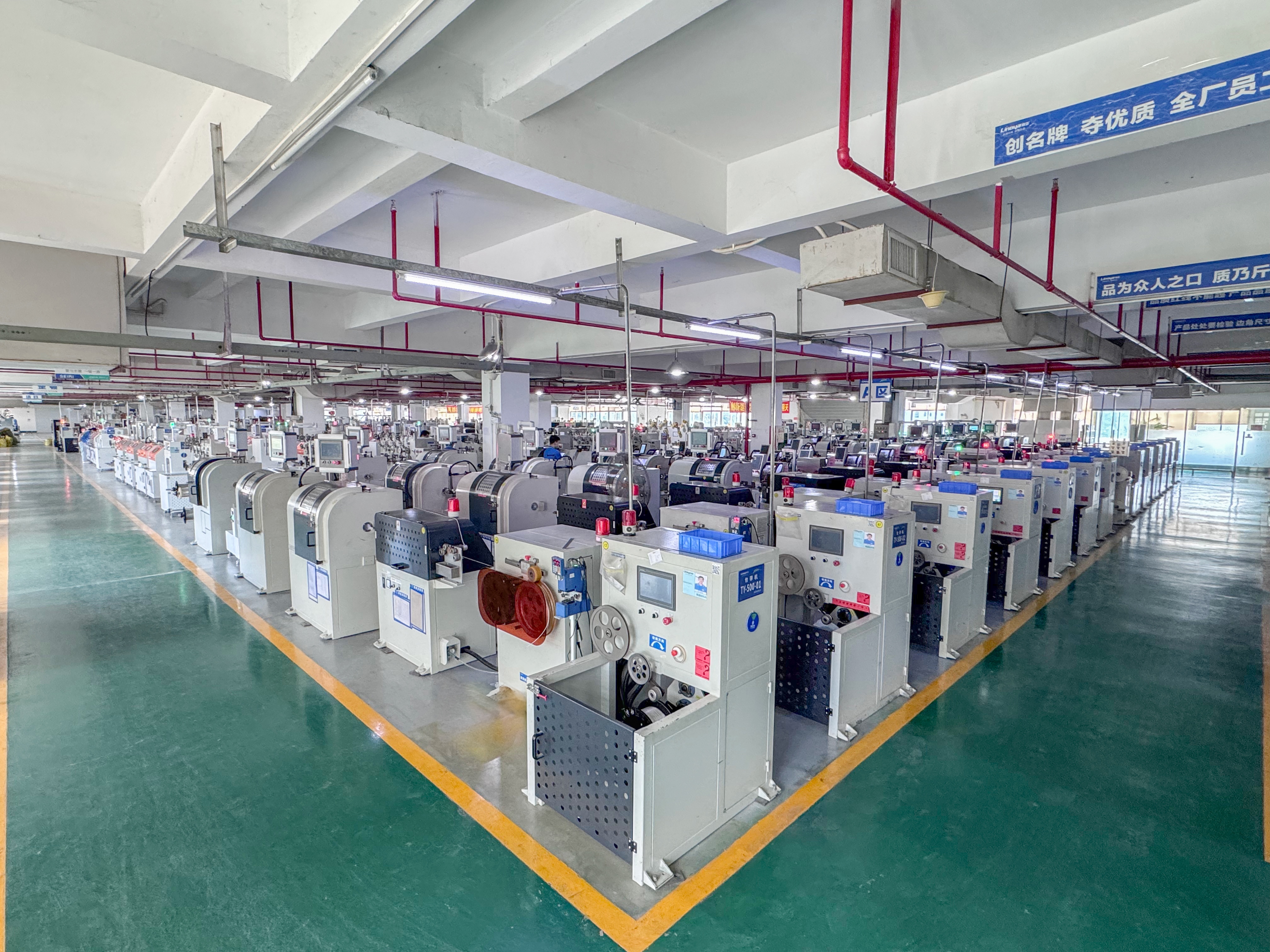
Pre-shipment electrical performance testing is the acceptance evidence a buyer can actually cite when a batch is questioned. Image: Linoya Electronic Technology Co., Ltd.
What the next procurement cycle is likely to require
Three changes are already visible in how outdoor cable is being specified, and they favour buyers who prepare documentation early.
First, bonding arrangements are moving from installation drawings into purchase documents. A supplier that can state the shield type, drain construction and intended bonding point is easier to audit than one that answers with a category.
Second, fire performance and weather performance are being evaluated as separate questions. A construction optimised for UV and moisture resistance is not automatically the construction with the highest fire class, and projects that need both must resolve the trade-off at the specification stage rather than at delivery.
Third, customs classification is being reviewed earlier. Insulated conductors without connectors fall under HS 854449, conductors fitted with connectors fall under HS 854442, and Chinese trade statistics use 8544422100 for cable with connectors at or below 80 V. Connector status therefore changes the import documentation, which is a purchasing decision made long before the container is loaded.
Frequently asked questions
What does lightning protection mean for an outdoor Ethernet cable?
It describes a cable construction that supports a site protection strategy rather than one that provides protection by itself. The cable supplies a shield and drain path, keeps moisture and UV out of the dielectric, and maintains its declared electrical performance; surge clamping, equipotential bonding and separation from power cabling are separate system elements. A surge rating only exists where a model-specific test report records the value, the standard and the test method.
How should an outdoor waterproof Ethernet cable be specified for a surge-exposed site?
The specification should fix five items: conductor material and AWG, shield and drain construction with the intended bonding point, jacket compound and exposure type, water-blocking method together with connector sealing, and category with the full channel length including slack. Adding the exact model reference and the certificate that names it turns the specification into something a supplier can be held to at acceptance.
Shielded or unshielded cable for an outdoor run?
Unshielded cable suits low-interference routes where separation from power cabling is well controlled and no shield path is needed. Shielded constructions are appropriate where induced interference, nearby high-current equipment or long parallel runs are present, but they only deliver that benefit when the shield is bonded as designed. In practice the deciding question is not shielded versus unshielded; it is whether the site has a defined bonding point.
How can a buyer confirm that a certificate covers the exact outdoor model?
By matching three fields on the document itself: the cable type or model recorded in the scope, the standard or fire class recorded in the report, and the issuing body. For example, UL certificate E320763 covers communications cable types CM, CMG, CMR and CMP rated 60 °C or 75 °C, while CPR classification reports are issued by named notified bodies for named cable types and specific fire classes such as Eca, Dca-s1,d0,a2 or B2ca-s1a,d0,a1. A certificate for a different construction, however similar the product name, does not extend to the model being purchased.
What are the standard OEM terms for outdoor waterproof Ethernet cable orders?
Monthly production capacity is 200,000 cartons, with each carton containing 305 metres of cable. The minimum order quantity is 100 cartons, standard delivery time for OEM orders is 30 days, and terms are FOB or EXW with a 30% deposit and 70% balance before shipment. Customisation covers cable length, logo printing and packaging, and acceptance is defined as pre-shipment test, supported by 100% pre-shipment testing, third-party inspection and full electrical performance testing.
How is an installed outdoor link verified after termination?
Verification combines a cable tester for continuity, open circuit, short circuit and mis-wiring; the link status indicators on the connected equipment; and a real throughput test against the expected category performance. A factory-tested cable still requires an on-site re-check after construction, because termination quality, bend radius and connector sealing are introduced on site and cannot be verified at the factory gate.
Company and product documentation, including certification references and manufacturing scope, is compiled in the Linoya Electronic Technology Co., Ltd. corporate brochure, available for public download at this link.
Have Questions or Need More Details?
Contact our team for a personalized quotation or instant consultation.
Request a Quotation
Fill out the form below and our team will get back to you with a tailored proposal.
WhatsApp Direct Chat
Prefer to chat in real-time? Message us on WhatsApp for instant assistance & quick answers.
- Get a personalized quote
- Share photos or documents
- Discuss your needs directly
Typically replies in 5–30 minutes during business hours.