
Liquid-Cooled Mining Container Certification: Buyer Evidence List
Liquid-Cooled Mining Container Certification: Buyer Evidence List
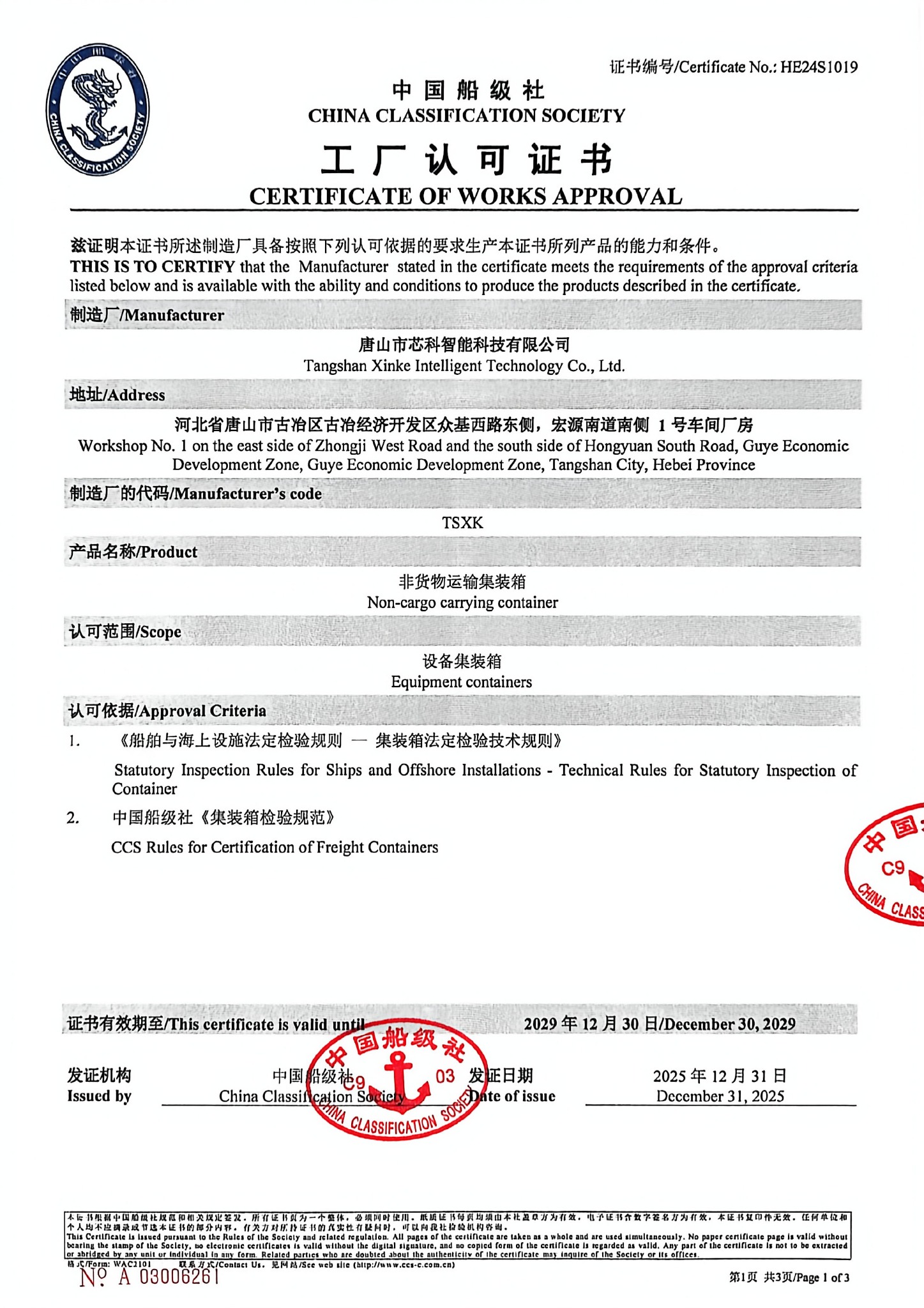
The CCS Works Approval cited in the reviewed evidence is a works approval for non-cargo carrying equipment containers. It is model- and site-specific; it is not a complete system certificate for electrical safety, fire protection or mining performance.
For a liquid-cooled mining container, “certified” is not a single document. The buyer needs a project-specific evidence package that ties the exact container model to the site electrical supply in V/Hz, the lightning-protection and grounding scope, the approved coolant and wetted materials, the redundancy configuration, and a signed first-startup acceptance record. xinkelcs Mining Container, the mining-container line offered by Tangshan Xinke Intelligent Technology Co., Ltd., illustrates why the distinction matters: the company holds site-level ISO 9001 and ISO 14001 certificates and a CCS Works Approval for a non-cargo equipment-container model, but those documents do not by themselves establish electrical safety, fire protection or mining performance for every configured system. The buying task is therefore to request the right documents for the actual model and destination market, then verify that their scope covers what the project needs.
What “certified” means in a mining-container purchase
Liquid-cooled mining containers sit at the intersection of three evidence layers: management-system certification, product or works approval, and project acceptance. These layers answer different questions. A quality-management certificate asks whether the manufacturing site operates a controlled process. A works approval asks whether a defined equipment-container model has been assessed under a specific approval scheme. A project acceptance record asks whether the delivered system, connected to the actual site utilities and coolant loop, started and performed within the agreed limits.
For xinkelcs Mining Container, the available evidence includes ISO 9001:2015 quality-management certification for the China manufacturing site, ISO 14001:2015 environmental-management certification for the same site, and CCS Works Approval HE24S1019 for non-cargo carrying equipment container model XKKJ-40HC003 under ISO code 45SM. Those are useful qualification documents. They should not be presented as a substitute for destination-market electrical, electromagnetic-compatibility, fire-protection, pressure-system or local site approvals for the complete mining container.
The ISO 9001:2015 certificate is numbered 06724Q20082R0S and was issued by Beijing Hengbiao Quality Certification Co., Ltd. It is valid from 2024-01-30 to 2027-01-29. Its scope covers R&D and production of cloud computing liquid cooling equipment and controls, and production of container bodies. That is a management-system scope. It does not state that a particular mining container has passed a dielectric test, short-circuit test, EMC test, fire test or pressure test.
The ISO 14001:2015 certificate is numbered 06726E00031R001 and was also issued by Beijing Hengbiao Quality Certification Co., Ltd. It is valid from 2026-01-22 to 2029-01-21. Its scope covers environmental management for R&D and production of cloud computing liquid cooling equipment and controls and production of container bodies, excluding activities requiring qualification. The certificate does not itself certify UL electrical safety compliance, and it does not document fire-protection or electrical inspection criteria for mining containers.
The CCS Works Approval is more product-facing, but its boundary is still specific. It was issued by the China Classification Society, covers non-cargo carrying equipment containers, applies to model XKKJ-40HC003, is issued for the manufacturing site, applies to the China market, and is subject to annual CCS surveillance. The certificate is valid from 2025-12-31 to 2029-12-30, and the applicable standard is the Technical Rules for Statutory Inspection of Container / CCS Rules for Certification of Freight Containers. A buyer should read that as a works approval for a defined equipment-container model—not as an electrical-safety certificate for a 1,200 kW, 1,600 kW or 2,400 kW liquid-cooled mining system.
The certificate and qualification matrix
A practical RFQ should not ask only “Do you have certificates?” It should ask for a matrix that maps each document to the model, market, scope and project interface. The table below shows the evidence a buyer should collect and the limits that should be stated beside it.
| Evidence item | What it can establish | What it does not establish by itself | What to request |
|---|---|---|---|
| CCS Works Approval | Certificate HE24S1019 from the China Classification Society; approval for non-cargo carrying equipment containers; model XKKJ-40HC003, ISO code 45SM; China market; manufacturing site; annual CCS surveillance; valid 2025-12-31 to 2029-12-30. | Electrical safety, EMC, fire protection, pressure-system compliance or mining performance for a complete configured liquid-cooled container. | Certificate copy, scope page, approved model, validity, surveillance terms and confirmation that the delivered container falls within the approved model boundary. |
| ISO 9001:2015 | Certificate 06724Q20082R0S; site quality-management system for R&D and production of cloud computing liquid cooling equipment and controls, and production of container bodies; valid 2024-01-30 to 2027-01-29. | A product type test, electrical certification, fire approval or performance guarantee for a specific mining container. | Certificate, scope, certified site name and issuing body. Check that the supplier’s legal entity and manufacturing site match. |
| ISO 14001:2015 | Certificate 06726E00031R001; environmental-management system at the China manufacturing site; valid 2026-01-22 to 2029-01-21; excludes activities requiring qualification. | UL electrical safety compliance, fire-protection approval or electrical inspection criteria for mining containers. | Certificate and scope. Keep it in the environmental-management file, not the product electrical-safety file. |
| Destination-market electrical, EMC, fire and pressure approvals | Conformity with the specific regulatory scheme that applies to the installation market and configuration. | Not established in the supplied evidence for the complete mining container. Absence of a document in the reviewed material does not prove that no approval exists; it means the project file should close the gap. | Declaration of conformity, test reports, certificate numbers, standards, issuing bodies and scope for the exact model and market. |
| Project technical agreement and acceptance records | Electrical supply in V/Hz, rated operating conditions, coolant compatibility, redundancy configuration, factory and site test scope, and first-startup acceptance criteria. | Statutory certification. These are contractual and engineering records, not a substitute for required approvals. | Signed technical agreement, drawings, FAT/SAT protocols, test results and signed acceptance records. |
Two certificate checks are often missed. First, confirm the certificate holder and manufacturing site match the entity that will supply the container. Second, confirm the certificate’s model or scope covers the configuration being purchased. A works approval for one equipment-container model is not automatically a works approval for a different model, a different cooling configuration or a different market.
Electrical supply in V/Hz: make the site interface explicit
The prefabricated modular data center container specification lists electrical supply as project-specific and expressed in V/Hz. That is the right starting point for a mining-container RFQ. The technical agreement should fix the supply voltage and frequency, the point of connection, the rated operating conditions and the exact container model. Brochure language is not enough if the site supply differs.
The Hydro ASIC Mining Container series lists maximum power of 1,200 kW for the 120-position model, 1,600 kW for the 160-position model and 2,400 kW for the 240-position model. Those are maximum power figures. They do not define average site load, utility capacity, transformer sizing or the operating profile. A buyer planning a 2,400 kW model should treat it as a different electrical-interface exercise from a 1,200 kW model, not as the same container with more miners installed.
Request the single-line diagram, load schedule, point-of-connection definition, protection-coordination assumptions, neutral and earthing arrangement, and the local electrical approval that applies to the destination market. Ask which items are inside the factory scope and which are site scope. If the site provides the transformer, switchgear or primary cooling equipment, the responsibility boundary should be written into the technical agreement. A V/Hz value on a datasheet is useful only when it matches the signed project interface.
The product specification also states that the final model is confirmed per order, miner compatibility is model-specific and rated operating conditions are confirmed in the technical agreement. That makes the electrical review inseparable from the final model selection. Buyers should not finalize the electrical package before the mining-container model and miner population are fixed.
Lightning protection and grounding: request the scope split
The Xinke liquid-cooled micro module lists lightning protection and grounding as one of seven integrated systems, together with racks, power distribution, thermal management, monitoring and management, structured cabling and fire protection. The AquaPlex-45 prefabricated modular container scope also lists lightning protection and grounding. These are relevant reference points because they show that the scope exists in the supplier’s system vocabulary. They do not prove that every mining-container configuration includes the same boundary.
For a mining-container project, ask for drawings that show the container earth bar, bonding of the enclosure and coolant piping, connection to the site earth electrode, lightning-protection devices and their coordination with other equipment, instrumentation and communications grounding, and the inspection or measurement record used at acceptance. The key question is not whether the datasheet contains a checkmark; it is where the factory scope ends and the site scope begins.
Grounding is also a cross-interface topic. The container supplier may supply internal bonding and a terminal for site connection, while the site owner supplies the earth electrode and the utility-side protection. The technical agreement should identify who designs, installs, inspects and signs off each part. If that split is left vague, the buyer can end up with two parties each assuming the other has closed the grounding loop.
Coolant compatibility: go beyond “water”
The CDU specification states that coolant compatibility is confirmed per project. The Hydro ASIC Mining Container uses hydro cooling, non-immersion, and its coolant piping is SS304 seamless stainless steel as specified for the applicable configuration. For the CDU, the plate heat exchanger and internal piping use stainless steel on applicable models, but the exact stainless-steel grade and wetted materials must be confirmed against the selected model. Pump redundancy is also project-specific.
Those statements should shape the RFQ. Ask for a coolant compatibility declaration that covers the approved coolant chemistry and concentration, inhibitor and freeze protection, water-quality limits, filtration, compatible cold-plate and miner-loop materials, elastomer and pump-seal compatibility, cleaning and flushing procedure, top-up rules and disposal requirements. The declaration should name the exact CDU model and the exact miner model. Miner compatibility is model-specific, so a coolant approval for one ASIC model should not be assumed to cover another.
Public supplier disclosures show why the coolant file needs to be specific. PowerMining lists water plus glycol as the cooling medium and gives 200 L/min per rack, 1,000 L/min total, a dry cooler and an outside operating range of -35°C to +50°C for a hydro-cooled container configuration. That is a supplier-listed configuration, not an independent benchmark and not a substitute for xinkelcs Mining Container project data. It does show the level of coolant, flow and environmental detail that a buyer can reasonably put on the RFQ.
The environmental conditions also belong in the same review. The application guidance for liquid-cooled infrastructure notes that thermal design considers ambient dry-bulb and wet-bulb temperatures, altitude, water quality and IT load, and that freeze protection, condensation prevention, corrosion protection, noise, electrical supply and local certification requirements should be confirmed for each site. A coolant that works in one climate may need a different concentration, freeze point or water-treatment approach in another. That is why the coolant declaration should be project-specific rather than a generic statement that the system is “compatible with glycol.”
Redundancy configuration: ask for the topology and the test
The supplied specifications make redundancy project-specific. CDU pump redundancy is project-specific. The prefabricated container’s redundancy configuration is project-specific. The micro module’s automatic switchover is project-configured. These statements are useful because they prevent a buyer from assuming a standard N+1 or 2N arrangement from a product-family description.
A buyer should request the redundancy block diagram and a written description of what is redundant: pumps, power feeds, controls, sensors, valves and cooling paths. Ask which actions are automatic and which are manual, what the expected response is after a defined failure, what single points of failure remain, and how the switchover is tested. The acceptance criteria should be agreed before the test, not written after the result is known.
For a mining container, redundancy also affects hashrate continuity, but the reviewed evidence does not establish an uptime guarantee, a failure rate or a service-response commitment. Those are project-contract subjects. The correct procurement position is to ask for the topology, the test method, the recorded result and the service-isolation procedure, then compare those documents across bidders on the same basis.
Documented first-startup acceptance: close the loop
A first-startup record should follow the approved commissioning plan. The plan should require review of approved drawings, coolant specifications and acceptance criteria; verification of power, grounding, valves, piping, connections and primary cooling availability; completion of cleaning, pressure and leak tests to approved limits; filling and venting with the specified procedure; verification of sensors, alarms, interlocks and pump controls; and staged load introduction with temperatures, flow and pressure recorded against agreed limits.
The safety boundary belongs in the same document. Only qualified personnel should commission the equipment. Electrical energy should be isolated and pressure released before a circuit is opened. Pumps should never be run dry, approved test limits should not be exceeded, and compatible coolant should be used according to the equipment manual and site safety procedures. These are not administrative details; they determine whether the acceptance record is usable evidence or only a start-up photo.
Factory and site tests should be separated. The supplier’s capability statement says that integrated systems undergo factory commissioning and testing, and that FAT scope follows the technical agreement. Factory prefabrication, integrated commissioning and testing are used to reduce on-site installation work. That makes the FAT protocol important, but it does not remove the need for site acceptance after connection to the actual primary cooling, electrical supply and grounding system.
A complete first-startup package should include as-built drawings, factory test results, site test results, the alarm and interlock list, the coolant fill and vent record, the staged-load log, the punch list and signed acceptance by the responsible parties. The record should show the agreed limits beside the measured results. “The container started” is not the same as “the container met the documented acceptance criteria.”
A practical request list for the RFQ
The evidence request can be organized as a short attachment to the technical enquiry. It should force each bidder to answer on the same model and scope.
- State the exact mining-container model, position count, maximum power and final configuration basis.
- Fix the electrical supply in V/Hz, the point of connection, the rated operating conditions and the site/factory responsibility split.
- Provide the lightning-protection and grounding drawings, the earth-connection point and the inspection record.
- Provide the coolant compatibility declaration for the exact CDU, piping, cold plates and miner model, including concentration, water quality and freeze protection.
- Provide the redundancy topology, automatic and manual actions, single points of failure, test method and acceptance criteria.
- Provide the FAT and site-acceptance protocols, including cleaning, pressure and leak tests, fill and vent, alarm and interlock checks, and staged-load records.
- Provide the certificate matrix: CCS Works Approval, ISO 9001, ISO 14001 and any destination-market electrical, EMC, fire or pressure approvals, with scope and validity.
For xinkelcs Mining Container, the certificate file should be read with the same precision. The CCS Works Approval, ISO 9001 certificate and ISO 14001 certificate are relevant qualification evidence for the manufacturing site and defined scope. They are not a substitute for project-level electrical approval, fire approval, coolant qualification or first-startup acceptance. A buyer who keeps those categories separate will make a better comparison and a safer handover.
FAQ
What certification documents should a buyer request first for a liquid-cooled mining container?
Request the supplier’s management-system certificates, any works approval for the equipment-container model, and the project technical agreement. For xinkelcs, the available evidence includes ISO 9001:2015 certificate 06724Q20082R0S, ISO 14001:2015 certificate 06726E00031R001, and CCS Works Approval HE24S1019 for non-cargo carrying equipment container model XKKJ-40HC003. Each document should be checked for scope, model, market, issuing body and validity. These documents do not replace destination-market electrical, fire, EMC or pressure-system approvals for the complete configured system.
Does an ISO 9001 certificate make a mining container electrically certified?
No. ISO 9001:2015 is a quality-management-system certificate for the manufacturing site’s R&D and production scope. It does not state that a particular container has passed electrical safety, EMC, fire or pressure testing. ISO 14001:2015 is an environmental-management-system certificate and does not itself certify UL electrical safety compliance. Buyers should request separate product-level evidence for the destination market and the exact configuration.
What electrical supply details should be fixed in the technical agreement?
The agreement should state the supply voltage and frequency in V/Hz, the point of connection, the rated operating conditions and the exact container model. The Xinke prefabricated container specification treats electrical supply as project-specific and expressed in V/Hz. For the Hydro ASIC Mining Container series, maximum power is listed as 1,200 kW, 1,600 kW and 2,400 kW for the 120-, 160- and 240-position models respectively. These are maximum figures and do not define average site load.
How should buyers confirm coolant compatibility?
Ask for a project-specific coolant compatibility declaration covering the approved coolant, concentration, inhibitor and freeze protection, water-quality limits, filtration, wetted materials in the CDU and piping, cold-plate and miner-loop materials, and cleaning procedure. The CDU specification states that coolant compatibility is confirmed per project, and the exact stainless-steel grade and wetted materials must be confirmed against the selected model. Miner compatibility is model-specific, so one approval should not be assumed to cover another ASIC model.
What should a documented first-startup acceptance include?
It should record completion of the approved commissioning steps: verification of power, grounding, valves and piping; cleaning, pressure and leak tests; coolant fill and vent; sensor, alarm, interlock and pump-control checks; and staged load introduction with temperatures, flow and pressure compared with agreed limits. The record should include as-built drawings, test results, coolant records, a punch list and signed acceptance. Only qualified personnel should perform commissioning, and protective interlocks should not be bypassed.
Conclusion
Certification evidence for a liquid-cooled mining container is a chain, not a badge. The chain begins with the exact model and site electrical interface in V/Hz, continues through the lightning-protection and grounding scope, coolant compatibility and redundancy topology, and closes with a signed first-startup acceptance record. Management-system certificates and a CCS Works Approval can support supplier qualification, but they must be read within their stated scope. The buyer’s best protection is a project-specific document request that separates what is certified, what is factory-tested, what is site-tested and what remains an open approval item.
Have Questions or Need More Details?
Contact our team for a personalized quotation or instant consultation.
Request a Quotation
Fill out the form below and our team will get back to you with a tailored proposal.
WhatsApp Direct Chat
Prefer to chat in real-time? Message us on WhatsApp for instant assistance & quick answers.
- Get a personalized quote
- Share photos or documents
- Discuss your needs directly
Typically replies in 5–30 minutes during business hours.