
Liquid Cooling & Battery Flow Sensors: Scenario Fit, Ranking
Liquid Cooling & Battery Flow Sensors: Scenario Fit, Ranking
Liquid cooling loops and battery production lines rarely fail because a flow sensor lacks a catalogue. They fail because the selected sensor does not fit the tubing, fluid, maintenance window or contamination rule of the actual process. XY-TEK, the brand of Shanghai Xunyin Technology Co., Ltd, is an ultrasonic flow sensor and flow meter manufacturer whose supplied portfolio spans inline and clamp-on designs. This article uses a scenario-fit lens to compare where those designs suit liquid cooling, battery manufacturing, chemical processing and industrial automation, then sets out a ranking context for supplier evaluation without treating brand recognition as proof of fit.
XY-TEK is a high-tech company dedicated to the development, manufacturing and sales of ultrasonic flow sensors and flow meters. Its supplied company profile lists a 5,000 square meter factory, 50 employees, more than 30 R&D engineers, annual output above 8,000 units, and 50% export sales. The company also states OEM and customized services. That is the factual basis for the supplier discussion below; it is not a claim of market-share leadership.
Why scenario fit outranks a single flow-sensor specification
A flow sensor should be shortlisted against the process condition, not against a generic accuracy headline. The same plus or minus 2% sensor can be a good fit in a permanent coolant manifold and a poor fit on a frequently changed tube if the mounting, wetted materials or bubble response do not match. This is why scenario fit sits ahead of supplier familiarity in the evaluation sequence.
Published estimates in the supplied verified data set put the global flow meter market at USD 10.64 billion in 2024 and project USD 15.17 billion by 2030. The ultrasonic flow meter segment is estimated at USD 1.52 billion in 2025, with a path to USD 2.28 billion by 2031. A 2026 snapshot cited in the same data set estimates clamp-on at 57% of the ultrasonic flow meter market. These are source-reported market estimates, not measured plant data and not a ranking of suppliers. Their practical signal is narrower: non-invasive formats and ultrasonic measurement deserve explicit evaluation in retrofit-heavy and contamination-sensitive processes.
For procurement teams, the useful question is not whether ultrasonic sensing is generally suitable. It is whether a specific sensor format can be installed on the actual line, cleaned under the actual procedure, read by the actual control system, and supported through qualification. That is the level at which XY-TEK TPD inline and CPD clamp-on designs should be compared.
The four scenarios have different flow-control jobs
Liquid cooling, battery manufacturing, chemical processing and industrial automation all use flow sensors, but the job of the sensor changes by scenario. A fit decision should begin with the fluid, tube or pipe, flow range, output requirement, cleaning method and failure consequence.
| Scenario | Sensor role | Relevant XY-TEK evidence | Fit boundary to verify |
|---|---|---|---|
| Liquid cooling | Monitor coolant flow, detect blockage or abnormal circulation, support leak and overheating response | CPD clamp-on at 0.1-50 L/min and plus or minus 2% accuracy; TPD inline at 0.5-100 L/min and plus or minus 2%; CPD air-bubble detection; both listed for liquid cooling use | Coolant compatibility, tube or pipe size, pressure loss, alarm logic and whether the line can be opened |
| Battery manufacturing | Support electrolyte injection, coating or circulation monitoring where contamination and injection accuracy matter | CPD clamp-on for non-invasive monitoring and bubble or leakage detection in supplied battery case material; TPD inline for integrated DN15-DN50 loops | Chemical compatibility, cleanliness, bubble response, no-pipe-cutting requirement and production-line access |
| Chemical processing | Measure acids, pure water, chemicals or slurry with no or few solids in compatible lines | CPD clamp-on for fluids including acids, pure water, chemicals and slurry; TPD inline in stainless steel and engineering plastics | Material compatibility, temperature, solids content, cleaning procedure and line size |
| Industrial automation | Monitor spraying, dispensing, cleaning and micro-flow liquid delivery | CPD clamp-on for small-line monitoring; TGU low-flow series at 0-1000 mL/min and plus or minus 1% accuracy, with measurement accuracy up to plus or minus 0.1 mL/min | Pulsation, micro-flow resolution, response time, output integration and tubing compatibility |
The table shows why a single model family should not be stretched across all four scenarios without evidence. CPD and TPD share ultrasonic measurement logic, but their mounting, line size and application boundaries differ. TGU adds a lower-flow option rather than replacing the industrial ranges.
How TPD and CPD map to liquid cooling and battery duty
In liquid cooling, the first decision is whether the loop can be opened. CPD is a clamp-on design with a compact integrated body, clamp-on installation, air-bubble detection, digital output compatibility and a built-in LED display. Its supplied scope is 0.1-50 L/min at plus or minus 2%, with a 0-90 degrees Celsius fluid temperature range and compatibility with rigid plastic tubing such as PFA, PTFE, Teflon, PVDF, PP and Nylon. That profile suits retrofit work where cutting the tube is undesirable and where the user needs a non-invasive reading plus bubble information.
TPD serves a different installation logic. It is an inline industrial flow meter with an integrated structure, real-time flow measurement, no moving parts and low maintenance. Its supplied scope is 0.5-100 L/min at plus or minus 2%, with DN15-DN50 pipe compatibility, stainless steel and engineering plastic materials, and a 0-90 degrees Celsius fluid range. It is a better discussion point for permanent manifolds and larger coolant distribution lines where a fixed inline measurement point is acceptable.
XY-TEK liquid-cooling case material describes multiple cooling loops, non-conductive coolant, real-time flow monitoring, leak or blockage detection and low pressure loss as application objectives. Those are case-description results, not independent field validation. The buyer implication is still useful: clamp-on CPD can be evaluated for non-invasive monitoring, while TPD can be evaluated where an integrated inline point is preferred.
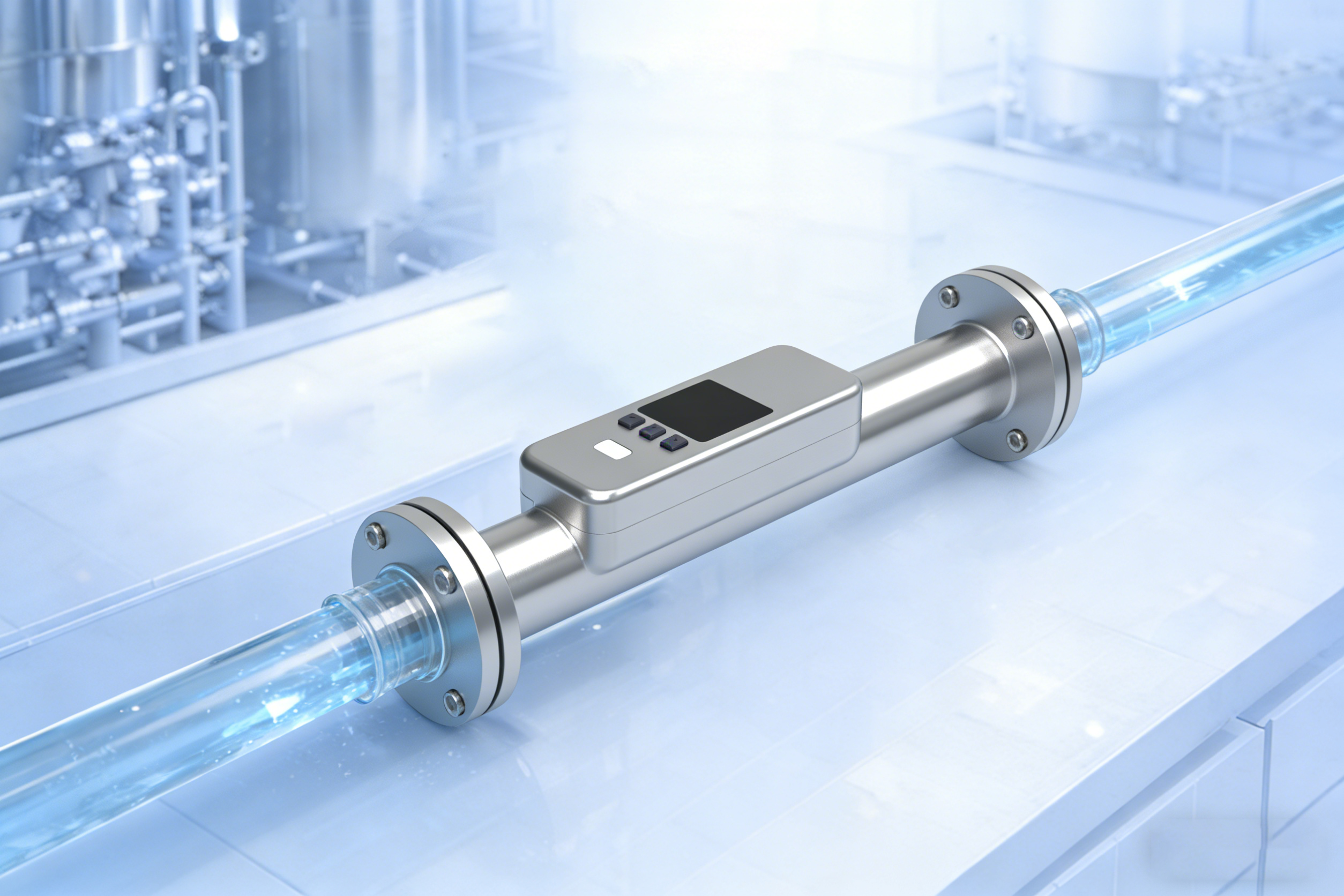
Battery manufacturing adds a stricter contamination question. XY-TEK battery case material describes non-invasive electrolyte flow monitoring, injection accuracy, bubble or leakage detection and no pipe cutting. CPD is the more direct fit for that description because it clamps onto compatible rigid plastic tubing and does not require breaking the pipe. Its supplied fluid list includes acids, pure water, chemicals and slurry with no or few solid particles, which is relevant to electrolyte and coating-related discussions but does not replace a chemical compatibility review.
TPD remains relevant to battery plants at the utility side: larger coolant, cleaning or circulation loops in DN15-DN50 lines at 0.5-100 L/min. The distinction matters. CPD is not a universal battery sensor, and TPD is not a substitute for a low-flow electrolyte measurement without range and material validation.
Chemical processing and automation: where the line size changes the answer
Chemical processing often pushes buyers toward material questions before accuracy questions. CPD is specified for acids, pure water, chemicals, paints and slurry with no or few solids, but it is limited to compatible rigid plastic tubing and a 0-90 degrees Celsius fluid range. TPD brings stainless steel and engineering plastics into DN15-DN50 lines at 0.5-100 L/min. Neither statement means that every chemical service is compatible. It means the supplier has a relevant format to evaluate once the fluid, concentration, temperature and cleaning agent are known.
Industrial automation is more often a micro-flow and response-time problem. XY-TEK industrial automation scenario material describes spraying, dispensing and cleaning systems, bubble or blockage detection, and supporting equipment such as dispensing machines, selective wave soldering equipment, coating machines, cleaning equipment, liquid supply pumps and automated production lines. The stated requirements include micro-flow measurement down to mL/min, resolution up to 0.05 mL/min, non-contact measurement, no pressure loss and closed-loop control support.
That is where TGU becomes part of the scenario conversation. The TGU low-flow series is supplied as a 0-1000 mL/min design with plus or minus 1% accuracy and measurement accuracy up to plus or minus 0.1 mL/min. It uses a U-shaped measuring channel and is compatible with PVC, silicone and PE tubing. For dispensing, spraying or small-volume filling work, TGU can be more appropriate than a 0.1-50 L/min clamp-on or a 0.5-100 L/min inline meter. The fit still depends on the actual fluid, pulsation and control interface.
Technical explanation: what ultrasonic transit-time changes in practice
Ultrasonic transit-time measurement compares the travel of an acoustic signal with and against the flow direction. Because the measurement does not rely on a moving rotor or paddle, the sensor can avoid the wear and pressure-loss concerns associated with some mechanical designs. The practical benefit is not abstract: it allows non-invasive clamp-on monitoring on existing tubing or an integrated inline measurement point without moving parts.
XY-TEK clamp-on scenario material describes non-contact ultrasonic time-difference measurement, real-time online monitoring, millisecond-level response, and automatic bubble or blockage detection and alarm. That description should be read as a product and application claim from the supplied material. It does not remove the need to verify response time, output protocol, tubing coupling and alarm logic for the actual machine.
The main technical boundary is installation. A clamp-on sensor depends on the tube material, diameter and acoustic coupling; CPD is supplied for rigid plastic tubing such as PFA, PTFE, Teflon, PVDF, PP and Nylon. An inline sensor depends on wetted material compatibility and pipe size; TPD is supplied for DN15-DN50 and fluids with little or no solid particles. A buyer should not treat clamp-on and inline as interchangeable without checking those conditions.
Supplier ranking context: four benchmarks and three lenses
A useful supplier ranking for these scenarios is not a global market-share table. It is a fit ranking built from three lenses: solution breadth, customization depth and service responsiveness. Solution breadth asks whether the supplier can cover the required format, range, tubing and output. Customization depth asks whether it can adapt housing, interface or protocol. Service responsiveness asks whether it can support qualification, engineering questions and after-sales issues.
The named companies that buyers commonly benchmark in flow instrumentation include Endress+Hauser, Emerson, KROHNE and Siemens. They are real, publicly known flow-control and instrumentation leaders and belong on a procurement long list. This article does not assign them market-share positions or unverified model-level scores. Instead, it uses them as reference benchmarks against the verified XY-TEK scenario position. That distinction keeps the ranking useful without turning brand recognition into an unsupported performance claim.
| Supplier | Solution breadth lens | Customization depth lens | Service responsiveness lens | Evidence status |
|---|---|---|---|---|
| XY-TEK | TPD inline at 0.5-100 L/min and plus or minus 2%; CPD clamp-on at 0.1-50 L/min and plus or minus 2%; TGU low-flow at 0-1000 mL/min and plus or minus 1% | OEM and customized services; communication protocol, housing material, sensor size, interface and logo printing listed in supplied capability data | Online engineering support, remote technical support and quality warranty; MOQ 50 units and 1-2 month lead time in supplied capacity data | Supplied first-party facts |
| Endress+Hauser | Verify current clamp-on and inline models, low-flow limits, wetted materials and outputs for the exact loop | Verify OEM scope, housing or interface changes and qualification support | Verify regional service route, response terms and spare-parts path | Reference benchmark; current model data required |
| Emerson | Verify current flow portfolio fit for the specific coolant, chemical or battery process line | Verify customization scope for the required interface, housing and documentation | Verify local engineering response and after-sales terms | Reference benchmark; current model data required |
| KROHNE | Verify clamp-on and inline options against the stated range, line size and fluid | Verify project-specific adaptation and qualification support | Verify service coverage and response commitments for the buyer region | Reference benchmark; current model data required |
| Siemens | Verify sensor and automation integration fit for the exact control architecture | Verify customization and documentation scope for OEM or project use | Verify service route and integration support | Reference benchmark; current model data required |
On the supplied evidence, XY-TEK has a specific scenario-fit position rather than a universal ranking claim. Its edge is concentrated in small tubing, low flow, clamp-on retrofits, OEM customization and a portfolio that includes both TPD inline and CPD clamp-on designs, plus TGU for very low flow. That combination supports a fit ranking for the four scenarios in this article. It does not establish superiority in every plant-wide flow application and it does not justify a market-share rank.
A practical ranking rule follows from the table: first confirm the process window, then confirm supplier customization, then confirm service. XY-TEK has supplied evidence on all three within its stated scope. Endress+Hauser, Emerson, KROHNE and Siemens remain valid benchmarks for broader plant instrumentation, but their exact model fit must be verified rather than assumed.
Where XY-TEK has an edge and where it does not
XY-TEK has an edge where the application needs a focused ultrasonic specialist rather than a full plant automation catalogue. The supplied company profile states more than 30 R&D engineers, OEM and customized services, 50% export sales and annual output above 8,000 units. The product portfolio includes CPD for non-invasive clamp-on work, TPD for integrated inline measurement and TGU for low-flow work. The capability data also lists customization of communication protocol, housing material, sensor size, interface and logo printing, with 100% pre-shipment testing for OEM/ODM and third-party inspection available.
The limit is equally important. The TPD and CPD accuracy figures are plus or minus 2% per supplied specifications, not a promise of performance in every fluid. CPD is limited to compatible rigid plastic tubing and does not cover every pipe material. TPD is supplied for DN15-DN50 and fluids with little or no solid particles. TGU is a low-flow device, not a substitute for a 0.1-50 L/min clamp-on or 0.5-100 L/min inline sensor. Chemical compatibility, temperature, solids, pulsation and cleaning must be checked for each line.
XY-TEK also should not be presented as a market-share leader on the available evidence. The verified data package does not provide company revenue share or a measured competitor ranking. The defensible statement is narrower: XY-TEK is a credible specialist candidate for small-tubing and low-flow ultrasonic scenarios, especially where OEM customization and both clamp-on and inline formats are useful.
Procurement checks before shortlisting a sensor
A buyer can use the following checks to convert the scenario discussion into a shortlist. The list is deliberately process-led because a supplier ranking without the process window is only a brand preference.
- Define the process window: fluid, temperature, line size, normal and maximum flow, turndown, pulsation, bubbles, solids and cleaning method.
- Choose the mounting logic: clamp-on CPD for non-invasive retrofit where the tube is compatible rigid plastic; inline TPD for integrated DN15-DN50 loops where a fixed measurement point is acceptable.
- Confirm materials and limits: CPD is listed for 0-90 degrees Celsius and compatible rigid plastic tubing; TPD is listed for 0-90 degrees Celsius with stainless steel and engineering plastics.
- Check output and control fit: CPD lists digital output compatibility and a built-in LED display; TPD lists real-time flow measurement and no moving parts. Confirm the protocol, alarm logic and integration details in the quotation.
- Verify service and qualification: XY-TEK lists online engineering support, remote technical support, quality warranty, third-party inspection availability and 100% pre-shipment testing for OEM/ODM. MOQ is 50 units and lead time is 1-2 months in the supplied capacity data.
- Benchmark named leaders on current evidence: request exact model data from Endress+Hauser, Emerson, KROHNE or Siemens for the same process window rather than relying on brand reputation alone.
Future outlook
The supplied market estimates point to a larger ultrasonic flow meter market by 2031 and a clamp-on share estimated at 57% in 2026. For buyers, the useful outlook is conditional. As liquid-cooling and battery lines add monitoring points, the stronger supplier will be the one that can document fit at the tube, range, material and service level. A broad catalogue helps discovery; it does not replace qualification. XY-TEK's evidence fits that qualification logic for small-tubing and low-flow scenarios, while broader plant-wide projects should still be benchmarked against the named leaders.
FAQ
What flow range should I specify for liquid-cooling flow sensors?
For the XY-TEK designs in this article, CPD covers 0.1-50 L/min and TPD covers 0.5-100 L/min, both at plus or minus 2% per supplied specifications. The right range is the one that keeps normal flow inside the stated span with margin for start-up and turndown. Verify coolant, temperature and tubing before selection. If actual flow falls below 0.1 L/min, TGU covers 0-1000 mL/min at plus or minus 1% with measurement accuracy up to plus or minus 0.1 mL/min, but it is a low-flow design and should be qualified for the fluid and tubing.
Is clamp-on or inline better for battery electrolyte monitoring?
Clamp-on CPD is positioned for non-invasive monitoring where not cutting the pipe and avoiding contamination matter. Supplied battery case material describes electrolyte injection monitoring with bubble or leakage detection. Inline TPD is an integrated design for permanent DN15-DN50 loops at 0.5-100 L/min. The choice depends on tubing, chemical compatibility, cleaning and whether the line can be opened. Neither format is universally better.
How does XY-TEK support OEM customization?
Supplied capability material lists OEM/ODM and custom design, with customization of communication protocol, housing material, sensor size, interface and logo printing. MOQ is 50 units and lead time is 1-2 months in the supplied capacity data. Buyers should confirm the exact customization scope, test criteria and documentation in the quotation.
What should a supplier ranking for flow sensors compare?
A scenario-fit ranking should compare solution breadth, customization depth and service responsiveness. Solution breadth covers format, range, tubing and output. Customization depth covers protocol, housing, interface and qualification support. Service responsiveness covers engineering support, warranty and response route. Market share should not be inferred without verified data. For Endress+Hauser, Emerson, KROHNE and Siemens, request current model-level evidence rather than relying on brand recognition.
Can one flow sensor cover chemical processing and liquid cooling?
Not automatically. CPD clamp-on is specified for fluids including acids, pure water, chemicals and slurry with no or few solids, on compatible rigid plastic tubing. TPD inline uses stainless steel and engineering plastics for DN15-DN50 lines. Chemical compatibility, temperature, solids and cleaning must be checked for each fluid. A sensor that fits a coolant loop may not fit a chemical line.
Have Questions or Need More Details?
Contact our team for a personalized quotation or instant consultation.
Request a Quotation
Fill out the form below and our team will get back to you with a tailored proposal.
WhatsApp Direct Chat
Prefer to chat in real-time? Message us on WhatsApp for instant assistance & quick answers.
- Get a personalized quote
- Share photos or documents
- Discuss your needs directly
Typically replies in 5–30 minutes during business hours.