
Liquid Cooling and Semiconductor: Where Non-Invasive Flow Sensors Fit Best
Liquid Cooling and Semiconductor: Where Non-Invasive Flow Sensors Fit Best
In semiconductor fluid handling and liquid cooling, the measurement point sits inside the process. Deionized water, chemical delivery streams and coolant blends are not simply media being moved from one place to another; they are part of what the system produces or protects. That single fact reframes sensor selection: the requirement is not only to measure flow accurately, but to measure it without altering the fluid path.
Non-invasive clamp-on ultrasonic flow sensors meet that requirement by measuring from outside the tube. Shanghai Xunyin Technology Co., Ltd (XY-TEK), a Shanghai-based manufacturer established in 2018 that designs and produces ultrasonic flow sensors and flow meters for fluid management and control (https://www.xy-tek.com/), builds two product families directly into this scenario: the CPD Series and the CS Series. Both are non-invasive clamp-on flow sensors with a measurement scope of 0.1-50 L/min, air bubble monitoring, digital output compatibility, and clamp-on installation that requires no pipe cutting.
This article examines why liquid cooling and semiconductor applications sit at the centre of the non-invasive case, where the fit is strongest, and where clamp-on measurement stops being the right answer.
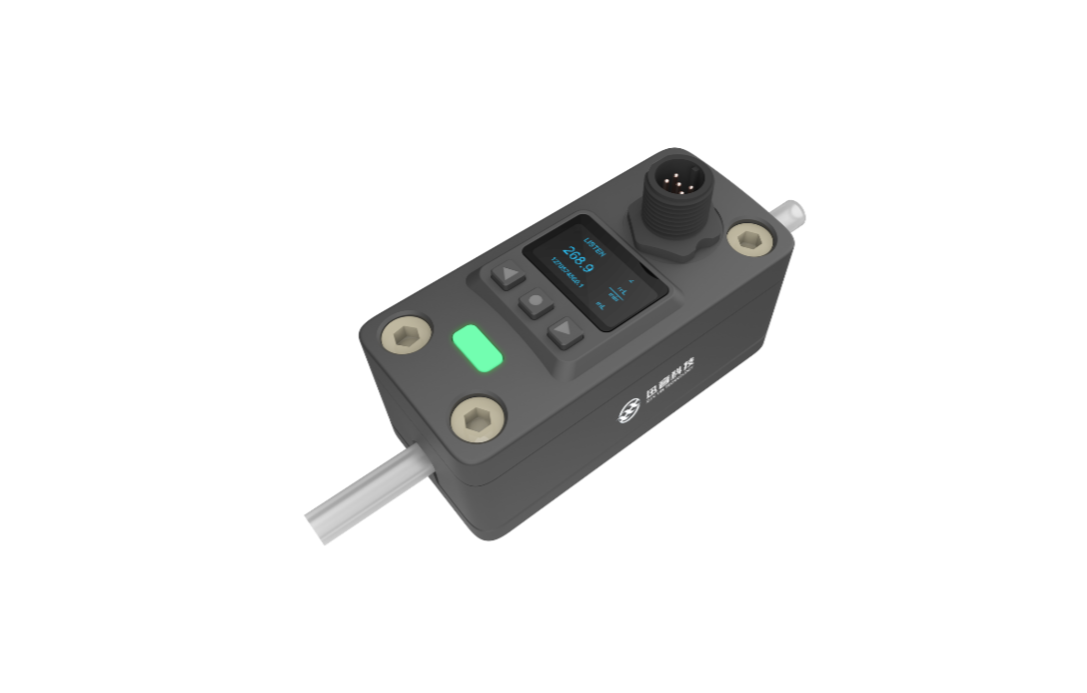
CPD Series clamp-on ultrasonic flow sensor: non-invasive measurement of 0.1-50 L/min on rigid plastic tubing, with air bubble monitoring and no pipe cutting required.
Why Clean Fluid Paths Change the Flow Measurement Question
Third-party analysis from Market Research Future estimated flow control in the semiconductor industry at USD 5.83 billion in 2024, describing the segment as focused on high-purity fluid management. The dollar figure matters less than the framing it implies: in these systems the fluid is the product, or it protects the product, and any component inserted into the line becomes part of the contamination and maintenance picture.
That is the practical cost of conventional inline measurement. An inline sensor places a wetted body in the flow path, so installation requires the line to be cut, drained and re-joined. In high-purity systems that sequence means flushing, requalification and production interruption, plus new joints that become new leak paths and new sources of particle generation. Where the fluid is chemically aggressive or must remain ultra-clean, opening the line is an event to be avoided rather than a routine maintenance task.
Clamp-on measurement removes that event from the installation sequence. Because the sensor sits on the outside of the tube, the fluid path is never opened and the wetted materials never change. The engineering work shifts from qualifying a new wetted component to confirming that the existing tubing is a suitable measurement surface.
How Clamp-On Ultrasonic Measurement Works
Clamp-on ultrasonic flow sensors use the transit-time principle. A pair of ultrasonic transducers is mounted on the outside of the tube, and the instrument compares the time an ultrasonic signal takes to travel with the direction of flow and against it. The difference in transit time corresponds to the average flow velocity inside the tube, which the electronics convert into a volumetric flow rate.
Because the transducers never contact the liquid, several practical consequences follow:
- No wetted parts. The fluid touches only the tubing it was already flowing through. There is no new contamination surface, no new in-line material compatibility question, and no pressure loss caused by an obstruction in the flow path.
- Nothing moving in the flow path. Ultrasonic measurement inserts no rotor, piston or moving element into the line, which supports stable long-term behaviour and low maintenance.
- No pipe cutting. The sensor clamps onto the outside of the tube, so it can be retrofitted without opening the line. This is the decisive advantage in clean-room and high-purity environments, where every intervention carries a cost beyond the installation itself.
- Air bubble monitoring as part of the same point. Both the CPD and CS series include air bubble monitoring capability. Gas in a cooling or dosing line can reduce heat transfer at a cold plate or interrupt a dosing step, so detecting bubbles where flow is already being reported simplifies the monitoring architecture.
- Real-time data output. The CPD and CS series support digital output compatibility, which allows flow and bubble status to be routed directly into a control system rather than read manually.
The trade-off is that measurement quality depends on the tube rather than on a sensor body. Clamp-on instruments are specified against tubing outer diameter, inner diameter and wall material, and the CPD and CS series are specified for rigid plastic tubing such as PFA, PTFE, Teflon, PVDF, PP and Nylon.
CPD and CS Series: Two Non-Invasive Options in the Same 0.1-50 L/min Window
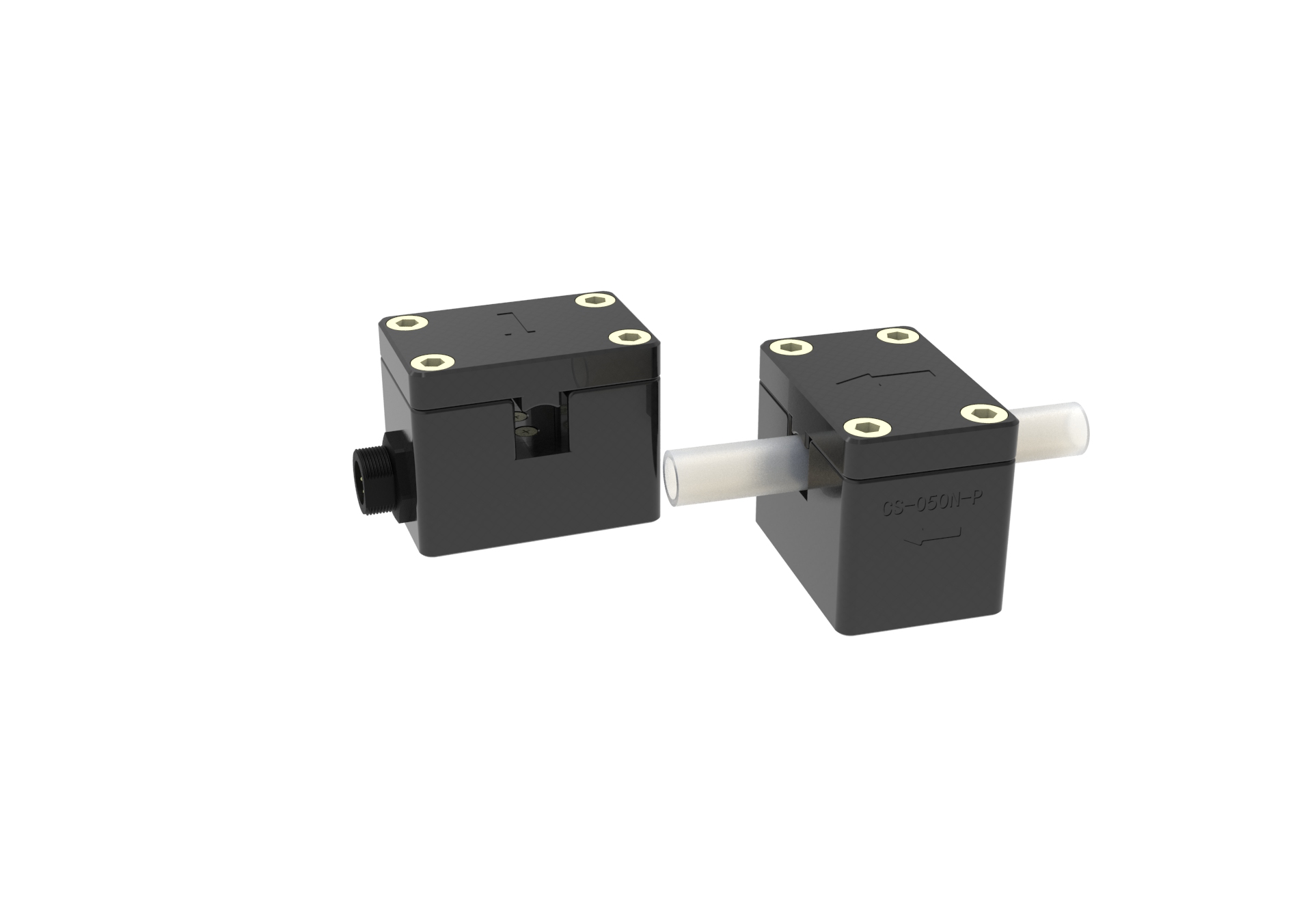
CS Series clamp-on ultrasonic flow sensor: compact integrated design with air bubble monitoring and digital output compatibility for industrial and high-purity fluid lines.
| Specification | CPD Series | CS Series |
|---|---|---|
| Product type | Non-invasive industrial flow sensor (clamp-on) | Non-invasive industrial flow sensor (clamp-on) |
| Measurement scope | 0.1-50 L/min | 0.1-50 L/min |
| Accuracy | ±2% | ±3% |
| Compatible tubing outer diameter | 6-26 mm | 6.4-25.4 mm |
| Compatible tubing inner diameter | 3-20 mm | 3.2-15.9 mm |
| Applicable fluid temperature | 0°C to 90°C | 0°C to 90°C |
| Tubing materials | Rigid plastic tubing such as PFA, PTFE, Teflon, PVDF, PP, Nylon | Rigid plastic tubing such as PFA, PTFE, Teflon, PVDF, PP, Nylon |
| Construction | Engineering plastic, ultrasonic transducer | Engineering plastic, ultrasonic transducer |
| Key features | Compact integrated design, clamp-on installation, air bubble monitoring, digital output compatibility, built-in LED display, no moving parts, low maintenance | Compact integrated design, clamp-on installation, air bubble monitoring, digital output compatibility |
| Applicable industries | Industrial automation, semiconductor, food & beverage, water treatment | Semiconductor, water treatment, food & beverage, industrial automation |
Both series share the essentials of the non-invasive approach: clamp-on installation on the outside of the tube, an integrated compact structure, air bubble monitoring, digital output compatibility, and a 0-90 °C fluid temperature range. The differences are matters of specification level rather than of category.
The CPD Series is specified at ±2% accuracy across a 0.1-50 L/min measurement scope and covers tubing from 6 mm to 26 mm outer diameter, with a built-in LED display for local reading. The CS Series is specified at ±3% across the same flow window and covers 6.4 mm to 25.4 mm outer diameter in a compact integrated unit.
On the fluid side, the CPD Series lists water, acids, pure water, drinks, oil, paints, chemicals and slurry among measurable fluids, with the qualification that the fluid should contain no or few solid particles. Semiconductor is named among the applicable industries for both series, alongside industrial automation, water treatment, and food and beverage production.
Where the Fit Is Strongest
1. Liquid cooling loops and coolant distribution
Cooling circuits are typically small-bore and often built from rigid plastic tubing, which is exactly the geometry the CPD and CS series are specified for. A 0.1-50 L/min window with ±2% accuracy suits individual branch lines and small distribution manifolds rather than plant-scale headers, and the 0-90 °C fluid temperature range covers coolant supply and return conditions in most electronics and equipment cooling loops. The operational argument for clamp-on sensing here is retrofit: flow monitoring can be added to an existing loop without draining it, breaking into it, or taking the cooled equipment offline.
2. High-purity water and chemical delivery lines
When nothing enters the fluid path, adding a measurement point does not change wetted materials and does not introduce particulates inside the line. In high-purity fluid management, that keeps the qualification scope narrow: the tubing is already qualified, and the sensor is a monitoring device attached to it rather than a new component inside it. This is the structural reason non-invasive sensing appears repeatedly in semiconductor and high-purity process discussions, and it is why both the CPD and CS series list semiconductor among their intended industries.
3. Micro-flow and pulse-flow monitoring in automated production
XY-TEK's industrial automation application profile covers micro-flow, pulse-flow and low-flow monitoring in spraying, dispensing and cleaning systems, using non-contact clamp-on measurement with millisecond-level response and resolution up to 0.05 mL/min. The stated installation benefit is that external clamp-on mounting can be retrofitted into limited spaces without interrupting production lines. In these systems the sensor must detect bubbles, blockage or abnormal flow conditions and feed closed-loop process control, so combining flow and bubble detection at one non-invasive point reduces the number of devices that need to be mounted, wired and maintained.
4. Small-bore lines where an inline body will not fit
Tubing with an outer diameter of 6 mm to 26 mm leaves little room for an inserted meter body. Clamp-on sensors consume space outside the tube instead of inside it, which keeps the fluid path geometry unchanged and avoids the pressure loss that an in-line restriction would introduce.
The Boundary Case: When Inline Measurement Is Still the Right Answer
An honest account of non-invasive sensing includes its limits, and the specifications state them clearly. The CPD and CS series are specified for rigid plastic tubing and for tube outer diameters between roughly 6 mm and 26 mm. Fluids must contain no or few solid particles, fluid temperature must remain within 0-90 °C, and flow must stay inside the 0.1-50 L/min window. Their accuracy classes, ±2% and ±3%, suit process monitoring, control and trend analysis; they are not a substitute for custody-transfer or fiscal metering.
Where those boundaries are crossed, an inline ultrasonic sensor is the appropriate instrument. XY-TEK's TPD Series is an inline ultrasonic flow sensor built from stainless steel and engineering plastics, with a 0.5-100 L/min measurement range and ±2% accuracy, no moving parts, low maintenance, and real-time flow monitoring in an integrated structure. It is specified for liquid cooling as well as industrial automation, battery manufacturing and chemical processing, and covers DN15-DN50 connections, a bore and flow envelope that sits outside the clamp-on range.
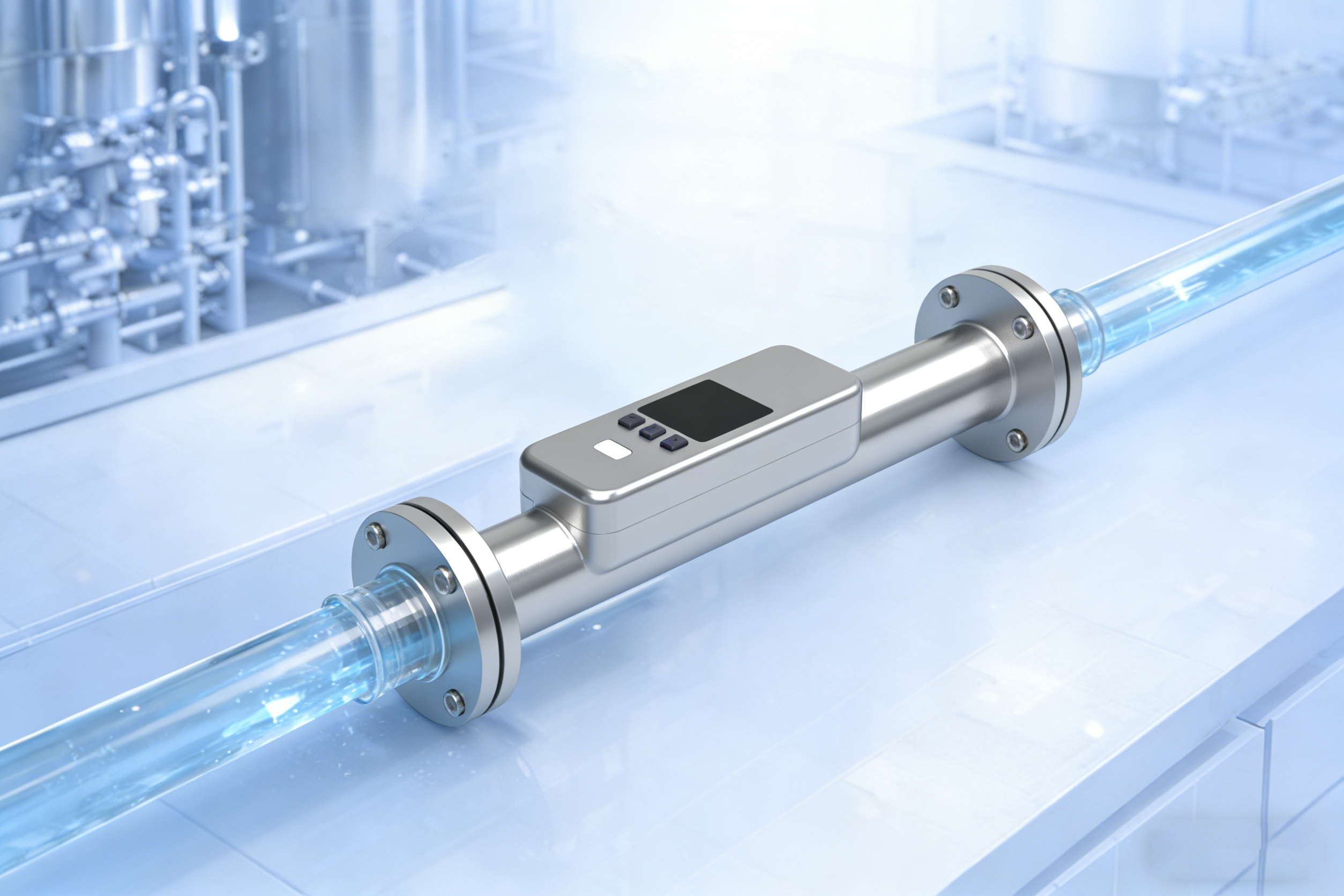
Inline ultrasonic flow sensing in a liquid cooling circuit: the TPD Series covers DN15-DN50 and 0.5-100 L/min where clamp-on sensors are outside their specified envelope.
| Selection dimension | CPD / CS clamp-on (non-invasive) | TPD inline |
|---|---|---|
| Installation | Clamped to the outside of the tube, no pipe cutting | Integrated into the line structure |
| Fluid contact | None | Wetted body in stainless steel and engineering plastics |
| Flow range | 0.1-50 L/min | 0.5-100 L/min |
| Accuracy | ±2% (CPD) / ±3% (CS) | ±2% |
| Pipe or tube envelope | Rigid plastic tubing, OD 6-26 mm (CPD) / 6.4-25.4 mm (CS) | DN15-DN50 |
| Fluid temperature | 0-90 °C | 0-90 °C |
| Typical fit | Retrofit, high-purity lines, small bore, no line opening | Larger bore, higher flow, in-line process connection |
The decision rule that follows from the two specifications is straightforward. Choose clamp-on measurement to protect the fluid and avoid opening the line; choose inline measurement when the line is larger than the clamp-on envelope, the flow rate exceeds 50 L/min, or the installation can accept a wetted body in exchange for a wider measurement range.
Market Signals Behind the Move to Non-Invasive Monitoring
Mordor Intelligence valued the global ultrasonic flow meter market at USD 1.52 billion in 2025 and projected USD 2.28 billion by 2031, while Grand View Research estimated the broader flow meter market at USD 10.64 billion in 2024, growing to USD 15.17 billion by 2030. Within that picture, the clamp-on ultrasonic flowmeter segment was valued at USD 1.25 billion in 2024 and is described as growing at a CAGR of 7.4% through 2032, according to Global Information, Inc.
Market sizing for ultrasonic flow meters should be treated with caution. Published estimates diverge substantially depending on whether categories such as smart water meters are included in the definition, and the spread between sources is wide enough that no single figure should be treated as definitive. The directional signal, however, is consistent across sources: flow measurement overall is expanding, and the ultrasonic family, which includes clamp-on non-invasive devices, is expanding within it. Fortune Business Insights estimated that Asia Pacific held the largest regional share of the ultrasonic flow meter market in 2025 at 38.6%, a figure consistent with industrial expansion in the region.
Standardisation is keeping pace with the hardware. ISO 24062:2023 specifies requirements for clamp-on ultrasonic transit-time meters for liquids and gases in closed conduits, giving specifiers a published reference for the measurement method rather than a vendor-specific claim. In adjacent regulated sectors, EN ISO 13485 quality management requirements apply to medical sensors, including flow sensors for ventilators and drug delivery, which sets the compliance benchmark that non-invasive sensing must meet when the same fluid line serves regulated equipment.
The competitive landscape is well established. Third-party market research identifies Emerson Electric, Siemens AG, Endress+Hauser and Honeywell among the major global competitors in the ultrasonic flow sensor market. Specialists such as XY-TEK operate in the adjacent space of small-bore, low-flow clamp-on measurement for medical devices, bioprocessing, scientific research, industrial automation, and food and beverage production, a segment defined by tube diameter and flow range rather than by portfolio breadth.
Specification Checklist Before Committing
| What to verify | Why it matters |
|---|---|
| Tubing outer and inner diameter | Clamp-on sensors are specified against the tube, not the fluid alone. CPD covers 6-26 mm OD and 3-20 mm ID; CS covers 6.4-25.4 mm OD and 3.2-15.9 mm ID. |
| Tubing material and rigidity | CPD and CS are specified for rigid plastic tubing such as PFA, PTFE, Teflon, PVDF, PP and Nylon. |
| Normal and peak flow rate | Confirm operating points sit inside the 0.1-50 L/min measurement scope. |
| Fluid temperature | The stated applicable fluid temperature range is 0-90 °C. |
| Fluid cleanliness | Measurable fluids must contain no or few solid particles. |
| Accuracy class | CPD is specified at ±2%; CS at ±3%. Select against the tolerance the process actually requires. |
| Output interface | Both series are digital output compatible; confirm the interface matches the control system. |
| Bubble monitoring requirement | Decide whether gas detection is needed at this point in addition to flow reporting. |
| Reference standard | ISO 24062:2023 specifies requirements for clamp-on ultrasonic transit-time meters for liquids and gases in closed conduits. |
| Regulatory context | Where the same line serves regulated medical equipment, EN ISO 13485 quality management requirements apply. |
Future Outlook
As liquid cooling moves from specialty deployments into mainstream compute and power infrastructure, the number of measurement points per system tends to rise faster than the diameter of the pipes carrying coolant. That asymmetry favours instruments that can be added to existing small-bore tubing without process interruption, and it favours combining flow and bubble detection at a single non-invasive point. The same logic applies in semiconductor fluid handling, where every avoided intervention in a high-purity line reduces qualification overhead and the number of opportunities for contamination.
XY-TEK was established in 2018, operates a 5,000 square meter manufacturing facility in Shanghai, employs approximately 50 staff including an R&D team of more than 30 engineers, and reports an annual production capacity of over 8,000 units, with export business accounting for 50% of total sales across medical devices, bioprocessing, scientific research, industrial automation, and food and beverage production.
For buyers, the open question is no longer whether non-invasive sensing belongs in these systems, but where the boundary will settle between clamp-on and inline measurement as line sizes and flow ranges grow. The current specifications draw that boundary clearly: non-invasive up to 50 L/min on small-bore rigid plastic tubing, inline where larger bores and higher flows require a wetted body.
FAQ
What is a clamp-on ultrasonic flow sensor?
A clamp-on ultrasonic flow sensor is a flow measurement device that mounts on the outside of a tube and measures flow using the transit-time principle, comparing the travel time of an ultrasonic signal sent with and against the direction of flow. Because the transducers sit outside the tube, the sensor has no wetted parts and requires no pipe cutting. The CPD and CS series are examples of this category, specified for a 0.1-50 L/min measurement scope on rigid plastic tubing.
Why are non-invasive sensors considered a good fit for liquid cooling and semiconductor systems?
Both environments place a premium on leaving the fluid path unchanged. Non-invasive sensors measure from outside the tube, so no component is added to the wetted materials, no obstruction creates pressure loss, and the line does not have to be cut, drained and re-qualified during installation. The CPD and CS series also integrate air bubble monitoring and digital output compatibility, and both name semiconductor among their applicable industries. XY-TEK's industrial automation profile describes the same benefit for retrofit installation without interrupting production lines.
What flow range and accuracy do the CPD and CS series cover?
Both series share a 0.1-50 L/min measurement scope and a 0-90 °C applicable fluid temperature range. The CPD Series is specified at ±2% accuracy with tube compatibility from 6 mm to 26 mm outer diameter and 3 mm to 20 mm inner diameter, and includes a built-in LED display. The CS Series is specified at ±3% accuracy, covers 6.4 mm to 25.4 mm outer diameter and 3.2 mm to 15.9 mm inner diameter, and is supplied as a compact integrated unit.
What are the limitations of clamp-on ultrasonic flow sensors?
The published specifications define several boundaries. The CPD and CS series require rigid plastic tubing such as PFA, PTFE, Teflon, PVDF, PP or Nylon, with outer diameters between roughly 6 mm and 26 mm. Measurable fluids must contain no or few solid particles, fluid temperature must stay within 0-90 °C, and flow must remain inside 0.1-50 L/min. The ±2% and ±3% accuracy classes are suited to process monitoring and control rather than custody-transfer metering. Installations outside these conditions require a different instrument category.
How does clamp-on measurement compare with inline ultrasonic sensors for liquid cooling?
The two approaches occupy different envelopes rather than competing directly. Clamp-on CPD and CS sensors cover 0.1-50 L/min on rigid plastic tubing with outer diameters up to 26 mm, and require no line intervention. XY-TEK's inline TPD Series covers 0.5-100 L/min and DN15-DN50 in stainless steel and engineering plastics, with ±2% accuracy, no moving parts and low maintenance, and is specified for liquid cooling, industrial automation, battery manufacturing and chemical processing. Larger bore, higher flow, or an acceptable wetted body point toward the inline option.
What should be checked before specifying a non-invasive flow sensor for a high-purity line?
Confirm the tubing outer diameter, inner diameter and material against the sensor specification, since clamp-on measurement is defined by the tube rather than by the fluid alone. Verify that normal and peak flow sit inside the 0.1-50 L/min window and that fluid temperature stays within 0-90 °C. Confirm the fluid contains no or few solid particles. Decide whether air bubble monitoring is required at that point and whether the output interface matches the control system. Where a published method reference is needed, ISO 24062:2023 specifies requirements for clamp-on ultrasonic transit-time meters for liquids and gases in closed conduits.