
Live Streaming Camera Procurement FAQ: TC-980S, TC420, TCHD-T3
Live streaming cameras have moved past the stage where the buying question is simply which model to buy. For procurement teams moving from evaluation into execution, the questions that actually delay a purchase order are narrower: which sensor, which zoom range, which connector, which control protocol, which power supply, and which certificate.
This reference answers those questions for three models in the TCHD Video live streaming camera range — TC-980S, TC420 and TCHD-T3. TCHD Video (TCHD Digital Video Technology Development (Beijing) Ltd) is a Beijing-based manufacturer of live streaming cameras, video capture cards, video converters, video encoders and video switchers, with major markets in the EU, USA and Asia. Every specification below is taken from the published product parameters for these models; no figures have been estimated or extrapolated.
Why the Procurement Questions Changed
A camera that sits in a classroom for six hours a day, a surgical training room where the lens has to hold up under low light, and an event rig that must be cabled up in a hotel ballroom have very little in common once you get past the marketing description. The evaluation stage tends to settle on the fact that several models look comparable on paper. The execution stage is where the differences surface, and they surface in three places: signal path, control path, and compliance documentation.
The three models examined here sit at different points in that picture. TC-980S and TC420 both carry SDI and serial control alongside HDMI, LAN and USB. TCHD-T3 is built around HDMI, USB and IP. Understanding that split early prevents a specification being written around a connector the chosen model does not have.
The Three Reference Models in Brief
TC-980S is a PTZ live streaming camera whose published product type covers video conferencing, medical teaching, education training and event streaming. It uses a 1/2.8 inch high quality CMOS sensor with 8.42M effective pixels in 16:9, and its parameter set lists three optical zoom configurations — 12X, 20X and 30X — each with 16X digital zoom.
TC420 is positioned as a video conference, PTZ, education and medical training camera. It uses a 1/2.8 inch HD CMOS sensor with 8.29M effective pixels in 16:9, a 12X optical zoom and 15X digital zoom, and lists 4K resolutions in its HDMI output options.
TCHD-T3 is positioned for education teaching, e-commerce streaming and medical training. It uses a 1/2.8 inch CMOS sensor with 2.07M effective pixels, a 12x lens and 16x digital zoom, and its video system tops out at 1080P.
| Item | TC-980S | TC420 | TCHD-T3 |
|---|---|---|---|
| Image sensor | 1/2.8″ high quality CMOS | 1/2.8″ HD CMOS | 1/2.8″ CMOS |
| Effective pixel | 8.42M (16:9) | 8.29M (16:9) | 2.07M |
| Optical zoom | 12X / 20X / 30X configurations | 12X | 12x |
| Digital zoom | 16X | 15X | 16x |
| HDMI 4K output | 3840x2160 listed | 4KP30, 4KP25 listed | Not listed (max 1080P) |
| SDI output | Yes | Yes | Not listed |
| Serial control | RS232-IN, RS232-OUT, RS485 | RS232-IN, RS232-OUT, RS422 (RS485 compatible) | Not listed |
| Presets | 255 (10 via remote) | 255 (10 via remote) | 255 |
| Power consumption | ≤18 W | <12 W | Not specified |
Imaging and Lens Specifications
What is the sensor and how many effective pixels does each model have?
All three models use a 1/2.8 inch CMOS sensor, but the pixel counts differ enough to change what the camera can output. TC-980S records 8.42M effective pixels in 16:9, TC420 records 8.29M in 16:9, and TCHD-T3 records 2.07M. The gap matters because it tracks the video signal list: TC-980S and TC420 both publish 4K resolutions in their HDMI output options, while TCHD-T3 publishes 1080P@60/50/30/25fps, 1080i@60/50fps and 720P@60/50fps.
What zoom range and field of view should be specified?
TC-980S is offered across three optical configurations. The 12X version uses a focal length of f=4.1–49.2mm with a FOV of 7.5°–78.4° (D), 6.72°–70.4° (H) and 3.76°–42.1° (V). The 20X version uses f=5.05–91.49mm with 3.93°–67.35° (D) and 3.81°–60.04° (H). The 30X version uses f=5.2–148.4mm with 2.48°–65.4° (D) and 2.14°–58.1° (H). All three configurations share a 16X digital zoom.
TC420 uses a single 12X optical zoom with a focal length of 3.9–46.8mm (±5%) and a horizontal viewing angle of 6.5° (N) to 70.9° (W). TCHD-T3 uses a 12x lens at f3.5mm–42.3mm, F1.8–F2.8, with a horizontal angle of view of 72.5°–6.9° and a vertical angle of view of 44.8°–3.9°.
For narrow rooms, the widest horizontal figure is the relevant one: TCHD-T3 opens at 72.5°, while TC420 opens at 70.9°. For long-throw applications such as a lecture hall or an arena floor, the 20X and 30X TC-980S configurations are the ones that reach further.
How do the models perform in low light?
All three publish a minimum illumination of 0.5 Lux measured at F1.8 with AGC on. Noise handling is specified separately: TC-980S and TC420 both use 2D and 3D digital noise reduction, while TCHD-T3 uses 2D&3D digital noise reduction. Published signal-to-noise ratios are >50dB for TC-980S, >50dB for TC420, and ≥55dB for TCHD-T3. TC-980S additionally lists an ultra low light mode among its video adjustment options.
PTZ Range, Speed and Presets
The mechanical envelope is consistent across the PTZ models. TC-980S pans from -170° to +170° and tilts from -30° to +90°. TC420 uses the same pan and tilt range. TC-980S pans at 0.1°/s to 60°/s and tilts at 0.1°/s to 30°/s, with preset speeds of 60°/s pan and 30°/s tilt. TC420 pans at 0.1°/s to 60°/s and tilts at 0.1°/s to 45°/s, with preset speeds of 60°/s pan and 45°/s tilt.
Preset capacity is 255 positions on all three models, with 10 positions accessible from the remote control on TC-980S and TC420. The published TCHD-T3 parameters do not list pan and tilt ranges or speeds, so a buyer specifying a moving-head installation should confirm those values rather than assume them from the other two models.
TC-980S also includes monocular tracking, with modes covering off, real-time tracking, stage tracking, area tracking and intelligent framing, and a maximum tracking distance of up to 18 meters.
Interfaces: HDMI, SDI, LAN and USB 3.0
The interface list is where the three models diverge most sharply, and it is usually the fastest way to eliminate a candidate.
| Interface | TC-980S | TC420 | TCHD-T3 |
|---|---|---|---|
| HDMI | HDMI output | HDMI output | 1x HDMI 1.4b |
| SDI | SDI output | SDI output | Not listed |
| LAN | 1000M Ethernet port, optional PoE+ | 10M/100M/1000M adaptive Ethernet port, PoE supported | 1x RJ45, 10M/100M adaptive, PoE supported |
| USB | USB3.0 | USB3.0 | 1x USB3.0 Type C, 1x USB 2.0 Type A |
| Audio in | Dual-channel 3.5mm linear input | Double track 3.5mm linear input | 1-ch 3.5mm audio interface, Line In |
| Serial control | RS232-IN, RS232-OUT, RS485 | RS232-IN, RS232-OUT, RS422 compatible with RS485 | Not listed |
| Power inlet | HEC3800 power socket (DC12V) | HEC3800 power socket (DC12V) | JEITA type (DC IN 12V) |
Two practical conclusions follow. First, if SDI is a mandatory requirement in the signal chain, TCHD-T3 is not a candidate — its published parameters list HDMI 1.4b, USB and RJ45, but no SDI. Second, if the installation relies on legacy RS-232 or RS-485 joystick controllers rather than IP control, the same model has no listed serial control interface, whereas TC-980S and TC420 both publish RS232-IN, RS232-OUT and an RS-485 or RS-485-compatible port.
Network Protocols and Streaming
TC-980S supports RTSP, RTMP, ONVIF, GB/T28181 and SRT, with NDI and Dante AV listed as optional. It also supports the network VISCA control protocol and remote upgrade, remote reboot and remote reset. Its LAN compression is H.264 and H.265, with a master code stream reaching 3840x2160 and a subcode stream reaching 1920x1080.
TC420 supports RTSP, RTMP, ONVIF, GB/T28181, VISCA OVER IP, IP VISCA, RTMPS and SRT, with LAN compression in H.264 and H.265, plus remote upgrade, remote reboot and remote reset. TCHD-T3 supports TCP/IP, HTTP, RTSP, RTMP, ONVIF, DHCP and multicast, with H.264, H.265 and MJPEG compression, a video bit rate range of 32Kbps to 20480Kbps, CBR and VBR bit rate control, and first-stream resolutions up to 1920x1080.
ONVIF and RTSP are common to all three, which is what makes them interchangeable in a VMS-driven workflow. GB/T28181 appears on TC-980S and TC420 only. Where an integrator has to register endpoints against a platform that mandates GB/T28181, that difference is a qualifying criterion, not a footnote.
Control Protocols: VISCA, Pelco-D and Pelco-P
TC-980S and TC420 both support VISCA, Pelco-D and Pelco-P over their serial ports, with selectable baud rates of 115200, 38400, 9600, 4800 and 2400. Both also support UVC for video communication and UAC for audio communication over USB. TC420 adds VISCA OVER IP and IP VISCA to its protocol list.
TCHD-T3 publishes USB Video Communication Protocol support at UVC 1.1 to 1.5, UVC PTZ support, and H.264/H.265/MJPEG video compression, but does not list Pelco or VISCA serial baud rates. In practice this positions it as an IP- and USB-controlled device rather than a serial-controlled one.
For a shopping list, the control question should be settled before the camera question: identify the controller first, then check which camera speaks the controller's language.
Power: Consumption, Adapters and PoE
TC-980S specifies total power consumption of ≤18 W, an input voltage of DC12V±10%, an input current of ≤1.5 A, and a power adapter with AC110V–AC220V input and DC12V/1.5A output. TC420 specifies consumption below 12 W, an input current below 1 A, DC12V±10% input voltage, and an adapter with AC110V–AC220V input and DC12V/2.5A output. Both use the HEC3800 power socket. TCHD-T3 uses a JEITA type DC IN 12V power jack and additionally supports PoE over its RJ45 network port.
The adapters are not interchangeable between TC-980S and TC420 on output rating, so a multi-model deployment should keep spares matched to the model rather than pooled. Where PoE is available at the switch, TC-980S supports PoE+ and TC420 and TCHD-T3 both support PoE over their Ethernet ports.
What Cables and Accessories Are Needed at Deployment
Cabling follows directly from the interface list, and a buyer can build the bill of materials from it without guesswork:
- HDMI cable — all three models publish an HDMI output (HDMI 1.4b on TCHD-T3).
- SDI cable — only for TC-980S and TC420, which are the models that publish an SDI output port.
- Ethernet cable — for the RJ45 network port on all three, and the same cable carries power where PoE or PoE+ is used instead of the adapter.
- 3.5mm audio cable — for the linear audio input, which is dual-channel on TC-980S and TC420 and single-channel on TCHD-T3.
- DC 12V power adapter — supplied per model; TC-980S and TC420 use the HEC3800 socket, TCHD-T3 uses a JEITA type jack.
- Serial control cable — only where RS232 or RS-485/RS-422 control is used, which excludes TCHD-T3 on published parameters.
These three models are specified for indoor deployment environments — the published applicable industries are broadcasting, medical, education and live streaming fields, and the published applications are classroom teaching, medical training, event streaming and e-commerce streaming.
Certification and Compliance
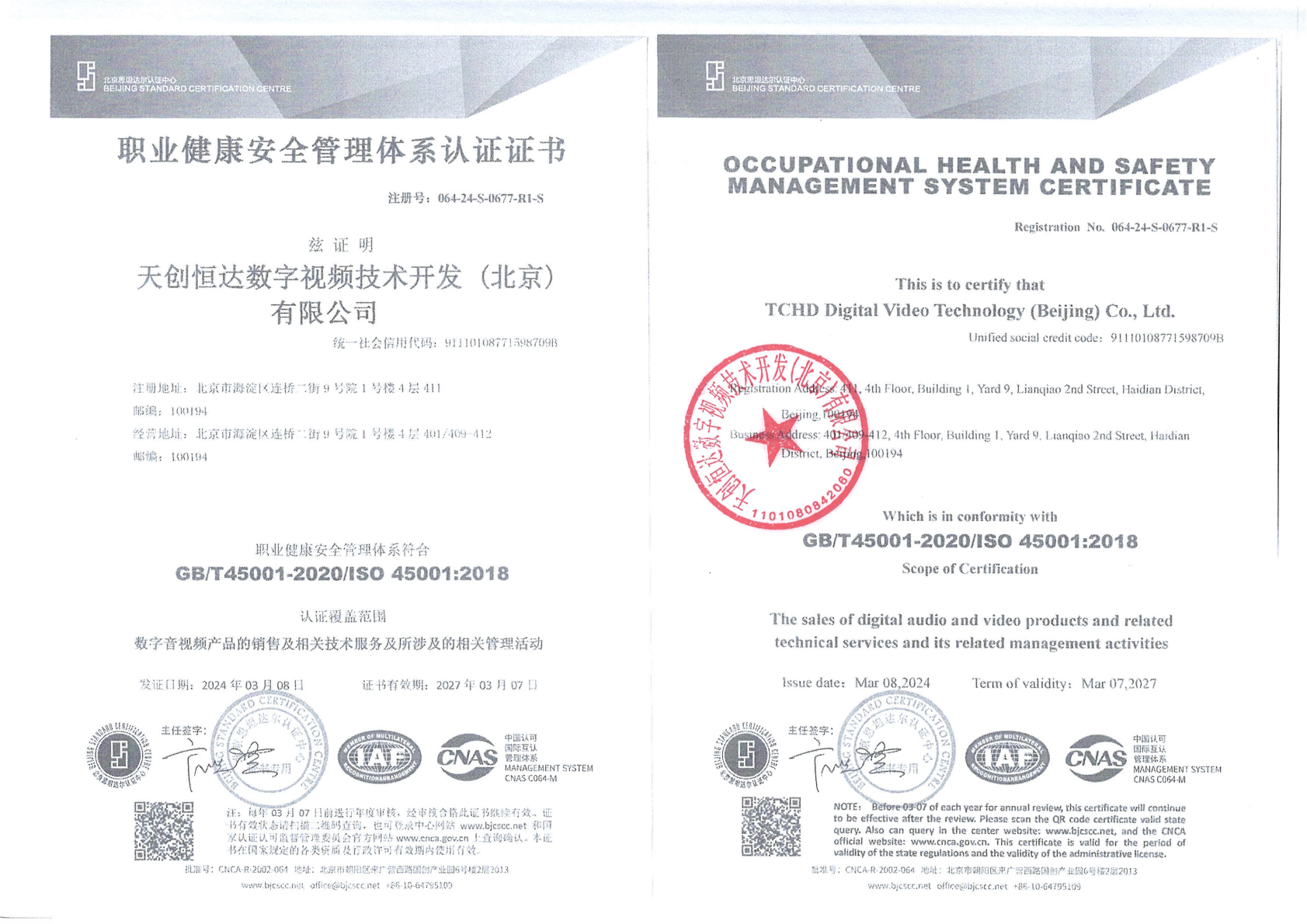
Certification questions are among the last to be asked and among the first to hold up a shipment. The certificates below are held by TCHD Digital Video Technology Development (Beijing) Ltd.
| Certificate | Standard | Certificate number | Issuer | Validity |
|---|---|---|---|---|
| Quality management system (ISO 9001) | GB/T19001-2016 / ISO9001:2015 | 064-24-Q-0675-R1-S | Beijing Standard Certification Centre | 2024-03-08 to 2027-03-07 |
| Environment management system (ISO 14001) | GB/T24001-2016 / ISO14001:2015 | 064-24-E-0676-R1-S | Beijing Standard Certification Centre | 2024-03-08 to 2027-03-07 |
| Occupational health and safety management system (ISO 45001) | GB/T45001-2020 / ISO 45001:2018 | 064-24-S-0677-R1-S | Beijing Standard Certification Centre | 2024-03-08 to 2027-03-07 |
| Attestation of Compliance (CE EMC) | EN 55032:2015/A1:2020; EN 55035:2017/A11:2020 | LCSA07075157E | LCS TESTING LABORATORY | Issued 2025-07-16 |
The three ISO certificates share the same scope wording: the sales of digital audio and video products and related technical services and its related management activities. The CE EMC attestation of compliance lists TCHD-T3, TC420 and TC-980S among its related products.
OEM/ODM and Procurement Terms
Commercial terms are frequently the reason a technically suitable camera does not get ordered. The published terms for this range are:
- OEM and ODM production services are available, with logo customization offered for OEM/ODM orders.
- Minimum order quantity: 1 unit.
- Monthly production capacity: 500 units.
- Typical lead time: 30–45 days.
- Quality control: 100% testing of all units.
- Export markets: EU, South East Asia and the USA at the capability level; the wider corporate market mix is the EU, USA and Asia, with export business representing 20% of total sales.
- Delivery terms: FOB / C&F.
- Payment terms: full payment prepaid.
- Acceptance criteria: pre-shipment test.
- After-sales: remote support.
Full prepayment before shipment is a cash-flow line item that procurement should flag early, and 30–45 days is the planning figure for delivery, not the total project timeline.
Matching Each Model to a Workflow
Classroom and lecture capture
TC-980S and TC420 carry SDI plus IP plus serial control, which suits fixed installations tied into a rack and a control surface. TCHD-T3 covers the same teaching scenario through HDMI, USB and PoE, which suits smaller rooms where the camera connects directly to a PC or a streaming encoder. Its widest horizontal angle of view, 72.5°, is the largest of the three and is useful in compact rooms.
Medical and surgical training
TC-980S lists medical teaching among its product types and includes low-light handling at 0.5 Lux, 2D and 3D noise reduction, and monocular tracking up to 18 meters. Medical electrical equipment is subject to the IEC 60601-1 series for basic safety and essential performance, so a buyer in this segment should confirm which standard applies to the specific device and fixture arrangement before relying on general EMC documentation.
Event and broadcast production
TC420 publishes SDI output alongside 4K HDMI output options, which lets a production chain split a broadcast feed and a monitoring feed. TC-980S adds the 20X and 30X optical configurations for long-throw positions, plus optional NDI and optional Dante AV with a published latency of ≤120ms at 1080p60 and bandwidth of 4–8Mbps at 1080p60.
E-commerce and desk-side streaming
TCHD-T3 publishes USB3.0 Type C and USB 2.0 Type A ports, UVC 1.1–1.5, UVC PTZ, and operating system support covering Windows 7, Windows 8, Windows 10, Mac OS X, Linux and Android, which matches a plug-into-a-laptop workflow.
Deployment evidence for TC-980S spans government, hospital, school and YouTuber customers in Germany, Australia and Malaysia, with 20 units deployed for teaching live streaming and a two-year operating record reporting stable performance, low noise and auto tracking.
Market Trend Context
Third-party industry research projects the global live streaming camera market at USD 3.35 billion in 2025, growing at a CAGR of 8.8% to USD 7.79 billion by 2035. In the conference camera category specifically, PTZ cameras are estimated to account for 38.5% of global revenue in 2025.
For procurement, the practical reading is that PTZ is no longer a specialized format — it is the default mechanical configuration for meeting rooms and teaching spaces. When a category becomes the default, the differentiating questions shift away from whether to use PTZ and toward protocol compatibility, power topology and documentable compliance. That is exactly the shift visible in the questions above.
Limits and Boundaries Buyers Should Note
An accurate specification list includes what a document does not cover. Several boundaries apply here.
- The CE EMC attestation of compliance number LCSA07075157E records its scope as the TC-400N4 HDMI series capture card, even though the related-product list includes TCHD-T3, TC420 and TC-980S. A buyer who needs EMC evidence for a specific camera model should request the certificate issued against that model rather than treating one document as blanket coverage for a product family.
- TCHD-T3 publishes no SDI output and no serial control interface. Any specification that requires either is out of its scope on published parameters alone.
- TCHD-T3 carries 2.07M effective pixels and a video system capped at 1080P, while TC-980S and TC420 publish 4K output resolutions. For 4K acquisition, TCHD-T3 is not the matching model.
- TC-980S and TC420 ship with adapters rated at DC12V/1.5A and DC12V/2.5A respectively. Adapters should be kept matched to the model rather than pooled across a mixed fleet.
- Payment terms are full prepayment, and the published after-sales provision is remote support. Multi-site rollouts with on-site response requirements should plan for that boundary.
- Published applicable industries and applications for these models are indoor environments — classrooms, training rooms, event venues and streaming studios.
Future Outlook
The current generation of live streaming cameras has already split into two recognizable lines. One line is built around fixed-installation signal paths — SDI, HDMI, serial control, PoE+ — and higher effective pixel counts. TC-980S and TC420 sit in that line. The other is built around direct connection to computing devices and networks, where HDMI, USB and IP carry the whole workflow. TCHD-T3 sits in that line.
What is likely to move in the near term is not the physical format but the protocol layer. ONVIF, RTSP, RTMP and SRT are now baseline expectations, GB/T28181 is a decisive requirement in some markets, and optional capabilities such as NDI and Dante AV remain configuration decisions rather than defaults. For buyers, the practical consequence is that a protocol and certification checklist will identify a suitable model faster than a feature comparison will.
Frequently Asked Questions
Do TC-980S and TC420 support 4K output?
Both publish 4K resolutions in their video signal lists. TC-980S lists 3840x2160 in its HDMI output options, and TC420 lists 4KP30 and 4KP25 in its HDMI output options. Each also publishes lower resolutions, so the output format can be matched to the receiving equipment.
Can TCHD-T3 be used in an SDI workflow?
No. The published parameters for TCHD-T3 list a 1x HDMI 1.4b output, USB3.0 Type C and USB 2.0 Type A ports, and an RJ45 network port. No SDI output is listed. TC-980S and TC420 are the models in this group that publish SDI outputs.
Which models support Power over Ethernet?
TC-980S publishes a 1000M Ethernet port with optional PoE+ power supply. TC420 publishes a 10M/100M/1000M adaptive Ethernet port supporting PoE. TCHD-T3 publishes a 1x RJ45 10M/100M adaptive Ethernet port supporting PoE. Power consumption for TC-980S is ≤18 W and for TC420 is below 12 W.
What should be included in the deployment cable kit?
An HDMI cable, an Ethernet cable, and the model-matched DC 12V power adapter form the baseline. An SDI cable is required only for TC-980S and TC420. A 3.5mm audio cable is required where the linear audio input is used, and a serial control cable is required where RS232 or RS-485/RS-422 control is used.
What certifications apply to these live streaming cameras?
The manufacturer holds ISO 9001:2015 (064-24-Q-0675-R1-S), ISO 14001:2015 (064-24-E-0676-R1-S) and ISO 45001:2018 (064-24-S-0677-R1-S), all issued by Beijing Standard Certification Centre and valid from 2024-03-08 to 2027-03-07, covering the sales of digital audio and video products and related technical services and its related management activities. A CE EMC attestation of compliance, number LCSA07075157E, was issued by LCS TESTING LABORATORY against EN 55032:2015/A1:2020 and EN 55035:2017/A11:2020.
What are the minimum order quantity and lead time?
The minimum order quantity is 1 unit, monthly production capacity is 500 units, and the typical lead time is 30–45 days. Quality control covers 100% testing of all units, and OEM and ODM production services are available with logo customization.
What are the payment and acceptance terms?
Delivery is arranged through FOB / C&F methods, payment terms require full prepayment before shipment, and acceptance is based on pre-shipment test procedures.
Which model is suitable for medical training rooms?
TC-980S lists medical teaching among its product types and publishes 0.5 Lux minimum illumination, 2D and 3D noise reduction, and monocular tracking up to 18 meters. TC420 also lists medical training as an application. Where a device is classified as medical electrical equipment, IEC 60601-1 series compliance is a separate requirement that should be confirmed against the specific configuration.
For the complete model list and specification tables across the TCHD Video range, the TCHD Product Catalog 2025 is available for reference and download.