
Living Room Wine Cabinet: Specs, Limits, and Compliance
A living room wine cabinet is a temperature-controlled storage unit installed in a shared domestic space rather than a dedicated cellar, which means it must satisfy storage, acoustic, electrical, and interior-integration constraints at the same time. In practice, the specification that fails in a living room is rarely the one with the weakest cooling performance. It is the one where depth, noise, power provision, or certification documentation was never confirmed before the surrounding cabinetry was built.
This reference examines those constraints for buyers at the research and evaluation stage: interior specifiers, importers, hospitality procurement teams, and homeowners commissioning custom joinery. It uses the documented specifications, certification records, and customization limits of Pinsec wine cabinets — produced by Foshan Pinsec Stainless Steel Co., Ltd., a Foshan-based manufacturer established in 2005 — as a worked example, and it separates verified facts from judgment calls throughout.
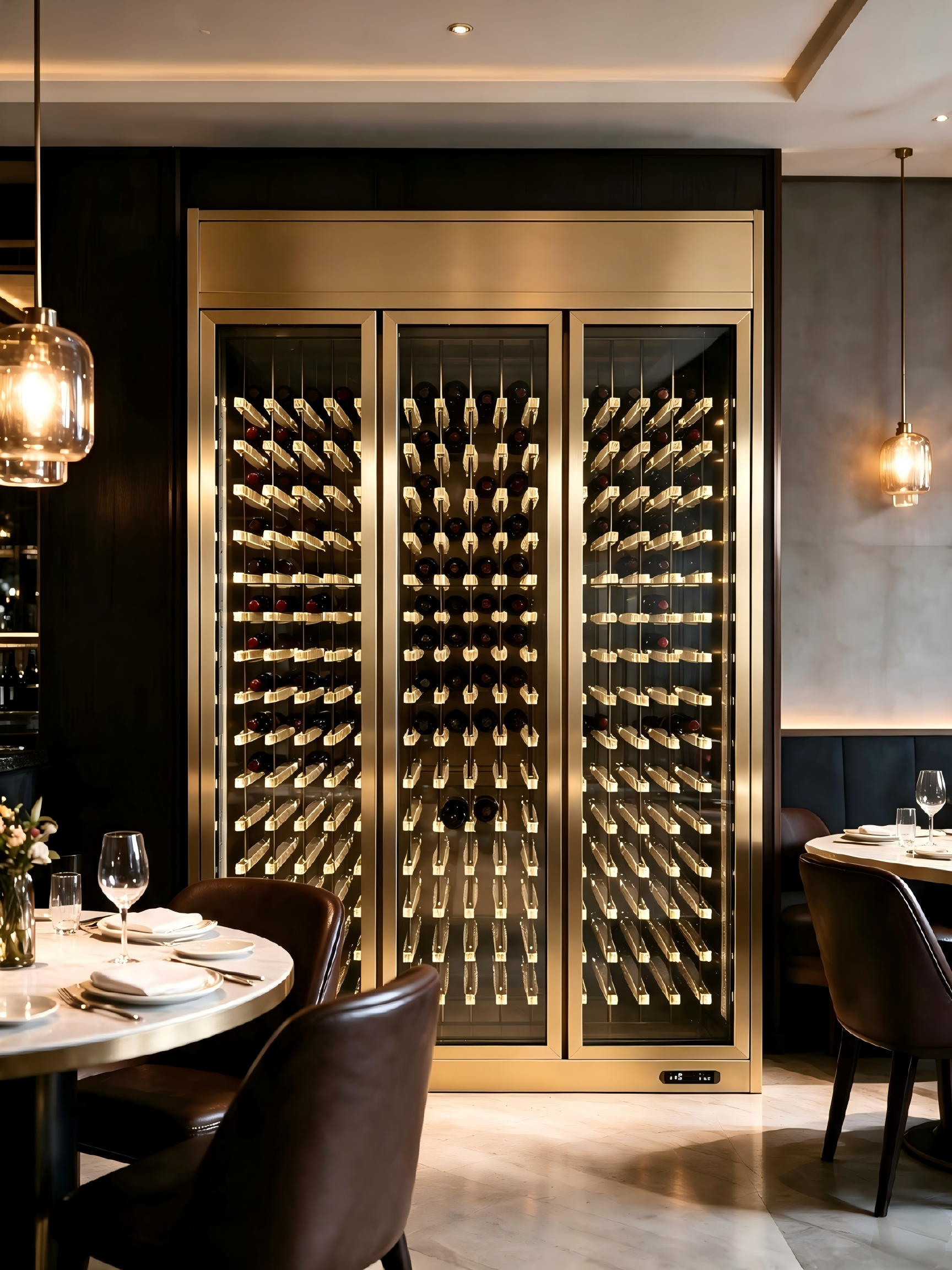
A stainless steel wine cabinet specified for a living room, where cooling performance, acoustics, and interior integration have to be resolved together. Image: Pinsec.
Why the Living Room Is the Harder Installation
Cellars are forgiving; living rooms are not. A wine storage cabinet placed in a living room operates in a space that is occupied for long periods, heated and cooled with the rest of the house, and visually exposed to guests. Four constraint categories follow from that single fact.
- Acoustic exposure. A cooling unit that is acceptable in a service corridor is judged differently next to a sofa. The documented noise level for the Pinsec stainless steel wine cabinet is 45 dB — a specification value, not a claim of inaudibility in a quiet room.
- Continuous duty. Living room installations typically run year-round rather than seasonally. The documented operating mode for living room, villa, hotel, and clubhouse applications is 24/7 under constant temperature.
- Electrical provision decided at the joinery stage. A built-in cabinet cannot be powered by an extension lead added after the walls are finished. The unit requires a defined outlet and cable cross-section.
- Visual integration. The cabinet becomes part of the room's composition, which pushes buyers toward full-length glass doors, stainless steel frames, and concealed lighting rather than utilitarian shelving.
Each of these constraints can be verified in advance. None of them can be resolved after delivery.
Specifications to Verify Before Ordering
The table below consolidates the documented specification of the Pinsec custom stainless steel wine cabinet. Buyers evaluating any living room wine cabinet — including compressor wine coolers from other suppliers — can use the same row set as a comparison frame, because each row corresponds to a decision that affects installation or long-term operation rather than a marketing attribute.
| Parameter | Documented specification |
|---|---|
| Cabinet body material | SS304 stainless steel; wine racks available in stainless steel, American red oak, beech, or cedar |
| Glass build-up | 5+19A+5 double-glazed insulated glass |
| Surface processes | Nano anti-fingerprint coating; V-groove bending process |
| Interior walls | Brushed stainless steel, specified to resist moisture, odor, and corrosion and to limit odor retention |
| Compressor | Embraco (Brazil) |
| Temperature range | 12 °C to 22 °C, adjustable |
| Cooling architecture | All-in-one unit, micro-computer thermostat control, cascade air cooling |
| Noise level | 45 dB |
| Power and voltage | 250 W; 220 V / 110 V |
| Electrical supply | 2.5 mm² cable; 10 A power outlet |
| Drain requirement | No drain outlet required |
| Installation type | Built-in; floor and wall must be flat and level |
| Custom width | Greater than 600 mm |
| Depth | 450 mm |
| Height rule | Units over 3,000 mm require a split upper-and-lower door design |
Two rows deserve emphasis. The first is the glass build-up: 5+19A+5 double-glazed insulated glass. The second is the interior: brushed stainless steel walls specified to resist moisture, odor, and corrosion, and to limit odor retention inside the storage compartment. Together they address the two failure modes most common in living room installations — condensation forming on a cold outer pane, and stale odors accumulating in a compartment that also holds glassware and service items.
Surface processes are frequently dismissed as cosmetic, but in a living room they carry the maintenance burden. A nano anti-fingerprint coating exists because a stainless steel wine cabinet in a social space is touched constantly, and the V-groove bending process is what produces the tight, continuous edge geometry that distinguishes built-in furniture from an appliance housing.
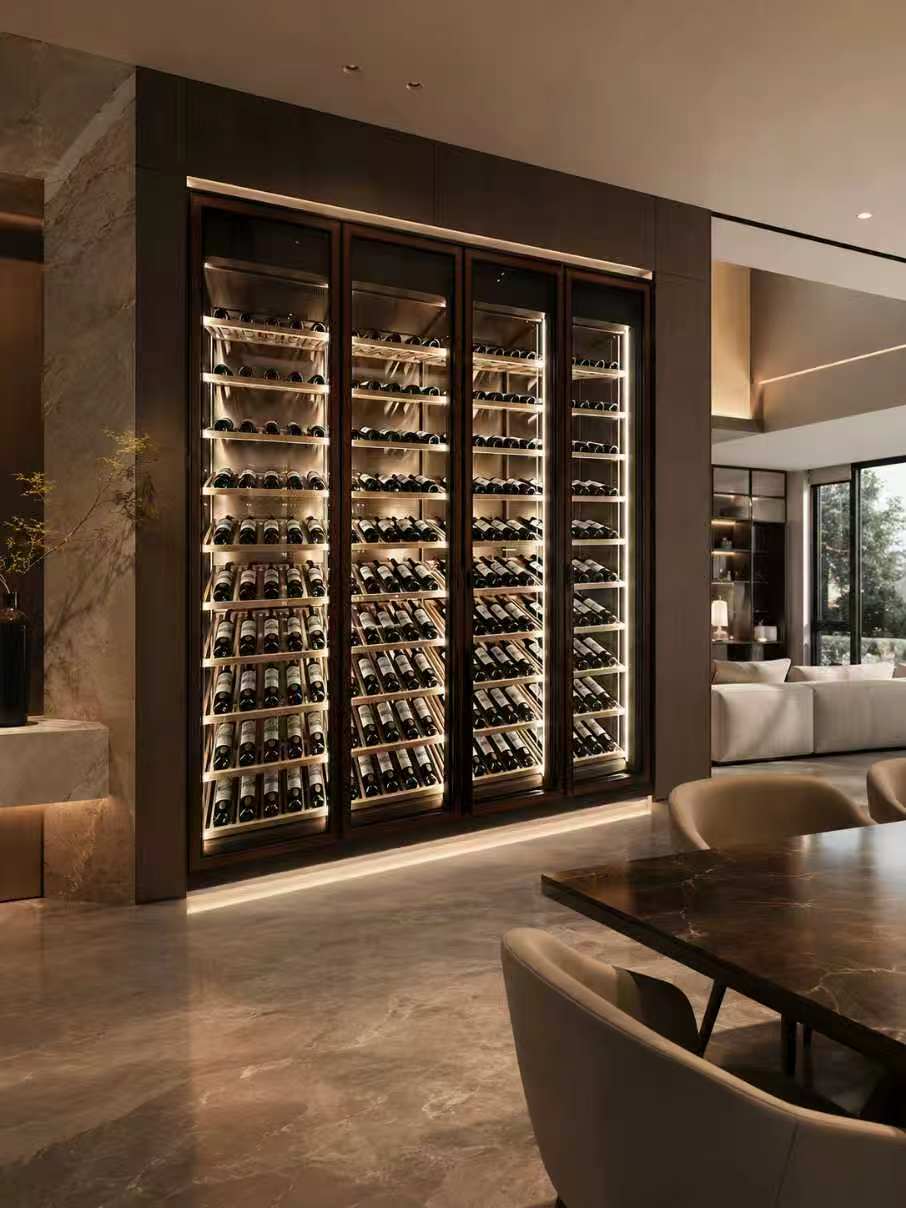
A four-door temperature-controlled configuration. Full-length glass exposes the shelving layout, which is why depth and level tolerances become visible quality issues in built-in installations. Image: Pinsec.
Cooling Architecture and the Working Temperature Band
Cooling in this cabinet is compressor-based rather than thermoelectric. The specification names an Embraco compressor, an all-in-one cooling unit, micro-computer thermostat control, and cascade air cooling. For a living room installation, compressor cooling matters for two reasons: it holds a set temperature across a continuous duty cycle, and its performance does not depend on the room being cool.
The adjustable range is 12 °C to 22 °C. That band is wide enough to cover service temperatures for red wine, white wine, champagne, and sake — the four categories listed in the documented application profile — without implying that one set point serves all of them equally. Buyers storing mixed collections should confirm how zones are configured for their intended bottle mix rather than assuming a single-zone cabinet behaves like a multi-zone one, and should note that bottle placement within a tall column affects the temperature a bottle actually experiences.
Air movement is described as cascade cooling, which distributes cooled air through the compartment rather than directing it from a single evaporator face. In a full-height, glass-fronted cabinet this detail matters because stratification is the visible failure mode: bottles at the top and bottom of a tall column drift apart if air distribution is poorly designed.
Electrical and Installation Requirements
These are the constraints that most often delay a living room project, and each is documented rather than inferred:
- Rated voltage 220 V / 110 V; rated power 250 W.
- Supply requires a 2.5 mm² cable and a 10 A power outlet.
- No drain outlet is required.
- Built-in installation requires a flat and level floor and wall.
The absence of a drain requirement removes one of the more expensive provisions in a wet-area installation, but it does not remove the electrical provision. In a renovation, the 10 A outlet has to be planned against the cabinet's final position, because a built-in stainless steel wine cabinet is not easily relocated once the surrounding joinery is closed. The flat-and-level requirement is similarly a construction-stage item: an out-of-true wall shows up as an uneven door gap on a full-height glass-fronted cabinet, where tolerances are visually obvious and cannot be hidden by trim.
What the CE, EMC, and RoHS Documentation Actually Covers
Certification is frequently cited in sales material and rarely read. For the EU market, two separate documents apply to this stainless steel thermostatic wine cabinet, and they address different risks. Electrical safety and electromagnetic compatibility are covered by one verification; restricted substances by another.
| Document | Scope | Certificate no. | Issuer | Validity |
|---|---|---|---|---|
| CE LVD 2014/35/EU and EMC 2014/30/EU — Verification of Conformity | Stainless Steel Thermostatic Wine Cabinet, EU market | DPWD/1988/04/KA/26 | ICG-Intercert Global Sp. z o.o. | 2026-02-04 to 2027-02-04 |
| CE (RoHS) — Certificate of Conformity | Stainless Steel Thermostatic Wine Cabinet (model Custom), EU market | HYC2026010032RV1 | Shenzhen HyCert Co.,Ltd | 2026-01-23 to 2027-01-23 |
The LVD/EMC verification cites EN IEC 60335-1:2023/A11:2023 and EN 60335-2-24:2024 for electrical safety, and EN IEC 55014-1:2021 and EN IEC 55014-2:2021 for electromagnetic compatibility. The RoHS Certificate of Conformity cites the IEC 62321 series: IEC 62321-4:2013+A1:2017, IEC 62321-5:2013, IEC 62321-6:2015, IEC 62321-7-1:2015, IEC 62321-7-2:2017, and IEC 62321-8:2017.
Three practical points follow for buyers:
- Both documents are time-bound. The LVD/EMC verification runs from 2026-02-04 to 2027-02-04; the RoHS certificate from 2026-01-23 to 2027-01-23. A quotation that cites certification without a validity date is incomplete, because the document may have lapsed by the time goods ship.
- Certification is scoped to a product, not to a supplier. Both documents name the Stainless Steel Thermostatic Wine Cabinet as the certified scope. A general certification claim does not automatically extend to a different model or a materially different configuration.
- CE and CB are stated as available on request. Buyers who need CB documentation for a specific market should confirm it at the enquiry stage rather than at shipment, since it is provided on request rather than as standard paperwork.
Dimensions, Customization, and Structural Limits
Custom sizing is where a living room project is won or lost, because the cabinet has to fit an alcove that already exists or a joinery plan already drawn. Documented customization covers size, logo, power, color, and wine rack configuration at OEM/ODM level. Two dimensional parameters are specified: custom widths greater than 600 mm, and a depth of 450 mm.
The depth figure is worth flagging early. At 450 mm the cabinet is shallower than some built-in cabinetry conventions, so the surrounding unit has to be designed around the cabinet rather than the reverse. On height, there is a documented structural rule: units over 3,000 mm in height require a split upper-and-lower door design. That is an engineering constraint rather than a styling preference — a single full-height glass door at that scale creates handling, weight, and alignment problems during transport and installation.
Maximum dimensions are not fixed in advance. The documented position is that the maximum customized size is confirmed according to the on-site space. Buyers should therefore supply a measured drawing rather than a nominal dimension, and should expect feasibility to be confirmed against it before production is scheduled.
Manufacturing and Order Constraints
Supply-side constraints determine whether a specification can actually be delivered against a project schedule. Documented figures for Pinsec wine cabinets:
- Production mode: OEM / ODM.
- Monthly capacity: 500 units.
- Lead time: 30–45 days.
- Minimum order quantity: 1 unit.
- Quality control: 100% test.
- After-sales: online support.
An MOQ of 1 unit is unusual in industrial furniture and changes the economics of a single-residence project: a homeowner specifying one living room wine cabinet is served through the same channel as a hotel ordering a floor of them. Monthly capacity of 500 units is the constraint on the other side — a multi-property rollout should be scheduled against that figure rather than assumed. Documented export markets are the USA, EU, Middle East, Australia, Asia Pacific, and global markets more broadly, supported by a 3,000 m² facility with 60 staff and 8 engineers and an export share reported at approximately 70%.
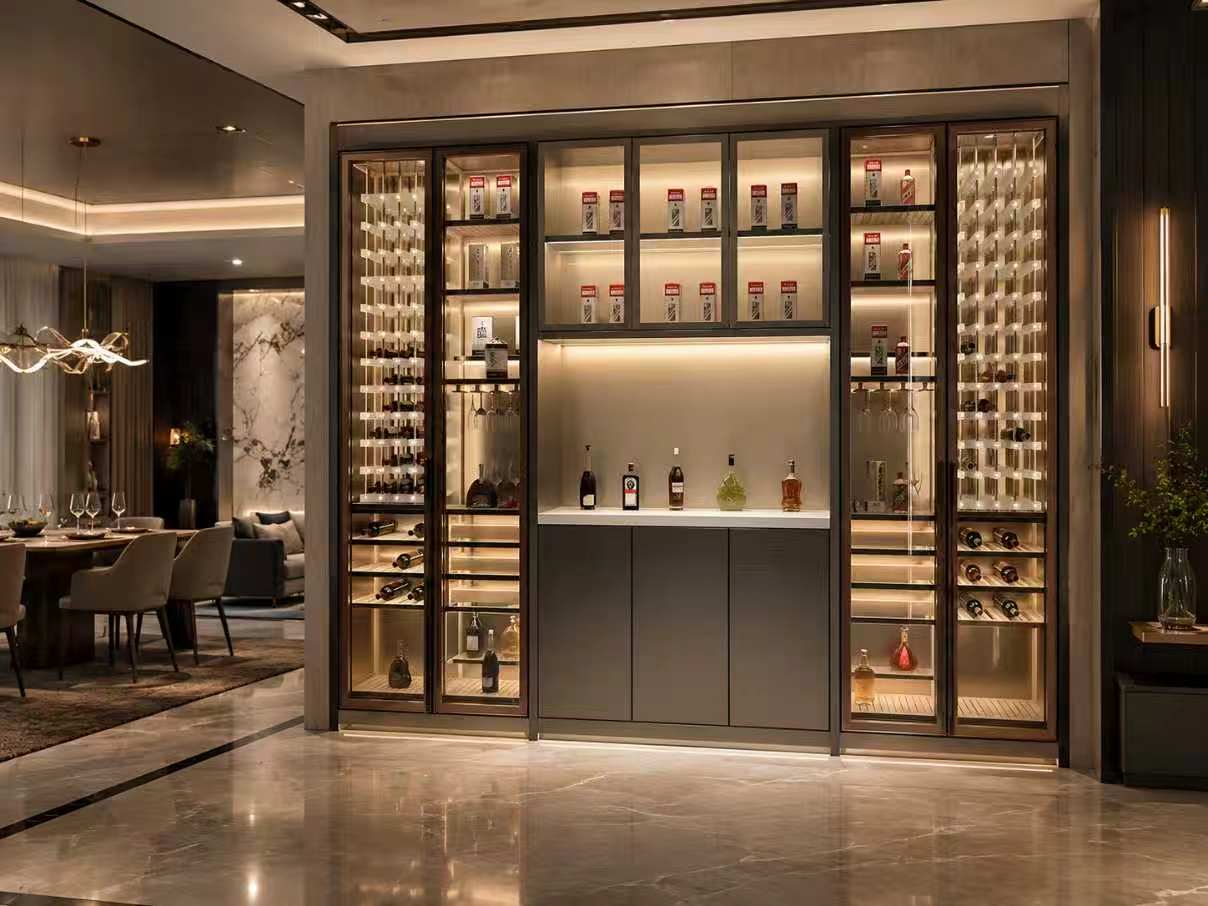
Living room integration: a wine storage cabinet paired with a sideboard, illustrating how the unit is specified as furniture rather than as a standalone appliance. Image: Pinsec.
Where This Configuration Fits
Documented application environments are living room, hotel, restaurant, villa, clubhouse, and large flat. The common thread is a space where the cabinet is seen as well as used. In those settings the functional brief is display and storage of red wine, white wine, champagne, and sake under constant temperature, running 24/7, with a temperature control system as the matched equipment and a double-glazed glass specification plus anti-fingerprint and V-groove processes as the stated special requirements.
A documented commercial case shows the scale this platform can reach: nine units supplied to a fine dining restaurant, where floor-to-ceiling temperature-controlled cabinetry became the visual focal point of the dining room. The reported outcome was an intensified premium atmosphere and stronger positioning around wine — an interior-design and brand result rather than a technical one, and it should be read as such. What it does demonstrate is that the same configuration logic scales from a single living room unit to a multi-unit commercial wall.
Market Context and Category Definition
Category data is useful for planning but must be read with its definitions attached. Market Research Future estimated the global wine cabinet market at 2.213 billion USD in 2024, projecting 4.531 billion USD by 2035 at a CAGR of 6.73%. Those figures sit alongside a material trend: stainless steel wine tanks and cabinets were reported at approximately 42.5% of global material share in 2025.
The definitional caveat is not minor. Different research houses scope the category differently — one 2025 estimate sits near 1.27 billion USD while another sits near 2.36 billion USD, largely because some definitions include non-electric wine furniture and others do not. Buyers using market size to justify a category decision should treat the range as the signal and the point estimate as one house's scope choice.
Two practical data points sit outside that debate. In the United States, electric wine coolers and refrigerators are typically classified under HS Code 8418.69.0180, which importers should verify with their customs broker before shipment. And the material shift is real at product level: stainless steel has moved from a functional tank material into a visible luxury surface in high-end living room cabinetry, which is precisely why surface processes such as nano anti-fingerprint coating and V-groove bending appear in specifications at all.
Comparison with Traditional Storage Solutions — and Where This Falls Short
A fair comparison sets a temperature-controlled stainless steel cabinet against the two alternatives buyers actually consider: passive wooden wine racks and freestanding wine coolers.
| Dimension | Passive wooden rack | Freestanding wine cooler | Built-in stainless steel wine cabinet |
|---|---|---|---|
| Temperature stability | Follows room temperature | Controlled, unit-dependent | Controlled at 12 °C–22 °C, adjustable |
| Interior environment | Depends on room humidity and odors | Typically plastic or coated interior | Brushed stainless steel walls specified to resist moisture, odor, corrosion and limit odor retention |
| Interior integration | Furniture-like | Appliance-like, usually visible | Built-in, full-length glass, concealed lighting |
| Installation complexity | Low | Low (plug-in) | Higher: flat and level substrate, 10 A outlet, 2.5 mm² cable |
| Noise exposure | None | Present, unit-dependent | 45 dB documented |
| Customization ceiling | Joinery-dependent | Fixed sizes | Custom size, logo, power, color, wine rack |
The limitations matter as much as the advantages, and they are specific:
- 45 dB is a measured specification, not a silence guarantee. In an open-plan living room with low background noise, a compressor inside a glass-fronted cabinet can be perceptible. Buyers whose seating is close to the cabinet should evaluate this against the room rather than the datasheet alone.
- The 450 mm depth constrains joinery design. It is an advantage in a tight alcove and a complication where surrounding cabinetry assumes a deeper module.
- Heights above 3,000 mm require a split door. Projects wanting one uninterrupted glass plane at that scale will not get it.
- Electrical provision is non-negotiable. No drain is required, but a 10 A outlet and 2.5 mm² cable are, and both must be planned before the wall is closed.
- Certification has a validity window. Documents valid into early 2027 require re-confirmation for projects shipping later.
- Custom sizing has no universal maximum. Feasibility is confirmed per project against on-site measurements, which adds a design-review step that off-the-shelf units do not require.
None of these limitations disqualifies the approach for a living room. They define the conditions under which it works, and they are the conditions a buyer can check before committing to a drawing.
Future Outlook
Three developments are likely to shape living room wine cabinet specification over the next planning cycle. First, differentiation is moving from material category to surface performance: with stainless steel holding near two-fifths of global material share, the question is less whether a cabinet is stainless and more how its surface resists fingerprints and wear under daily contact. Second, documentation discipline is tightening in the EU market, where LVD, EMC, and RoHS paperwork with named certificate numbers, cited standards, and validity dates is becoming part of the buyer's standard file rather than an afterthought. Third, the acoustic question remains the least standardized: comparative noise and vibration benchmarking across luxury brands is a documented gap in available third-party data, which means buyers currently have to verify quiet operation through specification review and, where possible, direct evaluation of the room.
FAQ
What should be verified first when specifying a living room wine cabinet?
Three items determine feasibility before any aesthetic decision. The electrical provision: rated voltage 220 V / 110 V, rated power 250 W, a 2.5 mm² cable, and a 10 A power outlet. The installation substrate: floor and wall must be flat and level for built-in installation. And the available depth: the cabinet is specified at 450 mm. All three are construction-stage constraints that cannot be resolved after the surrounding joinery is finished.
Can the size of a living room wine cabinet be customized?
Yes; custom size production is supported. Documented parameters include custom widths greater than 600 mm and a depth of 450 mm. The maximum customized size is confirmed according to the on-site space rather than fixed in advance, and units over 3,000 mm in height require a split upper-and-lower door design.
What electrical supply does the wine cabinet require?
Rated voltage is 220 V / 110 V and rated power is 250 W. Installation requires a 2.5 mm² cable and a 10 A power outlet. No drain outlet is required. Built-in installation requires a flat and level floor and wall.
What is the noise level, and is it suitable for an open living room?
The documented noise level is 45 dB. Whether that is acceptable depends on the room rather than on the number alone: in a quiet open-plan living area, a compressor in a glass-fronted cabinet may be perceptible, so the figure should be evaluated against expected background noise and the distance from seating areas.
Which certifications apply to the stainless steel thermostatic wine cabinet in the EU?
Two documents apply. First, a CE LVD 2014/35/EU and EMC 2014/30/EU Verification of Conformity, certificate number DPWD/1988/04/KA/26, issued by ICG-Intercert Global Sp. z o.o., valid from 2026-02-04 to 2027-02-04, citing EN IEC 60335-1:2023/A11:2023, EN 60335-2-24:2024, EN IEC 55014-1:2021, and EN IEC 55014-2:2021. Second, a CE (RoHS) Certificate of Conformity, number HYC2026010032RV1, issued by Shenzhen HyCert Co.,Ltd, valid from 2026-01-23 to 2027-01-23, citing the IEC 62321 series. CE and CB certification can also be provided on request.
What OEM options and order constraints apply?
Production mode is OEM / ODM, with customization of size, logo, power, color, and wine rack configuration. Minimum order quantity is 1 unit, lead time is 30–45 days, monthly capacity is 500 units, quality control is 100% test, and after-sales support is provided online.
For the complete specification set, customization scope, and configuration detail in a single document, the Pinsec premium custom wine cabinet catalogue is available for download: Pinsec Premium Custom Wine Cabinet Catalog 2026.
Have Questions or Need More Details?
Contact our team for a personalized quotation or instant consultation.
Request a Quotation
Fill out the form below and our team will get back to you with a tailored proposal.
WhatsApp Direct Chat
Prefer to chat in real-time? Message us on WhatsApp for instant assistance & quick answers.
- Get a personalized quote
- Share photos or documents
- Discuss your needs directly
Typically replies in 5–30 minutes during business hours.