
Long-Battery Phones: FAQ on Lifespan, Power Use and Cost
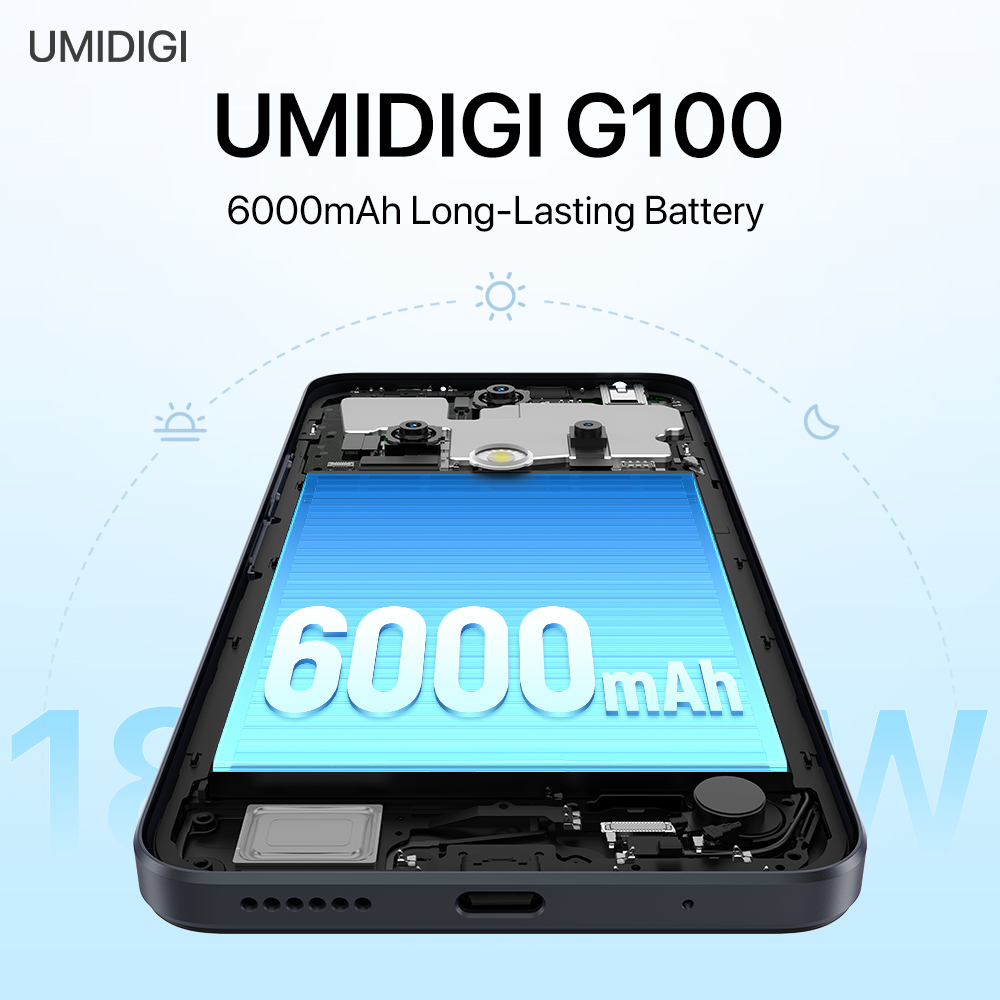
A large-capacity battery module used in UMIDIGI long-battery smartphones. Capacity is only one of three numbers a procurement team needs.
Battery capacity is the easiest specification to print on a purchase order and one of the hardest to verify before delivery. This FAQ addresses the questions buyers raise at the decision stage: how a quoted capacity translates into working hours, where power is actually consumed, how battery safety is controlled at scale, and why a long-life device can carry a lower total cost than a cheaper conventional handset.
The article is written for procurement managers, importers, distributors and OEM/ODM buyers who are comparing long-battery smartphones against conventional alternatives and need defensible answers rather than marketing claims. Every comparative figure below is attributed to the manufacturer or to a named third-party source, and every limitation is stated alongside the benefit.
Why a Battery Rating Does Not Answer a Procurement Question
Milliampere-hours describe how much charge a cell can hold. They do not describe how quickly a device spends that charge, how much capacity the cell retains after a year of field use, how safely it behaves under continuous load, or what it costs to keep a fleet running. For a buyer signing off on a container of handsets, that gap between a printed number and an operational outcome is where sourcing errors accumulate.
Market data shows how quickly the gap has widened. Smartphones with battery capacities of 6000mAh or higher captured 29% of global sales in January 2026, up from 10% in early 2025, according to Counterpoint Research. In the durable segment, the 5000mAh to 6000mAh band accounted for 42.9% of the rugged phone market in 2025, based on The Insight Partners' rugged phone market analysis. Large batteries are no longer a differentiator; they are the baseline. The procurement question has shifted to what a large battery delivers per charge cycle, per service year and per unit of total cost.
That shift matters commercially. A device that costs slightly more per unit but consumes less power and lasts longer changes the cost structure of a fleet over a two- to three-year horizon. The three figures a buyer should be able to trace are therefore capacity, consumption and lifecycle economics — not capacity alone.
What UMIDIGI Publishes for Its Long-Battery Devices
UMIDIGI is the smartphone brand of Shenzhen Keysmart Technology Co., Ltd., a Shenzhen-based communications technology company founded in 2012 that runs both an own-brand business and ODM/OEM services. The company reports a 10,000 m² facility, a workforce of 400–500 employees, a 30-engineer R&D team, an annual output of 30,000,000 units and a 100% export ratio, with sales across South America, Asia, Africa, the EU and the USA.
Two UMIDIGI devices are directly relevant to battery-life procurement decisions, and the company publishes comparative figures for each.
- UMIDIGI G100 5G — compared with traditional smartphones, the company states a 20% longer expected lifespan, 30% lower power consumption and 10% to 15% lower overall comprehensive cost. The stated core differences are a massive battery, a larger display, a stylish design and a slim frame, which UMIDIGI positions for daily work and life scenarios. The model is documented in UMIDIGI product imagery with a 6000mAh battery.
- UMIDIGI BISON X20 — compared with standard rugged smartphones, UMIDIGI states that it is slimmer, lighter and more durable, with 30% lower power consumption, 25% higher durability, 20% longer service lifespan and 10% to 15% lower overall comprehensive cost, plus less maintenance required. The listed target environments are construction and engineering, logistics and warehousing, manufacturing, mining, oil and gas, agriculture, transportation and delivery, public safety and emergency services, and outdoor field operations.
Read together, the two products occupy different positions on the same decision: the G100 5G optimises day-to-day stamina in a slim body, while the BISON X20 optimises survivability in demanding environments. Both figures sets are comparative, which is the single most important thing a buyer needs to understand before using them in a tender document.
Technical Breakdown: Where the Power Actually Goes
To evaluate the 30% lower power consumption figure, it helps to know what the device is doing with the energy. UMIDIGI specifies the G100 5G with a 6.8-inch 120Hz HD+ punch hole display and a UNISOC T765 5G processor, together with a rear 50MP triple camera system and a 16MP front camera. Each of those is a load, not just a feature.
Display load
The display is usually the largest continuous consumer of power in a smartphone. A 120Hz refresh rate redraws the screen far more often per second than a lower-refresh panel, and a 6.8-inch panel has more illuminated area than a compact screen. In general terms, larger and faster-refreshing displays draw more power per hour of use. The fact that the G100 5G pairs such a panel with a stated 30% lower power consumption compared with traditional smartphones therefore indicates system-level efficiency across the platform, not simply a bigger battery bolted onto a conventional design.
Processor and connectivity load
The UNISOC T765 5G processor determines both peak and idle consumption. 5G radios, camera processing and sustained background activity all place variable demand on the cell, which is why a comparison based on capacity alone tends to mislead. The same capacity can yield very different working hours depending on how efficiently the platform handles sustained workloads and idle states.
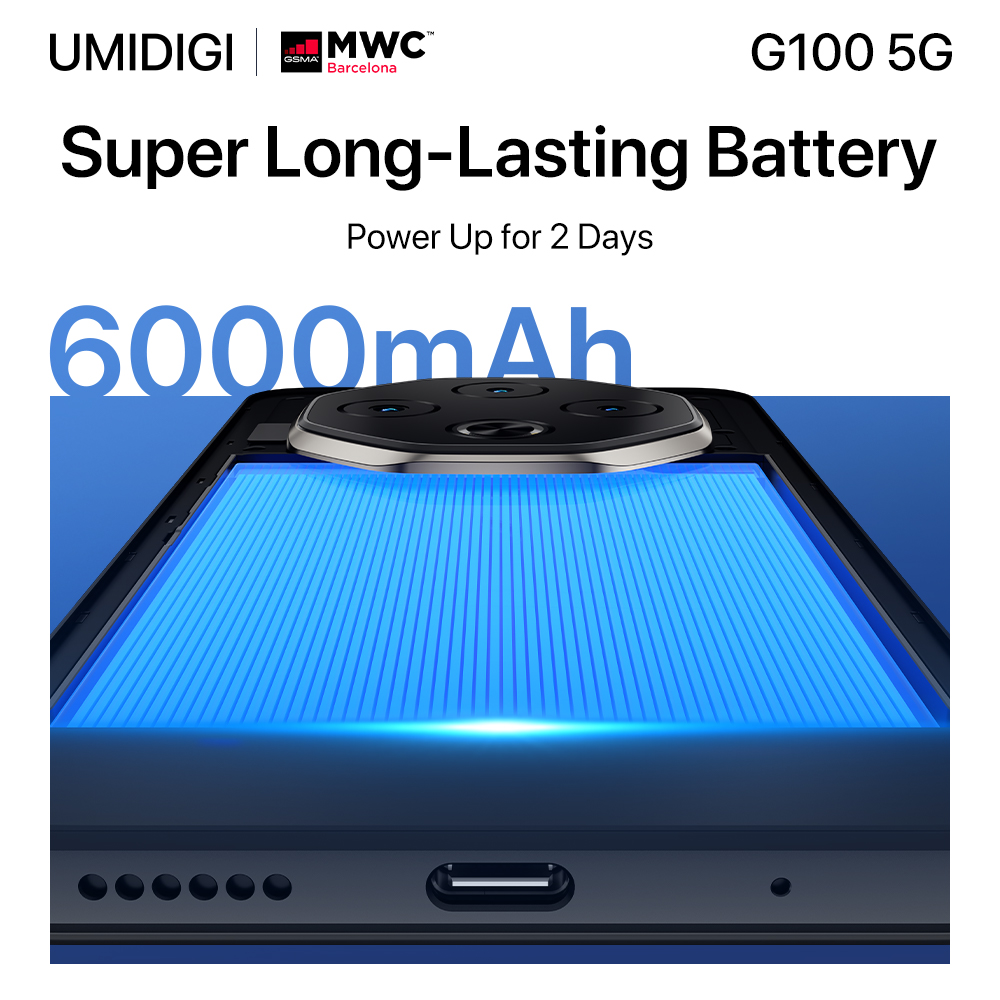
The G100 5G is documented with a 6000mAh battery; published figures state 30% lower power consumption than traditional smartphones.
Thermal behaviour and battery safety controls
Heat is the mechanism behind most battery complaints in the field: it accelerates capacity fade and is associated with cell swelling. UMIDIGI describes a control chain rather than a single protection feature. It includes qualified battery cell supplier selection, use of high-quality and certified battery cells, incoming inspection covering capacity, voltage, internal resistance, thickness and appearance, battery cell consistency testing, NTC thermistor temperature monitoring, and automatic cutoff of charging and discharging when temperature exceeds the safety limit.
At the process level, the company states that it controls battery swelling through qualified cell selection, strict incoming inspection, intelligent charging protection, thermal management, cycle-life testing, controlled production processes and comprehensive battery traceability. For a buyer, the practical value of that list is investigability: capacity claims can be checked against incoming inspection records, consistency testing and traceability data when a batch behaves unexpectedly.
Supporting equipment and bill-of-materials completeness
Long-battery devices are shipped as systems, not as standalone units. The required supporting equipment is a protector film, a phone case, a power adapter, a SIM tray ejector and a USB cable. Procurement teams that price the handset without these items understate the landed cost per usable unit, and leaving them out of the purchase order complicates after-sales handling.
Application Fit: Matching the Device to the Working Condition
The most common specification error at the decision stage is buying a slim long-battery phone for an environment that requires a rugged one, or over-specifying rugged protection for everyday commercial use. The choice should follow the working condition.
| Working condition | What the device must handle | Relevant positioning |
|---|---|---|
| Daily work and personal use | Long screen-on time, mixed communication and entertainment, slim form factor | UMIDIGI G100 5G — massive battery, larger display, slim frame, 20% longer expected lifespan |
| Construction, engineering, mining, oil and gas, agriculture | Water, dust and drop exposure; resistance to wear over multi-year service | UMIDIGI BISON X20 — 25% higher durability, 20% longer service lifespan, less maintenance required |
| Logistics, warehousing, manufacturing, transportation and delivery | Continuous scanning and communication, limited charging windows, low downtime tolerance | BISON X20 for rugged duty cycles; G100 5G where the phone is handled in normal conditions |
| Public safety, emergency services and outdoor field operations | Reliability when charging is not available and failure is costly | BISON X20, with the durability and lifespan figures stated against standard rugged smartphones |
The distinction is not cosmetic. A device selected for durability carries different internal protection priorities than a device selected for slimness, and UMIDIGI publishes separate comparative baselines for each: traditional smartphones for the G100 5G, standard rugged smartphones for the BISON X20.
Market Trend: Long Battery Life Is Becoming a Cost Line, Not a Feature
Three independent signals point in the same direction. First, capacity is normalising upward: 6000mAh-and-above devices reached 29% of global sales in January 2026, up from 10% in early 2025, per Counterpoint Research. Second, the technology underpinning those batteries is changing: silicon-carbon cells are increasingly replacing standard graphite anodes and offer 20–50% higher energy density for slim, long-lasting devices, according to Fortune Business Insights. Third, the durable-phone category itself is expanding: Verified Market Research values the global rugged smartphone market at approximately USD 2.98 billion in 2023, projected to reach USD 5.24 billion by 2030.
Demand is also broadening beyond industrial buyers. Independent contractors and outdoor sports enthusiasts are the primary consumer drivers for water-, dust- and shock-resistant phones, representing 38% of the global rugged market, based on Growth Research data.
A note on market data quality. Rugged phone market estimates diverge widely depending on whether semi-rugged consumer devices or industrial-grade units are included; published figures range from roughly USD 1.27 billion (Technavio) to USD 18.6 billion (Dataintelo) for overlapping periods. Buyers citing market size in an internal business case should define the segment first, because the definitions, not the arithmetic, explain most of the difference.
The procurement consequence is straightforward. As capacity becomes a baseline rather than a selling point, differentiation moves to power efficiency, safety control and service life — the variables that determine cost per year of use rather than cost per unit.
Comparison with Traditional Solutions — and Where the Comparison Stops
UMIDIGI publishes its long-battery comparisons against two defined baselines. The table below consolidates the stated differences without adding figures that are not published.
| Comparison dimension | Traditional / standard rugged smartphone | UMIDIGI G100 5G | UMIDIGI BISON X20 |
|---|---|---|---|
| Power consumption | Baseline | 30% lower | 30% lower |
| Service lifespan | Baseline | 20% longer expected lifespan | 20% longer service lifespan |
| Durability | Baseline | Not the stated comparison point | 25% higher than standard rugged smartphones |
| Overall comprehensive cost | Baseline | 10% to 15% lower | 10% to 15% lower |
| Maintenance | Baseline | Not specified | Less maintenance required |
| Form factor and use case | Conventional handset body | Slim frame, large display, daily work and life | Slimmer and lighter than standard rugged phones, industrial and field use |
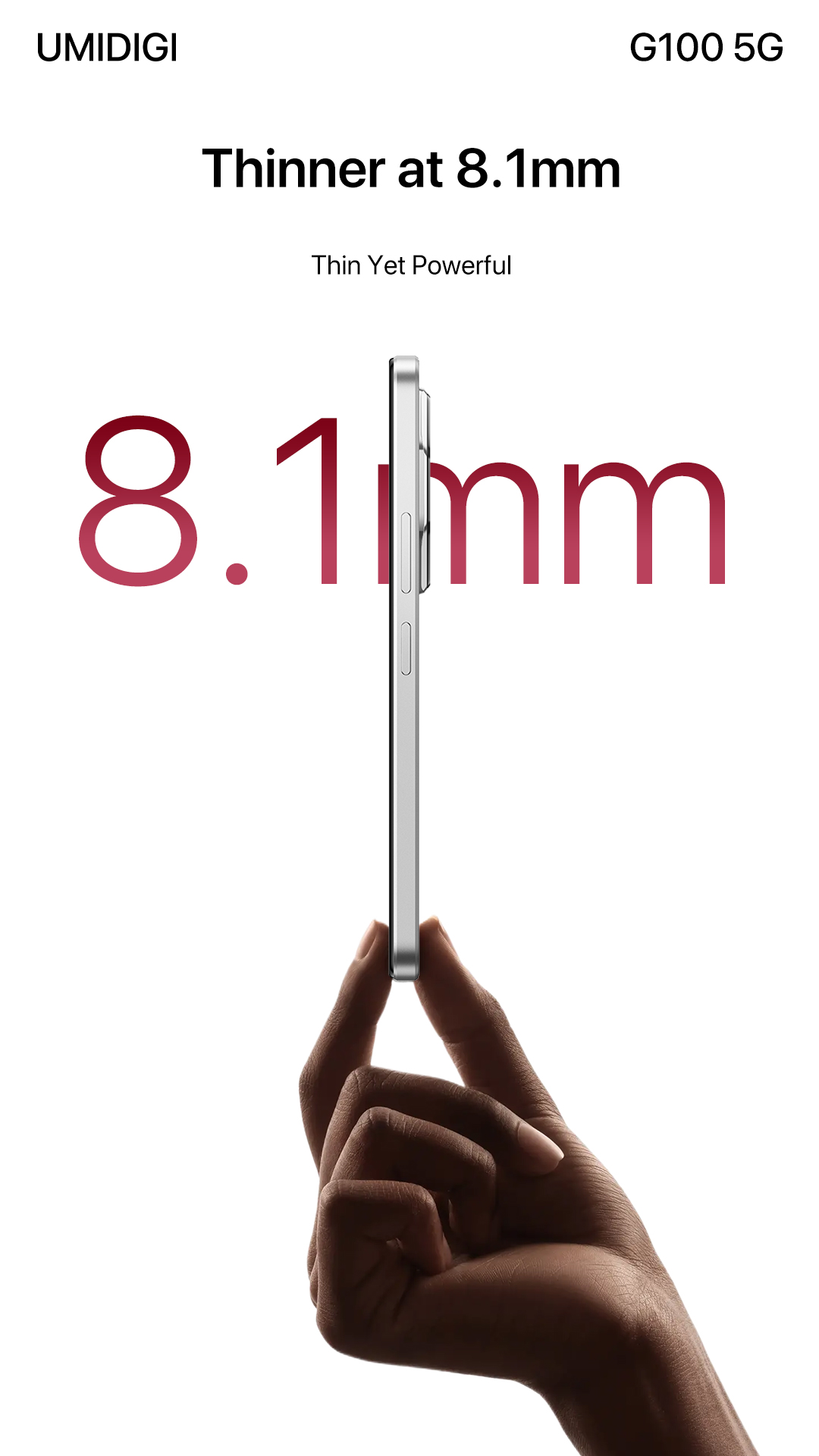
Slim-frame engineering and large battery capacity are competing design priorities; buyers should confirm which one their use case actually requires.
Limitations and boundaries buyers should confirm
- The percentages are relative, not absolute. The 30% lower power consumption, 20% longer lifespan, 25% higher durability and 10–15% lower cost figures are comparative statements made against defined baselines. A comparative claim is only as useful as its reference device and test conditions. Buyers should ask the supplier to state the baseline before the figure enters a tender document.
- Slimness and ruggedness are a trade-off. The G100 5G combines a slim frame with a large battery; the BISON X20 prioritises protection against water, dust and drops. A slim device does not substitute for a rugged one in construction, mining or field environments, and a rugged device is not the default choice for everyday commercial use.
- Expectations are not duty-cycle guarantees. The published figures describe expected lifespan and lower consumption; they do not guarantee a specific number of operating hours for a specific customer workload. Duty cycle, network conditions and charging discipline vary by deployment.
- Ingress and shock ratings are model-specific. Rugged devices for outdoor and industrial use are evaluated against IEC 60529 (IP68/IP69K) for ingress protection and MIL-STD-810H for shock and environmental resistance, but the applicable rating must be confirmed for the exact model quoted rather than assumed across a product family.
- The cost figure is aggregated. The 10% to 15% lower overall comprehensive cost is stated as a comprehensive total; a component-level breakdown (unit price, power, maintenance, replacement, downtime) is not published, so buyers should request the cost scope when building a business case.
Future Outlook
Three developments are likely to shape long-battery procurement over the next buying cycles. The first is the mainstreaming of silicon-carbon battery technology, which supports higher energy density in slim enclosures and continues to move large capacity from a premium specification toward a standard one. The second is the shift in evaluation criteria from capacity to efficiency: as 6000mAh-class devices approach 29% of global sales, capacity alone stops differentiating suppliers, and power consumption per hour of use becomes the more informative number. The third is documentation pressure. Certification, traceability and battery safety evidence increasingly travel with purchase orders because importers and distributors must be able to answer for the products they place on the market.
For manufacturers operating both a brand and an ODM/OEM business, that environment rewards process transparency. Incoming inspection records, cell consistency data, cycle-life testing and comprehensive battery traceability are not marketing features; they are the evidence base a buyer needs when a batch, a warranty claim or a regulator asks a specific question.
FAQ: Technical and Procurement Questions on Battery Life, Power and Cost
1. How should we interpret a claim of 20% longer lifespan when comparing supplier quotes?
The figure is a comparative statement rather than an absolute service guarantee. UMIDIGI publishes a 20% longer expected lifespan for the UMIDIGI G100 5G against comparable products, and a 20% longer service lifespan for the UMIDIGI BISON X20 against standard rugged smartphones. For procurement purposes, the number should be read together with the supplier's battery controls — qualified cell selection, incoming inspection of capacity, voltage, internal resistance, thickness and appearance, consistency testing, cycle-life testing and traceability — and with the commercial warranty terms. The figure helps compare options; it does not replace a defined service-level agreement.
2. What does 30% lower power consumption actually change in daily operation?
It changes how much of the stored charge is left at the end of a working day, and how many charge cycles are consumed to deliver the same amount of usage. UMIDIGI states 30% lower power consumption for both the UMIDIGI G100 5G, compared with traditional smartphones, and the UMIDIGI BISON X20, compared with standard rugged smartphones. Because the figure is relative to a baseline, its practical meaning depends on the reference device and on how the phone is used. Two deployments of the same model can therefore see different outcomes, which is why pilot testing with the buyer's own duty cycle remains the most reliable validation step.
3. Do the display and processor specifications affect the battery decision?
Yes, because they define the load. The UMIDIGI G100 5G is specified with a 6.8-inch 120Hz HD+ punch hole display and a UNISOC T765 5G processor, and is documented with a 6000mAh battery. A large, high-refresh display and a 5G modem are both significant power consumers, so a device that pairs them with a stated 30% lower power consumption is describing platform efficiency rather than battery size alone. Buyers evaluating alternatives should compare capacity, refresh rate, panel size and processor tier together, not capacity in isolation.
4. What battery-safety controls should be verified before placing a large order?
The relevant controls are process controls with records behind them. UMIDIGI states that it controls battery swelling through qualified battery cell supplier selection, use of high-quality and certified battery cells, incoming inspection for capacity, voltage, internal resistance, thickness and appearance, battery cell consistency testing, NTC thermistor temperature monitoring with automatic charging and discharging cutoff above the safety limit, thermal management, cycle-life testing, controlled production processes and comprehensive battery traceability. In an audit or supplier review, the questions that matter are which of these steps generate documented records, how long those records are retained, and how a specific unit can be traced back to its cell batch.
5. How should buyers read the 10% to 15% lower overall comprehensive cost figure?
It is stated as an overall comprehensive cost difference, not as a unit-price discount, and UMIDIGI publishes it for both the UMIDIGI G100 5G and the UMIDIGI BISON X20. The BISON X20 is additionally described as requiring less maintenance than standard rugged smartphones. Because the figure is aggregated, buyers should ask which cost elements are in scope — acquisition, power consumption, maintenance, replacement and downtime — and apply their own volumes and service periods. Treating the number as a component-level breakdown would overstate what has been published.
6. Which UMIDIGI device fits which environment?
The UMIDIGI G100 5G is positioned for daily work and life scenarios, where a slim frame, a larger display and a massive battery matter more than heavy-duty protection. The UMIDIGI BISON X20 is positioned for construction and engineering, logistics and warehousing, manufacturing, mining, oil and gas, agriculture, transportation and delivery, public safety and emergency services, and outdoor field operations. Selection should follow the working condition rather than the specification sheet alone, since slimness and rugged protection represent different design priorities.
7. What should be included in the purchase order beyond the handset?
The supporting equipment for these smartphones comprises a protector film, a phone case, a power adapter, a SIM tray ejector and a USB cable. Buyers should also confirm model-specific compliance documentation: rugged devices for outdoor and industrial use are evaluated against IEC 60529 (IP68/IP69K) for ingress protection and MIL-STD-810H for shock and environmental resistance, and the applicable rating must be verified for the exact model being quoted rather than assumed for an entire product family.
Reference Note
The company data cited in this article is drawn from UMIDIGI's own published product and corporate material; market and technology figures are attributed to Counterpoint Research, Fortune Business Insights, Verified Market Research, The Insight Partners, Growth Research and the divergence notes from Technavio and Dataintelo. Readers who need the underlying company documentation, including facility, R&D and ODM/OEM capability detail, can access the company profile here: Shenzhen Keysmart Technology Co., Ltd. — Company Profile.