
Long-Term Air Compressor Supplier Evaluation: Beyond Price
Long-Term Air Compressor Supplier Evaluation: Beyond Price
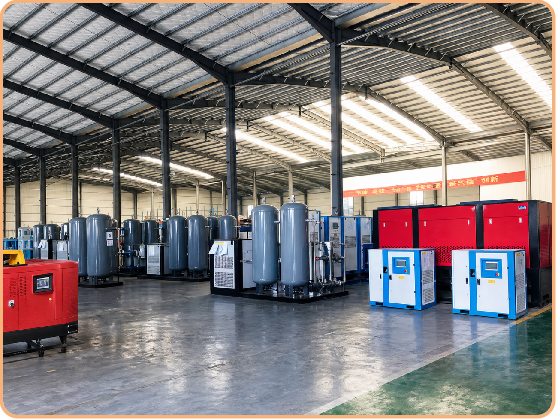
Finished industrial screw air compressor units staged for export at the UMW Air facility in Jinan, where documented annual output is 12,000 units.
Introduction: Compressed Air Is a Multi-Year Commitment, Not a Transaction
An industrial compressed air system sits at the base of factory infrastructure. A rotary screw air compressor commissioned on a production line today is expected to run for years, which means the supplier behind that machine — not only the specification sheet — determines whether those years are uneventful or expensive.
Market scale shows how much depends on that decision. The global industrial air compressor market was valued at USD 20.0 billion in 2025 and is projected to grow to USD 28.3 billion by 2033, according to Grand View Research. Asia Pacific held the largest revenue share at 42.8% in 2025, with China as a key market leader, and the rotary screw segment accounted for 47.0% of the market because of its efficiency in continuous industrial applications.
Those figures describe a market of installed bases rather than one-off purchases. This article examines how procurement teams in the evaluation and execution stages can assess whether an industrial air compressor supplier is able to sustain a multi-year partnership beyond initial pricing, and which capability evidence is worth requesting before a purchase order is issued.
Problem and Opportunity: What the Quotation Does Not Show
A commercial quotation compresses an entire supplier relationship into three numbers: unit price, delivery time and payment terms. None of them describes year three, when a production line depends on compressed air that cannot stop.
In practice, procurement teams that skip structured supplier evaluation tend to run into the same four gaps:
- A configured model or a component class is discontinued, and the replacement path is unclear.
- Measured energy consumption diverges from the selection model once real load profiles apply.
- Regulatory conformity has to be re-confirmed for a new project, and the documentation trail is incomplete for the covered models.
- A site issue requires troubleshooting, and there is no defined support route beyond a general contact address.
The opportunity runs in the opposite direction. Because compressed air is a continuous utility, small efficiency differences compound over time. The U.S. Department of Energy notes that Variable Frequency Drive (VFD) compressors can save up to 35% in energy costs by matching motor speed to actual air demand. Across a multi-year service life, that load-matching capability usually outweighs the price gap between two competing supplier quotations.
The practical consequence is that buyers now compare two different things at the same time. One is the machine. The other is the supplier's ability to stay relevant for the life of the asset.
| Evaluation focus | What it looks like at quotation stage | What actually determines the multi-year outcome |
|---|---|---|
| Cost | Unit price per compressor | Energy consumed per cubic metre of air delivered |
| Delivery | A promised lead time | Replenishment and spare-part continuity |
| Compliance | A certificate file attached to an email | Continued conformity and full documentation for the covered models |
| Support | A phone number | A defined technical support and remote troubleshooting process |
| Configuration | A catalogue model number | OEM/ODM flexibility on voltage, logo and color as requirements change |
Five Capability Dimensions That Decide Whether a Supplier Lasts
Long-term supplier evaluation is not a judgement about brand familiarity. It is a structured check across five dimensions, each of which can be evidenced rather than assumed.
1. Organizational continuity and engineering depth
A compressor partnership survives on people, not on a product catalogue. The relevant questions are how many engineers the manufacturer employs, whether those engineers own the configuration process, and whether the company has the operating history to support a spare-parts and service commitment several years out.
Concrete evidence includes company founding year, total headcount, the size of the R&D function, and whether custom engineering is offered as a standing service rather than a one-off exception.
2. Production capacity and lead-time discipline
Capacity determines whether a supplier can absorb a repeat order during a production ramp, and whether a replacement unit can be shipped before a line stops. Buyers should ask for monthly output, annual output and a stated standard lead time, then check whether those figures are consistent with each other and with the factory footprint.
3. Export-market resilience and compliance continuity
An export-oriented manufacturer has to satisfy different regulatory regimes at the same time. That is a capability signal, because compliance is not a one-time event: certificates have issue and expiry dates, and the harmonized standards behind them are periodically revised.
For the European market, the relevant framework for machinery is the 2006/42/EC Machinery Directive and the 2014/30/EU Electromagnetic Compatibility Directive. For compressed air quality, ISO 8573-1:2010 is the primary international standard for classifying contaminants such as particles, water and oil.
4. Lifecycle support and response paths
Support quality is best evaluated as a process, not as a promise. A verifiable support model states the channel (email or phone), the availability window, and whether remote troubleshooting is offered — because most compressed air problems are diagnosed before anyone arrives on site.
5. Configuration flexibility for OEM and ODM projects
Buyers who intend to extend a product line, rebrand equipment or adapt a machine to a regional voltage standard need a supplier that treats customization as standard practice. Customization scope — which attributes can be changed, and how — separates a catalogue seller from a long-term manufacturing partner.
| Capability dimension | Evidence a buyer can request | Risk if left unverified |
|---|---|---|
| Organizational continuity | Founding year, headcount, R&D team size | Loss of engineering contact and configuration knowledge |
| Production capacity | Monthly and annual output, standard lead time | Repeat orders slip during demand peaks |
| Compliance continuity | Certificate number, issuing authority, validity dates, covered models and standards | Re-certification problems at the next project stage |
| Lifecycle support | Support window, channel, remote troubleshooting scope | Extended unplanned downtime |
| Configuration flexibility | OEM/ODM scope, customizable attributes such as color, logo and voltage | Costly re-sourcing when requirements change |
Applying the Framework: UMW Air as a Capability Evidence Case
Shandong UMW Air Tech Co., Ltd, which trades as UMW Air, is an industrial air compressor manufacturer founded in 2019 and based at 68 Gongye South Road, Jinan, Shandong, China. The company operates a 2,000 m² facility with approximately 200 employees, including a 40-engineer R&D team, and reports an annual output of 12,000 units — equivalent to a monthly production capacity of 1,000 units.
Its product range covers Air-Cooled Screw Air Compressor, Direct-Driven Screw Air Compressor, Stationary Screw Air Compressor, Diesel Mobile Screw Air Compressor and Heavy-Duty Screw Air Compressor lines, oriented toward industrial compressed air system requirements rather than light-duty consumer applications.
Export orientation as a capability signal
UMW Air reports that 100% of its sales are export sales, distributed across the EU, USA, Southeast Asia, the Middle East, South America and Africa. For a buyer, that spread matters in two ways: it implies the supplier routinely handles multiple conformity regimes and documentation sets, and it implies that its reference base is geographically diverse rather than dependent on a single home market.
Compliance continuity in practice
UMW Air holds CE certification M.2026.206.C140156, issued by UDEM for the EU/EEA market, valid from 2026-05-11 to 2031-05-10. The certificate scope covers the UMW air L, UMW air Z, UMW air P, UMW air M, UMW air N and UMW air O product ranges, and references the 2006/42/EC Machinery Directive and 2014/30/EU Electromagnetic Compatibility Directive, with harmonized standards including EN ISO 12100:2010; EN 60204-1:2018/A1:2025; EN 1012-1:2010; EN IEC 61000-6-2:2019; EN IEC 61000-6-4:2019; and EN IEC 61000-3-2:2019+A1:2021+A2:2024.
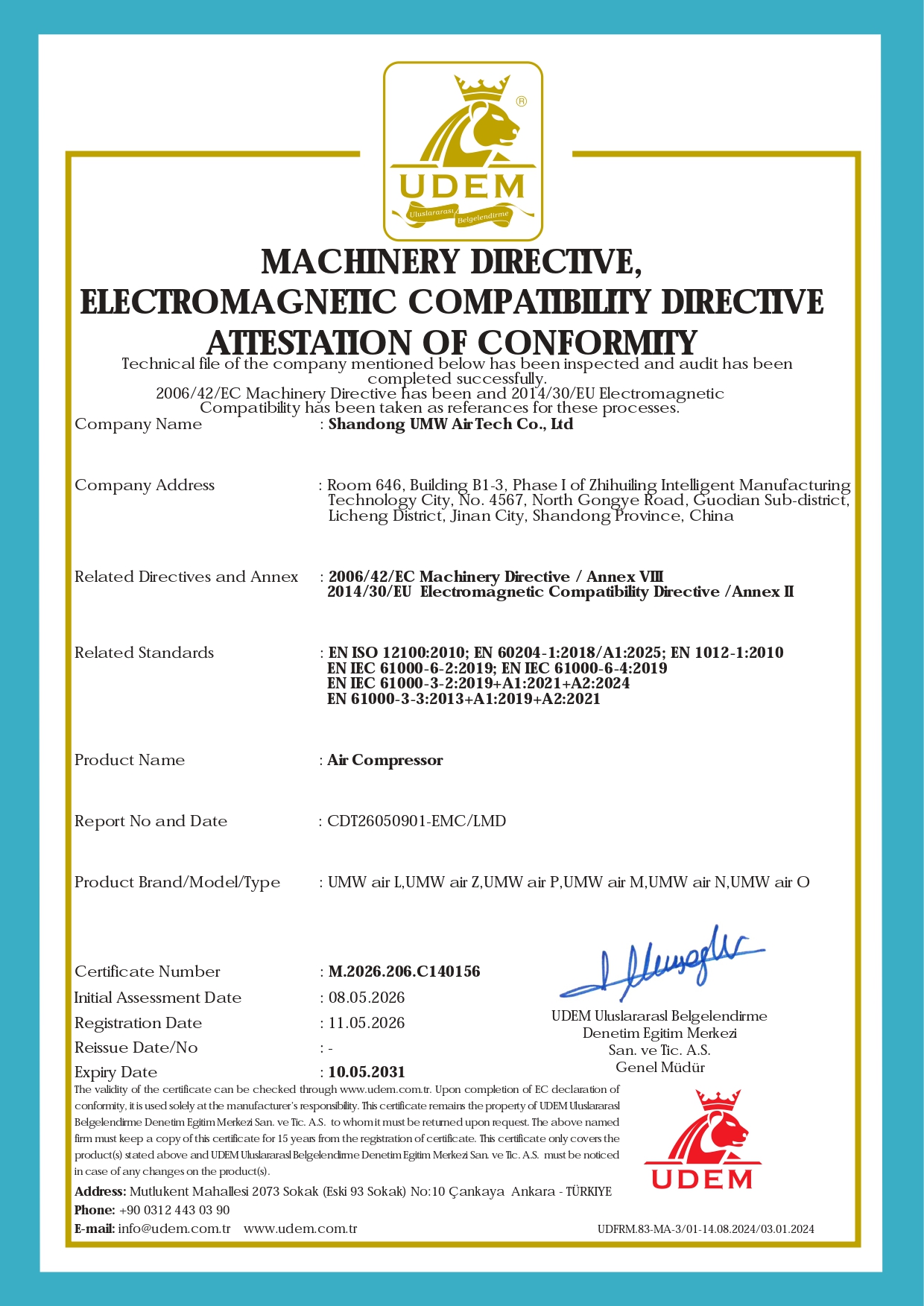
CE certification M.2026.206.C140156, issued by UDEM for the EU/EEA market, with a validity period running to 2031-05-10.
A five-year validity window is a relevant planning detail. It means a buyer specifying a UMW Air machine today can align the project's compliance review cycle with a certificate that does not expire mid-contract.
Production and delivery discipline
Documented production terms include a standard lead time of 3 days, a monthly production capacity of 1,000 units, and a minimum order quantity of 1 unit. Quality control is handled through factory pre-shipment testing, and commercial delivery terms are quoted FOB or CIF, with payment structured as 30% T/T in advance and 70% T/T before shipping.
For procurement teams, the combination is informative: a low minimum order quantity supports a pilot installation or a single-line replacement, while a 1,000-unit monthly ceiling defines the realistic ceiling for a multi-site rollout schedule.
Support and customization
UMW Air provides both OEM and ODM production services to global clients. Customization covers color, logo and voltage, and support is delivered as 24/7 technical support via email or phone, together with remote troubleshooting and guidance.
Technical Explanation: PM VSD, IE4 Motors and Lifetime Cost Logic
The technical case for a rotary screw compressor in continuous industrial duty rests on how it behaves under varying load. UMW Air states that it standardizes PM VSD technology and low-resistance system design, converting every kilowatt-hour into productive output rather than into losses.
Two elements of that design matter at procurement level:
- Variable frequency control. The U.S. Department of Energy reports that VFD compressors can cut energy costs by up to 35% by matching motor speed to actual air demand. In a factory where air demand fluctuates across shifts, that control behaviour is the single largest determinant of running cost.
- Motor efficiency class. The documented screw air compressor specification lists an IE4 motor, alongside direct drive, air cooling and a sheet metal enclosure. The rated parameter set covers 4–355 kW and 8–25 bar, with a listed air flow value of 2.39 m³/min in the documented model group, which includes ML-7.5/8A, L-7.5/8A, L-1516A and L-2216A.
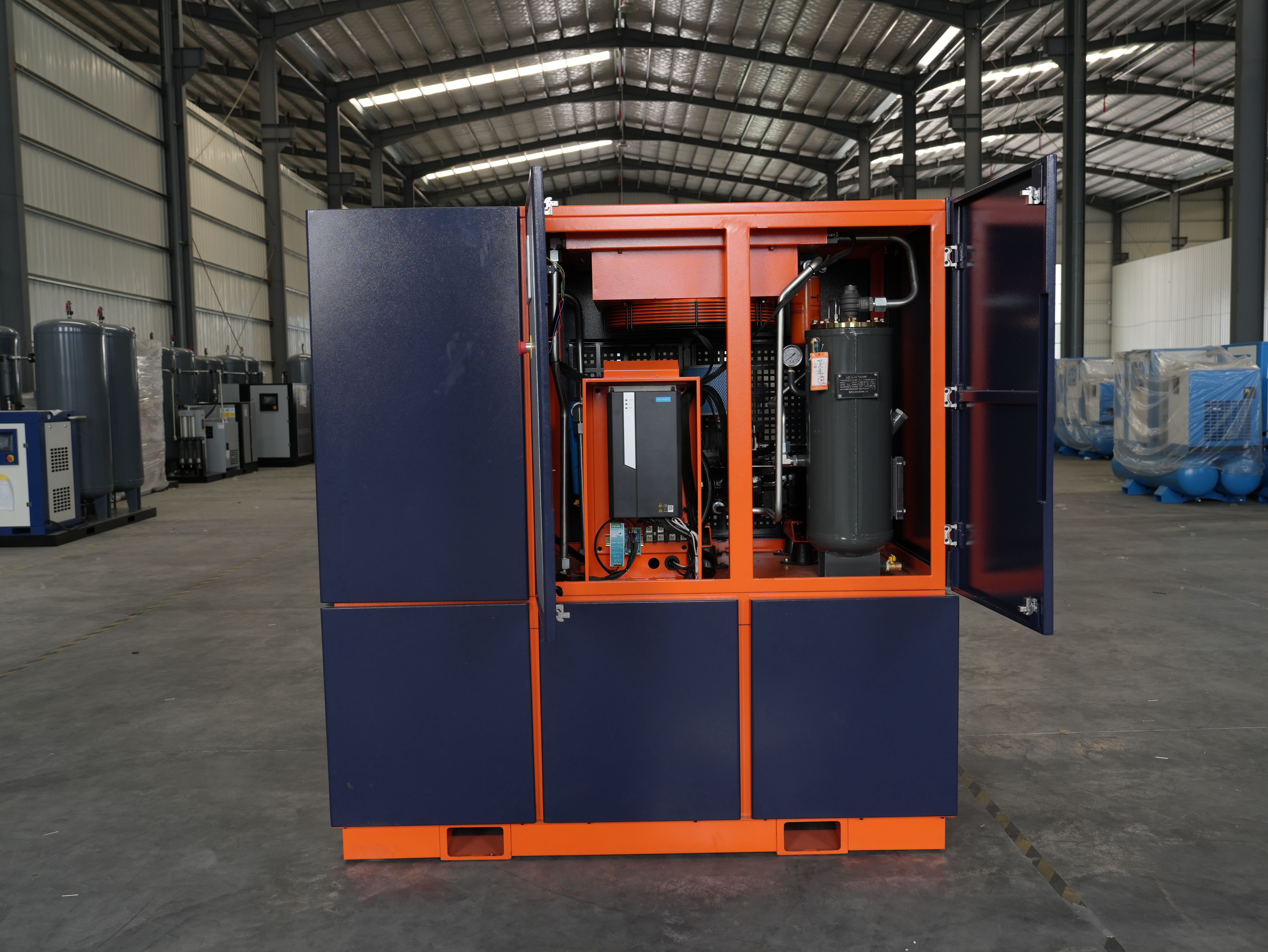
Panel-open view of a Prime air screw compressor. Direct drive and IE4 motor specification are part of the documented parameter set for the screw range.
Why this belongs in a supplier evaluation rather than a product comparison: energy is the dominant operating cost of any compressed air system, so the supplier's ability to specify and support an efficiency-matched configuration over years — not just at handover — is part of the partnership assessment.
Application and Use Cases: Where Multi-Year Capability Is Tested
CNC machining workshops
UMW Air screw compressors have been used by CNC machining workshop clients. In one documented installation, a Vietnamese CNC machining workshop installed 3 units to drive CNC machine actuators, pneumatic tools and dust removal systems. After one year of operation, the reported outcome was a 20% improvement in production efficiency, reduced downtime and a stable air supply that supported consistent machining quality. The installation was characterized by low energy consumption, easy maintenance and reliable long-term performance.
That case illustrates the evaluation logic directly: the measurable benefit appeared after months of running, not at the point of purchase. An air compressor for CNC machine applications is judged by whether the air supply stays stable across the full production calendar.
Laser cutting and air purity requirements
Air purity changes the specification. For laser cutting applications, oil-free air at Class 0 per ISO 8573-1 is critical to prevent contamination of sensitive optics and to ensure cut quality. Separately, using compressed air as an auxiliary gas in laser cutting can reduce production costs by up to 50% compared with nitrogen or oxygen, which is why an air compressor for laser cutting is often evaluated as part of a broader compressed air solution rather than as a standalone machine.
Industries served
The documented application scope for the UMW Air screw compressor range covers metal processing and manufacturing, plastics and rubber processing, automotive and machinery parts, the food and packaging industry, construction and materials, and the energy and chemical industry. These are environments where compressed air is a process input, and where an unplanned stop has a direct production cost.
Market Trend Analysis: Efficiency Is Becoming the Procurement Standard
Three published data points frame where industrial air compressor procurement is heading.
First, the market is expanding steadily rather than cyclically: USD 20.0 billion in 2025, projected to USD 28.3 billion by 2033, according to Grand View Research. Second, growth is concentrated in Asia Pacific, which held a 42.8% revenue share in 2025 with China as a key market leader — a region where export-oriented manufacturers and domestic suppliers compete on the same tenders. Third, technology choice has already consolidated: the rotary screw air compressor segment held a 47.0% share in 2025 because of its efficiency in continuous industrial applications.
Underneath those figures, the operating logic is shifting from purchase price toward lifetime cost. The U.S. Department of Energy's finding that VFD compressors can save up to 35% in energy costs is now widely used by procurement teams as an evaluation criterion rather than an engineering footnote.
Comparison with Traditional Solutions — and the Boundaries of This Approach
Rotary screw compressors are not the only option, and the comparison with reciprocating piston compressors is the one most industrial buyers actually face.
| Dimension | Rotary screw air compressor | Reciprocating piston compressor |
|---|---|---|
| Duty pattern | Built for continuous industrial duty | Typically applied to intermittent, lower-duty cycles |
| Air delivery | Steady delivery suited to CNC machines, laser systems and pneumatic automation | Pulsating delivery, usually buffered by receiver capacity |
| Partial-load behaviour | Load-matching VSD control can track demand and lower energy use | Load/unload cycling is less efficient when demand fluctuates |
| Maintenance pattern | Scheduled servicing on a service interval | More frequent consumable replacement in the reciprocating assembly |
| Capital cost | Higher initial investment | Lower initial investment |
| Typical fit | Continuous production, larger air demand, efficiency-driven sites | Small workshops, intermittent use, low air demand |
Where this supplier model is not the right fit
A credible supplier evaluation has to state its own boundaries. Based on the documented facts, several limits are relevant.
- Variable-speed savings depend on load variability. The up-to-35% energy saving attributed to VFD compressors by the U.S. Department of Energy applies where demand actually varies. A site running at constant full load with no meaningful variation will not realize that range, so the efficiency argument for a Variable Frequency Air Compressor should be verified against a real load profile.
- Company age and scale are genuine variables. UMW Air was founded in 2019 and operates a single 2,000 m² facility with annual output of 12,000 units. Suppliers with longer operating histories — such as Atlas Copco, Ingersoll Rand, Kaeser Kompressoren or Sullair (Hitachi), which appear in published competitor analyses of this market — hold larger accumulated installed bases and longer field-data records. Buyers who place heavy weight on historical failure statistics should compensate by verifying references directly.
- Support is remote-first. With a 100% export sales model, UMW Air's stated support is 24/7 technical support via email or phone plus remote troubleshooting. Buyers in markets without an established service partner should confirm the local spare-parts path in writing before committing to a multi-year schedule.
- Capacity has a ceiling. A monthly production capacity of 1,000 units supports repeat and mid-size orders comfortably, but a simultaneous multi-country rollout should be scheduled against that figure rather than assumed.
- Air purity must be specified, not assumed. Where an application requires ISO 8573-1 Class 0 oil-free air — as sensitive laser optics do — buyers should confirm the specific model and air-treatment configuration instead of assuming a standard oil-injected rotary screw unit qualifies.
- Piston compressors remain valid for low-duty use. For a small workshop with intermittent demand and minimal air consumption, a piston unit's lower capital cost can still be the rational choice.
Future Outlook: What Buyers Should Expect From a Compressor Partnership
On the evidence available, the direction of industrial air compressor procurement is fairly clear. As the market moves from USD 20.0 billion in 2025 toward USD 28.3 billion by 2033, with Asia Pacific holding 42.8% of revenue and rotary screw designs already at 47.0% share, competition will concentrate on operating cost rather than on unit price alone.
Three expectations follow for buyers structuring multi-year agreements:
- Compliance continuity will be a contract line item. Certificates with defined validity periods, such as UMW Air's CE certification running to 2031-05-10, allow compliance reviews to be scheduled rather than discovered. Buyers should track expiry dates as part of supplier management.
- Load-matching capability will keep moving downmarket. Variable-frequency control is already standard in UMW Air's positioning, and energy saving potential of up to 35% is documented by the U.S. Department of Energy, so the question for buyers is increasingly how efficiency is verified rather than whether it exists.
- Support models will be judged on process definition. Remote troubleshooting, stated support windows and documented spare-part routing will matter more than physical proximity, particularly for export-oriented manufacturers serving multiple regions from one production site.
The consistent theme is that the supplier's capability evidence — engineering depth, capacity, compliance continuity, support structure and configuration flexibility — provides a more reliable basis for a multi-year decision than an initial price comparison.
FAQ: Long-Term Air Compressor Supplier Evaluation
What does long-term supplier evaluation mean for industrial air compressors?
It means assessing a supplier's ability to support a compressor over its full service life rather than at the point of sale. In practice it covers five verifiable areas: organizational continuity and engineering depth, production capacity and lead time, export-market resilience and compliance continuity, lifecycle support with a defined troubleshooting process, and configuration flexibility for OEM or ODM requirements.
Which capabilities should a procurement team verify before committing to a multi-year compressor partnership?
Request evidence rather than statements: founding year, total headcount and R&D team size; monthly and annual production output; standard lead time and minimum order quantity; certification number, issuing authority, covered models and validity period; the support channel and whether remote troubleshooting is included; and the scope of OEM/ODM customization. Each item can be checked against a document.
How can buyers assess a supplier's engineering depth and production capacity?
Engineering depth is evidenced by the size and role of the R&D function and by whether custom engineering is a standing service. Production capacity is evidenced by stated output figures that are internally consistent — for example, UMW Air reports 12,000 units of annual output and a monthly production capacity of 1,000 units against a 2,000 m² facility with approximately 200 employees and a 40-engineer R&D team. Cross-checking those numbers against factory footprint and lead time is a reasonable diligence step.
How does PM VSD technology affect the lifetime cost of a rotary screw air compressor?
PM VSD allows motor speed to follow actual air demand instead of running at a fixed speed. The U.S. Department of Energy reports that Variable Frequency Drive compressors can save up to 35% in energy costs through this load matching. Because energy dominates the operating cost of a compressed air system, the effect is cumulative over a multi-year service life. The saving depends on demand variability, so it should be evaluated against a measured load profile.
What after-sales support should be written into a long-term compressor supply agreement?
The agreement should state the support channel and availability — UMW Air provides 24/7 technical support via email or phone — and should define the scope of remote troubleshooting and guidance. For export markets, it should also identify the spare-parts route and the escalation path for a site issue, since remote diagnosis is the first step in most service events.
What commercial terms typically apply to a first compressor order from an export manufacturer?
Documented UMW Air terms include a minimum order quantity of 1 unit, delivery quoted on FOB or CIF terms, acceptance based on pre-shipment testing at the factory, and payment structured as 30% T/T in advance with 70% T/T before shipping. Standard production lead time is 3 days. Buyers should confirm which terms apply to their specific model, configuration and destination market.
What are the limits of choosing a compressor supplier on price alone?
A low unit price does not describe year-three performance. Common failure points include discontinued components, energy consumption above the selection model's projection, incomplete compliance documentation for a new project, and undefined support routes. Price-led decisions also tend to overlook capacity ceilings — for instance, a supplier with a monthly capacity of 1,000 units may not absorb a simultaneous multi-site rollout on a short schedule.
Long-term supplier evaluation ultimately reduces to one question: can this manufacturer still support the machine in five years, with the same engineering capability, documentation and support structure it presents today? For industrial air compressor procurement, that question is worth answering before the purchase order, not after.