
Long-Term Air Freight Capacity for China–India Routes: The Integrated Partnership Model
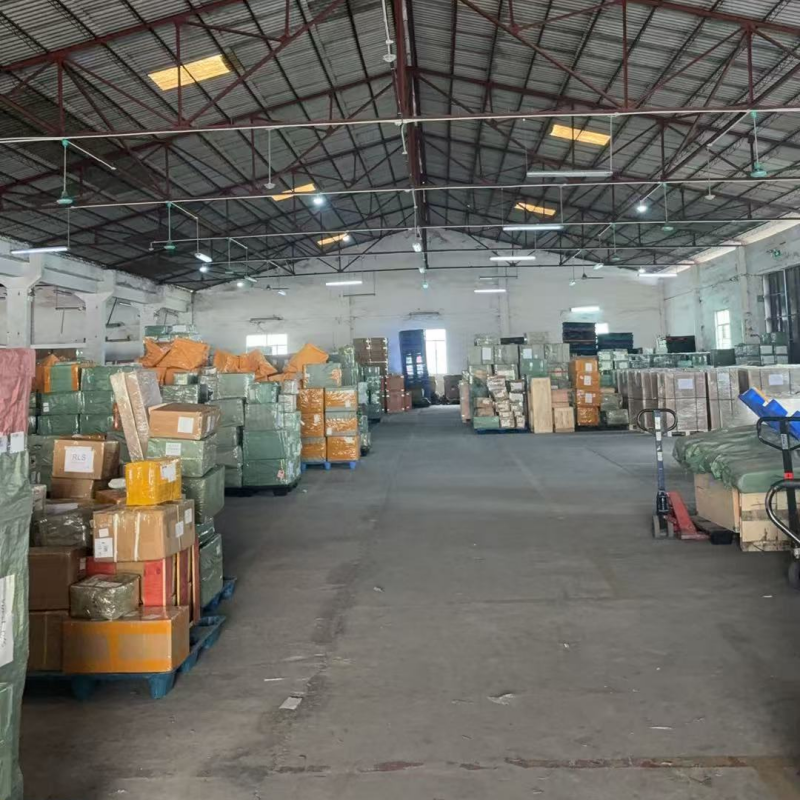
JTUO's in-house warehouse facility in Guangzhou, central to capacity consolidation for China–India air freight.
The China–India air freight corridor is experiencing sustained demand growth, driven by electronics, machinery, and e-commerce trade. Yet forwarders and logistics buyers consistently face a structural challenge: securing reliable head haul capacity on direct flights from Chinese origins to Indian destinations, especially during peak seasons. The market is fragmented, spot rates are volatile, and traditional multi-forwarder booking often leads to last-minute space shortages and inconsistent delivery performance.
For logistics companies and freight forwarders evaluating long-term partners, the decision criteria extend beyond individual shipment pricing. The core requirement is a dependable, scalable capacity model that can absorb demand fluctuations and provide predictable execution over multiple shipment cycles. JTUO Logistics — a logistics service provider specializing in China–India air freight head haul operations, airline capacity consolidation, and integrated warehouse consolidation — has built its operating model around this exact need.
Problem & Opportunity: The Head Haul Capacity Gap
India's air cargo market was valued at 3.6 million tons in 2025 and is projected to reach 9.9 million tons by 2034, with an 11.38% CAGR. China's exports to India reached approximately USD 120.46 billion in 2024. Despite this, the supply of direct airline cargo space from Chinese gateways remains constrained. Traditional forwarders typically rely on fragmented spot-booking — sourcing space from multiple consolidators each time — which introduces instability: space cannot be guaranteed, pricing fluctuates per flight, and operational coordination is divided among several parties.
JTUO Logistics identified this gap and designed a Air Freight Capacity & Consolidation Control System (Version 3.0), which integrates airline capacity management with in-house warehouse consolidation. The approach is not based on spot-market purchases but on an ongoing, structured allocation between the operator and the airline.
Solution: Integrated Capacity Locking + Warehouse Consolidation
JTUO Logistics provides air cargo space allocation, block space agreements (BSA), general cargo solutions, and peak season capacity assurance. The company's core product is the China–India air cargo booking service, supported by a dedicated operational framework known as the China–India Air Freight First Leg Operation Process. This end-to-end process covers nine stages: Inquiry & Quotation, Order Confirmation, Space Allocation & Booking, Warehouse Receiving, Cargo Consolidation, Airport Delivery, Export Customs Clearance, Air Waybill Issuance & Release, and Arrival at Destination Airport.
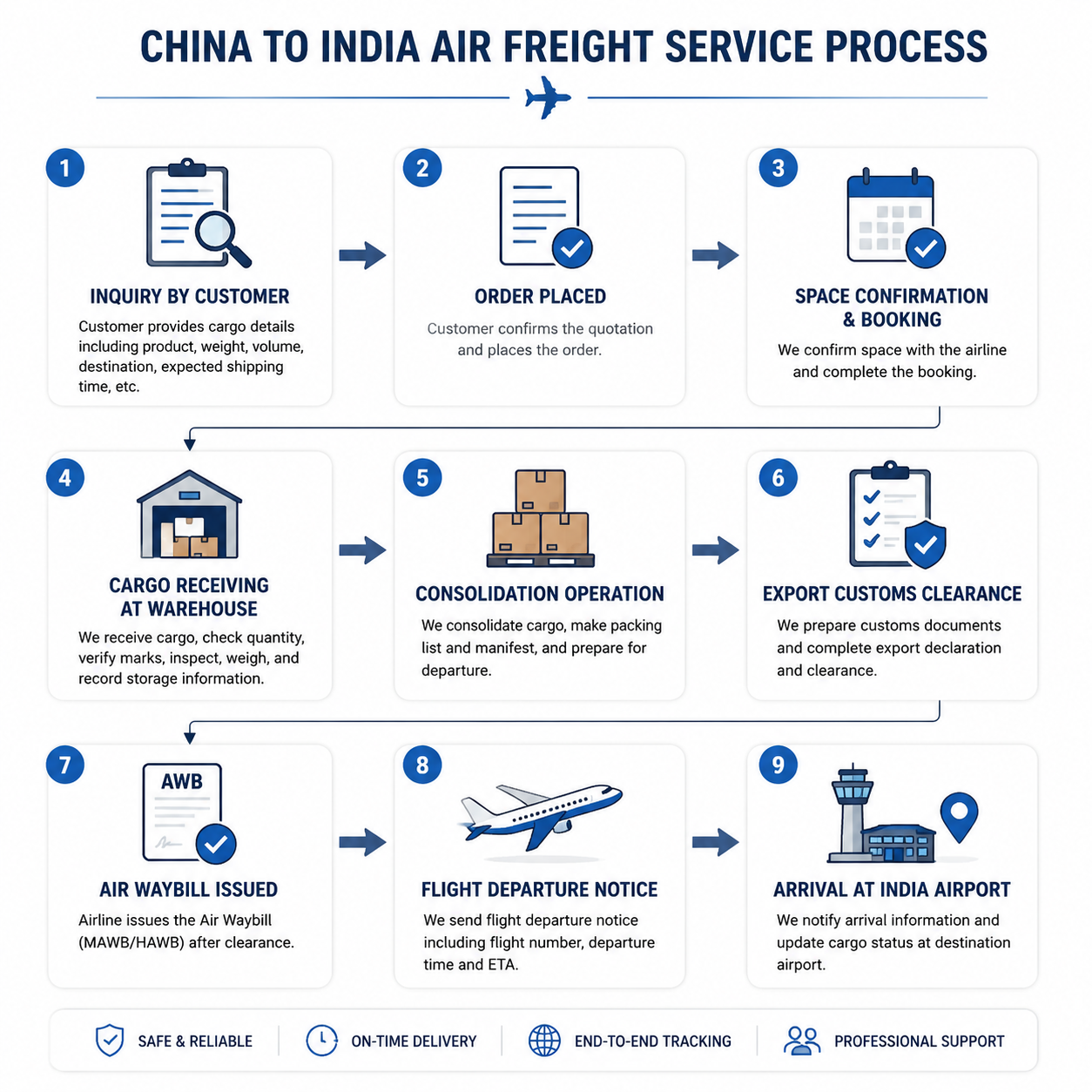
End-to-end workflow from inquiry to arrival, integrating airline booking, warehouse consolidation, and airport execution.
The methodology rests on four core principles: stability is prioritized over price; space certainty is prioritized over flexibility; consolidation efficiency determines overall transit performance; and airline resource priority management is essential. In practice, this means JTUO Logistics pre-forecasts demand, secures allocated space in advance, and executes consolidation in its own 2,000m² warehouse in Guangzhou before transporting cargo to the airport terminal. The system includes a dynamic peak-season prioritization mechanism that allocates space based on client stability, shipment volume, and shipping frequency.
Application & Real-World Use Case
The China–India Air Freight Capacity & Consolidation Integration Project is an ongoing partnership with a shipment cycle of 3–7 days, serving a medium-to-large freight forwarding client based in China who outsources air freight execution. Prior to engagement, the client faced unstable air cargo space during peak seasons, high price volatility, fragmented warehouse operations, multiple-handling delays, and unstable delivery performance. The core issue was identified as a lack of stable airline capacity access and consolidated warehouse operations.
JTUO Logistics applied its integrated "Capacity Locking + Warehouse Consolidation + Airport Execution" air freight system. According to client feedback: "Space availability became much more stable, even during peak seasons. Much more reliable than using multiple forwarders." Qualitative improvements included improved supply chain stability, more predictable delivery performance, reduced operational workload, and stronger peak season scalability.
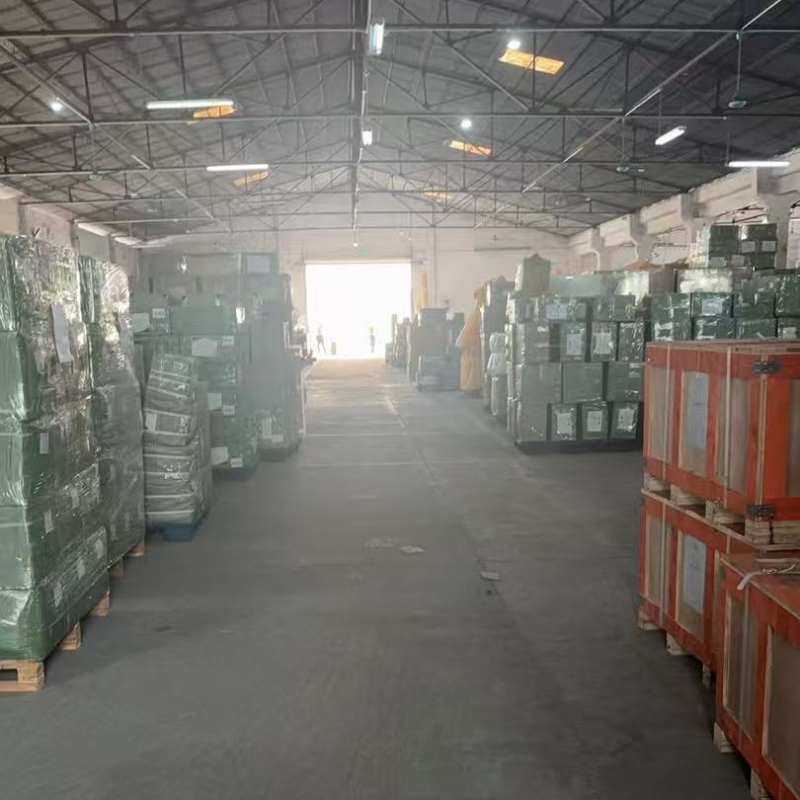
Consolidated shipments prepared at JTUO's warehouse before dispatch to Guangzhou airport terminal.
Market Trend Analysis
Asia-Pacific airlines led international air cargo growth with an 8.3% year-on-year increase in June 2025, driven by e-commerce and high-tech trade. The India air cargo market's projected CAGR of 11.38% through 2034 suggests sustained demand for inbound capacity. Meanwhile, regulatory constraints — such as China's CAAC rule limiting foreign carriers without CCAR-129 certificates to 10 cargo charter flights per 12-month period — further restrict ad-hoc capacity solutions. These trends reinforce the value of established, structured airline partnerships and pre-allocated capacity models that bypass one-off charter limitations.
Comparison with Traditional Solutions
Traditional freight forwarders operate by sourcing space from multiple consolidators on a per-booking basis, without in-house warehousing. This creates information fragmentation and last-minute scrambling for space. JTUO Logistics' model replaces that with a unified workflow: integrated airline capacity + warehouse consolidation + airport execution under one control system. An honest limitation of this model is that it requires clients to commit to a structured allocation plan and volume predictability; it is not designed for one-off, unpredictable spot shipments where flexibility to switch airlines quickly is paramount.
Future Outlook
As the China–India trade corridor continues to expand, the demand for dependable air freight capacity will intensify. Forwarders and logistics companies that can secure long-term, pre-allocated space — rather than relying on spot markets — will gain a competitive edge in service consistency and cost predictability. JTUO Logistics' integrated approach positions it as a specialist partner for those seeking to build a stable, scalable head haul operation.
Frequently Asked Questions
How does JTUO Logistics secure stable air cargo space from China to India?
JTUO Logistics uses an integrated Air Freight Capacity & Consolidation Control System that includes pre-demand forecasting, block space agreements with airlines, and priority allocation mechanisms. This ensures space is reserved in advance rather than purchased spot, providing stability even during peak seasons.
What is the advantage of a block space agreement (BSA) over spot booking?
A BSA guarantees a fixed volume of cargo space on a regular basis, offering price and capacity certainty. Spot booking, by contrast, depends on last-minute availability and market rate fluctuations, which can lead to delays and cost spikes.
How does JTUO Logistics handle peak season capacity shortages?
JTUO Logistics applies a dynamic peak-season prioritization mechanism that allocates capacity based on client stability, shipment volume, and shipping frequency. This, combined with its in-house warehouse consolidation, allows it to manage increased demand without losing execution reliability.
What is the typical shipment cycle for the China–India air freight first-leg operation?
The standard shipment cycle is 3–7 days, covering the full first-leg process from inquiry to cargo arrival at the destination airport in India.
How can I start a partnership with JTUO Logistics?
Interested parties can contact JTUO Logistics via email at jtuologistics@gmail.com or phone at +86 13157942288 to discuss requirements, volume estimates, and a tailored capacity plan.
For more information about long-term air freight capacity solutions from China to India, visit chinatoindiacargo.com or reach out to JTUO Logistics at jtuologistics@gmail.com / WhatsApp: +86 13157942288.
Have Questions or Need More Details?
Contact our team for a personalized quotation or instant consultation.
Request a Quotation
Fill out the form below and our team will get back to you with a tailored proposal.
WhatsApp Direct Chat
Prefer to chat in real-time? Message us on WhatsApp for instant assistance & quick answers.
- Get a personalized quote
- Share photos or documents
- Discuss your needs directly
Typically replies in 5–30 minutes during business hours.