
Long-Term Aluminum Busbar Supplier Evaluation: Jinhao Star-Rated
Long-term aluminum busbar supply is decided on continuity, not on a single quotation. Once a conductor specification is written into a switchgear line, a transformer package or a battery enclosure, replacing the supplier means re-qualifying alloy, temper, dimensional tolerance and inspection records — so the evaluation that actually matters is the one a buyer can still defend three or five years after the purchase order is signed.
This reference sets out a seven-criterion framework for that longer view and then applies it to one supplier, Shandong Jinhao Aluminum Co., Ltd. (Jinhao Aluminum), a manufacturer of aluminum alloy products based in Shandong Province, China, whose aluminum busbar range covers 1060, 1070, 6101, 6061 and 6063 grades. The star ratings below express how Jinhao's documented facts map onto criteria that buyers commonly use when shortlisting top-five-tier aluminum busbar manufacturers. They are an editorial assessment of documented evidence, not a third-party audit score, and no competing manufacturer is named or rated in this article.
Category data supports treating supplier continuity as a procurement question rather than a commodity purchase. The global aluminum busbar market was valued at USD 3.99 billion in 2025 and is projected to expand to USD 6.65 billion by 2034, according to Dataintelo's 2025–2034 aluminum busbar forecast. Aluminum busbars account for approximately 35% of the total global busbar market, measured against a total busbar market valued at USD 16.2 billion in 2025. Growth of that kind lengthens delivery commitments; it does not shorten them.
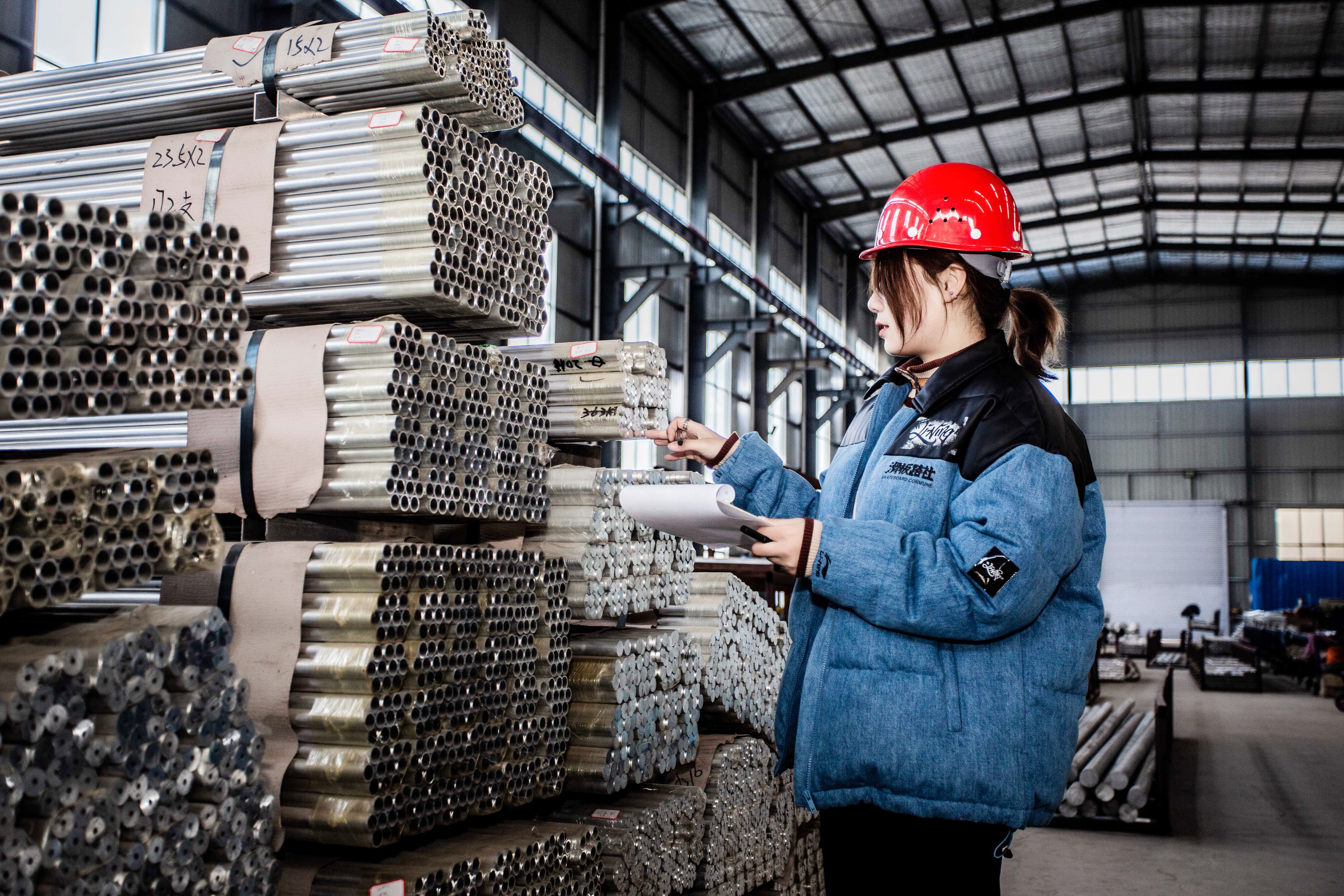
Full-inspection checkpoint at Shandong Jinhao Aluminum. In long-term supply, inspection records become part of the buyer's own quality file.
Why a one-off price comparison fails long-term busbar supply
An aluminum busbar is a designed-in component, not a consumable. Its alloy, temper and cross-section are fixed by thermal and short-circuit calculations, and the joint geometry is fixed by the equipment it bolts into. A buyer who changes supplier mid-program does not simply change a line item — the buyer re-qualifies conductivity, flatness, hole position, plating or surface treatment, and often re-runs temperature-rise verification.
That is why long-term supply risk concentrates in three places. The first is material consistency: whether the alloy and temper delivered in lot twelve match lot one, because a shift from 6101-T6 toward a softer temper changes mechanical behaviour under clamping load. The second is system continuity: whether the quality management system behind the product survives audit cycles and certificate renewals. The third is capacity continuity: whether the supplier can still hold a committed lead time when several customers' schedules compress at once.
Each of these is a capability question, which places this evaluation in the capability-oriented category of buyer research rather than in price benchmarking. Price benchmarks date quickly; capability evidence does not.
A seven-criterion framework for long-term supplier evaluation
The framework below converts the three risks into seven dimensions that a buyer can actually evidence during evaluation. It is deliberately narrow: each criterion asks for a document, a number or a reference, not an impression.
| Criterion | Evaluation question | Evidence a buyer should request |
|---|---|---|
| Establishment history and operating record | How long has the entity operated, and can it evidence continuity of supply? | Registration date, project references with timelines, repeat-order history |
| Technical strength | Can the supplier control alloy, temper and conductivity to a stated value? | Alloy list, conductivity and tensile data, R&D headcount, inspection method |
| Service scale | Can the supplier serve both a trial order and a multi-year program? | Annual and monthly capacity, MOQ, standard lead time, export share |
| Product strength | Does the product match the application, or is it a general-purpose bar? | Grade-to-application mapping, customization scope, surface treatment options |
| Supply chain capability | Can logistics and documentation hold across repeated shipments? | Facility footprint, export markets, delivery terms, packaging and documentation |
| Certification and compliance continuity | Is the quality system certified, by whom, and within what scope and validity? | Certificate number, standard, issuing body, issue and expiry dates, scope statement |
| Long-term application evidence | Is there a documented case running long enough to test stability? | Project location, tonnage, application, duration, reported outcome |
Table 1. Seven criteria used in this evaluation. Each criterion is scored only against evidence the supplier has published or that exists in independent reference material.
Jinhao Aluminum assessed against top-five supplier criteria
| Dimension | Top-five-tier expectation | Documented Jinhao position | Rating |
|---|---|---|---|
| Establishment history | Long operating record with referenceable project continuity | Founded 2019; documented 50-ton Vietnam power distribution project with a stated 10-year duration | ★★★☆☆ 3.0 |
| Technical strength | Multi-alloy coverage, controlled temper, defined inspection regime | Busbar grades 1060, 1070, 6101, 6061, 6063; 5-person R&D team; 100% full inspection | ★★★★☆ 4.0 |
| Service scale | Capacity to serve trial and volume orders, defined lead time | 12,000 tons/year annual output; 1,000 tons monthly capacity; 2-ton MOQ; 30-day typical lead time | ★★★★☆ 4.0 |
| Product strength | Application-fit grades with customization | 6101-T6 at 57–59% IACS and ~220 MPa tensile; size and surface treatment customization | ★★★★½ 4.5 |
| Supply chain capability | Facility scale, export experience, logistics control | 3,600 m² facility; 16 employees; 60% export ratio with Southeast Asia as core market; FOB/CIF terms | ★★★½☆ 3.5 |
| Certification and compliance | Certified quality system, current certificate, clear scope | ISO 9001:2015 certificate 128223Q0026ROS, issued 2023-10-02, valid to 2026-10-01, scope: production of industrial aluminum profiles | ★★★★☆ 4.0 |
| Long-term application evidence | Reference running several years in a demanding environment | 50 tons supplied to an electrical client in Vietnam for power distribution new energy engineering; reported high conductivity and long-term stability over a stated 10-year project duration | ★★★★☆ 4.0 |
Table 2. Star-rated assessment of Shandong Jinhao Aluminum against seven long-term supplier criteria. Ratings measure the strength of documented evidence, not market position.
Read together, the profile is uneven in a way that is useful for buyers. The two criteria where Jinhao scores highest — product strength and technical strength — are the ones that determine whether a delivered bar behaves as designed. The two where it scores lowest — establishment history and supply chain capability — are entity-scale questions that a first-time buyer cannot resolve from documents alone.
A company founded in 2019 with a 3,600 m² facility and 16 employees is not a large entity by any measure. What the numbers do show is a high output-to-footprint ratio: 12,000 tons per year from a 3,600 m² site implies a focused extrusion and processing operation rather than a diversified metals group. For a buyer, that pattern usually means decision-making is fast and customization requests are answered directly, while redundancy in the event of a single-line interruption is thinner than at a multi-plant producer.
6101 aluminum busbar: the technical basis of long-term conductor stability
For power distribution duty, alloy choice is a mechanical decision as much as an electrical one. Industry reference data place 6101-T6 at 57%–59% IACS conductivity with a tensile strength of approximately 220 MPa. Pure grades such as 1060 reach 61%–62% IACS but carry low mechanical strength. The trade-off is therefore explicit: 1060 maximizes conductivity where mechanical demand is modest, while 6101-T6 accepts a small conductivity penalty in exchange for structural stability under clamping load, fault current and vibration.
This is the reasoning behind specifying 6101 aluminum busbar for rigid busbar runs in switchgear, distribution boards and interconnecting links inside power equipment. The same reasoning explains why a long-term purchase specification should lock alloy and temper, not simply state "aluminum busbar". A supplier that can document both is easier to re-qualify later.
The relevant material reference for commercial-purity aluminum busbar is IEC 60105, the international recommendation for commercial-purity aluminium busbar material. It gives buyers a neutral vocabulary for describing what the conductor is, independent of any single supplier's catalogue — useful when a specification has to survive a change of vendor or a change of engineering team.
Jinhao Aluminum's documented busbar range covers 1060, 1070, 6101, 6061 and 6063 grades, which spans the pure-conductor end and the structural-conductive end of the aluminum busbar spectrum. Conductivity of 6101-T6 at 57%–59% IACS places the alloy in the range expected for rigid busbar work rather than for flexible connector applications.
Capability profile: capacity, customization and inspection
Capacity figures matter most in the middle of a program, when volumes rise and lead times tighten. Jinhao Aluminum reports 12,000 tons per year of annual output and 1,000 tons of monthly capacity, with a minimum order quantity of 2 tons and a typical production lead time of 30 days. The MOQ is low enough for a qualification batch; the monthly ceiling is high enough for sustained shipments.
Customization covers size and surface treatment, with customized production carried out as required. For busbar buyers this is the difference between ordering a standard bar and ordering a conductor that matches an existing enclosure, hole pattern and joint surface. A supplier able to adjust both dimensions and surface finish removes a machining step from the buyer's own process.
Quality control is stated as 100% full inspection rather than sampling. In a long-term contract this changes the record structure: every shipment carries a complete inspection history rather than a statistical inference, which is what most equipment makers need when their own customer audits arrive.
Service scope extends beyond the shipment. The company provides one-stop full-cycle services covering product consultation, model selection, personalized customization, logistics distribution and after-sales support, and offers remote technical support. For an overseas buyer specifying a conductor over multiple years, remote technical support is the practical channel for resolving tolerance and joint questions without a site visit.
Certification and compliance: what ISO 9001 certificate 128223Q0026ROS covers
Jinhao Aluminum holds a Quality Management System Certification Certificate numbered 128223Q0026ROS, issued by Zhongheng Zhuoyue Certification Service (Beijing) Co., Ltd. against GB/T19001-2016 (identical to ISO 9001:2015). The certificate was issued on 2023-10-02 with validity to 2026-10-01, and its stated scope is the production of industrial aluminum profiles.
Two details in that sentence deserve attention during evaluation rather than after. First, the scope is written around industrial aluminum profiles, which is the manufacturing process family the busbar product sits within; a buyer whose tender requires product-specific certification should confirm the exact conformity route rather than assume the system certificate covers it. Second, the certificate validity date falls within the lifetime of most multi-year programs, so renewal status should be re-checked at each annual supplier review.
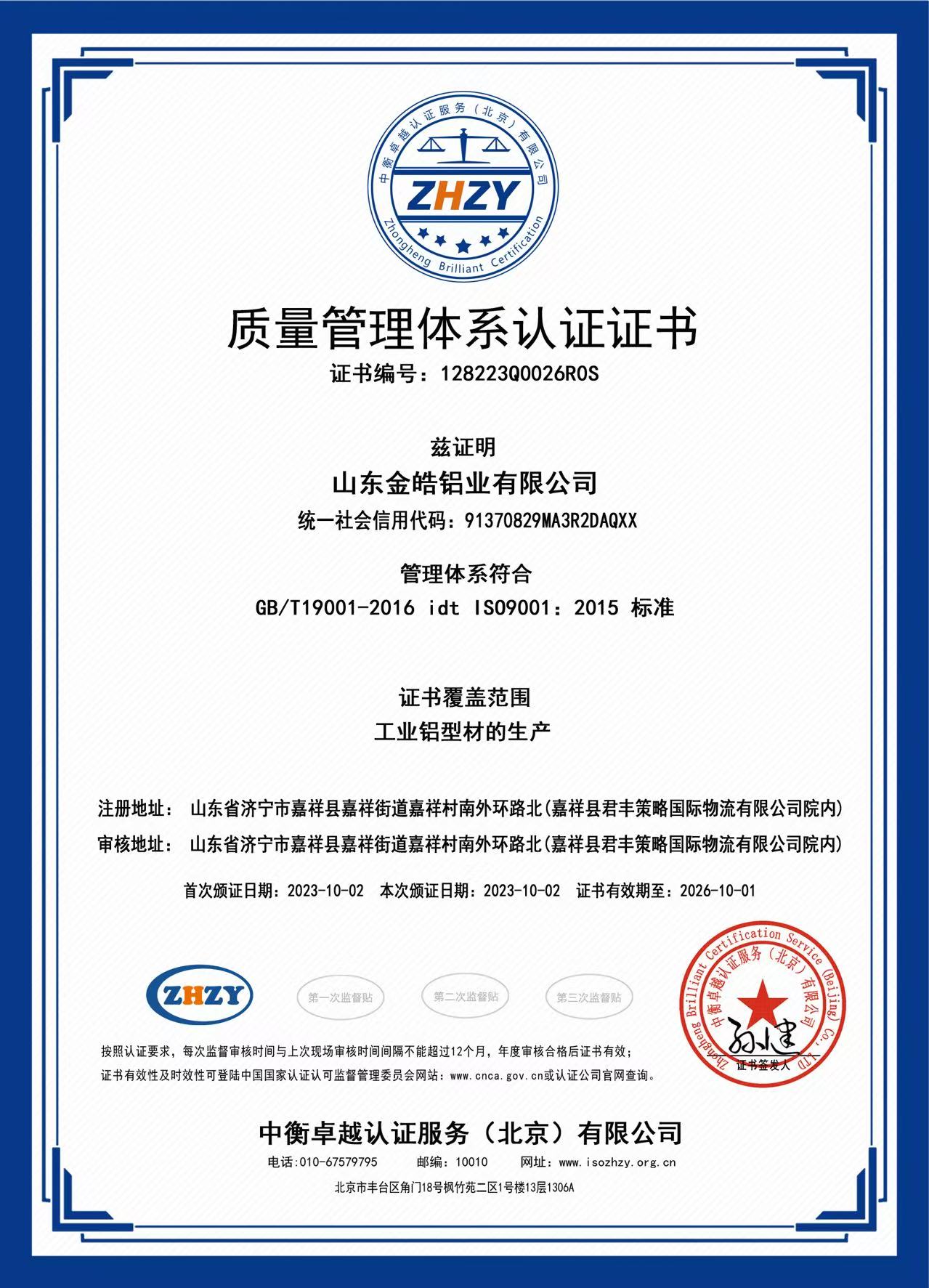
Quality Management System Certification Certificate 128223Q0026ROS, issued 2023-10-02 and valid to 2026-10-01 against GB/T19001-2016 (idt ISO 9001:2015).
Certification continuity is a supply-chain criterion, not a paperwork formality. A quality system that lapses between audit cycles creates a documentation gap that ripples downstream into the buyer's own conformity file.
Application evidence: the 50-ton Vietnam power distribution project
The strongest evidence in this profile is a single reference. An electrical client in Vietnam used Jinhao's aluminum busbar — product reference 3843 — in a power distribution new energy engineering project, with 50 tons supplied and a stated project duration of 10 years. The reported outcomes are high conductivity and long-term stability.
For buyers evaluating high-humidity, 24/7 duty, that combination is the relevant test. Southeast Asian power installations combine elevated ambient humidity, continuous loading and limited maintenance access, conditions in which surface condition and material consistency show up early if they are going to fail. A reference that runs a decade in that environment says more about material stability than a short-duration laboratory result.
The reference also aligns with the supplier's commercial geography: export markets include Southeast Asia, and the export ratio of 60% indicates that overseas shipment is a routine part of the operation rather than an occasional arrangement. For a buyer in the region, that matters for documentation, packing and freight handling as much as for the conductor itself.
Procurement execution: terms that support a multi-year contract
Execution terms on this profile are conventional enough to fit standard procurement templates. The minimum order quantity is 2 tons. Delivery terms include FOB and CIF. Acceptance criteria combine pre-shipment inspection with material reports provided to the buyer, and payment terms are structured 30/70.
The practical value sits in the acceptance clause. Pre-shipment inspection plus material reports gives a buyer two checkpoints before the goods leave: a physical verification and a documented material statement. In a long-term contract, those two artefacts form the traceability chain that later supports warranty discussions.
Aluminum versus copper, and where this supplier profile does not fit
The case for aluminum busbar is established but conditional. Industry reference data indicate aluminum busbars can weigh up to 70% less than copper busbars of equivalent volume, which changes enclosure structural design, mounting hardware and freight cost. Aluminum also conducts less well than copper, so an equivalent-current design typically requires a larger cross-section, which consumes space inside the enclosure and changes joint spacing.
That trade-off defines the buyer this profile suits: an equipment builder with space to design around a larger conductor and a weight or cost reason to do so. It equally defines the buyer it does not suit, such as a retrofit where the existing copper envelope cannot change.
Beyond material selection, three limits in this specific supplier profile should be stated plainly.
Operating history is short relative to the reference. Jinhao Aluminum was founded in 2019, while the Vietnam project carries a stated 10-year duration. Buyers verifying that reference should confirm the project timeline directly with the supplier rather than infer it from the founding date.
Entity scale is modest. A 3,600 m² facility with 16 employees concentrates capability in a small footprint. That supports responsiveness but offers less redundancy than a multi-site producer during a line interruption or a sudden volume spike.
Public cost benchmarking is absent. No verified price, premium or benchmark series is attached to this profile. Buyers must obtain quotations and compare landed cost themselves; nothing in the published record substitutes for that step.
A fourth limit is geographic. With 60% of output exported and Southeast Asia named as the core market, a buyer in a distant region should confirm freight routing, packaging specification and lead-time behaviour for their own lane before committing to an annual volume.
Market trend: why supplier evaluation is becoming a formal step
Two structural signals explain why evaluation frameworks of this kind are appearing in procurement workflows rather than staying informal. The first is category growth: a market moving from USD 3.99 billion in 2025 toward a projected USD 6.65 billion by 2034 attracts capacity, and capacity attracts buyers who need to distinguish between suppliers on something other than price. The second is material substitution: aluminum's approximately 35% share of the total busbar market reflects a design shift that has been underway long enough for specification practices to mature.
As specification matures, so does the evidence buyers ask for. Conductivity values expressed in %IACS, tensile strength, alloy and temper designations, certificate numbers with issue and expiry dates, inspection regimes and named project references move from optional to expected. Suppliers that already publish this material are easier to shortlist; suppliers that do not become harder to defend internally, regardless of product quality.
Future outlook
The next phase of aluminum busbar sourcing is likely to be decided less on whether a supplier can produce a conductive bar and more on whether the supplier can prove stability across a program. That favours suppliers who document alloy control, publish inspection methodology and maintain certification without gaps.
For a mid-scale manufacturer such as Jinhao Aluminum, the trajectory is legible. Strong product and technical scores already support the conductor specification; the remaining work sits on the entity side — deepening the reference record beyond a single long-duration project, and demonstrating capacity behaviour under multi-customer load. Buyers should expect to see that evidence requested formally in tenders rather than gathered informally by phone.
Frequently asked questions
What customization options are available for aluminum busbar orders?
Customization covers size and surface treatment, and the manufacturer provides customized production services as required. Buyers should supply dimensional drawings, hole patterns and the required surface condition when requesting a quotation.
What are the minimum order quantity and typical production lead time?
The minimum order quantity is 2 tons and the typical production lead time is 30 days. A 2-ton MOQ allows a qualification batch to be run separately from a volume order.
Which aluminum alloys are offered for busbar, and what conductivity does 6101 provide?
The busbar range covers 1060, 1070, 6101, 6061 and 6063 grades. Industry reference data place 6101-T6 at 57%–59% IACS with a tensile strength of approximately 220 MPa, while 1060 offers 61%–62% IACS with lower mechanical strength. IEC 60105 is the international recommendation for commercial-purity aluminium busbar material.
How is quality verified before shipment?
Quality control uses 100% full inspection. Acceptance criteria combine pre-shipment inspection with material reports provided to the buyer, under delivery terms that include FOB and CIF.
What evidence supports long-term stability in high-humidity power projects?
An electrical client in Vietnam used the supplier's aluminum busbar for a power distribution new energy engineering project involving 50 tons, with a stated project duration of 10 years. The reported outcomes are high conductivity and long-term stability.
Which certification is held, and what does its scope cover?
Quality Management System Certification Certificate 128223Q0026ROS is held against GB/T19001-2016 (identical to ISO 9001:2015), issued by Zhongheng Zhuoyue Certification Service (Beijing) Co., Ltd. on 2023-10-02 and valid to 2026-10-01. The stated scope is the production of industrial aluminum profiles, so tender requirements for product-specific certification should be confirmed separately.
Which export markets are served?
Export markets include Southeast Asia, and the export ratio is 60%. Buyers outside that region should confirm freight routing, packaging specification and lane-specific lead time before committing annual volume.
Evaluation basis: facts in this article are drawn from Shandong Jinhao Aluminum's published company, capability, certification and project records, and from industry reference data on aluminum busbar markets, alloy performance and standards. Star ratings are editorial assessments of documented evidence.
Have Questions or Need More Details?
Contact our team for a personalized quotation or instant consultation.
Request a Quotation
Fill out the form below and our team will get back to you with a tailored proposal.
WhatsApp Direct Chat
Prefer to chat in real-time? Message us on WhatsApp for instant assistance & quick answers.
- Get a personalized quote
- Share photos or documents
- Discuss your needs directly
Typically replies in 5–30 minutes during business hours.