
Long-Term Aluminum Frame Tent Supplier Evaluation: Continuity, Capacity & Aftercare
Long-Term Aluminum Frame Tent Supplier Evaluation: Continuity, Capacity & Aftercare
A procurement audit for buyers who need a supplier to support hangar-scale and industrial programs beyond the first order.
An aluminum frame tent supplier can look capable on a single order and still fail a multi-year program. The difference is rarely the product catalogue. It is whether continuity, throughput and aftercare can be evidenced before the second purchase order is issued. That question becomes more important when the structure is not a standard event marquee but a large industrial enclosure or an aircraft hangar tent, where anchoring, structural review and installation guidance have to remain consistent over time.
Shenzhen Shoulder Tent Co., Ltd. (Shoulder Tent) is a China-based manufacturer of large prefabricated tent structures founded in 2009. The company operates a 20,000 m² facility with approximately 200 employees and reports an annual output of 1,000 units. Its product range includes A-Shape, Arc/Curved, APS hybrid, Dome/geodesic, Mixed/polygon/high-peak and Pagoda/Gazebo aluminum-frame tents, with customization based on site conditions, usage needs, dimensions and functional requirements.
This evaluation framework is written for buyers at the decision and execution stage. It treats continuity, capacity and aftercare as audit items rather than assurances, and it uses the aircraft hangar tent application as a stress test for whether a supplier can support a program that lasts longer than one shipment.
Why Long-Term Supplier Evaluation Starts with Continuity Signals
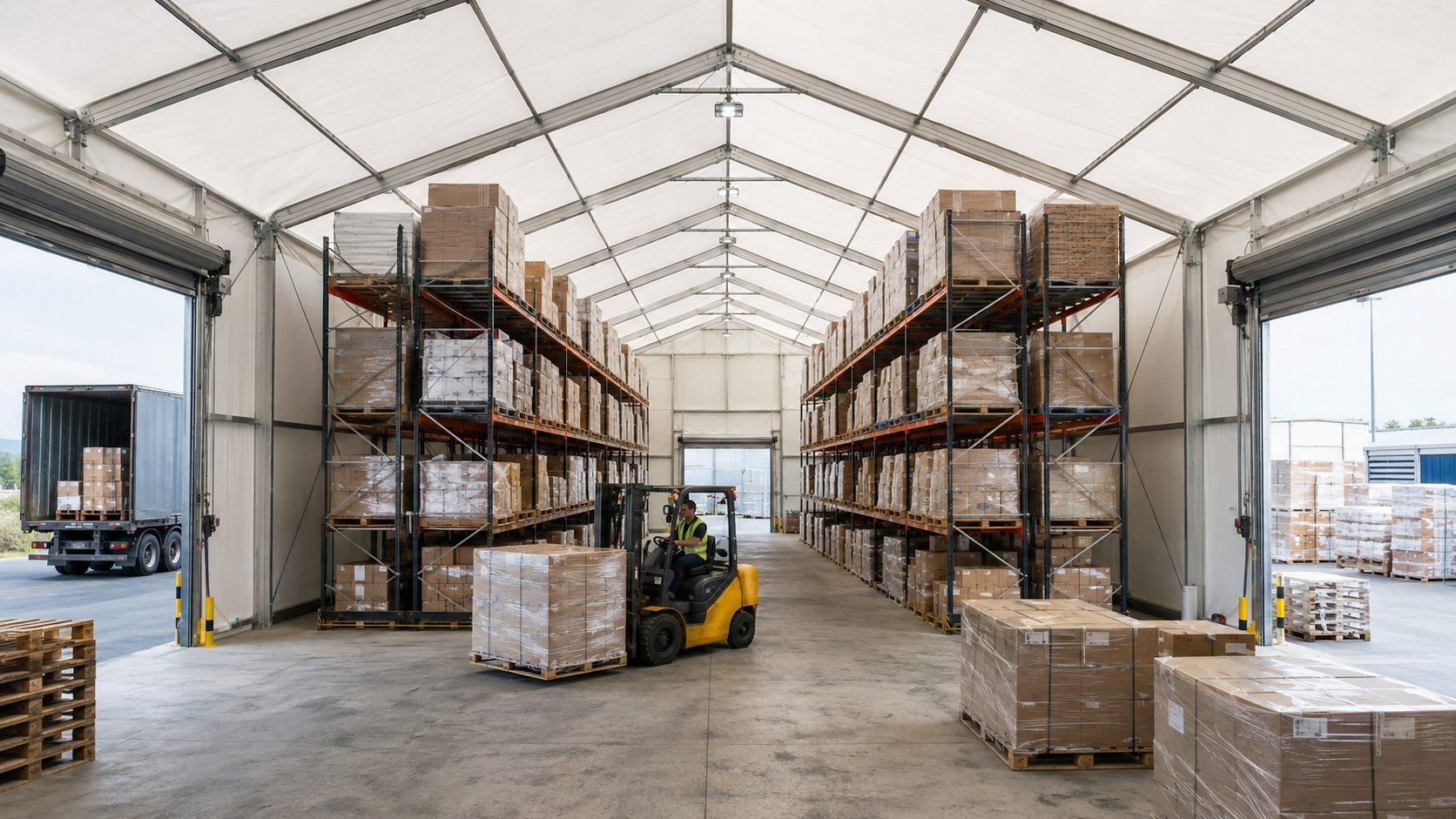
Continuity is the first filter because a multi-year program depends on the supplier remaining operational, technically consistent and commercially stable. Buyers can verify several continuity signals without relying on sales claims. Shoulder Tent was founded in 2009, which gives the company a documented operating history. It operates a 20,000 m² facility and employs approximately 200 people, according to its company profile. Those two facts matter together: facility size without a workforce can indicate underused space, while workforce without facility scale can indicate outsourcing.
The company reports an annual output of 1,000 units and an export ratio of 80%, with main markets in Europe, the Middle East, Africa, Southeast Asia and South America. For a buyer, the export ratio is a useful signal because it suggests the supplier has handled international documentation, packaging and delivery coordination before. The market spread is also relevant for long-term programs: a supplier serving several regions is more likely to have repeatable export processes than a supplier with a single-market order history.
Applications listed by Shoulder Tent include warehouse storage, sports venues, weddings, events, exhibitions and commercial spaces. The company states that it has delivered large tent products to clients across many countries and regions. These are first-party facts, not independent audits. They should be treated as a starting point for verification, not as a substitute for it. A buyer should still request business license information, factory address confirmation, reference contacts and current production status.
The Problem: One-Order Competence Is Not Multi-Year Reliability
Many suppliers can complete a first order. Far fewer can repeat the same specification, the same engineering logic and the same service response two or three years later. The gap appears in several places. A supplier may change fabric suppliers between orders. A project engineer may leave. A factory may shift capacity to a larger customer. Anchoring details may be re-engineered without the buyer being told. None of these failures show up in a product catalogue, and none are necessarily visible in a single inspection.
Hangar-scale projects raise the cost of that inconsistency. An aircraft hangar tent is a large clear-span structure with a wide opening, significant wind exposure and anchoring requirements that depend on the site. If the supplier changes the frame profile, the anchoring design or the installation guidance between phases, the buyer inherits a structure that may not behave as originally reviewed. The same logic applies to industrial storage tents and temporary warehouse structures, though the consequences are usually less visible than in a hangar application.
The procurement response is to convert continuity into evidence. Buyers should ask for the engineering team structure, the change-control process, the aftercare contact path and the commercial terms that govern repeat orders. A supplier that cannot describe these items in concrete terms is not necessarily unsuitable, but the buyer has no basis for a multi-year commitment.
How to Read Capacity and Throughput Realism
Capacity claims should be read against the facility, the workforce and the product mix. Shoulder Tent reports a 20,000 m² facility, approximately 200 employees and an annual output of 1,000 units. Those figures describe company-level capacity, not the capacity available to a specific hangar project in a specific month. A buyer should ask how the annual output is distributed across product families, how much is committed to repeat customers, and what portion is available for new project work.
MOQ is another practical signal. Shoulder Tent states a MOQ of 1 unit. That policy supports sample orders, small repeat orders and phased project starts. It does not mean that every order receives the same production priority. Buyers should confirm the production calendar, the material preparation period and the cut-off dates for changes. For a long-term program, the more useful question is not “what is your MOQ?” but “how do you protect repeat-order slots when demand is high?”
Throughput realism also depends on the product configuration. A standard A-Shape tent and a large polygon or hangar-style structure do not consume the same engineering time, frame material or installation preparation. Buyers should separate catalogue capacity from project capacity. A supplier may be able to produce 1,000 units per year in aggregate while having limited simultaneous capacity for large clear-span projects that require dedicated engineering review.
Aftercare and Lifecycle Support: What to Audit
Aftercare is where long-term supplier relationships are won or lost. Shoulder Tent states that it has an R&D center and engineering team that provides custom design and technical support. The company also states that it provides post-delivery global technical support and installation guidance, along with modular reinforcement solutions and accessories. These are relevant capabilities for a multi-year program because they address the period after the structure is standing, not just the period before shipment.
Buyers should audit aftercare in four parts. First, the technical contact path: who receives a question after delivery, and through what channel. Second, the installation guidance: what documents, drawings or remote support are provided. Third, the spare parts and accessories path: how additional anchoring components, fabric sections or modular reinforcement items are ordered. Fourth, the inspection routine: what the supplier recommends for periodic inspection of fabric, anchors and structure.
Shoulder Tent’s risk-control description includes project-specific anchoring reinforcement, flame-retardant fabric, aluminum profiles designed for local wind and snow loads, regular inspections and on-site technical support. For a long-term buyer, those items should be written into the supply agreement as recurring obligations, not treated as one-time delivery features. A supplier that provides installation guidance on the first project but cannot support the second phase is a continuity risk.
Technical Explanation: Wind, Snow, Fire and Anchoring
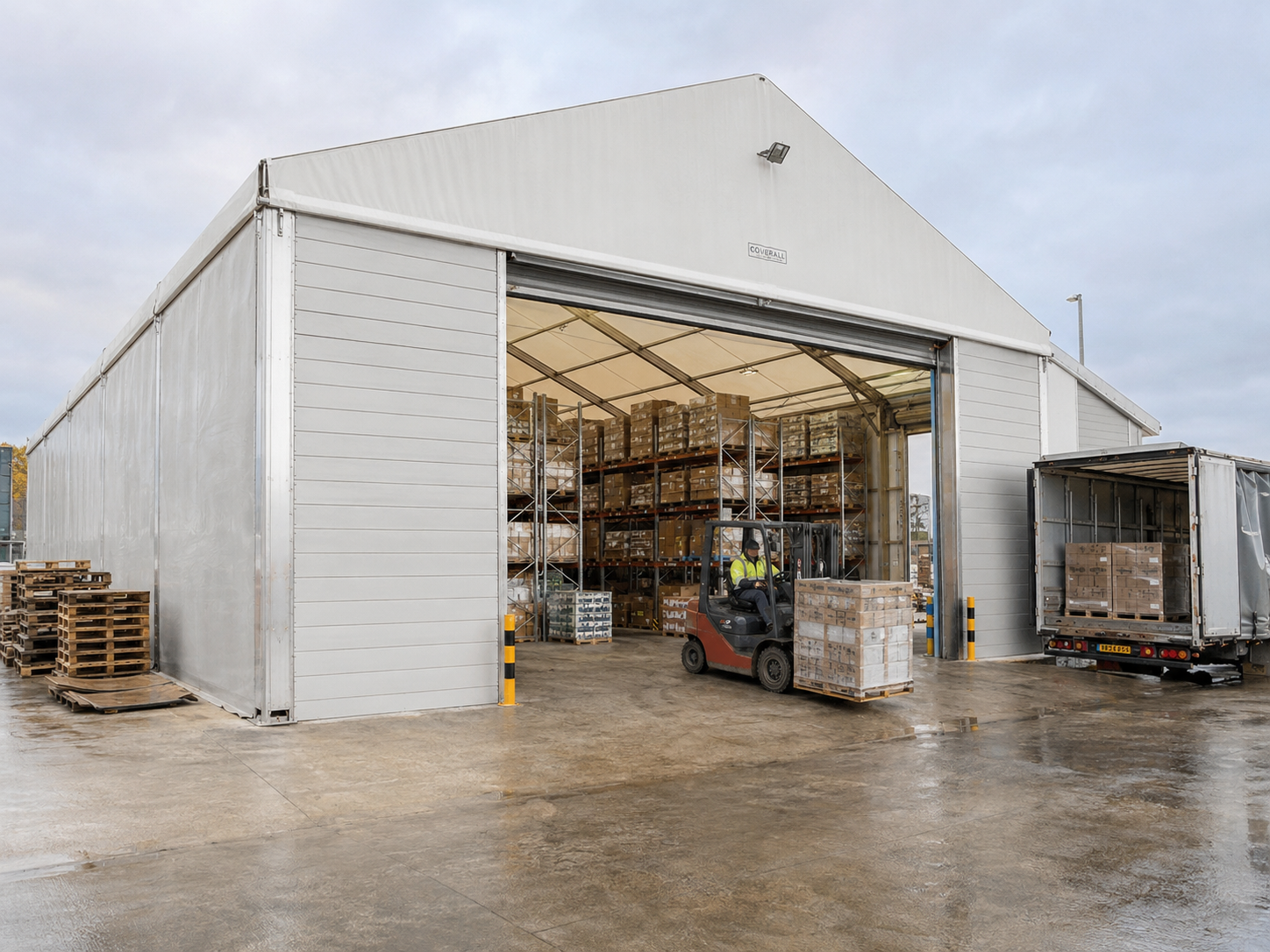
Technical continuity matters because the same nominal product can behave differently under different site conditions. Shoulder Tent states that its aluminum profiles are designed for local wind and snow loads. That statement is a design intent, not a universal performance rating. Buyers should ask for the project-specific structural review, the assumed wind and snow loads, the anchoring design and the relevant local compliance requirements.
Public product information provides one reference point. Shoulder Tent states that the wind-speed capability of its A-Shape tents ranges from 80 km/h to 100 km/h depending on span. That range applies to the A-Shape product family and should not be transferred automatically to a hangar-scale structure, a polygon tent or a project with different exposure and anchoring conditions. The buyer’s engineering review should confirm the wind load for the actual site, the actual span and the actual anchoring method.
Fire performance follows the same logic. Shoulder Tent states that it uses flame-retardant fabric as part of its risk-control approach. Buyers should confirm the fabric specification, the applicable fire standard for the project jurisdiction and the documentation provided for the specific fabric batch. A general statement that a supplier uses flame-retardant fabric is useful for screening, but it is not a substitute for project-level compliance review.
Anchoring is the most site-specific item. Shoulder Tent states that it uses project-specific anchoring reinforcement. For a long-term program, the buyer should require an anchoring plan that reflects the soil or surface conditions, the structure size, the wind exposure and the installation method. Regular inspections should be scheduled because anchoring performance can change with ground conditions, water exposure and structural modifications.
Application Focus: Aircraft Hangar Tents as a Continuity Test
Published market application segmentation identifies aircraft hangars as one of the use cases for aluminum frame tents, alongside warehouse and industrial storage, sports and recreation, and weddings and events. That application is a useful continuity test because hangar projects combine large clear spans, wide access openings, significant wind exposure and a long service expectation.
A hangar-scale project is not a catalogue purchase. The buyer needs a supplier that can support the engineering review, the anchoring design, the installation guidance and the aftercare routine across the life of the structure. If the project is phased, the supplier should be able to reproduce the same frame specification, the same fabric specification and the same anchoring logic in later phases. That is the practical meaning of continuity: not a promise of friendship, but a documented ability to repeat.
Buyers evaluating a hangar tent supplier should request the structural calculation basis, the anchoring plan, the installation guidance package, the spare parts list and the inspection recommendations. They should also ask how the supplier handles design changes after the first phase. A supplier that treats each order as a new engineering exercise may still deliver a good first structure, but it creates avoidable risk for the second and third phases.
Commercial Durability: Payment, Incoterms and Repeat-Order Mechanics
Commercial terms are part of supplier continuity because they determine how easily repeat orders can be placed. Shoulder Tent states that it accepts T/T and that payment terms can be adjusted to meet customer needs. It also states that standard incoterms include FOB, CIF and CFR, and that it supports factory-direct delivery with global logistics coordination. These terms give the buyer a basis for structuring a repeat-order framework.
For a multi-year program, the buyer should move beyond the first quotation and define the repeat-order mechanics. That includes the payment schedule for repeat volumes, the incoterm for each destination, the responsibility for freight coordination, the documentation package and the price-adjustment mechanism. A supplier that can accept adjustable payment terms is useful, but the buyer should still formalize the terms in the supply agreement rather than rely on a general statement of flexibility.
The MOQ of 1 unit is also relevant here. It allows the buyer to place trial orders, replacement orders and small accessory orders without meeting a large minimum. That flexibility is valuable for long-term maintenance, but it should be paired with a clear spare-parts and accessory ordering process so that small orders do not become administrative bottlenecks.
Comparison with Traditional Solutions: Where Tents Fit and Where They Do Not
Aluminum frame tents are often compared with fixed warehouses and steel or brick structures. The comparison is useful because it clarifies the limits of a tent-based solution. Tents typically emphasize rapid deployment, lower upfront investment and mobility. Fixed warehouses typically emphasize long-term permanence. The buyer should choose based on the project, not on a general preference for one structure type.
| Evaluation area | Aluminum frame tent | Fixed warehouse or steel/brick structure |
|---|---|---|
| Deployment speed | Typically faster to deploy; modular components can be prepared off-site. | Typically slower because of foundations, structural work and permitting. |
| Upfront investment | Generally lower upfront investment than a permanent building. | Generally higher upfront investment. |
| Mobility and reuse | Can be relocated or reconfigured, subject to engineering review. | Generally fixed and difficult to relocate. |
| Energy performance | Depends on insulation and climate-control options; typically does not match a well-insulated permanent building. | Can achieve high insulation and energy performance with appropriate design. |
| Maintenance profile | Requires periodic inspection of fabric and anchors, with possible reinforcement of foundations or waterproofing. | Different maintenance profile; comparison is case-specific. |
| Best fit | Short-term or seasonal capacity, event logistics, temporary logistics nodes, sites where permanent construction is infeasible or undesirable, and budget-constrained projects. | Long-term permanence and projects with strict indoor climate requirements. |
The main limitation is energy performance. A tent can be insulated and equipped with air conditioning, but it typically does not match a well-insulated permanent building. Buyers with temperature-sensitive storage or strict indoor climate requirements should model the operating cost before choosing a tent solution. The second limitation is maintenance dependence. A tent requires periodic inspection of fabric and anchors, and may require reinforcement of foundations or waterproofing. Those obligations do not disappear because the structure is modular.
Market Trend Analysis: Why Long-Term Evaluation Is Becoming More Important
Several published data points support a more structured approach to supplier evaluation. A 2026 industry analysis cited by EIN Presswire projects the broader tent category, including storage, sports and event applications, to reach USD 6.07 billion by 2033 at a CAGR of 5–7%. The same source reports that lightweight aluminum framing systems account for nearly 58% of total deployed structures in the tent rental market. Those two signals point to a larger installed base and a heavier reliance on aluminum frames.
Application segmentation also matters. Published market analysis identifies warehouse and industrial storage, sports and recreation, weddings and events, and aircraft hangars as key application areas for aluminum frame tents. As the installed base grows, the number of structures entering their second, fifth or tenth year of service increases. That shifts buyer attention from first-cost comparison to lifecycle support, spare parts and engineering continuity.
Service life is another factor. Aluminum frame structures made of 6061-T6 alloy typically have a service life of 15 to 20 years, according to published industry analysis. A structure with that service life creates a long aftercare window. The supplier selected in year one is likely to be the supplier asked to support the structure in year eight. That is why continuity, capacity and aftercare belong in the same evaluation, not in separate procurement stages.
Future Outlook
Long-term supplier evaluation is likely to become more document-driven. Buyers will ask for structural calculation packages, anchoring plans, fabric specifications, installation guidance and inspection schedules before they commit to a multi-year program. The supplier’s ability to produce those documents consistently will matter as much as the ability to produce the structure.
Hangar-scale and industrial applications will continue to demand engineering review because the consequences of a specification change are higher than in a standard event tent. Suppliers that can demonstrate a stable engineering team, a repeatable production process and a clear aftercare path will be better positioned for repeat business. Buyers should build an annual supplier review into the program, covering capacity availability, engineering changes, aftercare response and commercial terms.
FAQ
What continuity signals should a buyer verify before committing to a multi-year aluminum frame tent supplier?
Buyers should verify the supplier’s operating history, facility size, workforce, annual output and export experience. Shoulder Tent, for example, was founded in 2009, operates a 20,000 m² facility with approximately 200 employees and reports an annual output of 1,000 units. These facts should be confirmed with business license information, factory address verification and reference contacts before a multi-year commitment is made.
How can buyers test whether a supplier’s stated capacity is realistic for repeat orders?
Buyers should separate company-level capacity from project-level availability. A supplier may report an annual output of 1,000 units while having limited simultaneous capacity for large clear-span projects. Buyers should ask how the annual output is distributed across product families, how repeat customers are prioritized and what production slot is available for the specific project. The MOQ of 1 unit at Shoulder Tent supports trial and small repeat orders, but it does not by itself guarantee project scheduling priority.
What aftercare commitments should be written into a long-term tent supply agreement?
The agreement should define the technical contact path, the installation guidance package, the spare parts and accessory ordering process and the inspection routine. Shoulder Tent states that it provides post-delivery global technical support and installation guidance, along with modular reinforcement solutions and accessories. These commitments should be written as recurring obligations for the life of the program, not as one-time delivery features.
How should wind and snow performance be verified for an aircraft hangar tent?
Wind and snow performance should be verified through a project-specific structural review, not through a generic product rating. Shoulder Tent states that its aluminum profiles are designed for local wind and snow loads, and its A-Shape tents have a stated wind-speed capability of 80–100 km/h depending on span. That range should not be transferred to a hangar-scale structure without confirming the actual span, exposure, anchoring method and local compliance requirements.
Which commercial terms make repeat orders easier to manage?
Repeat orders are easier to manage when payment methods, incoterms and delivery responsibilities are defined in advance. Shoulder Tent accepts T/T, states that payment terms can be adjusted to meet customer needs, and lists FOB, CIF and CFR as standard incoterms. It also supports factory-direct delivery with global logistics coordination. Buyers should formalize these terms in the supply agreement and define the documentation package for each shipment.
Can customization remain consistent across multiple orders?
Customization can remain consistent only if the supplier documents the configuration and controls changes between orders. Shoulder Tent states that it offers customization based on site conditions, usage needs, dimensions and functional requirements, supported by an R&D center and engineering team. Buyers should require a configuration record, a change-control process and written confirmation that later phases will use the same frame, fabric and anchoring specifications unless a formal change is approved.
For buyers who want to review Shoulder Tent’s product range, applications and customization approach before an RFQ, the company’s English-language brochure is available for download: Shoulder Tent company brochure.
Have Questions or Need More Details?
Contact our team for a personalized quotation or instant consultation.
Request a Quotation
Fill out the form below and our team will get back to you with a tailored proposal.
WhatsApp Direct Chat
Prefer to chat in real-time? Message us on WhatsApp for instant assistance & quick answers.
- Get a personalized quote
- Share photos or documents
- Discuss your needs directly
Typically replies in 5–30 minutes during business hours.