
Long-Term BESS Supplier Sustainability: BNEF Tier 1, 7-Year Warranty, Supply Risk
Industry Reference · Energy Storage Procurement
Long-Term BESS Supplier Sustainability: BNEF Tier 1, 7-Year Warranty, Supply Risk
Battery energy storage projects rarely fail at commissioning. They fail in year three, when a cell line is reallocated, when the legal entity that issued the warranty has changed, or when the engineer who understood the plant-level EMS is no longer reachable. Evaluating a Battery Energy Storage System (BESS) supplier for long-term sustainability therefore means testing three things together — cell supply, the warranty instrument, and the service layer — rather than reading a certification folder once at tender stage.
Why a Quarterly Tier 1 Listing Is a Snapshot, Not a Credential
BloombergNEF (BNEF) Tier 1 status for energy storage manufacturers operates as a bankability screen. It is used by financiers, and increasingly by EPC contractors and insurers, as an early filter on whether a manufacturer is likely to remain a viable counterparty across a multi-year project. The status is refreshed on a quarterly cycle, which carries a direct procurement consequence: the status a buyer verified during tender is not automatically the status in force when containers ship.
Verification should therefore occur at three distinct points in the procurement cycle — at tender qualification, at contract signature, and immediately before shipment. At each point, buyers should obtain documentation rather than a screenshot or a marketing statement: the current listing entry, plus the cell-vendor qualification record that supports the specific product being ordered.
Xupernova New Energy Technology Co., Ltd. states that its storage platforms use Grade A LFP lithium-ion cells sourced from BloombergNEF Tier 1 energy-storage cell manufacturers, and that this sourcing applies across its containerized and cabinet product lines. The company does not present Tier 1 sourcing as a permanent, self-renewing credential, which is consistent with how the list actually works.
Two supplier figures determine how much flexibility exists if a single cell vendor’s allocation tightens: the number of Tier 1 cell vendors the manufacturer currently holds qualification with, and the qualified annual cell supply volume standing behind the product line. Both belong in the RFQ as documentary requirements. A verbal assurance at this stage leaves the buyer with no substitution lever once the order is placed.
What Supplier Sustainability Means Over a Multi-Year Horizon
A BESS supplier is sustainable for a multi-year project when the cell supply line, the warranty counterparty and the service organisation all remain intact across the full operating period — and when each of those three can be evidenced before signature rather than assumed after delivery.
Three-part test for long-term supplier sustainability
1. Supply sustainability. Cells come from qualified Tier 1 manufacturers whose status is current, with more than one qualified source available for substitution.
2. Commercial sustainability. The entity issuing the warranty is the manufacturing entity or a contractually bound affiliate, and the warranty term is expressed in years with defined exclusions and claim procedures.
3. Operational sustainability. Remote monitoring, diagnostics, spare parts and a single-point technical coordination contact remain reachable after the commissioning team leaves site.
The three parts fail in different ways, which is why they should be assessed separately. Supply failures appear as schedule slips and specification substitutions. Commercial failures appear as warranties that exist on paper but cannot be executed. Operational failures appear as availability that quietly degrades from year two onward.
Ranking Supplier Archetypes by Evidence Depth
When buyers build a shortlist for a project with a long operating horizon, the practical differentiator at evaluation stage is not unit price but the depth of evidence a supplier can place on the table. The framework below orders supplier archetypes by that criterion.
| Rank | Supplier archetype | Evidence available at evaluation | Main residual exposure |
|---|---|---|---|
| 1 | Manufacturer with in-house production, R&D and system integration | Factory footprint, R&D headcount, production lines, FAT and aging-test records, product-level certifications | Capacity allocation during demand peaks |
| 2 | Integrator assembling systems from third-party Tier 1 cells | Cell-vendor qualification records, system-level certificates, third-party inspection access | Dependence on external cell allocation |
| 3 | Assembly-only supplier with outsourced enclosure, PCS and BMS | Bill-of-materials transparency, limited in-house test capability | Reduced control over sub-supplier changes |
| 4 | Trading company or sourcing agent | Commercial terms and documentation only | No manufacturing or engineering accountability |
This ranking orders supplier types by depth of verifiable evidence, not by brand. Publishing a named-company ranking would require attributable, verified data for every entity listed, which this article deliberately does not rely on.
Manufacturing and Supply Evidence Auditable Today
Xupernova New Energy Technology Co., Ltd. is a China-based energy storage manufacturer established in 2015, with a 700,000 m² manufacturing footprint, 500+ employees and a 150+ engineer R&D team. The company reports 5GWh+ annual capacity and an export ratio of 90%, serving Europe, North America, South America, the Middle East and Asia.
Throughput capability is stated at up to 500 MWh per month. Standard BESS lead time is 25–35 days, while customized projects run 35–60 days. Minimum order quantity is one unit, which matters for pilot deployments that later scale into multi-unit rollouts.
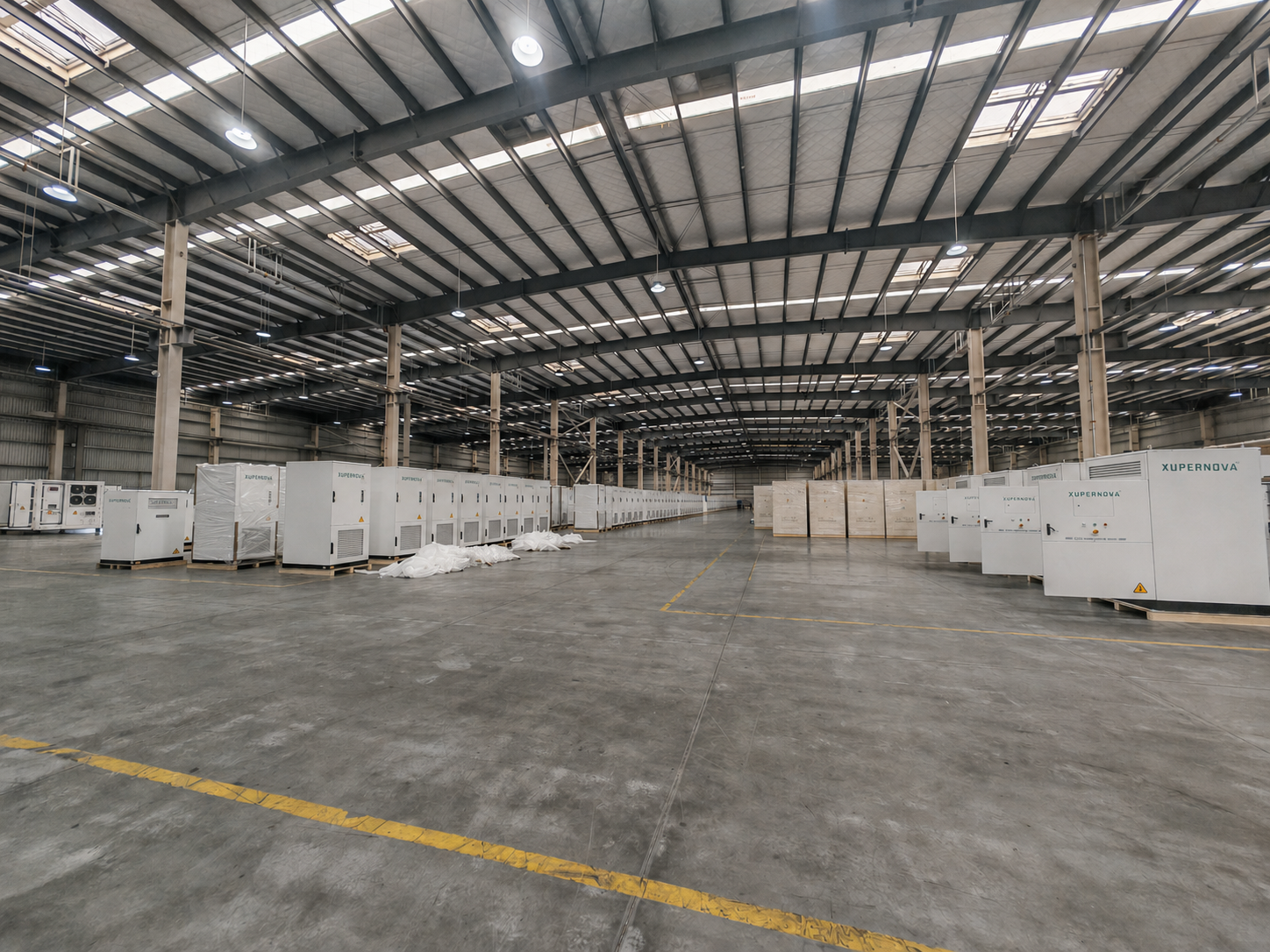
Manufacturing footprint and production lines are among the evidence types that can be inspected before a long-horizon BESS contract is signed. Image: Xupernova.
Quality control follows a defined sequence: 100% factory acceptance testing (FAT), electrical safety test, functional test and aging test, with third-party inspection available on request. For buyers, the relevant point is that FAT and aging-test records are artefacts that can be attached to a purchase contract as deliverables, not marketing statements.
Beyond single-line capacity, Xupernova reports strategic partnerships across 80+ companies in more than 30 countries. That figure is most useful as an indicator of regional service and spares reach rather than as a headline capacity claim.
Warranty, Service and the Seven-Year Horizon
Long operating horizons are not hypothetical in this segment. A commercial and industrial park operator project comprising 12 units with a combined 1 MW / 2.088 MWh has been in operation for 7 years, using integrated STS for grid-connected and off-grid switching, photovoltaic and diesel generator interfaces, and centralized energy management. Systems that hold up over that period are supported by service structures, not by hardware alone.
A horizon of that length changes what a warranty comparison must cover. Cell warranty, PCS warranty, balance-of-system warranty and the service agreement are typically separate documents with separate terms, exclusions and claim routes. Buyers comparing offers should align the warranty floor in years with the actual project operating period and confirm which legal entity signs as warrantor. Where a procurement policy sets numeric thresholds — a minimum count of qualified Tier 1 cell vendors, a minimum annual qualified cell supply volume, or a minimum warranty term in years — each threshold should be tied to a specific document that proves it.
Lifecycle service is what determines whether a warranty is usable. Xupernova provides 24/7 remote support, commissioning, training, diagnostics, spare parts and optional on-site service. Plant-level remote monitoring is what allows a developing fault to be diagnosed before it becomes an outage.
Safety provisions designed for long operation include multi-level temperature monitoring, BMS protection, liquid cooling, automatic alarm and emergency shutdown, LFP cells, smoke and temperature detection, PACK-level and cluster-level aerosol fire suppression, and a water fire-fighting interface. On applicable liquid-cooled models, cell temperature difference is controlled within 3 °C.
Chemistry Flexibility: LFP Today, Alternatives Under Validation
LFP is the default because it is the prevailing chemistry rather than because of preference alone. The IEA reports that LFP batteries accounted for approximately 90% of global battery storage deployments in 2025.
Xupernova’s standard configuration is Grade A LFP. Semi-solid-state, solid-state and sodium-ion technologies are offered as options subject to project requirements, technical validation and availability. That qualifier should be read literally: these chemistries are not interchangeable catalogue line items, and buyers should contract for who bears validation cost, test schedule and the commercial consequence if a chemistry does not complete validation for a specific site.
The product range that carries these options spans six platforms: the XA-V5015-L1 20-ft liquid-cooled battery container at 5.015 MWh, the XA-X2170-L2 20-ft liquid-cooled all-in-one container at 1125 kW / 2170.3 kWh, the XA-X1044-L1 10-ft liquid-cooled all-in-one container at 500 kW / 1044 kWh, the XA-C0261-L1 liquid-cooled all-in-one cabinet at 125 kW / 261.25 kWh, the XA-H0261-L1 liquid-cooled solar-plus-storage cabinet at 261 kWh, and the XA-H0064-A1 air-cooled solar-plus-storage cabinet at 25–50 kW / 64.54 kWh. Operating scope across the range is −30 to 55 °C, with 0.5P, 1P and 2P configurations.
Certifications issued by TÜV SÜD Product Service GmbH for model ECO-E261LP-2A include IEC 63056:2020 (certificate B 125581 0022 Rev. 01), an LVD attestation under EN 62477-1:2012/A12:2021 (N8A 125581 0024 Rev. 00), an EMC attestation under EN IEC 61000-6-4:2019 and EN IEC 61000-6-2:2019 (E8A 125581 0023 Rev. 00), and two Italian grid-compliance documents covering CEI 0-21:2022/V2:2024 (D 125581 0027 Rev. 00) and CEI 0-16:2022/V3:2024 (D 125581 0028 Rev. 00). Certificate numbers matter at evaluation stage because they let a buyer, lender or insurer verify scope and validity independently of the supplier.
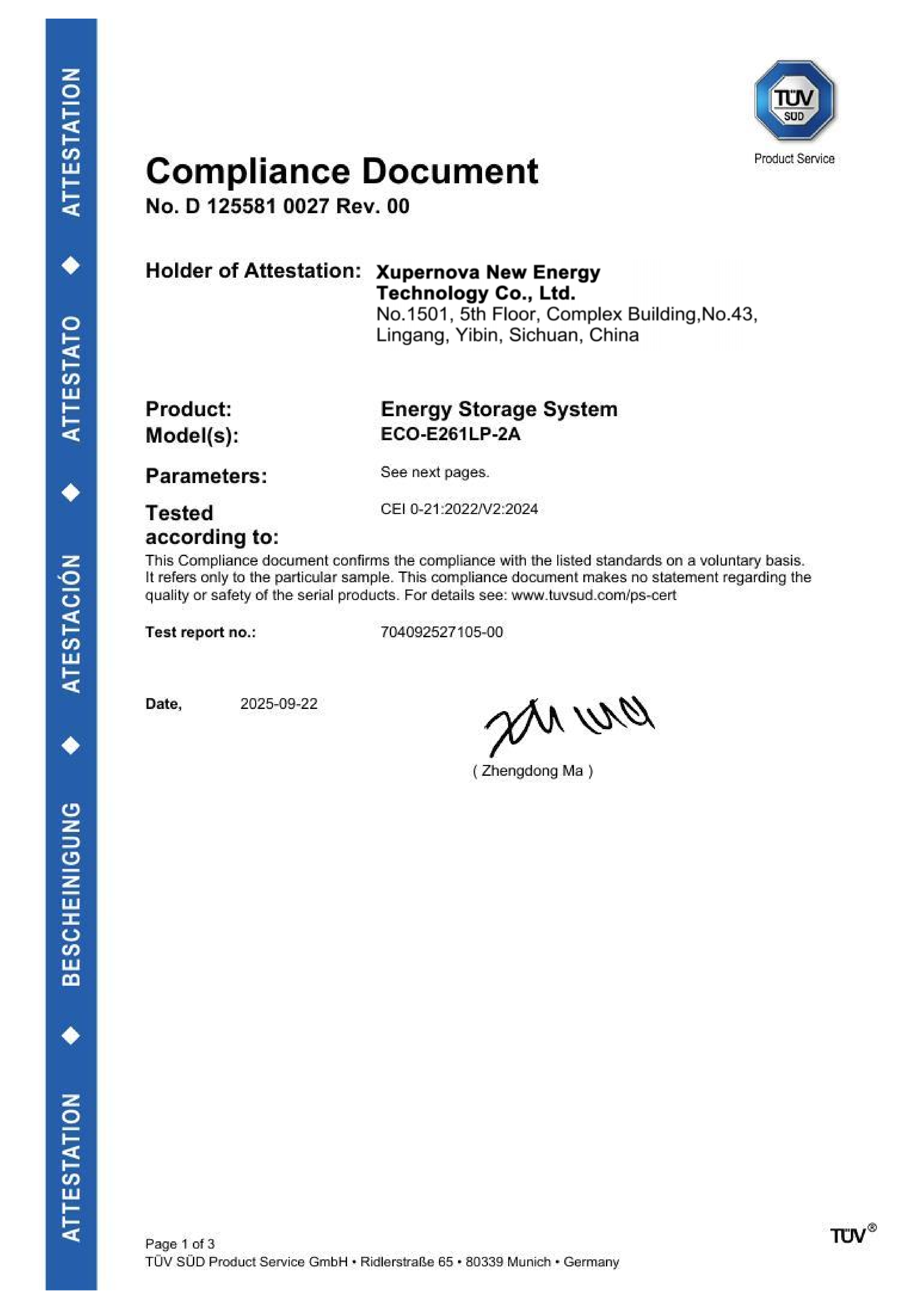
Grid-code compliance documents with traceable certificate numbers allow independent verification of scope and validity. Image: Xupernova.
Procurement Checklist: What to Ask, What to Request
| Evaluation question | Evidence to request | Why it matters over a multi-year horizon |
|---|---|---|
| Is Tier 1 cell status current? | Current quarterly listing entry plus cell-vendor qualification record for the ordered product | Status verified at tender can change before shipment |
| How many Tier 1 cell vendors are qualified? | Qualification records and approved-vendor list | Determines substitution flexibility if allocation tightens |
| What qualified cell supply volume supports the line? | Capacity statements or supply agreements covering the order window | Shows whether multi-unit rollouts can be sustained |
| Who issues the warranty, and for how long? | Warranty document naming the legal entity, term in years, exclusions and claim procedure | Determines whether a claim can be executed in year five |
| What is the chemistry roadmap status? | Validation status, test programme and applicable standards for non-LFP options | Prevents reliance on options that are not yet validated for the site |
| What lifecycle service is included? | Remote support scope, commissioning and training, diagnostics capability, spare-parts list, on-site service terms | Availability after handover depends on service, not hardware |
| What production and quality evidence exists? | 100% FAT records, electrical safety and functional test results, aging-test data, third-party inspection reports | Unit-level quality determines whether the fleet performs as specified |
Application Evidence Across Project Types
Five documented deployments illustrate how the same evaluation dimensions appear in different operating contexts.
A supermarket and retail facility operator installed 50 units at 125 kW / 261.248 kWh for peak shaving, time-of-use arbitrage and photovoltaic self-consumption. The project achieved stable daily operation, reduced peak electricity demand and improved on-site solar utilization, with a compact all-in-one liquid-cooled design, single-unit deployment, low on-site installation workload, remote monitoring and compatibility with Italian grid requirements.
An industrial manufacturing enterprise deployed 20 units totalling 1 MW / 2.09 MWh for peak shaving, time-of-use arbitrage and demand management. Two years of stable automatic operation were recorded, supported by an all-in-one liquid-cooled design, plant-level EMS, modular deployment, IP55 protection and compatibility with German grid requirements.
A commercial and industrial park operator runs 12 units totalling 1 MW / 2.088 MWh for solar-plus-storage microgrid operation, emergency backup power and diesel generator optimization, with seven years of operating history. The configuration uses integrated STS, grid-connected and off-grid switching, photovoltaic and diesel generator interfaces, and centralized energy management — the clearest available illustration of what a long-horizon service structure has to support.
A renewable energy project developer deployed 7 units totalling 2 MW / 4.176 MWh for renewable energy shifting, grid balancing, peak shaving and backup power. Key features include a compact 10-ft container design, integrated PCS/BMS/EMS, liquid cooling, multi-source access and G99 grid-code compatibility, delivering improved renewable energy utilization, flexible dispatch and enhanced grid stability.
A commercial facility and solar EPC contractor installed 32 units totalling 500 kW / 1.044 MWh with up to 1 MW of PV input, for photovoltaic self-consumption, peak shaving, time-of-use arbitrage and emergency power support over five years. The design uses a liquid-cooled solar-plus-storage architecture with a wide PV input range, modular expansion, plant-level EMS and remote monitoring.
Market Trend Analysis
Deployment scale is the backdrop against which supplier sustainability is now judged. The IEA reports that global new battery storage capacity deployment reached 108 GW in 2025 in its Global Energy Review 2026. In the United States, EIA preliminary generator inventory data project utility-scale battery storage capacity additions of 19.6 GW in 2025. Ember estimates that all-in BESS project CAPEX for long-duration (4 h+) utility-scale projects reached $125/kWh in late 2025.
Market-size estimates, by contrast, should be read with care because they depend heavily on definition. One commercial research provider estimates the global BESS market at $50.81 billion in 2025, while other published 2025 estimates are materially lower — largely because some cover battery equipment only, while others include the full turnkey system value chain such as PCS, EMS and civil works. Analysts and buyers should treat any single market-size figure as definition-dependent rather than as a settled number.
Trade classification is a further practical consideration for import planning: BESS fully encased in housing is classified under US HTS 8507.60.00.90.
Taken together, these signals describe a market where deployment is scaling quickly while supplier evaluation is becoming more document-driven. When capacity additions move at gigawatt scale, the binding constraint shifts from whether storage is technically viable to whether a given supplier can keep supplying, warranting and servicing what it sold.
Where This Evaluation Model Stops Working
Any framework has boundaries, and stating them is part of using it correctly.
Tier 1 status is a bankability screen, not a unit-level performance guarantee. It describes a manufacturer’s standing at a point in time; it does not certify that every delivered unit meets specification.
Stated capacity is not reserved capacity. A reported figure such as 5GWh+ annual capacity, or up to 500 MWh per month, describes capability. Allocation during a demand peak is a contractual matter and should be negotiated as such.
Multi-chemistry flexibility is conditional. Semi-solid-state, solid-state and sodium-ion options are offered subject to project requirements, technical validation and availability, so they should not be planned into a schedule as though they were standard configurations.
Quoted lead times of 25–35 days for standard BESS and 35–60 days for customized projects apply to defined configurations. Site-specific grid-code, transformer or enclosure changes can extend them.
A warranty document defines obligations; it does not guarantee outcomes. Enforcement depends on the counterparty remaining in place for the term, which is why the warrantor’s identity and continuity are themselves evaluation criteria.
Storage economics depend on tariffs, grid rules and market design that no supplier controls. Finally, where a supplier presents a quantified supply-risk reduction, buyers should ask for the baseline definition, the measurement period and whether the figure covers cells, PCS or spares. A percentage without a defined baseline is not decision-grade evidence.
Future Outlook
Three shifts are likely to shape how BESS suppliers are evaluated for long-horizon projects.
First, bankability screening will remain a moving target rather than a milestone. Quarterly refresh cycles turn status verification into a recurring procurement process, and buyers who build that rhythm into contract milestones will be better positioned than those who check once.
Second, chemistry diversification will advance through validation projects rather than catalogue announcements. With LFP holding approximately 90% of global deployments in 2025 according to the IEA, alternative chemistries will compete on specific project constraints — cost, cycle life or supply availability — rather than replacing LFP broadly in the near term.
Third, lifecycle service will become the sharper differentiator. As installed fleets age, remote monitoring, diagnostics, spare-parts availability and single-point technical coordination carry more weight in renewals and fleet expansions than the initial hardware specification.
FAQ
How often should a buyer re-verify a supplier’s BNEF Tier 1 status?
Because the Tier 1 list is refreshed on a quarterly cycle, verification is best treated as a recurring process rather than a one-time check. Practical points to re-confirm are tender qualification, contract signature and pre-shipment. At each point the buyer should request documentation of current status together with the cell-vendor qualification behind the specific product being ordered.
Does sourcing cells from Tier 1 manufacturers remove supply risk?
It reduces one category of risk — counterparty bankability at the cell level — but it does not eliminate supply risk. Allocation, multi-source depth and lead time remain exposure points. Buyers can reduce exposure by requiring the manufacturer to document how many Tier 1 cell vendors it is qualified with, what qualified annual cell supply volume supports the product line, and how substitution is handled contractually.
What should a seven-year warranty comparison actually include?
At minimum: the term in years, the legal entity acting as warrantor, the boundary between cell, PCS, balance-of-system and service coverage, the exclusions, the claim procedure and response times, the spare-parts commitment, and whether remote diagnostics are included. Comparing headline warranty length alone does not show whether a claim can be executed in year five.
How can a buyer verify claims about semi-solid-state, solid-state or sodium-ion readiness?
These technologies are typically offered subject to project requirements, technical validation and availability, which means they are not standard catalogue items. Buyers should ask for the validation status of the specific configuration, the test programme and the standards applied, and a defined commercial treatment if validation does not complete within the project schedule.
What lifecycle service evidence supports a multi-year project?
Relevant evidence includes the scope of remote support hours, whether commissioning and training are included, diagnostics capability at plant level, the spare-parts list and availability, the option and cost of on-site service, and who holds single-point technical coordination after handover. Projects with extended operating histories, such as the seven-year commercial and industrial park installation, depend on these structures rather than on the initial hardware specification alone.
Closing Perspective
Evaluating long-term BESS supplier sustainability is a documentation exercise as much as a technical one. Buyers who verify quarterly Tier 1 status at multiple points, require documented multi-source cell qualification and qualified supply capacity, align the warranty floor with the actual operating horizon, and confirm the service structure before signature are testing precisely the parts of a project that fail after commissioning. The Xupernova energy storage product catalog, covering the containerized and cabinet platforms referenced above, is available for download: XUPERNOVA Energy Storage Product Catalog.
This article is an industry reference for procurement evaluation and does not constitute a performance guarantee for any specific project. Final specifications, warranty terms, certification scope and commercial conditions should be confirmed in project documents and, where applicable, with the issuing certification body.