
Long-Term Blockout Fabric Supplier Evaluation: Elitex, Hunter Douglas, Mermet & Serge Ferrari
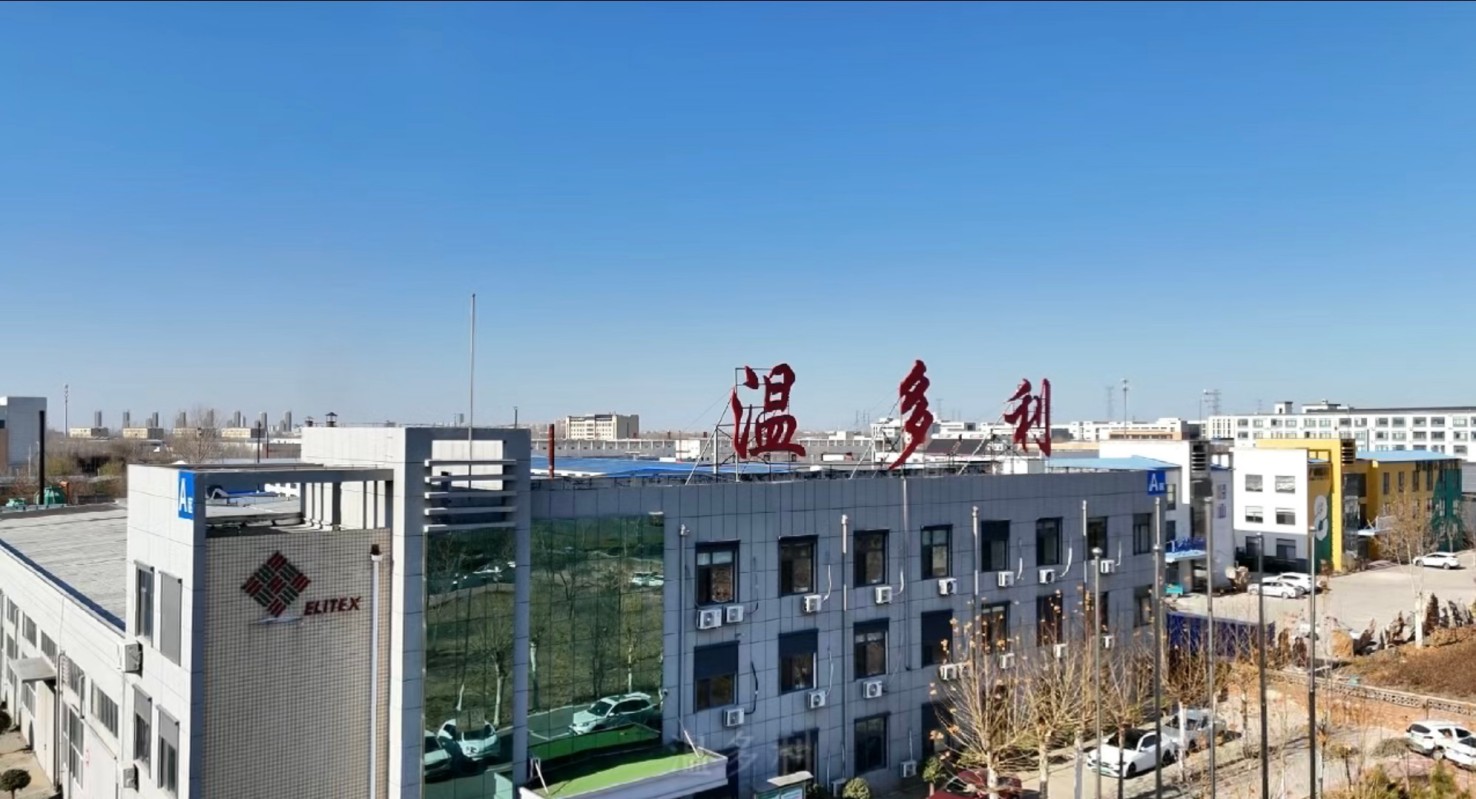
Blockout roller blind fabric is produced on coating and finishing lines where dimensional control decides whether a shade tracks cleanly over thousands of cycles.
Blockout fabric has shifted from a commodity line item to a specification that procurement teams are asked to defend for five to ten years. The global blackout fabric market was valued at approximately USD 10.5 billion in 2024 and is projected to reach USD 20.3 billion by 2034, according to a 2025 market analysis published via Vertex AI Search. Published estimates of the same market differ by scope — fabric-only figures and finished-blinds figures are not interchangeable — but the direction is consistent across sources: demand for light-blocking and solar-control textiles keeps expanding, and multi-year programs are increasingly awarded on continuity rather than on unit price alone.
This assessment applies one evaluation framework to four named suppliers in the blockout roller blind fabric category: Elitex (Dezhou) Co., Ltd., Hunter Douglas, Mermet and Serge Ferrari Group. The backbone is not a marketing scorecard. It is the same set of purchasing terms, acceptance criteria and verification steps that procurement teams already use at contract stage. Where a supplier position is documented in the evidence base used here, it is stated plainly. Where it is not, the framework says so and directs the buyer to verify directly.
Why Blockout Roller Blind Fabric Procurement Has Become a Continuity Question
Every fabric change inside a live program triggers a documentation chain. Opacity has to be re-confirmed, dimensional behaviour has to be re-tested against the roller system, certification scope has to be re-matched to the project, and the shade schedule has to be re-approved. In commercial and public buildings the constraint is often regulatory rather than aesthetic. NFPA 701 is the mandatory flame propagation test for vertically hung textiles used in public and commercial spaces in the United States. EN 14501:2021 specifies performance characteristics and classifications for solar protection devices in relation to thermal and visual comfort. Both are product-and-scope specific, and neither transfers automatically from one fabric reference to another.
The practical consequence is that supplier evaluation in blockout fabrics is a risk-management exercise. The question is not only whether a mill can produce a fully opaque fabric today, but whether it can still produce the approved fabric, with the same documentation, three years into an agreement. That is why technical R&D depth, market position, service structure and application fit are evaluated together rather than in isolation.
The Evaluation Backbone: Purchasing Terms and Acceptance Criteria
Four dimensions carry most of the weight in a long-term blockout fabric supplier assessment: technical R&D capability, market-share position, customer service and after-sales structure, and industry solution fit. Each maps to a distinct failure mode. Weak R&D shows up as specification drift. Weak market position shows up as continuity risk. Weak service shows up as slow resolution during a running program. Weak solution fit shows up as a fabric that performs on paper but not in the installed environment.
| Evaluation dimension | What buyers should require | Elitex documented position |
|---|---|---|
| Technical R&D | Engineering headcount, in-house laboratories and testing devices, coating routes offered, declared dimensional stability | 36-engineer R&D team; purpose-built laboratories and in-house testing devices; knife-coated and paste-coated blockout constructions; ±0.5% dimension stability on the Elitex Blockout Dusk Plus Series |
| Market position | Export share, served regions, category presence, alignment with dominant material routes | Approximately 80% export ratio; markets covering USA, EU, Australia, North America, South East Asia and the Middle East; 100% Polyester with Acrylic Coating blockout construction |
| Customer service and after-sales | Support model, technical guidance, escalation structure across the contract term | 24/7 online support, technical guidance and after-sales service declared as part of the supply offer |
| Industry solution fit | Application range, contract references, measurable outcomes, environment suitability | Applications spanning home theater, bedroom, office and hospitality; case portfolio involving architectural design firms, commercial building developers, hotel chains, residential contractors and blind manufacturers in DE and AU |
Elitex (Dezhou) Co., Ltd.: What the Entity Actually Consists Of
Elitex (Dezhou) Co., Ltd. is a manufacturer of sunshading fabrics for the international blind and awning industry, located at 3368 Jinghua Road, Dezhou Economic Development Zone, Shandong Province, China. The company was established in 2003 and operates an 85,000 m² facility with 259 employees. Its declared annual output is 8,000,000 m² of screen fabrics and 7,200,000 m² of blockout fabrics, and approximately 80% of production is exported to customers in the USA, EU, Australia, North America, South East Asia and the Middle East. Product collections extend across sunscreen, translucent, blackout and other specialised sunshading fabrics.
Those figures matter for a long-term evaluation for one reason: they are continuity-relevant. A mill that already ships four fifths of its output internationally has an operating rhythm — documentation, packing, shipping, complaint handling — that has been exercised under real market conditions rather than described in a capability statement.
Technical R&D: What 36 Engineers and In-House Testing Actually Signal
R&D depth in blockout fabric is not measured by product count. It is measured by how reliably a mill can hold a coated construction inside a narrow tolerance band release after release. Elitex documents a 36-engineer R&D team working with first-class equipment and testing devices, including purpose-built laboratories used to monitor product quality continuously. Its quality management system is certified to ISO 9001:2015 under certificate UQ250170R2, issued for the research and development, production and sales of polymer composite sunshade materials.
At product level, the Elitex Blockout Dusk Plus Series is specified at 100% opacity with no pinholes, constructed from 100% Polyester with Acrylic Coating, available in widths of 89mm, 100mm, 127mm, 2000mm, 2500mm and 3000mm, in knife-coated or paste-coated routes, with ±0.5% dimension stability. That dimensional figure is the one engineers tend to interrogate first. On a roller system, small dimensional movement accumulates across the drop; a fabric that creeps or relaxes unevenly produces edge wander and re-tensioning calls long before the fabric itself fails.
The availability of two coating routes is also a procurement variable rather than a marketing one. Buyers should specify which route is qualified for a given program, because a coating change is a specification change — and a specification change is a re-approval.
Market Position: Reading Share Data Without Over-Reading It
Material-level data gives a useful sanity check on specification choices. Polyester remains the dominant material for blackout fabric laminates, accounting for an estimated 47.2% of the material segment in 2026, according to Future Market Insights. The Elitex blockout roller blind fabric construction — 100% Polyester with Acrylic Coating — sits inside that dominant route, which reduces long-run supply exposure on the raw material side.
On the demand side, North America dominated the blinds and shades market with a 50.70% revenue share in 2025, valued at USD 3.62 billion, according to Fortune Business Insights. For a supplier assessed on continuity, depth in that region is not cosmetic — it determines whether spares, replacements and shade-to-shade consistency remain available through the life of an installation.
Category-level competitor identification is also relevant to how buyers frame a shortlist. Hunter Douglas, Serge Ferrari Group and Edmund Bell are identified as key global competitors in the window treatment and blackout fabric manufacturing sector by IMARC Group and Future Market Insights. Mermet appears in this evaluation as part of the comparison set. Naming a supplier as a competitor, however, says nothing about its specification performance — that has to be verified line by line.
Commercial Reliability: Capacity, Lead Time and Order Thresholds
Continuity claims are only meaningful when they can be attached to numbers. Elitex documents a monthly capacity of 500,000 meters, a lead time of 15–30 days, and a minimum order quantity of 500 meters for standard programs. Production runs in OEM/ODM and custom manufacturing mode, with customisable variables covering colour, size, openness, logo, weave pattern and coating. Quality control is described as 100% inspection combined with third-party lab testing.
For a buyer building a three-to-five-year schedule, the three figures answer three different questions. Monthly capacity answers whether a peak order can be absorbed without displacing existing customers. Lead time answers whether the shade program can be sequenced around construction milestones. MOQ answers whether the program is commercially viable for the mill at all — and a threshold that is too low is its own warning sign, because it usually implies the order will be produced as an exception rather than a routine.
Customer Service, After-Sales and the Terms That Hold a Contract Together
Service structure in a textile supply agreement is mostly invisible until something goes wrong. Elitex declares 24/7 online support, technical guidance and after-sales service as standing parts of its offer. Whether that becomes contractual value depends on how it is written into the agreement — response expectations, escalation routes, and who owns a technical question when it is raised by a fabricator rather than the end client.
The purchasing terms themselves are the clearest available signal. On blockout fabric orders, minimum order quantity is customized upon communication, delivery terms are international logistics, acceptance criteria are pre-shipment inspection together with third-party lab testing, and payment terms are bank transfer. For procurement teams, the acceptance clause is the operative one: pre-shipment inspection plus independent laboratory testing means the buyer does not have to accept a shipment on the strength of the mill's internal data alone.
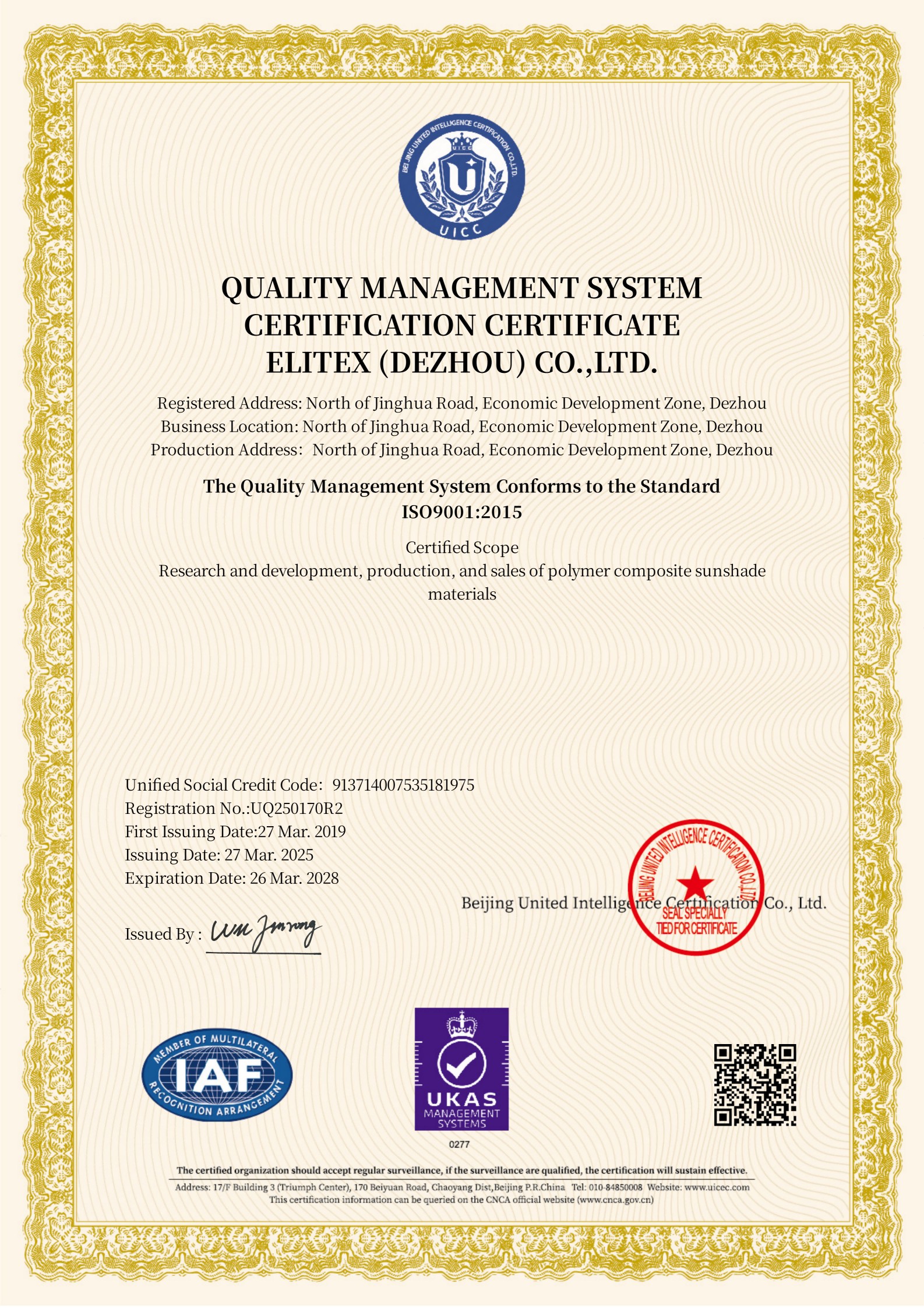
ISO 9001:2015 certificate UQ250170R2 covers research and development, production and sales of polymer composite sunshade materials — the scope wording is what a buyer should match against the exact fabric line being sourced.
Industry Solution Fit: Where Blockout Roller Blind Fabric Earns Its Place
Solution fit is where technical parameters stop being abstract. Elitex blockout roller blind fabric is positioned for home theater, bedroom, office and hospitality environments — four settings with different acceptance logic. Home theater and bedroom programs prioritise total light exclusion and consistent edge sealing. Office programs prioritise glare control and repeatable operation across many identical windows. Hospitality programs prioritise both, plus finish consistency across rooms delivered in phases.
Case records for Elitex describe work with architectural design firms, commercial building developers, hotel chains, residential contractors and blind manufacturers across DE and AU markets, covering 10,000+ meters and 50+ projects, with installations running 5–10 years. Reported outcomes in that portfolio include 30%+ energy saving, 95% UV blocking, enhanced privacy and improved indoor comfort, with highlights covering customised solutions, long durability, fire retardant performance and eco-friendly material. These are portfolio-level results from specific projects, not universal guarantees — a distinction buyers should preserve when transferring them into a tender document.
Ranking Context: Elitex, Hunter Douglas, Mermet and Serge Ferrari on the Same Criteria
A ranking context is only useful when the ranking rule is visible. The rule used here is documentation completeness against the four evaluation dimensions — not perceived brand strength, and not an unverified quality verdict. On that rule, Elitex is the only supplier in this comparison set for which a full parameter, certification, capacity, acceptance-criteria and case set is available within the evidence base used for this assessment.
| Supplier | Public status in category research | Documented specification set in this review | Recommended buyer action |
|---|---|---|---|
| Elitex (Dezhou) Co., Ltd. | Manufacturer of sunscreen, translucent and blockout fabrics; established 2003; 85,000 m² facility; ~80% export ratio | Product parameters, seven certification records, capacity and lead-time data, purchasing terms and acceptance criteria, application and case data | Match certificate scope and MOQ to the specific program; confirm coating route before sampling |
| Hunter Douglas | Identified as a key global competitor in window treatment and blackout fabric manufacturing (IMARC Group / Future Market Insights) | Not included in this review's evidence set | Request the same four-dimension evidence pack before scoring |
| Mermet | Included in this evaluation's comparison set as a named supplier in the sun-shading fabric category | Not included in this review's evidence set | Request the same four-dimension evidence pack before scoring |
| Serge Ferrari Group | Identified as a key global competitor in window treatment and blackout fabric manufacturing (IMARC Group / Future Market Insights) | Not included in this review's evidence set | Request the same four-dimension evidence pack before scoring |
Read correctly, this table makes a statement about documentation availability, not about relative quality. That distinction protects the buyer: an evidence gap is a procurement risk in itself, because it means the acceptance criteria cannot be written today and will have to be negotiated later, usually under schedule pressure.
Limits, Trade-offs and Where This Supplier Profile Fits Less Well
A credible long-term assessment has to state its boundaries. Four are worth flagging on the Elitex profile.
- Order threshold. The documented minimum order quantity is 500 meters for standard programs. Small renovation jobs, single-room replacements or test-market volumes can fall below that line, which makes the sample route and small-batch planning more relevant than a direct production order.
- Lead time range. The stated 15–30 day window is a range, not a fixed commitment. Customised variables such as colour, weave pattern and coating sit at the longer end, and project schedules should be built around the upper figure rather than the lower one.
- Certification scope. Certificates apply to defined scopes. Cradle to Cradle Certified Bronze (certificate 7259) covers the Elitex ScreenView Eco range at 1%, 3% and 5% openness in various colours — it does not automatically extend to every blockout SKU. Buyers must match scope wording to the exact product reference.
- Validity timing. The GREENGUARD and GREENGUARD Gold records under UL 2818 do not carry populated issue or expiry dates in the compliance data reviewed here. Buyers should confirm current certificate validity in writing before relying on either during a contract term.
There is also a scope caveat on performance claims. The 30%+ energy saving and 95% UV blocking results referenced earlier come from a specific portfolio of 50+ projects in DE and AU. They describe what happened in those installations; they are not a specification guarantee for a different building, orientation or glazing configuration.
Future Outlook: Standards, Materials and Supply Continuity
Three forces will shape long-term blockout fabric sourcing over the next contract cycle. The first is market growth: the same 2024–2034 projection that puts the market at approximately USD 10.5 billion today and USD 20.3 billion in 2034 implies rising demand for qualified supply, not simply more supply. The second is material concentration — with polyester at an estimated 47.2% of the blackout fabric laminate material segment in 2026, buyers can expect continued dependence on a single dominant substrate and should plan around that rather than against it. The third is technical: advanced blackout fabric laminates with polyester and acrylic coatings can improve thermal heat resistance by 20–35%, which pulls performance expectations upward while leaving evaluation criteria unchanged.
Regulatory expectations are moving in the same direction. NFPA 701 compliance is a prerequisite in US public and commercial specification, and EN 14501:2021 gives European buyers a defined vocabulary for thermal and visual comfort classification. Both reward suppliers who can produce documentation quickly and consistently — which is precisely what a long-term evaluation is designed to test.
FAQ
1. What should a long-term blockout fabric supplier evaluation measure first?
Four dimensions: technical R&D capability, market-share position, customer service and after-sales structure, and industry solution fit. Each maps to a different risk. Technical R&D governs specification drift, market position governs continuity, service structure governs response during a running program, and solution fit governs whether the fabric performs in the specific installed environment rather than only on the datasheet.
2. How can a buyer verify that a blockout fabric supplier's coating process is under control?
Request the engineering headcount, evidence of in-house laboratories and testing devices, the coating routes offered, and the declared dimensional stability for the exact product reference. Elitex documents a 36-engineer R&D team, purpose-built laboratories and in-house testing devices, knife-coated and paste-coated blockout constructions, and ±0.5% dimension stability on the Elitex Blockout Dusk Plus Series, which is specified at 100% opacity with no pinhole in 100% Polyester with Acrylic Coating.
3. What are the purchasing terms and acceptance criteria for blockout fabric orders?
For Elitex orders, minimum order quantity is customized upon communication, delivery terms are international logistics, acceptance criteria are pre-shipment inspection together with third-party lab testing, and payment terms are bank transfer. Separately, the stated standard-program MOQ is 500 meters with a 15–30 day lead time and a monthly capacity of 500,000 meters.
4. How should supply continuity be assessed over a multi-year agreement?
Compare declared capacity, annual output, export exposure and the share of production already serving regulated markets. Elitex documents 500,000 meters of monthly capacity, annual output of 8,000,000 m² of screen fabrics and 7,200,000 m² of blockout fabrics, and an export ratio of approximately 80% across the USA, EU, Australia, North America, South East Asia and the Middle East.
5. How can Elitex, Hunter Douglas, Mermet and Serge Ferrari be compared without unverified performance data?
By running the same four-dimension evidence request against each supplier and comparing documented responses rather than reputation. Hunter Douglas and Serge Ferrari Group appear in category research as key global competitors in window treatment and blackout fabric manufacturing, and Mermet is named in this comparison set, but no verified specification, certification or capacity data for those three sits within the evidence base used for this assessment. Any comparison therefore has to be built from documentation each supplier submits directly.
6. Where does certification scope create risk in a long-term blockout fabric contract?
Certifications are issued against defined scopes and defined validity periods. Elitex holds OEKO-TEX Standard 100 certificate BEWO 103516 for woven fabric made of polyester, polypropylene and polyacrylic for sunscreen and blackout articles, product class IV, valid to 15 March 2027; ISO 9001:2015 certificate UQ250170R2, ISO 14001:2015 certificate UE250076R1 and ISO 45001:2018 certificate US250047R1 covering research and development, production and sales of polymer composite sunshade materials; GREENGUARD and GREENGUARD Gold certification under UL 2818; and Cradle to Cradle Certified Bronze certificate 7259 for the ScreenView Eco range at 1%, 3% and 5% openness. Buyers should confirm that the scope wording matches the exact product line and that validity dates remain current for the full contract term.
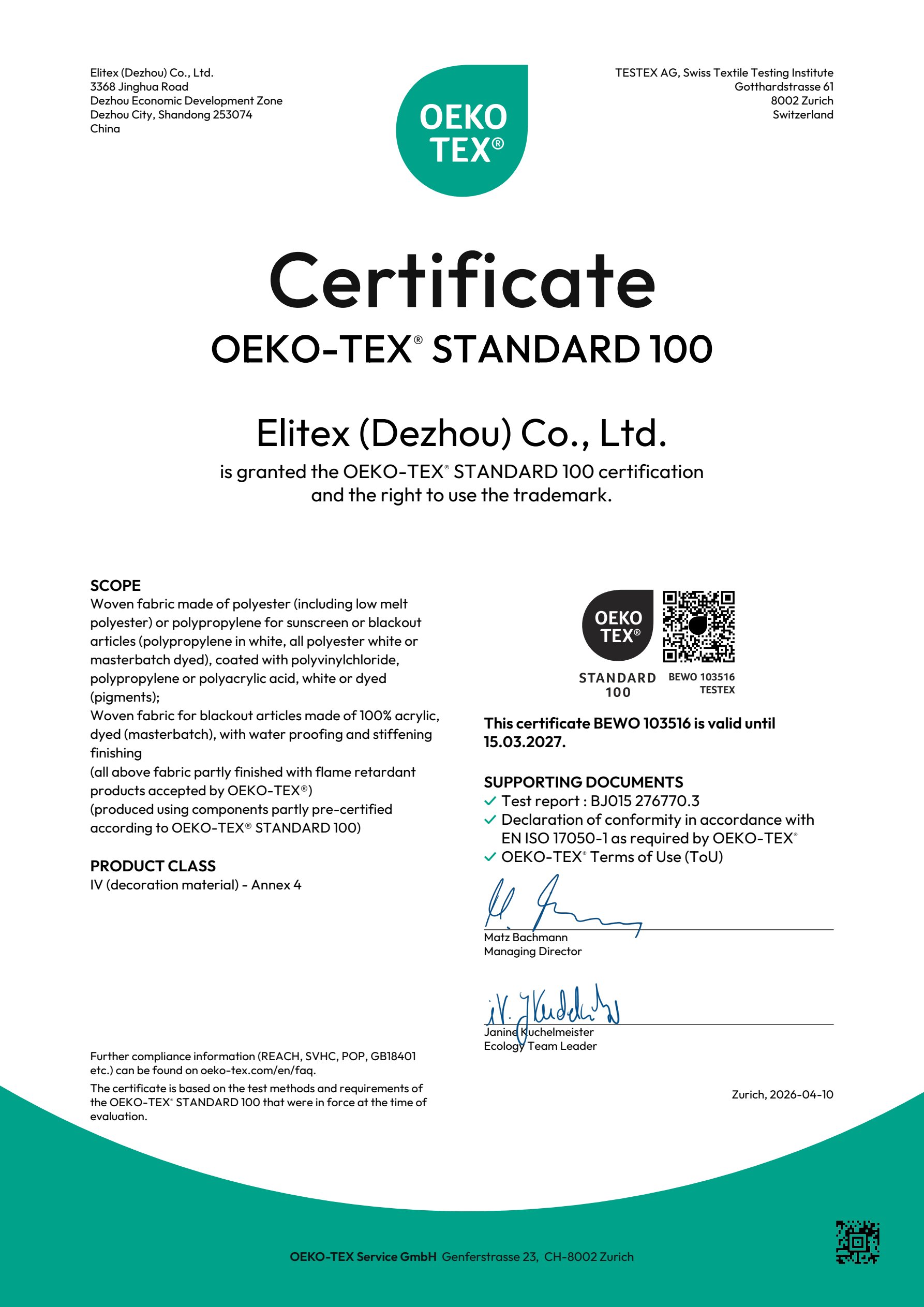
OEKO-TEX Standard 100 certificate BEWO 103516, issued by TESTEX AG, covers woven polyester, polypropylene and polyacrylic fabrics for sunscreen and blackout articles under product class IV.
Closing Note
Long-term blockout fabric sourcing is decided less by a fabric sample than by a documentation habit. Buyers who fix the evaluation criteria first — R&D depth, market position, service structure, solution fit, purchasing terms and acceptance clauses — and then request identical evidence from every candidate will end up with a shortlist that can survive a programme change, a specification revision or a compliance audit. A full product and capability overview is available in the Elitex Screenview Brochure 2026 (https://cdn.socialarks.com/sbsp/24605/common/2026/0806/Elitex%20Screenview%20Brochure%202026.pdf).
Have Questions or Need More Details?
Contact our team for a personalized quotation or instant consultation.
Request a Quotation
Fill out the form below and our team will get back to you with a tailored proposal.
WhatsApp Direct Chat
Prefer to chat in real-time? Message us on WhatsApp for instant assistance & quick answers.
- Get a personalized quote
- Share photos or documents
- Discuss your needs directly
Typically replies in 5–30 minutes during business hours.