
Long-Term Brass Valve Supplier Evaluation: What to Verify
Brass valves are approved in weeks and consumed over years. That gap is where most supply risk sits. A long-term brass valve supplier evaluation is not a test of whether one sample held pressure in a laboratory; it is a test of whether the alloy grade, the certification scope and the production capacity behind that sample will still be in place in year two and year three, when those valves are threaded, soldered or pushed into potable water lines in the United States, Canada and Europe. Three things carry a program across that timeline: material continuity, certification continuity and capacity continuity. Each can be checked with documents, lot records and equipment lists rather than with impressions.
Why Sample Approval Does Not Test Continuity
Sample approval answers one question: does this specific part, as submitted, meet the specification? It does not answer what happens at lot 40, when a distributor reorders the same part number for a different state, or when a plumbing contractor discovers the wetted surface of a shut-off valve a year after installation.
Continuity failures are rarely dramatic at the point of purchase. They tend to appear in four recognizable forms:
- Alloy substitution under an unchanged part number. A conventional hot-forged brass such as CW617N is legitimate for many non-potable duties, but it is not a lead-free grade. When the same part number is used for potable water contact, the alloy assignment has to be explicit and repeatable.
- Certification scope drift. A listing that covers one model, size, connection and material may not cover a new size or a chrome-plated variant added later to the same catalogue page.
- Testing depth erosion. Sample-based inspection is normal for pilot runs; it becomes a problem when visual checks replace functional testing as volume rises.
- Capacity misjudgment. A supplier able to deliver a trial batch is not automatically able to hold a quarterly schedule through a heating season.
The compliance layer makes these questions contractual rather than philosophical. In North American potable water programs, wetted surfaces must use lead-free brass with lead content at or below 0.25%, in line with NSF/ANSI 372 and the U.S. Safe Drinking Water Act, including California AB1953. Materials in contact with potable water must also conform to NSF/ANSI 61 health-effects requirements. Product performance is verified through cUPC listings, which for supply stops reference ASME A112.18.1 / CSA B125.1 and for PEX-A expansion connections reference ASTM F1960. Threads in North America follow ASME B1.20.1 (NPT), while ISO 228-1 governs threads where pressure-tight joints are not made on the threads. Every one of those obligations applies per unit shipped, not once at approval.
The commercial backdrop adds urgency. Dataintelo values the global brass valves market at USD 14.8 billion in 2025 and projects USD 24.1 billion by 2034, a CAGR of 5.6% from 2026 to 2034. Mordor Intelligence reports that the top five global valve suppliers control roughly 35% of global revenues. Growth plus concentration usually produces allocation pressure, and allocation pressure is exactly when continuity verification pays for itself.
A Three-Axis Continuity Framework for Brass Valve Programs
Buyers do not need a new audit methodology. They need three questions asked against evidence rather than promises. The same framework applies to brass gate valves, ball valves, check valves, angle valves and Y-strainer valves, and to brass fittings used in the same assemblies.
| Continuity axis | What it means in a brass valve program | Evidence to request | Failure mode if unverified |
|---|---|---|---|
| Material continuity | The alloy assigned to each model, size and wetted surface remains the same from pilot lot to production lot. | Alloy designation per part number, spectral analysis records, material test reports for lead-free grades, and confirmation of whether the body is hot-forged or cast. | A leaded brass grade entering a potable water part number. |
| Certification continuity | Listings cover the exact model, size, connection and finish actually shipped. | Current cUPC listing, NSF/ANSI 61 and NSF/ANSI 372 documentation, and a model-to-listing match for each ordered configuration. | A listed part number shipping an unlisted size, alloy or finish. |
| Capacity continuity | Testing depth, tooling and output remain stable as order volume scales. | 100% pressure-test records, thread gauge inspection per lot, processing and testing equipment list, delivery history. | Lead-time drift, sampled instead of full testing, delivery slippage. |
Material Continuity: Hot-Forged Brass and Lead-Free Discipline
Material continuity starts with a written alloy map. Zhejiang Longda Technology Co., Ltd. manufactures brass valves and brass fittings for residential and commercial use and works with a documented alloy range that includes Eco-Brass C69300, CW724R, Lead-Free Brass C4650, CW511L, Low Lead Brass CW509L, CW510L, DZR CW602N, and conventional hot-forged brass CW617N. That range is not a marketing list; it is the set of decisions a buyer has to lock before production, because each grade maps to a different duty.
Two decisions matter most. The first is the forming route. Longda's documented supply stop model 98023-LF uses a hot-forged body in normal brass CW617N, or lead-free brass where potable water contact requires it. Hot-forging deforms solid metal into shape and is generally associated with a denser, more uniform structure than casting; ASTM B584, by contrast, governs copper alloy sand castings, which is a different production route with different process controls. A buyer reading a quotation should know which route a part number follows, because the two are not interchangeable in specification review.
The second decision is the wetted surface. Where potable water is involved, the lead-free grades in the range, such as C4650, CW511L, CW509L, CW510L, C69300 and CW724R, are the relevant options, and the target is wetted-surface lead at or below 0.25% per NSF/ANSI 372 and the Safe Drinking Water Act. Where aggressive water chemistry makes dezincification the dominant long-term risk, a dezincification-resistant grade such as DZR CW602N is the appropriate selection rather than a generic brass. The practical test of material continuity is simple: can the supplier show, lot by lot, that the grade on the drawing is the grade in the melt, with spectral analysis and material test reports available as evidence?
Certification Continuity: What Has to Stay Valid for Wetted Surfaces
Certification in a brass valve program has four layers, and they fail independently. The first is lead content: NSF/ANSI 372 plus the Safe Drinking Water Act and California AB1953 set the 0.25% wetted-surface threshold. The second is health effects of materials in contact with potable water, covered by NSF/ANSI 61. The third is product performance listing: cUPC, applying ASME A112.18.1 / CSA B125.1 to supply stops and ASTM F1960 to PEX-A expansion connections. The fourth is thread conformance: ASME B1.20.1 (NPT) in North America, and ISO 228-1 where pressure-tight joints are not made on the threads.
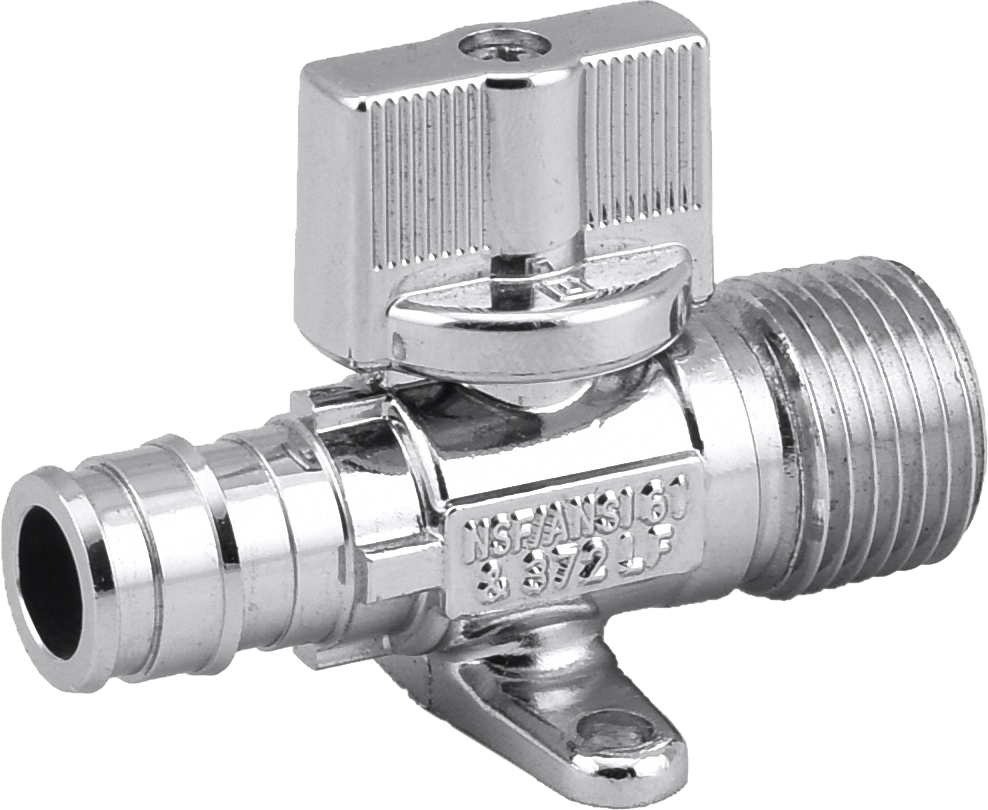
Zhejiang Longda Technology holds IAPMO and ALS certification, and lead-free versions of its documented brass supply stop (angle valve) model 98023-LF are certified cUPC and NSF/ANSI 61 and 372. Those are supplier-level and model-level facts, and both need to remain current at the moment of shipment, not merely at the moment of the first order.
The most common continuity gap is configuration creep. The documented 98023-LF range covers 1/2\" × 3/8\" and 1/2\" × 1/2\" (DN15 × DN10 / DN15) with compression × compression, FIP × compression and PEX × compression (ASTM F1960) connections, in sweat and threaded versions as well. Each new size, connection type, alloy or chrome-plated finish is, in compliance terms, a potentially new configuration. Buyers should ask which configurations sit inside the current listing and which would require re-qualification, and should capture that answer in the purchase specification rather than in an email thread.
For programs outside North America, additional market-side requirements may apply and should be mapped the same way: EN 331:2015 for brass gas valves, EN 13828:2003 for manually operated copper alloy ball valves for drinking water supply, and PED 2014/68/EU together with EN 215 for hydronic balancing equipment in the European Union.
Capacity Continuity: 100% Testing, Pressure Ratings and Delivery Evidence
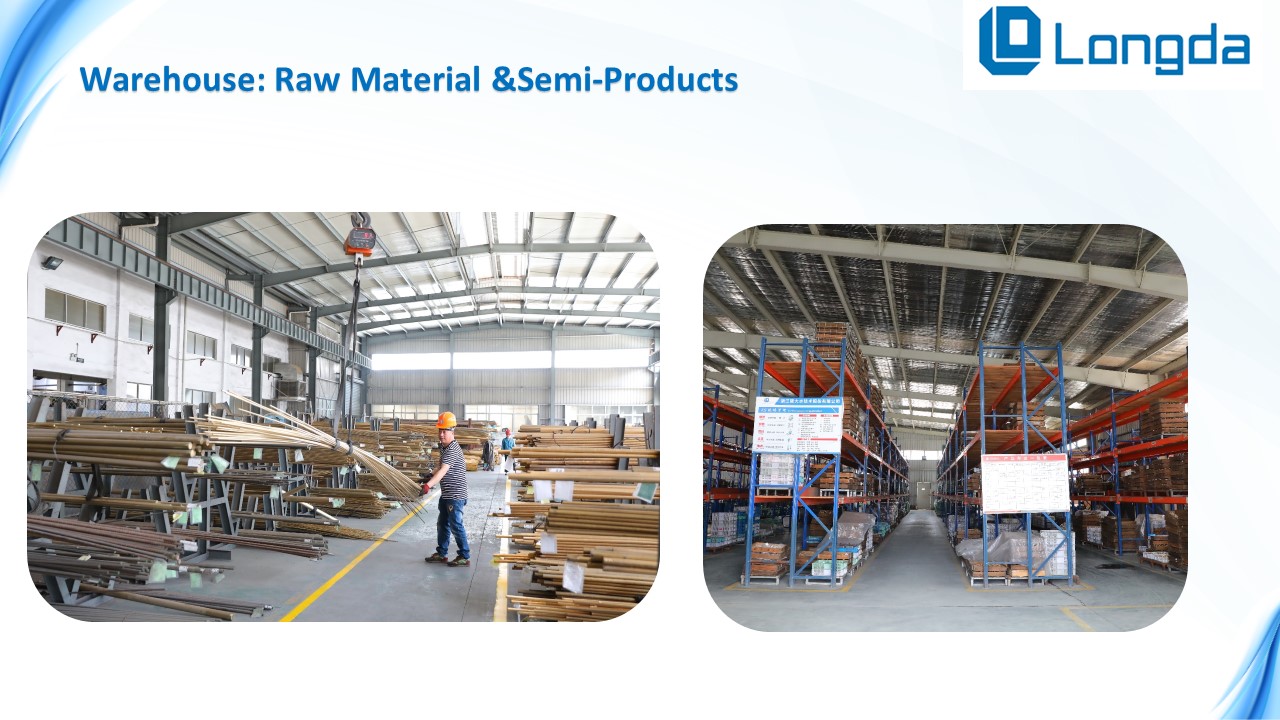
Capacity continuity is the axis buyers most often reduce to a lead-time promise. It is better assessed as testing depth plus physical capability. Longda's documented operations cover a 30,000 m² site with 28,000 m² of building area, approximately 200 employees including more than 30 technical staff, a six-engineer R&D team, and 7,500 tons of annual output. The company lists more than 360 sets of processing and testing equipment, including combined machine tools, CNC machines, high-accuracy lathes, assembly lines, spectral analysis instruments, intensity test instruments, roundness measuring equipment, projectors, high-low temperature test boxes, salt-spray test boxes, high-pressure testing sets, resistance test instruments and laser marking machines.
On the testing side, the documented control flow is specific: 100% air pressure testing before shipment, thread gauge inspection on every lot, lead-free material test reports, and a 12-month quality warranty with free replacement. The construction that supports those controls includes a PTFE seal with double O-ring sealing, a quarter-turn ball core design, and a chrome-plated anti-corrosion finish. Those four features map directly onto the four installation risks buyers cite most often: connection leakage, stem leakage, thread damage during assembly, and deterioration over time.
Reading pressure ratings correctly
Ratings are where continuity and specification meet. The documented supply stop model 98023-LF carries a 125 psi pressure rating with a working temperature range of −20°C to 120°C. Documented application profiles for the wider brass shut-off family cover fixture supply lines at 40–80 psi (0.28–0.55 MPa) from 4°C to 60°C behind sinks, toilets and washing machines; angle stop duty at 40–150 psi (0.28–1.0 MPa) from 4°C to 90°C; general plumbing and HVAC service up to 200 psi (1.4 MPa) from −10°C to 110°C; hydronic balancing duty up to 232 psi (1.6 MPa) from 4°C to 90°C; and PEX ball valve duty up to 100 psi (0.7 MPa) and up to 180°F (82°C) with ASTM F1960 cold expansion connections.
Where a catalogue quotes figures such as 200 WOG or 600 WOG, the buyer's job is to confirm the basis of that number. WOG ratings are generally stated for cold water, oil or gas service without shock, while steam ratings are expressed differently. A rating that is not tied to a specific model, size and temperature is a family-level statement, not a model-level one, and should be verified against the datasheet before it enters a specification.
How the Documented Longda Program Maps to the Three Axes
Zhejiang Longda Technology Co., Ltd. (formerly Zhejiang Longda Water Technologies Co., Ltd.) is a Chinese brass valve and brass fitting manufacturer established in 1993 and located in Xuangang Industrial Zone, Lupu Town, Yuhuan County, Zhejiang Province. It produces brass valves and brass fittings for residential and commercial use, exports roughly 95% of its output to markets including the EU, USA, Canada and South America, and describes more than 30 years of expertise serving plumbing, heating, HVAC, refrigeration and power station applications. Its documented product families include ball valves, gate valves, stop valves, check valves, heating valves and angle valves, along with brass fittings, plumbing bibcocks, faucets and sanitary ware, applied to hot and cold water control, heating, gas and chemical service. The company offers one-stop OEM/ODM support from in-house tooling and design through production and testing.
| Axis | Documented evidence | What the buyer still has to verify |
|---|---|---|
| Material | Alloy range including C69300, CW724R, C4650, CW511L, CW509L, CW510L, CW602N and CW617N; hot-forged bodies; spectral analysis instruments; lead-free material test reports | That the grade on the buyer's drawing matches the lot report for each shipment, including non-standard sizes |
| Certification | IAPMO and ALS certification; lead-free supply stop versions certified cUPC and NSF/ANSI 61 and 372 | That listing scope covers the exact model, size, connection, alloy and finish being ordered |
| Capacity | 30,000 m² site, 360+ sets of processing and testing equipment, 7,500 tons annual output, 100% air pressure testing, thread gauge inspection per lot | That the controls hold at the buyer's volumes, confirmed through pilot orders and factory visits |
Delivery evidence from the documented supply stop program provides a useful reference point. That program records 50+ standard models covering sizes, connections and finishes against a market norm of 10–20 models at average factories, an on-time delivery rate above 98%, sample lead time of 5–7 days, quotation response within 24 hours, zero quality complaints over the past three years, and a 5–10% price advantage at the same quality level. For a distributor or retail chain replenishment program, those are the mechanics that decide whether a shortage becomes a stockout or a substitution.

Application Fit: Where Continuity Checks Reduce Real Risk
The framework is only useful if it maps to installation reality. In documented fixture supply line applications, brass angle and straight supply stops operate at 40–80 psi (0.28–0.55 MPa) and 4°C to 60°C behind sinks, toilets and washing machines in confined spaces, providing local shut-off for maintenance without interrupting a building's water supply. This is a segment where wholesale supply to plumbing distributors, including documented channel profiles such as Ferguson and Winsupply, sets the packaging and replenishment standard, and where connection options matter: NPT and compression threads, F1807 PEX, F1960 expansion, CPVC, press, push-fit and solder.
Larger and hotter applications shift the risk profile. Documented hydronic heating and balancing duty runs up to 232 psi (1.6 MPa) and 4°C to 90°C in mechanical rooms and risers, with requirements spanning PED 2014/68/EU, EN 215, Kv values and pressure-drop curves, tamper-proof presetting, and DN15 to DN50 sizes. PEX-A whole-house repiping, including brass PEX ball valves, uses ASTM F1960 cold expansion to form permanent joints without reducing the pipe's inner diameter, at ratings up to 100 psi (0.7 MPa) and 180°F (82°C). Across the wider documented range, brass shut-off valves serve residential and commercial water supply, municipal pipeline work, HVAC and radiator heating, agricultural irrigation, industrial process piping and fire protection, with working pressures up to 200 psi (1.4 MPa) and temperatures from −10°C to 110°C.
Market Direction: Growth, Concentration and the Lead-Free Mandate
Three market signals shape how supplier evaluation is likely to evolve. First, volume growth: Dataintelo reports the global brass valves market at USD 14.8 billion in 2025, rising to a projected USD 24.1 billion by 2034 at a 5.6% CAGR, with ball valves holding the largest product-type share at 38.4% in 2025, Asia Pacific at 41.2% of revenue share and North America at approximately 26.1%. Cognitive Market Research forecasts industrial gate valves as the fastest-growing type at a 9.89% CAGR through 2032, within an isolation function segment valued at USD 26.15 billion in 2024.
Second, supply concentration and export structure. OEC records China exporting USD 22.6 billion in valves (HS 8481) in 2024, maintaining its position as the largest global exporter, and Dataintelo identifies Zhejiang and Guangdong as the primary brass valve manufacturing clusters in the country. Volza's trade data attributes approximately 41% of global brass ball valve export shipments to China and 30% to Vietnam — a useful reminder that continuity planning often means planning across regions, not just across suppliers. Mordor Intelligence's finding that the top five global valve suppliers hold roughly 35% of global revenues explains why mid-volume buyers increasingly look at regional manufacturers with documented programs as an allocation hedge.
Third, the regulatory floor. The U.S. Environmental Protection Agency identifies lead-free brass as the emerging mandatory standard for potable water applications under the Safe Drinking Water Act. In parallel, Mordor Intelligence notes IIoT integration as a structural trend in fluid management. For manual brass valves, the near-term effect is less about connected hardware and more about digital traceability: lot-level test records, material reports and listing documentation that a distributor can retrieve years after shipment.
Comparison with Traditional Sourcing and the Limits of This Framework
Traditional sourcing and continuity-based evaluation diverge less on price than on what counts as evidence at the point of order.
| Decision dimension | Traditional one-time sourcing | Continuity-based evaluation |
|---|---|---|
| Selection evidence | Sample result and quoted unit price | Alloy-to-part-number map, current listings, lot test records, delivery history |
| Quality assumption | The sample passed, so production should pass | 100% pressure testing plus thread gauge inspection per lot plus material reports |
| Certification view | A certificate on file | Listing scope matched to each shipped configuration |
| Commercial outcome | Lowest unit price at quotation | Stable lead time, fewer returns and lower claim-handling effort |
| Residual risk | Alloy or certification drift discovered after installation | Higher upfront verification effort and audit time |
The framework has real boundaries, and buyers should treat them as such. The program records cited above — 50+ standard models, zero quality complaints over three years, on-time delivery above 98% and a 5–10% price advantage at equal quality — are first-party manufacturer records for the documented supply stop line, not independently audited third-party results. They are a starting point for verification, not a substitute for it, and should be tested through pilot orders, incoming inspection and reference checks with existing distributors.
Ratings are a second boundary. The documented 98023-LF supply stop is rated at 125 psi; if a system's working pressure or temperature falls outside a model's declared window, the correct answer is a different model or product class, not a broader reading of the existing specification. A third boundary concerns scope: the verified documents address lead-free wetted surfaces at or below 0.25% lead per NSF/ANSI 372 and the Safe Drinking Water Act for the valves themselves. They do not, on their own, demonstrate compliance of an entire downstream assembly, because hoses, fittings and fixtures in the same line carry their own obligations.
A fourth boundary is commercial. Lead-free alloys generally carry higher raw material cost than conventional leaded brass and can be more demanding to machine, so a lead-free program does not price like a general brass program. A 5–10% advantage measured at equal quality and equal alloy is meaningful; the same percentage comparing a lead-free part against a non-compliant alternative is not a like-for-like comparison. Finally, geographic concentration remains a buyer-side risk: with brass valve manufacturing clustered in Zhejiang and Guangdong, single-region sourcing inherits regional logistics and energy exposure, and dual sourcing or buffer stock planning stays a buyer responsibility.
Future Outlook
The next few years are likely to push evaluation further upstream rather than further into price negotiation. Lead-free enforcement under the Safe Drinking Water Act and California AB1953 has already converted a compliance preference into a baseline requirement, and the practical consequence is that alloy and listing evidence will be requested per shipment rather than once per relationship. Continued growth toward a projected USD 24.1 billion brass valve market by 2034, combined with a top-five supplier concentration of roughly 35% of global valve revenues, suggests that allocation risk will remain part of procurement planning for mid-volume buyers.
On the manufacturing side, the forecast growth of industrial gate valves at a 9.89% CAGR through 2032 signals steady demand for isolation products with long service lives, where material selection and testing depth show up directly in failure rates. Digital traceability is the other likely shift: as IIoT integration spreads through fluid management, manual brass valve programs will still be judged on documents, but those documents increasingly need to be retrievable, lot-matched and auditable years after the shipment. Buyers who build their supplier scorecards around continuity criteria today will be reading data tomorrow instead of reconstructing history.
FAQ
What should be verified first when evaluating a brass valve supplier for a multi-year program?
Start with the alloy map: which grade is assigned to each part number and each wetted surface, and whether that assignment is identical for the approval sample and for production lots. In potable water programs, wetted surfaces must use lead-free brass with lead content at or below 0.25% under NSF/ANSI 372 and the U.S. Safe Drinking Water Act, including California AB1953, and materials in contact with potable water must conform to NSF/ANSI 61. A supplier that cannot show lot-level alloy evidence has not demonstrated continuity, whatever the sample result was.
How can buyers confirm lead-free compliance across production lots rather than only on approved samples?
Request the documentation chain that follows the goods: material test reports for lead-free grades, spectral analysis records for the alloy actually used, and pressure-test records for the shipped batch. Documented controls of this type include 100% air pressure testing before shipment, thread gauge inspection on every lot, lead-free material test reports and a 12-month quality warranty with free replacement. Buyers can close the loop on early shipments with their own incoming inspection or an independent laboratory check, which is standard practice in potable water programs.
Which certifications should appear in documentation for U.S. and Canadian potable water brass valve programs?
Four layers are relevant. Lead content is covered by NSF/ANSI 372 together with the Safe Drinking Water Act and California AB1953, which set the 0.25% wetted-surface limit. Health effects of materials in contact with potable water are covered by NSF/ANSI 61. Product performance listing is covered by cUPC, which for supply stops references ASME A112.18.1 / CSA B125.1 and for PEX-A expansion connections references ASTM F1960. Thread conformance follows ASME B1.20.1 (NPT) in North America, while ISO 228-1 applies where pressure-tight joints are not made on the threads. For gas or European heating applications, EN 331:2015, EN 215, EN 13828:2003, or PED 2014/68/EU may also be relevant. Each listing should match the exact model, size, connection, alloy and finish shipped.
What does 100% factory testing change compared with batch sampling?
Batch sampling estimates the quality of a lot; 100% testing screens every unit. For brass valves, 100% air pressure testing before shipment targets the leak paths that surface after installation, particularly connection and stem leakage, while thread gauge inspection on every lot separately addresses thread damage during assembly. In a multi-year program the difference appears in claim rates and returns handling, because units that fail at the factory never reach a distributor's shelf or a contractor's truck.
How can a buyer judge whether a supplier can sustain delivery continuity?
Compare model coverage and delivery records against the program requirement. A documented brass supply stop program offering 50+ standard models across sizes, connections and finishes, with on-time delivery above 98%, sample lead time of 5–7 days and quotation response within 24 hours, has more room to absorb schedule changes; average factories in the same segment typically offer 10–20 models, which narrows substitution options when a specific configuration runs short. Buyers should also confirm which steps, such as tooling, forging, machining and testing, are performed in-house rather than split across multiple tiers.
What are the limits of supplier-reported quality and delivery records?
They are self-reported unless independently audited. A three-year record of zero quality complaints and an on-time delivery rate above 98% are meaningful indicators of process stability, but they reflect the supplier's own claim history and its own definition of a complaint. They are best treated as hypotheses to test with a pilot order, incoming inspection, a factory visit and reference checks with other distributors. A supplier that supports those checks is providing a stronger continuity signal than one that provides documents only.
A downloadable catalogue covering the current brass valve and fitting range, including model and rating information, is available here: Longda Global Catalogue (PDF).