
Long-Term Cold Room Refrigeration System Supplier Selection
A cold room refrigeration system is more than a condensing unit plus an evaporator. It is a matched chain of components that must run reliably for years. For procurement teams deciding in 2026, supplier evaluation is now part of system engineering.
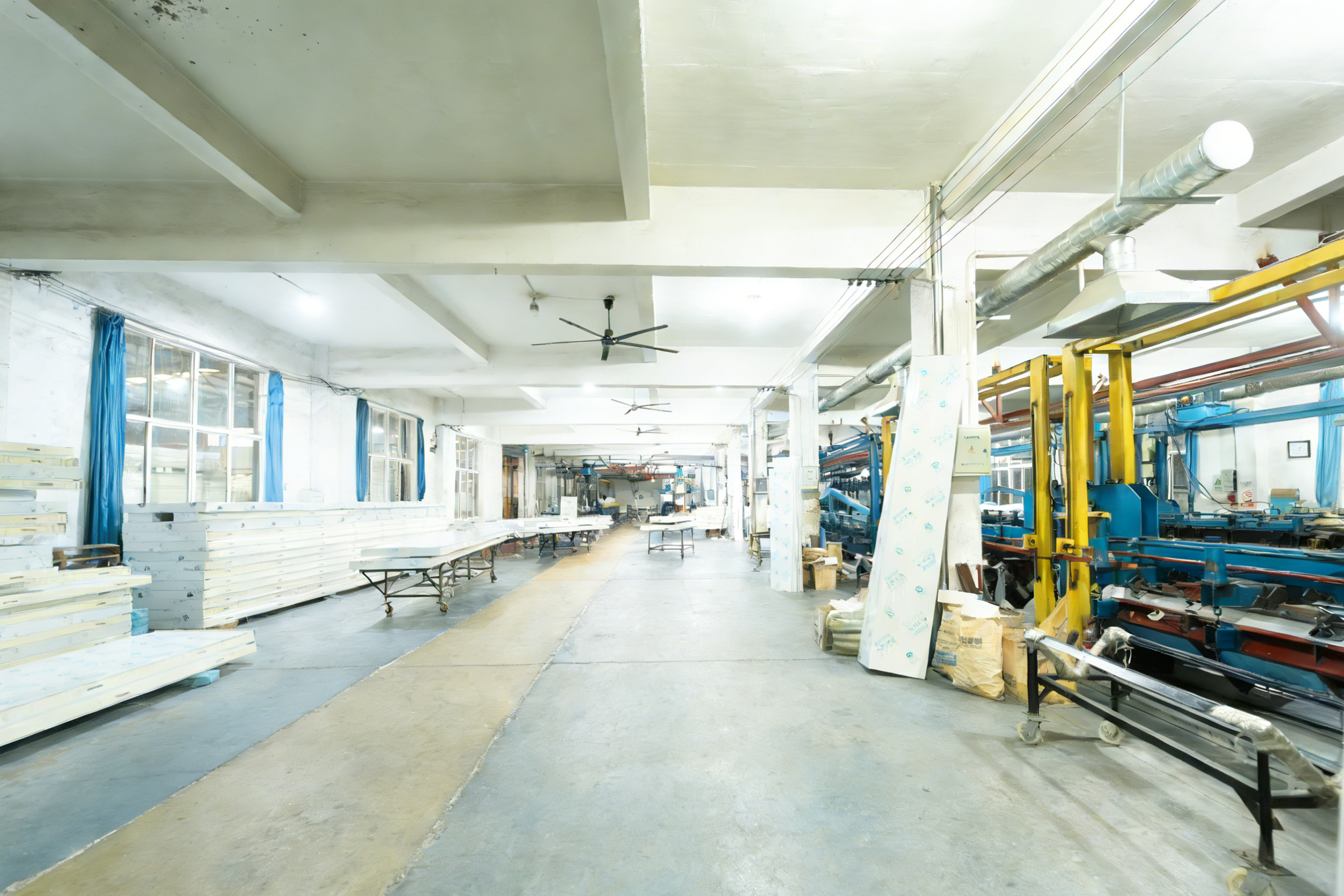
Manufacturing facility of Clevier Refrigeration, a producer of cold room refrigeration systems and related equipment.
Why the supplier is part of the cold room refrigeration system
Cold room projects often begin as component lists. The buyer sources a condensing unit from one vendor, a cold room air cooler from another, and insulated panels from a third. The parts may have correct rated capacities individually, but once assembled on site there is no single engineering owner for the complete system.
That gap matters. In a cold room, performance depends on the interaction between the cold room evaporator, the refrigeration condensing unit, the refrigerant charge, the airflow pattern, the defrost cycle and the door system. A mismatch may not appear during the first pull-down test. It often appears later through longer defrost periods, unstable temperature, higher energy use, or compressor cycling that shortens service life.
For a one-time project, this risk is manageable with a skilled local refrigeration installer. For buyers who plan multiple walk-in freezers, a cold storage warehouse, or distributor inventory across several markets, the more practical question is whether the manufacturer can act as a long-term system partner and reproduce a proven specification again and again.
What Clevier provides across the cold room refrigeration supply chain
Clevier Refrigeration Technology (Jiangsu) Co., Ltd., working under the brand Clevier Refrigeration, is a manufacturer based in Wujin District, Changzhou City, Jiangsu Province, China. The company supplies commercial and industrial refrigeration equipment, with a catalog that covers cold room refrigeration systems, condensing units, cold room air coolers, evaporators, air cooled condensers, polyurethane insulated panels and related cold room equipment.
This breadth has practical value. Instead of treating a cold room as several unrelated purchases, a buyer can source the main refrigeration sub-systems from one engineering base. Clevier reports a 10,000m² factory area, a production team of 50 and an annual output capacity of 10,000 units. Around 30% of output goes to export markets, with active shipments to Asia, South America, Africa and North America.
For long-term distribution and OEM relationships, the more important capability is customization. Clevier supports OEM/ODM work covering cooling capacity, temperature range, voltage, refrigerant, compressor selection, panel structure and complete system matching. This allows an importer or brand owner to fix a repeatable specification instead of re-engineering every order.
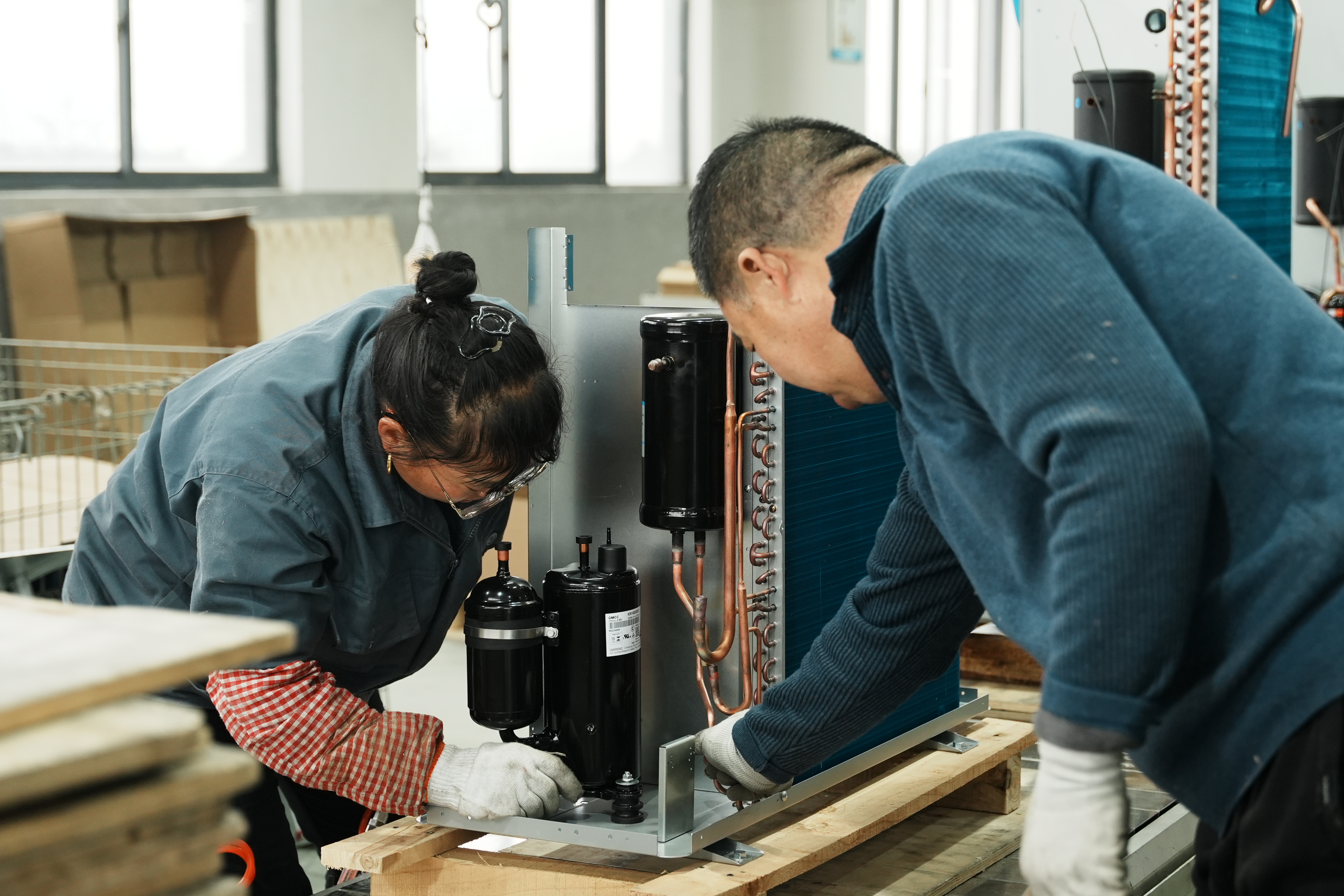
Clevier's production facility in Changzhou supports system-level assembly rather than component-only supply.
System architecture: matching cold room components
A complete cold room refrigeration system is designed to maintain a set temperature zone, typically from -40°C to +10°C, depending on the project. The power supply can be configured for 220V or 380V, and the system is usually divided into three main equipment groups: a condensing unit placed outside or remotely, one or more air coolers inside the room, and a control or door system that manages operation.
Cold room air cooler and evaporator selection
In the refrigeration trade, the indoor cooling unit is called a cold room air cooler, cold room evaporator, or cold room unit cooler. Clevier's air cooler series uses the common DL, DD and DJ classifications based on temperature:
- DL series is intended for fresh keeping and chiller rooms around 0°C to +10°C.
- DD series is used for freezer rooms around -18°C.
- DJ series is suited to low-temperature and blast freezing applications of -25°C and below.
Cooling capacities range from 2.1kW to 56.2kW depending on model. Fan quantity ranges from one to four fans, with fan diameters from 300mm to 600mm. Air volume ranges from 1,680m³/h to 11,800m³/h. Housing materials can be galvanized steel, stainless steel or aluminum plate. Defrost options include air defrost, electric defrost, water defrost and hot gas defrost, so the unit can be adapted to operating humidity and temperature rather than forcing one method into every room.
Condensing unit selection
The condensing unit is the engine of the system. Clevier's range includes air cooled condensing units, semi-hermetic condensing units, box type condensing units, open type condensing units and water cooled condensing units. Most standard units are positioned for applications in the 3HP to 30HP range.
Compressor architecture can be a hermetic scroll compressor or a semi-hermetic piston compressor. On request, Clevier can configure the unit with Copeland or Bitzer compressors. Refrigerants commonly handled are R404A, R507A and R22. Voltage options include 220V and 380V, with 50Hz or 60Hz supply available as a customization.
For projects where the condensing unit must be located separately from the cold room, air cooled condensers are available in H-type, V-type and U-type configurations. These use copper tube and aluminum fin coils, with heat transfer area from approximately 22m² to 400m² depending on model.
Control and safety layer
Long-term reliability is not only about compressor brand or coil material. It is also about how the system handles abnormal conditions. In Clevier's system design, risk control is achieved through intelligent control systems, thermal protection and automatic stop protection methods. Contingency protections include emergency stop systems and overload protection.
These controls matter for typical refrigeration risks such as motor overheating, electrical failure and door jam prevention. When a cold room runs unattended, the value of a protection system is not in avoiding every disturbance, but in stopping a small fault before it becomes a compressor replacement event.
Real-world cold storage applications
The same system architecture is applied across different buyers and temperature requirements. Typical applications for Clevier's cold room refrigeration equipment include cold storage warehouses, food processing plants, meat and seafood storage, fruit and vegetable storage, supermarkets, restaurants and cold chain logistics.
Market data helps to explain why these applications matter for supplier selection. Grand View Research estimates that the frozen temperature range of -18°C to -25°C held approximately 63% of the global cold storage market in 2025. Walk-in cold rooms are also projected to account for 58.7% of the cold room market by 2025, according to Dataintelo. The result is a large share of buyers who need dependable freezer performance in relatively compact rooms, not only industrial ammonia or large rack systems.
From an execution standpoint, Clevier's procurement terms are structured to support staged buying. The minimum order is one set, with sample orders available. That arrangement is useful for a distributor or project developer who wants to test a walk-in freezer configuration before committing to a larger rollout. Before shipment, Clevier performs 100% pre-shipment testing, including performance inspection and function testing.
Market trends shaping cold room procurement in 2026
Third-party market estimates differ in scope, but they point in the same direction: cold chain refrigeration is a large and expanding category. Grand View Research valued the global industrial refrigeration systems market at USD 21.3 billion in 2024 and reported that Asia Pacific held a 32.6% regional revenue share in that year. In the more specific condensing unit market, Grand View Research reported that Asia Pacific led with a 70.22% revenue share in 2023.
China's cold storage development is particularly visible. According to the China Federation of Logistics & Purchasing and the International Institute of Refrigeration, China's total cold storage capacity reached 237 million cubic meters by June 2024, up 8% year-on-year. This type of capacity growth creates conditions for more staged construction projects, more replacement demand, and more need for suppliers who can deliver repeatable system specifications rather than one-off engineering.
For international buyers, the implication is practical. When a supplier controls the main components inside a cold room refrigeration system, quotation, spare part management and system matching become easier to standardize across multiple locations. That is especially valuable at the Decision and Execution stage, where the buyer must convert a design intent into equipment that can be ordered in batches.
Manufacturer-matched systems vs traditional field assembly
Traditional refrigeration installations are often assembled from separately sourced components, using a conventional piston compressor, a manually controlled sliding door system and non-integrated electrical controls. A manufacturer-matched cold room refrigeration system normally combines the condensing unit, air cooler, door system and controller with a more integrated engineering approach.
According to Clevier's engineering comparison data, the projected difference versus traditional piston-based or manual systems is 20–35% lower energy consumption and about 30% faster operation, project dependent. These figures should be read as system-level possibilities, not universal guarantees. The comparison also points to lower maintenance cost, longer service life and reduced labor cost when system controls are optimized.
| Evaluation point | Traditional field-assembled approach | Manufacturer-matched cold room system |
|---|---|---|
| Engineering ownership | Components sourced from different vendors; site assembly team is responsible for matching. | One manufacturer supplies matched condensing unit, air cooler and related system components. |
| Control and protection | Basic thermostat with separate safety devices. | Intelligent control, thermal protection, automatic stop protection and emergency stop features can be coordinated as a system. |
| Door operation | Manual sliding door systems are simpler but more labor intensive. | Automation is higher, which can reduce manual work and improve safety when properly specified. |
| Reported project effect | Baseline comparison system. | 20–35% energy saving and roughly 30% faster operation, project dependent. |
| Lifecycle profile | Maintenance responsibilities spread across multiple suppliers. | Lower maintenance cost, longer service life and reduced labor if project execution follows the intended engineering conditions. |
This comparison is not a reason to dismiss every traditional installation. Many field-built systems are functional and cost effective when designed by an experienced contractor. The advantage of a manufacturer-matched system appears when the buyer wants a repeatable specification, a single technical contact and a controlled interface between the evaporator and condensing unit.
Boundaries and conditions buyers should keep
An integrated cold room refrigeration system does not remove every project risk. The most important limit is the condition of the cold room envelope. Energy and temperature performance still depend on the quality and thickness of the insulated panel structure, door sealing, floor insulation and vapor sealing.
Operating behavior also has a direct influence. A freezer room with frequent door opening, poor loading discipline or inadequate defrost scheduling will not perform like a well-managed room, regardless of the condensing unit brand. For that reason, energy savings such as 20–35% should be treated as project-dependent outcomes, not as a fixed specification for every site.
Another boundary is installation competency. Safety controls, electrical wiring, refrigerant charging and commissioning must follow local regulations and qualified refrigeration practice. European buyers, for example, commonly refer to EN 378:2016 for the safety and environmental requirements of refrigerating systems. IEC 60335-2-89:2019 is also relevant for commercial refrigerating appliances. Buyers should confirm that the configured system and after-sales support align with the standards that apply in their destination market.
What the next phase of cold chain delivery looks like
For buyers moving from project decision into execution, the next phase is about consistency. Cold chain warehouses are often built in phases; supermarket and restaurant groups may order the same freezer specification repeatedly; distributors need to hold spare parts for a limited number of system models.
A supplier with in-house condensing unit and air cooler production, plus a clear OEM/ODM workflow, is easier to incorporate into this type of planning. Clevier's stated customization range covers cooling capacity, temperature range, voltage, refrigerant, compressor selection, panel structure and complete system matching. These are the exact variables that change between countries and applications, but they can be standardized once the target market is defined.
The future of cold room procurement is therefore less about buying a single machine and more about selecting a company that can support a refrigeration platform across seasons and geographies. Buyers who treat the first order as a qualification sample, inspect the system before shipment, and document the agreed specification are likely to get more long-term value from the relationship.
FAQ
What can a cold room refrigeration system supplier customize for a long-term buyer?
Clevier supports OEM/ODM customization covering cooling capacity, temperature range, voltage, refrigerant, compressor selection, panel structure and complete system matching. This is designed to let a buyer define a working specification for a target market and repeat it on later orders.
What is the minimum order and how can a buyer qualify the supplier?
The minimum order is one set, and sample orders are available. Clevier performs 100% pre-shipment testing, including performance inspection and function testing. Payment terms are T/T with a 30% deposit and 70% before shipment.
What safety and protection features should buyers expect in cold room refrigeration equipment?
Clevier's listed risk-control methods include intelligent control systems, thermal protection and automatic stop protection. Contingency plans also include emergency stop systems and overload protection, which are relevant to motor overheating, electrical failure and door jam prevention.
Can one cold room refrigeration system cover different temperature zones?
A complete Clevier system is configurable for a temperature range of -40°C to +10°C. The indoor cold room air cooler is divided into DL, DD and DJ series for chiller, freezer and low-temperature blast applications respectively, while the condensing unit is matched to the required duty.
Why is OEM/ODM capability relevant for distributors and cold chain buyers?
Distributors often need consistent specifications across multiple projects. Customization of voltage, refrigerant, compressor brand and panel structure makes it possible to adjust the product to local power and climate standards without losing the benefit of a standard system architecture.
Have Questions or Need More Details?
Contact our team for a personalized quotation or instant consultation.
Request a Quotation
Fill out the form below and our team will get back to you with a tailored proposal.
WhatsApp Direct Chat
Prefer to chat in real-time? Message us on WhatsApp for instant assistance & quick answers.
- Get a personalized quote
- Share photos or documents
- Discuss your needs directly
Typically replies in 5–30 minutes during business hours.