
Long-Term Cosmetic Filling Machine Supplier Ecosystem Audit
A cosmetic filling machine is normally bought once and then asked to serve a product portfolio that keeps changing. Liquid lipstick, mascara, nail polish, cream, compact powder and hot-poured lipstick behave differently inside a filling head, a hopper or a cooling tunnel, and most factories only discover which of those differences matter after the second or third SKU launch. Long-term supplier evaluation in this category is therefore closer to a product-ecosystem audit than to a price comparison: the real question is not only whether a supplier can fill today's bottle, but whether the same supplier's machinery range, changeover practice, spare-part logic, documentation and upgrade path can absorb the formats that come next.
The commercial context makes the audit more consequential than it used to be. Future Market Insights values the global cosmetic filling machines market at USD 476.80 million in 2025 and projects USD 718.63 million by 2036. Fortune Business Insights reports that Asia Pacific held a 33.08% share of the wider filling machine market in 2025. In the cosmetic segment specifically, Future Market Insights projects that automatic filling machines will take a 41.2% share of the technology market in 2026. Capital decisions in this category are increasingly automation decisions, and automation decisions have a longer service life than most product cycles.
This article sets out a practical sustainability checklist for that evaluation, covering range breadth across six machinery domains, changeover and spare-part practice, documentation, application fit, the market signals behind upgrade demand and the limits of the model. SHANGHAI GIENI INDUSTRY CO., LTD., which manufactures cosmetic filling and packaging equipment under the GIENICOS brand and was founded in Shanghai in 2011, is used as the reference case for what a full-range supplier looks like on paper.
Why a Single-Machine Price Comparison Fails the Long-Term Test
Most procurement comparisons at the decision stage examine three variables: filling accuracy, output and unit price. All three are necessary and none of them is sufficient. Three failure patterns recur when cosmetic manufacturers buy filling capacity on price alone.
Format gap. A machine specified for 50 ml cream cannot be re-purposed for hot-poured lipstick, and a powder press cannot fill nail polish. When the product plan expands, the gap reappears as a second capital purchase rather than as an upgrade of the first.
Integration gap. Filling is one step in a sequence. Capping, labelling, check-weighing, sleeve shrinking and, on powder lines, robotic assembly all have to match the filling platform in pitch and container handling. A supplier that stops at the fill point transfers integration risk back to the buyer.
Lifecycle gap. Spare parts, material certificates, changeover time, documentation for customer and regulatory audits, and a credible upgrade path determine what a machine costs in years three to ten rather than in month one.
The opportunity sits in the same place as the risk. An ecosystem audit turns each of those patterns into a checkable item before the purchase order is signed.
Eight Items to Check Before You Commit to a Filling Machine Supplier
The checklist is deliberately ordered from product fit through to exit conditions. Skipping the later items is the most common reason a technically sound machine becomes an operational constraint.
- Material-state coverage - liquids, pastes, hot-pour waxes and dry powders.
- Primary and secondary operation coverage - filling plus capping, sealing, labelling, weighing and assembly.
- Changeover capability - documented changeover and cleaning times rather than verbal estimates.
- Spare-part strategy - the grade of product-contact material and the named suppliers of critical components.
- Documentation and standards - declared EN standards, CE certification and customs classification.
- Trial-scale capability - a practical way to validate a new formula before committing to a full line.
- Upgrade path - modularity and readiness for robotic or vision-based extensions.
- An honest statement of fit - where the supplier is not the right choice.
Audit 1: Range Breadth Across Six Machinery Domains
Range breadth is the fastest way to test whether a supplier is structured for long-term supply or for single-machine sales. Six domains matter for cosmetic production, and each one should be evidenced by actual model numbers rather than by category labels.
| Machinery domain | Representative models | What the audit should confirm |
|---|---|---|
| Liquid colour cosmetics | JQR-01N, JQL-02N, JQH-02, JQR-01A, JR-01M/L, JR-02M/L, JR-02E, JR-01P | Whether nail polish, lip gloss, mascara, eyeliner and pouch formats are covered by one supplier |
| Hot filling and cooling | JHF, JCT, TSP, MT 20 SE, MT 30SE, MT 50P, MT 100 SE, MT 300 SE, JLG-10/12, JSM, GLU-1300, JPF-12 | Whether the supplier can carry a wax-based product from bulk melting to solidification, not only fill it |
| Powder processing and pressing | JY-CR50, JY3-CR100, JY-CR200, JMP08, PSF, JLF, JLF-A, JTC, JBC-4, JBC-5, GP 050 SE, JZF | Whether powder is treated as a full process - mixing, sifting, filling, pressing, assembly - or as a single press |
| Skincare, toner and cream | JRS-G2, JRS-G3, JQR-04(L), GFS-40/60 | Whether liquid and viscous skincare formats share the same service, spare-part and documentation model |
| Capping, labelling and secondary operations | JR-01X, JSS-01, JTB-815S, JTB-812, JTB | Whether the line ends as a finished, labelled unit or stops at the fill point |
| Trial and sample scale | JLG-10H | Whether a new formula can be validated before a full line is committed |
Liquid colour cosmetics. The audit should establish whether one supplier covers both rotary and linear architectures. The GIENICOS range lists the JQR-01N rotary nail polish filling machine for 5-30 ml containers with filling precision of approximately plus or minus 0.2 g, and the JQL-02N nail polish filling and capping machine at 80 pcs/min with plus or minus 0.15 g precision for 5-20 ml. For lip gloss and mascara, the JQH-02 runs at 60-80 pcs/min with plus or minus 0.1 g precision, while the automatic rotary JQR-01A handles 2-14 ml at 40-45 pcs/min across container diameters of 10-125 mm. Rotary semi-automatic units (JR-01M/L, JR-02M/L) cover 30-40 pcs/min for lower-volume formats, and the JR-01P extends the same logic to pouch-type lip gloss and concealer at 20-30 pouches/min.
Hot filling and cooling. This is where a narrow supplier list usually breaks, because bulk preparation, filling and solidification have to be sourced as a sequence. The JHF hot filling and cooling line covers 1-20 ml, 20-50 ml, 50-100 ml and 100-200 ml ranges with 2, 4, 6 or 16 nozzle configurations and a maximum output of up to 60 pcs/min at six nozzles. The JCT cooling tunnel provides continuous refrigerated-air solidification after hot filling. Bulk preparation runs from the MT 20 SE six-tank system (6 x 20 L) and the MT 30SE 30 L tank through to the MT 300 SE 300 L tank with oil-circulation heating. Finishing options include the JLG-10/12 semi-automatic lipstick and lip balm filling series with 10 or 12 nozzles and plus or minus 0.1 g precision, the JSM half-silicone line at 1,800-3,000 pcs/hour with silicone moulds and 2,160-3,600 pcs/hour with metal moulds, the GLU-1300 silicone-mould machine at 1,000-1,300 pcs/hour with a 112-cavity mould, and the JPF-12 eyebrow pencil and eyeliner gel line at 45-50 pcs/min with cooling between minus 1 and minus 2 degrees Celsius.
Powder processing and pressing. A powder line is a process rather than a machine. The GIENICOS range includes high-speed mixers at 50 L (JY-CR50, 10 kg per batch), 100 L (JY3-CR100, 10-25 kg) and 200 L (JY-CR200, 20-50 kg per batch), the JMP08 pulverizer at 20-50 kg/hour with 1.0, 1.5 and 2.0 mm sieves, and the PSF vibration sifter with a 440 mm screen at 40 or 60 mesh. Loose powder filling is available in rotary form (JLF, 900-1,800 pcs/hour) or as a dual-nozzle linear machine (JLF-A, 30-40 pcs/min with SUS316L product-contact parts). Pressing is covered by the JTC hydraulic machine (up to 8 tons), the JBC-4 (720-1,080 pcs/hour) and the JBC-5 (14 tons, up to 3 moulds/min) bottom-up presses, and the GP 050 SE rotary servo press at 50-60 pcs/min with four cavities. Assembly can be extended with the JZF vision-guided robotic compact powder line, which handles powder cases from 10-60 mm and quotes a changeover and set time of approximately 15 minutes.
Skincare, toner and cream. Viscosity is the dividing line. The JRS-G2 dual-nozzle machine covers 10-300 ml at normal pressure with material viscosity up to 15,000 mPa.s and a speed of 45 bottles/min at 50 ml. The JRS-G3 rotary machine covers the same 10-300 ml range at up to 50 pcs/min, with precision of plus or minus 0.5 g between 20-100 ml and plus or minus 0.5% between 101-300 ml, and a documented changeover time of 15 minutes. Tube-based skincare formats are handled by the GFS-40 and GFS-60 tube filling and sealing machines at 5-250 ml and 5-200 ml respectively, at 30-40 and 60-80 pcs/min for tubes of 10-50 mm diameter.
Capping, labelling and secondary operations. The JR-01X semi-automatic rotary capping machine runs at 30-40 pcs/min with servo capping and adjustable torque. Labelling coverage includes the JSS-01 sleeve shrink labelling machine at up to 100 pcs/min with film cut precision of plus or minus 0.25 mm, the JTB-815S bottom colour-code labelling machine at 60-90 pcs/min with plus or minus 1 mm accuracy, and the JTB-812 top-and-bottom labelling unit for powder cases at 50-80 pcs/min.
Trial and sample scale. The JLG-10H high-speed trial sample filling machine fills 1-19 ml through 10 nozzles at 100-130 pcs/min using SS316L product-contact parts. For buyers entering the decision stage, the presence of a sample-scale platform indicates that new formulas can be tested before a full line is purchased.
GIENICOS equipment is stated to be developed for colour cosmetics and skincare production, covering lip gloss, lipstick, mascara, cushion, foundation, compact powder, nail polish, eyeliner, eyebrow pencil, cosmetic cream and lotion, and serving both OEM and ODM contract manufacturers and brand-owned production bases.
Audit 2: Changeover, Spare Parts and Documentation
Changeover capability
Documented changeover times are the clearest single indicator of whether a supplier understands multi-SKU production. Across the GIENICOS range, the JRS-G3 rotary toner and cream machine and the JZF compact powder assembly line both quote changeover or set times of approximately 15 minutes, and the JMF vertical dual-nozzle high-viscosity machine quotes a cleaning time of approximately 30 minutes with dual 20 L tanks. Modular structural design supports fast disassembly, easy cleaning and convenient component replacement throughout the range, which is what makes those figures operational rather than nominal.
Spare-part strategy and material specification
Two specification choices determine the long-run spare-part profile. GIENICOS specifies SUS316L stainless steel for all wetted parts that come into contact with cosmetic bulk materials, and sources critical components from Mitsubishi and Schneider. The supplier states that this combination lowers wear and replacement frequency, supports lower failure rates and stable continuous operation, and underpins a filling tolerance of plus or minus 0.1-0.2 g under long-run continuous production at speeds of up to 80 pcs/min.
For an audit, the checkable item is not the machine nameplate but the material certificate for product-contact parts. Material grade differences between suppliers are a specification difference rather than a quality verdict, and buyers should request written confirmation of the grade used for tanks, nozzles, pumps and valves before comparing quotations.
Documentation and standards
Documentation determines how quickly a machine passes internal qualification and customer audits. Within the GIENICOS range, the applicable standards for the JY-CR50 and JY-CR200 high-speed powder mixers, the MT-1 melting tank and the JSFL single-nozzle hot filling line are EN 60204-1:2018 and EN ISO 12100:2010. CE certification is stated for product lines including mascara, lip gloss, eyeliner, CC cream and high-speed filling production lines. For import and customs planning, machinery used for opening, filling and closing containers falls under HS Code 8422.30, with 8422.30.91 cited as the subheading in the USITC Harmonized Tariff Schedule.
Audit 3: Where the Ecosystem Fits
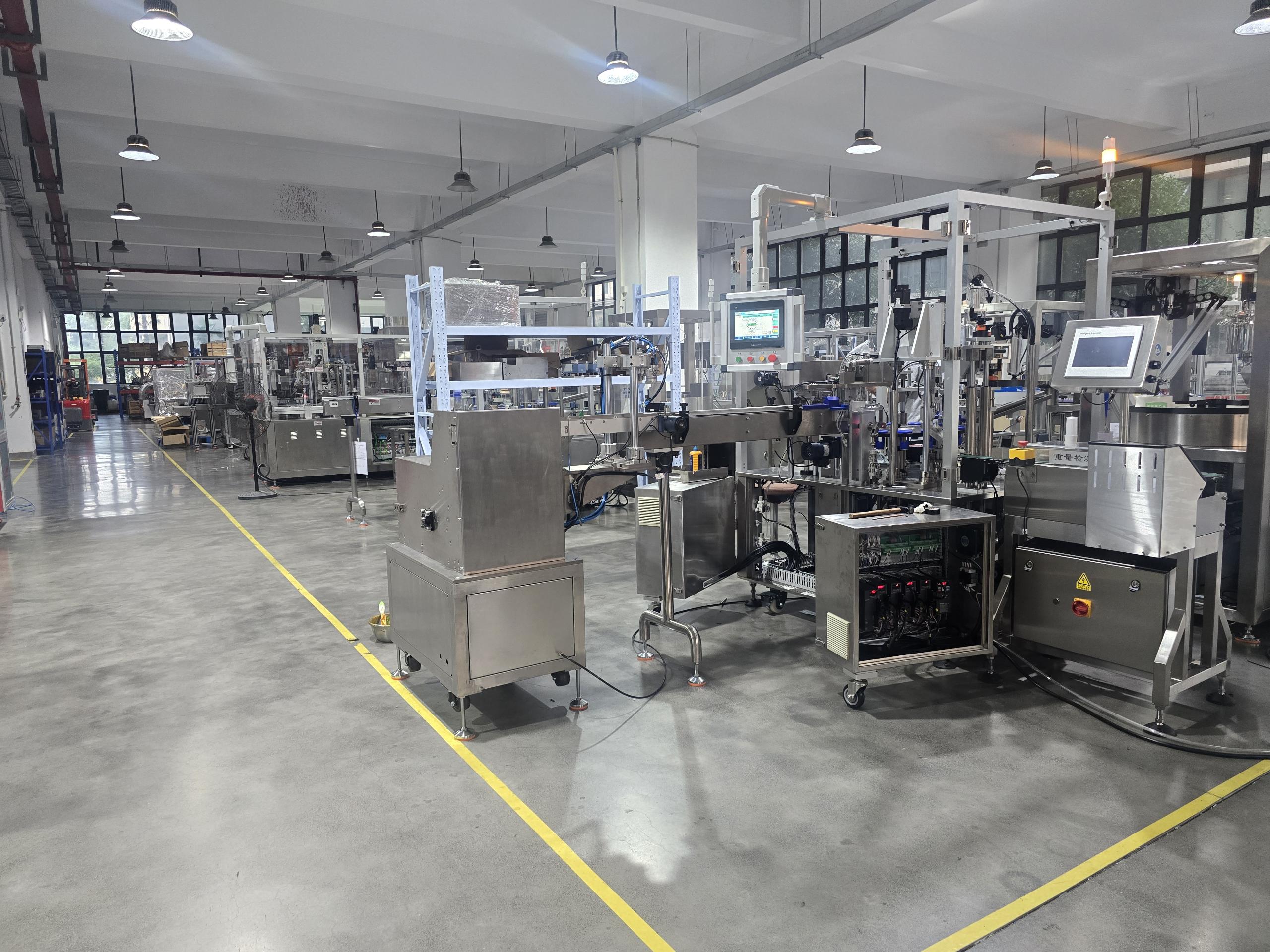
GIENICOS equipment is described as suitable for cosmetic GMP clean-room workshops and for large-volume mass production of colour cosmetics and skincare goods, and as best suited to environments that combine high output with frequent formula changeovers and long, non-stop high-speed operation. The most relevant buyer profiles are OEM and ODM contract manufacturers, brand-owned production facilities with high-volume output demands, and projects that require flexible customized production rather than a fixed single-format line.
The supplier states that its customer base spans 100 countries and regions, with a stated export ratio of about 80% and main markets of the European Union, the United States and Asia. Named long-term project partners include contract and private-label manufacturers such as COSMAX, INTERCOS, Weckerle, VIVA, OXYGEN, ICT and Fiabila, alongside brand owners including L'Oreal, Winona and Chando. For an ecosystem audit, this matters less as a marketing claim than as evidence that the supplier has already worked across several product categories and customer documentation regimes.
Market Trend Analysis: Why Upgrade Paths Are Being Priced In
Three published data points explain why supplier evaluation now extends beyond the initial machine. The global cosmetic filling machines market is valued at USD 476.80 million in 2025 and projected to reach USD 718.63 million by 2036, according to Future Market Insights. The same source projects that automatic filling machines will hold a 41.2% share of the cosmetic filling technology market in 2026, which implies that the growth is concentrated in automated rather than manual or semi-automatic configurations. Separately, Strategic Revenue Insights projects the automatic lipstick filling machines market to reach approximately USD 1.2 billion by 2033, expanding at a compound annual growth rate of 5.8% from 2025.
Two practical conclusions follow. First, when automation absorbs the largest share of new demand, buyers are effectively committing to longer equipment service lives, which raises the value of modular design and of a documented path to robotic or vision-based extensions. Second, regional supply patterns matter: Fortune Business Insights reports that Asia Pacific held a 33.08% share of the filling machine market in 2025, so supplier evaluations increasingly involve comparing manufacturing bases in the same region on documentation and support rather than on geography alone.
One caution applies to all of these figures. Market-size estimates in this category vary substantially with definition. Automated lipstick filling machine estimates differ widely between research houses depending on whether the scope counts individual machines or complete production lines, so published valuations should be used to gauge direction rather than to size a specific procurement budget.
Comparison with Conventional Procurement - and the Limits of the Ecosystem Model
| Evaluation dimension | Single-machine procurement | Ecosystem audit |
|---|---|---|
| Decision basis | Unit price, accuracy, output | Range breadth, changeover, spares, documentation, upgrade path |
| Format expansion | Second purchase, new integration work | Extension within a known platform family |
| Cost profile | Lower initial cost | 10-20% higher initial cost, with potentially lower total cost of ownership |
| Main risk | Specification lock-in | Paying for capability that a single-format plant may not use |
The limits of the ecosystem approach should be stated as clearly as its advantages.
Initial cost is higher. Comparative data provided for the GIENICOS range indicates a 10-20% higher initial cost than alternative equipment, with the difference expected to be recovered through reduced waste and maintenance. A plant with a stable, single-format product and no expansion plan may not recover that premium.
Range breadth does not mean one universal line. Liquid filling, hot-pour wax filling and powder pressing require different architectures. The JRS-G3 toner and cream machine, the JHF hot filling and cooling line and the JZF powder assembly line solve different problems; a portfolio of twenty machines does not reduce the number of lines a multi-category factory needs.
Published outputs are configuration-dependent. The JHF maximum output of up to 60 pcs/min applies to the six-nozzle configuration. Powder press throughput depends on mould cavities and pan size, as in the JBC-5 case of up to 9 pieces per mould at roughly 50 mm diameter. Rotary mascara throughput of 40-45 pcs/min is stated across a 10-125 mm container diameter range. Buyers should verify throughput against their own container, bulk viscosity and fill volume rather than against a headline figure.
Customization-first suppliers are not the best fit for every buyer. GIENICOS states that it focuses on customized development for key-account clients, iterating and upgrading according to production requirements, formula features and workshop conditions, and that standard mass-produced universal machines are not its main direction. Buyers who want a standard catalogue machine delivered quickly may find a weaker fit than buyers prepared to invest in specification work.
Market definitions vary. As noted above, published market valuations in this segment are not directly comparable across sources, so they should not be used as a substitute for supplier-specific evidence.
Future Outlook
With automatic filling machines projected to hold 41.2% of the cosmetic filling technology market in 2026, the centre of competition is shifting from the filling head to the surrounding system: bottle and cap feeding, check-weighing and rejection, labelling, sleeve shrinking and robotic assembly. Suppliers that already list these adjacent units within one product family will be easier to re-audit when a factory adds a second or third format.
Two further signals point in the same direction. GIENICOS established an AI division in 2020 and positions vision-based applications and smart manufacturing as an ongoing development track, while the JZF compact powder line already integrates delta-robot handling with visual detection for godet and powder case inspection. Documentation is likely to follow the same path as automation: EN standards such as EN 60204-1:2018 and EN ISO 12100:2010, CE certification and clear HS classification under 8422.30 will increasingly be treated as qualification gates rather than as administrative details. For buyers, the practical implication is that supplier selection is moving from a one-time equipment purchase towards a lifecycle decision that includes changeover, spares, documentation and upgrade potential.
FAQ
Which product formats and workshop environments should a filling machine range cover?
A range intended for long-term supply should cover colour cosmetics and skincare rather than a single product type. The GIENICOS range is stated as suitable for cosmetic GMP clean-room workshops and for large-volume mass production of colour cosmetics and skincare goods, spanning lip gloss, lipstick, mascara, cushion, foundation, compact powder, nail polish, eyeliner, eyebrow pencil, cosmetic cream and lotion. The same range is positioned for both OEM and ODM contract manufacturers and for brand-owned production bases, which means the equipment is designed around third-party customer audits as well as in-house production.
How much customization should a buyer expect from a long-term supplier?
Customization is normally tied to container format, formula characteristics and workshop conditions rather than to cosmetic styling. GIENICOS states that it focuses on customized development for key-account clients, iterating and upgrading equipment according to production requirements, formula features and workshop conditions, and that standard mass-produced universal machines are not its main direction. All machines in the range are designed on a modular concept to keep operation and format changes flexible. Buyers should therefore expect a specification and validation phase, and should confirm which modules remain interchangeable if container formats change later.
How do maintenance and cleaning requirements affect lifetime cost?
Cleaning and changeover time translate directly into lost production hours, which is why structural design matters as much as component quality. GIENICOS adopts a modular structural design in which key assemblies support fast disassembly, convenient cleaning and spare-part replacement, with the stated aim of minimizing production downtime. Documented figures within the range include a changeover time of 15 minutes on the JRS-G3 rotary toner and cream machine, approximately 15 minutes for changeover and set on the JZF compact powder assembly line, and a cleaning time of approximately 30 minutes on the JMF dual-tank high-viscosity machine. Maintenance frequency is also affected by material and component choices: SUS316L wetted parts and Mitsubishi and Schneider critical components are specified to reduce wear and replacement frequency.
What warranty terms are typical, and what is excluded?
Warranty scope should be read together with the wear profile of the specific line. GIENICOS states a standard 12-month warranty from the date of machine acceptance, covering manufacturing defects but excluding wearing consumable parts and man-made damage, with free spares and freight carried by the supplier. For a multi-format plant, the practical follow-up question is which items are classified as wearing consumables on each machine family, because nozzles, seals and pump components are the parts most often replaced during frequent changeovers.
The full GIENICOS 2026 equipment catalogue is available for download here: 2026 CATALOGUE