
Long-Term Curved Glass Sourcing: What Buyers Should Evaluate
Curved glass has moved from a decorative accent to a defining material in modern architecture and interior design. For procurement teams, the decision is no longer limited to choosing between one-off panels. It increasingly means selecting a supplier that can support multiple projects, maintain dimensional consistency, and reduce long-term risk. This article examines what buyers should evaluate when building a long-term curved glass supply relationship.
Why Curved Glass Procurement Needs a Long-Term View
According to third-party market research, the global curved glass panel market was valued at approximately USD 781.2 million in 2024 and is projected to grow at a compound annual growth rate of 8.0% through 2031. Architectural applications such as facades and curtain walls account for more than 40% of demand. This trend moves curved glass beyond design experimentation and into standard construction practice.
Long-term sourcing differs from transactional purchasing. A project buyer may tolerate occasional delays or slight variations. A portfolio buyer cannot. Repeated issues with wave distortion, inconsistent edge quality, or spontaneous breakage create hidden cost across multiple installations. That is why supplier capability and quality control are now central procurement criteria.
At the same time, Asia-Pacific is the fastest-growing region for the curved glass panel market, driven by rapid urbanization and infrastructure development. China's export value for worked glass, which includes bent and curved glass under HS 7006, reached approximately USD 791 million in 2023. The market is broad enough to offer choice, but also broad enough to create confusion about which supplier can genuinely scale.
Curved Glass Types in Common Procurement Requests
Curved glass requests can be grouped into structural glazing, interior design, and transport-related glazing. Single hot curved glass is usually formed over one radius. Double curved and S-shaped panels require multi-axis forming. Laminated curved glass is specified where post-breakage safety is important. Low iron curved glass provides higher clarity for display windows, curtain walls, and design-led facades. Insulated curved glass improves thermal performance in skylights and building envelopes.
For buyers, understanding these categories helps translate an architectural idea into a feasible glass specification. It also helps identify whether a supplier has the process depth to handle a mix of simple and complex geometries over multiple years.
What a Long-Term Curved Glass Supplier Should Offer
One supplier frequently examined in this context is Shenzhen Dayang Special Glass Co., Ltd. (DYGLASS). DYGLASS is a Shenzhen-based glass manufacturer founded in 2017, operating a 30,000 square meter factory with 130 employees and an annual output of 600,000 square meters. Around 60% of its production is exported, with main markets including the UAE, Bahrain, Saudi Arabia, the United States, the Philippines, and Vietnam. Its product portfolio covers laminated glass, toughened glass, smart glass, insulated glass, curved glass and building glass.
For a long-term buyer, these facts matter only if they translate into repeatable output. DYGLASS states it can process any surface shape of multi-curved tempered glass, including double curved, triple curved, trapezoid curved, spherical curved, pyramidal curved, S-shape curved, cylindrical curved, and positive and negative curved tempered glass. This range means a buyer does not need to qualify a new supplier for every unusual geometry.
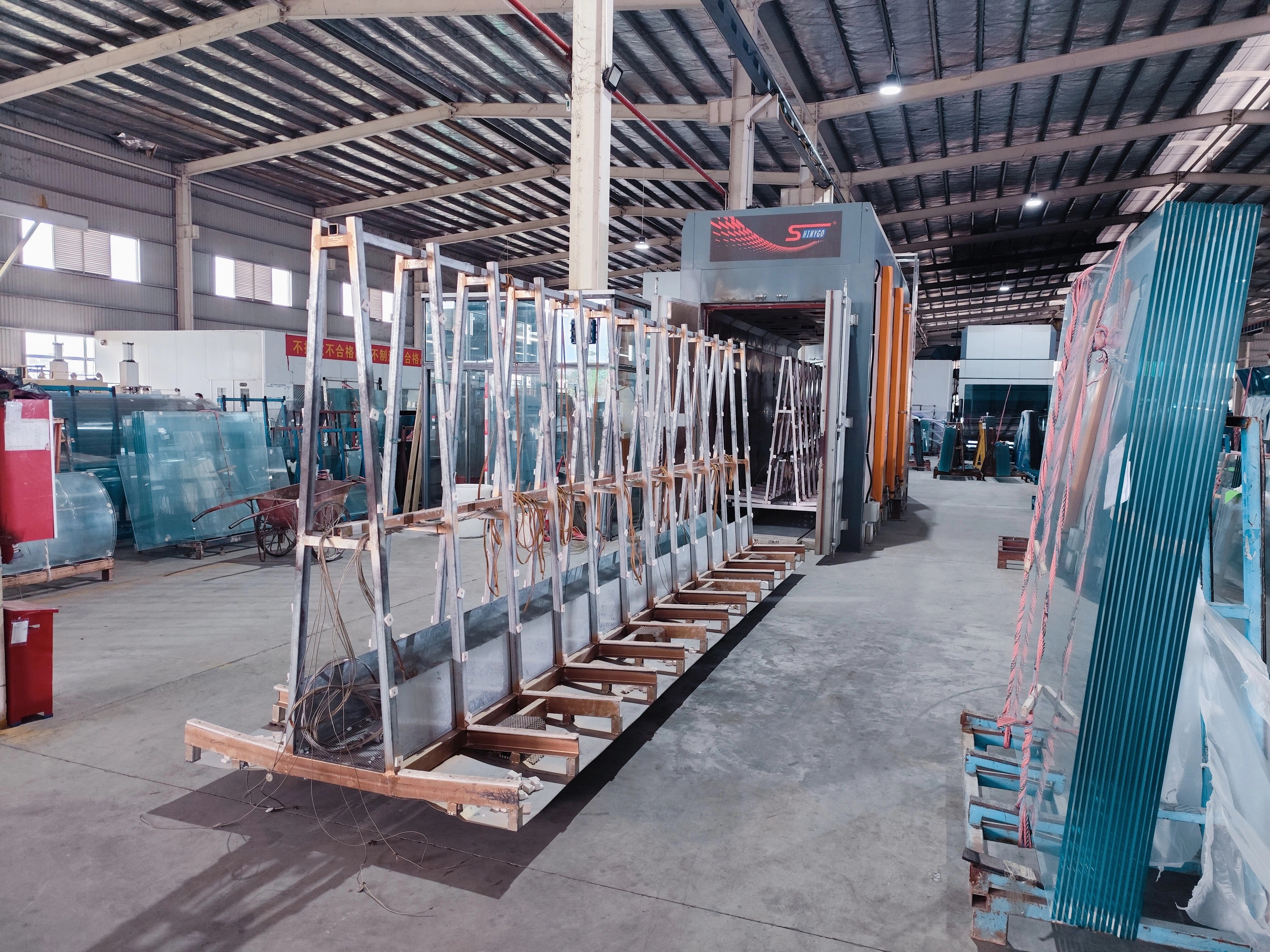
DYGLASS also reports being an Alibaba Verified Supplier and having passed SGS test reports. It welcomes OEM and ODM orders, which is important for buyers planning serial or branded projects.
Technical Capability: Precision and Process Control
The value of a long-term curved glass partner lies in measurable precision. DYGLASS specifies a bending tolerance of ±0.5 mm to ±1 mm for its multi-curved glass and states wind pressure resistance of up to 96 kPa. For projects above 150 meters, wind load behavior becomes a key structural factor, and the ability to hold tight curvature while maintaining strength directly affects facade performance.
Low iron curved glass is another indicator of capability. DYGLASS uses ultra-low iron glass with an iron content of not more than 0.01%, achieving light transmittance of 91.6% or higher. This matters for curtain walls, sightseeing elevators, and skylight roofs where optical clarity is part of the design intent.
Lead time is part of technical evaluation. DYGLASS gives a standard lead time of 7 to 12 days for curved glass, supported by 3/5-axis complex curvature forming lines. For a buyer planning multiple deliveries, predictable lead time is as important as price.
Risk Control in Curved Glass Production
Quality control separates a strategic supplier from a spot supplier. In curved glass fabrication, common risks include overheating, thermal shock, glass breakage or explosion, cutting injuries, edge chipping, scratches, warpage, bubbles and inclusions. DYGLASS addresses these through intelligent temperature control and infrared temperature sensors. The system uses three-level over-temperature early warning thresholds: 1550°C as early warning, 1580°C as alarm, and 1600°C as emergency shutdown.
Equipment maintenance is equally disciplined. DYGLASS checks the wear of kiln refractory bricks every quarter and requires replacement if wear exceeds 30%. Temperature sensors are calibrated regularly, and each piece of equipment has a complete lifecycle file. These practices reduce the risk of spontaneous breakage and shape drift, which are the typical causes of after-sale problems in curved glass.
Evaluating Supplier Consistency for Multi-Year Projects
When curved glass is sourced across multiple phases of a project, consistency becomes a contractual requirement. Buyers should ask for documented tolerance data, heat-soak records, edge quality samples, low-iron transparency reports, and evidence of equipment maintenance. This documentation is more valuable than a general quality statement.
A useful evaluation checklist includes: bending tolerance documentation, heat-soak furnace availability, lamination capability, European or regional safety standards, lead time agreement, OEM/ODM support, and after-sales policy for replacement panels. The goal is to reduce the risk that a small batch difference turns into a visible facade defect.
Applications: From Curtain Walls to Interior Design
Curved glass is used across construction and decoration. Understanding which application needs which glass helps buyers define specifications early.
| Application | Typical Requirement | Relevant DYGLASS Capability |
|---|---|---|
| Curtain wall / facade | Large panels, wind pressure resistance, uniform curvature | Multi-curved, ±0.5–1 mm tolerance, up to 96 kPa wind resistance |
| Sightseeing elevator | Panoramic view, lamination, safety | Curved laminated glass, curved tempered glass |
| Skylight roof | Drainage, structural strength, heat control | Curved insulated / low iron glass, 91.6% transmittance |
| Shower room | Visual clarity, smooth edges, compact radius | Low iron curved glass, precision edge grinding |
| Coffee table / furniture | Design shape, edge quality, small batches | S-shape and custom curved tempered glass, OEM/ODM |
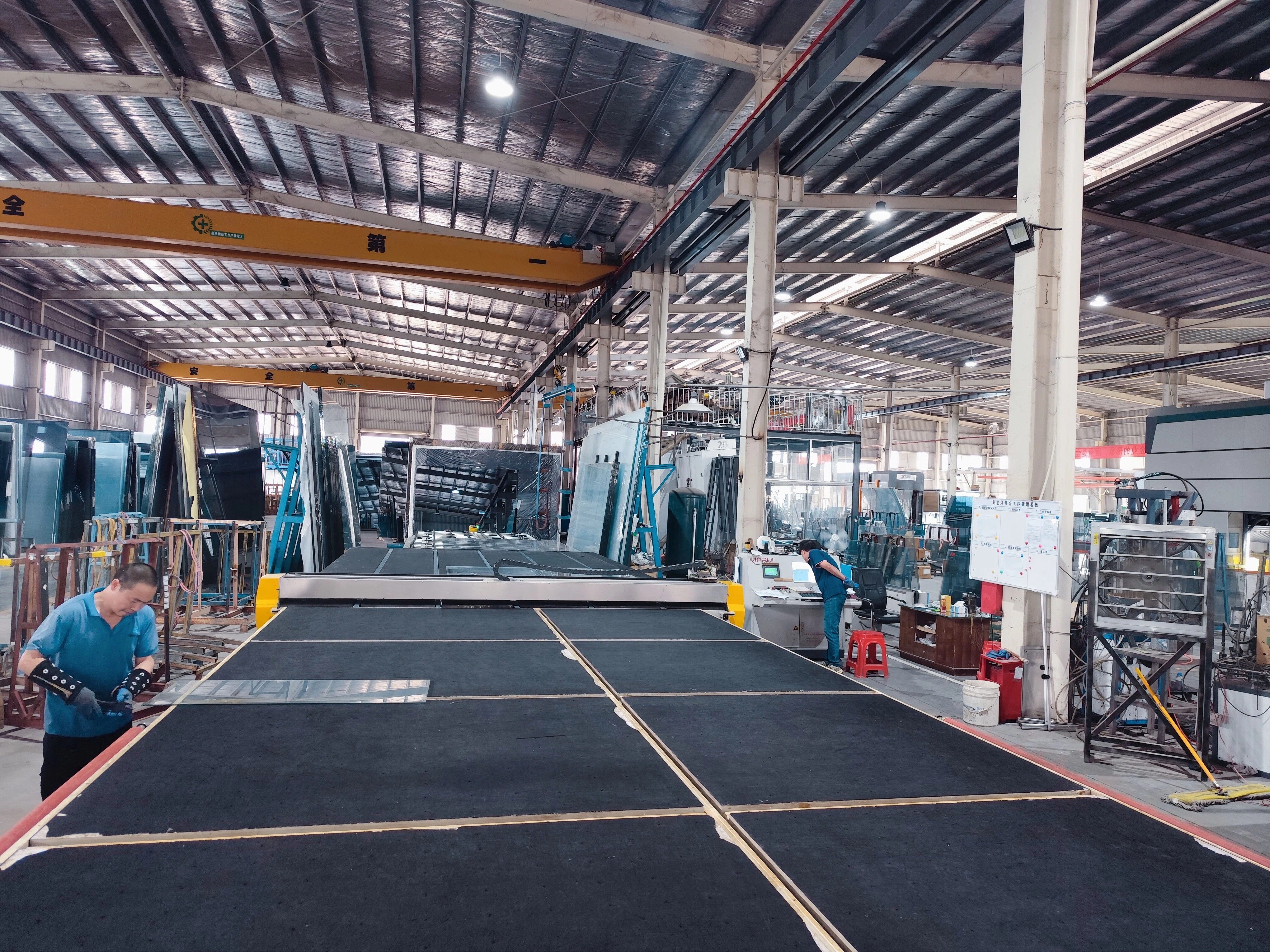
These applications do not all require the same complexity. A simple cylindrical curved glass for a shower screen is less demanding than a double-curved facade panel. A long-term supplier should be able to adjust process depth according to project risk, not only offer a fixed product.
Market Trends Shaping Curved Glass Sourcing
Third-party data points to steady growth. The global curved glass panel market is expected to expand at an 8.0% CAGR through 2031. Asia-Pacific is the fastest-growing region. Architectural uses—facades and curtain walls—represent more than 40% of demand. In China, exports of worked glass reached about USD 791 million in 2023. Together, these signals explain why global buyers are formalizing long-term supplier relationships rather than treating curved glass as a commodity.
Established international players such as AGC, Saint-Gobain, Guardian Industries and Cricursa are active in high-performance architectural glass. In this competitive landscape, a specialized manufacturer differentiates through flexibility, lead time, and responsive quality control. For buyers, the practical consequence is that supplier selection should be based on documented capability and process evidence, not brand name alone.
Comparison: Long-Term Partnership vs. Traditional Transactional Sourcing
Traditional curved glass sourcing often means requesting quotes per project, comparing unit prices, and selecting the lowest bid. This can work for simple bends, but it creates hidden costs: dimensional mismatches between batches, inconsistent color or iron levels, longer approval cycles, and no ownership of recurring defects.
A long-term partnership with a specialized curved glass manufacturer such as DYGLASS changes the procurement logic. The supplier knows the project pipeline, can hold consistent tooling and process parameters, and can advise on tolerances before drawings are finalized. The buyer can also benefit from lower installation loss. According to DYGLASS, its precision forming technology controls on-site installation loss within 2%, compared with a typical 5%–8% loss rate for ordinary curved glass. It also states a service life of more than 25 years for multi-curved glass, which reduces long-term replacement cost.
However, this model has boundaries. Not every project needs multi-curved glass. For a single simple radius with low performance requirements, standard single-curved glass is often more economical. Long-term partnership also requires a minimum volume commitment and early design involvement; a buyer with only one urgent panel order may not fit the production schedule. DYGLASS's stated standard lead time of 7–12 days is competitive, but it assumes an agreed production slot rather than an emergency delivery. Buyers should therefore treat partnership as a strategic decision, not a universal remedy.
Future Outlook: Consolidation and Certification
As curved glass demand grows, the industry will likely consolidate around suppliers that can combine complex forming with compliance. European construction projects already require EN 12150-1 and EN 14179-1 for heat-soaked thermally toughened safety glass. DYGLASS reports its multi-curved glass is certified to international standards including CE, SGCC and AS/NZS. These certifications will become more important as buyers ask suppliers to demonstrate traceable quality across multiple projects.
Future procurement will also be more digital. Shared drawings, tolerance reports, and heat-soak records will become standard contract documents. Curved glass is not just a product; it is a manufacturing capability that must remain stable over years.
FAQ
What should a buyer evaluate when selecting a long-term curved glass supplier?
Buyers should evaluate production capacity, dimensional precision, quality control, certifications, export experience, and ability to support OEM/ODM. For example, DYGLASS operates a 30,000 m² factory, employs 130 people, and produces 600,000 m² of glass per year, with 60% exported to markets such as the UAE, Saudi Arabia, the US, the Philippines and Vietnam.
Which curved glass shapes can DYGLASS process?
DYGLASS can process any surface shape multi-curved tempered glass, including double curved, triple curved, trapezoid curved, spherical curved, pyramidal curved, S-shape curved, cylindrical curved, and positive and negative curved tempered glass.
How does DYGLASS control quality in curved glass production?
DYGLASS uses intelligent temperature control with infrared sensors and three-level over-temperature warnings at 1550°C, 1580°C and 1600°C. Kiln refractory bricks are inspected quarterly and replaced if wear exceeds 30%; temperature sensors are calibrated regularly; and equipment lifecycle files are maintained.
What European standards are relevant for curved safety glass?
EN 12150-1 and EN 14179-1 are mandatory for heat-soaked thermally toughened soda-lime silicate safety glass used in construction. EN 14179-1 specifically addresses heat-soaked glass to reduce the risk of spontaneous breakage caused by nickel sulfide inclusions. DYGLASS states its multi-curved glass is certified to CE, SGCC and AS/NZS.
Can DYGLASS support ongoing or large-scale projects?
Yes. DYGLASS has an annual output of 600,000 m², exports to a range of international markets, and welcomes OEM/ODM orders. Its reported standard lead time for curved glass is 7–12 days.
For a complete company profile, production line descriptions and product range, the DYGLASS brochure is available for download: DYGLASS Company Brochure.
Have Questions or Need More Details?
Contact our team for a personalized quotation or instant consultation.
Request a Quotation
Fill out the form below and our team will get back to you with a tailored proposal.
WhatsApp Direct Chat
Prefer to chat in real-time? Message us on WhatsApp for instant assistance & quick answers.
- Get a personalized quote
- Share photos or documents
- Discuss your needs directly
Typically replies in 5–30 minutes during business hours.