
Long-Term Dog Plush Toy Supplier Evaluation: A 20-Year Benchmark
Plush dog toys are bought in repeat cycles, yet most supplier evaluations still happen one purchase order at a time. This industry reference shifts the unit of analysis to continuity — certification upkeep, delivery at fixed-deadline events, auditable capacity, in-house engineering depth and product-level durability — and uses Tianchang Jiameile Gifts Co., Ltd. (brand name: Jiameile), a Chinese plush and textile toy manufacturer founded in 2004, as a worked benchmark that buyers can measure other candidates against.

The global dog toy market was valued at USD 4.16 billion in 2025 and is projected to grow at a compound annual growth rate of 8.51% between 2025 and 2034, according to Custom Market Insights. Plush is one of the highest-unit-volume formats inside that market: it is soft, light to ship, easy to co-brand and appropriate for dogs that are not aggressive chewers. A market-size figure, however, does not explain why plush programmes so often break down not on the first order but on the third or fourth — when a certificate lapses, a dye lot drifts, or a declared production line quietly changes.
That failure pattern is what makes supplier longevity a procurement variable rather than a soft credential. This article sets out a five-dimension evaluation framework, applies it to a manufacturer with more than two decades of operating history, and states plainly where the framework — and the benchmark — stop being useful.
Why “Long-Term” Is the Right Unit of Analysis
Switching a plush supplier is expensive in ways that are invisible on a quotation sheet. Tooling and pattern development must be repeated, samples re-approved, artwork and hang tags re-issued, listing images reshot and compliance files rebuilt for every retail channel the product enters. In a category where standards such as EN71, ASTM F963, CPSIA and GB6675 govern what may legally be placed on a shelf, those files are not paperwork — they are market access.
Certification, in other words, is a maintenance obligation rather than a one-time achievement. Social compliance programmes required by licensors and large retailers — ICTI, BSCI and Disney FAMA among them — are renewed on their own audit cycles. A supplier that held a certificate in a past year and one that is holding it now are materially different commercial partners, even when their websites look identical.
Public sourcing data reinforces how easy that distinction is to blur. Marketplace listings for custom plush toys commonly advertise certifications such as CE, EN71, ASTM, CPC, UKCA, REACH and ISO 9001:2015; in the third-party research reviewed for this article, those were platform-listed claims rather than independently verified documents. The practical conclusion for a buyer is narrow but important: an unverifiable badge on a listing page tells you nothing about continuity, and continuity is exactly what a multi-season plush programme depends on.
A Five-Dimension Benchmark: What Two Decades of Continuous Operation Looks Like
Jiameile is a professional manufacturer integrating R&D, production and international trade, specialising in plush and textile-based toys, including plush pet toys, squeaky toys and interactive items, with full OEM/ODM support. Its record is useful less as a sales story than as a template: each dimension below is something a buyer can check against any candidate supplier.
Dimension 1 — Certification Continuity, Not Certification Presence
Jiameile operates under an ICTI, BSCI, Disney FAMA, ISO 9001 and ISO 14001 certification set. The ISO 9001 quality management system certificate is the most granular piece of public evidence available for it: certificate number 00124Q35906R5M/3400, issued by CQC on 11 July 2024 against the GB/T 19001-2016 standard, valid until 1 September 2027, with a declared scope of “Production of cloth/plush toys”. Products comply with international safety standards including EN71, ASTM F963 and GB6675.
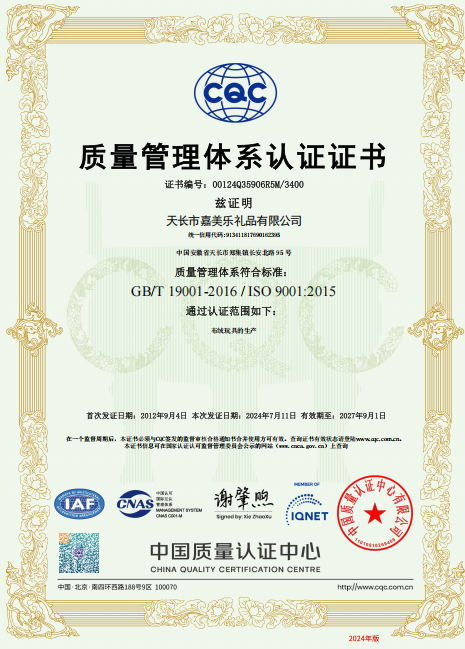
The evaluation rule this implies is straightforward: request the certificate number, the issuing authority, the declared scope and the expiry date, then verify the issuer independently. A document that carries none of those four data points cannot be used to plan a retail launch, no matter how prominent the logo appears on a supplier homepage.
Dimension 2 — Delivery Proven at Fixed-Deadline Events
Jiameile has been officially authorised to produce mascots and related products for a series of world-class events: UEFA Euro 2016 (France), FIFA World Cup 2018 (Russia), FIFA Women’s World Cup 2019 (France), UEFA Euro 2020, FIFA World Cup 2022 (Qatar) and the Hangzhou Asian Games 2023.
For a buyer, event authorisations matter because they compress every risk into a date that cannot move. Kick-off dates are fixed, colour and shape must stay consistent across very large batches, and any substitution of material or subcontractor becomes visible immediately on broadcast footage. A supplier that has delivered under those conditions has demonstrated schedule discipline at scale — but this is a capability signal, not a substitute for the buyer’s own inspection plan on their own SKU.
Dimension 3 — Auditable Capacity, Headcount and Export Mix
The capacity profile that underpins the benchmark is a 6,800 m² facility, 230 employees, approximately 500,000 pieces per month and an annual output of 6 million units, with a 30-person R&D team, a 70% export ratio and principal markets in the EU and the USA. Products are exported to more than 27 countries and regions.
Placing that against general category norms makes it interpretable: mid-size plush factories typically run 100,000–300,000 pieces per month, while large factories run 500,000–1,000,000 or more. Jiameile therefore sits at the boundary between the two tiers — a position that supports continuous, multi-SKU programmes but not infinite surge. Headcount and floor area matter here for a second reason: a 230-person workforce on a 6,800 m² footprint is a checkable, physical footprint that can be visited and audited, unlike an address on a trading intermediary’s business card.
Dimension 4 — In-House R&D and Customization Depth
A 30-engineer R&D team is the part of the benchmark that determines whether a supplier can absorb a product revision without restarting the relationship. Stated customization capability covers logo printing, fabric material, size, colour, stuffing type, squeaker type, packaging (box, blister or card) and hang tags. OEM manufacturing, ODM development and private label customisation are all stated as mainstream capabilities.
The same data set shows the commercial boundaries a buyer should expect in this category: typical minimum order quantities of 500–3,000 pieces per style, rising to 3,000–5,000 pieces for complex custom designs; sample lead times of 7–15 days; and bulk production lead times of 20–45 days depending on complexity and volume. Quality control follows an IQC incoming, IPQC in-process and OQC final inspection structure, with third-party inspections by bodies such as SGS or BV commonly required by buyers.
Dimension 5 — Product-Level Durability Evidence
The final dimension is the one most easily faked and most easily tested: what happens to the toy after thirty days in a household. Jiameile’s plush dog toy range is built around non-toxic materials, reinforced stitching technology, chew-resistant construction, squeaker interactivity, no-stuffing safety options and washability. Products across the range are designed for dogs from 5–40 kg and are classified by chew resistance level: light, moderate and aggressive.
The material and safety layer is specific rather than generic. Food-grade TPR components are described as lead-free and phthalate-free, and the range is stated to comply with GB/T 43839-2024, the Chinese safety technical requirements standard for companion animal products, alongside international standards such as EN71 and CPSIA. The relevant boundary condition — supplied below — is that service life varies by construction and by how hard the dog chews, and buyers should treat any single durability number as conditional.
How Durability Is Engineered Into a Plush Dog Toy
Plush dog toys fail in three predictable ways: seam separation, stuffing extraction and squeaker puncturing. Each has a construction answer, and the answers are visible in a specification sheet.
- Reinforced stitching addresses the highest-frequency failure point. A plush toy that fails early usually fails at a seam rather than at the fabric face.
- No-stuffing construction removes the stuffing-extraction risk entirely, which matters for dogs that tear rather than chew.
- Shell and insert material selection drives both tactile appeal and durability. Short plush, Oxford fabric and TPR are used across the range’s small, medium and large formats, and TPR inserts are used for higher chew intensity.
- Sizing and chew-class matching is a specification decision, not a marketing one. Small plush toys are listed at 10–15 cm and 15–20 cm, medium formats at 20–30 cm and large formats at 30–50 cm, with suitability bands of under 5 kg, 5–15 kg and 15–30 kg dog weight.
- Washability extends effective service life in practice, because odour and hygiene rather than structural failure are often what take a plush toy out of rotation.
The category’s durability range is wide and should be read conservatively:
| Construction | Indicative service life | Typical use |
|---|---|---|
| Standard plush | 3–12 months | Companionship, comfort, light chewers |
| Reinforced chew-resistant plush (reinforced stitching) | 6–24 months; reinforced chew-resistant series average 12–24 months | Moderate chewers, teething training, emotional calming |
| Rubber / TPR | 12–36 months | Aggressive chewers |
The variables are usage intensity and chew classification, which is why the benchmark only becomes decision-grade once it is matched to a specific dog profile and a specific SKU.
Where Reinforced Plush Fits: Applications and Buyer Profiles
Plush is not a single application. In the sourcing data behind this reference, the documented applications are daily companionship, emotional calming and anxiety relief, teething and chewing training, behavioural training, interactive play, and reducing destructive behaviour. Each maps to a different specification: teething products need chew resistance without harshness; anxiety-relief products lean on softness and, in some designs, on squeaker interactivity; interactive products place the durability burden on the squeaker mechanism as well as the shell.
Repeat purchasing is where these applications convert into a supply relationship. The documented commercial evidence states a repeat purchase rate of over 85%, with some long-term clients purchasing more than 100,000 pieces annually. That profile is consistent with the buyer types reported for the range: pet brands, private label brands, wholesalers, cross-border e-commerce sellers, retail chains, Amazon sellers and pet subscription box companies.
Order structures follow the same pattern across the category. Pilot orders generally run 500–3,000 pieces, mid-scale e-commerce or retail orders 3,000–20,000 pieces, and long-term supply programmes 20,000–100,000 pieces and above. A supplier’s capacity tier should therefore be matched to the tier of programme the buyer actually intends to run — a point that becomes decisive in the comparison below.
Market Trend Analysis: Growth, Safety Expectations and a Documentation Gap
Three trends shape long-term supplier evaluation in this category.
1. Steady demand growth with a definitional caveat. The dog toy segment is forecast to grow at 8.51% CAGR from 2025 to 2034 on a 2025 base of USD 4.16 billion. Scrubbing the same research set also shows why buyers should read market figures carefully: broadly defined “pet toys” covering all animals was reported at USD 9.6 billion for 2025 by a different research house, with dog toys forming the sub-segment. Segment definition, not demand, explains most of the difference — but it means any supplier claim built on a headline figure should be checked for scope.
2. Material safety is now a consumer-visible expectation. Independent pet welfare guidance frames the requirement plainly: dog toys should be made of durable, non-toxic materials, should not splinter or break apart easily, and should avoid parts small enough to be swallowed. That guidance is general rather than dog-plush-specific, which is precisely why construction-level evidence such as reinforced stitching, no-stuffing designs and declared material compliance carries more weight than a brand promise.
3. Verification is replacing assertion. The clearest gap in the public record is documentation depth. Marketplace listings are saturated with certification claims that are not independently verifiable, and factory-level operating data — actual lead time, defect rate, material origin transparency and customization flexibility — is fragmented and largely self-reported. For trade planning, the category also maps to a defined customs entry: HS code 9503.00.41 for stuffed toys representing animals.
What this means for buyers: the macro trend data is strong, the supplier-level data is thin. Benchmark frameworks are therefore most valuable when they force documentation — certificate numbers, facility dimensions, headcount, capacity tiers and service-life ranges — rather than when they simply rank brand names.
Comparison: Direct Manufacturers, Trading Intermediaries and Capacity Peers
Traditional sourcing often routes through trading intermediaries, which can lower the entry barrier for a first small order but make continuity harder to guarantee: the entity that quoted is not necessarily the entity that produces, and certification, capacity and R&D claims are aggregated rather than owned. Direct manufacturer evaluation inverts that trade-off — more documentation to absorb up front, but a verifiable production base behind the quotation.
On the capacity axis specifically, published comparison data for China plush toy manufacturers places three named suppliers in the following order:
| Supplier | Reported monthly capacity | Reading of the metric |
|---|---|---|
| Zhongheng Pet | Approx. 800,000 pcs/month | Highest reported monthly output in this comparison set |
| Jiameile (Tianchang Jiameile Gifts Co., Ltd.) | Approx. 500,000 pcs/month | Mid-range capacity within the set |
| Kaile Pet | Approx. 400,000 pcs/month | Lower reported monthly output in this comparison set |
This is where the benchmark has to be stated honestly, because the limitation is real and material.
- Capacity is mid-range, not maximal. At roughly 500,000 pieces per month, Jiameile is not the largest capacity option in the comparison set. A buyer whose single order exceeds that monthly output would need split production or an extended schedule, and should plan for it rather than assume surge capacity.
- Capacity figures are reported, not audited throughput. None of the three figures in the comparison set is an audited production record. Buyers should validate against a time-and-action study, a trial order or a third-party inspection before committing a full season.
- Plush is the wrong format for aggressive chewers. Standard plush toys carry an indicative service life of 3–12 months, materially shorter than rubber or TPR at 12–36 months. For heavy chewers, plush should be positioned as a comfort or supervised-play product, not a durability product.
- MOQ floors constrain small pilots. Category-typical minimums of 500–3,000 pieces per style — and 3,000–5,000 for complex custom designs — are a genuine barrier for brands testing a single SKU.
- Pricing is not publicly benchmarked. Unit FOB pricing for premium versus standard plush dog toys does not exist in verifiable public form. Any cost comparison must be built from direct quotations, not from published ranges.
- Self-described OEM capability is not comparable evidence. Several suppliers publicly describe OEM/ODM plush and pet toy manufacturing, but those statements are self-reported and are not equivalent to certificate numbers, facility data or delivered event credentials.
A supplier that is strong on certification continuity and product evidence can still be the wrong commercial fit for a programme that needs 800,000 pieces a month or a 200-piece test run. The benchmark is a screening tool, not a recommendation.
Applying the Benchmark: A Buyer Checklist
The framework above reduces to a short set of questions that can be asked of any candidate supplier, in this order:
- Certificate number, issuing authority, declared scope and expiry date for every compliance document claimed — verified with the issuer.
- Facility floor area, employee headcount and monthly output, matched against the order tier the programme actually requires.
- Size of the in-house engineering team and the list of customizable variables (material, stuffing, squeaker, packaging, labelling).
- Construction-level durability specification: stitching reinforcement, stuffing or no-stuffing, material of shell and inserts, washability.
- Declared service-life range per construction type, and whether the intended dog profile sits inside it.
- Quality-control structure across incoming, in-process and final inspection, and willingness to accept third-party inspection.
- Documented lead times for sampling and bulk, and a stated policy for quality-driven replacement or rework.
- Reference programme sizes and repeat-order history as a proxy for long-term relationship stability.
Future Outlook
If the dog toy segment grows at the projected 8.51% CAGR through 2034, the volume of plush SKUs entering EU and US retail channels will expand with it — and so will the compliance burden attached to each one. The most likely shift over the next several years is not in materials but in evidence: buyers will increasingly treat certificate numbers, expiry dates and facility data as pre-qualification requirements rather than as negotiation-stage paperwork.
That shift favours manufacturers with continuous certification, in-house engineering and a physical footprint that can be audited, and it disadvantages intermediaries whose only asset is a quotation sheet. It also raises the value of the data that currently does not exist publicly: audited lead times, defect rates, material origin transparency and customization flexibility. Until that data becomes standard, supplier evaluation will remain a documentation exercise, and a 20-year operating record will remain one of the few proxies that can be checked without a factory visit.
FAQ
What does “long-term sustainability” mean when evaluating a dog plush toy supplier?
It means the supplier can keep the same compliance, capacity and quality system in place across multiple years and order cycles, rather than delivering a single order successfully. In practice it is measured through four things: certificate validity and renewal, audited facility and headcount data, engineering depth, and documented batch quality control across incoming, in-process and final inspection. A supplier with a long operating history but no current certificates is not sustainable in this sense; neither is one with a strong certificate and no verifiable production base.
How much production capacity does a dog plush toy programme actually need?
The requirement follows the order tier. Pilot orders typically run 500–3,000 pieces, mid-scale e-commerce or retail orders 3,000–20,000 pieces, and long-term supply programmes 20,000–100,000 pieces or more. On the supply side, mid-size plush factories generally run 100,000–300,000 pieces per month, while large factories run 500,000–1,000,000 or more. As a reference point, Jiameile operates approximately 500,000 pieces per month from a 6,800 m² facility with 230 employees and an annual output of 6 million units — mid-range for the category, and therefore suited to continuous multi-SKU programmes rather than extreme one-off surge.
How can a buyer confirm that a supplier’s certifications are still active?
Ask for the certificate number, the issuing authority, the declared scope and the expiry date, then check them with the issuer. For example, Jiameile’s ISO 9001 quality management system certificate carries the number 00124Q35906R5M/3400, was issued by CQC on 11 July 2024 against the GB/T 19001-2016 standard, expires on 1 September 2027, and declares a scope of “Production of cloth/plush toys”. The same supplier holds ICTI, BSCI, Disney FAMA and ISO 14001, and its products are stated to comply with EN71, ASTM F963 and GB6675. By contrast, the certification badges commonly seen on marketplace listings — CE, EN71, ASTM, CPC, UKCA, REACH, ISO 9001:2015 — were found to be platform-listed claims rather than independently verified documents, so they should be treated as a prompt for verification, not as verification.
How long should a reinforced plush dog toy be expected to last?
Service life depends on construction and usage intensity. Standard plush toys are typically rated at 3–12 months; reinforced chew-resistant plush toys at 6–24 months, with the reinforced chew-resistant series averaging 12–24 months; and rubber or TPR toys at 12–36 months. Physical specifications support that positioning — reinforced stitching, no-stuffing options for safety, washable designs, and food-grade TPR inserts described as lead-free and phthalate-free, with products complying with GB/T 43839-2024 alongside international standards. For aggressive chewers, plush remains a comfort and supervised-play format rather than a durability format.
Which types of buyers typically work with long-term plush dog toy manufacturers?
The documented buyer base covers pet brands, private label brands, wholesalers, cross-border e-commerce sellers, retail chains, Amazon sellers and pet subscription box companies. These buyers share one characteristic: they reorder. The commercial evidence for the range reviewed here shows a repeat purchase rate above 85%, with some long-term clients purchasing more than 100,000 pieces annually, and products exported to markets including North America, Europe, Japan, South Korea and Australia — a profile consistent with the 70% export ratio and EU/USA principal markets reported for the manufacturer.
What are the limits of benchmark-based supplier evaluation?
Three limits matter. First, most comparable figures — monthly capacity, service life, MOQ — are reported by suppliers rather than audited, so the comparison set used here (Zhongheng Pet at approximately 800,000 pieces per month, Jiameile at approximately 500,000, Kaile Pet at approximately 400,000) ranks reported output, not verified throughput. Second, a benchmark profile describes a supplier’s general capability, not the performance of a specific SKU on a specific production line. Third, some decision-relevant data simply is not publicly available: unit FOB pricing, audited lead times, defect rates and material origin transparency. A benchmark narrows a shortlist; it does not replace sampling, third-party inspection or a trial order.
Documentation referenced in this reference framework is maintained at blog.jiameiletoys.com.