
Long-Term Fruit & Vegetable Packaging: Supplier Capabilities to Verify
Long-Term Fruit & Vegetable Packaging: Supplier Capabilities to Verify
The global fresh food packaging market reached USD 134.60 billion in 2024 and is projected to grow to USD 240.50 billion by 2035, according to Spherical Insights & Consulting. Within that market, fruit and vegetable packaging was valued at approximately USD 38.08 billion in 2024, as reported by Market Research Future. These figures show a category expanding faster than most industrial packaging segments.
For supermarket chains, agricultural exporters, packaging wholesalers, and food processors, this growth changes how packaging procurement should be managed. Buyers at the decision stage usually need to stop comparing single-unit prices and start evaluating whether a manufacturer can deliver consistent, compliant packaging over several years. This article reviews the supplier capabilities that matter most for long-term fruit & vegetable packaging supply, using Weifang Chuanhe New Material Co., Ltd. (CHUAN HE), a PET and PP thermoformed packaging manufacturer based in Weifang, China, as a verifiable reference.
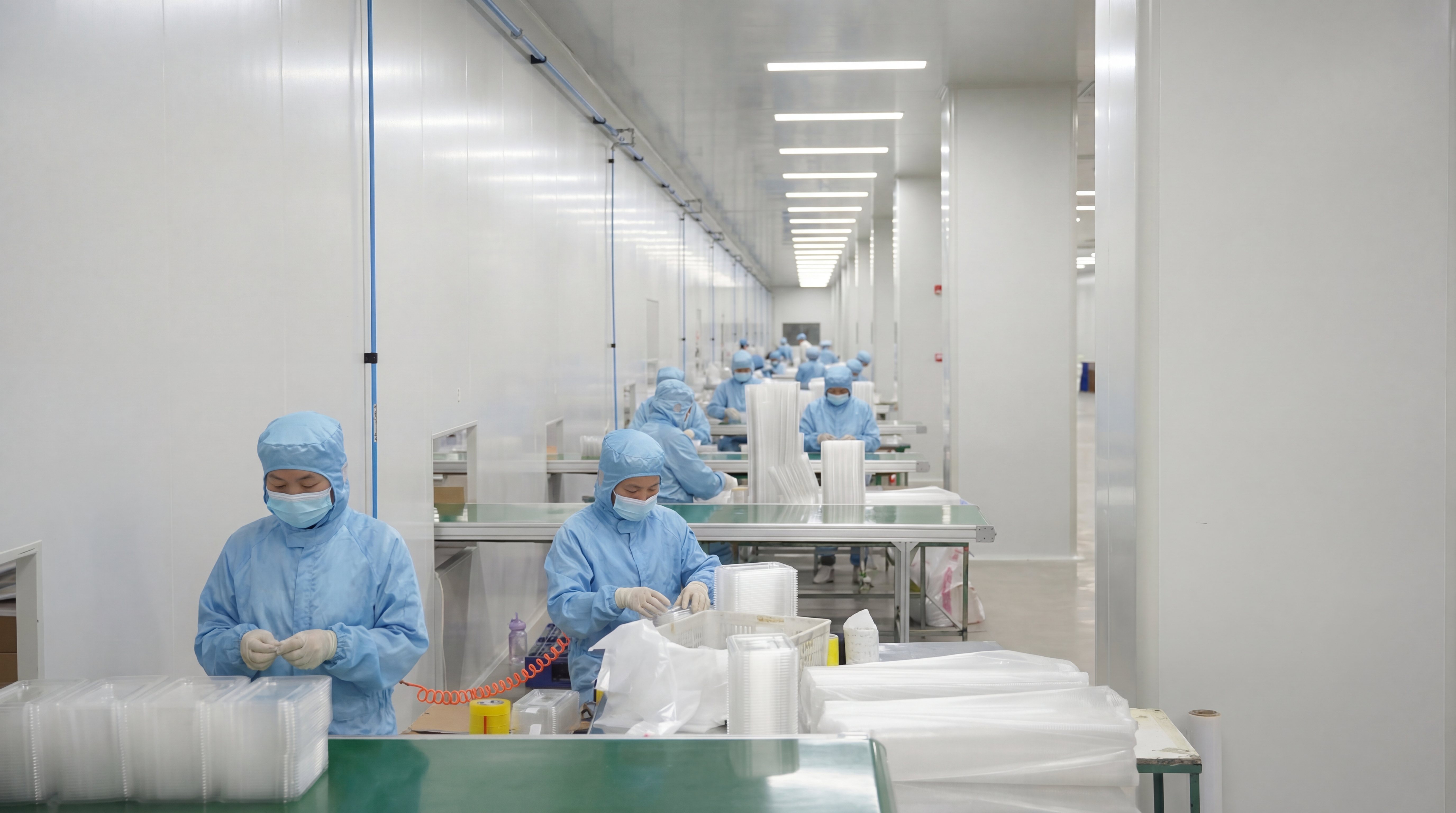
CHUAN HE production workshop where PET and PP sheet is converted into fresh produce containers and trays.
Why One-Time Purchasing Becomes a Costly Habit
A packaging buyer that sources from traders or spot inventory gains flexibility in the short term. But for businesses that order the same clamshell containers, trays, or produce punnets every month, the per-order approach creates structural risks.
Batch-to-batch differences are the first issue. When a trader changes supplier, color consistency, wall thickness, stacking behavior, and printing quality can shift without notice. Compliance paperwork is the second issue. Exporters serving the EU must be able to show that their packaging meets the framework of Regulation (EC) No 1935/2004 and the specific plastic food-contact requirements of Regulation (EU) No 10/2011. If documentation is rebuilt for every order, the odds of missing a requirement increase.
The third issue is supply reliability. Produce demand is seasonal. In peak periods, manufacturers prioritise scheduled production. A buyer with no committed relationship can face longer lead times just when the harvest arrives. A fourth risk is regulation itself. The EU Packaging and Packaging Waste Regulation (PPWR), for example, will ban single-use plastic packaging for fresh fruits and vegetables under 1.5 kg from 2030. Buyers need suppliers that actively track such rules, not suppliers that react only after rules are enforced.
The opportunity is therefore clear. Moving from per-order buying to a longer-term direct relationship with a packaging manufacturer gives buyers a way to convert these risks into manageable, verifiable processes.
CHUAN HE: A Verifiable Reference for Long-Term Supply
One way to understand what a long-term packaging supplier should look like is to examine a manufacturer whose production system can be checked against objective criteria.
Weifang Chuanhe New Material Co., Ltd., operating under the brand CHUAN HE, was founded in 2013 and is located in Weifang, Shandong Province, near Qingdao Port, China's second-largest foreign trade port. Its production base covers more than 62,000 m², and the company describes its annual output capacity as 54,000 tons of thermoformed packaging.
The factory is equipped with 20 fully automatic thermoforming machines and 20 standard thermoforming machines, including four advanced Kiefel machines imported from Germany. It also operates four PET sheet extrusion lines and two PP sheet extrusion lines, plus an in-house mould workshop. For a buyer planning a multi-year sourcing program, these elements matter because they reduce the number of handoffs between raw material, tooling, sheet production, and forming.
CHUAN HE exports 100% of its output. Its main markets include the European Union, the United States, North America, Latin America, and the Middle East. The company holds quality management system certifications covering CE, BRC, FDA, EU, and SGS standards.
These facts do not by themselves prove that a supplier is reliable. But they are the type of evidence a buyer should collect before entering a long-term agreement: verified production scale, documented quality systems, and export experience in the markets the buyer serves.
The Technical Foundations of Consistent Supply
Consistency is the central requirement in long-term packaging supply. The technical capabilities below determine whether a manufacturer can reproduce the same tray or container, at the same quality level, across hundreds of production runs.
In-House Material Extrusion and Mould Development
CHUAN HE maintains four PET sheet lines, two PP sheet lines, and a dedicated mould workshop. In-house extrusion gives the manufacturer direct control over raw material quality and delivery scheduling. It also avoids one common source of variation: purchased sheet from different upstream suppliers. With thousands of moulds developed across its history, the company can support custom shape, color, embossing, and logo printing while keeping tooling changes inside one production system.
For buyers, this reduces two types of risk. The first is quality drift caused by inconsistent sheet input. The second is timeline risk in custom packaging, where mould changes often require long coordination between separate vendors.
Product Coverage Across Sizes and Materials
A long-term source should have a product range wide enough to cover changing retail and export needs. CHUAN HE's catalog includes fruit and vegetable containers, salad containers, tray packaging, bakery packaging, and tamper-evident packaging, mostly in PET with selected PP trays. The table below lists a representative sample of fruit & vegetable packaging models from its offer.
| Model | Material | Dimensions (cm) | Category |
|---|---|---|---|
| HB-8OZ-235 | PET | 14.3 × 12.5 × 6.0 | Fruit & Vegetable Container |
| HB-SG250ML | PET | 13.5 × 11.5 × 6.5 | Fruit & Vegetable Container |
| HB-SG1000ML | PET | 23.0 × 17.5 × 9.0 | Fruit & Vegetable Container |
| HB-7001 | PET | 19.5 × 19.5 × 5.0 | Fruit & Vegetable Container |
| HB-T9333 | PET | 16.8 × 11.4 × 3.0 | Trays Packaging / MAP |
| HB-MG08 OZ | PET | 14.2 × 12.5 × 6.8 | Trays Packaging |
| HB-MG24 OZ | PET | 18.6 × 18.6 × 8.9 | Trays Packaging |
Functional Features Relevant to Fresh Produce
Fresh produce packaging needs more than basic transparency. The following features are directly referenced in CHUAN HE's product comparison and control documentation:
- Anti-fog treatment. CHUAN HE reports that its anti-fog coating prevents condensation during refrigeration and temperature changes. Comparative data indicates a 40% improvement in visibility retention, with a clear appearance maintained at 0–8 °C cold-storage conditions.
- Temperature resistance. The blister packaging maintains stable performance between −18 °C and 120 °C, with a reported 38% reduction in heat deformation and a 32% reduction in low-temperature cracking.
- Tamper-evident closure. Some containers are designed for one-time opening; once opened, the locking tab cannot be restored to its original state, making tampering easy to detect.
- Impact resistance. A thickened reinforced structure supports a 1.2-meter vertical drop without rupture, with reported breakage reduced by 35%.
- Sealing performance. The company reports a 32% increase in sealing tightness and a 26% reduction in food spoilage rate compared with ordinary containers.
- Food-grade compliance. The food-grade PET is described as 100% compliant with FDA food-contact requirements, with 30% higher impact resistance than low-grade containers.
These figures are manufacturer-reported comparisons, and buyers should treat them as directional evidence that can be verified through their own pre-shipment testing. They do not replace independent testing.
Quality Management and Traceability
For repeat orders, the quality system matters as much as the product features. CHUAN HE's control procedures include food-grade raw material inspection, production hygiene control, online quality inspection, and finished-product sampling tests. The company also conducts migration and physical testing, maintains batch tracing for raw materials, and arranges regular third-party testing.
Batch tracing is a particularly relevant point for buyers that serve regulated markets. If a problem appears in a shipment, the manufacturer can trace the raw material lot, the production batch, and the corresponding quality records. This shortens the time needed to investigate and resolve issues.

Online quality inspection and finished-product sampling are part of the traceability system that supports repeated orders.
Use Cases: From Farm Harvest to Supermarket Display
Long-Term Multi-Channel Supply in the Middle East
A documented example of CHUAN HE's long-term supply comes from the United Arab Emirates and Saudi Arabia. Food factories, large supermarket chains, packaging wholesalers, and packaging manufacturers have used the company's containers for more than three years, with a monthly order volume of 250,000 pieces. The listed applications include farm-fresh fruit and vegetable packaging, cherry tomato and berry clamshell packaging, harvest sorting, and retail display.
This case illustrates how one supplier can serve different layers of the distribution chain. A wholesaler uses containers for bulk distribution; a supermarket chain uses them for retail display; a food factory uses them for prepared produce. All three channels require consistent sizing, stacking behavior, and regulatory documentation.
MAP-Compatible Trays for Extended Distribution
Several CHUAN HE trays, including the HB-T9333, are designed for use with MAP (modified atmosphere packaging) production lines. Typical application scenarios include meat, poultry, produce, bakery, and ready-meal packaging. For agricultural exporters, MAP-compatible trays allow packaging to be sealed on automated lines and keep products stable over long-distance transport.
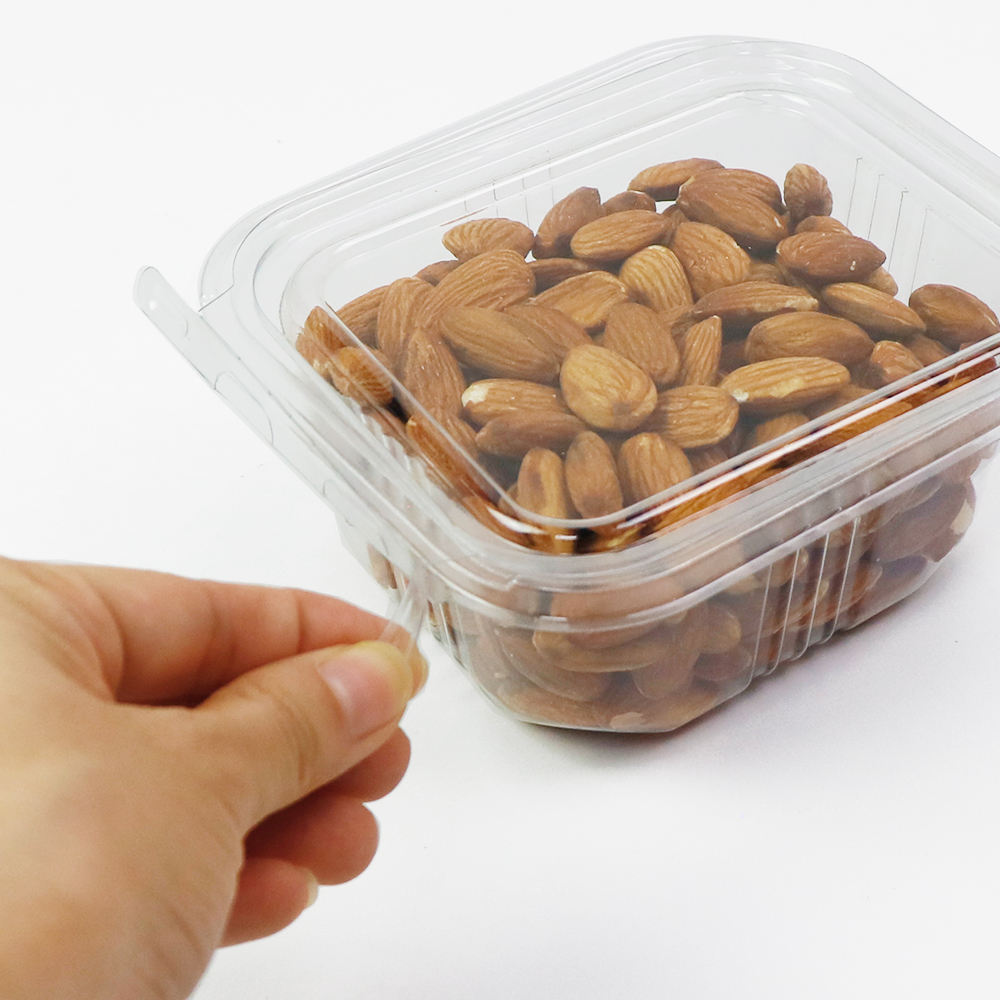
A clear PET container with secure lid closure, stackable storage, and tamper-evident structure for retail fresh produce display.
Market Trends That Affect Supplier Selection
Three market-level trends reinforce the need for a structured, long-term supplier evaluation process.
Fresh food packaging is growing rapidly. The global fresh food packaging market is projected to rise from USD 134.60 billion in 2024 to USD 240.50 billion by 2035. The produce packaging segment specifically was valued at approximately USD 38.08 billion in 2024. The European fresh food packaging market is projected to grow at a CAGR of 4.5% through 2033. Growth brings more buyers into the market and increases competition for reliable capacity.
Thermoforming technology is expanding. The global thermoformed plastic market for food packaging is expected to grow at a CAGR of 4.9% and reach USD 20.66 billion by 2030. This is relevant because fruit & vegetable clamshells, trays, and punnets are predominantly thermoformed products.
Regulation is tightening. For buyers selling into the EU, the compliance baseline is Regulation (EC) No 1935/2004 for all food-contact materials and Regulation (EU) No 10/2011 for plastic food-contact articles. From 2030, the EU's Packaging and Packaging Waste Regulation will ban single-use plastic packaging for fresh fruit and vegetables under 1.5 kg. This means packaging suppliers must be able to innovate toward recyclable, reusable, or lighter designs while maintaining food safety and shelf life.
Large global packaging groups such as Amcor, Berry Global, Sealed Air, Mondi, and Smurfit Kappa are active in this space. For many mid-market buyers, however, the decision is between these large groups and specialised direct manufacturers. A direct manufacturer can offer faster tooling iteration and more flexible customisation, while the large groups offer a broader global footprint. Buyers should evaluate both models against their own order pattern.
Long-Term Direct Supply vs. Per-Order Sourcing
The choice between building a direct supplier relationship and continuing with per-order purchasing depends on the buyer's demand profile. The table below summarizes the main differences observed in the fresh produce packaging market.
| Criterion | Long-Term Direct Supply | Per-Order / Spot Buying |
|---|---|---|
| Cost transparency | Higher upfront evaluation cost; stable unit pricing over contracted volumes | Flexible volumes; pricing varies by batch |
| Quality consistency | Supported by batch tracing, online inspection, and finished-goods sampling | Depends on the source of each batch |
| Compliance documentation | Complete certification files, DoC, and test reports can be maintained | Documentation may be incomplete or inconsistent |
| Customisation | In-house mould workshop enables shape, colour, embossing, and logo changes | Usually restricted to existing stock items |
| Supply reliability | Production scheduling can prioritise recurring customers | Peak-season shortages possible |
| Best fit | Stable demand, large volumes, brand and regulatory requirements | Small trials, emergency replenishment, rapidly changing SKUs |
When a Long-Term Relationship Is Not the Right Answer
A long-term relationship is not universally better. Buyers with highly seasonal and unpredictable demand, or those that launch short-lived promotional packs, may find that the administrative cost of maintaining a direct supplier qualification outweighs the benefits. The MOQ of 10,000 units also makes direct sourcing impractical for very small retailers or startup brands evaluating an initial market test. For these buyers, working with an established packaging wholesaler that carries multiple brands remains a valid route. The key is to match the sourcing model to the demand pattern, not to a default assumption that direct and long-term are always better.
A Practical Checklist for Long-Term Supplier Selection
Buyers that have reached the execution stage can use the following checklist as a starting point. It consolidates the criteria discussed in this article into a manageable set of verification actions:
| Capability | What to Verify |
|---|---|
| Production scale | Factory area, number of forming machines, sheet extrusion lines, and mould workshop |
| Quality system | Food-contact certifications, migration test reports, online inspection, batch tracing, and third-party testing records |
| Product range | Availability of standard sizes, materials (PET/PP), and compatible models such as MAP trays |
| Customisation | In-house mould development, logo printing, custom shape and colour capabilities |
| Export experience | Verified cases or references in the buyer's target markets |
| Procurement terms | MOQ, incoterms, pre-shipment testing, and payment flexibility |
| Regulatory monitoring | Evidence that supplier tracks PPWR, EU 10/2011, and market-specific rules |
What the Next Phase of Produce Packaging Supply Looks Like
As the 2030 PPWR deadline approaches, food-contact compliance and environmental performance will become harder to separate. Buyers will increasingly ask suppliers for evidence of recyclability, material reduction, and regulatory monitoring, not just a price list.
Suppliers with internal sheet extrusion, mould development, and established certification systems are better positioned to respond to these demands because they can adjust formulations and designs without coordinating across multiple external parties. For buyers, the evaluation criteria will shift further in the direction of documented quality systems, traceability, and the ability to support repeated orders with consistent output.
For procurement teams that want to review the full packaging lineup, CHUAN HE publishes a downloadable brochure with product models and specification summaries: 2026 CHUAN HE Product Brochure (PDF).
Frequently Asked Questions
What certifications should a long-term fruit & vegetable packaging supplier hold?
For export-oriented buyers, the supplier should provide evidence of food-contact compliance plus a documented quality management system. CHUAN HE holds CE, BRC, FDA, EU, and SGS quality management certifications. For EU-destined goods, the relevant regulatory baseline is the framework regulation (EC) No 1935/2004 and the plastics-specific regulation (EU) No 10/2011. A buyer should request certification documents and the supporting test reports before approving a supplier.
How can produce packaging buyers verify consistent quality across repeated orders?
Consistency is built into the production system, not into a single inspection. CHUAN HE applies food-grade raw material checks, hygiene controls, online quality inspection, finished-product sampling, migration and physical testing, periodic third-party testing, and batch tracing for raw materials. Buyers can request these records on a per-batch basis and use pre-shipment testing as the acceptance gate.
What supply chain risks should be considered in large-volume packaging orders?
The main risks are chemical migration, physical breakage, microbial contamination, non-compliant raw materials, incomplete traceability, and outdated regulatory compliance. Mitigation measures include auditing raw-material suppliers, using approved food-grade materials, maintaining clean production, implementing batch tracing, and monitoring regulation updates. CHUAN HE's stated supply-chain measures include verifying supplier certificates, using EU-approved raw materials where applicable, and retaining compliance records.
What MOQ and delivery terms apply when buying directly from a packaging manufacturer?
CHUAN HE's standard MOQ is 10,000 units. Delivery can be arranged under FOB, CIF, or DDP incoterms, with pre-shipment testing as part of the acceptance procedure. Payment terms include T/T, L/C, D/P, D/A, MoneyGram, PayPal, Western Union, and cash. Direct purchasing removes intermediaries but requires a buyer to plan inventory around the MOQ.
How will the EU PPWR regulation affect plastic produce packaging after 2030?
According to the EU Packaging and Packaging Waste Regulation, single-use plastic packaging for fresh fruit and vegetables under 1.5 kg will be banned starting in 2030. Buyers that supply EU retail markets should evaluate whether their packaging partners are developing recyclable, reusable, or alternative designs and whether those designs can still satisfy shelf-life and food-safety requirements.
Why does an in-house mould workshop matter for custom fruit & vegetable packaging?
An in-house mould workshop shortens the distance between a custom design and a production-ready tool. CHUAN HE has experience developing thousands of moulds and offers custom shape, colour, embossing, and logo printing. For a buyer that needs to differentiate packaging in retail, this reduces the coordination and delay that often come from outsourced tooling.