
Long-Term Functional Knit Fabric Supplier Evaluation: Capacity, Lab, and Dyeing Continuity
Independent Industry Reference · Functional Knit Fabric Sourcing
A functional knit fabric programme rarely fails on the first order. It fails on the fourth or fifth — when the dye lot drifts after a season change, when a finish stops performing after repeated washing, or when a 30–45 day production window no longer fits the garment delivery calendar.
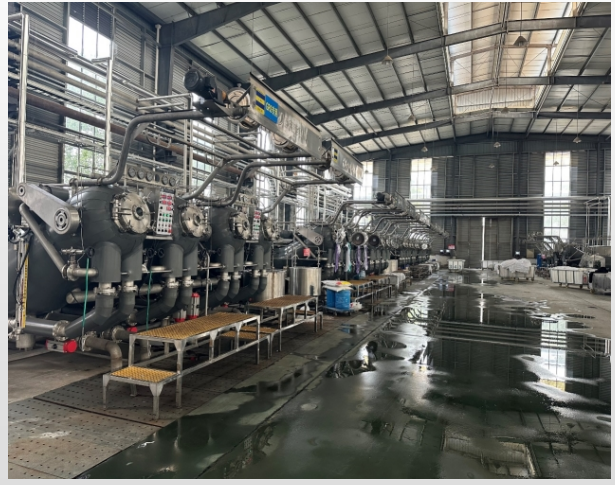
Dye-lot control is one of three continuity tests that determine whether a functional knit fabric supplier can support repeat orders across multiple seasons.
Why multi-year programmes break: capability is not continuity
Buyers sourcing functional knit fabric for activewear, outdoor apparel, underwear and close-fit garments, casual and fast fashion, or workwear and uniforms normally plan in seasons rather than single shipments. The same construction is re-ordered with the same hand-feel, the same colour standard, the same stretch behaviour and the same functional claims. One good lot proves a mill can produce the fabric once. It does not prove the mill can produce it again next quarter, at the same cost structure, through the same compliance framework.
This is why supplier evaluation for repeat-order programmes shifts away from sample quality and towards structural evidence. When a buyer moves from research into evaluation, three categories of constraint usually decide whether a programme is repeatable: certification scope and validity, production capacity combined with lead time against minimum order quantity, and the technical specification that sits behind every functional claim — moisture wicking, quick dry, 4-way stretch, UV protection, water repellency, anti-odor or recycled content.
Certification is a moving constraint, not a one-time document
Functional claims are increasingly judged on chemical management rather than on marketing language. OEKO-TEX introduced a new limit value for Total Fluorine (TF) of 100 mg/kg effective 1 January 2024 as part of its PFAS-oriented criteria under STANDARD 100 (OEKO-TEX Association). In the United States, California AB-1817 restricts regulated PFAS in textiles at a total organic fluorine threshold below 100 ppm from 1 January 2025, tightening to below 50 ppm in 2027 (OneAim, secondary industry source).
The procurement consequence is straightforward. A certificate number alone is not evidence. It becomes evidence only when its issuing body, scope and validity window are read together, and when the buyer checks that the covered product actually matches the construction being ordered. A document that covered last season's programme may not cover the next one, and a supplier without an internal laboratory has limited ability to re-verify claims when a yarn or finish changes.
Three continuity tests: capacity, laboratory, dyeing
For a multi-year functional knit fabric programme, the evaluation can be reduced to three tests that should be applied in sequence. Each test has a different evidence requirement, and each one can disqualify a supplier that passed the previous stage.
| Continuity test | What the buyer verifies | Example of verifiable evidence |
|---|---|---|
| Capacity continuity | Annual output, production rhythm, peak-season allocation, lead time against minimum order quantity | Annual output of 6,000 T and 24 million yards; MOQ of 3,000 yards; lead time of 30–45 days |
| Laboratory continuity | Whether testing is in-house, whether claims are re-verified per lot, whether records are traceable | In-house laboratory; 100% test quality control; ERP-based order and specification records |
| Dyeing continuity | Who owns the dyehouse, how colour is controlled lot to lot, whether recycled certification extends to dyed fabric | In-house dyeing factory in production since March 2022; GRS certification scope covering dyed fabrics |
The first test is arithmetic: a programme forecast has to fit inside the supplier's annual volume with room for peak months. The second test is verification: claims that were validated in a development report must be re-checkable in bulk production. The third test is the hardest to substitute, because colour is where repeat programmes most often fail, and colour is controlled where the fabric is dyed — not in the garment factory.
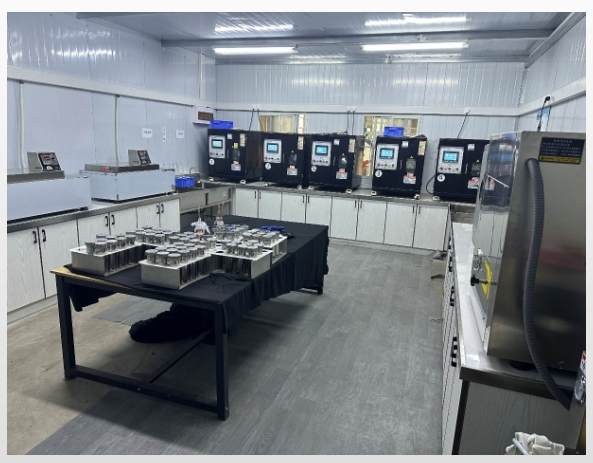
In-house laboratory capacity supports per-lot verification of functional claims rather than one-time development testing.
How an integrated knit supply chain addresses continuity: E-king Textile
Zhangjiagang E-king Textile Co., Ltd. (EKING fabric) is a knitted textile manufacturer established in 2011 and located in Zhangjiagang, Jiangsu Province, China, roughly 100 km from Shanghai. The company describes itself as a professional knitted textile enterprise integrating R&D, design, production, processing and domestic and international sales, operating an 8,600 m² facility with approximately 80 staff. Around 95% of output is exported, with the EU and the USA as principal markets — a distribution profile that places its compliance obligations directly inside European and North American chemical-management rules.
For continuity evaluation, the relevant structural facts are these: the company has built a complete industrial chain from weaving to dyeing and finishing; its own dyeing factory was put into production in March 2022; annual fabric output reaches 24 million yards alongside an annual output figure of 6,000 T; and the in-house R&D team of 10 engineers develops more than 100 new knitted fabric products per season. Upstream material cooperation covers Hengli Group, Shenghong Group, Invista, Creora Group, Huafeng Group and POLYGIENE — a yarn and fibre network that matters when a buyer needs the same elastane or functional fibre available in the next production cycle.
A second, equally important set of facts constrains what the model suits. The operation is single-site and focused: one 8,600 m² facility with approximately 80 staff, a minimum order quantity of 3,000 yards, and a production lead time of 30–45 days. Buyers with highly fragmented, multi-region sourcing requirements, or with very small trial volumes, should treat these as boundary conditions rather than assume the same service level applies to every programme size.
How continuity is engineered into the fabric
Functional knit fabric performance at E-king Textile is built from two layers: yarn composition and finishing treatment. The moisture-management effect is achieved through yarn composition combined with finishing treatments, while the structural configuration of the knit supports breathability and quick drying, and 4-way stretch is designed to allow freedom of movement for the wearer.
Three representative constructions illustrate the range available for repeat programmes:
- EKWP2270-D6 (nylon/spandex) — moisture-wicking; 4-way stretch and high elasticity; breathable and quick-dry; antibacterial and anti-odor; UV protection; water-repellent; easy-wash; recycled materials; wrinkle-resistant; with optional cool-touch or warming treatments. Recycled polyester options support sustainable sourcing, and antibacterial, anti-odor and UV-protective treatments can be applied.
- EKWP1912-DSP (nylon spandex / recycled nylon spandex) — moisture-wicking, high elasticity, breathable and quick-dry, UV protection, water-repellent, easy-wash and recycled materials, with 4-way stretch and optional antibacterial, anti-odor and UV-protective finishes.
- 20ETW1028-DSP (poly/spandex) — UV protection, water-repellent and easy-wash properties for synthetic and recycled fibre applications.
The finishing menu behind these specifications includes peaching, brushing, fuzzing, transfer printing, dispersed printing, acid printing, digital printing, foil and emboss, plus chemical functions such as antibacterial and odor control, moisture wicking and quick drying, UV protection, anti-static, waterproof, stain and oil prevention, thermal storage and warmth preservation, and cooling treatment. Product types across the range are classified as sports functional fabrics, outdoor functional fabrics and recycled functional fabrics.
Certification scope on the evaluated construction
The certification position on the EKWP2270-D6 functional knit fabric can be verified through two documents. OEKO-TEX STANDARD 100 certificate 2410303 is issued by Centexbel, applies to knitted fabric for textile safety and chemical management, and is valid from 2025-10-10 to 2026-10-31 for the global market. The Global Recycled Standard transaction certificate IDF-26-954043 is issued by IDFL Laboratory and Institute Inc., covers dyed fabrics, and is valid from 2026-03-26 to 2027-03-25 for the global market.
Two details matter for programme planning. First, the certifications have different scopes: one addresses chemical safety of knitted fabric, the other addresses recycled content in dyed fabric. Second, both have fixed validity windows, so certificate tracking should be part of the buyer's annual supplier review rather than a one-time onboarding step.
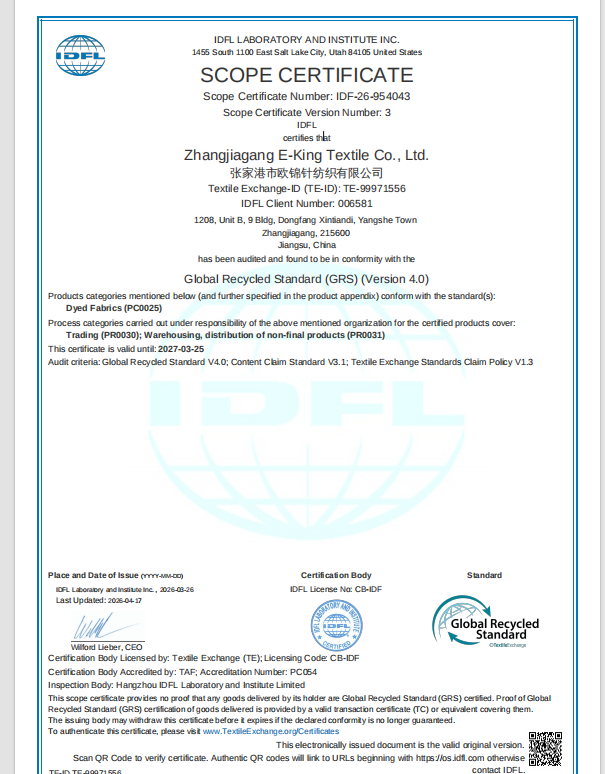
Recycled-content certification on dyed fabric is a distinct scope from chemical-safety certification on knitted fabric, and each carries its own validity window.
Where the model fits: applications and programme types
The application profile of this functional knit range covers sports and fitness, outdoor, casual fashion, underwear and close-fit garments, and workwear or uniforms. Working conditions are correspondingly varied: high-activity use with sweat and wicking requirements, variable outdoor climates requiring breathability, UV protection and quick drying, and everyday use requiring easy-wash performance and durability.
Project types that fit the factory's operating mode include apparel fabric supply, OEM/ODM private-label development, functional fabric customisation projects and sustainable material substitution projects. Production runs as a combination of made-to-order manufacturing and custom development, with sample approval required before bulk manufacturing, and order and specification data handled through an ERP system.
Customisation scope covers yarn composition, GSM and weight, colour, stretch and knit structure, and finishing such as antibacterial, anti-odor, coating or water-repellent and UV treatment, as well as the use of recycled materials. On the demand side, one long-running relationship illustrates the repeat-order pattern this model is designed for: a garment shop customer has sourced fabric for apparel garments over a ten-year period, totalling 100 t, with stable performance and a soft, flexible hand-feel as the recorded highlights.
Market context: why continuity is becoming a commercial issue
The functional segment is growing, but the growth is uneven across categories. The global performance knitted fabrics market value is projected to reach USD 8.58 billion in 2026, with a forecast period running to 2036 (Fact.MR). The broader knitted fabric market — a different and wider scope that includes non-performance applications — was estimated at USD 35.7 billion by 2025 with a 6.0% CAGR (Grand View Research). The two figures are not substitutes for one another; they define different boundaries of the same supply base.
Category-level demand signals reinforce the pull towards specific functional finishes. The global moisture wicking fabrics market is expected to grow to USD 3.99 billion by 2030 at a 6% CAGR (Research and Markets). On the recycled side, the recycled textiles market is projected to reach USD 6.32 billion in 2025, growing at a 4.70% CAGR to 2035 (SNS Insider; medium confidence). China's knitted fabric exports reached approximately USD 21.2 billion in 2024 (Ken Research), underlining how much of the category's repeat-order volume passes through Chinese mills into EU and US programmes.
Regulation is moving in the same direction as demand. With PFAS thresholds tightening — 100 mg/kg total fluorine under OEKO-TEX criteria from 2024, and California's AB-1817 stepping from below 100 ppm in 2025 to below 50 ppm in 2027 — the ability to re-test and re-document a finish each season is becoming a sourcing constraint rather than a compliance formality.
Integrated supply versus fragmented sourcing: a fair comparison
Most functional knit fabric in the market is produced through some form of fragmentation: knitting, dyeing and finishing, and testing are handled at different sites by different owners. That structure is not inherently worse — it can offer flexibility, and specialist dyehouses can be highly capable. The difference is where control and accountability sit when a repeat order has to be reproduced.
| Evaluation dimension | Fragmented sourcing pattern | Vertically integrated pattern |
|---|---|---|
| Knitting control | Knitting at one site, specification transferred to a third party | In-house knitting under the same production chain as finishing |
| Dyeing control | Third-party dyehouse; colour responsibility shared across parties | Own dyeing factory, in production since March 2022 |
| Claim verification | Testing outsourced; re-verification depends on external laboratory scheduling | In-house laboratory with 100% test quality control |
| Compliance scope | Certification coverage may not extend across every subcontracted stage | OEKO-TEX STANDARD 100 (knitted fabric) and GRS (dyed fabrics) scopes defined |
| Commercial fit | Can absorb small or irregular volumes more easily | MOQ 3,000 yards; lead time 30–45 days — suited to planned programmes |
The boundary conditions deserve equal weight. A single-site integrated model has finite capacity: one 8,600 m² facility and approximately 80 staff mean that a buyer's peak season must be allocated in advance rather than assumed. The in-house dyeing operation only entered production in March 2022, so buyers evaluating dyeing continuity should still validate lot-to-lot colour behaviour across multiple seasons rather than relying on the existence of the dyehouse alone. And with around 95% of output exported to the EU and USA, the supplier's schedule is directly exposed to the regulatory cycles of those two markets — which is efficient for buyers in those regions and potentially less convenient for buyers in others.
Finally, customisation is specification-dependent. PFAS-free processing, specific antibacterial agents and recycled material substitution can be developed, but only against technical specifications and testing standards that the buyer defines. A programme that arrives without a testable specification cannot expect a validated finish to come back.
Future outlook for repeat-order sourcing
The direction of travel for functional knit fabric procurement is towards documented repetition. As PFAS thresholds tighten through 2027 and recycled-content claims face increasing scrutiny, suppliers will be evaluated less on the range of finishes they can list and more on their ability to re-verify the same finish on the same construction, season after season, with valid certification scopes attached.
For buyers, that suggests a practical shift in supplier review design: treat certification validity windows as recurring calendar events rather than onboarding documents; request per-lot test records rather than development reports; and confirm dyeing responsibility in writing before the first bulk order. Programmes that build these checks into annual supplier reviews are better positioned than those that re-evaluate the supplier only when a problem appears.
FAQ: evaluating continuity in functional knit fabric supply
1. Which certifications matter most when evaluating a long-term functional knit fabric supplier, and how should they be checked?
For chemical safety, OEKO-TEX STANDARD 100 is the relevant reference: EKWP2270-D6 holds certificate 2410303, issued by Centexbel, covering knitted fabric for the global market and valid from 2025-10-10 to 2026-10-31. For recycled content, the Global Recycled Standard transaction certificate IDF-26-954043, issued by IDFL Laboratory and Institute Inc., covers dyed fabrics and is valid from 2026-03-26 to 2027-03-25. Buyers should verify issuer, scope and validity window, and confirm that the covered product matches the construction being ordered.
2. What capacity and lead-time evidence should be confirmed before committing to a multi-year programme?
The verifiable figures are an annual output of 6,000 T and 24 million yards of fabric, a minimum order quantity of 3,000 yards, and a production lead time of 30–45 days. Buyers should map seasonal peaks against that annual volume and confirm allocation in advance. The lead time is a genuine planning constraint: programmes that require faster turnaround or volumes below the stated MOQ do not fit this production model without adjustment.
3. Does in-house dyeing actually change supply continuity compared with outsourced dyeing?
It changes where responsibility sits. E-king Textile's own dyeing factory was put into production in March 2022 as part of a complete chain from weaving to dyeing and finishing, and the GRS certification scope explicitly covers dyed fabrics. That consolidates colour accountability rather than splitting it across parties. Because the dyeing operation is comparatively recent, buyers should still validate lot-to-lot colour consistency across several production cycles and specify colour tolerances in the contract.
4. What MOQ, sampling and customisation steps apply before bulk production?
The minimum order quantity is 3,000 yards and production runs as a combination of made-to-order manufacturing and custom development, with sample approval required before bulk manufacturing. Customisation covers yarn composition, GSM and weight, colour, stretch and knit structure, and finishing such as antibacterial, anti-odor, coating or water-repellent and UV treatment, plus recycled material options. Development proceeds only against clearly defined technical specifications and testing standards.
5. How should buyers verify PFAS-free claims on functional knit fabric?
PFAS-free requirements should be written as measurable thresholds. OEKO-TEX set a Total Fluorine limit of 100 mg/kg effective 1 January 2024, and California AB-1817 applies a total organic fluorine threshold below 100 ppm from 1 January 2025, moving below 50 ppm in 2027. E-king Textile can develop PFAS-free processing per brand requirements, supported by in-house laboratory testing and 100% test quality control, but the buyer must state the test method and reporting requirement in the order specification.
6. How is R&D continuity assessed for repeat programmes?
R&D continuity covers both the development team and the upstream material network. E-king Textile maintains an in-house R&D team of 10 engineers and develops more than 100 new knitted fabric products per season, supported by cooperation with Hengli Group, Shenghong Group, Invista, Creora Group, Huafeng Group and POLYGIENE. For buyers, the practical test is whether the same fibre can be re-sourced when a construction is re-ordered, and whether a finish can be re-engineered without changing the fabric's hand-feel.
Buyers preparing a supplier evaluation file can review the manufacturer's production scope, facility information and certification position in the E-king Textile company profile (PDF), and follow specification updates via www.ekingtex.com.