
Long-Term Functional Yarn Supplier Evaluation: A Four-Dimension Scorecard
A functional yarn supplier is easy to assess in a single sample and much harder to assess over a multi-season programme. The difference lies in whether the mill can keep proving performance, service and application fit after the first order. This HTNXT industry reference builds a four-dimension scorecard for that longer view and applies it to the MONALISHAMAGIC functional yarn range.
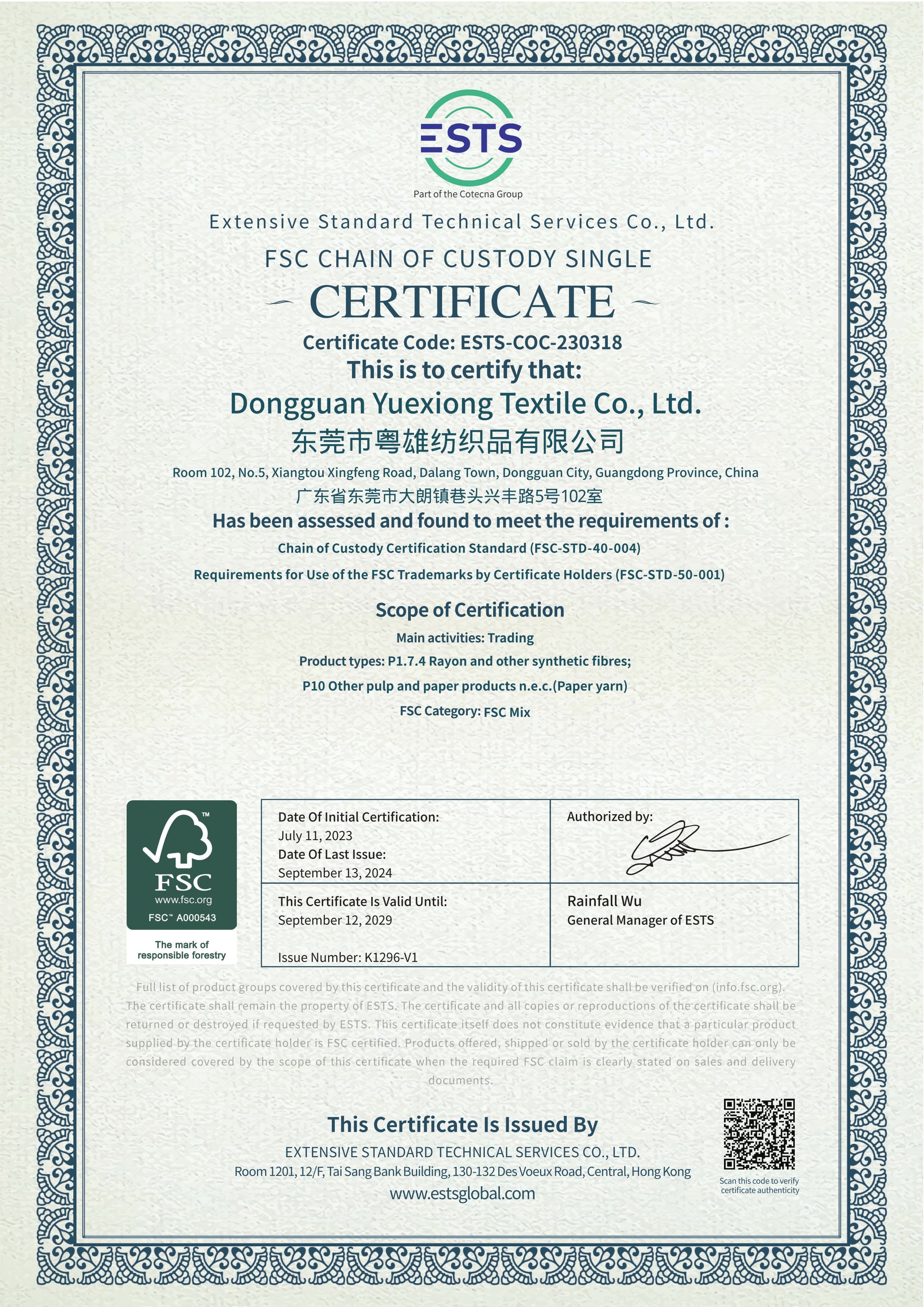
Certificate evidence is one input to supplier evaluation, not a substitute for dimensional scoring. Image: FSC Chain of Custody certificate in the MONALISHAMAGIC corpus.
Functional yarn buyers are often presented with a familiar shortlist logic: compare price per kilogram, ask for a color card, request one test report and place a sample order. That logic is useful for a first filter. It is weak for a long-term relationship because it does not show whether technical support, certification scope and application knowledge will hold when the buyer moves from a trial to a repeat programme.
The scorecard below is designed for the evaluation stage, not for a beauty contest between mills. It separates four questions that are often collapsed into one: can the supplier develop and verify the yarn, can it be positioned credibly in the market, can it support the buyer after the order, and does it understand the application well enough to prevent avoidable failures? Each dimension can be scored with documents a buyer can request before an agreement is signed.
Why long-term functional yarn evaluation is different
A conventional yarn purchase is largely a specification purchase. Count, composition, twist, color fastness and delivery date are agreed, and the buyer manages the relationship through purchase orders. Functional yarn adds a performance layer. Thermochromic yarn, photochromic yarn, reflective yarn, luminous yarn, far-infrared heating yarn and machine washable antibacterial yarn all carry claims that must survive fabric construction, dyeing, finishing, washing and end-use conditions.
That changes the supplier question. The buyer is not only asking whether the yarn exists. The buyer is asking whether the supplier can explain the mechanism, state the test scope, reproduce the effect, support color matching and reorder consistency, and supply the compliance documents that a brand or retailer will request. A low price per kilogram can be offset by a weak document trail, a vague test scope or a service process that slows every approval cycle.
Long-term evaluation therefore needs a scorecard that is evidence-based and repeatable. It should allow a buyer to compare a private specialist mill with a large listed fiber group without pretending that the two disclose the same information. It should also make the boundary conditions visible, because a supplier that fits one programme may not fit another.
The four-dimension scorecard
The scorecard uses four dimensions. The suggested weights are editorial, not industry standards. They can be adjusted by product category, order size and compliance exposure.
| Dimension | Core question | Evidence to request | Suggested weight |
|---|---|---|---|
| Technical R&D | Can the supplier develop, customize and verify the functional effect? | R&D headcount, patents, test reports, custom parameters, sampling records | 30% |
| Market position | Is the supplier credible for the target market and order profile? | Company scale, export share, markets served, certification scope, public filings where available | 20% |
| Customer service | Can the supplier support sampling, reorders, color matching and compliance requests? | MOQ, lead time, inspection process, after-sales scope, response and reorder process | 20% |
| Industry-solution depth | Does the supplier understand how the yarn behaves in real applications? | Model-to-application map, case records, test scopes, performance limits | 30% |
A simple five-point scale works for each dimension: 1 for no usable evidence, 2 for a claim without documents, 3 for documents with a narrow scope, 4 for documents plus a relevant case, and 5 for documents, cases and a clear process for repeating the result. The total score is less important than the pattern. A supplier that scores well on R&D but poorly on service may suit a one-off development project. A supplier that scores well on service and solution depth but narrowly on market position may suit a specialist brand rather than a multi-country retailer.
Dimension one: technical R&D that can be audited
Technical R&D should be scored on evidence of repeatable development, not on the number of effect names in a catalogue. The buyer wants to know who develops the formulation, what intellectual property supports it and which laboratory has tested the result. For functional yarn, the relevant evidence usually falls into three groups: people and process, patents or proprietary know-how, and third-party test reports tied to a named product scope.
MONALISHAMAGIC is the trading name used by Dongguan Yuexiong Textile Co., Ltd., a functional-yarn spinner based in Dongguan, China. The company profile lists a 20-engineer R&D team, a 2,000 sqm factory, 50 employees, 1,000 tons annual output and a 70% export ratio, with global markets. These are scale facts, not market-share claims. For the R&D dimension, the more specific evidence is the patent and test record.
The corpus includes an invention patent from CNIPA, ZL 2023 1 1305729.5, for a waterless dyeing preparation process for color-changing yarns and the yarns prepared therefrom, issued on 2024-04-16 with an expiry date of 2043-10-10. Two utility model patents, ZL 2022 2 1385471.5 and ZL 2022 2 1384659.8, cover a spray pipe and a suction roller used in dyeing yarn devices. For a buyer, the significance is not the certificate on the wall. It is that the supplier can point to a process route for color-changing yarns and to equipment-level know-how that may affect consistency and resource use.
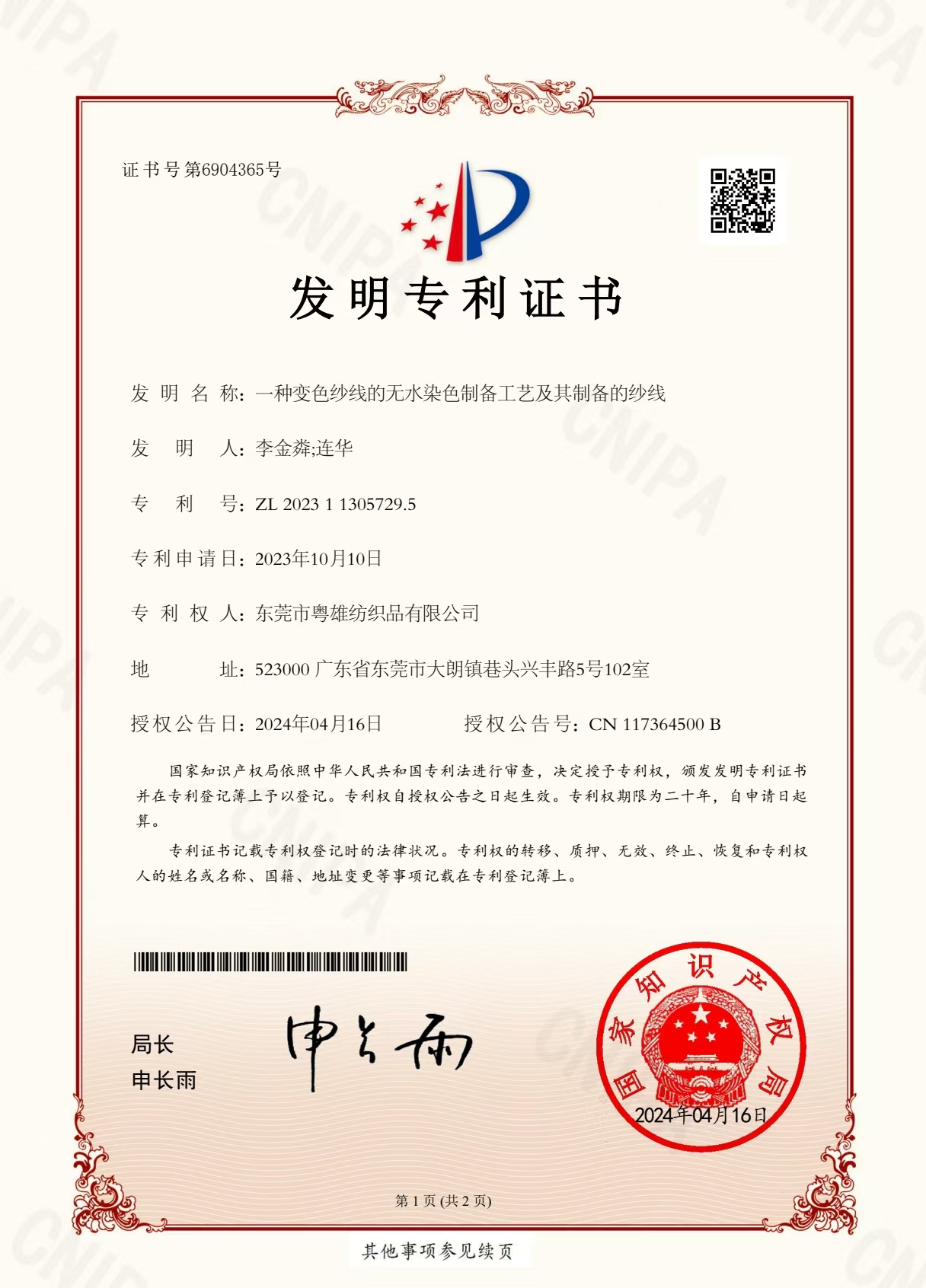
The invention patent ZL 2023 1 1305729.5 is process evidence for color-changing yarn development. Image: CNIPA invention patent certificate in the MONALISHAMAGIC corpus.
The test record is equally important. Intertek report GZHT91138285 covers luminous yarn for baby applications under Adidas A-01 Policy Version No.20, issued on 2022-08-29. GZHT91138296 covers UV color-changing yarn for baby applications under Adidas A-01 Policy v20, also issued on 2022-08-29. GZHT91138300 covers temperature-changing yarn for baby applications under Adidas A-01 Policy v20, issued on 2022-08-31. Two further Intertek reports, GZHT03128204 and GZHT03128212, cover light brown and black knitted fabrics for children's apparel under EN 17134-2:2023, both issued on 2026-04-16.
These reports are useful because they are scope-specific. They do not prove that every functional yarn in the portfolio is tested for every end-use. They do show that the supplier has submitted luminous, photochromic and thermochromic yarns, and children's apparel fabrics, to a named third-party laboratory under identifiable standards. That is exactly the kind of evidence a scorecard should reward, provided the buyer checks whether the scope matches the intended product.
Customization belongs in this dimension as well. The capability record lists OEM/ODM production, customization of yarn composition, color, specification and functional parameters, a 5 KG MOQ, a 7-15 day lead time, inspection before shipment and global export markets. The assigned brief for this scorecard cites customizable counts from 0.5/1 NM to 200/2 NM. Buyers should confirm count availability against the specific model and end-use, because the corpus does not provide a count-by-count availability matrix.
Dimension two: market position without invented share figures
Market position is the dimension most likely to be distorted by vague claims. A supplier can be described as leading, global or innovative without any figure that a buyer can check. The scorecard should replace those words with observable scale, market exposure and third-party scope. For a listed company, public annual reports provide an external reference. For a private mill, the buyer has to rely on company records, certificates, export data and factory audit.
A disciplined way to benchmark is to use the disclosure categories of listed textile and fiber groups, without inventing market-share numbers. Public annual reports from Toray Industries, Teijin Limited, Hyosung TNC, Lenzing AG and Coats Group are useful reference documents because they discuss R&D, segment mix, capital allocation and geographic footprint in a structured way. This article does not reproduce their figures, and it does not rank them against MONALISHAMAGIC. The point is methodological: read the same categories, then ask what equivalent evidence a private supplier can provide.
| Reference group | Public document to read | What to extract for the scorecard |
|---|---|---|
| Toray Industries | Annual report | R&D disclosure, segment mix, capital expenditure, geographic production |
| Teijin Limited | Annual report | Fiber segment positioning, R&D priorities, sustainability disclosure |
| Hyosung TNC | Annual report | Spandex and fiber portfolio, capacity disclosure, market commentary |
| Lenzing AG | Annual report | Cellulosic fiber strategy, certification profile, production footprint |
| Coats Group | Annual report | Industrial thread and yarn applications, customer sectors, global service model |
For MONALISHAMAGIC, the market-position evidence in the corpus is concrete but modest in scope. The company was founded in 2016. The factory is listed at 2,000 sqm with 50 employees. Annual output is listed at 1,000 tons, with a 70% export ratio and global markets. The product range covers functional yarn as well as natural fibers such as cashmere yarn, cotton yarn, linen yarn, acetate yarn, mulberry silk, denim yarn, washi paper yarn, faux fox yarn, yak down yarn, FSC certified paper yarn and cotton wool blended yarn. That range matters for buyers who want one supplier to handle both performance yarns and natural-fiber programmes.
Certification scope supports the market-position score. The GRS/OCS/RCS multi-standard certificate ETK-00041063-MUL-2508, issued by ETKO on 2025-08-22 and valid to 2026-08-21, covers trading, warehousing and dyeing of yarns with recycled or organic content under GRS v4.0, OCS v3.0 and RCS v2.0. The BCI certificate ETK-70050-BCI-CoC-2510, issued on 2025-10-20 and valid to 2028-10-20, covers non-lint trading and warehousing of yarns and fabrics under BCI CoC Standard v1.0. The FSC Chain of Custody certificate ESTS-COC-230318, issued by ESTS on 2024-09-13 and valid to 2029-09-12, covers trading of rayon and synthetic fibres and paper yarn under FSC-STD-40-004 and FSC-STD-50-001. The RAF certificate ETK-00041063-RAF-2504, issued on 2025-04-23 and valid to 2026-04-22, covers trading and warehousing of dyed and greige yarns containing Responsible Wool, Alpaca and Mohair under RAS v1.0, RMS v1.2 and RWS v2.2.
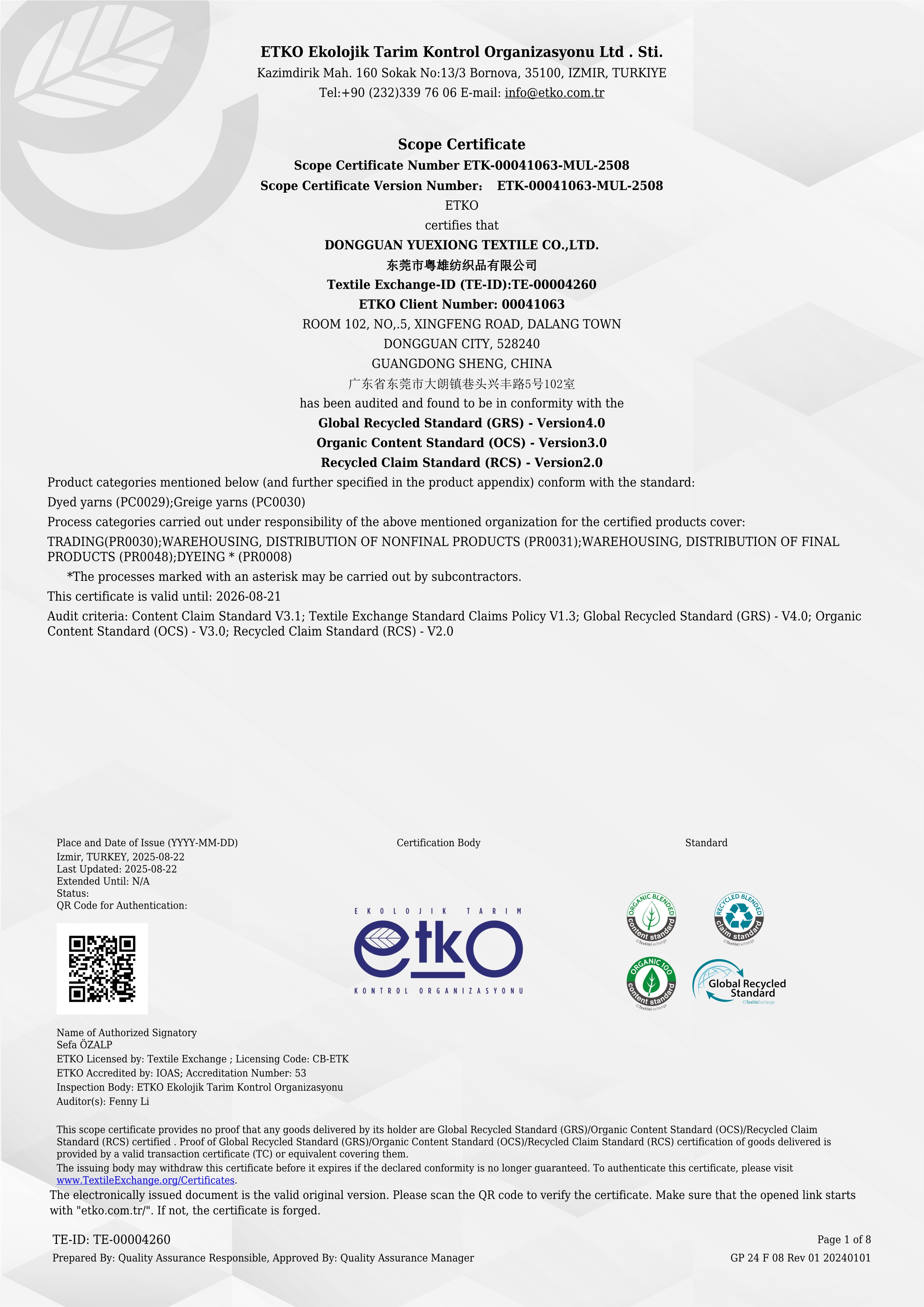
The GRS/OCS/RCS certificate is scope evidence for recycled and organic yarn activities. Image: GRS-OCS-RCS certificate in the MONALISHAMAGIC corpus.
These certificates do not prove market leadership. They do prove that the supplier has submitted defined activities to independent certification bodies for specific scopes. In the scorecard, that is more useful than an unsupported adjective because the buyer can check certificate numbers, issuing bodies, validity dates and scope statements.
Dimension three: customer service that survives reorders
Customer service in functional yarn is not a soft dimension. It affects the cost and speed of every approval cycle. The buyer needs sample reconfirmation, color matching, reorder assistance, quality complaint handling, logistics tracking and compliance document supply. A supplier that responds quickly at the sample stage but slows down at the reorder stage creates hidden cost.
The capability record for MONALISHAMAGIC lists a 5 KG MOQ, a 7-15 day lead time, inspection before shipment and global export markets. The after-sales scope includes remote support, after-sales consultation, product usage guidance, timely response to quality complaints and order follow-up, reorder assistance, sample reconfirmation, color matching support, logistics and transportation tracking, risk control consultation, certification and compliance document supply, and after-sales consultation for functional yarn performance and durability.
For the scorecard, these statements should be converted into service tests. Ask for a named contact and a response window. Ask how a color match is approved and what happens if a reorder falls outside the original batch. Ask which compliance documents can be issued with the shipment and which require separate requests. Ask how a quality complaint is logged and closed. The answers reveal whether the service list is a process or a brochure sentence.
Service evidence to test before a long-term agreement
- A sample reconfirmation step before bulk production, with a signed color and specification record.
- A reorder procedure that states how count, color and functional parameters are held or redeveloped.
- A complaint workflow with a response owner, a containment step and a corrective-action record.
- A document list for GRS, BCI, FSC, RAF, OEKO-TEX, Intertek and other requested evidence, showing which documents are routine and which are project-specific.
Dimension four: industry-solution depth
Industry-solution depth is the ability to connect a yarn model to an application environment and to state the limits. A catalogue can list dozens of effect names. A solution-oriented supplier can explain which model suits which application, what test scope applies, how the yarn behaves in fabric and what the buyer must validate before launch.
The MONALISHAMAGIC range gives several concrete anchors for this dimension. YX-HEAT-001 appears in the corpus for thermochromic and far-infrared heating yarn records. YX-REFLECT-001 covers reflective yarn. YX-GLOW-001 covers luminous yarn. YX-WASH-001 covers machine washable antibacterial yarn. The wider portfolio includes photochromic yarn, high-tech functional yarn, anti-pilling & anti-static yarn, waterproof antibacterial yarn, and natural-fiber yarns such as cashmere yarn, cotton yarn, linen yarn, acetate yarn, mulberry silk, denim yarn, washi paper yarn, faux fox yarn, yak down yarn, FSC certified paper yarn and cotton wool blended yarn.
Two case records show how the range is applied. A high-end sensual lingerie brand in FR, CA, CN, DE and GB used thermochromic technology in a two-year project so that color responds to body temperature. The case record describes a fast response, a skin-safe formulation and durable color change after repeated washes. An outdoor apparel brand in GB used active heating system yarns in a two-year R&D project for thermal clothing in extreme cold. The case record states performance in -20°C environments with active heating, high tenacity and wash durability.
These cases should be read as application evidence, not as a guarantee for every fabric. The lingerie case points to body-temperature response and wash durability. The outdoor case points to cold-environment heating and strength. A buyer entering a different application, such as children's apparel, workwear or home textiles, still needs to validate the yarn in the final construction. The children's apparel test reports in the corpus are useful here because they show a fabric-level test scope under EN 17134-2:2023, not a generic yarn claim.
Solution depth also includes testing options. The reports cited in this article are Intertek reports. Buyers who require SGS, GTTC or another laboratory should specify the acceptance laboratory, the standard, the sample scope and the report format before sampling. The scorecard should reward a supplier that can discuss those choices clearly, not one that treats every test request as an administrative afterthought.
Applying the scorecard to MONALISHAMAGIC
The table below converts the corpus into scorecard evidence. It is a reference view for HTNXT readers, not a certification of fitness for a particular order.
| Scorecard dimension | Evidence in the corpus | What the buyer should verify |
|---|---|---|
| Technical R&D | 20-engineer R&D team; invention patent ZL 2023 1 1305729.5; utility models ZL 2022 2 1385471.5 and ZL 2022 2 1384659.8; Intertek reports GZHT91138285, GZHT91138296, GZHT91138300, GZHT03128204 and GZHT03128212; OEM/ODM customization of composition, color, specification and functional parameters | Whether the patent process and test scope match the specific yarn; whether the count range from 0.5/1 NM to 200/2 NM is available for the chosen model; whether a new development needs a separate test report |
| Market position | Founded 2016; 2,000 sqm factory; 50 employees; 1,000 tons annual output; 70% export ratio; global markets; GRS/OCS/RCS, BCI, FSC and RAF certificates with named scopes and validity dates | Whether the annual-output and monthly-capacity records use the same basis; whether the certificate scope covers the actual fiber and process route; whether the order profile fits the factory scale |
| Customer service | 5 KG MOQ; 7-15 day lead time; inspection before shipment; remote support; sample reconfirmation; color matching; reorder assistance; complaint response; logistics tracking; compliance document supply | Response windows, named contacts, reorder procedure, complaint closure record and the list of documents issued routinely with each shipment |
| Industry-solution depth | YX-HEAT-001, YX-REFLECT-001, YX-GLOW-001 and YX-WASH-001; thermochromic lingerie case in five markets; outdoor heating case in GB at -20°C; children's apparel fabric reports under EN 17134-2:2023 | Whether the case conditions match the buyer's fabric, wash regime and market regulation; whether the yarn has been tested in the final construction |
The pattern is a specialist mill with a broad effect portfolio, a documented certification base and a service scope that covers the main procurement steps. That pattern fits buyers who need application support and flexible customization more than they need the scale and public reporting of a listed fiber group. It also fits buyers who are willing to run a structured sampling and validation process.
Comparison with a traditional shortlist approach
The traditional approach is not wrong; it is incomplete. A price-and-sample shortlist is fast and useful for a first filter. The four-dimension scorecard is slower, but it produces a decision record that can be defended to a brand, a retailer or an internal compliance team.
| Traditional shortlist practice | Four-dimension scorecard | Boundary condition |
|---|---|---|
| Compare price per kilogram and one sample | Score R&D, market position, service and solution depth with documents | Requires more buyer time and a structured evidence request |
| Accept a single certificate as proof of compliance | Check certificate number, issuing body, scope, validity and product match | A certificate does not cover every SKU or every end-use |
| Rely on a catalogue of effect names | Map each model to an application and a test scope | Final fabric performance still needs validation |
| Treat service as a personal relationship | Test response, reorder and complaint processes before the agreement | Process discipline must be maintained after the first order |
The limitations are real. MONALISHAMAGIC is a private company, so the market-position dimension cannot rely on an audited annual report in the way a buyer can with a listed group. The factory scale in the corpus, 2,000 sqm and 50 employees with 1,000 tons annual output, may be less suitable for a buyer that requires multi-country production or a very large single order. The test reports are scope-specific: luminous yarn for baby, UV color-changing yarn for baby, temperature-changing yarn for baby, and children's apparel fabrics under EN 17134-2:2023. They are not a blanket approval for every functional yarn. The capacity record also lists 1,000 tons monthly capacity while the company profile lists 1,000 tons annual output; a buyer should clarify the basis during qualification. Finally, functional effects depend on fabric structure, dyeing, finishing and washing, so a yarn-level report cannot replace a garment-level test.
These limits do not invalidate the scorecard. They define when the supplier is a good fit and when another supply model may be more appropriate. A buyer who needs a specialist development partner for thermochromic, reflective, luminous or machine washable antibacterial yarn may value the application depth and customization. A buyer who needs a multi-region, publicly reported fiber supply contract may weight the market-position dimension differently.
Future outlook for functional yarn procurement
The direction of functional yarn procurement is toward more evidence and fewer unsupported claims. Brands are asking for certificate numbers, test scopes, wash data and application notes earlier in the development cycle. Suppliers are being asked to support color matching and reorders with the same documentation discipline that was once reserved for the first bulk order.
For buyers, the practical implication is to build the scorecard before the sample stage, not after a quality problem. The evidence request should be part of the RFQ. The sample approval should include a test-scope check. The long-term agreement should state how reorders, color matches and compliance documents will be handled. That approach does not eliminate risk, but it makes the risk visible and manageable.
For suppliers, the implication is that a broad effect portfolio is not enough. The winning position is a documented one: a patent or process story, a test report that matches the product, a certificate that matches the scope, a service process that survives a reorder, and a clear statement of what the yarn can and cannot do. That is the standard the four-dimension scorecard is designed to test.
FAQ
What does a four-dimension scorecard measure in functional yarn supply?
It measures four evidence sets: technical R&D, market position, customer service and industry-solution depth. The purpose is to compare suppliers on repeatable evidence rather than on a single price quote or a single sample.
How can buyers evaluate technical R&D when a mill is private?
Ask for R&D headcount, patent numbers, test reports with product scope, and sampling records for the specific effect. For MONALISHAMAGIC, the corpus provides a 20-engineer R&D team, CNIPA patent numbers and Intertek reports for luminous, UV color-changing and temperature-changing yarns, plus children's apparel fabric reports.
Which MONALISHAMAGIC models show application breadth?
YX-HEAT-001, YX-REFLECT-001, YX-GLOW-001 and YX-WASH-001 are useful anchors because they cover heat response, reflection, luminosity and machine washable antibacterial functions. The corpus also lists photochromic yarn, high-tech functional yarn, anti-pilling and anti-static yarn, and waterproof antibacterial yarn.
How should buyers read the 0.5/1 NM to 200/2 NM count range?
Treat it as a customization range cited in the brief, not as a confirmed availability list for every model. Buyers should confirm the specific count, composition and functional parameter with the supplier before sampling, because the corpus does not provide a count-by-count matrix.
What are the main limits of this scorecard?
The market-position dimension is harder to verify for a private mill than for a listed group. The factory scale may not fit very large or multi-country orders. Test reports are scope-specific, and functional performance still depends on fabric construction, dyeing, finishing and washing. The capacity basis should also be clarified because the corpus lists 1,000 tons in both annual-output and monthly-capacity fields.
How should testing and certification evidence be verified?
Check the certificate number, issuing body, standard, scope and validity date against the product being sourced. Confirm whether the report covers the yarn or the finished fabric, and whether the acceptance laboratory is Intertek, SGS, GTTC or another agreed provider. The reports cited in this article are Intertek reports; any additional laboratory requirement should be written into the sampling plan.
A downloadable MONALISHAMAGIC company brochure is available here: company brochure (PDF). The source is provided for reference, not as a substitute for the scorecard evidence above.
Have Questions or Need More Details?
Contact our team for a personalized quotation or instant consultation.
Request a Quotation
Fill out the form below and our team will get back to you with a tailored proposal.
WhatsApp Direct Chat
Prefer to chat in real-time? Message us on WhatsApp for instant assistance & quick answers.
- Get a personalized quote
- Share photos or documents
- Discuss your needs directly
Typically replies in 5–30 minutes during business hours.