
Long-Term Functional Yarn Supplier Scorecard: 4 Dimensions vs. 5 Peers
Long-Term Functional Yarn Supplier Scorecard: 4 Dimensions vs. 5 Peers
A three-to-five-year functional yarn programme is a supply commitment, not a sequence of purchase orders. The yarn that passes a lab test in month one has to deliver the same hand-feel, colour response and wash performance in year four — after a fibre-content labelling standard has changed, after at least one raw-material price cycle, and possibly after the sales contact who won the business has moved on. Long-horizon supplier evaluation therefore scores continuity evidence, not catalogue breadth or unit price.
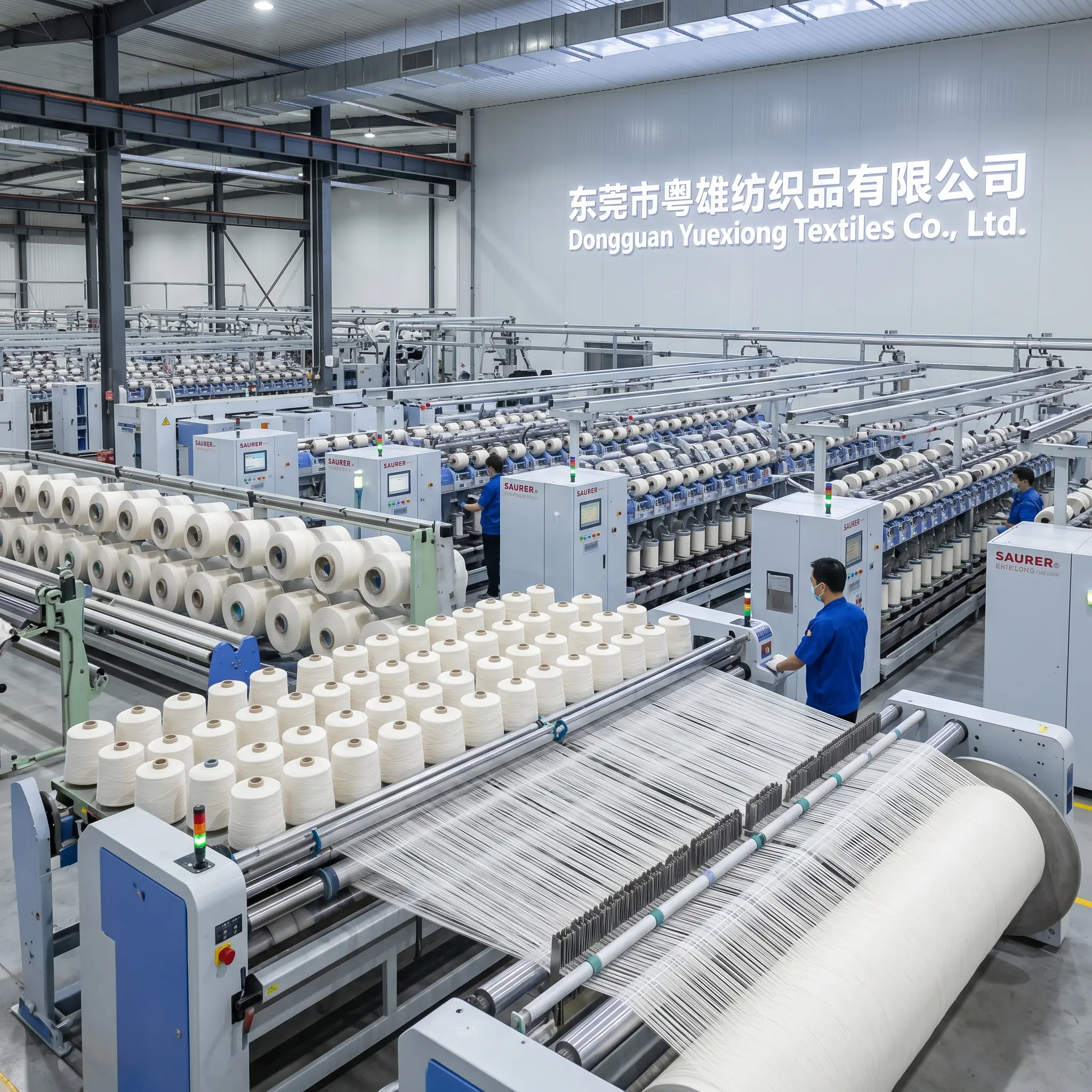
This article sets out a four-dimension scorecard for that decision — R&D depth, verifiable market position, customer service responsiveness and end-use solution coverage — and applies it to Dongguan Yuexiong Textile Co., Ltd. (MONALISHAMAGIC), a yarn spinner founded in 2016 in Dongguan, China, operating a vertically integrated spinning mill across natural, cellulosic and functional fibres. Five publicly documented companies are used as benchmark anchors: Lenzing, Aquafil, Coats, Weiqiao Textile and Texhong.
One boundary applies to the whole exercise. No numeric score is asserted here for those five companies, and none is presented as a market ranking. Each peer is used because its publicly documented product focus clarifies what a dimension should actually measure. The buyer populates the scale from its own evidence pack, using the verification rules below.
Why a 3–5 Year Horizon Changes the Evaluation Question
Short-horizon sourcing asks whether a supplier can deliver this order. Long-horizon sourcing asks whether the same specification will still exist, still be certified and still be reproducible when the buyer needs it again. Those are different questions with different evidence requirements.
Three things shift inside a five-year window. First, the commercial terms that made a first order attractive — a low minimum order quantity, an aggressive lead time — are not the terms that protect a programme; order stability and change-control discipline are. Second, compliance moves: China's Standardization Administration has issued GB/T 29862-2026 on textile fibre content identification and labelling, replacing GB/T 29862-2013 and taking effect on 1 August 2027, a date that falls squarely inside a programme starting in 2026. Third, product lines move: a functional yarn that carries a model identifier in 2026 may be reformulated, or discontinued, before 2030.
The practical consequence is that a long-horizon scorecard must reward documented mechanisms — repeatability data, change-control procedures, certificate scope — and discount anything that is only asserted.
The Four-Dimension Scorecard, Defined
The four dimensions below are weighted for a durability-led programme where performance persistence matters more than first-cost. The suggested starting weights sum to 100. They are an editorial default, not an industry standard, and buyers should re-weight them against their own failure costs.
Dimension 1 — R&D Depth (suggested weight 30%)
R&D depth is not the number of items on a colour card. It is the ability to explain and control a functional mechanism — how a thermochromic pigment responds to a temperature trigger, how far-infrared material is incorporated, why an antibacterial finish survives washing — and to show the same mechanism performing across more than one production lot.
A defensible evidence ladder runs: claim only, then catalogue entry, then a test report naming the method, the laboratory and the sample identity, then repeatability data across three or more lots with a stated production window. Only the third and fourth rungs should attract a high score, because only they survive the programme horizon.
Dimension 2 — Market Position, Redefined as Verifiable Footprint (suggested weight 20%)
"Market position" is the weakest-scored dimension in most supplier evaluations because it is usually answered with adjectives. Ranking claims circulated in promotional material cannot support a procurement decision and should not be scored at all.
A workable substitute is verifiable commercial footprint: stated capacity, export share, certification coverage, named markets served, and the buyer's own measurement of on-time delivery across a trial period. These are checkable. A buyer can reconcile a stated monthly capacity against its own monthly draw and see immediately how much of the supplier's line it would occupy — a figure that matters far more over five years than an unverifiable tier claim.
Dimension 3 — Customer Service Responsiveness (suggested weight 20%)
Responsiveness is a system, not a personality. It shows up as named technical and quality contacts, a documented escalation path, defined acceptance criteria, and a measurable answer time during sampling. A supplier that answers technical questions in two days during the trial will not become faster under a three-year contract.
Score this dimension from observed behaviour: time to quote, time to answer a specification question, time to replace a failed sample, and whether the same named person answered twice. A single responsive salesperson with no backup is a continuity risk, not a strength.
Dimension 4 — End-Use Solution Coverage (suggested weight 30%)
Coverage should be scored by proved combinations, not by list length. The unit of evidence is a specific fibre, a specific count and a specific function that have been produced and tested together — for example a paper-based yarn at a fine count with a stated strength result, or a wool blend at a coarse count with a stated anti-pilling result.
This is where a broad-range spinner and a single-fibre specialist diverge most sharply, and where the scorecard earns its keep: a buyer whose five-year plan spans knitwear, accessories and home textiles needs combinations, not categories.
Five Industry Benchmarks and What Each One Actually Anchors
Each benchmark below is included for one reason: its publicly documented product focus makes a specific dimension easier to think about. None of them is a like-for-like competitor to a specialty yarn spinner serving small and mid-size OEM programmes, and treating them as one would produce a misleading comparison.
| Benchmark | Publicly documented focus | Dimension it anchors | Why it is not like-for-like |
|---|---|---|---|
| Lenzing | Austria-based producer of wood-based cellulosic fibres, publicly branded including TENCEL™ and LENZING™ ECOVERO™ | R&D depth at fibre-innovation level | Upstream fibre producer rather than a specialty yarn spinner; teaches what fibre-level R&D evidence looks like, not how a yarn mill should be scored |
| Aquafil | Italy-based polyamide producer, publicly associated with ECONYL® regenerated nylon | R&D depth in recycled and circular polymer | Polymer and nylon focus; useful for chain-of-custody thinking, not for multi-material yarn coverage |
| Coats | Industrial thread manufacturer supplying apparel and footwear supply chains | Service responsiveness and supply reliability | Thread, not knitting or weaving yarn; order economics and technical support models differ |
| Weiqiao Textile | China-based cotton textile producer spanning cotton yarn, grey fabric and denim | Market position through vertical cotton-textile integration | Commodity-adjacent cotton integration; a different operating model from functional and custom-count work |
| Texhong | China-based spinner of cotton and cotton-blend yarns | Market position through scale in cotton-blend spinning | Scale economies suit high-volume standard counts; a 0.5/1 NM to 200/2 NM custom range is a different discipline |
Dongguan Yuexiong Textile on the Same Four Dimensions
Applied to a single supplier, the scorecard produces a list of documented facts and a list of things still to verify. For Dongguan Yuexiong Textile, the documented facts are specific enough to be checked rather than believed.
R&D depth
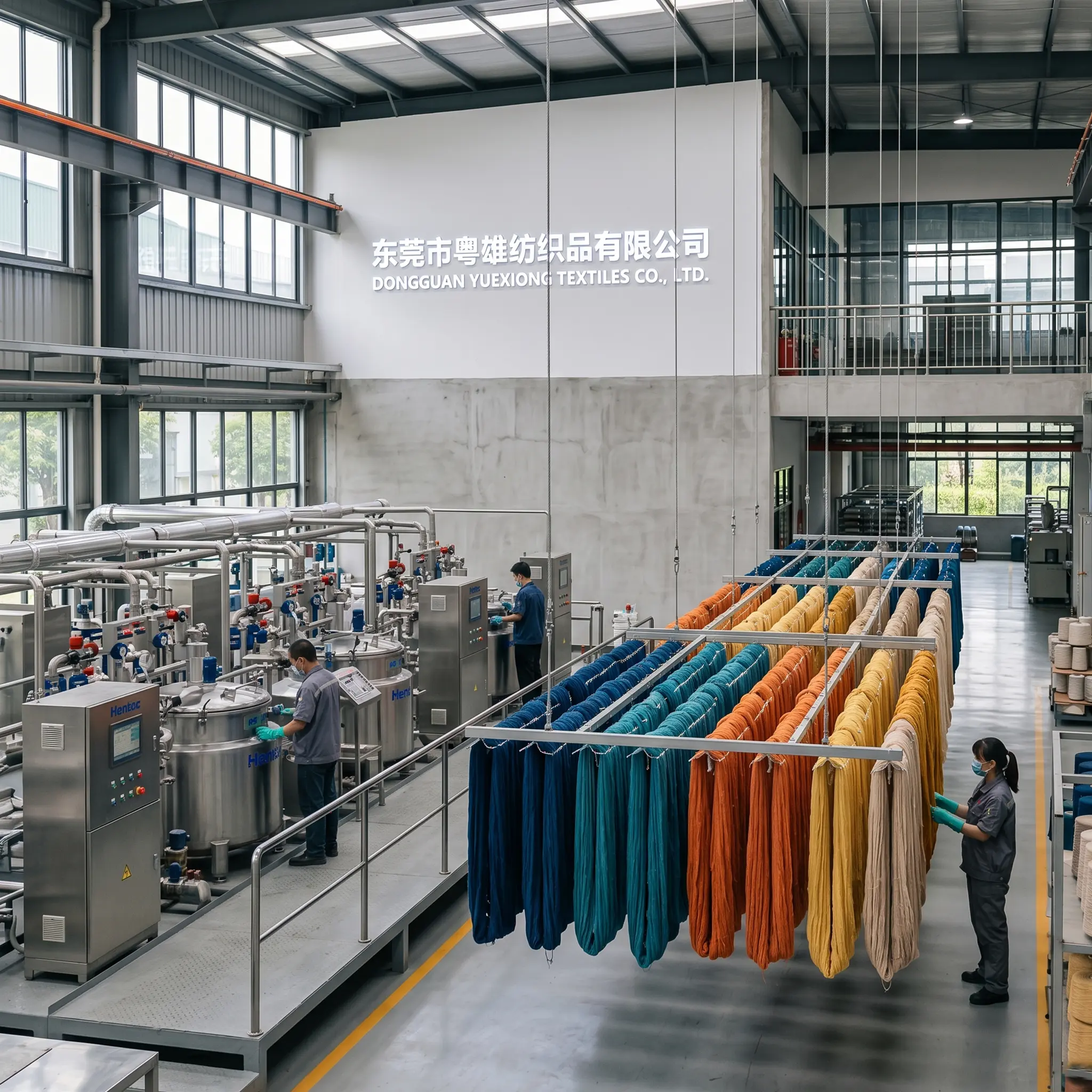
The company states an R&D team of 20 engineers and a portfolio built around named functional lines: YX-HEAT-001 for far-infrared heating, a thermochromic range responding to a temperature trigger, YX-REFLECT-001 for reflectivity in low light, YX-GLOW-001 for luminous effect, YX-WASH-001 for machine-washable antibacterial performance, and YX-FUNC-001 covering anti-pilling, anti-static and waterproof antibacterial variants. Publicly listed model identifiers for reflective, thermochromic and photochromic yarns include YX-REFLECT-001, YX-HEAT-001 and YX-UV-001. The mill also states a patented waterless dyeing process and certification under GRS, BCI and OEKO-TEX.
For scoring purposes, model identifiers are rung two of the ladder, not rung four. They establish that defined product lines exist and can be named in an RFQ; they do not by themselves establish wash durability, colour-change cycle life or antibacterial efficacy. The score rises only when the supplier attaches test reports naming method, laboratory and sample identity — which is exactly what third-party testing through SGS or GTTC is for.
Market position
The verifiable footprint is: founded 2016, a 2,000 sqm facility, 50 employees, a stated monthly production capacity of 1,000 tons, a 70% export share and global markets. Those figures let a buyer do the arithmetic that unverifiable tier claims never allow — a programme drawing 50 tons a month would occupy roughly 5% of stated monthly capacity, which is a comfortable position for both sides; a programme drawing 300 tons a month would not be.
Customer service responsiveness
Stated commercial terms are a typical production lead time of 7–15 days and a minimum order quantity of 5 kg, with delivery by air, sea or land, pre-shipment inspection as the acceptance criterion, and payment by TT, L/C, D/P, PayPal, Payoneer, Wise or Western Union. The 5 kg minimum matters more than it appears over a five-year horizon: it makes multi-round sampling and lot comparison economically realistic, which is the only way to generate the repeatability data the R&D dimension depends on.
End-use solution coverage
The stated material base spans cotton, linen, wool, cashmere, mulberry silk, acetate, denim, washi paper including FSC-certified paper yarn, faux fox, yak down, cotton-wool blends and functional blends, with count customisation from 0.5/1 NM to 200/2 NM. On material guidance, the company reports that yak down at 16–20 microns approaches cashmere in softness while being described as warmer, more durable and machine washable — a company-reported positioning that should be confirmed by a physical sample rather than accepted as a specification.
Side-by-Side: Evidence, Anchor and What to Verify
| Dimension | Benchmark anchor | Dongguan Yuexiong Textile — documented evidence | Verification the buyer must request |
|---|---|---|---|
| R&D depth | Lenzing, Aquafil (fibre and polymer innovation) | 20-engineer R&D team; YX-HEAT-001, YX-REFLECT-001, YX-GLOW-001, YX-WASH-001, YX-FUNC-001, YX-UV-001; patented waterless dyeing | Test reports naming method, laboratory and sample ID; three-lot repeatability data; patent number and jurisdiction |
| Market position | Weiqiao Textile, Texhong (vertical and scale cotton spinning) | 1,000 tons stated monthly capacity; 70% export share; 2,000 sqm facility; 50 employees; founded 2016 | Capacity reconciliation against your monthly draw; certificate numbers checked with the issuing body; named export markets |
| Service responsiveness | Coats (industrial supply-chain service model) | 7–15 days typical lead time; 5 kg MOQ; pre-shipment inspection acceptance; multi-currency payment terms | Observed quote and query response times; named technical and quality contacts; escalation path in writing |
| End-use coverage | All five, as scope contrast | Cotton, linen, wool, cashmere, silk, acetate, denim, paper, faux fox, yak down and blends; 0.5/1 NM to 200/2 NM; SGS or GTTC testing support | Proved fibre–count–function combinations; whether sample and bulk come from the same line; disclaimers on any untested combination |
Where a Specialist Mill Fits — and Where It Does Not
The scorecard is only honest if it records fit boundaries alongside strengths. A vertically integrated mill of this profile suits buyers who need multi-material range, custom counts and functional development across a modest number of lots, particularly where a 5 kg minimum allows repeated sampling before a bulk commitment.
It is a weaker fit in three situations. A buyer whose five-year plan is a single fibre at commodity volume is better served by the scale model that Weiqiao Textile and Texhong anchor. A buyer seeking polymer or cellulosic fibre innovation at source is dealing with a different layer of the chain, which is what Lenzing and Aquafil represent. And a buyer who needs a fully documented, independently audited service infrastructure across many countries should test the responsiveness dimension hard before committing, because a 50-person operation and a global industrial thread supplier are not interchangeable on service depth.
A 2,000 sqm footprint with 50 employees is compact. That is not a defect for specialty work — small-lot flexibility usually comes from exactly this configuration — but it does mean that capacity concentration and single-point-of-failure risk should be assessed explicitly rather than assumed away.
A Regulatory Date Inside Your Programme Window
China's GB/T 29862-2026, issued by the Standardization Administration of China, covers textile fibre content identification and labelling. It replaces GB/T 29862-2013 and takes effect on 1 August 2027. Any programme running from 2026 to 2030 or beyond will cross that date.
For buyers, the implication is procedural rather than dramatic: fibre-content declarations attached to each lot must be traceable to the version of the standard in force at the time of shipment or labelling, and blended functional yarns — cotton-wool blends, paper-based yarns, multi-material constructions — are precisely where declaration errors concentrate. Asking a supplier how it will manage the transition, and which version its current declarations follow, is a cheap and revealing continuity question.
Red Flags That Predict a Supplier Will Not Last the Programme
Most long-term supplier failures are visible before the first bulk order. These signals are worth treating as disqualifying until explained.
- Certification claims without identifiers. If GRS, BCI or OEKO-TEX is named but no certificate number, scope or issuing body is offered, the claim cannot be checked and should not be scored.
- A catalogue that lists every functional category with no test method. Breadth without method usually means the mechanism has not been characterised, and an uncharacterised mechanism cannot be reproduced in year three.
- Lead time quoted without capacity arithmetic. A 7–15 day lead time means little until the supplier states how many concurrent orders that figure assumes.
- One contact, no function. A single responsive salesperson with no named quality or technical backup is a continuity gap, not a service advantage.
- Refusal of a three-lot repeatability test. Declining to hold the specification across successive lots is the clearest early signal of a process that is not controlled.
- No change-control or substitution policy. If the supplier cannot describe what happens when a pigment, additive or fibre supply changes, assume the change will happen silently.
- Sample and bulk from different sources. A perfect development sample produced on a different line tells the buyer nothing about the production lot.
- Patent claims with no number or jurisdiction. An unlocatable patent claim is a marketing statement.
- No answer on discontinuation. Ask what happens if a specified functional additive is withdrawn. An evasive answer is an answer.
How to Verify Continuity Claims Instead of Accepting Them
Verification is a sequence, and it should run before the first bulk commitment rather than alongside it.
- Reconcile capacity. Convert your planned monthly draw into a percentage of the supplier's stated monthly capacity. Above roughly a quarter of stated capacity, ask what happens to your allocation when another customer scales up.
- Check certificates at source. Take the certificate number and issuing body and confirm scope, product coverage and validity directly, rather than relying on a scanned image.
- Match test reports to the offered lot. A report is only useful if it names the method, the laboratory — SGS or GTTC, for instance — and a sample identity you can tie to the yarn you will actually receive.
- Run a three-lot repeatability test. Order the same specification across three lots spaced over six to nine months and test the same property each time. This is the single most informative step available to a long-horizon buyer.
- Measure response time rather than ask about it. Log the time to quote, to answer a technical question and to replace a failed sample. Score what happened.
- Test the extremes of the count range. If your plan touches 0.5/1 NM or 200/2 NM, sample those counts specifically; a supplier's competence at mid-counts does not transfer automatically to the endpoints.
- Put acceptance criteria in writing. Pre-shipment inspection is a workable acceptance mechanism only when the inspection standard, sampling plan and rejection consequence are specified.
- Re-verify annually. Continuity claims expire. Certificate scope, contact names, capacity and product-line status should be re-checked each year of the contract.
Market Context, Scoped Carefully
Two published figures are useful for orientation, provided their boundaries are respected. Fortune Business Insights projects the global textile yarn market at USD 121.99 billion in 2026, rising from USD 117.1 billion in 2025 and reaching USD 170.32 billion by 2034. Future Market Insights values the thermochromic fabrics market at USD 314.5 million in 2025, projected to reach USD 552.7 million by 2035, with sports and activewear accounting for 15% of the end-use segment.
The first figure covers textile yarn broadly. It does not isolate functional yarn, and it should not be apportioned to that segment — the product boundary is simply not defined that way. The second is a niche figure for a specific colour-change category. Both are commercial research estimates rather than official statistics, and neither supports a claim about any individual supplier's share. Used as directional context for a five-year programme, they are adequate; used as a sizing basis for a functional yarn budget, they are not.
Frequently Asked Questions
What should a three-to-five-year functional yarn agreement actually lock down?
It should lock down the specification, not just the price. The elements that carry the programme are the fibre and functional specification per lot, the test method used to confirm it, the acceptance criterion, the change-control procedure for fibre or additive substitution, the lead time basis, and the annual re-verification step. Price matters, but a fixed price against a drifting specification is a worse outcome than a reviewed price against a controlled one.
How do you score R&D depth without relying on a product catalogue?
Score the evidence attached to the catalogue entry, not the entry itself. A product name sits at the bottom of a four-rung ladder; a catalogue entry with a stated mechanism sits above it; a test report naming the method, laboratory and sample identity sits higher; repeatability data across three or more lots sits at the top. Functional yarn lines such as YX-HEAT-001, YX-REFLECT-001, YX-GLOW-001, YX-WASH-001 and YX-FUNC-001 should be scored on which rung their documentation reaches.
Is a stated monthly capacity of 1,000 tons meaningful for a multi-year programme?
It is meaningful once it is converted into your share of it. Divide your planned monthly draw by the stated monthly capacity to see how much of the supplier's line you would occupy, then ask what allocation policy applies if another customer scales up. A small share gives flexibility; a large share demands a written allocation commitment. The same arithmetic applies to the stated 5 kg minimum order quantity and the typical 7–15 day lead time, both of which describe normal conditions rather than peak conditions.
How should a 0.5/1 NM to 200/2 NM count range and multi-material base be verified?
Sample the endpoints, not the middle. Order the coarsest and finest counts you actually plan to use, in the specific fibre and function combination you need, and require the test report for those samples. A multi-material base spanning cotton, linen, wool, cashmere, silk, acetate, denim, paper, faux fox, yak down and blends establishes capability only where a named combination has been produced and tested; the list itself is a statement of range, not of proved performance.
Which continuity claims should be re-verified every year of the contract?
Certificate scope and validity, the identity of named technical and quality contacts, stated capacity, product-line status for every model you buy, and the version of the fibre-content standard against which declarations are made. In China, GB/T 29862-2026 on fibre content identification and labelling replaces GB/T 29862-2013 and takes effect on 1 August 2027, so the labelling basis will change inside most multi-year programmes and should be confirmed rather than assumed.
Outlook: What the Scorecard Is Really Protecting
A four-dimension scorecard does not eliminate supplier risk, and it should not be presented as if it does. What it does is convert a subjective impression into a set of checkable statements, so that a decision made in 2026 can be reviewed in 2029 against the same criteria rather than against memory.
Applied honestly, the framework will usually show a specialist mill of Dongguan Yuexiong Textile's profile scoring strongly on multi-material range, count customisation and sampling economics — a 5 kg minimum order quantity and SGS or GTTC testing support make a real repeatability programme affordable — while scoring lower on the scale and global service infrastructure that companies such as Weiqiao Textile, Texhong, Coats, Lenzing and Aquafil anchor. Neither result is a verdict. The verdict belongs to the buyer's own arithmetic: how much of the supplier's stated 1,000-ton monthly capacity the programme occupies, how the specification behaves across three lots, and whether the certification and test documentation survives being checked at source.
The appropriate first exchange with any supplier on this list is documentary rather than commercial: sample availability, test reports naming method and laboratory, certificate numbers, and a written change-control procedure. Buyers who start there tend to discover in month one what would otherwise surface in year three.
Company brochure (PDF, public download): Dongguan Yuexiong Textile Co., Ltd. — company brochure
Have Questions or Need More Details?
Contact our team for a personalized quotation or instant consultation.
Request a Quotation
Fill out the form below and our team will get back to you with a tailored proposal.
WhatsApp Direct Chat
Prefer to chat in real-time? Message us on WhatsApp for instant assistance & quick answers.
- Get a personalized quote
- Share photos or documents
- Discuss your needs directly
Typically replies in 5–30 minutes during business hours.