
Long-Term Golf Cart Battery Supplier Evaluation: 48V–72V LiFePO4
Long-Term Golf Cart Battery Supplier Evaluation: 48V–72V LiFePO4
An independent evaluation framework for fleet operators, golf cart dealers and distributors assessing whether a lithium battery supplier can support 48V, 51.2V and 72V LiFePO4 programs across multiple replacement cycles.
Cell-level chemistry is one of several layers a long-term supplier evaluation has to cover. Image: Sisway Battery content unit (Lithium Iron Battery Cell).
Long-term golf cart battery supplier evaluation is the process of judging whether a manufacturer can continue to supply, document and service the same LiFePO4 platform over several replacement cycles — not whether a single pack happens to be the cheapest option on the day of purchase. For operators running 48V, 51.2V or 72V systems, the decisive question is rarely the unit price of one battery. It is whether the same supplier can still deliver the correct BMS generation, the same enclosure footprint, the matching charger, and a valid certification file five or eight years after the first order.
That distinction matters because lithium golf cart batteries are no longer a consumable bought by the pallet. LiFePO4 packs commonly deliver 2,500 to 9,000 cycles at 80% depth of discharge, while traditional flooded lead-acid batteries typically deliver roughly 300 to 500 cycles at 50% DoD. The purchase has moved from a recurring annual expense to a multi-year equipment relationship — and equipment relationships are evaluated differently from commodity purchases.
Why unit price is a weak predictor of long-term supply
The global golf cart battery market reached approximately USD 1.49 billion in 2024 and is projected to reach USD 2.21 billion by 2030, a CAGR of 6.8%, according to Strategic Market Research. Lithium-ion chemistries accounted for roughly 47% of that market by revenue in 2024. North America dominated the electric golf cart market in 2024 with a 44.7% revenue share, and the U.S. electric golf cart market alone was estimated at USD 529.4 million, based on Grand View Research data.
Two structural consequences follow from that growth profile. First, volume is concentrated in a small number of mature markets where buyers compare documentation as carefully as they compare amp-hours. Second, the suppliers that absorb that volume are the ones able to keep production, engineering support and compliance paperwork aligned as battery standards evolve. A buyer who selects purely on price is effectively betting that none of those layers will change during the life of the fleet — a bet that most fleet operators and dealers are unwilling to make once they have replaced an entire cart lineup twice.
A seven-point sustainability checklist for LiFePO4 suppliers
The framework below is designed for the research-to-evaluation stage of a procurement cycle: the point at which a buyer has decided that lithium is the right direction and is now comparing suppliers rather than chemistries. Each dimension corresponds to a failure mode that shows up years after the contract is signed.
1. Manufacturing continuity
A supplier that cannot state its own plant footprint, capacity and quality-control regime in concrete terms is a reseller or an assembler, not a manufacturer. Plant scale is not a proxy for quality, but it is a proxy for the ability to absorb a fleet order without displacing existing commitments. Buyers should ask for the facility address, the annual and monthly capacity figures, and an explicit statement of how many units are tested before shipment.
2. R&D depth
BMS firmware, protection thresholds and low-temperature logic are the parts of a golf cart battery that actually age. A supplier with a thin engineering team cannot revise protection behaviour when a fleet reports a specific failure mode. The practical signal is the ratio of engineers to total headcount, plus whether the supplier holds a certification that covers battery R&D and production scope rather than only trading activity.
3. Certification coverage and document control
Certification is a layered requirement, not a single badge. Corporate quality management (ISO 9001) speaks to process control. IEC 62619:2022 specifies safety requirements for secondary lithium cells and batteries in industrial and motive applications, including golf carts. UL 2580 covers electrical, mechanical and environmental testing for batteries used in electric vehicles. UN 38.3 certification is required for the safe global transport of lithium batteries, and a current MSDS is required for chemical handling documentation in destination markets. Buyers should collect the certificate numbers, not just the certificate logos.
4. Export stability and regulatory exposure
Export behaviour is a leading indicator of whether a supplier can still reach your market in three years. The relevant questions are the share of sales generated by export, how many countries the supplier actually ships to, and which single market carries the most weight. Regulatory exposure matters as well: China's Ministry of Commerce issued Announcement No. 58 in 2025 regulating the export of high-energy-density lithium batteries at or above 300Wh/kg, and China exported nearly USD 1 billion worth of golf carts and similar vehicles in 2024, with 81% directed to the U.S. market. Suppliers with a documented export desk and local warehousing absorb those changes more predictably than suppliers shipping intermittently.
5. Voltage-program fit: 48V, 51.2V and 72V
A supplier worth a long-term relationship should be able to hold 48V, 51.2V and 72V programs simultaneously, because fleets rarely standardize on one voltage forever. Mainstream 48V cart platforms commonly associated with Club Car, EZ GO and Yamaha fleets are the most common replacement target, while 72V systems are increasingly specified for heavier carts and utility variants. Buyers running 36V cart platforms should confirm voltage support with the supplier before scoping, since a 36V fleet cannot be served by a 48V pack without a system-level change.
6. Service continuity, spares and local support
Warranty length is the easiest number to compare and the hardest to enforce across borders. The evaluation question is not only how many years of coverage a model carries, but where the replacement unit ships from and who performs the technical diagnosis. A supplier with an overseas warehouse and a named regional service channel can resolve a failed pack inside a season; a supplier without one converts a warranty claim into a shipping project.
7. Commercial structure: MOQ, lead time and customization
Long-term supply is also a production-planning question. Minimum order quantities, lead-time ranges and customization scope determine whether a dealer can start with a trial volume and scale, or must commit to container-level inventory before validating fitment. Suppliers offering low minimum quantities alongside OEM customization on logo, design, size and specifications give buyers a lower-risk entry point into a multi-year program.
Reading the checklist against documented evidence
To make the framework concrete, it helps to see how a single manufacturer's disclosed facts map onto the seven dimensions. Shenzhen Shiwei New Energy Co., Ltd., which trades under the Sisway Battery brand, is a Shenzhen-based lithium battery manufacturer established in 2017 that specializes in lithium iron phosphate battery packs for golf carts, UTVs, ATVs, forklifts, AGVs and home energy storage. The company operates a 20,000 m² facility with an annual output of 90,000 units and approximately 150 staff, of whom 25 are R&D engineers. It holds ISO 9001 certification and more than 100 global certifications including CE, UL, UN38.3 and MSDS, and partners with leading golf cart manufacturers in China while exporting to dozens of countries, with 50% of sales generated by export and the USA as its principal market.
Document-level evidence is the part most buyers skip. On the 48V battery, the relevant transport document is UN38.3 Test Report No. TSZ25H8045A01-01. For the USA market, the corresponding MSDS is No. TSZ25LL028A86-01, issued under GHS and OSHA HazCom 2012. The 51.2V battery carries ISO 9001 certification No. 24CN34504502Q. The 72V battery holds an ACM INTERNATIONAL CERTIFICATION LIMITED certification covering Li-ion battery R&D and production (excluding 3C). Those four documents answer the certification-coverage and R&D-depth questions with traceable numbers rather than marketing statements.
| Model | Nominal voltage / capacity | Energy | BMS | Cell configuration |
|---|---|---|---|---|
| 48V golf carts battery (48V 100Ah) | 48V / 100Ah | 4800Wh | Smart 200A | 15S1P, 15 cells |
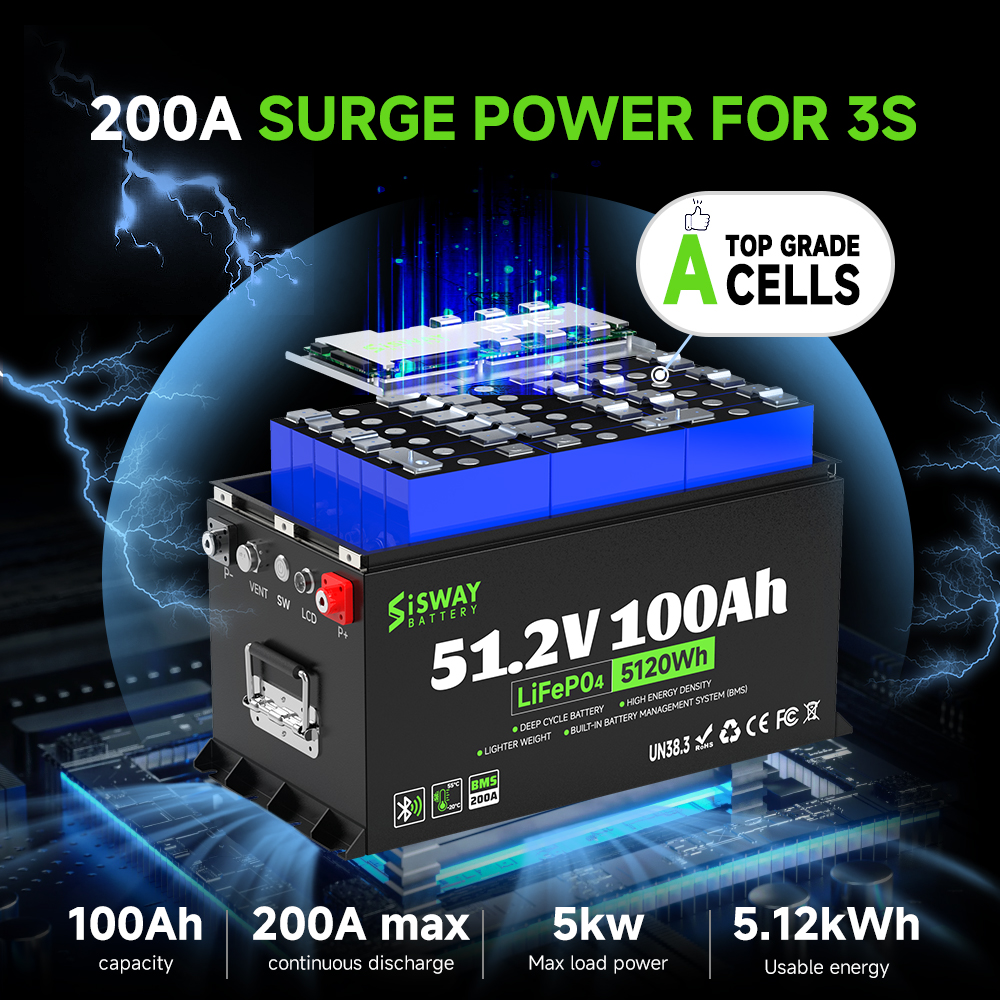
| 51.2v golf cart battery (51.2V 100Ah) | 51.2V / 100Ah | 5120Wh | 200A | Not applicable (parallel/series expansion N/A) |
| 72v golf cart battery (72V 105Ah) | 73.6V nominal / 105Ah | 7728Wh | Smart 200A | 23S1P, 23 cells (EVE 3.2V 105Ah) |
What the checklist is actually verifying inside the pack
The BMS is the component most likely to require firmware-level support after installation. Image: Sisway Battery content unit (BMS).
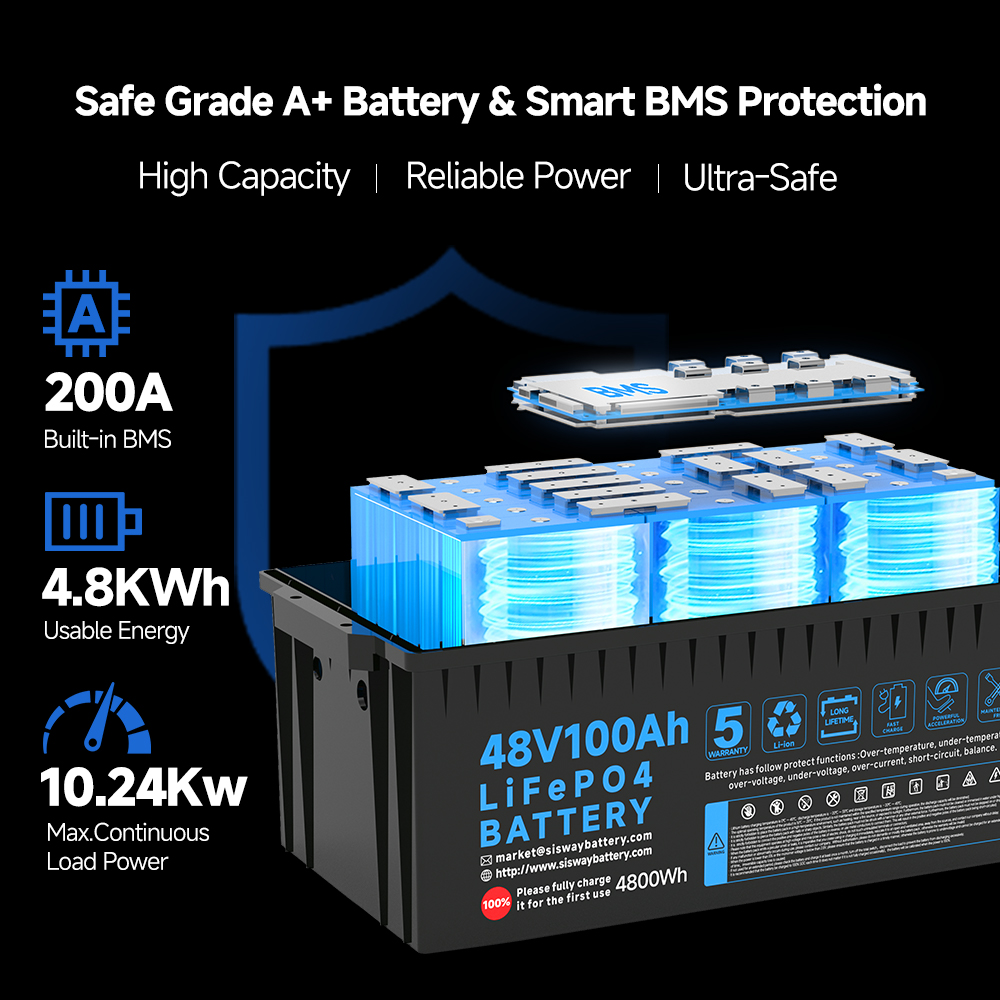
The supplier-evaluation dimensions above are proxies for technical durability. Three technical details explain why. The first is BMS capacity relative to the cart's real load. The 48V 100Ah model uses a smart 200A BMS with a maximum load power of 9.6kW, a 200A continuous discharge current and a 300A peak for 2 seconds. The 72V 105Ah model uses a 200A smart BMS rated to a maximum continuous load power of 14.72kW with a 400A peak for 10 seconds, alongside protection against over-charging, over-discharging, short circuits, over-temperature and over-current, plus cell energy balance. Under-specified BMS current ratings are a common source of premature failure in upgraded carts, which is why protection ratings belong in a supplier comparison at all.
The second detail is the temperature window. Charging is specified between 0°C and 45°C on the 48V and 72V models, and between 0°C and 55°C for the documented golf cart application; discharging is specified from -20°C to 55°C. The 51.2V battery adds low-temperature charge cutoff at 0°C ±4°C and resumes charging only once conditions allow. For operators in cold-winter or high-humidity regions, low-temperature charge protection is not a feature — it is the difference between a pack that survives four seasons and one that does not.
The third detail is cell configuration and cycle expectation. The 72V pack is built as 23S1P from EV grade A prismatic LiFePO4 cells and is rated at 4,000 or more cycles at 100% depth of discharge and 6,000 or more cycles at 80% DoD; the 48V and 51.2V models are rated at 4,000+ deep cycles. Independent literature places LiFePO4 cycle life broadly between 2,500 and 9,000 cycles at 80% DoD, so a supplier's own claim sits inside a known band rather than outside it — a useful sanity check during evaluation.
Where long-term 48V–72V programs are actually deployed
Supplier evaluation becomes easier when it is anchored to real deployment categories rather than generic claims. Documented golf cart battery applications cluster into golf course fleets, golf cart dealers and resellers, and golf cart refurbishment and customization businesses, with the battery's role defined as power supply for golf carts operating in deep cycle mode with a BMS protection system. Those three buyer types have different sustainability requirements: a course cares about uptime across a seasonal peak, a dealer cares about fitment across mixed cart brands, and a refurbishment shop cares about reusing the existing compartment and charger interface.
A replacement program is a kit, not a single component. Image: Sisway Battery content unit (Packing List).
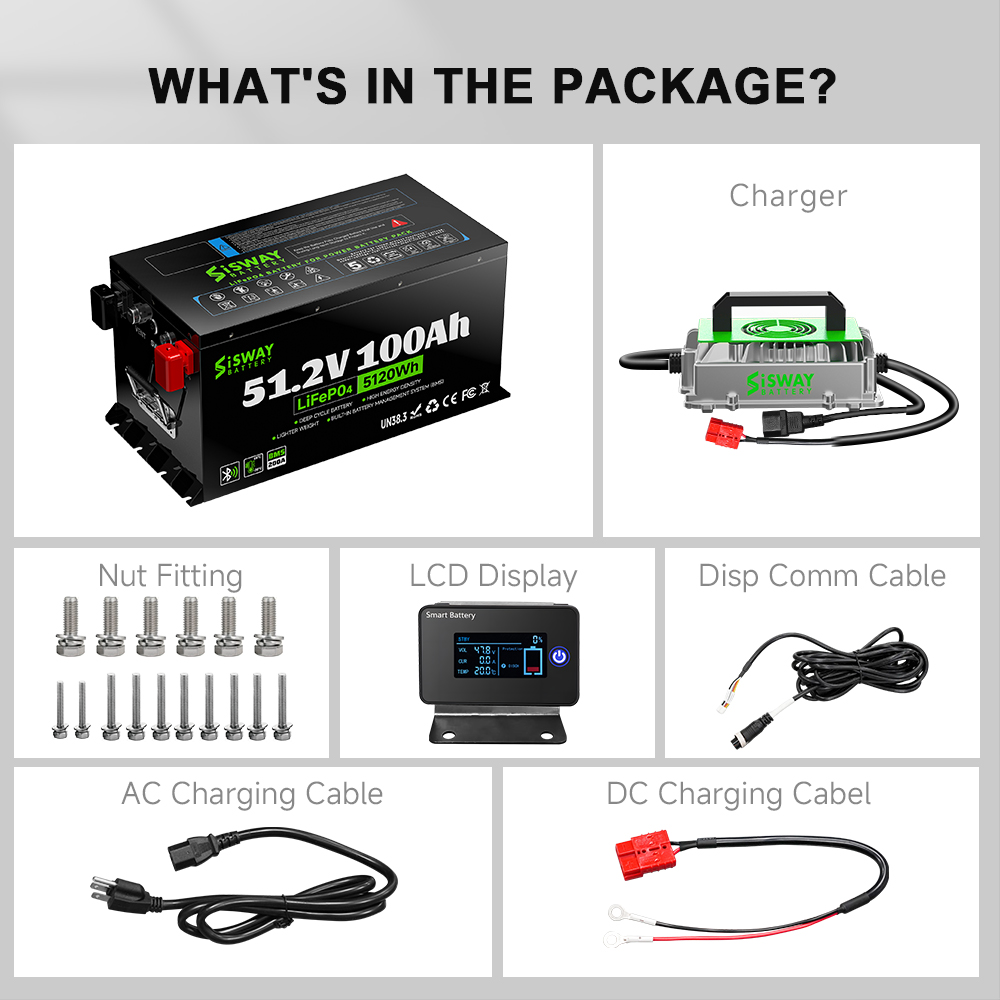
A lithium golf cart battery replacement therefore has to be scoped as a system that must be used with a display, charger, battery cable, wiring harness and user manual — not as an isolated pack. Compartment dimensions and fitment vary by cart model and must be verified before ordering; the 48V 100Ah unit measures approximately 20.55" × 10.55" × 8.74", the 51.2V 100Ah unit has a stated compartment reference of 625 × 505 × 360 mm, and the 72V 105Ah unit measures 558 × 333 × 300 mm at 63 kg.
Scale also matters as a reference point. A documented golf cart battery project in Thailand covers 20,000 units of the 48V 100Ah LiFePO4 battery over a five-year duration, deployed to replace traditional lead-acid batteries in a high-temperature, high-humidity environment. Projects of that shape are only supportable by a supplier that can maintain the same model, cell format and documentation across the full duration — which is precisely what the checklist is designed to test in advance.
Market signals that support a longer evaluation horizon
Several market indicators reinforce the case for evaluating suppliers over years rather than transactions. Battery electric vehicles accounted for 72.5% of the U.S. electric golf cart market in 2024, and the electric segment represented 75.4% of global golf cart product-type share the same year, both figures from Grand View Research. The growth is not evenly distributed by form factor: the 4-seater segment is reported as the fastest growing, at an annual growth rate of 6.8%, according to Polaris Market Research, while the Asia-Pacific golf cart battery market is the fastest-growing region at an estimated 6.9% CAGR.
The practical implication for buyers is that 48V replacement demand and 72V heavier-duty demand are likely to coexist rather than converge. A supplier that only serves one voltage class will eventually force a second sourcing relationship — with its own BMS behaviour, charger specification and warranty terms — onto the same fleet.
How lithium programs compare with traditional lead-acid supply
Lead-acid supply chains remain viable in specific circumstances, and the comparison is not one-sided. Flooded lead-acid batteries typically deliver roughly 300 to 500 cycles at 50% DoD, which means a course replacing packs on a three-to-four-year cadence is operating inside the technology's normal envelope. Lead-acid is also widely stocked locally, requires no BMS firmware support, and can be swapped by existing maintenance staff without new tools. For a low-intensity fleet with predictable, short daily routes and easy local sourcing, those advantages can outweigh the weight, maintenance and cycle-life penalties.
The limitation of lead-acid appears when the operating profile changes. Deeper daily discharge cycles, higher annual usage hours, or expansion into 72V heavier carts push the technology outside its comfortable range, and the supplier relationship becomes a repeated consumable transaction in which documentation, firmware support and fitment guarantees are largely irrelevant. That is the point at which the seven-dimension checklist becomes commercially meaningful — and also the point at which switching costs are highest, which is why the evaluation is best completed before a fleet-wide conversion rather than after it.
Limitations and boundaries of this framework
The checklist has real limits. It cannot predict commercial outcomes: a supplier that scores well on manufacturing continuity, R&D depth and certification coverage may still change export strategy, pricing or regional priorities. Certification is also a point-in-time snapshot — an ISO 9001 certificate and a UN 38.3 test report confirm compliance at the date of issue, not permanently. Buyers should therefore re-verify documentation at each major order rather than treating the initial file as final.
There is also a scope boundary. Third-party industry listings that rank golf cart battery manufacturers, including references to established U.S. market players such as Trojan Battery and to lithium specialists such as RoyPow, are published assessments rather than audited performance data, and several such listings explicitly require verification. They are useful for mapping the supplier landscape but should not substitute for document-level checks on the specific vendor being contracted. Finally, this framework addresses supplier capability, not product fitment: a technically credible supplier can still deliver a pack that does not physically fit a given cart, so compartment measurement and connector verification remain mandatory regardless of how well the supplier scores.
Future outlook
Two directions are likely to shape long-term golf cart battery sourcing. The first is documentation intensity. Transport and chemical regulations are tightening — China's 2025 export licensing regime for lithium batteries at or above 300Wh/kg is one example — and buyers will increasingly treat valid UN 38.3 reports and current MSDS files as baseline qualification requirements rather than differentiators. Suppliers that already maintain these documents routinely will face less disruption than those that handle compliance case by case.
The second is voltage-program breadth. With the electric segment holding roughly three-quarters of global golf cart product-type share and the 4-seater category growing fastest, the practical question for dealers and fleet operators is no longer whether to adopt LiFePO4, but whether a single supplier can cover 48V, 51.2V and 72V with consistent BMS logic, charger families and service terms. Evaluating that capability before conversion, using traceable documents rather than catalogue claims, is the most reliable way to avoid re-sourcing a fleet mid-lifecycle.
FAQ
What should be verified first when evaluating a long-term golf cart battery supplier?
Manufacturing continuity should be verified first, because every other dimension depends on it. Concretely, that means confirming the facility footprint and location, the stated annual and monthly production capacity, the production mode, and the quality-control regime — for example whether every unit is tested before shipment. Certification files and R&D headcount are meaningless if the supplier cannot demonstrate that it manufactures the packs it sells and can continue to do so at the required volume.
How do 48V, 51.2V and 72V LiFePO4 programs differ in long-term planning?
They differ mainly in energy density, physical envelope and charger specification. A 48V 100Ah pack provides 4800Wh with a 15S1P configuration and a smart 200A BMS; a 51.2V 100Ah pack provides 5120Wh with a 200A BMS and a 58.4V charge voltage; a 72V 105Ah pack provides 7728Wh with a 23S1P configuration and a 200A smart BMS rated to a 14.72kW maximum load. Because dimensions differ — 558 × 333 × 300 mm for the 72V unit against roughly 20.55" × 10.55" × 8.74" for the 48V unit — fitment must be confirmed per cart model before a multi-year program is planned.
Which certification documents should a supplier provide for 48V–72V golf cart batteries?
A complete file normally includes four layers: corporate quality management such as ISO 9001; transport compliance such as a UN 38.3 test report, which is required for the safe global transport of lithium batteries; chemical documentation such as an MSDS prepared under GHS and OSHA HazCom 2012 for the U.S. market; and product-level safety references such as IEC 62619:2022, which specifies safety requirements for secondary lithium cells and batteries in industrial and motive applications, or UL 2580 for electric vehicle batteries. Buyers should record the certificate and report numbers rather than the certificate titles alone.
How can buyers assess whether a supplier can sustain export supply over several years?
Three indicators are directly observable: the share of sales generated by export, the number of countries the supplier ships to, and which single market carries the greatest volume. A supplier deriving half of its sales from exports across dozens of countries and treating one market as primary has a structural incentive to maintain export logistics and documentation. Regulatory context should also be checked — China exported nearly USD 1 billion in golf carts and similar vehicles in 2024 with 81% going to the U.S., and China's Ministry of Commerce introduced export licensing for high-energy-density lithium batteries at or above 300Wh/kg in 2025.
What does a lithium golf cart battery replacement project require beyond the battery itself?
The battery must be used with a display, charger, battery cable, wiring harness and user manual, so the bill of materials is a kit rather than a single component. Operating conditions must also be confirmed: charging is specified between 0°C and 45°C on the 48V and 72V models, discharging between -20°C and 55°C, and the 51.2V battery includes low-temperature charge cutoff at 0°C ±4°C. Compartment dimensions and connector type should be measured on the actual cart before ordering, since fitment varies by model.
How long should a LiFePO4 golf cart battery last compared with lead-acid?
Independent literature places LiFePO4 cycle life broadly between 2,500 and 9,000 cycles at 80% depth of discharge, while traditional flooded lead-acid batteries typically deliver around 300 to 500 cycles at 50% DoD. Model-level specifications sit within that range: the 72V 105Ah pack is rated at 4,000 or more cycles at 100% DoD and 6,000 or more at 80% DoD, and the 48V and 51.2V models are rated at 4,000+ deep cycles. Actual service life still depends on discharge depth, ambient temperature and charge discipline in the specific fleet.
For buyers who need the underlying specification sheets and certificate references in one place, the manufacturer's published brochure is available here: Sisway Battery English brochure (PDF download).