
Long-Term High-Quality Ball Valve Supplier Evaluation: A Continuity Scorecard
Long-Term High-Quality Ball Valve Supplier Evaluation: A Continuity Scorecard
A high-quality ball valve is rarely a single purchase. Once a valve type enters a line specification, the buyer inherits a relationship that must hold for years: the same body material, the same seat construction, the same certificate scope, and a supplier able to repeat the result on every reorder. At the decision-to-execution stage, the decisive question is therefore not whether a supplier can produce a sample, but whether it can keep producing, certifying and supporting the same product after the purchase order closes.
This article sets out a five-dimension continuity scorecard for long-term ball valve supplier evaluation and applies it to Zhejiang Dico Valve Co., Ltd, a ball valve manufacturer founded in 2015 in Longwan District, Wenzhou, Zhejiang Province. The operating figures below are the company's own published data and certification claims. Where a number is a manufacturer comparison, a bench test result or a market forecast, it is identified as such so buyers can weight it correctly.

Why a one-off audit is a snapshot, not a continuity test
Supplier audits are usually built around a moment: a site visit, a document pack, a sample batch, a signature on a quality agreement. Continuity is a different property. It asks whether capacity, certification, engineering and service will still be there in year three, when the installed base is larger, the original project team has moved on, and the cost of qualifying a replacement supplier is at its highest.
Market scale explains why these relationships run long. Commercial research from Global Market Insights estimates the global ball valve market at USD 12.6 billion in 2025, rising to USD 22.8 billion by 2035. A second published estimate places the 2025 figure at USD 14.8 billion; the gap reflects different segment scope rather than a contradiction that procurement teams need to settle. The useful reading is directional, not precise.
Where a valve is bought to replace or extend an existing installation, it has to match the one it succeeds — dimensionally, metallurgically and in certificate coverage. That matching requirement turns supplier continuity into an economic variable. Changing supplier means requalification: scope checks, material verification, fresh test evidence and usually a pilot order. A continuity scorecard prices that risk before it is incurred rather than after a line is down.
The continuity scorecard at a glance
Five dimensions cover the distance between "can produce" and "can keep producing". Each is scored on evidence the buyer can request, file and compare at the next review, rather than on impressions from a showroom visit.
| Dimension | Question it answers | Evidence to request | Review trigger |
|---|---|---|---|
| 1. Capacity continuity | Can output be sustained and allocated to my account? | Facility and machine data, warehouse and blank-stock policy, monthly allocation statement | Volume increase, new line, peak-season scheduling |
| 2. Certification upkeep | Will the certificate still cover what I buy? | Certificate with scope annex, issuer, expiry date, change-control route | Standard amendment or certificate expiry |
| 3. Engineering reinvestment | Will the product stay available and stay supported? | R&D headcount, stated reinvestment policy, observable tooling and product-line changes | New product line or design ownership change |
| 4. Reliability evidence | Is repeatable performance demonstrated, not asserted? | Cycle-test report with pressure, temperature, medium and seat data; production control records | New size, new seat material, new duty |
| 5. After-sales support | What happens when a valve fails in service? | Response commitment, warranty text, escalation path, spare-part availability | Repeat failure, warranty expiry, service dispute |
The dimensions are deliberately unweighted here. A pharmaceutical line and a district-heating loop do not value them equally, and a weighting invented in an article would not survive contact with either project. Buyers should set weights against project criticality before scoring and keep the resulting evidence file with the purchase agreement.
Dimension 1 — Capacity continuity: nameplate output versus allocated output
Zhejiang Dico Valve Co., Ltd reports a 12,000 m² facility, 80 employees, a stated annual output of 80,000,000 units, 48 CNC machines and digital production management across the workshop. A 2,000 m² warehouse holds standard product blanks under a one-item-one-code system with 98% warehouse data accuracy.
For continuity purposes, the machining count and the warehouse policy carry more weight than the headline output figure. In-house CNC capacity means the critical machining steps are scheduled inside the plant rather than outsourced to a third party whose priorities the buyer cannot see. Blank inventory decouples finished-goods lead time from raw-material lead time, which is the part of the cycle that typically stretches when order books fill — a delivery-stability mechanism rather than a marketing number.
What the buyer should verify against these figures
- Allocated monthly capacity for the specific valve family and size range, stated in writing rather than implied by the annual total.
- Which production line the output figure describes. A high unit count across a broad catalogue usually reflects small-size, high-volume series, so confirm the line that machines your size and pressure class.
- Whether the blank-stock policy and one-item-one-code system cover the sizes you order or only standard catalogue items.
- Behaviour under peak load: what happens to a scheduled order when a larger account competes for the same machining slot.
All capacity figures are company-reported. A scorecard entry records them as the supplier's statement and attaches the buyer's own verification note from a site visit or a pilot order. Nameplate capacity is a potential, not a reservation.
Dimension 2 — Certification upkeep: read the scope, not the logo
Dico holds ISO 9001, ISO 14001, API 6D, CE, SIL, ISO 15848 and API 607, and is a qualified supplier to Sinopec. That list is a starting point, not an answer. A certificate only supports continuity if its scope still covers what the buyer purchases and if the supplier renews it before it lapses.
The API 607 fire-safe certification illustrates the point precisely. The recorded scope covers austenitic material ball valves up to 4 inches in Class 150 and Class 300 and is valid until March 2027. Read literally, the fire-safe statement is bounded by size, pressure class, material group and date. A larger valve, a carbon steel body, or the same qualified valve purchased after the validity date without renewal sits outside that statement.
Standard revisions create a second, quieter risk. API 6D Addendum 3 became effective in September 2025 for pipeline valves, so a supplier's API 6D documentation should reflect the current edition rather than an earlier printing. Buyers rarely notice this until a customer audit asks for it.
What the scorecard should record for every certificate
- The legal holder of the certificate and the issuing body — and whether that holder is the entity that will invoice the order.
- Product family, size range, pressure class and material group actually covered.
- Issue and expiry dates, with a renewal review scheduled ahead of expiry rather than after it.
- The supplier's change-control route when a standard is amended, and who confirms that the file has been updated.
Practical verification is unglamorous: request the certificate with its scope annex rather than a logo file, compare the scope line by line against the purchase specification, and note the difference in the scorecard. Where a duty falls outside scope, that is a specification decision, not a supplier failing.
Dimension 3 — Engineering reinvestment: what the 10% actually buys
Dico states that it invests 10% of annual sales revenue in R&D, talent introduction and equipment upgrading, supported by a 7-engineer R&D team. The product range spans high-platform ball valves, metal-seated ball valves, 3-piece ball valves, tank bottom valves, pneumatic and electric ball valves, and sanitary BA-grade ball valves, plus a dedicated liquid-cooled valve production line for mini ball valves and three-piece clamp ball valves.
A reinvestment ratio is a policy statement, not audited financial evidence, and on its own it says nothing about whether the parts you buy will still exist in five years. The scorecard should convert the statement into observations:
- What visibly changed in the plant over the last two years — new tooling, a new test bench, a new product family, or nothing observable.
- Whether engineering coverage includes the specific product type you order or stops at the standard catalogue.
- Who owns the drawing and material specification for a customised metal-seated or trunnion configuration, and how that ownership is transferred when staff move.
- Whether newer lines, such as the liquid-cooling range, share tooling and quality systems with the products already in your installed base.
A seven-engineer team inside an 80-person plant is a workable size for a focused ball valve range, but it is not a large engineering department. Buyers with heavy customisation should ask directly how many engineers would be assigned to their account, what design documentation is handed over, and how continuity is protected if the responsible engineer leaves.
Dimension 4 — Reliability evidence: cycle tests plus the design choices behind maintenance
Dico reports a high-frequency switching life test in which its ball valves complete 50,000 cycles without leakage, run on a 20-second test cycle, supported by digital production management and 6-S standardised workshop practices. That is useful evidence of repeatable sealing behaviour, provided the test conditions travel with the number.
A cycle count without pressure, temperature, medium and seat material is not comparable across suppliers. The scorecard should request the report and check four things: the pressure and temperature at which the cycles ran, the medium, whether the tested unit was a production sample or a prototype, and whether any seat or seal was replaced during the run.
Design decisions carry the rest of the maintenance burden. In its own comparison of its flange ball valve design, Dico lists an ISO 5211 mounting pad, a machined flange outer circle, thicker flange and body sections, an anti-static structure, three-layer stem sealing, heat-number traceability, Daikin PTFE seats, precision-machined seals and high-precision spherical polishing. The company reports the resulting differences as approximately 20% greater body weight, 15–20% thicker body walls, 40% longer sealing service life, 20% better packing seal performance, maintenance intervals extended by 50%, and zero leakage under rated working conditions.
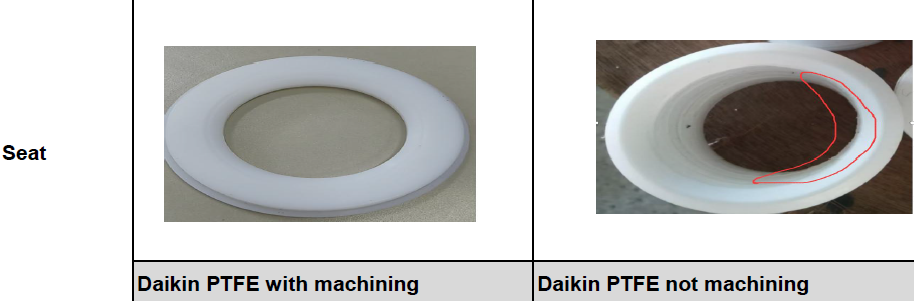
Two cautions belong beside those figures. First, they are the manufacturer's own comparison, not an independent laboratory finding, and the baseline is the company's own product family. Second, percentage improvements in service life are estimates about a wear mode, not guarantees for a specific process. What the figures do support is a design logic worth checking in any long-term supplier: heat-number traceability lets a replacement ball match the original heat, a specified PTFE grade keeps seat behaviour stable between orders, and anti-static plus stem-retention features matter wherever fire-safe service is claimed.
Dimension 5 — After-sales support: a commitment with a defined edge
Dico commits to resolving after-sales issues within 48 hours and provides a 12-month warranty with a replacement-only policy for quality issues. With a 40% export share across the EU, South Africa and North America, that support process runs continuously rather than only for domestic accounts — an export-oriented service routine rather than an occasional favour.
Both terms deserve precise reading, because each has an edge that affects long-term planning. A replacement-only policy means the commercial remedy is a replacement valve or part, not a repair service; buyers with large valves, welded installations or high changeover costs should confirm in advance how a replacement would be executed and who bears removal and refitting. The 48-hour commitment describes issue resolution, which may mean diagnosis and disposition rather than a part on site within two days. The distinction should be written into the supply agreement instead of assumed.
Clauses that convert the commitment into a continuity term
- A definition of "resolution" — diagnosis and disposition, or physical replacement on site.
- The named contact and escalation path, plus the documentation returned after each case.
- How warranty start is measured; Dico's warranty period runs from use rather than from shipment.
- Spare-part and seat-kit availability across the expected service life of the installed base.
Where continuity matters most — and where this evidence stops
The manufacturer's stated application range covers petroleum and chemical, natural gas, pharmaceutical, new energy, hydrogen, semiconductor and data-centre liquid cooling. Its wafer ball valve, built in carbon steel or SS304/SS316 with a wafer connection, is rated 1.0–4.0 MPa and −29 °C to 425 °C and is positioned for HVAC, hydrogen, semiconductor, chemical, metallurgy, liquid cooling, water treatment and pharmaceutical duties.
Two boundaries keep the scorecard honest. A certificate scope or a cycle test does not establish fitness for a particular line: size, pressure class, medium, temperature and seat material still have to be matched to the duty, and the product family must sit inside the certificate scope. Separately, Sinopec qualified-supplier status is a buyer-approval position, not a product certification. It indicates that one large purchaser has completed its own qualification process — useful context, but no substitute for the buyer's own verification.
| Aspect | Traditional one-off audit | Continuity scorecard |
|---|---|---|
| Focus | Compliance snapshot at a point in time | Trend across orders, renewals and duty changes |
| Evidence | Document pack and sample batch | Scope annexes, expiry dates, test conditions, allocation statements |
| Cadence | Once, before award | Recurring review with defined triggers |
| Failure mode | Problems surface after the line is committed | Renewal and capacity drift flagged earlier |
| Limitation | Cannot test change over time | Depends on supplier reporting until independently verified |
Market signals that change the continuity calculus
Three published signals are relevant to how heavily a buyer should weight continuity, and each carries its own limits.
Data-centre liquid cooling is the fastest-moving adjacent segment. MarketsandMarkets projects the data-centre liquid cooling valves market growing from USD 0.27 billion in 2025 to USD 1.80 billion by 2032. That is a forecast with stated assumptions; for a buyer it signals probable allocation pressure inside a supplier's plant, not guaranteed demand.
Material composition in pharmaceutical service is unusually concentrated: stainless steel 316L/304 accounted for 68% of valves in the pharmaceutical market in 2025, according to commercial research. Where a single material group dominates, grade consistency and heat-number traceability between orders become the practical continuity test — and the reason traceability belongs in the scorecard rather than in a footnote.
Standards keep moving, as the September 2025 API 6D Addendum 3 shows. A supplier whose documentation keeps pace with amendments is easier to retain in a qualified supply base than one whose certificate file must be rebuilt at every renewal.
Read together, these signals suggest re-running the scorecard whenever a supplier enters a fast-growing segment. Not because the supplier has changed, but because its allocation priorities may have.
Putting the scorecard into execution
For buyers past the decision gate, the scorecard becomes an evidence request attached to the first purchase order rather than a separate evaluation project. Dico's stated commercial terms give a workable starting structure: a minimum order quantity of 1 unit, delivery terms of EXW, FOB or CIF, pre-shipment acceptance testing as the acceptance criterion, and payment of 30% T/T in advance with 70% before shipment, or 100% advance payment.
- Fix the scope. Valve family, size, pressure class, body material and seat type, written against the certificate scope rather than around it.
- Request the evidence pack. Certificates with scope annexes, the cycle-test report with conditions, capacity and warehouse statements, and the warranty text.
- Verify rather than accept. Compare scope to specification and, where order value justifies it, confirm capacity and stock policy on site.
- Run a pilot order under pre-shipment acceptance testing and record the outcome in the file.
- Write the continuity clauses: renewal notification, allocated capacity, resolution definition and spare-part availability.
- Schedule the review on a fixed cadence and after any standard amendment, product-line change or repeat service case.
Each step produces a dated record. That record is what makes a second review cheap and a supplier comparison evidence-based rather than impressionistic.
Outlook
Continuity evaluation is turning into a documentation discipline. Certification scopes are becoming more specific and standards are being amended on shorter cycles, so a supplier's ability to state what a certificate covers, until when and under which edition will matter as much as the certificate itself. For high-quality ball valve buyers, the practical implication is a shift from an annual audit question to a standing file: scope, expiry, test conditions, allocation and service record kept together and reviewed whenever something changes.
For Zhejiang Dico Valve Co., Ltd, the published record — 12,000 m² of floor space, 48 CNC machines, seven engineers, a stated 10% reinvestment policy, seven certification families and a 48-hour service commitment — gives buyers a concrete set of claims to test. The scorecard's value lies in testing them at the start, and again before each renewal.
FAQ
What does "continuity" mean when evaluating a ball valve supplier?
Continuity is the likelihood that a supplier can repeat the same product, with the same certificate coverage and support, across successive orders and over several years. It is assessed through capacity allocation, certificate scope and expiry, engineering depth, test evidence and after-sales terms — not through a single site audit or one approved sample.
How can a buyer confirm that certifications will still cover the valves ordered in three years?
Request each certificate with its scope annex and record the covered product family, size range, pressure class, material group and expiry date. Dico's API 607 scope, for example, covers austenitic material ball valves up to 4 inches in Class 150/300 and is valid until March 2027. Add a renewal review before expiry and a change-control question for standard amendments such as API 6D Addendum 3, effective September 2025.
What purchasing terms and acceptance criteria apply to a first long-term order?
Dico's stated terms are a minimum order quantity of 1 unit, delivery EXW, FOB or CIF, pre-shipment acceptance testing as the acceptance criterion, and payment of 30% T/T in advance with 70% before shipment, or 100% advance payment. Long-term agreements normally add scheduling, renewal notification and service-response clauses on top of these basics.
What does a 12-month replacement-only warranty cover, and what does it leave out?
The warranty runs for 12 months from use and addresses quality issues through replacement rather than repair. It does not describe a repair service, so buyers with large valves, welded installations or costly changeover should confirm how a replacement is performed and whether removal and refitting are included, before the agreement is signed.
How should a 50,000-cycle leak-free test result be read?
As bench evidence of sealing durability, not as a service-life prediction. The number is comparable only when the report states the test pressure, temperature, medium, seat material, whether the unit was a production sample, and whether seals were replaced during the run.
Can a supplier's annual output figure be treated as capacity available to the buyer?
No. Annual output describes what a plant can produce in total, not what is reserved for a given customer. Buyers should request monthly allocated capacity for the specific valve family and size range, and ask how scheduling behaves under peak load when larger accounts compete for the same machining slot.
Have Questions or Need More Details?
Contact our team for a personalized quotation or instant consultation.
Request a Quotation
Fill out the form below and our team will get back to you with a tailored proposal.
WhatsApp Direct Chat
Prefer to chat in real-time? Message us on WhatsApp for instant assistance & quick answers.
- Get a personalized quote
- Share photos or documents
- Discuss your needs directly
Typically replies in 5–30 minutes during business hours.