
Long-Term Home Organization Supplier Evaluation: A Scorecard
Long-Term Home Organization Supplier Evaluation: A Scorecard
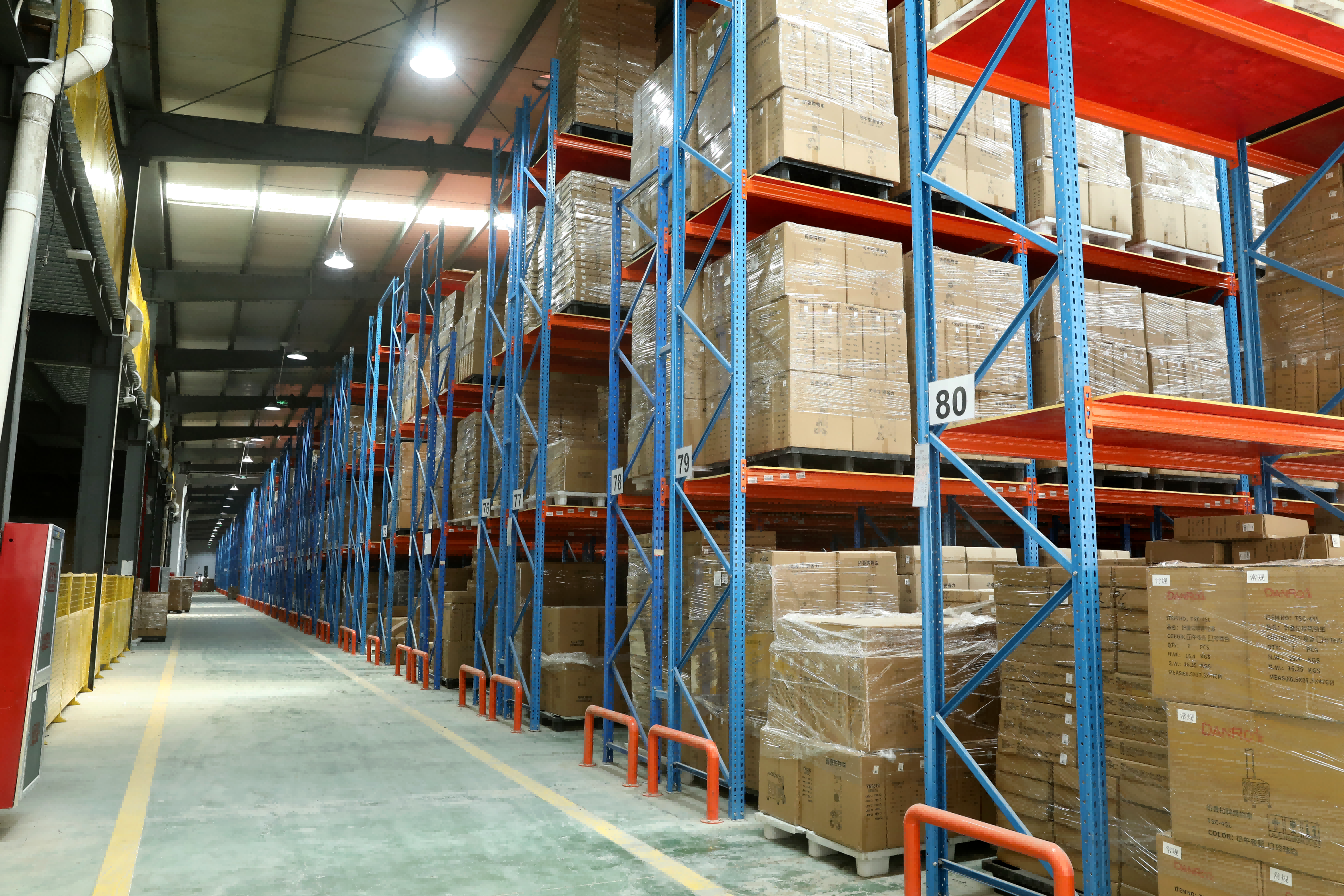
Inventory and warehouse management is one of the practical signals buyers can inspect when assessing whether a home organization supplier can sustain repeat orders.
A home organization program is rarely lost on the first order. It is usually lost on the fourth — when a color is discontinued, a mould is retired, or a panel specification quietly changes between shipments. Capability is easy to demonstrate with one sample; continuity is much harder to prove, and it is the variable that decides whether a retail or distribution program still works two years after launch.
The global home organization products market was estimated at USD 14.06 billion in 2024 and is projected to reach USD 21.65 billion by 2035, according to Market Research Future. Growth at that scale rewards buyers who consolidate categories behind fewer suppliers, because consolidation reduces sourcing overhead and gives better control over planograms. Consolidation only works, however, when the supplier can keep the same models orderable across seasons. This article sets out a six-dimension continuity scorecard for that evaluation, built from product-line depth, material declarations, dated compliance records and repeat-order terms — evidence a buyer can verify rather than claims a buyer has to trust.
Why Supplier Continuity Is the Real Sourcing Risk
Capability questions — can this factory produce a foldable cabinet — are answered by a sample. Continuity questions are answered by the shape of the product line. A supplier that has built its catalogue as ladders, rather than one-off items, can extend an assortment without new tooling and can re-quote a repeat order against a model that already exists. A supplier that sells single configurations forces the buyer back into sampling every time the assortment changes.
Taizhou Xinhai Cross-border E-commerce Service Co., Ltd., which operates under the brand name xinhaibox, is a B2B supplier of plastic household storage and daily-use products based in Taizhou, Zhejiang, China. It serves wholesalers, distributors, retailers, supermarkets and e-commerce sellers in North America, the EU, Southeast Asia and Latin America, and states that it is supported by more than 20 years of manufacturing experience from Zhejiang Jinmao Plastic Group. The company reports 500 employees, a 30-person engineering and design team, an annual output of 1,000,000 units, and an export share of 70%. Those numbers describe scale; the scorecard below is about whether that scale is expressed as a line a buyer can keep ordering.
The Continuity Scorecard: Six Dimensions
The scorecard weights documentary evidence more heavily than presentation. Each dimension can be checked against published material, product documentation or a supplier questionnaire before a pilot order is placed.
| Dimension | What the buyer verifies | Weight |
|---|---|---|
| 1. Model continuity and SKU laddering | Whether the same model is orderable in more than one size, layer count or capacity | 25% |
| 2. Material declaration consistency | Whether the range is built on a small, stable set of declared polymers with per-model disclosure | 15% |
| 3. Feature architecture consistency | Whether folding, stacking, wheel and handle logic repeats across product families | 15% |
| 4. Compliance continuity | Whether named, numbered certificates carry issue and expiry dates and cover the product scope | 20% |
| 5. Capacity and repeat-order terms | Whether MOQ, lead time and monthly capacity are published per production mode | 15% |
| 6. Documentation and delivery evidence | Whether sampling plans, inspection steps, packing and loading are standardised | 10% |
Dimension 1 — Model Continuity: Reading the SKU Ladder
A supplier that intends to support long-term programs usually publishes families, not items. Three examples from the xinhaibox storage range show what that looks like in practice.
The Foldable Storage Cabinet YN8871 is offered in three sizes: 51.5 × 36 × 95 cm, 60 × 42 × 105.5 cm and 67 × 47 × 116 cm, corresponding to width options of 51.5 cm, 60 cm and 67 cm. It is a PP cabinet with a foldable structure, magnetic opening and closing, rounded handles, a top storage surface, a stackable structure and a double-door design with vintage-style textured doors. A buyer can therefore scale a bedroom or living-room assortment across three footprints without changing supplier or design language.
The Foldable Shoe Cabinet 7008 holds a single 37 × 26 cm footprint and grows vertically: 20.6 cm at one layer, 44.7 cm at two, 65.3 cm at three, 85.9 cm at four, 106.5 cm at five and 127.1 cm at six. The unit requires no assembly, is foldable, stackable and dustproof, uses PP, and is described as formaldehyde-free and odorless, with universal wheels. One mould, six retail configurations, and a predictable replacement part list.
The Foldable Storage Drawer YN484536 combines nine height × width × depth combinations with ten declared capacities of 49L, 50L, 56L, 57L, 62L, 64L, 69L, 72L, 77L and 86L, in high-strength PP with a transparent front panel, tool-free assembly and stable stacking. The line also includes the Foldable Car Storage Box YN8980 at 57L with a 7 cm folded thickness, and the Foldable Camping Storage Box YN8880 in three sizes from 39.6 × 26.3 × 21 cm to 54 × 36 × 29 cm.
For continuity scoring, the useful measure is not the number of SKUs but the number of configurations per tooling family. Broader line coverage also reduces how many suppliers a buyer must qualify: the same catalogue branch extends into stackable bins and organizers, laundry baskets such as the JH2018 hamper, toy storage such as the ZK-601 bin and HYN8021 basket, under-bed boxes such as HT8861, and folding carts, alongside adjacent categories such as rotating cosmetic organizers and sorting trash cans.
Dimension 2 — Material Consistency: PP and PET as a Common Baseline
Material consistency is what allows one incoming inspection protocol to serve an entire range. If a supplier declares a narrow set of polymers and applies them consistently, a buyer can write a single specification annex instead of one per item.
| Product line | Model | Declared material |
|---|---|---|
| Foldable Storage Cabinet | YN8871 | PP |
| Collapsible Home Storage Cabinet | YN8887 | PP with transparent PET panel |
| Foldable Storage Drawer | YN484536 | High-strength PP |
| Foldable Shoe Cabinet | 7008 | PP |
| Foldable Car Storage Box | YN8980 | PP |
| Foldable Camping Storage Box | YN8880 | PP with wooden top |
| Toy Storage Bin | ZK-601 | High-strength PET barrel with PP lid |
| Toy Storage Basket | HYN8021 | PP |
| Laundry Hamper | JH2018 | PP |
| Under-bed Storage Box | HT8861 | PP |
| Foldable Shopping Cart | YN8821 | Premium PP, metal and rubber |
Two polymers — polypropylene for structural bodies and polyethylene terephthalate for transparent panels and barrels — carry most of the range, with wood and metal reserved for specific carts and tops. That pattern matters for compliance planning as well. The European Commission adopted a ban on Bisphenol A in food contact materials under Regulation (EU) 2024/3190, effective with an 18-month phase-out period from late 2024. Buyers placing pantry or kitchen storage into the EU therefore benefit from suppliers who can state material composition per model and confirm it in writing rather than describing a range in general terms.
Dimension 3 — Feature Continuity Across the Range
Feature continuity is the third scored dimension because it determines how much consumer-facing material a buyer has to rewrite. When folding and stacking logic repeats, product pages, instruction sheets and returns handling stay stable across a catalogue expansion.
- Fold-and-stack spine. YN8871 is foldable and stackable; 7008 requires no assembly and is foldable and stackable; YN484536 offers stable stacking with no tipping risk; YN8880 uses a foldable, stackable structure; YN8980 folds to 7 cm thickness; the JH2018 hamper is quick-foldable for space saving.
- Mobility. 7008 uses universal wheels; JH2018 and HYN8021 use 360° swivel wheels; YN8887 ships with pre-installed wheels; YN8821 uses 360° silent swivel wheels with a brake.
- Access and handling. YN8871 uses magnetic opening and rounded handles; YN484536 uses a smooth pull-out drawer with a transparent front panel; ZK-601 uses an elastic self-closing lid with a side zipper opening; YN8887 uses a five-door lockable multi-access structure.
- Load and structure. YN8887 relies on an enhanced rhombic and wave-wall structure; HT8861 uses a tri-fold lid with 20 cm extended sealing latches; YN8821 carries a stated 100 kg load capacity with a folding thickness of 10.9 cm and a two-level pull rod adjustable between 79.5 cm and 89.5 cm.
Scored together, these details indicate whether a supplier designs as a system or assembles a catalogue. They are also testable: a buyer can ask for the same feature description across two orders and compare.
Dimension 4 — Compliance Continuity You Can Date
Compliance is the dimension most often checked once and never revisited. Certificates have validity windows, and those windows create a natural audit calendar for a long-term agreement.
| Certificate | Number | Authority | Standard | Valid until |
|---|---|---|---|---|
| Quality Management System Certification | 28725Q1039R0M | Zhongzheng Excellent Certification Group Co., Ltd. | GB/T 19001-2016 / ISO 9001:2015 | 2028-10-19 |
| Occupational Health & Safety Management System Certification | 77725S00040R053 | Zhongzheng Excellence Certification Group Co., Ltd. | GB/T 45001-2020 / ISO 45001:2018 | 2028-12-22 |
| Environmental Management System Certification | 77725E00040R053 | Zhongzheng Excellence Certification Group Co., Ltd. | GB/T 24001-2016 / ISO 14001:2015 | 2028-12-22 |
| Certificate of Technical Inspection | M.2022.206.C75474 | UDEM International Certification Auditing Training Centre Industry and Trade Inc. Co. | EN 14073-2:2004 | 2027-07-11 |
The declared scope of the ISO 9001 certificate covers research and development, production and sales of daily storage plastic products — boxes, cases, cabinets and baskets — excluding items subject to licensing requirements. The environmental and occupational health and safety certificates describe the same product scope, and the technical inspection certificate references EN 14073-2:2004, a furniture storage standard. For a buyer, the practical point is that the certifications apply to the category being purchased, not to an unrelated division, and that their expiry dates can be tracked alongside the supply agreement.
Dimension 5 — Capacity and Repeat-Order Terms
Continuity is ultimately a commercial question. A supplier can hold a model in its catalogue but still be unable to schedule it. Published order terms are therefore scored directly.
| Item | OEM path | ODM path |
|---|---|---|
| Minimum order quantity | 500 units | 5,000 units |
| Lead time | 15–45 days | 30–60 days |
| Monthly capacity | 100,000 units | 8,000 units |
| Customisation | Color, logo, printing | Logo, color, packaging, size, structural design, material (for example PET/PP ratio) |
| Quality control | AQL 2.5/4.0 standardized sampling | AQL 2.5/4.0 standardized sampling |
| Export markets | North America, EU, Southeast Asia, Latin America | North America, EU, Southeast Asia, Latin America |
Read as continuity evidence, the two paths serve different replenishment models. The OEM path suits buyers who need frequent, smaller replenishment cycles against an existing design. The ODM path suits buyers who need structural change — different panel ratios, sizes or packaging — and can plan in longer blocks. After-sales terms on both paths are remote technical guidance plus compensation or replacement for quality issues, which is the kind of clause a continuity scorecard should capture in writing rather than assume.
Dimension 6 — Documentation, Sampling and Delivery Evidence
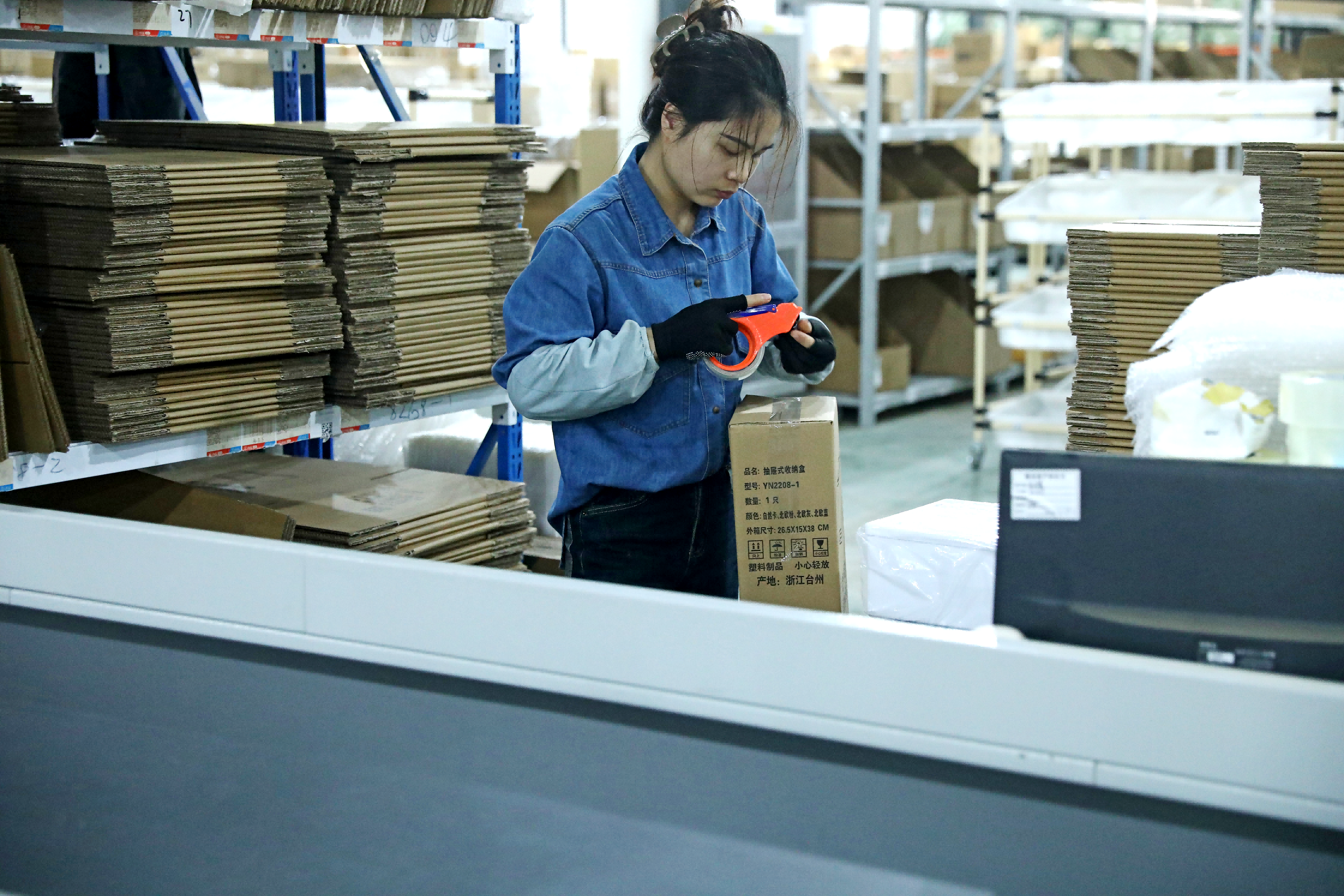
Standardised inspection and packing steps are repeatable evidence: the same check applied to order one and order four.
The final dimension looks for processes that repeat without being reinvented. AQL 2.5/4.0 standardized sampling is applied on both production paths, and the documented workflow runs through injection moulding, conveyor sorting, manual inspection and precision packaging, warehouse and inventory management, and container loading for export. Buyers can request evidence from each stage rather than a summary statement.
Two completed programs illustrate what that evidence looks like when it is recorded. A custom printed-lid foldable camping storage box, model YN8880, was produced at 5,000 units for buyers in the United States and the United Kingdom for camping gear storage, car trunk organization, picnic use and home storage, with a stated service life of 3–5 years under normal use; the printed lid is removable for branding flexibility. Separately, 5,000 units of the foldable shopping cart YN8821 shipped to the same markets. That cart uses premium PP, metal and rubber construction with a stated 3–5 year lifespan, folds to 10.9 cm, has a two-level pull rod adjustable from 79.5 cm to 89.5 cm, and runs on 360° silent swivel wheels with a brake. Reported outcomes were stable operation, smooth movement, easy storage, and waterproof, easy-to-clean performance.
These are supplier-reported project records rather than independently audited results, and a buyer should treat them as reference points to be confirmed by sampling and pilot orders.
Applying the Scorecard: Room-by-Room Use Cases
Scenario coverage is itself a continuity metric, because every additional scenario served by one supplier removes a qualification cycle elsewhere.
| Scenario | Representative models | Continuity relevance |
|---|---|---|
| Kitchen pantry sorting | YN484536 drawer range, stackable bins | Ten capacities from 49L to 86L allow assortment changes without new tooling |
| Closet and bedroom storage | YN8871, YN484536, HT8861, YN8887 | Three cabinet widths plus nine drawer combinations and 16+ under-bed height choices |
| Kids toy organization | ZK-601, HYN8021 | PET barrel and PP basket variants share the same material and inspection logic |
| Laundry room utility | JH2018 | Quick-fold, 360° wheel design consistent with the mobility feature set |
| Car trunk and outdoor camping | YN8980, YN8880, YN8821 | Foldable, stackable, load-rated products built on the same PP baseline |
| Small-format organizing | Rotating organizers and sorting bins | Extends the catalogue into adjacent categories under existing compliance scope |
The value of mapping scenarios to models is that it reveals gaps early. A buyer planning a full-room reset can see which categories the line already covers and which will require an additional supplier before the assortment plan is finalized.
Market Signals Behind Continuity-Based Sourcing
Several published data points support treating continuity as a first-order selection criterion rather than a secondary one.
- The global home organization products market was estimated at USD 14.06 billion in 2024 and is projected to reach USD 21.65 billion by 2035 (Market Research Future).
- Plastic-made products accounted for approximately 36% of the kitchen storage and pantry organization market in 2023, while jars and containers held a 27% share (Grand View Research).
- The stackable container market was projected at USD 7.8 billion in 2024, growing at a CAGR of 6.4%, driven by e-commerce and urbanization (Strategic Market Research).
- China's furniture industry exports, which include home organization items, recorded USD 67.81 billion in 2025, reflecting continued supply capacity despite global trade fluctuations (China Customs, cited by Soonfor).
- Recognized global competitors in the category include IKEA (Sweden), Rubbermaid (USA), Sterilite (USA) and The Container Store (USA) (Market Research Future).
Taken together, these signals describe a category that is growing, materially concentrated around plastics, and populated by large, long-established brands. Suppliers competing in that environment are judged less on whether they can produce one attractive bin and more on whether they can keep producing it while a buyer's assortment expands.
Continuity Scorecard vs. Traditional Sample-Based Selection
Traditional supplier selection in this category follows a familiar pattern: request samples, compare unit price, place a trial order, then renegotiate. It works well for one-time purchases and poorly for programs, because it evaluates an object rather than a system.
| Evaluation focus | Sample-based selection | Continuity scorecard |
|---|---|---|
| Primary question | Is this unit good enough and cheap enough? | Will this model still be orderable in 24 months? |
| Evidence used | Sample, quotation | Model ladders, material declarations, dated certificates, order terms |
| Assortment expansion | New sampling round per item | Re-quote within an existing tooling family |
| Compliance handling | Checked once at onboarding | Tracked against certificate expiry dates |
| Main weakness | Continuity invisible until it fails | Documentary screen only; does not test unit performance |
Limitations: Where the Scorecard Stops
A scorecard is only useful if its boundaries are stated as clearly as its criteria.
- Production mode imposes real trade-offs. The ODM path carries a 5,000-unit minimum order quantity and a 30–60 day lead time, and its stated monthly capacity is 8,000 units against 100,000 units on the OEM path. Buyers with small or fast-turn replenishment needs are better served by the OEM route — 500 units and 15–45 days — and buyers planning very large ODM volumes should confirm scheduling rather than assume it.
- Material scope is specific. The catalogue is built around PP and PET for rigid plastic storage, plus metal, rubber and wood elements on certain carts and tops. A buyer assembling a whole-home program that also needs textile, glass or solid-wood storage will still require additional suppliers.
- Certificates are system-level, not unit-level. ISO management system certificates and a technical inspection certificate confirm audited scope and validity; they do not guarantee the performance of an individual unit under a specific load or climate condition.
- Some variables are outside the framework. Financial stability, resin price movement, freight reliability, and long-run mould maintenance are not visible in published product or certificate data and must be handled through contract terms and pilot orders.
Future Outlook
Two forces are likely to push continuity evaluation further into standard procurement practice. The first is regulatory: the EU restriction on Bisphenol A in food contact materials under Regulation (EU) 2024/3190 introduced a phase-out from late 2024, and material declarations per model become more valuable as compliance expectations tighten. The second is sustainability reporting: polypropylene storage containers can qualify for recyclability verification such as GreenCircle Recyclable Material certification in #5 plastic facilities, which gives buyers a documented route to substantiate recyclability claims rather than assert them.
Against that backdrop, the practical shift is from price per container to continuity per supplier. Buyers are likely to ask for multi-year model availability statements, per-model material declarations, and certificate calendars as part of the initial quotation rather than as an afterthought. Suppliers with deep, laddered catalogues and dated compliance records are structurally better positioned to answer those questions than suppliers whose range is a loose collection of items.
FAQ
What is a supplier continuity scorecard in home organization sourcing?
A continuity scorecard is an evaluation tool that scores a supplier on whether it can keep supplying the same products over time, rather than on whether it can produce a single sample. In home organization sourcing it typically covers model continuity, material declarations, feature architecture, dated compliance records, published order terms, and repeatable inspection and delivery documentation.
How can a buyer verify that a supplier's product line is deep enough?
Count the configurations behind each item rather than the number of items. The Foldable Storage Cabinet YN8871 is documented in three sizes — 51.5 × 36 × 95 cm, 60 × 42 × 105.5 cm and 67 × 47 × 116 cm — with width options of 51.5 cm, 60 cm and 67 cm. The Foldable Shoe Cabinet 7008 uses one 37 × 26 cm footprint across six stack heights from 20.6 cm to 127.1 cm. The Foldable Storage Drawer YN484536 spans nine size combinations and ten declared capacities from 49L to 86L. Depth is measured by how many alternative configurations share the same tooling and design language.
Which material specifications should be tracked across repeat orders?
Track the declared polymer per model, plus any secondary material. Across the lines reviewed here the dominant declarations are PP and PET: YN8871, 7008, YN8980, HYN8021, JH2018 and HT8861 are PP-based, YN484536 uses high-strength PP, YN8887 combines PP with a transparent PET panel, and ZK-601 uses a high-strength PET barrel with a PP lid. A narrow polymer set allows one incoming inspection protocol and one compliance file to cover the range. Buyers placing kitchen or pantry products into the EU should also note Regulation (EU) 2024/3190, which bans Bisphenol A in food contact materials with an 18-month phase-out from late 2024.
What order terms indicate whether a supplier can support repeat purchasing?
Published MOQ, lead time and monthly capacity for each production mode. The OEM path is stated at a 500-unit minimum order quantity, a 15–45 day lead time and 100,000 units of monthly capacity, with color, logo and printing customization. The ODM path is stated at a 5,000-unit minimum, a 30–60 day lead time and 8,000 units of monthly capacity, adding packaging, size, structural design and material ratio customization such as PET/PP ratio. A buyer can compare those figures against its own replenishment cycle before committing to volume.
What does a continuity scorecard not tell a buyer?
It does not verify financial stability, resin price behavior, freight reliability or product performance under a specific use condition. Certificates confirm that a management system or technical inspection scope has been audited within a stated validity window; they are not per-unit performance guarantees. A scorecard is a documentary screen that narrows the field, and it should be combined with sampling, pilot orders and delivery observation.
For buyers who want to compare the full model ladder behind the examples used in this scorecard, the supplier's product documentation is available as a downloadable storage products brochure, and company information is published at xinhaibox.com.