
Long-Term Hoodie Manufacturer Partnerships: A Buyer's Brief
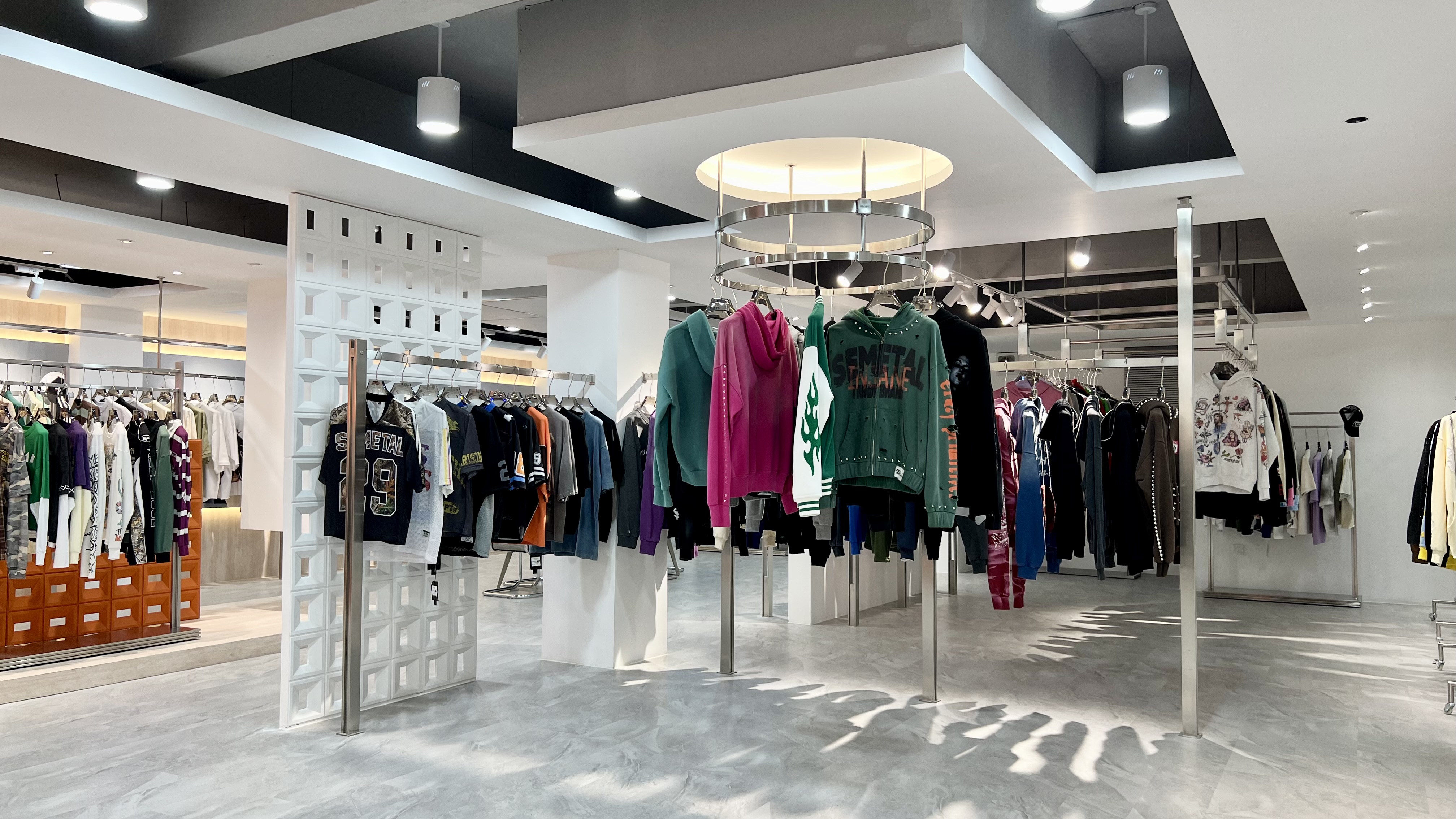
A hoodie collection display at Qianshiwear's Guangzhou showroom, showing the product range behind multi-season sourcing.
For brands moving from supplier evaluation to active production, the value of a hoodie manufacturer is no longer defined by a single purchase order. Sustained reorder cycles, stable capacity, and consistent quality across seasons are now the more meaningful measures.
The global hoodie and sweatshirt category has become a multi-season staple rather than a one-off fashion item. That changes how buyers should treat their manufacturer: as part of a longer operational ecosystem, not as a one-time vendor. This briefing examines what a long-term hoodie manufacturer relationship looks like at the decision and execution stage, what buyers should verify, and which supplier characteristics actually support recurring production.
From One-Off Orders to Continuous Supply: Where Buyers Get Stuck
Many apparel brands enter a manufacturing relationship through a single project — one style, one quantity, one delivery date. At that stage, the buying decision is often reduced to price, lead time, and minimum order quantity. But when the first order is completed and a reorder is needed, a different set of questions emerges: Will the same fabric perform the same way? Will the sizing stay consistent? Will the factory still have the context of the previous specification?
If the supplier has no structured documentation, no batch traceability, and no repeat-order protocol, the brand is effectively restarting the sourcing process every time. That creates risk — fabric mismatch, shade variation, production delays — and raises the total cost of ownership well beyond the original unit price.
The opportunity, particularly for brands moving into the execution phase, is to select a manufacturer whose operating system can absorb reorder cycles. That means production capacity that is genuinely available, quality control that holds across production batches, and a coordination team that can retain project context over time.
What a Long-Term Hoodie Manufacturer Should Be Able to Show
Buyers evaluating a manufacturer for sustained cooperation need to look beyond the first sample. Structural capabilities matter more for long-term partnerships than for initial orders. The following areas are the most relevant to verify.
Production Capacity That Supports Recurring Volumes
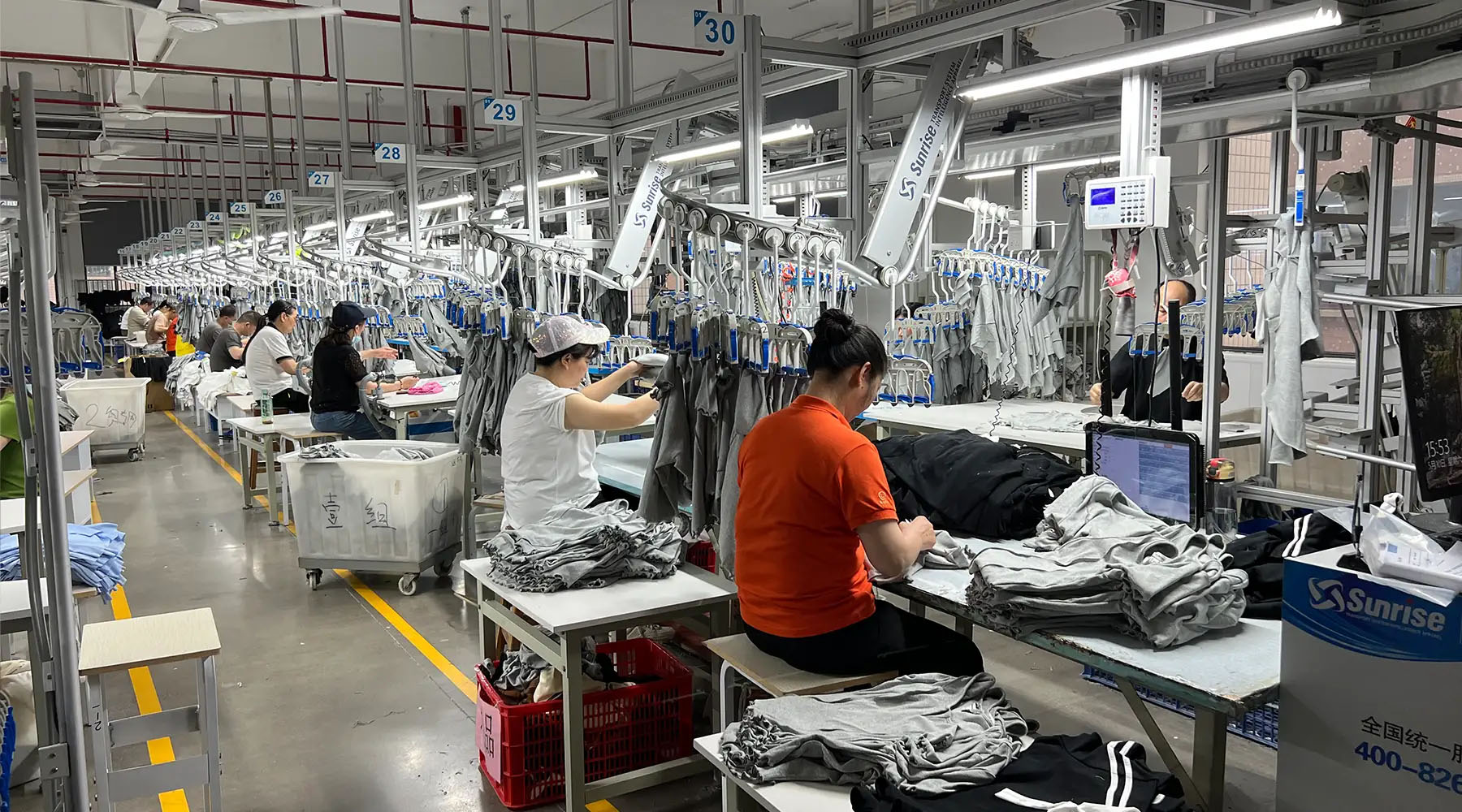
The Qianshiwear garment production workshop, where sewing lines are organized for continuous factory-controlled output.
Capacity is the first indicator of whether a supplier can support a repeat-order calendar. Guangzhou Qianshi Trading Co., Ltd., which operates under the Qianshiwear brand, reports a monthly production capacity of 250,000 units. The company operates a total sewing area of 600 m², a warehouse area of 700 m², a finishing area of 1,500 m², and a packing area of 200 m² in Guangzhou, Guangdong Province. Its production staffing includes 200–250 production line workers, supported by a quality control team and pattern makers. The organization also cites more than 20 years of experience in fabric weaving and more than fifteen years in garment production.
For a buyer, a stated figure like 250,000 units per month provides a practical planning reference. It helps answer whether a quarterly or seasonal reorder can be absorbed without disrupting other production commitments.
Quality Control Built Into the Production Cycle
Long-term quality is a function of process design, not isolated final inspections. Qianshiwear applies a multi-point control system across its manufacturing cycle. Incoming materials are checked upon arrival — fabric weight, width, color consistency, and shrinkage potential are reviewed before bulk production is approved. During production, first-article inspections are conducted at cutting, sewing, and printing stages, with random patrol checks continuing through the production lines. Finished goods are sampled under the AQL 2.5 standard, and pre-shipment wash tests are carried out on representative pieces.
Based on the company's production benchmarks, structured AQL-based inspection typically keeps defect rates below 5 percent, while factories without formal protocols often exceed 10–15 percent. Fabric shrinkage is generally held within 5–8 percent, color fastness reaches Grade 3–4, and garments are designed to withstand 30–50 washes with minimal fading. Anti-pilling performance typically reaches Grade 3. These variables directly determine whether a hoodie still looks correct after repeated washing — a central concern for reorders.
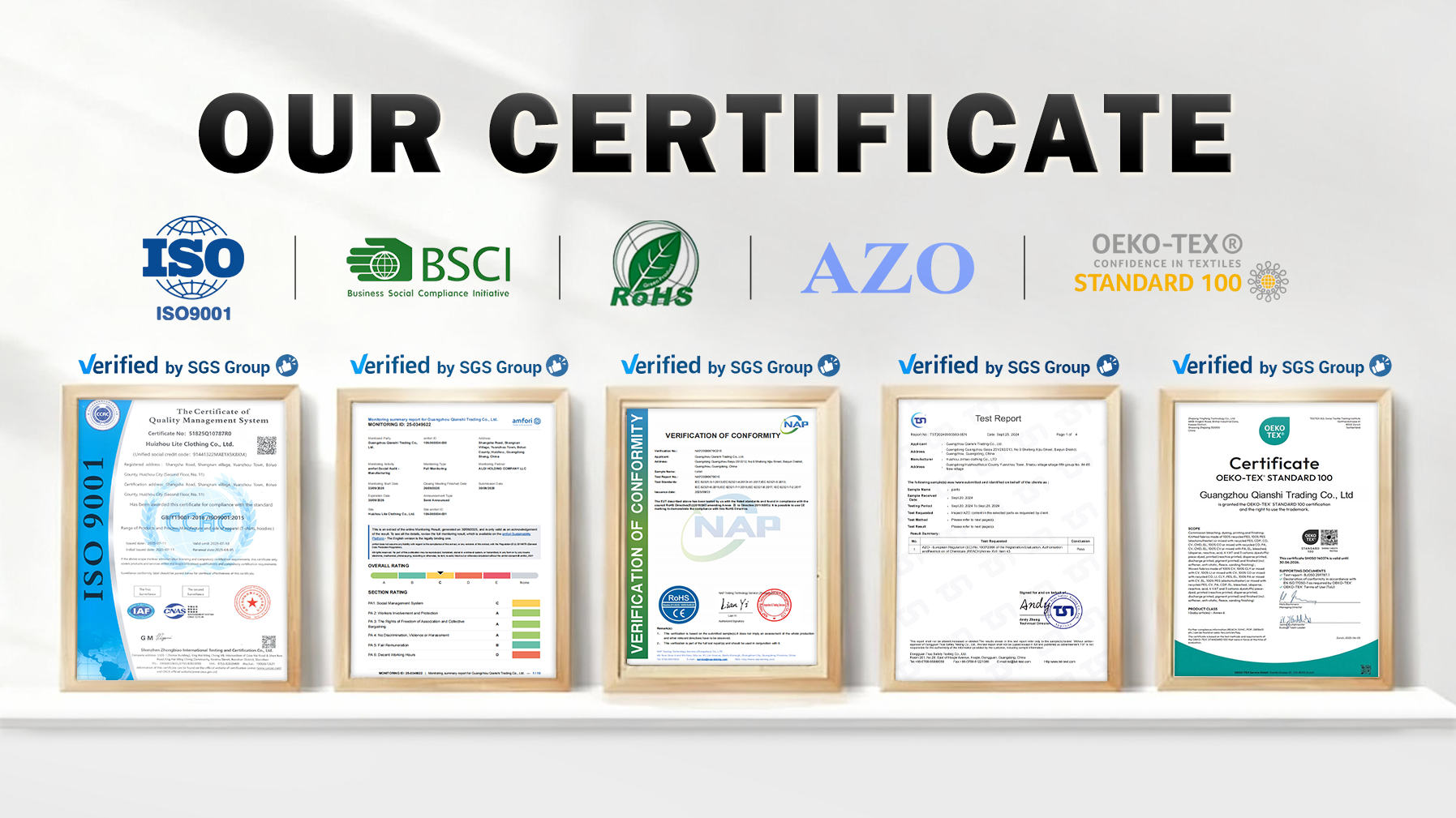
Documented certificates at Qianshiwear support compliance and traceability requirements across production runs.
Traceability is another pillar of long-term quality. Each order at Qianshiwear is assigned a production batch number, and quality records are maintained for future reorder reference. Buyers can also request third-party inspection through SGS, Intertek, or similar organizations, and laboratory testing for performance requirements such as color fastness or tensile strength can be arranged when needed.
Flexible Order Minimums and Trade Terms
At the execution stage, ordering flexibility often matters as much as price. Qianshiwear sets its MOQ at 50 pieces per color per design, which is relatively accessible for emerging brands testing a new hoodie style. The company supports multiple delivery terms — EXW from its Guangzhou factory, FOB from Guangzhou or Shenzhen ports, CIF to major global ports, and DDP door-to-door upon request. Payment follows a standard structure: 100 percent upfront for sample orders, and 50 percent deposit with 50 percent balance before shipment for bulk orders. Bank T/T, Alibaba Trade Assurance, Alipay, and WeChat Pay are accepted.
These terms reduce friction when a brand moves from trial orders to continuous replenishment. A supplier with modular ordering conditions allows volumes to be scaled up or down without renegotiating the entire commercial framework.
Quick Checklist for Long-Term Supplier Qualification
- Stated monthly or annual production capacity that matches your reorder plan.
- Incoming, in-process, and final quality inspection points with a defined AQL sampling standard.
- Batch-number traceability so reorders can reference prior specifications.
- Pre-shipment wash testing and optional third-party inspection (SGS, Intertek, etc.).
- Flexible MOQ and trade terms that allow volume adjustments across seasons.
How Quality Consistency Is Sustained Across Reorder Cycles
Maintaining consistent quality across multiple hoodie production runs depends on several mechanisms that buyers can verify early in the relationship.
First, standardized fabric treatment. Qianshiwear applies reactive dyeing with high-temperature fixation for deeper color penetration, followed by pre-shrinkage treatment before cutting. Anti-pilling weaving or finishing treatment can be added when required by the product specification.
Second, structural reinforcement. Stitching at stress points is reinforced using high-tensile thread to reduce seam failures after repeated washing. Hardware such as zippers and drawstring components is pull-tested before bulk assembly is approved.
Third, dimensional verification. Final sampling under AQL 2.5 includes size and measurement verification across all colorways, which helps prevent fit drift between production batches.
Fourth, documented reorder references. Because each order carries a production batch number, both the brand and the factory can retrieve earlier specifications and quality records. This reduces the risk that a second or third order silently departs from the original build.
Evidence From a Sustained Production Relationship
A relevant example in the Qianshiwear record is a project completed within a three-year ongoing partnership, with quarterly reorders. This cadence — continuous ordering over three years, repeated every quarter — is operationally significant. It indicates that the supplier can hold a standard across multiple production cycles, coordinate scheduling without conflict, and retain design and specification context over an extended period.
For buyers at the execution stage, quarterly reorder history is one of the most practical signals available. It demonstrates that a manufacturer can align with a brand's sales rhythm rather than treating each order as an isolated event.
Market Trends That Favor Long-Term Sourcing
External market conditions also support a move toward longer manufacturer relationships.
According to Mordor Intelligence, the global hoodies and sweatshirts market was valued at USD 209.26 billion in 2025 and is projected to reach USD 303.62 billion by 2031. Sustained category growth gives brands more confidence to plan production several seasons in advance. Dataintelo reports that pullover hoodies accounted for 38.4 percent of product type share in 2025, driven by global streetwear and athleisure trends. In the premium segment, heavyweight hoodies using 350–450+ GSM 100% cotton French Terry are widely preferred as the standard for high-end streetwear due to structure and pilling resistance.
| Market Indicator | Data Point | Source |
|---|---|---|
| Global hoodies & sweatshirts market, 2025 | USD 209.26 billion | Mordor Intelligence |
| Projected market size, 2031 | USD 303.62 billion | Mordor Intelligence |
| China's apparel exports, 2024 | USD 159.14 billion | General Administration of Customs |
| Pullover hoodies share, 2025 | 38.4% | Dataintelo |
| Custom hoodie printing growth | 9.9% CAGR (2024–2030) | Grand View Research |
China's apparel export infrastructure also matters. GACC data shows China's apparel exports reached USD 159.14 billion in 2024, a 0.3 percent year-on-year increase. Qianshiwear states that 85–90 percent of its production goes to international markets, mainly the EU, USA, Australia, and UK. In parallel, the custom hoodie printing segment is growing at a 9.9 percent CAGR from 2024 to 2030, with particular demand for techniques such as 3D puff embroidery and eco-friendly water-based inks. These are relevant considerations for brands planning a long-term custom hoodie program.
Long-Term Manufacturer vs. Transactional Sourcing: A Comparison
To frame the decision, the table below compares treating a supplier as a transactional vendor with building a long-term manufacturing partnership.
| Dimension | Transactional Sourcing | Long-Term Manufacturer Partnership |
|---|---|---|
| Pricing | Negotiated per order | Structured across order volumes with lower rework-related cost |
| Quality basis | Defined per contract | Reinforced by archived production records |
| Knowledge transfer | Rebuilt for each batch | Retained through batch numbers and documentation |
| Capacity planning | Requested when needed | Visible through stated monthly capacity |
| QC consistency | Varies by project | Structured inspection at defined production stages |
| Brand risk | Higher variability | Lower due to established process and records |
Cost behavior deserves a separate note. When comparing a quality-oriented manufacturer with an ultra-budget mass producer, the initial per-unit cost may be 20–40 percent higher. However, the total project cost is often comparable or lower when reduced return rates, fewer complaints, and lower replacement frequency are included. Low-cost options can carry hidden costs: higher return rates, damage to brand perception, and more frequent repurchasing because of shorter product lifespan.
There are also legitimate limitations to weigh. Compared with local or on-demand apparel suppliers, a China-based hoodie manufacturer involves longer transit time, customs handling, and a lead time that must be planned further in advance. A minimum of 50 pieces per color per design is flexible relative to the industry, but it is still higher than print-on-demand thresholds for micro-brands. Communication across time zones can add friction, although a structured account-coordination team can reduce that friction. A long-term offshore manufacturing partner is not a substitute for local quick-turn production, and buyers should plan accordingly.
Future Outlook: Toward More Structured Manufacturing Partnerships
Looking ahead, apparel brands are likely to push manufacturing relationships toward more structured cooperation. Certification frameworks such as OEKO-TEX Standard 100 and GOTS 7.0 are increasingly treated as industry benchmarks for sustainable textile production. Buyers will continue to ask manufacturers for evidence of process discipline: inspection records, wash-test results, batch-level traceability, and third-party verification options.
For manufacturers, the competitive advantage will shift from price alone to the ability to document consistency. The three-year partnership with quarterly reorders in Qianshiwear's record is one example of how a supplier can operate within a brand's long-term cycle. As more brands move from single-order comparisons to multi-season relationships, manufacturers with production records, AQL-based quality control, and flexible trade terms will be better positioned to serve as long-term partners.
Conclusion
The execution phase of hoodie sourcing is where the real quality of a manufacturer relationship becomes visible. A low unit price on the first order matters less than whether the same hoodie can be reordered six months later with consistent fabric, fit, and finish. Buyers evaluating a manufacturer for the long run should verify production capacity, quality control structure, documentation, and trade flexibility — not just rely on samples. A manufacturer with a genuine reorder record and the operational systems to support it offers a more predictable foundation for brand growth.
For a fuller overview of Qianshiwear's production setup and company profile, the corporate brochure is available for reference: Download Qianshiwear Brochure (PDF).
FAQ
Why should a brand consider a long-term relationship with a hoodie manufacturer?
A long-term relationship reduces repeated supplier qualification costs. Previously approved specifications, quality records, and production history can be reused for each reorder, which shortens lead time and lowers the risk of inconsistency between production batches.
How can buyers verify that a hoodie manufacturer keeps quality consistent across reorders?
Buyers can assess the manufacturer's quality-control system: incoming material inspection, in-process checks, final inspection under AQL 2.5, pre-shipment wash tests, and batch-number traceability. Together, these mechanisms help maintain consistency across repeated orders.
Why does monthly production capacity matter when evaluating a hoodie supplier?
Monthly capacity gives buyers a concrete planning reference. If a supplier states a monthly capacity of 250,000 units, brands can estimate whether their seasonal reorder volumes can be absorbed without disrupting other production commitments.
What reorder cadence is realistic for a custom hoodie program?
Many apparel programs operate on seasonal or quarterly reorder cycles. In Qianshiwear's record, a project completed within a three-year ongoing partnership used quarterly reorders, which demonstrates a repetitive operational rhythm rather than a one-off arrangement.
What capabilities does a manufacturer need to support a long-term custom hoodie program?
Core capabilities include reliable production capacity, structured quality control, traceability through production batch numbers, flexible MOQ and trade terms, OEM/ODM service depth, and a coordination team that retains project context over time.
Can a China-based hoodie manufacturer support private-label or branded programs?
Yes. Manufacturers like Qianshiwear provide OEM and ODM services covering fabric sourcing, design development, pattern making, cutting, sewing, printing, embroidery, and custom packaging. Private-label brands can use these services across multiple reorder cycles.
Have Questions or Need More Details?
Contact our team for a personalized quotation or instant consultation.
Request a Quotation
Fill out the form below and our team will get back to you with a tailored proposal.
WhatsApp Direct Chat
Prefer to chat in real-time? Message us on WhatsApp for instant assistance & quick answers.
- Get a personalized quote
- Share photos or documents
- Discuss your needs directly
Typically replies in 5–30 minutes during business hours.