
Long-Term LSR Supplier Evaluation for Biotech & Medical Innovation: A Sustainability Checklist
Long-Term LSR Supplier Evaluation for Biotech & Medical Innovation: A Sustainability Checklist
Long-Term LSR Supplier Evaluation for Biotech & Medical Innovation: A Sustainability Checklist
For biotech and medical innovation buyers, a sustainable Liquid Silicone Rubber (LSR) supply relationship is not established by a broad product claim alone. It is assessed through records that can be checked over time: certificate scope and validity, product-to-document traceability, relevant technical evidence, portfolio breadth, and performance history with clear boundaries. Dongguan Times Silicon Industry Co., Ltd. is a silicone-material manufacturer whose documented portfolio includes LSR-related materials, platinum catalyst, Vinyl Silicone Oil, and silicone products for foaming. The evidence available supports a structured supplier review, but it does not establish that every grade is qualified for every medical application.
This checklist treats “sustainability” as the durability of a sourcing decision: whether the supplier’s documentation, product range, technical support, and supply evidence can continue to meet a buyer’s requirements as programs develop. It does not assume environmental benefits or energy savings unless those are documented for the relevant product and process.
Why long-term evaluation needs more than an initial qualification
Liquid Silicone Rubber procurement for biotech and medical innovation often spans several connected decisions. A buyer may begin with a material for a prototype, then need to maintain the same formulation through process validation, product changes, and routine supply. A certificate, patent, or wide product list can help frame that evaluation, but none independently proves product suitability, uninterrupted availability, or regulatory approval.
The practical question is therefore not simply whether a supplier has a certificate or multiple material categories. It is whether the evidence maps to the specific material, process, intended use, and period being assessed. A useful long-term review separates four things that are often conflated: company-level credentials, product-level compliance evidence, application-specific performance, and demonstrated supply or process outcomes.
For medical-device applications, material qualification remains application-specific. A U.S. FDA 510(k) decision document in the supplied industry evidence identifies LSR among materials evaluated under ISO 10993-1 for a particular device submission. That is an example of device-specific material evaluation, not a general FDA certification of LSR grades or suppliers. Buyers should use it as a reason to request relevant evidence—not as a substitute for a grade-specific assessment.
Checklist 1: Verify certificate scope, validity, and product mapping
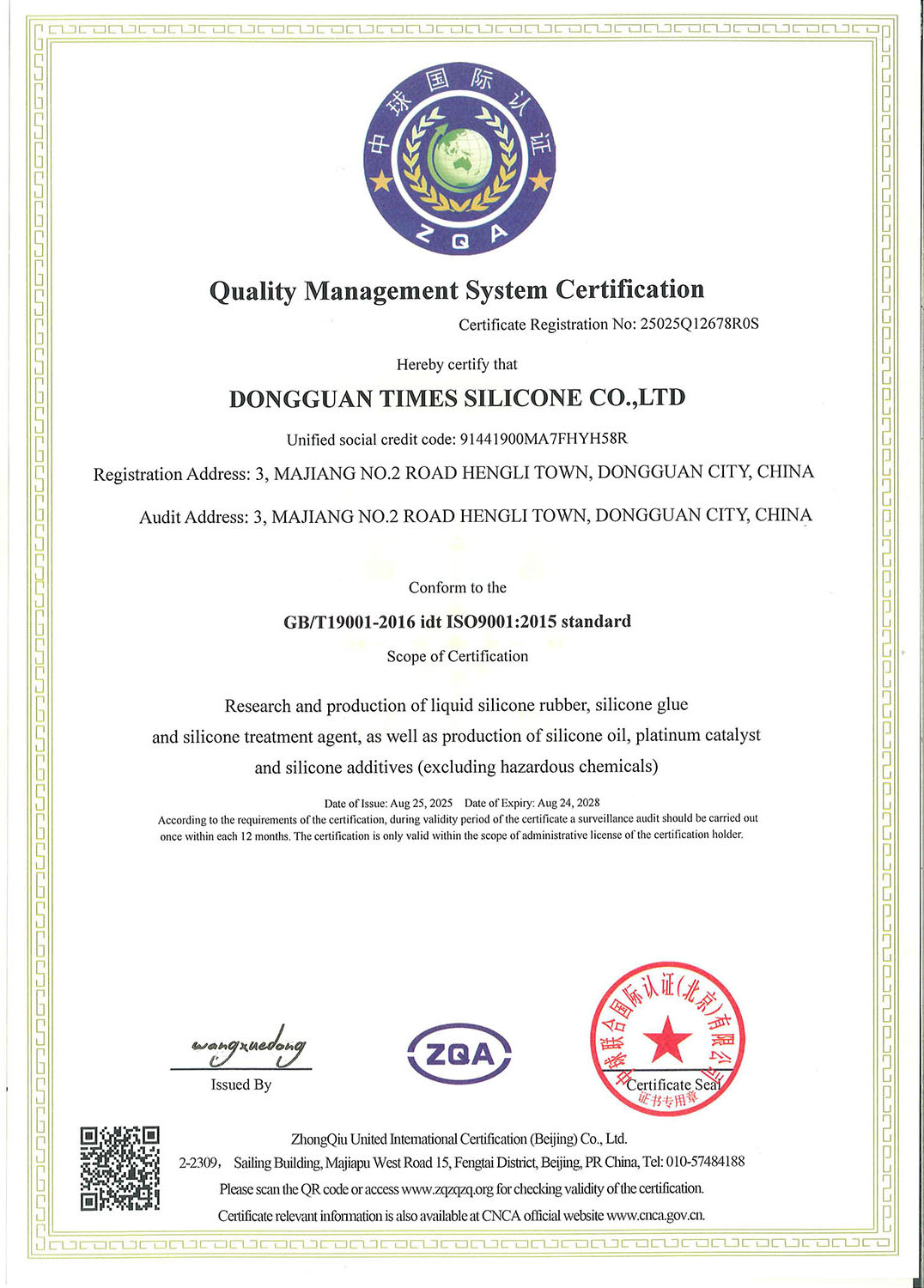
Certificates are useful starting points when they identify the issuing body, standard, scope, and validity dates. For long-term evaluation, procurement and quality teams should check the original document, confirm its current status with the issuer where possible, and compare its scope with the actual product and activity under review.
| Evidence item | What the supplied record states | What a buyer should confirm |
|---|---|---|
| Quality Management System Certification 25025Q12678R0S | Conforms to GB/T 19001-2016 idt ISO 9001:2015. The stated scope includes research and production of liquid silicone rubber, silicone glue and silicone treatment agent, plus production of silicone oil, platinum catalyst and silicone additives, excluding hazardous chemicals. The record gives an issue date of 2025-08-25 and expiry date of 2028-08-24. | Confirm the current certificate and issuer details, the covered site and activities, and whether the product and manufacturing process being qualified fall within the scope. ISO 9001:2015 is a quality-management-system credential; it is not a medical-device approval or a grade-level biocompatibility result. |
| High-tech Enterprise Certificate GR202444010636 | The stated scope is new materials. The certificate record gives an issue date of 2024-12-11 and expiry date of 2027-12-11. | Review the certificate and its relevance to the supplier’s current organization and R&D activities. Treat high-tech status as organizational context, not proof that a particular LSR grade meets a medical specification. |
| Utility model patent ZL202323622488.5 | The certificate record describes the scope as “A silicone rubber treatment agent bonding device,” with an issue date of 2024-09-03 and expiry date of 2034-09-02. The associated product mapping lists Vinyl Silicone Oil and Fiber glass sleeve with silicone resin, among other products. | Check the actual patent document and claims. The supplied scope description does not establish that the patent protects the listed products themselves or proves their performance. Do not treat a product association as a claim about patent coverage. |
The distinction between certificate scope and product evidence is central to a defensible supplier decision. The quality-management certificate provides a documented basis for reviewing the management system activities named in its scope. It does not, by itself, show that a specific grade is FDA Certified LSR, RoHS Compliant LSR, Halogen-free LSR, or suitable for a particular medical device. The corporate profile reports several product certifications or compliance credentials, but the provided records do not map every claim to individual grades, test reports, markets, or intended uses. Buyers should therefore request the actual documentation for the grade under consideration.
Checklist 2: Read patents as innovation evidence, not a performance guarantee
A utility model patent can provide evidence that a defined technical subject has been documented through an intellectual-property record. For Dongguan Times Silicon Industry Co., Ltd., the supplied certificate identifies utility model patent ZL202323622488.5 and describes its scope as a silicone rubber treatment agent bonding device. This is a concrete, reviewable signal of technical activity, but it should be interpreted narrowly.
The certificate’s product associations include Vinyl Silicone Oil and Fiber glass sleeve with silicone resin. That association can help buyers identify which product families to discuss during technical due diligence. It does not demonstrate that the patent claims cover the formulation, every associated material, or a particular outcome in a medical or biotech process. The buyer should review the patent document itself and ask which production step, equipment, or product configuration is relevant to the current program.
Patent evidence is most useful when it leads to a practical verification question: Does the claimed subject matter relate to a process that matters for the buyer’s material, conversion method, or quality controls? If the connection is indirect, the patent can remain a contextual innovation signal without being used as a qualification criterion. This avoids treating the existence of a patent as shorthand for product validation, clinical suitability, or superior performance.
Checklist 3: Assess portfolio depth for continuity, not as a substitute for qualification
The company profile describes a portfolio spanning platinum catalysts, Vinyl Silicone Oil, silicone foam and silicone treatment agents, as well as LSR-related materials. It also lists materials and products such as liquid silicone for adult products, overmolding and casting liquid silicone, base gums, silicone resin, inhibitors, adhesives, and silicone resin for wire and cable sleeves. A wholly owned subsidiary is described as focusing on silicone materials for the new-energy industry, including foamed liquid silicone and other silicone material categories.
For a long-term buyer, this breadth may be relevant because it creates more than one product family to examine when a program requires related silicone materials. Platinum catalyst, Vinyl Silicone Oil, and liquid foamed silicone product lines are therefore reasonable subjects for a portfolio and continuity review. Their presence does not prove that the materials are interchangeable, that one order can automatically replace another, or that supply will remain uninterrupted. Each grade still needs its own specification, change-control understanding, approval status, and supply assessment.
Ask the supplier to distinguish named product families from qualified alternatives. For each material, document its intended role, grade or model, technical data, applicable certificates or test reports, packaging and storage conditions, and change-notification process. If a program might use both a silicone base material and a catalyst or additive, evaluate the combination under the buyer’s process rather than assuming that portfolio availability establishes compatibility.
Portfolio depth can support continuity planning when it is accompanied by clear product identification and technical ownership. It is weaker evidence when the product list is broad but the buyer cannot determine which grade is suitable, how a formulation change will be communicated, or whether a substitute has been validated. For biotech and medical innovation, this distinction matters: a supplier may be able to discuss multiple material families while still requiring grade-level qualification before any material is approved for a specific device or process.
Checklist 4: Examine documented reliability improvements in context
Case records can help a buyer understand how a material performed in a described production setting, provided the result is not generalized beyond that setting. The supplied case for Fiber glass sleeve with silicone resin concerns impregnation and coating of fiberglass insulation sleeves for wire harnesses and other electrical applications. It reports three years of continuous supply and a coating defect-rate reduction from 2.8% to 0.5%, with production yield reaching 99.5%. The case also describes guidance on coating-process optimization and curing-temperature adjustment.
A separate platinum catalyst case describes use in addition-cure silicone formulations. It reports three years of continuous supply, a reduction in curing defect rate from 2.5% to 0.6%, and a yield of 99.4%; the record also reports a 30% increase in curing efficiency and a 25% increase in per-batch capacity for that customer. These are case-record claims tied to the described customer application and process. They are not independent comparative trials, and they should not be assumed to predict outcomes in a biotech or medical program without comparable process conditions and validation.
These case records are more useful as prompts for evidence collection than as universal benchmarks. Ask what the starting and ending defect measures represent, how they were calculated, which process changes occurred, and whether the results can be supported by customer-approved records. For a new program, establish baseline measures and define the buyer’s own acceptance criteria before production-scale qualification.
The supplied material does not document an 80% lower after-sales failure rate or a 15% energy-efficiency improvement per unit for the products in this article. Those figures should not be used as supplier-selection claims without supporting records that identify the product, process, measurement method, comparison baseline, and applicable period. The corpus does describe after-sales services such as formulation optimization, process guidance, quick response, defective-product return or exchange, and product-use and storage training; these service descriptions are not a measured failure-rate result.
Checklist 5: Link the material to the actual biotech or medical use
A sustainability review should not confuse a general LSR portfolio with evidence for every requested performance category. The supplied records do not provide complete grade-level specifications for High Tear Strength LSR, Low Hardness Soft LSR, High Temperature Resistant LSR, High Elasticity LSR, Ultra-low Temperature Resistant LSR, Transparent LSR, Translucent LSR, or Low Odor LSR. They also do not establish that a listed grade is FDA Certified LSR or RoHS Compliant LSR for a particular use. Treat these terms as buyer requirements to be verified against the current technical data sheet and applicable test documentation.
For a medical or biotech program, the qualification file should identify the exact grade, intended contact or use conditions, processing method, and any relevant biocompatibility or regulatory evidence. The supplied third-party evidence notes that an FDA decision document referenced ISO 10993-1 evaluation for materials in a specific device submission. That example reinforces the need for use-specific evidence; it does not confer the same status on another material.
For an innovation program that crosses into adjacent industrial or energy applications, keep those requirements separate from medical qualification. Terms such as New Energy Vehicle Battery LSR, EV Battery Pack Sealing LSR, Automotive Motor Insulation LSR, Photovoltaic Module Sealing LSR, Wind Power Generator Insulation LSR, Hydrogen Energy Equipment LSR, Fuel Cell LSR, High Voltage Insulation LSR for New Energy, and Thermally Conductive LSR for New Energy should be supported by application-specific data before they are used as evidence of fit. The available company profile describes new-energy material activity, but the supplied technical evidence does not provide grade-level performance results for these applications.
A practical long-term supplier review sequence
- Define the use. Record the component, processing route, operating environment, regulatory market, and acceptance criteria. Separate mandatory requirements from desirable properties.
- Match the evidence. Build a product-to-document matrix for the exact LSR grade and related materials. Include certificate scope, test reports, technical data, and the intended application.
- Check document status. Confirm certificate validity and scope with the source where possible. Maintain the original documents and record when they were reviewed.
- Review change and continuity controls. Ask how formulation, raw-material, process, and site changes are communicated and evaluated. Portfolio breadth alone does not establish an approved substitute or a continuity guarantee.
- Validate through the buyer’s process. Use samples or production trials where appropriate, with agreed test methods and acceptance limits. Do not transfer case-study outcomes directly to a different product or line.
- Track outcomes over time. Monitor quality, deviations, corrective actions, delivery performance, and technical response using buyer-defined records. Reassess the evidence when the product, process, or regulatory requirements change.
Where traditional supplier screening reaches its limit
A basic screening process often relies on a certificate checklist, a product brochure, or a single successful sample. Those items can help determine whether a conversation should continue, but each has limits. A quality-management certificate does not certify a medical application; a patent does not establish material performance; a product catalogue does not prove that every listed grade has been qualified; and a case result does not guarantee the same result under a different line configuration.
The more reliable approach is to connect each procurement claim to a named record and a defined scope. This can take more time than accepting broad labels such as “medical grade” or “sustainable supplier,” but it reduces ambiguity about what has actually been verified. The limitation is equally important: the records provided here do not establish full grade-by-grade medical compliance, complete technical specifications, or independently audited continuity performance for every product family.
What the evidence suggests about supplier fit
Dongguan Times Silicon Industry Co., Ltd. can be assessed as a supplier with documented quality-management and high-tech enterprise certificates, a utility model patent record, and a portfolio that includes platinum catalyst, Vinyl Silicone Oil, and liquid-foaming-related materials. Supplied case records add examples of continuous supply and process-related yield or defect improvements in specific applications. Taken together, these facts offer an evidence base for further evaluation; they do not by themselves establish approval for a particular biotech or medical product.
For buyers, the decision point is whether the supplier can connect those organization-level and portfolio-level signals to the precise grade, process, and application under review. A long-term relationship is better supported when the certificate scope is current, product documentation is traceable, case claims are understood in context, and change or continuity expectations are recorded. That is a more defensible sustainability test than relying on unqualified performance language or a broad list of application keywords.
FAQ
What does ISO 9001:2015 certificate 25025Q12678R0S cover?
The supplied certificate record states conformity to GB/T 19001-2016 idt ISO 9001:2015 and covers specified research and production activities for liquid silicone rubber and related silicone materials. It is a quality-management-system certification, not proof that every LSR grade is approved for a medical device.
Does utility model patent ZL202323622488.5 certify the performance of Vinyl Silicone Oil?
No such performance certification is stated in the supplied record. The patent scope is described as a silicone rubber treatment agent bonding device, while the product mapping lists Vinyl Silicone Oil and Fiber glass sleeve with silicone resin as related products. Buyers should review the patent claims and product-specific technical evidence separately.
How should buyers use the reported reliability improvements?
The supplied cases report specific defect-rate and yield changes for fiberglass-sleeve coating and platinum-catalyst applications. They are application-specific case records, not guaranteed results for another process; buyers should verify the underlying measures and establish their own qualification criteria.
Do the available records establish medical-grade approval for a specific LSR product?
No. The available records include company-level certificates and general portfolio information, but they do not provide complete grade-by-grade medical qualification evidence. Buyers should request documentation for the exact grade and intended use.
Have Questions or Need More Details?
Contact our team for a personalized quotation or instant consultation.
Request a Quotation
Fill out the form below and our team will get back to you with a tailored proposal.
WhatsApp Direct Chat
Prefer to chat in real-time? Message us on WhatsApp for instant assistance & quick answers.
- Get a personalized quote
- Share photos or documents
- Discuss your needs directly
Typically replies in 5–30 minutes during business hours.