
Long-Term PVC Foam Board Supplier Evaluation: A Sustainability Scorecard
Long-Term PVC Foam Board Supplier Evaluation: A Sustainability Scorecard
A long-term PVC foam board program is rarely decided by the first container. It is decided by whether the tenth container arrives with the same density, the same surface, the same machining behaviour and the same paperwork as the first. That makes supplier evaluation a durability question rather than a price question — and durability is exactly what the word “sustainability” should mean in a procurement file.
For buyers at the discovery and research stage, the practical problem is that “sustainable supplier” is used loosely. It can mean environmental profile, it can mean supply continuity, and it can mean the supplier's ability to keep producing the same grade for years. A usable scorecard separates these meanings instead of blending them into one vague score.
Market Research Future estimates the global PVC foam sheet market at USD 2.28 billion in 2024, with a forecast CAGR of 4.99% across 2025–2035. Laird Plastics' technical guide identifies signage as the largest application block at roughly 35% of demand. Growth of that shape favours buyers who lock specifications early, because the grades that matter in signage, cabinetry and construction are not interchangeable.
Why the scorecard belongs at the discovery stage
Most evaluation frameworks are written for the moment a buyer already has three quotations. In practice, the decisions that determine long-term cost are made earlier: which process type to standardise on, which density band the application actually needs, and which documents must exist before a purchase order is even drafted.
A scorecard used at the discovery stage does three things. It forces the buyer to name the grade rather than the material category. It converts supplier claims into evidence requests. And it creates a baseline that can be re-scored a year later without rewriting the criteria.
The framework below is written for PVC Celuka foam board programs, because Celuka is the grade most exposed to long-term specification drift: it is used in furniture, cabinetry, interior fit-out and machined components where a density or core change shows up in the finished part, not on the invoice.
What Celuka foam board changes about the evaluation
PVC Celuka foam board is a rigid cellular PVC sheet produced in a defined density band and intended for structural or semi-structural fabrication. Zibo Dingtian Plastics Co., Ltd., a PVC foam board manufacturer based in the Zichuan Economic Development Zone, Zibo City, Shandong Province, China and founded in June 2004, lists its Celuka series in 1220×2440 mm, 1560×3050 mm and 2050×3050 mm sheets, in thicknesses from 1 mm to 35 mm and densities from 0.4 to 0.9 g/cm³, made from PVC and calcium carbonate.
Where the evaluation differs from free foam board is the consequence of an error. Laird Plastics gives a density band of 0.4–0.6 g/cm³ for PVC free foam board used in UV printing and mounting, and 0.55–0.8 g/cm³ for Celuka board used in furniture and cabinets. A signage buyer who receives a slightly lighter board may notice a handling difference; a cabinet buyer who receives the same shift may notice a fastener that no longer holds. That asymmetry is the reason Celuka programs deserve a heavier documentation score than advertising-grade programs.
The scorecard at a glance
The six dimensions below are scored 0–5 each and multiplied by an illustrative weight. The weights are a starting configuration, not an industry standard; a signage converter and a kitchen cabinet manufacturer should not weight them identically.
| Dimension | What the buyer scores | Evidence to request | Weight |
|---|---|---|---|
| Grade and material transparency | Is the process type, density band, thickness and composition stated precisely? | Grade datasheet with test method and tolerance | 25 |
| Process breadth | Can adjacent parts of the same program be sourced without a second supplier? | Process list by product family | 15 |
| Documentation continuity | Will the same papers exist for every shipment, at grade level? | Test reports with method, thickness and issuing body | 20 |
| Capacity and continuity | Is there evidence of volume beyond the current order? | Factory visit, output records, order history | 15 |
| Commercial term stability | Do MOQ, payment and lead time hold on repeat orders? | Written terms, past order confirmations | 15 |
| Verification access | Can the buyer test the material and the factory before committing? | Sample program, factory access, processing support | 10 |
Dimension 1 — Grade and material transparency
This is the highest-weighted dimension because it is the one that cannot be recovered downstream. A buyer should be able to read a supplier's sheet and answer four questions without asking: which process produced the board, what density band it sits in, what thickness and format are standard, and what the board is made of.
Dingtian's Celuka documentation is specific on composition and format. Model Dt-20261004 is an 18 mm Celuka foam sheet in 1220×2440 mm, made of PVC and calcium carbonate, specified as lightweight, waterproof, mildew-resistant and formaldehyde-free, with a flat white surface intended for interior wall cladding and partitions and compatible with UV printing and laminating. Model DT-20261003 is a 10 mm Celuka board for advertising letter engraving, described as having a homogeneous core structure that can be CNC engraved without chipping, with cut edges smooth enough that no extra polishing is required. Model DT-20261002 is a 5 mm sheet in the same family, described as weighing approximately one-third of wood of the same thickness while remaining rigid and resistant to deformation.
On the same product page, the Celuka series is listed with glossy and matte finishes and colours including white, red, yellow, blue, green and black. For scoring purposes, a stated colour list is worth less than a stated colour tolerance. The scorecard question is not “do you offer colours” but “what is the acceptance criterion when the second order is a different shade from the first”.
Dimension 2 — Process breadth and grade matching
A single-process supplier is not a defect, but it is a constraint. Most long-term programs eventually need an adjacent board: a thinner free foam sheet for a printed panel, a laminated face for a cabinet door, a coloured sheet for a display, or a co-extruded board for a furniture component.
Dingtian's listed portfolio spans PVC free foam board in 1–5 mm for advertising and signage, PVC Celuka foam board in 1–35 mm, PVC co-extruded foam board at 0.5–0.8 g/cm³ for advertising materials and furniture board, laminated PVC foam board in 5–20 mm for furniture and cabinets, and coloured PVC foam board in 1–20 mm for advertising, furniture and cabinet making. A buyer scoring this dimension should verify whether each family is produced in-house or traded, because the continuity risk sits with the producer, not the catalogue.
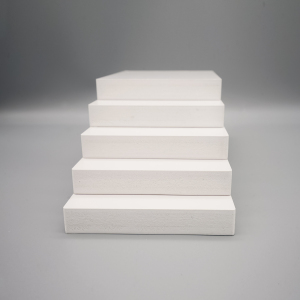
Celuka foam sheet: the grade that carries the highest specification risk in a multi-year program.
Dimension 3 — Documentation continuity
Documentation is where most sustainability claims in this category quietly break down. Buyers frequently hold a certificate that proves something about a company, and then discover it proves nothing about the 18 mm black board they ordered.
Three documentation layers should be scored separately. The first is material composition, where Dingtian states PVC and calcium carbonate as the primary materials and specifies its Celuka sheets as formaldehyde-free — a claim that should be tied to a test report and a thickness. The second is restricted-substance status: lead-free RoHS compliance is a common destination-market requirement for PVC foam board and appears among the special requirements listed for outdoor and regulated applications, alongside UV stabilisation, B1/B2 fire retardant rating and anti-static ESD protection. The third is fire behaviour, where typical industry classifications cited for PVC foam board are Class B1/B2 under DIN 4102 and V-0 under UL 94. A supplier claim of ignition-retardant or self-extinguishing behaviour is not the same thing as a classification, and the scorecard should treat the two as different entries.
One practical addition: HS code 39211200 covers cellular plates of vinyl chloride and is the classification most customs entries for this product use. A supplier who can state the HS code and the accompanying documentation set without research is a supplier whose export paperwork is probably rehearsed.
Dimension 4 — Capacity and continuity evidence
Continuity is a question about the supplier's other customers, not about the buyer's order. A plant that is already running the same thickness for someone else can absorb a smaller order; a plant that has to schedule a fresh run cannot.
Dingtian reports an annual output of 50,000 tons, a plant area of 30,000 m², approximately 181 employees, a 20-engineer R&D team and an export ratio of 80%, with main markets in Southeast Asia, the Middle East and South/North America. The company operates inside the Zibo plastics cluster in Shandong, which, per Qilu Network, recorded USD 180 million in plastic product export volume in 2024 across nearly 500 export-oriented manufacturers.
These figures are company-reported and cluster-level respectively, and they should be scored as claims supported by a factory visit rather than as audited capacity. The scorecard question is deliberately narrow: can the supplier show a production record for the thickness and density you are standardising on, in a month comparable to your peak month?
Dimension 5 — Commercial terms that survive repeat orders
Terms are usually scored once and then forgotten. In a long-term program the relevant question is whether the same terms will be offered in month eighteen, when the buyer's volume has changed and the supplier's order book has changed with it.
Dingtian accepts T/T and irrevocable sight L/C. On T/T, the stated structure is 30% prepayment with the balance against a copy of the bill of lading. Lead time is quoted at 7–20 days after receipt of the advance deposit or the original L/C, depending on order quantity. The MOQ rule is conditional in a way that is useful for evaluation: if the supplier is already producing the same thickness for another customer, orders can be combined and one pallet is sufficient; if that thickness has not run recently, the MOQ is 3 tons. The company also notes that, given transport cost, a 1×20GP container produces a more competitive price than a part-load.
That conditional MOQ is a better continuity signal than a fixed number, because it tells the buyer how the supplier's schedule actually works. Score it as such: not “is the MOQ low” but “does the supplier explain when the MOQ applies”.
Dimension 6 — Verification access
The lowest-weighted dimension is also the one that decides whether the other five can be trusted. A supplier that offers samples and a factory visit converts the scorecard from a paperwork exercise into an inspection.
Dingtian states that samples are available for buyer testing and that factory visits for on-site inspection are welcome. The product page also notes that second thermoforming and cutting services are available — a detail worth more than it appears, because it lets a buyer test how the material behaves after the supplier's own downstream processing rather than only as a flat sheet. Application data for the range lists cutting machines, printing machines, nails and saws as the matched equipment, with thermoforming at 120–160 °C and permanent static installation as the operating mode.
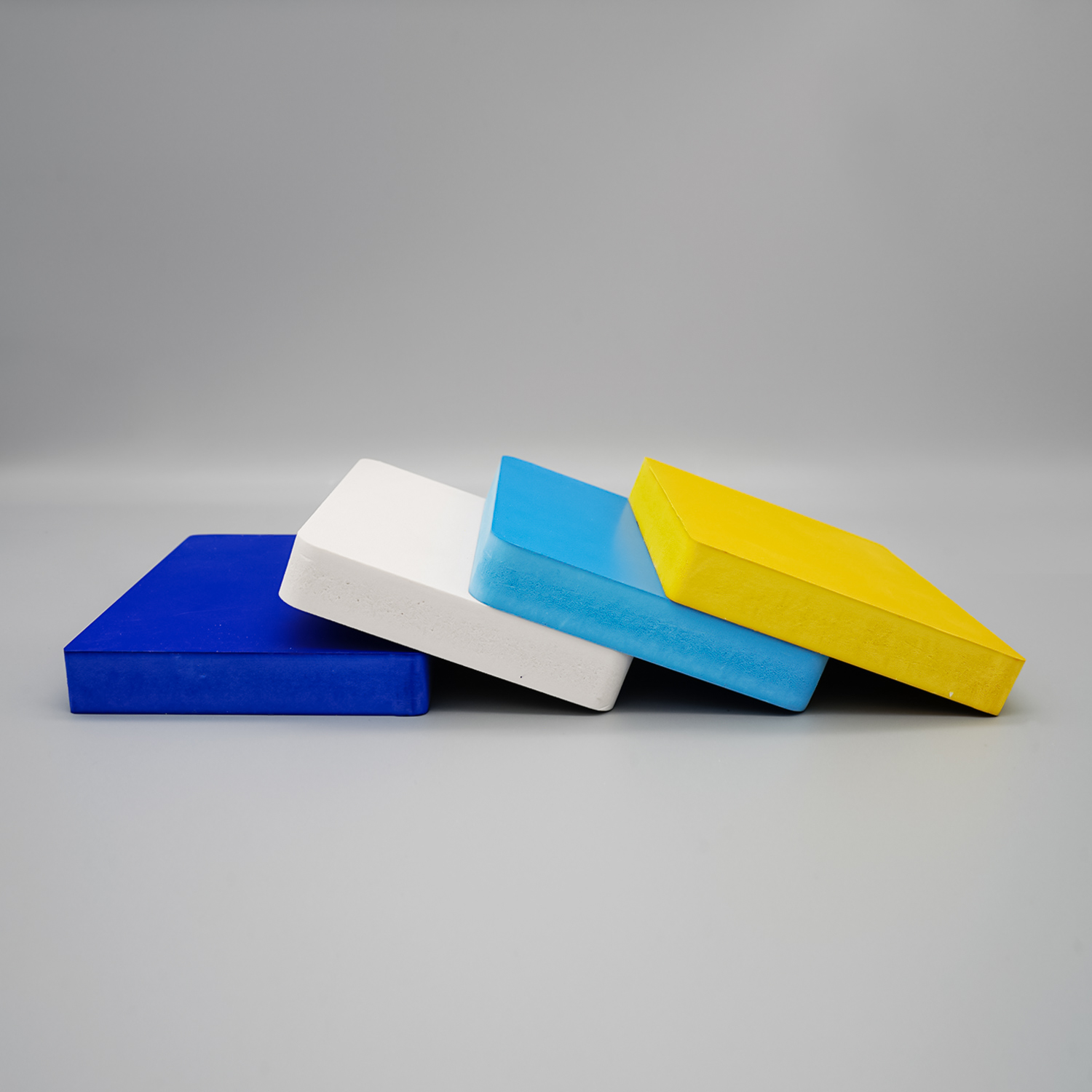
Colour and finish continuity across repeat orders belongs in the acceptance criteria, not in the brochure.
Where the scorecard stops: limits buyers must price in
A framework that only records strengths is a sales document. Four limits apply to this one.
Density figures are not directly comparable between suppliers. A published range such as 0.4–0.9 g/cm³ describes what a supplier can offer, not how a specific board will test. Unless the test method, thickness and board construction are aligned, two suppliers' density numbers should be recorded separately and never averaged into a single benchmark. Buyers should ask for the method and the tolerance, not only the band.
A fire claim is not a fire classification. The product description for this range refers to ignition-retardant and self-extinguishing behaviour. That is a useful statement of intent, but it is not a DIN 4102 or UL 94 result. Programs in regulated construction, transport or public interiors must request the grade-specific report before the scorecard is finalised, and should expect the answer to depend on thickness.
Capacity numbers are self-reported. Output, plant area and headcount are useful for screening and for framing a factory visit, but they are not an audit. A buyer scoring 5/5 on continuity without a site visit has scored a website.
The scorecard does not produce a landed cost. No verified price, freight, packaging or duty data is implied by any dimension here. Commercial scoring measures term stability and predictability; the quotation and freight model must run in parallel, not inside the scorecard.
Celuka board versus wood-based panels: what the substitution actually buys
The comparison buyers actually run is not PVC foam board against another PVC foam board; it is PVC foam board against plywood, MDF and other wood-based panels. On that comparison, Celuka board offers three concrete differences: it weighs approximately one-third of wood of the same thickness, it is specified as waterproof and mildew-resistant, and it is formaldehyde-free.
The limitation is equally concrete. Foamed PVC is a petrochemical material, and its end-of-life route is not equivalent to that of solid thermoplastics or of wood. A buyer should not convert “formaldehyde-free” into “closed-loop”, and should not assume that a sustainability scorecard built around material durability also answers the recyclability question. Where a destination market imposes end-of-life obligations, that needs a separate line in the procurement file.
The engineering limitation matters too. A one-third weight advantage changes handling and installation cost, but it does not mean a timber drawing can be rebuilt in foam board at the same thickness. Load-bearing designs must be recalculated around the board's own rigidity and the fastener pattern, not copied across.
Application fit across a multi-year program
Dingtian's own application breakdown for the board places advertising and signage at 35%, construction and decoration at 30%, furniture and cabinetry at 15%, transportation at 10% and special-purpose applications at 10%. Each block stresses a different part of the scorecard.
Signage and printing demand surface consistency and ink behaviour. The free foam sheet in the range is described as having a smooth, clean white surface with stable surface tension, strong ink adhesion for UV printing, screen printing, laminating and vinyl application, and no ink bleeding or colour fade. Construction and decoration demand humidity performance: the listed working condition for UV-stabilised grades is −20 °C to +60 °C with 100% humidity resistance. Furniture and cabinetry demand density and machining stability, which is where the Celuka models sit. Transportation and special-purpose work often introduce the fire, ESD and restricted-substance requirements that make documentation continuity the deciding dimension.
A program that spans two or more of these blocks should score the supplier once per block. A supplier that is strong in signage substrates and average in cabinetry grades should not receive one blended score that hides the gap.
Market trend: procurement is moving from price to specification
The direction of the category supports this kind of framework. With the PVC foam sheet market estimated at USD 2.28 billion in 2024 and forecast to grow at 4.99% annually through 2035, the competitive pressure shifts from finding any supplier to holding a specification across a longer relationship.
At the same time, the demand mix is concentrated. Signage at roughly 35% of demand means a large share of buyers are purchasing thin, print-facing grades where surface consistency dominates. The remaining share — construction, furniture, transport — is where density, fire documentation and supply continuity decide whether a program survives its second year. Suppliers that publish process-specific ranges, formats from 1220×2440 mm to 2050×3050 mm and thicknesses from 1 mm to 35 mm are responding to that specification-led buying pattern.
Future outlook
Two changes are likely to reshape this scorecard over the next few years. The first is grade-level documentation: buyers are moving from company certificates toward test reports that name the thickness, the density and the method. The second is continuity planning, as buyers treat lead time and MOQ conditions as risk variables rather than as negotiation levers.
Neither change requires new material science. Both require suppliers to publish what they can already prove, and buyers to score what they can already verify. That is a low bar, and it is the one most supplier evaluations still fail.
FAQ
What is PVC Celuka foam board, and how does it differ from free foam board?
Celuka foam board is a rigid cellular PVC sheet produced in a higher density band than free foam board and used where machining and structural behaviour matter. Laird Plastics cites 0.55–0.8 g/cm³ for Celuka board used in furniture and cabinets, against 0.4–0.6 g/cm³ for free foam board used in UV printing and mounting. Dingtian lists its Celuka series in 1–35 mm thickness and 0.4–0.9 g/cm³ density, made from PVC and calcium carbonate, with free foam board offered separately in 1–5 mm for advertising and signage.
What density and thickness should a buyer specify for a long-term Celuka program?
The specification should follow the finished part rather than the catalogue. In the Dingtian range, an 18 mm Celuka sheet is positioned for interior wall cladding and partitions, a 10 mm sheet for advertising letter engraving with a homogeneous core that machines without chipping, and a 5 mm sheet for printing applications where the board weighs about one-third of wood of the same thickness. Buyers should state density band, thickness and tolerance together, and confirm the density test method, because published ranges are not comparable across suppliers unless method and construction are aligned.
How can a buyer verify quality before committing to a long-term agreement?
Dingtian states that samples are available for buyer testing and that factory visits for on-site inspection are welcome. Verification should cover three things in sequence: dimensional and density checks on the sample, machining behaviour on the buyer's own equipment, and a factory visit that confirms the production line for the specific thickness. Because second thermoforming and cutting services are listed as available, a buyer can also test the material after downstream processing rather than only as a flat sheet.
What evidence supports a supplier's ability to sustain volume over several years?
Dingtian reports a 50,000 ton annual output, a 30,000 m² plant, approximately 181 employees, a 20-engineer R&D team and an 80% export ratio, with main markets in Southeast Asia, the Middle East and South/North America. These are company-reported figures. The supporting evidence a buyer should request is production records for the specific thickness and density, checked against a comparable peak month, plus a site visit. The Zibo cluster context — USD 180 million in plastic product exports in 2024 across nearly 500 export-oriented manufacturers, per Qilu Network — describes the regional environment, not an individual supplier's capacity.
What commercial terms apply to repeat PVC foam board orders?
Dingtian accepts T/T and irrevocable sight L/C, with T/T structured as 30% prepayment and the balance against a copy of the bill of lading. Lead time is stated as 7–20 days after receipt of the deposit or the original L/C, depending on order quantity. MOQ is conditional: one pallet is sufficient where the required thickness is already being produced for another customer, and 3 tons where it is not. The company also notes that a 1×20GP container gives a more competitive price than a part-load.
What fire and compliance documentation should a buyer request?
Typical classifications cited for PVC foam board include Class B1/B2 under DIN 4102 and V-0 under UL 94, and lead-free RoHS compliance is a common destination-market requirement alongside UV stabilisation and anti-static ESD protection where applicable. Dingtian specifies its Celuka sheets as formaldehyde-free and made from PVC and calcium carbonate. The product description also refers to ignition-retardant and self-extinguishing behaviour, but no test method or classification certificate is published alongside it. Buyers should request a grade-specific report that names the thickness, the test method, the issuing laboratory and the validity date before treating fire performance as established.
Scoring a supplier, not a brochure
The value of this scorecard is not the total. It is the argument the buyer can have with the total. A supplier that scores well on grade transparency but poorly on documentation continuity is a different risk than one that scores the reverse, and the two should not be reduced to the same number without a note explaining why.
Re-scoring matters as much as scoring. A framework applied once at the start of a program measures a sales presentation; a framework applied at month twelve measures a supply relationship. For buyers standardising on PVC Celuka foam board, that second measurement is the one that protects the program.
Additional technical specifications and the full product range from Zibo Dingtian Plastics Co., Ltd. are available in the company brochure: Dingtian product brochure (PDF). Company information is published at www.dingtianpvcfoamboard.com.
Have Questions or Need More Details?
Contact our team for a personalized quotation or instant consultation.
Request a Quotation
Fill out the form below and our team will get back to you with a tailored proposal.
WhatsApp Direct Chat
Prefer to chat in real-time? Message us on WhatsApp for instant assistance & quick answers.
- Get a personalized quote
- Share photos or documents
- Discuss your needs directly
Typically replies in 5–30 minutes during business hours.