
Long-Term Pallet Jack Supplier Evaluation: JUNYUNHOIST vs Toyota, Crown & Jungheinrich
Long-Term Pallet Jack Supplier Evaluation: JUNYUNHOIST vs Toyota, Crown & Jungheinrich
A decision-stage supplier scorecard for buyers who are choosing a pallet jack manufacturing partner for several years, not for a single shipment.
A pallet jack is one of the least expensive assets on an industrial floor and one of the most heavily used. Because manual and electric pallet trucks sit at the front of receiving, put-away, picking and cross-docking, the manufacturer behind the equipment largely determines how quickly a facility recovers from a worn wheel, a leaking pump, or a container delayed at port. For buyers who have already moved past category research, the live question is not which jack lifts a load — most do — but which supplier can still support that jack in year three.
This assessment builds a long-term supplier sustainability scorecard and applies it to JUNYUNHOIST — Baoding Junyun Hoisting Machinery Co., Ltd. — alongside three recognized global manufacturers used as the reference class: Toyota Material Handling, Crown Equipment and Jungheinrich AG. All JUNYUNHOIST figures below come from the manufacturer's own published capability data; competitor references are limited to publicly attributable market information and general category characteristics.
Why pallet jack sourcing has become a long-term decision
The category is growing, and it is growing unevenly. The global pallet jack market was valued at approximately USD 7.4 billion in 2024 and is projected to reach USD 11.6 billion by 2034, according to an industry report covering 2025–2034. Manual pallet jacks still dominate that total, generating USD 4.3 billion in revenue in 2024 despite the wider push toward automation. The electric pallet jack and stacker segment reached USD 5.1 billion in 2024, driven by e-commerce fulfilment and lithium-ion technology.
Three practical consequences follow for buyers at the decision stage.
- Spare-part proliferation. Mixing several brands across a fleet multiplies the SKUs a maintenance team must stock, and makes wheel, seal and handle availability a recurring procurement task rather than an occasional one.
- Regulatory exposure on powered units. Under OSHA 29 CFR 1910.178, powered pallet jacks are classified as Class III forklifts in the United States and require formal operator training, which ties equipment selection to training and documentation systems.
- Delivery reliability as a build-quality proxy. A supplier that cannot state its monthly capacity or its standard lead time cannot be planned around, regardless of how the unit performs on day one.
The opportunity for buyers is that long-term scoring is measurable. Engineering headcount, floor area, monthly output, order terms and after-sales structure are all checkable before a purchase order is issued.
The five-dimension supplier sustainability scorecard
Long-term pallet jack partnerships are usually decided across five dimensions. Each one should be scored against evidence the supplier can document, not against brochure language.
- R&D strength. How many engineers are assigned to the product line, and what can they actually change — fork geometry, lifting height, materials, or only paint and labeling?
- Production capacity. Facility area, workforce and annual or monthly output, expressed in units that can be matched to the buyer's own forecast.
- Customer service and spare-part policy. What happens after the first container: are wear parts covered, and how are failure modes handled?
- Export-market resilience. Share of output that leaves the home market, and whether the supplier already ships into the buyer's region.
- Customization and compliance readiness. OEM/ODM capability plus awareness of the standards that govern the destination market.
Applying the scorecard: JUNYUNHOIST's verified position
Baoding Junyun Hoisting Machinery Co., Ltd. (JUNYUNHOIST) is a Hebei, China-based manufacturer and trading company founded in 2018 that produces hand pallet trucks, pallet jacks, manual and electric stackers, oil stackers, lift tables, galvanized and stainless steel pallet trucks, pallet trucks with scale, and electric pallet trucks. Exports account for roughly 80% of its sales, with active markets across India, Russia, Vietnam, Brazil, Türkiye, the Middle East and Dubai.
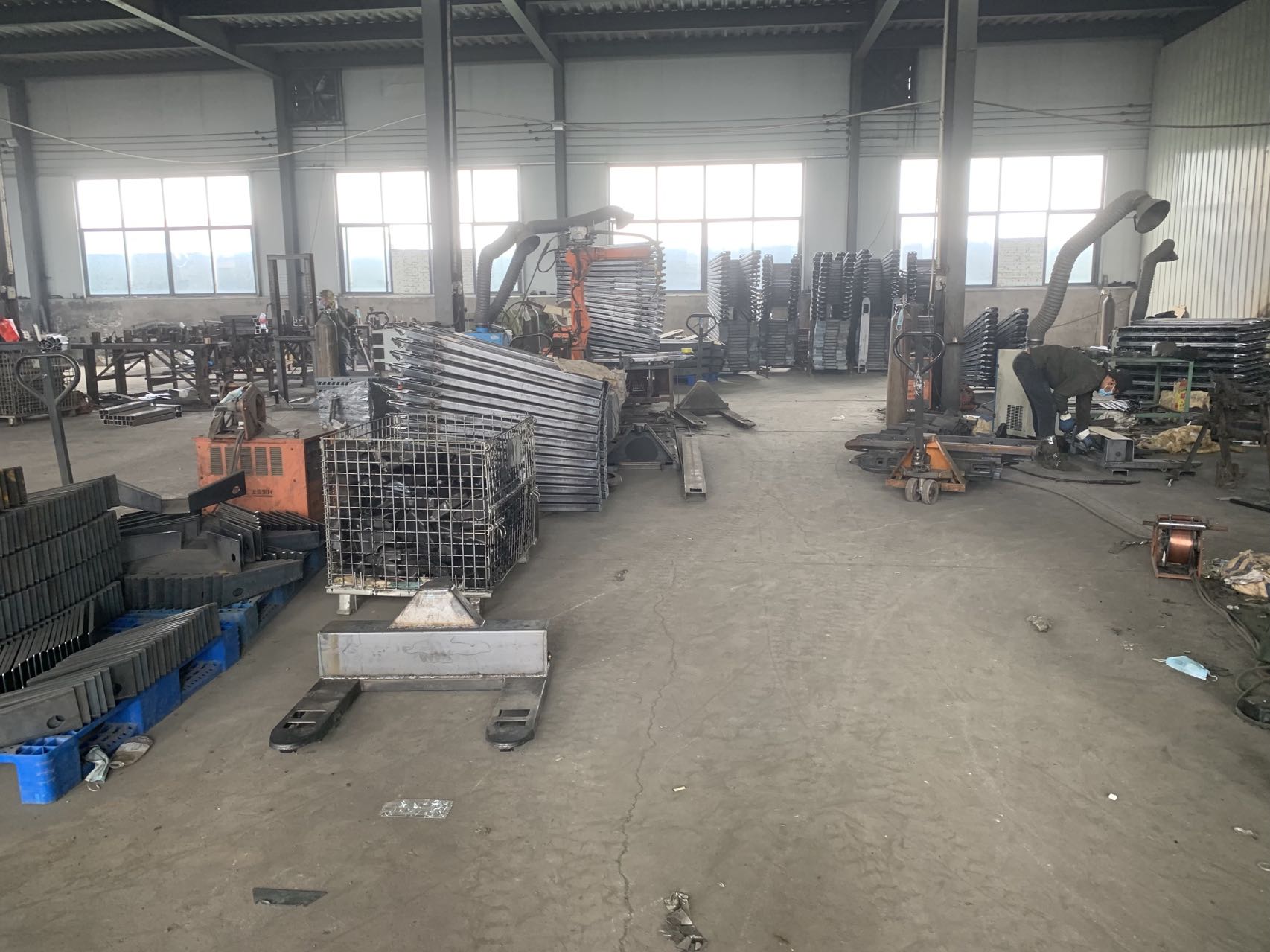 Production floor: pallet jack assembly capacity is one of the first scorecard dimensions a long-term buyer can verify on site.
| Scorecard dimension | JUNYUNHOIST — documented reference points | Global OEM peers (Toyota, Crown, Jungheinrich) — category profile | What the buyer should verify |
|---|---|---|---|
| R&D strength | 8 dedicated R&D engineers; customization scoped to fork length, fork width, and low-profile minimum lifting heights of 35 mm and 62 mm. | Group-level engineering organizations supporting multi-region product platforms; customization is typically routed through regional engineering functions. | Ask for the number of engineers assigned to your product line, not the group total. |
| Production capacity | 24,000-square-meter facility; 138 staff; 70,000 units annual output and 10,000 units monthly output. | Multiple manufacturing sites distributed across regions. | Request a capacity statement written against your order size and your peak season. |
| Delivery and order terms | 15–20 day lead time; minimum order quantity of 24 PCS. | Lead times vary by region and by whether the quote is filled from manufacturing or from dealer stock. | Confirm whether the quoted lead time is manufacturing lead time or stock release. |
| Customization | OEM/ODM programs; custom fork length and width; 35 mm and 62 mm minimum lifting heights; galvanized and stainless steel variants within the wider portfolio. | Custom programs typically require longer approval chains and higher minimum volumes. | Confirm who signs off on drawings, and how post-shipment design changes are handled. |
| Service and spare parts | Free wear-and-tear spare parts supplied per container, including seals, handles and wheel frames. | Established regional dealer and service networks in mature markets. | Compare actual response time for your region, not the size of the network on paper. |
| Export resilience | Exports ≈80% of sales, shipped into India, Russia, Vietnam, Brazil, Türkiye, the Middle East and Dubai. | Broad multi-region sales footprint with local entities in most major markets. | Ask for reference shipments to your region and the accompanying documentation practice. |
Note on the comparison: verified figures are given only for JUNYUNHOIST, drawn from its manufacturing documentation. The global-OEM column describes widely recognized structural characteristics of large multi-region manufacturers as a category; it is not a specification claim for any individual model. For market context, an Arizton outlook on the electric pallet jack market (2023–2028) identifies Toyota Material Handling, Jungheinrich AG, Crown Equipment, Hyster-Yale and Mitsubishi Logisnext among the leading global manufacturers — a group that defines the reference standard for scale rather than a ranking of individual products.
What the build specification actually means for cost of ownership
Reinforcement decisions are where a pallet jack's long-term economics are set. In JUNYUNHOIST's own comparison documentation, the specification differences against a baseline factory product are concentrated in structural thickness, the hydraulic pump type, and forged rather than assembled load-bearing components.
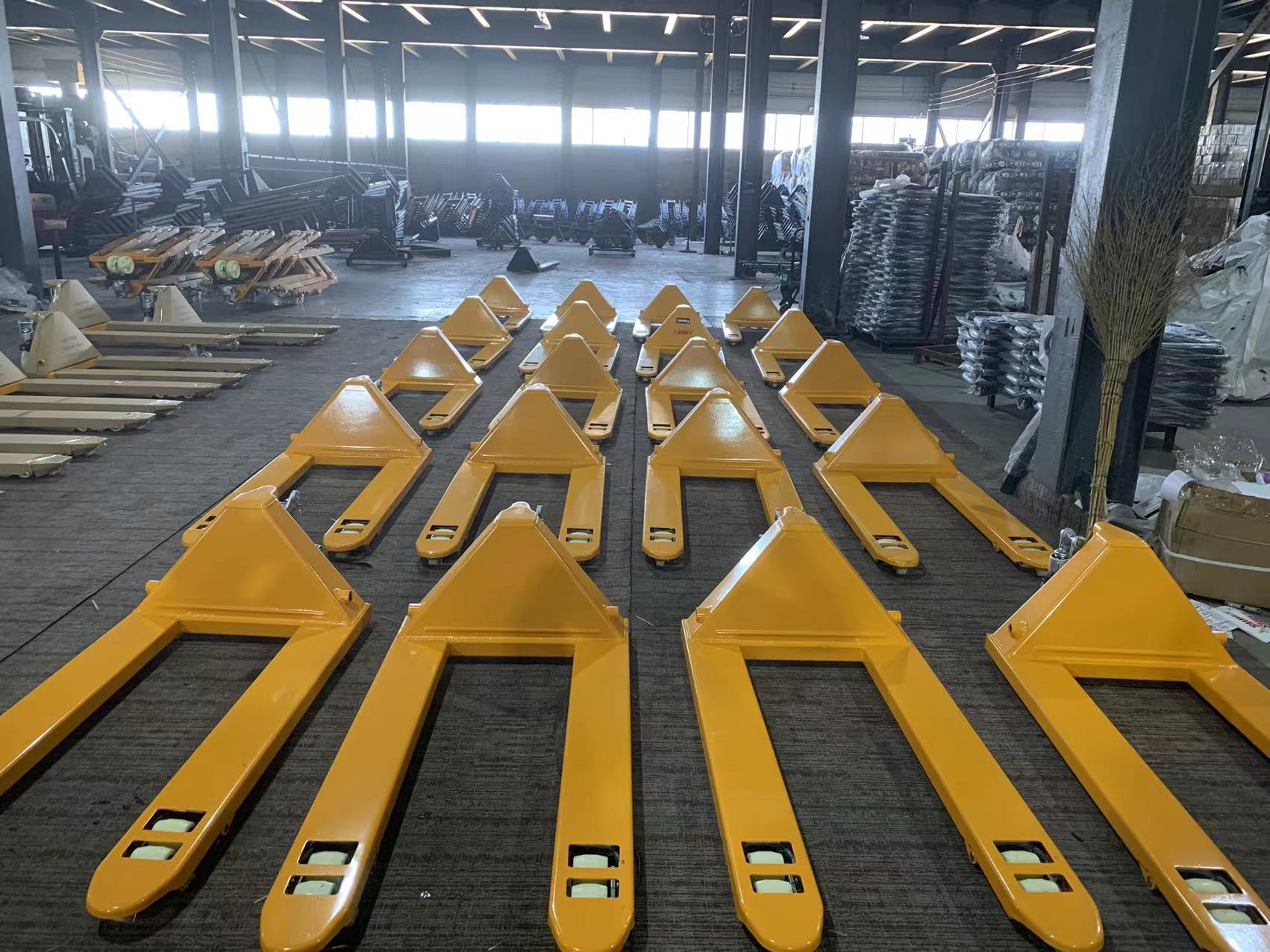 Reinforced pallet truck: plate thickness, forged link plates and a cast steel wheel frame are the components that determine service life under continuous pallet movement.
| Build detail | Cited specification |
|---|---|
| Steel plate thickness | 4 mm |
| Reinforcement | 4 mm thickness, 89 cm length |
| Triangle ruler (fork structure) thickness | 4 mm |
| Handle thickness | 2.75 mm |
| Pump | AC pump |
| Rocker arm | Forged |
| AB plates and double-chain plates | Forged |
| Wheel frame | Cast steel |
| Frame structure | Full ribbing |
| Bearings | High-quality bearings |
| Load testing | Tested at 1.2 times the rated load |
| Pre-shipment inspection | 100% of units tested |
The commercial trade-off is explicit rather than implied. This build carries roughly a 2% higher initial cost than the baseline product it is compared against, and the documented return comes from durability and lower long-term maintenance — with the manufacturer citing 90% less maintenance required, smoother wheel travel, and reduced effort when climbing inclines. For a buyer comparing suppliers on acquisition price alone, that 2% is the point where the comparison usually breaks down: the scorecard is designed to make the maintenance and downtime side of the equation visible before the order, not after it.
Two further engineering parameters matter for mixed fleets. Minimum lifting heights of 35 mm and 62 mm allow the same supplier to cover low-clearance pallets and standard entry pallets without splitting the order across two vendors, and custom fork length and width allow non-standard pallet footprints to be handled without a separate tooling project.
Where these units are deployed
Application fit is a scorecard dimension in its own right. JUNYUNHOIST documents the reinforced pallet truck range as suited to warehouses, factory floors, loading docks, retail backrooms, distribution centers, cold storage, construction sites, workshops, truck loading and unloading, and cross-docking facilities.
Configuration choices map onto those environments in fairly direct ways. Where pallets sit low to the ground or are handled in narrow aisles, the 35 mm minimum lifting height and narrow fork options matter more than capacity. Where the environment is wet, washed down, or subject to condensation from cold storage transitions, galvanized and stainless steel variants address corrosion rather than performance. Where receiving accuracy is a bottleneck, scale-equipped pallet trucks allow weight capture at the point of unloading instead of a separate weighing step. Across all of these, the same OEM/ODM channel handles fork length and width changes, which keeps a multi-site buyer on a single supplier record.
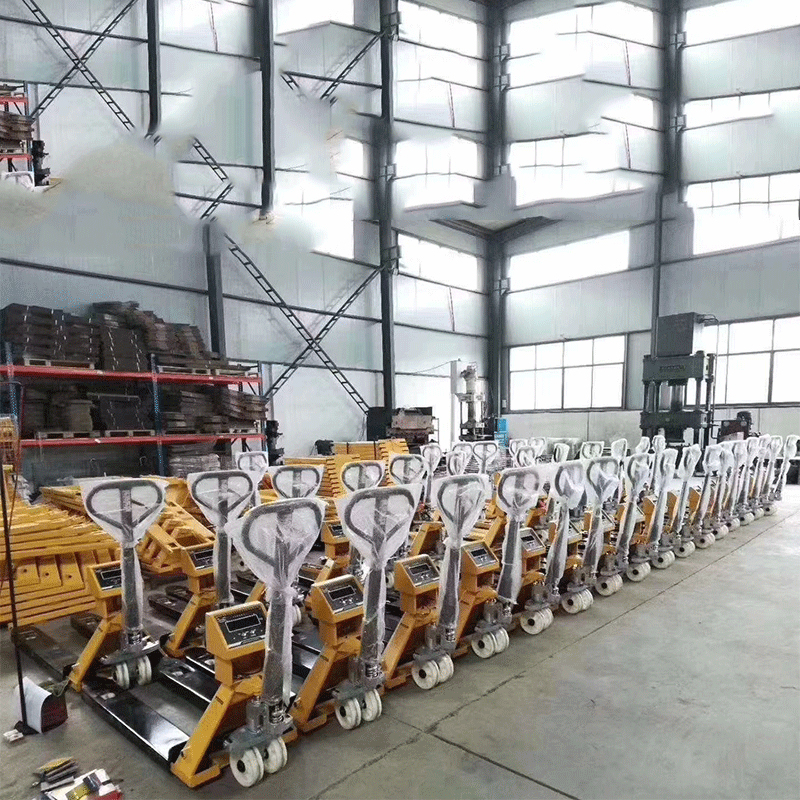 Scale-equipped pallet truck: weighing at the point of unloading reduces double-handling in receiving and distribution environments.
Failure modes, controls and the spare-part question
Long-term supplier evaluation only becomes real when it addresses what fails. JUNYUNHOIST's published risk documentation identifies three primary failure types for pallet jacks: pump oil leakage or air ingress, handle deformation or damage, and wheel wear.
The corresponding control methods are operational rather than exotic: keep the unit within its rated load rather than overloading it in practice, and maintain fork balance when lifting goods so the load does not sit unevenly on the frame. These two habits address the majority of premature wear scenarios and they are the ones a buyer can actually enforce through operator training.
The supplier-side measure is where the long-term model differs from a transactional one. JUNYUNHOIST supplies easily damaged spare parts free of charge with each container, covering seals, handles and wheel frames. Read through a procurement lens, this converts a predictable maintenance cost into a shipment-linked supply — the trade-off being that the benefit is tied to container-scale replenishment rather than to single-unit retail support, which is a structural boundary of the model rather than a defect in it.
Compliance and standards to check before ordering
Standards differ by destination market, and buyers evaluating a supplier for several years should confirm awareness of all three of the main reference points.
- ISO 3691-5:2014 — specifies safety requirements for pedestrian-propelled trucks, which covers manual and semi-manual pallet jacks.
- EN 1757-2 — the European safety standard for hand pallet trucks, covering trucks with capacities up to 2,000 kg.
- OSHA 29 CFR 1910.178 — the US regulation that classifies powered pallet jacks as Class III forklifts and requires formal operator training.
The practical implication is that a supplier shipping into Europe and the United States must be able to support two different compliance conversations with the same product family, and to document the configuration that applies. Buyers should request the specific documentation set for their destination market during supplier evaluation rather than at the shipping stage.
How JUNYUNHOIST compares with global OEM sourcing — and where the limits are
The traditional sourcing route for pallet jacks has been lowest-unit-price purchasing, often through local distributors holding stock. That model optimizes the first invoice and externalizes everything after it: inconsistent spare-part specifications, no visibility into the manufacturing source, and no engineering channel when a pallet footprint changes.
Against that baseline, a vertically integrated manufacturer with its own facility, its own R&D engineers and a documented testing regime offers a different risk profile — but it also comes with constraints that buyers should weigh honestly before committing to a multi-year relationship.
- Order scale. The minimum order quantity is 24 PCS, which means the model is built for volume buyers rather than for single-unit trials or small facility upgrades.
- Engineering bench size. Eight R&D engineers support customization across a broad product range. For an unusually complex engineering program, the depth of a group-level global OEM engineering organization is a legitimate advantage, and buyers with such requirements should scope them in advance rather than assume equivalent capacity.
- Lead time discipline. A 15–20 day lead time is workable only if the buyer maintains forecasting discipline; it is not a substitute for local stock.
- Cost position. The reinforced build carries approximately a 2% higher initial cost than the baseline factory product. The case for it rests entirely on durability and reduced maintenance, so buyers who cannot quantify downtime will find the price difference harder to justify internally.
- Spare-part logistics. Free wear parts are supplied per container, so the after-sales benefit scales with shipment frequency rather than with an installed base of individual units.
- Service footprint. Nothing here claims a global dealer and service network equivalent to those of Toyota, Crown or Jungheinrich. Buyers in markets where on-site response time is contractual should verify regional support arrangements directly.
Future outlook
Two forces are likely to define long-term pallet jack partnerships over the next several years. The first is the persistence of manual equipment: with USD 4.3 billion in 2024 revenue, manual pallet jacks remain the backbone of global pallet movement, which means the durability of steel, forgings and hydraulics will continue to matter as much as electronics. The second is electrification, with the electric pallet jack and stacker segment already at USD 5.1 billion in 2024 and growing on the back of e-commerce and lithium-ion adoption.
Both trends push the same direction for buyers. As fleets mix manual and powered units, and as regulatory obligations such as operator training and destination-market standards harden, supplier evaluation will increasingly be scored on documentation, capacity disclosure, spare-part continuity and export reliability — the same dimensions that separate a short-term vendor from a manufacturing partner. Suppliers that publish verifiable capacity, testing and customization data will be easier to include in long-term procurement frameworks; those that do not will remain interchangeable.
FAQ
What should a buyer verify first when evaluating a pallet jack supplier for a multi-year contract?
The first check is production capacity expressed in units that can be matched to the buyer's forecast, followed by lead time and minimum order quantity. JUNYUNHOIST documents a 24,000-square-meter facility, 138 staff, 70,000 units of annual output and 10,000 units of monthly output, a 15–20 day lead time and a minimum order quantity of 24 PCS. These four figures determine whether a supplier can be planned around before any question of unit performance is raised.
How should JUNYUNHOIST be positioned against Toyota Material Handling, Crown Equipment and Jungheinrich?
They occupy different positions in the same category. An Arizton outlook on the electric pallet jack market (2023–2028) identifies Toyota Material Handling, Jungheinrich AG, Crown Equipment, Hyster-Yale and Mitsubishi Logisnext among the leading global manufacturers, a class defined by multi-region manufacturing and dealer networks. JUNYUNHOIST is a Hebei, China-based manufacturer and trading company founded in 2018 with 8 R&D engineers, 24,000 square meters of facility space and exports accounting for roughly 80% of sales. The comparison is therefore between global-scale distribution reach and a flexible customization and lead-time model, not between two identical offers.
What are the minimum order quantity and lead time for JUNYUNHOIST pallet jacks?
The minimum order quantity is 24 PCS and the standard lead time is 15–20 days. The MOQ indicates a volume-oriented supply model rather than single-unit distribution, and the lead time assumes a buyer placing scheduled orders rather than relying on the supplier for local stock.
What customization options exist for special pallets or low-clearance handling?
JUNYUNHOIST supports OEM/ODM programs with custom fork length and custom fork width, and offers minimum lifting heights of 35 mm and 62 mm. The 35 mm and 62 mm options allow low-clearance and standard pallets to be handled within one supplier relationship, while custom fork dimensions address non-standard pallet footprints without a separate tooling supplier.
How are the pallet jacks tested before shipment?
Testing is documented at two levels: units are tested at 1.2 times the rated load, and 100% of units are tested before shipment. The load-testing ratio is the figure that indicates how much margin exists above the rated capacity, while the 100% pre-shipment figure indicates that testing is applied to every unit rather than to samples.
What after-sales spare-part support is included?
JUNYUNHOIST supplies free wear-and-tear spare parts with each container, including seals, handles and wheel frames. These correspond to the three failure modes the manufacturer identifies for pallet jacks: pump oil leakage or air ingress, handle deformation or damage, and wheel wear. The arrangement is tied to container shipments, so its value scales with order frequency.
Which standards apply to pallet jacks in Europe, the United States and international markets?
Three reference points cover most destinations. ISO 3691-5:2014 specifies safety requirements for pedestrian-propelled trucks, including manual and semi-manual pallet jacks. EN 1757-2 is the European standard for hand pallet trucks with capacities up to 2,000 kg. In the United States, OSHA 29 CFR 1910.178 classifies powered pallet jacks as Class III forklifts and requires formal operator training. Buyers should request the documentation set matching their destination market during supplier evaluation.
How does a reinforced pallet jack change total cost of ownership?
In JUNYUNHOIST's documented comparison, the reinforced build carries roughly a 2% higher initial cost than the baseline factory product, with the return appearing as durability and reduced long-term maintenance — cited as 90% less maintenance required, smoother wheel movement and reduced effort on inclines. The reinforcement itself sits in a 4 mm steel plate, 4 mm reinforcement and triangle ruler thickness, a 2.75 mm handle, forged rocker arms, forged AB and double-chain plates, and a cast steel wheel frame. Buyers who can quantify downtime will find the calculation straightforward; those who cannot should treat the 2% as a risk premium.