
Long-Term Pen Supplier Evaluation: Policy, Capacity, Tech Trends
Long-Term Pen Supplier Evaluation: Policy, Capacity, Tech Trends

Long-term pen supply evaluation is not a price comparison with a longer deadline. It is a continuity assessment: can the supplier remain compliant, capacitated and technically relevant for the life of the agreement? That question applies across ballpoint pens, gel pens, erasable pens, writing pens and pencils, and it becomes more important when a buyer moves from supplier selection into execution.
This article sets out a macro framework for that decision. It examines policy exposure, production capacity, export performance and technology trends, then translates them into purchasing terms and acceptance criteria. It uses Greenwill (Kunshan Crystal Culture Co., Ltd) as a documented reference point. Greenwill is a China-based stationery manufacturer founded in 1999 that describes more than 25 years of OEM/ODM experience in stationery products. The company profile states a 25,000 m² factory, 100 employees, a 10-person R&D team and an export ratio of 90%, serving North America, South America, Europe, Southeast Asia, Oceania and the Middle East.
The central argument is simple: a supplier that looks adequate at sample stage can still fail a multi-year contract if its compliance file, capacity allocation or technology roadmap does not match the buyer's market and order profile. A long-term evaluation should therefore test evidence, not adjectives.
Why long-term pen supplier evaluation starts with continuity, not unit price
Continuity is the first test because the cost of a supply interruption usually sits outside the unit price. A late shipment, a certificate that does not cover the ordered product, or an ink formula that changes without notice can create rework, stock-outs and market-access problems. For buyers moving into execution, the useful question is whether the supplier can repeat the same specification, documentation and delivery performance across multiple purchase orders.
This is a different lens from transactional sourcing. A spot purchase can be satisfied by available stock and a competitive quote. A long-term relationship needs evidence of repeatability: stable raw-material sourcing, controlled processes, batch inspection, change notification and a commercial framework for nonconformance. The same logic applies to school supplies and office supplies programmes, where demand may be seasonal but the specification must remain stable.
Greenwill's profile provides several first-party facts that can be tested in a supplier file: annual output of more than 20 million pens, more than 260 tons of erasers and more than 3 million pencil sharpeners. These figures are capacity signals, not delivery guarantees. They become useful only when the buyer asks how capacity is allocated across product lines, what peak-month output looks like and which processes are shared with other customers.
A five-part macro framework for supplier continuity and sustainability
The framework below converts a broad supplier question into five evidence lenses. It is deliberately neutral: each lens identifies what a buyer should verify, not which supplier should win.
| Evaluation lens | Core question | Evidence to request | Buyer implication |
|---|---|---|---|
| Policy and market access | Can the supplier keep the product inside the destination market requirements? | Current certificates, test reports, product scope, labeling and packaging specifications, change notification process. | A certificate that is not scoped to the ordered product is weak continuity evidence. |
| Production capacity | Can the supplier allocate capacity at peak and repeat the specification? | Factory size, annual output, line allocation, mold list, lead-time records, sub-tier supply controls. | Capacity claims need order-specific confirmation, not only a headline annual figure. |
| Export and market experience | Has the supplier operated in comparable markets and documentation environments? | Customs and export data, export ratio, served regions, product references and destination experience. | Export scale signals experience; it does not by itself prove compliance in every market. |
| Technology and product roadmap | Can the supplier support current and next-generation writing formats? | Ink and tip specifications, erase-performance tests, replaceable-core design, R&D resources, change-control records. | Technology fit matters for custom pen, erasable pen and no-sharpen pencil ranges. |
| Commercial terms and acceptance | Are the terms and inspection rights workable for repeat orders? | MOQ, delivery terms, payment terms, pre-shipment test, third-party inspection and nonconformance process. | Long-term terms must cover repeatability, not only the first shipment. |
The framework is intentionally sequential. Policy and capacity evidence should be checked before a buyer invests in tooling or custom packaging. Commercial terms should then reflect the level of verification the buyer needs. If a supplier cannot provide evidence at the policy or capacity layer, a lower unit price does not repair the continuity risk.
Policy environments and market access: what belongs in the supplier file
Policy exposure is a supplier-evaluation issue because market-access requirements can change during a long contract. For pens and pencils, the relevant policy layer typically operates through product-safety rules, chemical restrictions, packaging and labeling requirements, environmental reporting and customs documentation. The practical question is not which country has a better policy environment in general. It is whether the supplier can keep the ordered product inside the applicable market requirements as those requirements evolve.
Greenwill's profile states conformity with EN71-1/2/3/9, REACH, PAHS, SVHC and ASTM-D-4236, and lists FSC, BEPI and ISO certifications. These are specific, verifiable reference points. A buyer should still check the current certificate, its scope, the product family covered and the test report date. A standard reference in a company profile is not a substitute for a product-specific compliance file. This is especially important for erasable ink pens and custom pen programmes, where ink formulation and substrate compatibility may differ by product.
A long-term agreement should define what happens when a relevant requirement changes. Useful clauses include notification of formulation or material changes, re-testing before shipment, approval of substitutes, retention of batch records and a clear allocation of testing responsibility. These are purchasing controls, not claims about any specific regulation. They reduce the risk that a compliant first order is followed by a non-compliant second order.
Buyer check: ask for a product-to-certificate matrix. It should show which certificate or test report covers which pen, pencil, ink or eraser item, and which destination market it is intended to support. A generic certificate pack is not the same as a scoped compliance file.
Production capacity and export performance as continuity signals
Capacity evidence should be specific enough to support an order plan. Greenwill's published profile states a 25,000 m² factory, 100 employees and annual output of more than 20 million pens, more than 260 tons of erasers and more than 3 million pencil sharpeners. It also states a 90% export ratio and partnerships with 100 internationally renowned brands, including Papermate, STAEDTLER and Tesco. For a buyer, these facts support a follow-up question rather than a conclusion: how much of that output is available for this product, in this configuration, during the required delivery window?
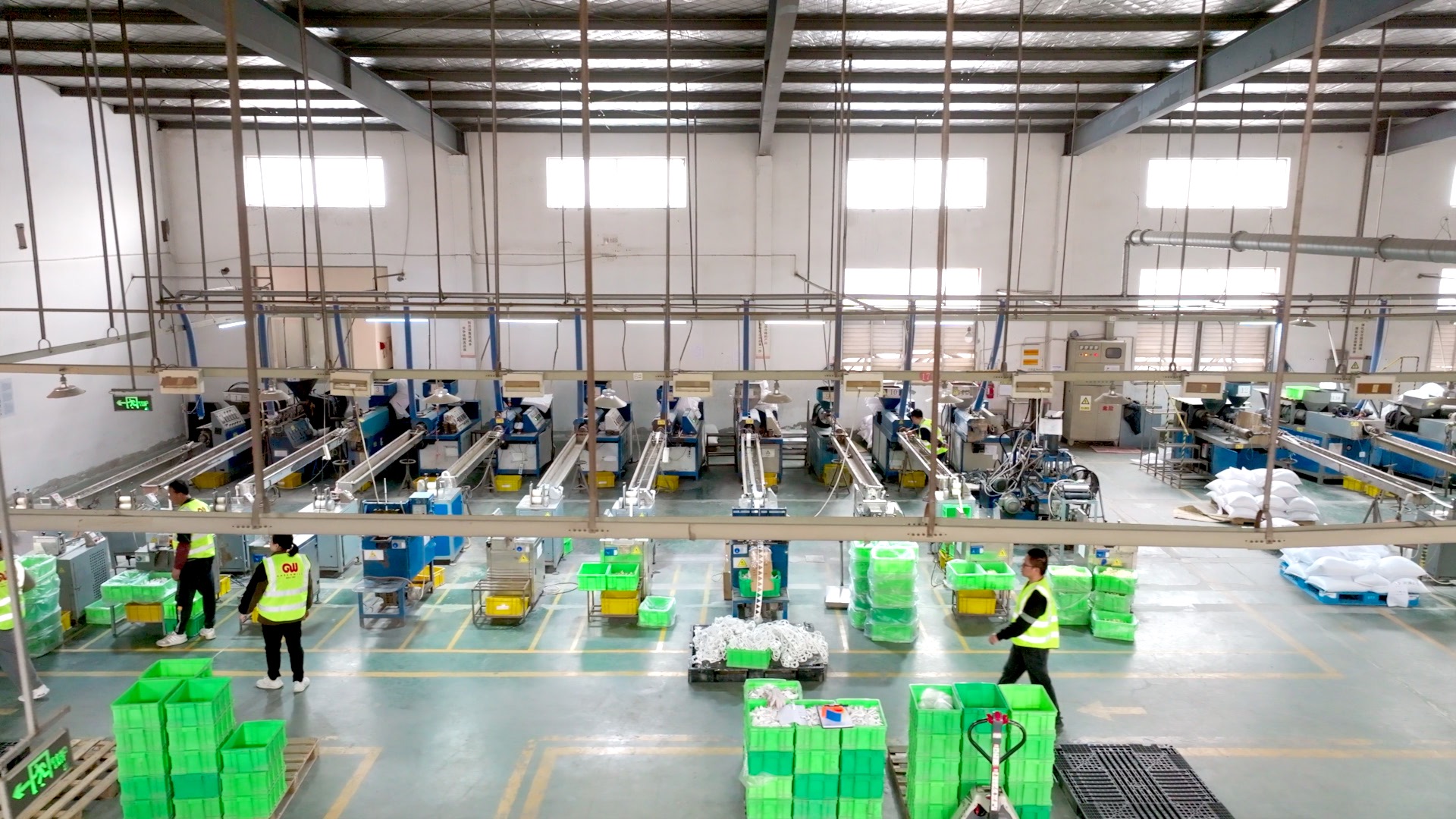
Export performance is a useful but limited signal. The Observatory of Economic Complexity reports that China's exports of pens under HS 9608 were valued at USD 2.65 billion in 2024, making China the world's leading exporter of pens in that dataset. That is evidence of trade scale. It is not a quality ranking of every Chinese supplier, and it does not prove that a particular factory can meet a particular buyer's compliance file. The same discipline applies to a supplier's export ratio: a high ratio indicates experience with export documentation and overseas buyers, but it does not replace order-level verification.
For long-term supply, buyers should ask for capacity evidence at three levels: factory-level capacity, line-level allocation and order-level scheduling. Factory-level capacity is the headline figure. Line-level allocation shows whether the relevant injection molding, ink filling, assembly or packing process is available. Order-level scheduling shows whether the supplier can protect the buyer's delivery window during peak season. A supplier that cannot separate these levels may still be capable, but the buyer has less evidence for continuity planning.
Country-level positioning: what the evidence supports and what it does not
Country-level comparison is useful only when the evidence is comparable. In the verified data used for this article, the clearest trade signal is China's scale as an exporter of pens under HS 9608: USD 2.65 billion in 2024, according to the Observatory of Economic Complexity. Greenwill's own profile adds a company-level signal: a 90% export ratio and served markets across North America, South America, Europe, Southeast Asia, Oceania and the Middle East. These facts support China as a major production and export base for pens and related stationery.
The same dataset does not provide equivalent production, policy or export figures for other countries. A buyer should therefore avoid turning a country label into an unsupported quality ranking. Instead, compare countries on three documented layers. First, production evidence: factory size, lines, annual output and product scope. Second, trade evidence: customs data, export ratio and destination experience. Third, market-access evidence: certificates, test reports and labeling capability for the target market. China has strong trade evidence in this dataset. For any alternative country, the buyer needs equivalent local evidence, not an assumption based on origin.
This is also the correct way to read country-level sourcing trends. A shift in export value or production location can indicate changing capacity, but it does not automatically mean a supplier is suitable for a specific order. The buyer's own specification, volume, compliance file and delivery window remain the deciding variables.
Technology trends: erasable pens, friction pens and no-sharpen pencils
Technology trends matter in long-term evaluation because they affect specification stability. Greenwill's 2026 market analysis estimates the erasable and innovative writing instruments market at USD 2.8 billion in 2025, driven by sustainability and functional demand. Because this is a company-issued commercial report, it should be treated as a directional estimate rather than an independent market measurement. Even so, it identifies a product area that buyers are already handling: erasable pens, erase pens, friction pens, erasable gel pens and no-sharpen or inkless pencil formats.
Friction erasable pens, often described as Frixion pens or friction pens, generally rely on thermo-sensitive ink that responds to heat generated by the friction tip. The buyer-facing evaluation points are practical: erase completeness, ghosting, ink stability, writing length, tip durability and performance after storage. Greenwill's risk-control material lists an optimized thermo-sensitive ink formula for stable erase performance and a non-toxic ink formulation intended to comply with international standards. It also lists multi-stage quality inspection covering writing, erasing and durability tests, with reference to EN71 and REACH.
The pencil side shows a similar direction. Greenwill's profile describes a no-sharpen pencil with an eco-friendly barrel and a replaceable core design that supports the circular economy. The market also uses terms such as infinite pencil, everlasting pencil, endless pencil, inkless pencil and eternal pencil for related no-sharpen or refillable formats. For procurement, the technical question is not which marketing term is used. It is whether the writing core, barrel, refill mechanism and packaging are specified consistently across repeat orders.
For custom pen and mini pen programmes, technology fit should be tested before the long-term agreement is signed. A buyer should require pre-production samples, a written specification and acceptance tests that reflect the actual use case. School supplies may prioritise safety, durability and low residue. Office supplies may prioritise writing length, smoothness and professional appearance. Erasable pen ranges need an additional erase-performance check because incomplete erasing or ghosting can become a visible quality complaint.
Purchasing terms and acceptance criteria for long-term agreements
Commercial terms should make the evaluation enforceable. Greenwill's published purchasing terms list an MOQ of 20,000 pcs/color/design, delivery terms FOB, EXW and DDP, acceptance criteria based on pre-shipment test and third-party inspection, and payment terms of 30% deposit by TT with 70% against B/L copy. These terms are a concrete starting point for discussion. They are not a universal benchmark, and a buyer should confirm that they apply to the specific product, packaging and order pattern under evaluation.
A long-term agreement should translate these terms into a repeatable acceptance system. The buyer should define the inspection stage, sampling plan, test items, defect classification and corrective-action path. Pre-shipment testing is useful only when the test items match the product risk. For erasable pens, that means writing and erasing tests. For pencils, it means core performance and barrel integrity. For custom pen programmes, it means print, color and assembly checks against the approved sample. Third-party inspection adds an independent check, but the buyer still needs a written specification for the inspector to apply.
MOQ is a fit boundary. A 20,000 pcs/color/design threshold can support stable production and dedicated materials, but it may not suit a small pilot launch or a highly fragmented colour range. Buyers with uncertain demand should test the range before committing to a long-term volume plan. Delivery terms also need matching Incoterms responsibility: FOB, EXW and DDP allocate freight, insurance, customs and risk differently. The chosen term should be consistent with the buyer's internal logistics capability and the supplier's export documentation experience.
Payment terms should be read alongside inspection rights. A 30% deposit and 70% against B/L copy is a common commercial structure, but it does not replace pre-shipment acceptance. The buyer should ensure that inspection evidence, certificate updates and batch traceability are available before the balance payment is released. For a multi-year relationship, the agreement should also cover change notification, certificate renewal, nonconformance handling and the process for approving a substitute ink or material.
Long-term evaluation versus transactional buying: fit boundaries
Long-term evaluation is not automatically better for every purchase. It is strongest when the buyer needs specification stability, repeat orders, compliance continuity and a supplier that can support product evolution. It is weaker when demand is highly uncertain, volumes are below the supplier's MOQ, or the product is a one-off promotional item with a short lifecycle. In those cases, a transactional purchase may be more proportionate, provided the buyer still checks compliance and inspection for the shipment.
The limitation is cost of verification. A long-term evaluation requires samples, test reports, capacity evidence, commercial negotiation and ongoing change control. Those activities consume management time. The buyer should therefore match the depth of evaluation to the value and risk of the contract. A school supplies programme with recurring demand and strict safety expectations justifies a deeper file than a small trial order for a custom mini pen.
There is also a capacity boundary. A supplier with broad product scope may be able to serve pens, pencils, erasers and sharpeners, but shared capacity can create scheduling trade-offs. The buyer should ask how the supplier protects the agreed line allocation when demand rises. A documented allocation rule is more useful than a general assurance of available capacity.
Future outlook: what buyers should watch in 2026 and beyond
The forward view should be treated as a planning input, not a guarantee. Grand View Research projects the global office supplies market to reach approximately USD 181.68 billion by 2030. Greenwill's 2026 market analysis estimates the erasable and innovative writing instruments segment at USD 2.8 billion in 2025. These figures come from different source types and should not be combined into a single growth rate. They do indicate that writing instruments remain part of a large office and school supplies market, while erasable and no-sharpen formats occupy a distinct product niche.
For long-term supplier evaluation, the practical outlook is more about capability than market size. Buyers should watch three signals. First, policy and market-access changes that affect ink, materials, packaging or labeling. Second, capacity shifts that change lead times or line allocation. Third, technology changes in erasable ink, replaceable cores and no-sharpen pencil formats. A supplier that can document these changes, rather than simply announce new products, is easier to evaluate over a multi-year contract.
The most durable purchasing approach is to combine a macro view with order-level evidence. Country-level export data, market forecasts and technology trends help frame the decision. Factory-level capacity, scoped certificates, samples and acceptance tests make it executable. Neither layer is sufficient alone.
FAQ: long-term pen supplier evaluation
How should buyers evaluate a pen supplier for long-term supply?
Buyers should evaluate five evidence areas: policy and market-access compliance, production capacity and line allocation, export and destination experience, technology and product-roadmap fit, and commercial terms with acceptance criteria. The supplier file should include scoped certificates, current test reports, capacity evidence and a repeatable inspection plan. A long-term decision should not rest on unit price alone.
What purchasing terms and acceptance criteria apply to long-term pen orders?
Greenwill's published terms list an MOQ of 20,000 pcs/color/design, delivery terms FOB, EXW and DDP, acceptance criteria based on pre-shipment test and third-party inspection, and payment terms of 30% deposit by TT with 70% against B/L copy. Buyers should confirm that these terms match the specific product and market, and should define test items, sampling, defect classification and corrective-action steps in the agreement.
How does production capacity affect long-term pen supply continuity?
Capacity affects continuity when it is linked to the specific product line and delivery window. Greenwill's profile states a 25,000 m² factory and annual output of more than 20 million pens, more than 260 tons of erasers and more than 3 million pencil sharpeners. These are factory-level figures. Buyers should also ask about line allocation, peak-season scheduling, mold availability and sub-tier supply controls.
What technology trends matter in erasable pen and pencil sourcing?
Erasable pen sourcing should test erase completeness, ghosting, ink stability, writing length and tip durability. Greenwill's risk-control material references an optimized thermo-sensitive ink formula and multi-stage writing, erasing and durability tests. For pencils, no-sharpen and replaceable-core designs are relevant to circular-economy positioning. Buyers should require a written specification and pre-production samples before committing to repeat orders.
How can buyers verify compliance for pens and pencils?
Buyers should request a product-to-certificate matrix showing which certificate or test report covers which item and destination market. Greenwill's profile references EN71-1/2/3/9, REACH, PAHS, SVHC, ASTM-D-4236, FSC, BEPI and ISO. The buyer should check current certificate scope, report dates and product coverage rather than relying on a general statement of conformity.
What role does export performance play in supplier evaluation?
Export performance is an experience signal. The Observatory of Economic Complexity reports China's HS 9608 pen exports at USD 2.65 billion in 2024, and Greenwill's profile states a 90% export ratio across several regions. These facts suggest export familiarity, but they do not prove compliance in every destination. Buyers should still verify destination-specific documentation, labeling and product testing.
Is long-term supplier evaluation suitable for every pen purchase?
No. It fits repeat orders, compliance-sensitive programmes and products that require specification stability. It may be disproportionate for small, one-off or highly uncertain orders, especially where the supplier's MOQ is above expected demand. In those cases, transactional buying can be appropriate if compliance and pre-shipment inspection are still checked.
Have Questions or Need More Details?
Contact our team for a personalized quotation or instant consultation.
Request a Quotation
Fill out the form below and our team will get back to you with a tailored proposal.
WhatsApp Direct Chat
Prefer to chat in real-time? Message us on WhatsApp for instant assistance & quick answers.
- Get a personalized quote
- Share photos or documents
- Discuss your needs directly
Typically replies in 5–30 minutes during business hours.