
Long-Term Resistance Band Supplier Due Diligence: A Checklist for Fitness Brands
A resistance band programme rarely fails at the sample stage. It fails two or three seasons later — when a supplier reallocates a production line, substitutes a compound, or cannot produce the test documentation a new retail account suddenly demands. By then the tooling, artwork, packaging specification and marketplace listing have all been built around that supplier.
That gap is where supplier due diligence earns its keep. Most buyers evaluate a band by feel, price and a handful of photos. A brand committing to a multi-year range needs something different: evidence that the manufacturer behind the product will still be producing it, certifying it and shipping it in year four.
This article sets out a practical due diligence checklist for fitness brands evaluating resistance band suppliers as long-term partners. It covers six dimensions — operating continuity, verified capacity, compliance, quality system, innovation capacity and commercial execution — and uses one manufacturer's published operating record to show what each dimension looks like when documented.
Why Supplier Sustainability Became a Procurement Question
Two forces are pushing supplier viability to the top of the buying agenda in this category.
The first is category scale. Grand View Research estimates the global resistance bands market at USD 1.7 billion in 2024, with a projected compound annual growth rate of 9.9% between 2025 and 2030. Those figures should be treated as directional rather than definitive: commercial research providers publish materially different estimates for the same category, sometimes differing by orders of magnitude because of unit and scope definitions. What the range of estimates agrees on is direction — the category is expanding, and brands are extending ranges rather than refreshing them seasonally.
The second is retail saturation. Amazon's US resistance bands category returns over 40,000 results. When tens of thousands of listings compete on nearly identical product photography, differentiation migrates to what happens behind the product: tension consistency, documentation readiness, and the ability to keep a SKU in stock for several years without a formulation change.
Both forces convert a transactional question — “who can quote me the lowest FOB price?” — into a structural one: who can still supply this product when the range is mature, the compliance file has thickened and the retail partner has raised its documentation requirements?
The Six-Dimension Due Diligence Checklist
The framework below is ordered by risk, not by convenience. Continuity and capacity come first because they cannot be remediated after a purchase order is placed; price and terms come last because they are the most negotiable.
| Dimension | Core question | Evidence to request |
|---|---|---|
| 1. Operating continuity | Will this supplier exist and stay in this product category? | Business licence, founding year, plant ownership, export market mix |
| 2. Verified capacity | Can the supplier hold volume without reallocating lines away from you? | Line count by product type, daily output in metres, in-house compounding and moulding |
| 3. Compliance | Which claims are certified, and what do they not cover? | Certificate scope and validity, third-party test reports, material safety documentation |
| 4. Quality system | Is quality measured, or only asserted? | Incoming inspection rate, finished-goods test regime, defect and complaint rate definitions |
| 5. Innovation capacity | Can the supplier absorb a material or design change mid-programme? | R&D headcount, patent portfolio, tooling and hardware capability |
| 6. Commercial execution | Do the terms support a three- to five-year programme? | MOQ by order type, Incoterms, payment structure, inspection rights |
1. Operating Continuity: Will the Supplier Still Be There?
Founding year is a crude proxy, but it is a cheap and surprisingly informative one. Suppliers that have held a position in latex or textile-based fitness products through multiple demand cycles usually carry the institutional knowledge — compound formulation, dipping parameters, cure times — that a newer entrant has to relearn under pressure.
What to ask:
- Year of establishment, and whether ownership and legal entity have changed.
- Whether the factory site and equipment are owned or leased.
- Export share as a proportion of total output, and market concentration within that share.
- Whether the product line you are buying has been continuously produced, or is a periodic add-on.
What a documented record looks like:Haiyang Libenli Body-Building Apparatus Co., Ltd. (Libenli) is a manufacturer and exporter of latex tubing and latex resistance bands, established in 1997, operating a 50,000 m² plant with more than 300 employees. Roughly 70% of output is exported, with the main markets listed as Germany, the USA, the UK, France and Canada. For a European or North American brand, that market mix matters: a supplier already shipping into those five destinations has usually absorbed their documentation expectations at least once.
2. Verified Capacity: Can Volume Be Held Without Disruption?
Capacity claims are the easiest thing in this industry to state and the hardest to verify. The useful distinction is not total floor space but line allocation by product type. A manufacturer whose bands are a by-product of a tubing schedule can be deprioritised the moment tubing orders spike. A manufacturer with separate, dedicated band lines has a structurally different risk profile.
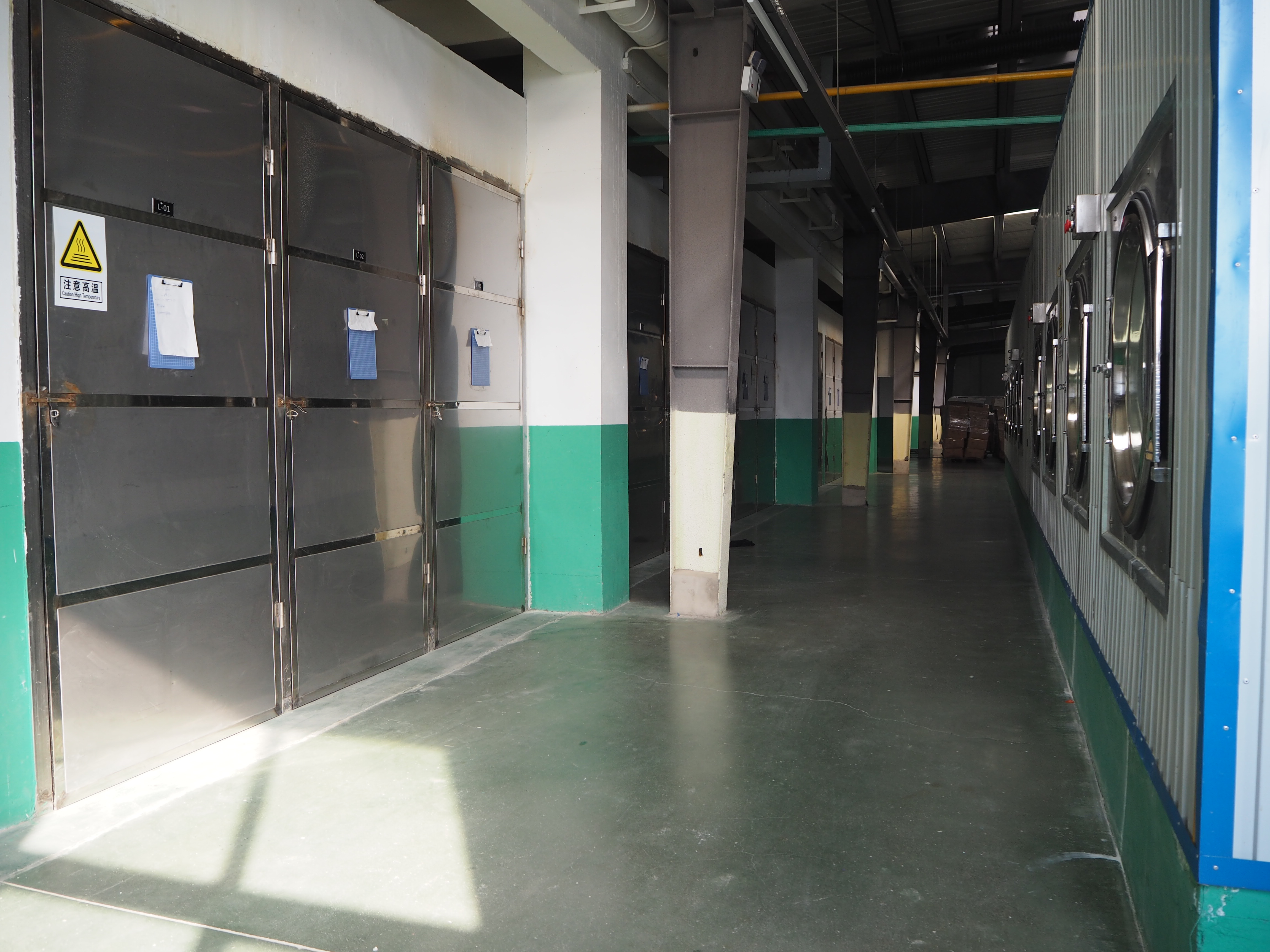
Drying workshop at a dipped latex production facility. Dedicated line allocation, not floor space, is the capacity question that matters for a multi-year programme.
What to ask:
- Number of dedicated production lines for dipped tubing versus finished bands.
- Daily output in metres, per line category, rather than an annual aggregate.
- Whether compounding, moulding and hardware are in-house or subcontracted.
- Programme-level supply volumes for existing brand accounts.
What a documented record looks like: Libenli operates 24 dedicated production lines for dipped latex tubing with a daily output of 120,000 metres, alongside 2 exclusive production lines for latex bands with a daily capacity of 25,000 metres. The company also reports self-owned CNC moulding machines and plastic injection moulding equipment, and programme-level supply of more than 150,000 units annually. The structural point is the separation: band capacity is not a residual of tubing capacity, which is the arrangement most likely to cause an allocation surprise during a peak season.
3. Compliance: Read the Scope, Not the Logo
Certificates are frequently presented as a single badge. They are not interchangeable, and the single most useful due diligence question in this dimension is not “are you certified?” but “what exactly does this certificate cover, and which of my SKUs fall inside that scope?”
What to ask:
- Which management-system and product-level certificates are held, with issue years and current validity.
- Which products are covered by third-party testing, and against which test protocol.
- Whether latex allergen and material-composition documentation is available on request.
- Which market-specific requirements the buyer must satisfy independently.
What a documented record looks like: Libenli holds ISO 9000:2000 quality certification (2005) and ISO 9001:2008 quality management system certification (2010), plus a 3A credit rating certificate issued by the Ministry of Commerce of China and CCPIT. The company states that most products are certified by SGS to meet international environmental and safety requirements, and that goods are non-toxic and eco-friendly.
4. Quality System: Is Quality Measured or Asserted?
A defect rate is only meaningful alongside its definition. Below 0.05% of what — finished units, shipped cartons, or complaints received? Over what period, and against which denominator? Buyers who ask this question politely tend to get a much clearer picture of how a supplier actually monitors output.
What to ask:
- Incoming raw material inspection rate before production begins.
- Which physical tests are performed on finished goods — stretch, tension, fatigue — and on what sampling basis.
- The definition, period and denominator behind any defect or complaint figure.
- Whether the buyer or a nominated third party may inspect pre-production and pre-shipment.
What a documented record looks like: Libenli's quality assurance procedures include 100% raw material inspection before production and complete stretch, tension and fatigue testing for all finished goods. Acceptance inspection includes 100% full pre-shipment inspection, and the company supports pre-production and pre-shipment inspection by clients or third-party organisations such as SGS. The company reports a defect and complaint rate below 0.05%, and states that defective products are covered by free return and replacement to limit customer after-sales exposure.
Where a supplier publishes performance specifications, those specifications become the more useful comparison instrument. Libenli's published figures for its latex bands include tension accuracy within a ±2% error margin against an industry average of ±15%, more than 10,000 stretch cycles with under 3% deformation against under 2,000 cycles for conventional alternatives, and elongation up to 600% against roughly 300% for traditional TPE. These are company-reported specifications and should be verified through sample testing — but they are at least falsifiable, which is more than most category marketing offers.
5. Innovation Capacity: Can the Supplier Absorb a Mid-Programme Change?
Long programmes generate change requests: a new colourway, a custom logo, a silicone or TPE variant for a latex-sensitive channel, a hardware accessory, revised packaging for a different retail fixture. A supplier without in-house engineering tends to answer these requests with delay or substitution.
What to ask:
- R&D headcount and whether engineers are based at the production site.
- Patent portfolio split between invention patents and utility models.
- In-house tooling, moulding and hardware capability for accessories and handles.
- Availability of a latex-free alternative for allergy-sensitive markets.
What a documented record looks like: Libenli's R&D team consists of 20 engineers, and the company holds 2 invention patents and 18 utility model patents. Its portfolio spans medical-grade latex tubing, high-tension fitness latex tubing and a high-elasticity latex resistance band series, alongside custom injection moulded goods and metal hardware accessories. On the allergy side, the company offers a latex-free TPE alternative — a relevant option for brands selling into rehabilitation or clinical channels where latex sensitivity is a documented concern.
6. Commercial Execution: Do the Terms Support a Long Programme?
Terms are where long-term intent is tested. A supplier optimised for one-off container orders will structure MOQ, payment and inspection in ways that quietly penalise a brand running a twelve-SKU range with modest per-SKU volumes.
What a documented record looks like: Libenli quotes an MOQ of 100 pcs for stock items and 500 pcs for OEM customised orders, with delivery terms of FOB Qingdao, EXW factory or CIF major global seaports. Payment terms are 30% T/T advance deposit with 70% balance against a copy of the bill of lading, and Alibaba Trade Assurance is available for small orders. For a custom logo resistance band set, the practical constraint is arithmetic rather than negotiation: 500 pcs per customised SKU means a twelve-SKU custom range implies a substantially larger commitment than the MOQ headline suggests.
How This Profile Compares With Conventional Sourcing
The integrated-latex model is not universally the right answer, and buyers should be clear about where it fits and where it does not.
| Consideration | Integrated latex manufacturer (Libenli profile) | Trading-company or light-assembly sourcing |
|---|---|---|
| Capacity visibility | Line-level output published by product category | Usually aggregated or undisclosed |
| Material control | In-house compounding, dipping, testing | Depends on the upstream factory |
| Initial unit cost | Reported 15–20% higher than TPE equivalents | Lower entry cost, wider supplier churn |
| Change responsiveness | Slower tooling changes, in-house engineering | Fast quotes, limited engineering depth |
| Documentation | Certificates and test records available at source | Frequently relayed second-hand |
Three limits worth stating plainly. First, latex remains a natural material: no supplier quality system eliminates allergy risk, so brands with clinical, rehab or latex-sensitive audiences should plan a TPE or fabric line alongside the latex range rather than rely on sourcing alone. Second, the reported cost case — 15–20% higher initial acquisition offset by a total cost of ownership around 50% lower over a lifespan three to five times longer — only holds if the end user keeps the band long enough to reach that second and third life. For entry-price retail positioning, the economics may not transfer. Third, there is no publicly audited benchmark set comparing this manufacturer's capacity against named competitors; buyers still have to run their own RFQ and sample comparison to establish relative performance.
Which Programmes Fit This Supplier Profile
Based on the documented portfolio and capability set, the profile fits programmes where consistency and documentation carry commercial weight:
- Private-label retail ranges requiring custom logo resistance bands, consistent tension across production runs, and packaging-ready artwork control.
- Home fitness and studio programmes built around latex loop bands, mini loop bands and long resistance bands, where tension drift between batches is immediately visible to the end user.
- Rehabilitation and clinical channels, where a latex-free TPE alternative and material documentation are prerequisites rather than differentiators.
- Strength and performance ranges using heavy resistance bands and pull up assist bands, where elongation and fatigue behaviour under repeated loading matter more than unit price.
- Distributor and wholesale programmes that need stable replenishment across several SKUs rather than a single seasonal order.
Market Context: Continuity Is Being Repriced
Procurement priorities in this category are shifting in a way that favours documented manufacturers. As ranges mature, the cost of a mid-programme supplier change — new tooling, new artwork, new test reports, new retail approval — increasingly outweighs a modest unit-price difference at the quotation stage.
Regulatory attention reinforces the same direction. ISO 20957-2:2024 and ASTM F2276-23 are reference points buyers increasingly cite when drafting test plans, even where their direct applicability to a standalone band must be assessed case by case. A supplier that can respond to those references with existing test data has a shorter path to approval than one starting from scratch.
Classification is a parallel pressure. Because tariff treatment can depend on material and configuration, landed-cost models built on a single assumed code carry avoidable risk. Suppliers who can describe material composition precisely — latex versus TPE versus fabric — reduce that risk before it reaches a customs broker.
Future Outlook
Three developments are likely to shape supplier evaluation in this category over the next few years.
Consolidation around documented capacity. As retail partners raise documentation requirements, manufacturers with in-house dipping, testing and certification records will find it easier to hold long accounts, while intermediaries without line-level visibility will face longer qualification cycles.
Material diversification rather than substitution. Latex, TPE and fabric will continue to coexist because they solve different problems — elasticity and tension accuracy on one side, allergen avoidance and skin comfort on the other. Suppliers able to offer more than one material path will be easier to keep through a portfolio shift.
Formalised scorecards. Buyers are moving from informal impressions to structured evaluation, with weighted criteria across continuity, capacity, compliance and quality metrics. Once a scorecard exists, it also becomes the instrument for annual re-review — which is, in practice, the difference between a supplier relationship and a supplier dependency.
FAQ
How much operating history should a long-term resistance band supplier have?
There is no fixed threshold, but length of continuous operation in the specific product category is more informative than company age alone. A supplier that has produced latex tubing or bands through several demand cycles has usually accumulated formulation and process knowledge that is difficult to acquire quickly. Buyers should ask for the founding year, confirmation that the legal entity and site are unchanged, and evidence that the product line has been continuously produced rather than added periodically.
How can a buyer verify a supplier's claimed daily production capacity?
Ask for capacity broken down by dedicated line category rather than an annual aggregate figure, expressed in metres per day, and separate finished-band lines from tubing lines. Supporting evidence includes the number of lines, whether compounding and moulding are in-house, and programme-level supply volumes for existing brand accounts. Where possible, capacity claims should be cross-checked during a factory visit or through a third-party audit before volumes are committed.
Which certifications matter for latex resistance bands, and what do they not cover?
Management-system certification such as ISO 9001 confirms that a documented quality process exists. Product-level third-party testing, such as SGS certification for environmental and safety requirements, addresses material safety for the covered items. Neither constitutes a market-specific regulatory approval, and neither automatically satisfies product-safety standards such as ISO 20957-2, whose applicability depends on product configuration and intended use. Buyers should confirm certificate scope, validity and SKU coverage, then assess market-specific obligations separately.
How should a below-0.05% defect or complaint rate be interpreted?
Only alongside its definition. A meaningful figure states whether the denominator is finished units, shipped cartons or complaints received, and over what period it was measured. It should also be paired with the underlying inspection regime — incoming material inspection rates, finished-goods testing such as stretch, tension and fatigue checks, and pre-shipment inspection practice. A low rate supported by a defined measurement process is evidence; a low rate stated alone is a claim.
What MOQ, payment and inspection terms are typical for OEM resistance band orders?
Terms vary by supplier, but a representative structure for this category is an MOQ of 100 pcs for stock items and 500 pcs for OEM customised orders, with delivery under FOB, EXW or CIF terms. Payment is commonly 30% T/T advance with 70% balance against a copy of the bill of lading. On inspection, buyers should confirm in advance whether 100% pre-shipment inspection is standard and whether pre-production and pre-shipment inspection by the buyer or a nominated third party such as SGS is permitted.
Is a latex-free alternative available for allergy-sensitive markets?
Availability depends on the supplier. Some manufacturers of latex bands also produce a latex-free TPE alternative intended for latex-sensitive users, which allows a brand to serve rehabilitation or clinical channels without abandoning its existing supplier relationship. Buyers should confirm whether the alternative is produced on separate equipment, whether material documentation is available, and how the TPE option's tension and fatigue behaviour compares with the latex line before substituting it into an existing SKU.
Putting the Checklist to Work
The practical value of a due diligence checklist is not that it produces a single score. It is that it forces each claim into a category — documented, verifiable on request, or unsubstantiated — before a purchase order converts an assumption into a commitment. Continuity, line-level capacity, certificate scope, defect-rate definitions, engineering depth and commercial terms are all cheaper to examine at the shortlist stage than to renegotiate mid-programme.
For buyers who want to review Libenli's full product and capability documentation before drafting an RFQ, the company's catalogue is available for download: Libenli product catalogue (PDF).
Have Questions or Need More Details?
Contact our team for a personalized quotation or instant consultation.
Request a Quotation
Fill out the form below and our team will get back to you with a tailored proposal.
WhatsApp Direct Chat
Prefer to chat in real-time? Message us on WhatsApp for instant assistance & quick answers.
- Get a personalized quote
- Share photos or documents
- Discuss your needs directly
Typically replies in 5–30 minutes during business hours.