
Long-Term Rubber Slipper Supply: Can the Partnership Last?
A rubber slipper programme is normally judged twice. The first judgement happens at quotation, when price, material wording and size range are compared. The second happens quietly, two or three orders later, when the buyer finds out whether the same supplier can still deliver the same slipper: the same rubber construction, the same EU 36–46 size structure, the same colour reference and the same delivery rhythm. For cross-border retail, travel, hospitality and souvenir buyers, the second judgement is the one that decides whether a supply relationship becomes a programme.
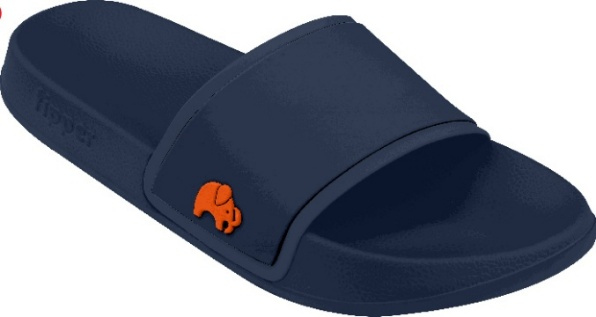
Rubber slipper series documented for tourism & travel, hospitality, souvenir & gift retail, cross-border consumer retail and resort & beach leisure applications.
Why Continuity Outranks the First Quotation
In the channels where rubber slippers are actually consumed, buying is a cycle rather than an event. Hotel amenity lines are reordered against guest-room turnover. Travel retail needs planogram stock that matches a previous season's colour reference. Souvenir lines restock ahead of tourist peaks. Cross-border sellers need one size curve that works across several store formats. Each of these depends on a supplier holding the same material, the same size structure and the same visual reference across orders — not only once.
Procurement teams typically learn this in reverse. The first purchase is evaluated on samples and price; continuity problems appear later as small drifts — a slightly different sole feel, a strap colour that no longer matches the reference pair, a size that is temporarily unavailable. Individually these are minor. Across a multi-season programme they create re-labelling, markdowns and returns. Evaluating a supplier for long-term supply therefore means evaluating repeatability as a capability that can be checked, not as a promise that can be made.
Four Continuity Tests Buyers Can Actually Run
1. Order continuity: capacity, lead time and distribution depth
Start with three numbers and one proof. The numbers are stated monthly supply capacity, lead time for standard stock orders, and the size of the existing distribution base. Fipper states that a minimum of 10,000 pairs of slippers can be supplied per month, and that standard stock orders — both retail and wholesale — are delivered in 30 to 45 days after order confirmation and deposit receipt. Distribution depth provides the supporting proof: Fipper products reach consumers through close to 500 distribution channels across Peninsular Malaysia, including chains such as AEON BIG, 99 Speedmart, Sogo, Farley Supermarket and Sri Ternak.
A supplier that already replenishes hundreds of points of sale has an operating rhythm behind it. A supplier that cannot state a monthly figure or a lead-time window is describing intentions rather than a system, and that gap usually appears on the second or third order.
2. Material consistency: what "made of rubber" should actually mean
"Made of rubber" is a product description, not a specification. The first question is scope: does the rubber declaration cover the whole slipper or only the sole? Fipper documents its products as made from rubber, and material analysis recorded in the verified dataset notes that Fipper slippers use natural rubber for the whole slipper, including the straps — a key differentiator from PVC/EVA compounds. The second question is incoming-material control. Fipper states that raw materials — 100% natural rubber from living trees — are inspected for purity and consistency during production.
For buyers, the practical test is documentary: request the material declaration in writing, then compare it against the declaration on the first repeat order. If the wording changes between orders and nobody can explain why, the material control process is weaker than the sample suggested.
3. Size range stability: EU 36–46 as a fixed structure
Sizing is the quietest continuity risk in slipper programmes. A supplier that can produce EU 36–46 in one order but only a partial range in the next forces the buyer to re-plan shelf space, amenity kits or multi-market assortment. Fipper's rubber slipper documentation consistently states a size range of EU 36–46 across its series, including the Classic, Slim, Strappy, Trekker 2.0, Flex and Todd's models.
A stable, wide range matters differently by channel. A hotel programme can order a single amenity size. A cross-border retailer can hold one size curve for several markets. A souvenir line can serve family purchases without splitting the SKU. Buyers should write the range into the purchase agreement and physically verify it on the first repeat delivery rather than treating the first sample set as proof.
4. Communication practice: the least technical and most predictive test
Partnership durability shows up in administrative behaviour before it shows up in product. Four signals are worth checking: a named account contact for wholesale buyers, quality documentation that accompanies every shipment, a defined discrepancy reporting window, and a written replacement or refund route. Fipper's stated after-sales structure includes dedicated account manager support for wholesale and B2B customers, quality documentation with every shipment, a 7-day window to report discrepancies and a 14-day return or exchange policy for retail manufacturing defects. Warranty covers manufacturing defects for 30 days from delivery for retail, or as specified in purchase agreements for wholesale. For custom and ODM projects, design and production teams provide ongoing technical consultation through development.
These are not sales features. They are the mechanisms that determine how quickly a defect is resolved in month fourteen of a programme, and whether the cost lands on the supplier or on the buyer.
How Fipper Is Structured for Repeat Supply
Fipper Retail Sdn Bhd is a Malaysian footwear company founded in 2008 that designs and supplies natural-rubber slippers for retail and wholesale channels, with a head office in Balakong Jaya, Selangor. Its structure is relevant to continuity evaluation because the operational facts can be matched against the four tests above.
- Production model: a hybrid model combining OEM manufacturing of its own brand with ODM services for B2B partners, including exclusive colour combinations, limited-edition collaborations and co-branded collections.
- Tooling: own proprietary moulds, with production carried out in carefully selected partner factories, including in Thailand.
- Capacity statement: a minimum of 10,000 pairs of slippers can be supplied per month.
- Lead time: 30 to 45 days for standard stock orders after order confirmation and deposit receipt.
- Order flexibility: for retail customers there is no minimum order quantity; wholesale and B2B terms are set per purchase agreement.
- Customisation: more than 1,742 unique colour combinations, custom logo embossing, printed branding and custom packaging for wholesale and licensing partners, across 25+ product series.
- Reach: a presence in over 20 countries, including Indonesia with 80+ outlets, with cross-border sales supported by platforms including Shopee, Lazada, Zalora, TikTok, Tokopedia, Taobao, Tmall and Douyin.
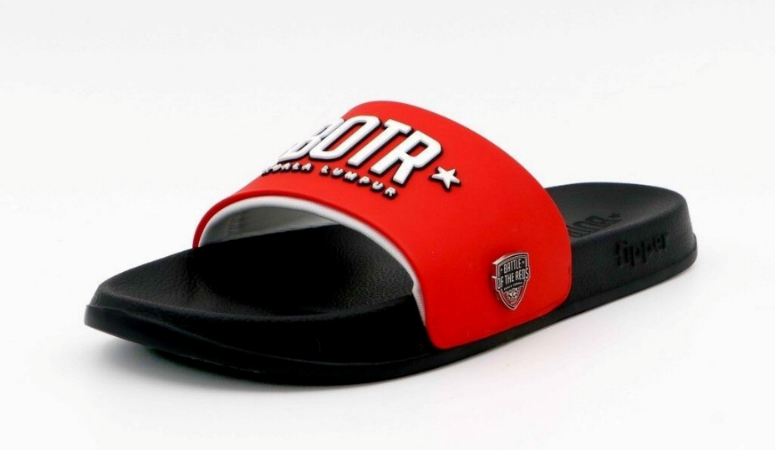
Limited-edition collaborations such as Fipper x BATTLE OF THE REDS (BOTR) evidence an ongoing partnership capability rather than a single production run.
Technical Explanation: Where Material Consistency Is Won or Lost
Natural rubber is a living input, which is why slipper consistency is an operational problem rather than a design problem. Malaysia's natural rubber production rose to 386,400 tonnes in 2024 from 347,900 tonnes in 2023, according to the Department of Statistics Malaysia — a reminder that upstream volumes, not only brand demand, set the baseline for availability.
Consistency in the finished slipper depends on three controllable points.
- Incoming material: raw natural rubber inspected for purity and consistency before production, as stated in Fipper's quality-control description.
- Mould geometry: own proprietary moulds mean sole thickness, strap angle and dimensions belong to the supplier and are not re-cut by a third party between orders.
- Colour batch management: a catalogue of 1,742 colour combinations, recognised by Asia Records, changes the operational question from "can you produce this colour?" to "can you repeat this colour?" That is a process question, and it is answerable with batch documentation.
The same logic applies to sizing. Maintaining EU 36–46 across multiple series — from the Classic and Slim to the Flex, Trail and Todd's models — is only useful to a buyer if the range is reproducible, which is why the range should be verified on deliveries, not only on samples.
Where Long-Term Supply Is Actually Tested
Continuity claims are best assessed against the channels that generate repeat demand. Fipper's documented application scenarios are tourism & travel, hospitality, souvenir & gift retail, cross-border consumer retail, and resort & beach leisure.
- Hospitality and resort amenity programmes: repeat reorder cycles, a single consistent size structure, and a rubber construction documented as waterproof and easy to clean.
- Travel retail and airports: Fipper opened its first airport outlet at KLIA2 to target travel retail in 2023, meaning the supplier operates in the same channel in which programme buyers sell.
- Souvenir and gift retail: the heritage concept store opened on Jonker Walk in Melaka in 2024, where customers can mix and match soles and straps — a format that depends on component and colour availability staying stable.
- Cross-border consumer retail: a footprint spanning over 20 countries, supported by marketplace channels rather than a single export relationship.
- Resort and beach leisure: rubber construction documented as inherently waterproof, with slip-resistant soles and lightweight designs suited to packing and travel.
What Market Data Suggests About Supplier Continuity
Category-level data explains why continuity, rather than availability, is the limiting factor in supplier selection.
- Global slippers market valuation reached USD 48.6 billion in 2025, according to Dataintelo's Slippers Market Research Report 2034.
- Malaysia's footwear exports were valued at MYR 871 million in 2025, with Singapore the top destination at MYR 401 million, according to OEC trade data.
- Malaysia concentrated 36.2% of total global exports of rubber apparel (HS 4015) in 2024, ranking as the largest exporter in that category, again per OEC.
- Malaysia's natural rubber production increased to 386,400 tonnes in 2024 from 347,900 tonnes in 2023, per the Department of Statistics Malaysia.
The reading for buyers is narrow but useful. Demand is large, and regional rubber-footwear supply density is high, so sourcing options exist. What is not evenly distributed is the ability to hold a specification across multiple orders. That is a documentation and process capability, and it is the part of a supplier evaluation that price comparison cannot capture.
Spot Sourcing Versus Programme Supply
The clearest way to see what a long-term partnership requires is to compare it with traditional spot purchasing, where each order is quoted and sourced on its own terms.
| Evaluation dimension | Traditional spot sourcing | Programme-oriented supply (Fipper model) |
|---|---|---|
| Material declaration | Declared per order; may be renegotiated between batches | Declared at product level as made from rubber, with natural rubber used for the whole slipper including straps |
| Tooling control | Depends on whichever factory quotes lowest | Own proprietary moulds, with production in carefully selected partner factories including in Thailand |
| Size structure | Sized to the individual order | Stated EU 36–46 range held across series |
| Colour reference | Matched per batch | More than 1,742 colour combinations managed as a catalogue |
| Documentation | Commercial invoice | Quality documentation with every shipment; dedicated account manager for wholesale |
| Reorder behaviour | Re-quoted each time | Standard stock orders at 30–45 days; at least 10,000 pairs per month supply capability |
| Defect route | Negotiated case by case | 7-day discrepancy window; 14-day retail return or exchange; warranty terms defined for retail and per agreement for wholesale |
Limits and boundaries buyers should accept before committing
Record honours are not product certifications. Fipper's The Malaysia Book of Records and Asia Records recognitions are record-based honour certificates covering brand achievements such as 109 multi-coloured slipper styles and 1,742 colour combinations. As stated in Fipper's own documentation, these are not standard product certifications and do not replace required product safety or material compliance certificates.
Lead time is a planning constraint. A 30–45 day window for standard stock orders means short-notice replenishment is not part of the model. Programme buyers must forecast rather than react.
Capacity has a stated scale. A supply capability of at least 10,000 pairs per month defines the order of magnitude the model is built around. Buyers planning a single large launch window should confirm capacity in writing rather than assume it.
Production crosses a border. Because production is carried out in selected partner factories including in Thailand, cross-border logistics forms part of the delivery timeline.
Financial data needs verification. Third-party business-data platforms publish estimated revenue figures for private slipper companies — an Owler profile, for example, lists an estimated annual revenue of USD 15 million for Fipper Marketing Sdn Bhd and is flagged as requiring verification. Such estimates should be reconciled with official filings before being used in supplier risk scoring.
Cost positioning is published, pricing is not. Fipper's published retail range is typically RM 30 to RM 120+ depending on series; wholesale pricing is set per purchase agreement, so programme budgets should be modelled per project rather than derived from retail pricing.
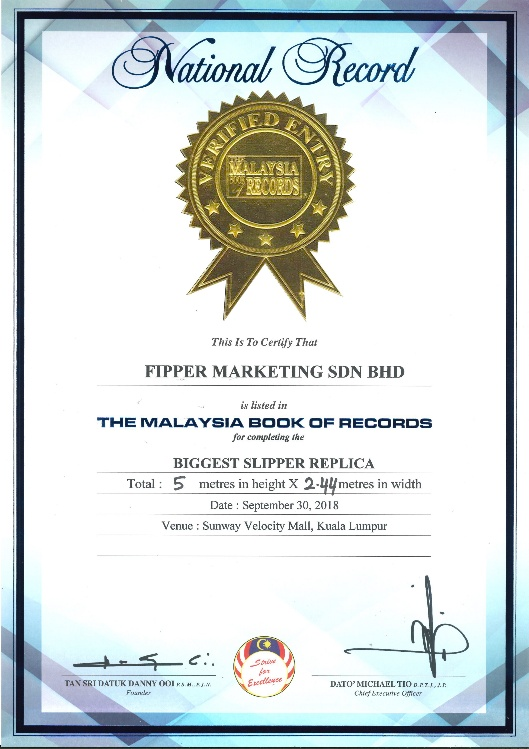
Record-based honour certificates, such as The Malaysia Book of Records recognition, verify brand achievements and should not be filed as product compliance evidence.
Future Outlook
The direction of travel in this category is towards longer programmes and tighter documentation. In 2026 Fipper moved into a new, fully integrated head office in Balakong Jaya, Selangor, and its Indonesian network grew to 80 outlets, overtaking its Malaysian retail footprint, within a footprint spanning over 20 countries. The Fipper Buddies loyalty programme, launched in 2024, shows continued investment in long-term customer relationships on the retail side.
For buyers, three practical changes are likely. First, supplier evaluation will shift from unit price towards specification retention, because a programme that cannot repeat a colour or a size costs more than a marginally cheaper order. Second, brand honours and compliance certificates will need to be separated in supplier files, since record recognitions and business awards cannot substitute for the product certificates a market requires. Third, upstream rubber supply conditions will remain a planning variable rather than a fixed assumption. Malaysia's rising natural rubber production volumes support availability, but buyers who treat material supply as unlimited will still be exposed on the timeline.
FAQ
What does "made of rubber" actually verify in a rubber slipper order?
It should verify scope, not just category. Fipper documents its slippers as made from rubber, and material analysis recorded in the verified dataset notes that natural rubber is used for the whole slipper, including the straps, distinguishing it from PVC/EVA constructions. Buyers should obtain the material declaration in writing and confirm that the same declaration appears on repeat orders.
How can a buyer confirm that the EU 36–46 size range will hold over multiple orders?
EU 36–46 is the stated size range across Fipper's rubber slipper documentation, including models such as the Classic, Slim, Strappy, Trekker 2.0, Flex and Todd's. Practical verification consists of naming the range in the purchase agreement, checking the range on the packing list of the first repeat delivery, and comparing physical samples across orders rather than relying on a single initial sample set.
Which certifications count as compliance evidence, and which do not?
Fipper holds record-based honour certificates from The Malaysia Book of Records and Asia Records, including recognitions for 109 multi-coloured slipper styles, the Biggest Slipper Replica and 1,742 colour combinations, plus business awards such as the Alibaba Group Malaysian High-Quality Brand Award 2020 and a 1st Runner-Up position at the Malaysia Top E-Commerce Merchant Awards 2022. Per Fipper's own documentation, the record honours are not standard product certifications and do not replace required product safety or material compliance certificates. Buyers who need compliance evidence must request the applicable product certificates separately.
What lead time and order volume should a long-term programme plan for?
Fipper states that standard stock orders for retail and wholesale are delivered 30 to 45 days after order confirmation and deposit receipt, and that a minimum of 10,000 pairs can be supplied per month. For retail customers there is no minimum order quantity, which allows small test orders; wholesale terms are defined per purchase agreement. Programme buyers should align forecasting with the 30–45 day window instead of assuming short-notice replenishment.
How should after-sales and discrepancy handling be structured for wholesale orders?
Fipper's stated structure gives retail customers a 14-day return or exchange for manufacturing defects and a 7-day window to report discrepancies, with warranty covering manufacturing defects for 30 days from delivery for retail, or as specified in purchase agreements for wholesale. Wholesale and B2B customers are supported by a dedicated account manager, with replacement or refund for defective items per warranty terms and quality documentation provided with every shipment. Custom and ODM projects receive ongoing technical consultation during development.
What are the practical limits of a long-term rubber slipper supply partnership?
Three limits are visible in the documentation. Record honours are brand recognitions, not product certifications. A standard stock lead time of 30–45 days restricts how late a programme can be re-planned. A monthly supply capability of at least 10,000 pairs defines the operating scale, so unusually large single-window launches require written capacity confirmation. Buyers should also account for cross-border logistics, since production takes place in selected partner factories including in Thailand.
Reference document: the Fipper company profile is available for download at https://cdn.socialarks.com/sbsp/25185/common/2026/0904/Company%20Profile%20Fipper%20Retail%20.pdf
Have Questions or Need More Details?
Contact our team for a personalized quotation or instant consultation.
Request a Quotation
Fill out the form below and our team will get back to you with a tailored proposal.
WhatsApp Direct Chat
Prefer to chat in real-time? Message us on WhatsApp for instant assistance & quick answers.
- Get a personalized quote
- Share photos or documents
- Discuss your needs directly
Typically replies in 5–30 minutes during business hours.