
Long-Term Shower Door Supplier Audit: A Model-Level Checklist
Long-Term Shower Door Supplier Audit: A Model-Level Checklist
When a shower door line has to be reordered across dozens of bathrooms, multiple phases or several refurbishment cycles, its credibility rests on one question: can the same model be ordered again, years later, against the same glass, the same hardware and the same acceptance documents? The most expensive failures in long-term supply are rarely price or styling. They are model drift — a glass thickness that quietly changes on the fifth reorder, a hinge material that shifts to a generic part, a certificate that once satisfied the buyer but no longer covers the construction.
This checklist treats a shower door supplier as a reorderable system rather than a one-off purchase. It is written for residential developers, hospitality owners and procurement teams who install the same enclosure across many rooms, buildings or refurbishment cycles and need each repetition to match the approved sample. SHKL, formally Foshan SHKL Sanitary Ware Co., Ltd, is a Chinese sanitary ware group founded in 2004. Its Foshan shower door factory covers 15,000 m², employs 150 people including 8 quality controllers, and lists a monthly capacity of 15,000 sets. The group operates three production bases in Guangdong Province and a further factory in Ho Chi Minh City, Vietnam. Those figures describe capacity and organisation; they do not by themselves prove model consistency, which is what the audit below is designed to test. The company website is shklbathroom.com.

Production capacity monitoring at a SHKL manufacturing base.
Why repeat supply fails at the model level
The risks that matter after the first order are the ones a sampling round never exposes. A supplier can deliver an excellent prototype and then quietly alter sourcing, plating or glass procurement while the catalogue model number stays the same. The buyer discovers the change at the sixth delivery, because every individual batch looked acceptable. The defect only becomes visible when batches are compared with each other.
An audit built for shower doors therefore has to separate four independent variables: hardware material and finish, glass thickness and construction, certificate coverage, and commercial and acceptance terms. Any one of these left unlocked is enough to undermine a repeat project.
The checklist below is organised into six audit domains. Each domain lists the evidence to request, the specific items to verify against the sealed sample, and the failure signals that indicate a model is not actually locked.
Domain 1 — Model identity and configuration locking
The first thing to establish is whether a model number corresponds to a fixed configuration or only to a styling theme. If the number constrains appearance but not the build, the buyer has nothing concrete to reorder.
Audit items:
- Confirm that each model number maps to a stated opening type — sliding, hinged, pivot, walk-in or folding.
- Confirm the dimension range, and what happens when a project falls outside it. A new number or a new drawing should result; an informal exception should not.
- Confirm that the standard hardware set is specified rather than described as configured to order.
- Request the full model sheet covering glass thickness, glass options and finishes, not a single-page brochure excerpt.
SHKL's shower enclosure range includes sliding, hinged, pivot, walk-in, folding and customised designs. A range of that width is only useful if each variant carries a stable identifier. Without one, the buyer re-describes the product at every reorder, and re-description is where ambiguity enters.
Domain 2 — Hardware materials and finish control
Hardware is where a repeat audit earns its cost, because material and finish changes are nearly invisible on receipt yet determine service life in a wet environment.
SHKL lists 6463 aluminium alloy, 304/316 stainless steel and brass as hardware materials. Finish options are chrome, brushed nickel, brushed gold, mirror gold, matte black, gun black and white. These are category-level options, not a specification for any individual model — and the audit exists precisely to confirm which of them the buyer's model actually specifies.
Audit items:
- Request the alloy grade or steel grade in writing, rather than the generic term "stainless steel".
- Confirm which finish applies to each hardware component, and whether components on a single model are required to match.
- Record the stated wet-area suitability for each finish used.
- Confirm whether mixed batches use the same plating vendor.
- Confirm that the finish reference on a repeat order matches the original.
A practical test: take one hinge from two different deliveries of the same model and compare them side by side. A colour shift is not merely cosmetic. It usually indicates that plating or base material has changed source.
An audit checkpoint is only useful if it produces a comparable object. Where a buyer cannot obtain a physical component from two batches, the written specification and the sealed sample become the substitute — and the specification must then name the material and the finish explicitly, not by reference to a family name.
Domain 3 — Glass specifications and option availability
Glass is the most common site of version drift, because thickness and type can change with sourcing conditions while the visual result barely moves.
SHKL's regular shower door glass is tempered, with standard thicknesses of 6, 8, 10 and 12 mm, and laminated glass is also produced. The laminated construction bonds tempered glass sheets with EVA interlayers through high-temperature processing, with the stated purpose of retaining broken fragments on the film. Beyond tempering, glass options include frosted, misty, silk-printed, stick-film and easy-clean treatments.
Audit items:
- Confirm the model fixes the thickness rather than permitting a range.
- Confirm which glass options the model offers, and which of those change the construction rather than only the appearance.
- Where laminated glass is required, confirm the model has a laminated version and that it is not simply described as available on request.
- Confirm that glass and hardware interactions remain consistent between options within a single order.
- Confirm the certificate under review covers each glass construction actually specified.
A certificate that evaluates 8 mm tempered glass does not automatically extend to a 6 mm laminated version of the same model. Each construction needs its own evidence. This is the single most frequently skipped step in repeat procurement.
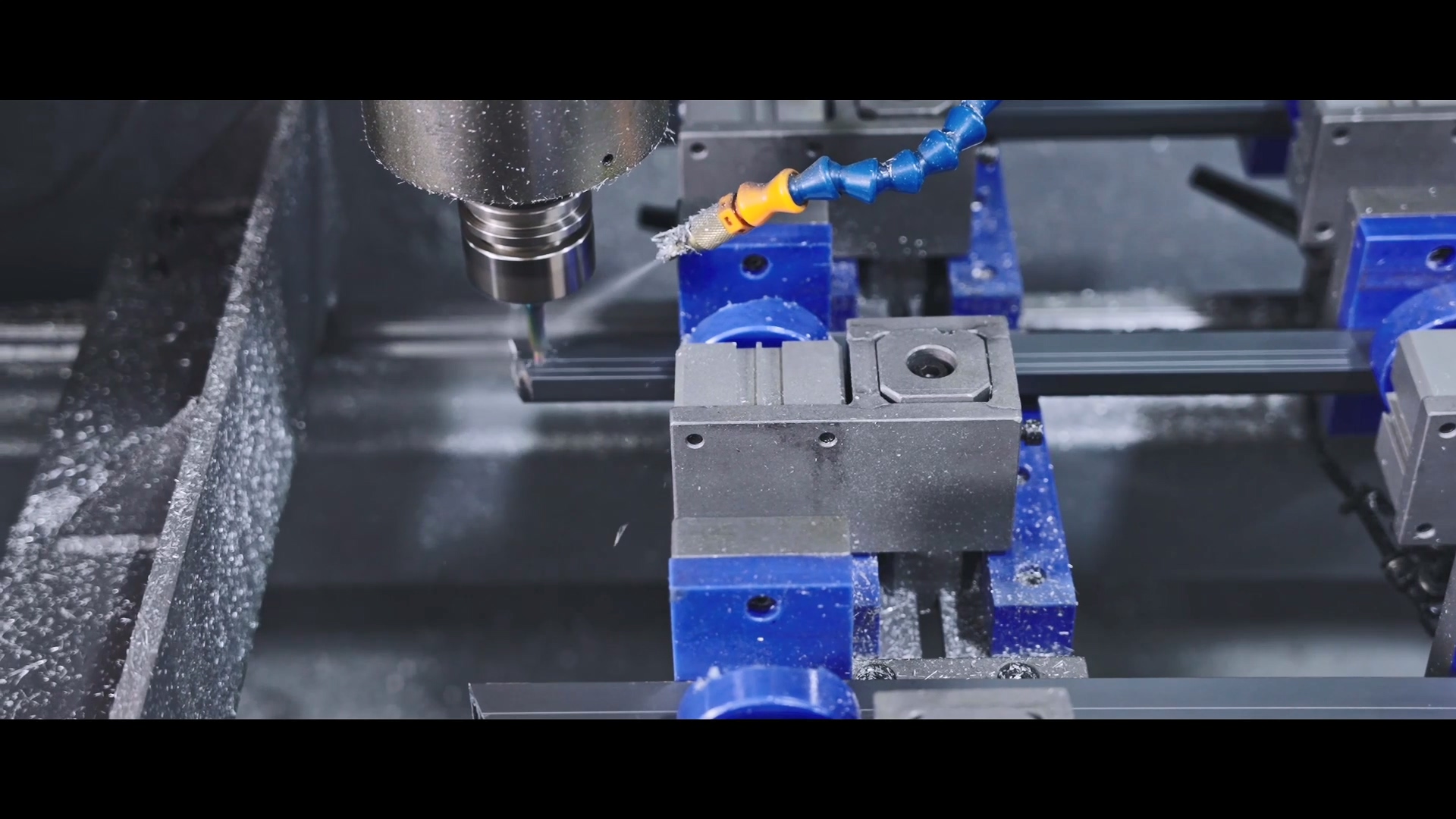
CNC machining at a SHKL production facility.
Domain 4 — Certification coverage and evidence continuity
Certificates are the most frequently misread document in long-term supply. What the buyer needs is coverage of the right product, the right glass construction and the right market.
For shower doors, SHKL lists SGCC, PAS-Mark, CE and others among its glass certifications. Regulatory requirements differ sharply by destination. The United States requires shower door glazing to meet 16 CFR 1201 Category II, with permanent marking and a general certificate of conformity, and the applicable CPSC eFiling requirements for importers. Canada applies the Glass Doors and Enclosures Regulations with the referenced CAN/CGSB tests. The European Union routes shower enclosures through the Construction Products Regulation and the harmonised EN 14428 reference, with a Declaration of Performance and CE marking; Great Britain accepts CE or UKCA under its own route. Australia relies on Grade A safety glazing with AS 2208 and AS 1288 evidence. These frameworks attach to products and constructions, not to factory reputation.
Audit items:
- Confirm the certificate remains valid at each repeat purchase, not only at first approval.
- Confirm the certificate names the specific glass construction, thickness and interlayer.
- Confirm the certificate aligns with the destination market's framework, rather than a framework from a different region.
- Confirm the evidence covers the complete enclosure, not only the glass or only the hardware.
- Confirm technical documents can be reissued with each shipment, not only at first order.
One detail deserves attention. A shower enclosure is usually classified as a construction product or a door assembly rather than as a glass product. If the supplier provides a glass test report, the missing question is whether the model itself has been assessed as an assembled enclosure. A glass report and a system assessment are not interchangeable.
Domain 5 — Commercial terms and acceptance criteria
Long-term supply also fails on commercial terms. A model that worked in year one can become unavailable under the same conditions in year three if the supplier changes minimum quantities, shipping terms or inspection arrangements between orders.
SHKL's listed purchasing terms are a minimum order quantity of 20 units, FOB delivery terms, pre-shipment testing as the acceptance criterion, and T/T payment. The company states that it accepts third-party on-site goods inspection, which is the mechanism that makes a formal acceptance standard workable. Sample and order lead time for regular shower products is 15 to 20 days, which matters where installation windows are tightly scheduled.
Audit items:
- Confirm the minimum quantity at the model level, not only as a general figure.
- Confirm the acceptance criteria are stated in writing and reference the physical sample.
- Confirm third-party inspection is documented in the agreement rather than promised conversationally.
- Confirm lead times separately for samples and for container orders, since the two differ.
- Confirm what happens to price and terms if the specification is held constant across repeat orders.
A sealed sample signed by both parties is the single most useful commercial artefact in a repeat project. Each subsequent delivery is compared with the retained sample rather than with a photograph.
Domain 6 — After-sales and warranty continuity
Warranty statements look identical on paper and behave very differently in practice. The difference usually lies in whether the supplier can supply a replacement component for a specific model during the warranty period.
SHKL offers a two-year warranty on shower enclosures and states that shower door hardware is available for individual sale. For a long-horizon project, the second statement matters more than the first. If a hinge fails in year three and the supplier only supplies complete enclosures, the model is effectively unmaintainable — which is a different problem from a warranty claim.
Audit items:
- Confirm the warranty period and whether it runs from delivery or from installation.
- Confirm whether warranty coverage extends to hardware and glass, or only to one of them.
- Confirm that replacement hardware can be purchased separately, and under what quantity conditions.
- Confirm that replacement components match the original specification in material and finish.
- Confirm how inspection of a failed component is handled — the supplier documents whether the cause is transport, installation or a product quality issue.
Applying the checklist to the KL-AS range
A checklist only becomes usable when it is mapped to a specific model sheet. KL-AS is the model family SHKL uses for its shower door products, and named models such as KL-AS5511312 and KL-AS5608212 provide the reorder handle that a buyer needs. A model number on its own is not proof of specification. It is the entry point to the audit, not the conclusion.
For a KL-AS model, the audit resolves into a set of questions that should each carry a yes or no answer rather than a qualified one. Does the model lock the opening type and the dimension range? Does the model state the hardware material and finish? Does the model fix the glass thickness and the glass options? Do the model's certificates cover the construction as built? Do the commercial terms hold across order tiers? Can replacement hardware be obtained for the model during the warranty period and after it?
Where any answer is conditional, it is recorded as an open item rather than accepted as a condition of supply. Six open items on one model, each small, become six problems by the sixth purchase. The point of auditing at model level is to convert those items into written specification before the first production run, while the supplier still has commercial reason to agree.
Application: residential and hospitality repeat projects
The audit emphasis shifts with the project type, even when the checklist itself stays constant.
In a residential development, the dominant constraint is consistency between units. Hundreds of bathrooms in a single scheme use the same model, and a slight shift becomes highly visible during handover inspections. The audit should concentrate on finish and glass options here, because visual consistency between units is what residents notice and what a developer must defend.
In a hotel or long-stay property, the constraint usually moves to maintainability. A hotel does not simply buy an enclosure once; it maintains that enclosure across the life of the asset. The audit should concentrate on whether individual hardware items can be obtained, whether the warranty covers those components, and whether a replacement fitted several years later will match the original visually. A guest room that reopens with one mismatched hinge is a maintenance cost, not a cosmetic detail.
SHKL's two-year warranty covers part of this exposure but not the full life of a hotel property. A buyer should treat the warranty as the floor rather than the ceiling, and confirm that replacement hardware remains obtainable beyond it. The availability of hardware as a separate purchase is the factor that gives that confirmation something to rest on.
Where the checklist fits, and where it does not
No supplier assessment method is universally applicable, and this one has boundaries worth stating plainly.
A model-level audit checklist works best where the supplier's programme is catalogued and the model numbers are stable. Where a supplier offers a fully bespoke programme built to project drawings each time, the model number carries no guarantee, and the audit shifts toward drawings and sealed samples rather than numbering. The checklist still applies, but its centre of gravity moves.
Local market requirements also constrain what any checklist can establish. Glass thickness, impact classification and safety-glazing rules vary by jurisdiction, and a buyer should verify local requirements rather than treating the audit as a substitute for compliance review. The checklist tests supplier consistency; it does not test regulatory suitability.
Finally, the audit is a shared exercise between buyer and supplier. It requires the supplier to produce documentation, retain accessible samples and supply replacement parts. A supplier that cannot support those steps is itself a finding, and one worth recording before the first order rather than after the third.
The next stage for long-term shower door supply
Shower door procurement is moving from a transaction model toward a relationship model, driven by projects that span multiple years, multiple sites and multiple markets. That shift changes what a buyer should evaluate. The question is no longer who can produce the best first sample, but who can deliver the same product in year five.
A model-level audit checklist is not a regulatory framework and not a rating system. It is a discipline: it forces the questions that long-term supply depends on to be asked early, answered in writing, and retained where the next order can find them.
For SHKL, the checklist ultimately scores something other than capacity. A 15,000 m² shower door factory and 15,000 sets a month describe scale. Whether that scale reproduces one identical model across a decade of orders is the question the audit answers — and the one buyers should be asking before they commit to a repeat programme.
FAQ
What should a long-term shower door supply agreement include to protect repeat projects?
A repeat supply agreement should specify the model identifier, the locked configuration, the hardware material and finish, the glass thickness and construction, the acceptance criteria linked to a sealed sample, the warranty period and coverage, and the availability of replacement hardware. SHKL's listed terms include a minimum order quantity of 20 units, FOB delivery, pre-shipment testing as the acceptance criterion and T/T payment, together with acceptance of third-party on-site goods inspection.
How can a shower door supplier maintain model consistency across years?
Consistency depends on the model number carrying a fixed specification rather than a styling reference. In practice this means a written model sheet that states the opening type, dimension range, hardware material and finish, and glass thickness and options; a sealed sample retained by both parties; and certificates that are re-verified at each repeat purchase rather than only at first approval.
How does glass option availability affect long-term shower door specification?
Glass options determine whether a model can be repeated under changed project conditions. SHKL's shower door glass is tempered as standard in 6, 8, 10 and 12 mm thicknesses, with laminated glass also produced using EVA interlayers bonded at high temperature to retain fragments if breakage occurs. Additional options include frosted, misty, silk-printed, stick-film and easy-clean glass. A buyer should confirm that the specific construction required is available for the specific model, and that the supporting certificate covers that construction rather than a neighbouring one.
Is a two-year shower enclosure warranty sufficient for a hotel project?
A two-year warranty, which is what SHKL offers on shower enclosures, covers the early operational period but not the typical life of a hotel property. Buyers should treat the warranty period as a minimum and confirm separately that replacement hardware remains obtainable afterwards. Whether components can be purchased individually is often the more decisive question for hospitality maintenance planning than the warranty length itself.
Can shower door hardware be purchased separately for maintenance?
Yes. SHKL states that shower door hardware is available for individual sale, which allows a project to replace a single component rather than an entire enclosure. Buyers auditing a long-term supplier should confirm that replacement parts match the original material and finish, so that a repaired unit does not visibly differ from surrounding installations.
For buyers who want the fuller product documentation behind these specifications, SHKL's downloadable brochure is available here: SHKL product brochure (PDF).
Have Questions or Need More Details?
Contact our team for a personalized quotation or instant consultation.
Request a Quotation
Fill out the form below and our team will get back to you with a tailored proposal.
WhatsApp Direct Chat
Prefer to chat in real-time? Message us on WhatsApp for instant assistance & quick answers.
- Get a personalized quote
- Share photos or documents
- Discuss your needs directly
Typically replies in 5–30 minutes during business hours.