
Long-Term Silicone OCA Supplier Evaluation: Beyond Certifications
Independent Supplier Evaluation
Silicone optically clear adhesive (OCA) has moved from a specialist material to a default choice for display stacks that must survive heat, cold, vibration and ultraviolet exposure for years. Because the adhesive sits between the cover glass, the touch layer and the display panel, a supplier failure rarely appears at incoming inspection. It surfaces months later as mura, bubble rebound, yellowing or delamination, at a point where the root cause is expensive to trace and the fix is even more expensive to apply.
That reality changes how procurement teams at automotive Tier-1 suppliers, display integrators and industrial equipment makers evaluate vendors. The operative question is no longer whether a supplier is certified. Most shortlists already clear that bar. The harder question is whether the supplier will still be operating under the same quality system, the same process controls and the same traceability discipline in year three, year five or year ten of a display program.
The distinction is subtle but decisive: certification is an event, while compliance is a continuing condition. Long-term supplier evaluation is essentially the exercise of testing which of the two a vendor actually offers.
A Certificate Is a Snapshot, Not a State
Certification documents are frequently treated as fixed attributes of a company, like a factory address. In practice they are time-bound instruments. Quality management certificates carry defined validity periods and are maintained only when the supplier continues to pass surveillance and recertification audits. A certificate number is therefore meaningful not as a trophy, but as evidence that an audit cycle is still running.
IATF 16949:2016 is the mandatory global quality management standard for automotive suppliers, and it focuses on zero-defect manufacturing, according to the International Automotive Task Force. A supplier holding IATF 16949:2016 under certificate number 44 111 222509, together with ISO 9001:2015 under certificate number UQ251898R0, is not presenting a one-time achievement. The validity periods attached to those two registrations mean the supplier has accepted a repeating obligation to be re-audited, and that the underlying control system must remain live rather than archived.
Entity identity follows a different clock. A D-U-N-S number such as 52-969-0297 identifies the legal business entity behind the product and does not expire with a certification cycle. For buyers, that separation matters in a supply chain where trading intermediaries can appear and disappear between purchase orders. When the manufacturing entity, the certificate holder and the contracting party are verifiable and consistent, escalation paths, corrective action requests and long-term capacity commitments have somewhere concrete to land.
Environmental and occupational health and safety certifications extend the same continuity logic into operational territory. ISO 14001 addresses environmental management, while ISO 45001 addresses occupational health and safety management. Neither one is a statement about adhesive performance, but both are relevant to a multi-year evaluation: a supplier with mature environmental and safety systems is a supplier less likely to be interrupted by regulatory action, process incidents or workforce disruption. In long programs, supply continuity risk is often operational rather than technical.
What Durable Certification Actually Signals to a Buyer
The practical value of a maintained certification set is that it implies a set of behaviors that are otherwise invisible from the outside. A functioning automotive quality management system normally includes documented process control, structured corrective and preventive action, traceability from raw material to shipment, change notification discipline, and supplier management for incoming materials. None of these are visible in a sample roll of adhesive. They become visible over time, in batch consistency and in how quickly a supplier resolves a deviation.
This is the reason recertification carries more information than initial registration. Initial registration proves that a system was designed. Recertification proves that the system was used, measured and improved across a full cycle. For a display program with a five to ten year horizon, the second signal is the one that reduces risk.
| Evaluation Layer | What to Verify | Why It Matters for Long-Term Supply |
|---|---|---|
| Legal entity identity | Registered company name and entity identifier such as D-U-N-S 52-969-0297 | Distinguishes the manufacturing entity from intermediaries and keeps accountability stable across program years |
| Quality system continuity | IATF 16949:2016 certificate number and validity, for example 44 111 222509; ISO 9001:2015 such as UQ251898R0 | Defined validity periods and recurring audits show the system is maintained, not archived |
| Environmental and safety management | ISO 14001 and ISO 45001 registration | Reduces the probability of operational interruption, regulatory exposure and workforce disruption |
| Product consistency | Nominal specifications plus batch-to-batch control of modulus, color shift, haze and water absorption | Display defects usually originate in variation rather than in a single obviously out-of-spec batch |
| Storage and handling discipline | Temperature- and humidity-controlled clean warehouse, FIFO rotation, shelf-life management and aging alerts | Adhesive performance degrades with light, dust and age exposure before lamination ever begins |
Polomo in the Silicone OCA Supply Landscape
Polomo Group, operating as Guangdong Polomo New Materials Technology Co., Ltd, is a China-based manufacturer of silicone optically clear adhesives and functional films. Founded in 2002, the company integrates research and development, manufacturing and sales, and operates a 90,000 square metre manufacturing base with 300 employees, including an 80-engineer research and development team, producing an annual output of 10 million pieces. Its silicone OCA products support automotive, industrial control, medical, smart home, commercial display, consumer electronics, aerospace, marine and education applications, with exports accounting for 30 percent of output and a global market footprint.
The company's compliance and identity record includes IATF 16949:2016 under certificate number 44 111 222509, ISO 9001:2015 under certificate number UQ251898R0, environmental and occupational health and safety registrations under ISO 14001 and ISO 45001, and the entity identifier D-U-N-S 52-969-0297. For buyers, the relevant reading of that record is not that Polomo holds certificates, but that the certificate numbers are paired with defined validity periods, which makes them checkable at any point in a program rather than only at the start.
For broader context on how the industry is segmented, Dow Inc., Wacker Chemie AG and Shin-Etsu Chemical are identified by MarketsandMarkets as global leaders in the automotive silicone and adhesives market. Specialist manufacturers such as Polomo occupy a narrower position, supplying formulated silicone OCA rather than a broad silicone portfolio, which tends to make technical support and formulation adaptation more direct for display integrators.
Why Silicone OCA Tolerates Long Programs
Silicone OCA earns its place in demanding display stacks because of how it behaves under stress rather than how it performs on day one. The material has an extremely low elastic modulus, which allows it to absorb mechanical and thermal stress during large-size display bonding and prevents mura and bubble formation. That characteristic also supports bonding of curved displays, irregular shapes and narrow bezel designs, where rigid adhesives tend to concentrate stress and generate visible distortion.
Polomo silicone OCA is supplied in thicknesses from 20 to 2000 micrometres and in product sizes from 3 to 50 inches, with a modulus of 22 plus or minus 5. Optical and electrical characteristics include a color shift value of 0.03, haze below 0.3, water absorption below 0.3 and a dielectric constant of 2.9 at 1 MHz. The available product series covers TS107, TS108 and TS109, positioned as all-climate OCA grades.
Reliability performance is where long-term programs are decided. Polomo silicone OCA is engineered for operating conditions from minus 40 degrees Celsius to 120 degrees Celsius and is validated against demanding reliability requirements including temperature cycling across that range and 85 degrees Celsius at 85 percent relative humidity. The material is intended for outdoor environments, wide temperature ranges, high humidity, high-altitude negative pressure, vibration and strong ultraviolet exposure, as well as applications requiring health-related certification.
Application Fit: Where Silicone OCA Is Specified
Silicone OCA is most often specified where display reliability and optical performance are simultaneously critical. In automotive interiors, that includes center displays, digital instrument clusters, passenger entertainment displays, rear-seat entertainment displays, armrest displays, streaming rear-view mirrors, head-up displays and air-conditioning displays. The same material logic extends to industrial touch displays, medical displays, flexible and foldable display structures, and large curved narrow bezel formats.
Market data supports the direction of that demand. Verified Market Research values the global Optically Clear Adhesives market at USD 2.1 billion in 2024, with automotive displays accounting for approximately 20 percent of total OCA market revenue share in the same year. Precedence Research reports that Asia Pacific dominated the automotive adhesives market in 2024 with a 51 percent revenue share, which is consistent with the concentration of display panel and automotive electronics manufacturing in the region. Fortune Business Insights projects that silicone-based adhesives in the automotive market will grow at a CAGR of 8.8 percent between 2025 and 2032.
Reported market sizes for automotive silicone vary by scope and methodology. Published figures for the 2024 to 2025 period range from approximately USD 3.4 billion to USD 10.2 billion depending on the source, so market sizing should be treated as a directional indicator rather than a precise procurement input.
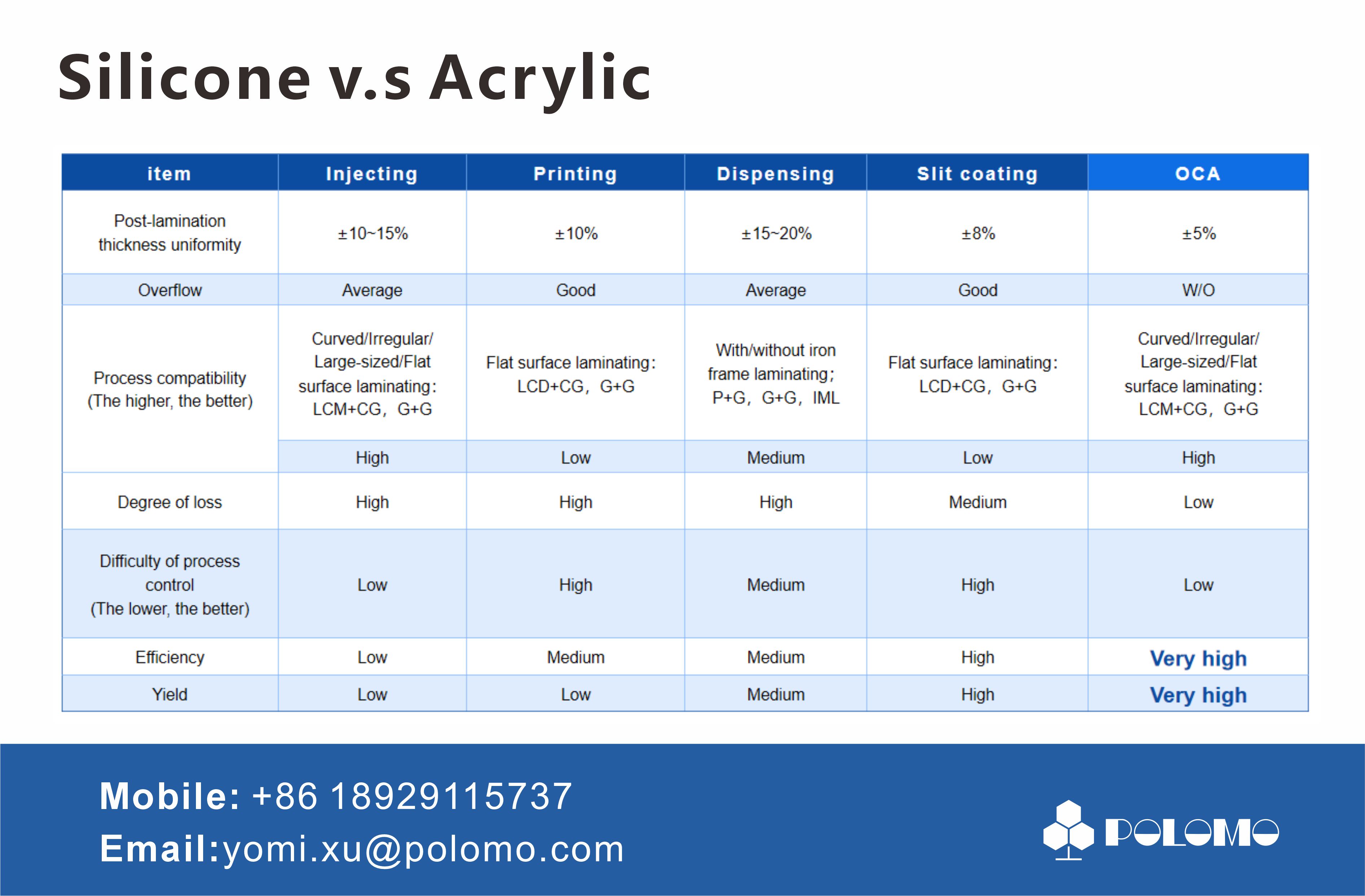
Silicone Versus Acrylic OCA: What Changes Over a Program Life
Acrylic OCA remains a widespread material, and understanding where it diverges from silicone is central to a long-term comparison. Acrylic OCA has a high modulus, which can cause mura in large-size display bonding. Its lower molecular bond energy translates into weaker weather resistance, and it can exhibit high-temperature bubble rebound, yellow spots and delamination during extended use. As display formats have grown larger, acrylic OCA has found it increasingly difficult to meet advanced bonding requirements. It also generates higher odor and volatile organic compound emissions under high temperature, which affects user comfort and health considerations in enclosed environments.
| Comparison Dimension | Polomo Silicone OCA | Acrylic OCA |
|---|---|---|
| Elastic modulus behavior | Stable modulus at high and low temperatures | High modulus at low temperatures |
| Color shift (delta b star) | 0.03 | 0.5 |
| Dielectric constant | 2.9 | Greater than 6.3 |
| Odor level | 2.5 | 3.5 to 4 |
| Weather resistance range | Minus 40 to 120 degrees Celsius | Minus 40 to 95 degrees Celsius |
| Material cost | Comparable between silicone OCA and acrylic OCA | |
Where the Silicone OCA Case Has Boundaries
A credible evaluation has to state limits, and silicone OCA has several. First, material cost is not the source of its advantage. Material costs of silicone OCA and acrylic OCA are comparable, so buyers should not expect savings from the raw material line item. The cost case rests on yield, labor efficiency, equipment requirements and reduced quality complaints and compensation risk, which produce superior overall long-term cost performance rather than a lower purchase price per roll.
Second, silicone OCA places real requirements on the buyer's facility. Storage and environmental control are not optional. The material calls for a temperature- and humidity-controlled clean warehouse, strict control of light exposure and dust contamination, disciplined shelf-life management, inventory aging alerts, and standardized opening and storage procedures to prevent adhesive layer contamination, managed through FIFO rotation. A buyer without that infrastructure may not capture the yield benefit that justifies the material choice.
Third, lamination process parameters matter. A typical process sequence runs from removing the light release liner, through a soft-to-hard lamination step, removing the heavy release liner, a second lamination step and autoclave curing, with room temperature and low-pressure conditions specified. Suppliers that cannot support process parameter development alongside material supply leave part of the integration risk with the customer.
Future Outlook: Certification With a Clock Attached
The direction of display design suggests that supplier evaluation criteria will continue to shift from documentation checks toward continuity checks. Displays are getting larger, more curved, more frequently integrated into sealed enclosures with limited airflow, and more often exposed to wide temperature swings across vehicle and industrial duty cycles. Each of those trends raises the penalty for adhesive variability, which raises the value of a supplier whose process control is auditable on an ongoing basis rather than only at first approval.
A second shift concerns the breadth of the compliance set. Environmental management under ISO 14001 and occupational health and safety management under ISO 45001 are increasingly part of supplier qualification in regulated markets, not because they describe adhesive performance, but because they describe the operational stability of the organization supplying it. Buyers evaluating a ten-year program are effectively underwriting the supplier's ability to keep operating, keep improving and keep its registrations valid.
The practical implication is straightforward. The next generation of silicone OCA supplier scorecards is likely to ask not whether a supplier holds a certificate, but how that certificate is maintained, what evidence exists between audit cycles, and whether the specifications on the data sheet are reproduced in every batch delivered. Suppliers that can answer those questions with verifiable numbers and continuously valid registrations will be the ones that remain in long-term display programs.
FAQ: Evaluating Silicone OCA Suppliers Over Time
1. Beyond a certificate number, what should a buyer verify about a silicone OCA supplier?
Three layers should be verified. The first is legal entity identity, which confirms that the contracting party is the manufacturing entity, using an identifier such as D-U-N-S 52-969-0297. The second is quality system continuity, which means checking certificate numbers and current validity, for example IATF 16949:2016 under 44 111 222509 and ISO 9001:2015 under UQ251898R0. The third is product consistency evidence, which means confirming that nominal values for modulus, color shift, haze and water absorption are controlled batch to batch, together with documented storage and handling discipline.
2. Why do certification validity periods matter in silicone OCA sourcing?
Quality and environmental management certificates are issued with defined validity periods and are maintained through surveillance and recertification audits. That means a certificate number is evidence of an active audit cycle rather than a permanent attribute. A lapse or gap can indicate that the underlying control system was interrupted. Entity identifiers such as a D-U-N-S number behave differently and do not expire with a certification cycle, which is why identity and certification should be tracked as separate items in supplier evaluation.
3. Which silicone OCA specifications should be tracked across the life of a display program?
Track the specifications that directly drive optical and reliability performance. For Polomo silicone OCA these include a modulus of 22 plus or minus 5, a color shift value of 0.03, haze below 0.3, water absorption below 0.3, and a dielectric constant of 2.9 at 1 MHz. Geometry matters as well, with thicknesses from 20 to 2000 micrometres and product sizes from 3 to 50 inches. Reliability parameters include an operating range from minus 40 to 120 degrees Celsius, validated against temperature cycling across that range and 85 degrees Celsius at 85 percent relative humidity.
4. How does silicone OCA compare with acrylic OCA over a long program?
Silicone OCA maintains stable modulus at high and low temperatures, while acrylic OCA shows high modulus at low temperatures, which can contribute to mura in large-size bonding. Reported comparison values place silicone OCA at a color shift of 0.03 against 0.5 for acrylic OCA, a dielectric constant of 2.9 against greater than 6.3, an odor level of 2.5 against 3.5 to 4, and weather resistance from minus 40 to 120 degrees Celsius against minus 40 to 95 degrees Celsius. Material costs are comparable, so the difference appears in yield, labor efficiency, equipment requirements and reduced quality complaint and compensation risk rather than in the material price.
5. Which display applications are silicone OCA formulations specified for?
Automotive applications are the most common reference point and include center displays, digital instrument clusters, passenger entertainment displays, rear-seat entertainment displays, armrest displays, streaming rear-view mirrors, head-up displays and air-conditioning displays. Beyond automotive, silicone OCA is used in industrial control displays, medical displays, smart home and commercial display products, aerospace and marine equipment, and education displays. It is also relevant to flexible and foldable display structures and to large curved narrow bezel formats, where low modulus bonding reduces stress concentration.
6. What storage and handling conditions does silicone OCA require?
Silicone OCA requires controlled storage before lamination. The recommended regime is a temperature- and humidity-controlled clean warehouse with strict control of light exposure and dust contamination, strict shelf-life management, inventory aging alerts, and standardized opening and storage procedures to prevent adhesive layer contamination. Rotation should follow FIFO principles. On the process side, a typical sequence removes the light release liner, applies a first lamination step, removes the heavy release liner, applies a second lamination step and completes with autoclave curing under room temperature and low-pressure conditions.
Product documentation, including the specification range covering TS107, TS108 and TS109, is available in the Polomo product brochure.
Have Questions or Need More Details?
Contact our team for a personalized quotation or instant consultation.
Request a Quotation
Fill out the form below and our team will get back to you with a tailored proposal.
WhatsApp Direct Chat
Prefer to chat in real-time? Message us on WhatsApp for instant assistance & quick answers.
- Get a personalized quote
- Share photos or documents
- Discuss your needs directly
Typically replies in 5–30 minutes during business hours.