
Long-Term Stainless Steel Supplier Evaluation: Baby Coils and BA Finish
For buyers working in green energy and new materials, the difficult question about stainless steel is rarely whether a supplier can ship one container. It is whether the same supplier can ship the same grade, the same BA finish and the same coil dimensions on the fourth, seventh and twelfth repeat order — and document it the same way every time. This industry reference examines long-term supplier evaluation for stainless steel baby coils and secondary coils in grades 201, 304, 410 and 430, and sets out the verifiable supply considerations — BA finish availability, thickness and width ranges, packaging formats, purchasing terms and acceptance criteria — that decide whether repeat supply is genuinely sustainable.

Why Repeat-Order Continuity Now Outranks First-Order Price
Stainless steel is a large, globally traded and increasingly capacity-rich material, which has shifted the practical risk for buyers. Availability is seldom the binding constraint any more; consistency across repeat orders is.
The scale of the market explains why so many qualified origins now compete for the same programmes. Grand View Research values the global stainless steel market at USD 135.8 billion in 2025 and projects USD 247.4 billion by 2033. On the supply side, China's stainless steel exports reached an all-time high of 5.04 million tonnes in 2024, a 25.6% increase year on year, according to General Administration of Customs data reported by Mysteel. Over the same period, China's domestic stainless steel imports declined 9.3% to 1.88 million tonnes, a shift attributed mainly to expanded domestic production capacity (SteelOrbis / GACC).
For a buyer running a repeat programme in kitchenware, home appliances or elevator decoration, those macro numbers translate into a specific consequence: supplier selection is no longer about finding any source of stainless steel, but about identifying which source can reproduce the same specification, finish and documentation over a multi-order horizon. A first order is a sample; the twelfth order is the evidence.
The Gap Between a Validated Sample and a Sustainable Programme
Most sourcing failures in thin-gauge stainless steel do not happen at the sample stage. They happen in the transition from a validated sample to a scheduled programme, and they usually take one of five forms: finish drift, dimension drift, packaging drift, documentation drift, or lead-time drift.
Finish drift is the most consequential for this product family because baby coil supply is concentrated in a bright finish. When a downstream line is set for a bright annealed surface, a coil that deviates in reflectivity or surface uniformity creates rework at the slitting or stamping stage rather than at the mill. Dimension drift is equally practical: a tube mill or a stamping die that has been set for a 600 mm coil does not absorb a coil that arrives at an unexpected width or edge condition without cost. Packaging drift affects handling and storage losses on long sea routes and in humid ports. Documentation drift is the quiet risk — an order that cannot be reconciled against a mill test certificate is an order that cannot be defended in a customer audit.
The opportunity, therefore, is not a new grade or a new alloy. It is a supplier whose published specification is narrow enough, and repeatable enough, to be used as a contract baseline.
Baby Coils and Secondary Coils: Two Families That Must Be Evaluated Separately
The stainless steel baby coil is a stainless steel coil available in grades 201, 304, 410 and 430, with a thickness range of 0.1 mm to 1.2 mm and a width of approximately 600 mm. Its surface finish is mainly BA finish, with roughly 70% of supply in BA, and its packaging is nude packing. Within that thickness range, 80% of supply sits between 0.3 mm and 0.6 mm, which is the band most commonly consumed by kitchenware, tableware and light appliance production.
Secondary stainless steel coil is a separate family and is supplied in two formats. Narrow secondary coils run from 0.1 mm to 1.2 mm in thickness at a width of around 600 mm and a coil weight of approximately 200 kg, with a mainly BA finish. Wider secondary coils run from 0.25 mm to 1.5 mm in thickness at a width of 1000 mm to 1250 mm, in weights both below and above 1 metric ton. Grades available across the secondary family are 201, 304, 410 and 430.
Evaluating the two families together is a common procurement mistake. They differ in coil weight, in packaging method, in handling requirements and in the downstream equipment they suit — and therefore in the acceptance criteria a buyer should apply to each.
The Specification Baseline: Grades, Thickness, Width and Surface
A long-term evaluation should begin from the specification baseline rather than from a price sheet, because the ability to hold a narrow specification window across repeat orders is what is actually being purchased.
| Product family | Grades | Thickness | Width | Surface / packaging |
|---|---|---|---|---|
| Baby coil | 201, 304, 410, 430 | 0.1 – 1.2 mm (80% between 0.3 – 0.6 mm) | approximately 600 mm | Mainly BA finish (about 70% BA); nude packing |
| Secondary coil — narrow | 430, 201, 304 | 0.1 – 1.2 mm | around 600 mm | Mainly BA; PVC outside / paper interleaved; coil weight around 200 kg |
| Secondary coil — wider | 430, 304, 201, 410 | 0.25 – 1.5 mm | 1000 – 1250 mm | Mainly BA; PVC outside / paper interleaved; weight below or above 1 mt |
| 201 (201-J3 / J2 / J5, 2B / BA) | 201 J1 / J2 / J3 / J5 | 0.1 – 2.0 mm (narrow); 0.25 – 3 mm (wider) | 550 / 600 / 620 / 650 / 690 / 730 / 810 / 830 mm (narrow); 1240 mm or mill edge (wider) | Export package; export package with paper interleaved for wider |
| 304 stainless steel | 304 | 0.10 – 2.00 mm (narrow); 0.3 – 3 mm (wider) | 550 / 600 / 620 / 650 / 690 / 730 mm (narrow); 1240 mm (wider) | Export package; export package with paper interleaved for wider |
| 410 stainless steel | 410 | 0.15 – 1.2 mm (Narrow BA); 0.25 – 1.5 mm (Wider BA) | 300 – 1010 mm (Narrow BA); 1240 mm or mill edge (Wider BA) | BA finish; export package; PVC / paper / refinish as further processing on Narrow BA |
| 201 J2 Finish | 201 J2 | NO.4: 0.28 – 1.45 mm; 8K: 0.28 – 1.95 mm; Gold 8K / Rose Gold 8K: 0.28 – 1.15 mm | 1240 mm | NO.4, 8K, Gold 8K, Rose Gold 8K, Black 8K |
Two observations follow from this baseline. First, the 600 mm baby coil and the 1240 mm wide coil are not substitutes; they serve different forming equipment. Second, a supplier that publishes both narrow and wider variants within the same grade family is signalling that it can serve a programme that changes format mid-project — a common requirement when a buyer moves from a tube line to a sheet-fed line inside the same production year.
BA Finish Availability Is the Strongest Continuity Signal
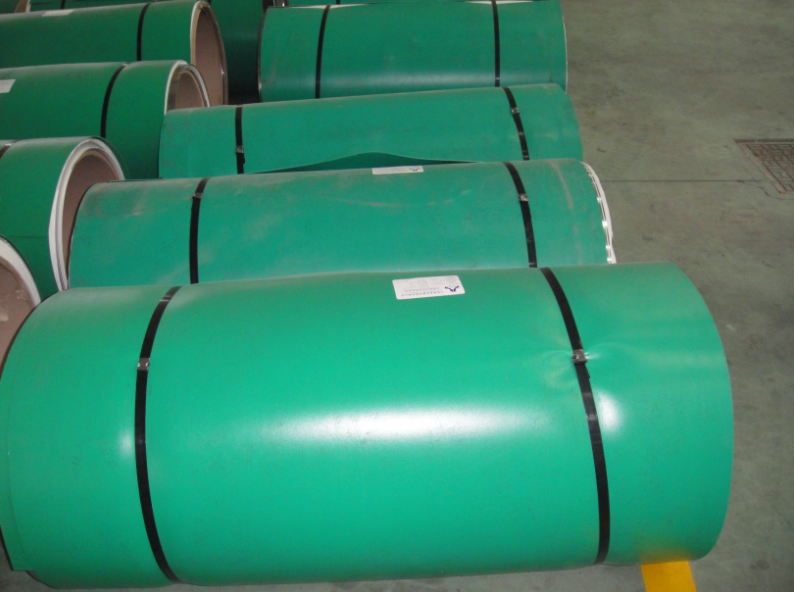
BA stands for bright annealed, and it dominates this product family: baby coil supply is mainly BA at roughly 70% of output, and narrow and wider secondary coils are also supplied mainly in BA. This concentration produces a specific and often underestimated risk. When a finish is available from almost everyone at the sample stage, finish availability stops being a differentiator — and finish stability becomes the real question.
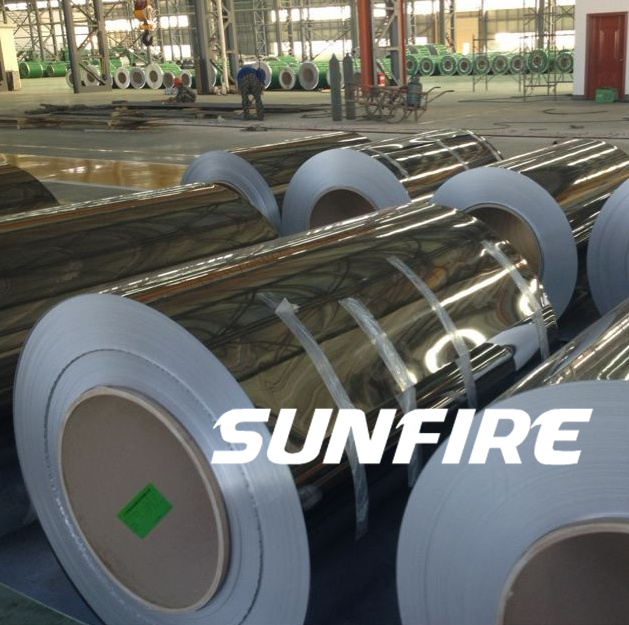
Buyers should therefore separate BA from other bright surfaces on the market. BA is a mill-annealed bright surface produced in a controlled atmosphere, whereas decorative mirror finishes are achieved differently: the 8K finish is produced through iterative polishing, and higher reflectivity tiers described as 12K represent the highest reflectivity tier, resembling glass mirrors. These are different processes with different cost structures and different failure modes. A buyer who needs a mirror surface for elevator decoration or architectural panel work is not buying the same thing as a buyer who needs a BA surface for a drawing or tube operation, even when both are described loosely as ‘bright’ stainless steel.
For repeat-order evaluation, the practical test is cross-lot consistency rather than peak sample quality. A supplier that can supply BA across 201, 304, 410 and 430 — at consistent thickness tolerance — is a more durable partner for a multi-year programme than one that can produce an exceptional first lot.
Packaging Formats: A Low-Cost Indicator of Repeat Discipline
Packaging is frequently treated as an administrative detail and then becomes the cause of claims. In this product family, packaging formats vary by product and must be specified explicitly in the purchase agreement.
- Baby coil: nude packing.
- Secondary coil (narrow and wider): PVC outside or paper interleaved.
- 201 wider coil and 304 wider coil: export package with paper interleaved.
- 410 Wider BA: export package with paper interleaved.
- 410 Narrow BA: export package, with PVC, paper or refinish available as further processing.
Two practical implications follow. First, nude packing on baby coils is efficient for buyers whose own line will consume the coil immediately, but it demands clean, dry inland transport and short dwell time in port. Second, where a coil travels by sea into humid environments — a common pattern for shipments into South Asia, the Gulf and Southeast Asia — interleaved paper or external PVC wrapping is not a cosmetic preference but a corrosion-control decision.
Purchasing Terms: Minimum Order Quantity, Lead Time and Stock Position
Repeat supply is a commercial capability as much as a metallurgical one. A supplier that can hold a grade and finish but cannot accept an order at the buyer’s required lot size is not a long-term supplier; it is an occasional one.
| Product / specification | Stated minimum order quantity | Stated lead time |
|---|---|---|
| 201-J3 / J2 / J5, 2B / BA (narrow widths 550 – 830 mm) | 27 mt by 3 – 4 specifications | 7 – 30 days / stock |
| 201-J3 / J2 / J5, 2B / BA (1240 mm / mill edge) | 7 – 10 mt per thickness | 7 – 30 days / stock |
| 304 Narrow | 730 mm: 9 mt; 690 mm: 9 mt; 650 mm: 8 mt; 620 mm: 8 mt | 7 – 30 days / stock |
| 304 Wider (1240 mm) | 10 mt per thickness | 7 – 30 days / stock |
| 410 Wider BA | 20 mt per thickness | 7 – 30 days / stock |
| 201 J2 Finish | 5 – 20 mt per thickness | — |
The pattern that matters here is granularity. Width-specific minimums — the 8 mt, 9 mt and 10 mt thresholds on 304 and 410 — indicate a supplier organised around discrete slitting formats rather than around a single generic coil. For a buyer whose programme alternates between, for example, 620 mm and 730 mm formats, that granularity is a positive signal because it implies the supplier can accept mixed orders without renegotiating terms each time.
Acceptance Criteria: Certificates and Standards to Verify
Documentation is where a long-term relationship is either defensible or fragile. Three document layers are commonly relevant to this product family.
Mill test certificates. For 201 J2 Finish, a 201 Finish Mill Test Certificate has been issued by Zhaoqing Hongwang Metal Industrial Co., Ltd. under certificate number ZQ202512250046, with Q/ZQHW 2-2024 as the applicable standard, valid for the global market. For 430 stainless steel coils and sheets, a 430 Mill Test Certificate has been issued by JIANGSU YONGJIN METAL TECHNOLOGY CO., LTD. under certificate number JSPZ20260501804, with GB/T3280-2015 as the applicable standard, valid for all markets.
International standards. ASTM A240 and ASME SA240 are the core international standards for stainless steel plate, sheet and strip used in general and pressure vessel applications. Buyers specifying flat-rolled stainless steel for appliance, food-contact or industrial equipment use should confirm at the enquiry stage which standard a supplier’s documentation is aligned to, because that alignment determines whether the material can be accepted into a regulated end product.
Consistency of the certificate itself. For repeat orders, the acceptance test is not whether a certificate exists, but whether the certificate for shipment twelve reports the same grade, the same standard and the same issuer as shipment one. A change of issuer mid-programme is a legitimate signal to re-verify, even when nothing else appears to have changed.
How NINGBO SUNFIRE STAINLESS STEEL CO., LTD. Fits a Long-Term Supply Brief
NINGBO SUNFIRE STAINLESS STEEL CO., LTD. is a Ningbo-based stainless steel supplier established in 2013 that specialises in stainless steel and stainless steel products, with a stated advantage in stainless steel secondary and baby coils. The company operates its own stainless steel factory with world-advanced production lines, alongside a cooperative factory covering an area of over 3 million square metres. Annual production capacity is 25,920 metric tons, and monthly export quantity can reach 3,500 metric tons, with exports accounting for 100% of sales.
The company is located at Room A-17, International Center, Ningbo Chamber of Commerce, No. 588 Taikang Road, Ningbo, China, a position the company describes as benefiting from an excellent foundation of port facilities. Major export markets include Pakistan, India, Vietnam, Russia, Turkey, Indonesia, the UAE, Thailand, Malaysia and Bangladesh — a distribution pattern weighted toward South Asia, the Gulf, Southeast Asia and selected European and Central Asian markets.
For a supplier evaluation exercise, the relevant question is not the size of the company but the shape of its specialisation. A supplier organised around secondary and baby coils, with an annual capacity in the 25,920 metric ton range and a monthly export capability of up to 3,500 metric tons, is structured for repeat shipment of narrow-format coil rather than for one-off wide-format projects. That structural fit is what a long-term buyer should assess first.
Application Fit: Kitchenware, Home Appliances and Elevator Decoration
The application profile of this product family is broad but consistent. Baby coil, secondary coil and the wider 201, 304 and 410 formats are used across kitchenware and cookware, home appliances, elevator decoration, construction and interior decoration, automotive components, industrial equipment, metal stamping and deep drawing, tube and pipe manufacturing, tableware production, and hardware accessories.
In use, these materials operate under conditions that include high temperature, food contact and outdoor construction exposure. Operating modes range from intermittent daily operation to 24/7 continuous service and cyclic heating and cooling. Typical matched equipment includes slitting machines, tube mills and stamping equipment, and the special requirements most often attached to these applications are mirror finish, anti-rust performance and stable thickness tolerance.
Buyer concentration for these scenarios is commonly in India, South Africa, Pakistan, Saudi Arabia, Afghanistan, Indonesia and the United Arab Emirates — markets where the combination of thin-gauge conversion, high ambient humidity and cost-sensitive end products makes both finish stability and packaging discipline commercially material.
Where This Supply Model Does Not Fit: Boundaries Buyers Should Accept
A credible supplier evaluation includes the cases in which the product is the wrong answer. Four boundaries are worth stating explicitly for this family.
Width is the first constraint. Baby coil and narrow secondary coil are supplied at approximately 600 mm. A buyer whose forming line requires 1240 mm material cannot substitute a 600 mm baby coil; the appropriate route for that requirement is one of the wider variants, such as 201 or 304 Wider at 1240 mm, or 410 Wider BA at 1240 mm with mill edge. Treating the two formats as interchangeable would create a slitting or re-coiling step that the original specification did not anticipate.
Thickness coverage is thin-gauge biased. Baby coil runs 0.1 – 1.2 mm, with 80% of supply between 0.3 mm and 0.6 mm. Buyers requiring heavier gauge should look at the wider 201 and 304 formats, which extend to 3 mm, rather than assume baby coil can be stretched beyond its published range.
Surface is concentrated in BA. Where the requirement is a decorative mirror surface, a polished finish such as 8K — or the higher reflectivity tiers — is the correct route, available on 201 J2 Finish at 1240 mm across NO.4, 8K, Gold 8K, Rose Gold 8K and Black 8K. Applying a BA specification to a mirror-surface requirement, or the reverse, is a specification error rather than a supply failure.
Lead time depends on stock position. Published lead times of 7 to 30 days are stated in relation to stock. In periods when the required grade and width are not held, the effective lead time changes, and repeat-order buyers should treat stock position — not the nominal lead-time figure — as the planning input.
Trade measures are a market-level boundary. For buyers selling into the European Union, anti-dumping duties on stainless steel cold-rolled flat products originating in China and Taiwan were maintained following a 2025 expiry review, with duty levels in the range of 24.6% to 28.5% (European Commission Regulation 2025/1573). That cost sits outside the supplier’s control and should be modelled separately when evaluating landed cost by destination.
A Practical Evaluation Framework for Repeat-Order Supply
The following sequence converts the considerations above into a repeatable assessment. It is deliberately ordered from specification to commercial terms, because each step narrows the set of suppliers that can proceed to the next.
- Fix the format before the price. Determine whether the programme requires approximately 600 mm baby coil or narrow secondary coil, or a wider 1000 – 1250 mm or 1240 mm format. This single decision eliminates most mismatched quotations.
- Confirm grade and standard alignment. Identify whether 201, 304, 410 or 430 is required, and which standard the end product demands — for example GB/T3280-2015 for 430 coils and sheets, or alignment with ASTM A240 / ASME SA240 for general flat-rolled applications.
- Verify BA availability across the full grade set. Ask for evidence of BA supply in each grade the programme uses, not only in the lead grade.
- Test cross-lot consistency, not sample quality. Request thickness and surface data from more than one production lot before committing to a schedule.
- Match packaging to the route. Nude packing for immediate inland consumption; PVC outside or paper interleaved where sea freight and humid port conditions apply.
- Reconcile MOQ with the order rhythm. Compare the stated minimums — such as 27 mt by 3 – 4 specifications on narrow 201, 8 – 9 mt width-specific minimums on 304 Narrow, 10 mt per thickness on 304 Wider, 20 mt per thickness on 410 Wider BA, or 5 – 20 mt per thickness on 201 J2 Finish — against the buyer’s actual monthly draw.
- Verify the documentary chain. Check certificate numbers and issuing mills at the first order, and re-check at each renewal.
- Model destination-specific cost. Include applicable trade measures for the destination market before comparing supplier quotations.
Market Trends Shaping Supplier Evaluation in 2026
Three structural trends are visible in the available evidence and each one changes how buyers should weigh supplier continuity.
The first is export-led capacity scale. China's stainless steel exports rose to 5.04 million tonnes in 2024, up 25.6% year on year, while domestic imports fell 9.3% to 1.88 million tonnes — a combination that indicates capacity is increasingly oriented toward export markets rather than domestic substitution. For buyers, this means a deeper field of potential suppliers and a higher premium on documentation and repeatability as selection filters.
The second is consolidation of cold-rolling capability at larger producers. Hongwang Group, a major global producer specialising in cold-rolled stainless steel, operates a joint venture in Indonesia with a 700,000-tonne-per-year cold rolling capacity. Capacity of that scale at upstream level does not remove the need for downstream evaluation — it changes it, because buyers increasingly work with suppliers who convert and document rather than only with mills.
The third is trade policy. The maintenance of EU anti-dumping duties on stainless steel cold-rolled flat products from China and Taiwan after the 2025 expiry review, with duties between 24.6% and 28.5%, illustrates that destination regulation now sits alongside material specification in the supplier evaluation. Two suppliers can offer identical grades and finishes and still differ materially in landed cost depending on the destination market.
Future Outlook
Over the medium term, the direction of travel for baby coil and BA finish supply is likely to be defined less by new grades and more by repeatability. As global stainless steel consumption continues to expand — the market is projected to move from USD 135.8 billion in 2025 toward USD 247.4 billion by 2033 — buyers in kitchenware, appliance, elevator decoration and related segments will continue to consume thin-gauge, narrow-format and BA-finished coil at volume.
What is likely to change is the standard of proof. Where a sample and a price were once sufficient to start an order, repeat-order buyers now require a documented specification window, a verifiable certificate chain and a packaging standard aligned to the actual shipping route. Suppliers who can present that evidence consistently — including suppliers built specifically around secondary and baby coil formats — are better positioned than suppliers who can only demonstrate capability at the sample stage.
For buyers, the practical implication is to treat supplier evaluation as an annual, documented exercise rather than a one-off qualification. The specification baseline, the certificate chain and the packaging standard should be re-confirmed at each renewal, because continuity is not a property a supplier possesses permanently; it is a property that has to be evidenced order after order.
Frequently Asked Questions
What is a stainless steel baby coil, and how does it differ from a secondary coil?
A baby coil is a stainless steel coil available in grades 201, 304, 410 and 430, with a thickness range of 0.1 mm to 1.2 mm and a width of approximately 600 mm, supplied mainly in BA finish with nude packing. Secondary stainless steel coil is supplied in two formats: narrow secondary coils at around 600 mm width with a thickness of 0.1 – 1.2 mm and a coil weight of approximately 200 kg, and wider secondary coils at 1000 – 1250 mm width with a thickness of 0.25 – 1.5 mm. The main differences are packaging method, coil weight and the width band, which determine which downstream equipment each format suits.
Which stainless steel grades and finishes are available for baby coil and BA finish supply?
Baby coil is available in grades 201, 304, 410 and 430, with BA as the main surface finish, accounting for roughly 70% of supply. Secondary stainless steel is available in grades 201, 304, 410 and 430 with a primarily BA finish. Where a decorative polished surface is required instead of BA, 201 J2 Finish is offered in NO.4, 8K, Gold 8K, Rose Gold 8K and Black 8K at a width of 1240 mm. The 8K finish is produced through iterative polishing, which is a different process from bright annealing.
What thickness, width and packaging should a buyer verify before committing to repeat orders?
For baby coil, the thickness range is 0.1 – 1.2 mm with 80% of supply between 0.3 mm and 0.6 mm, the width is approximately 600 mm, and packaging is nude packing. For narrow secondary coil, thickness is 0.1 – 1.2 mm at around 600 mm width, with PVC outside or paper interleaved packaging and a coil weight of approximately 200 kg. For wider secondary coil, thickness is 0.25 – 1.5 mm at 1000 – 1250 mm width, with PVC outside or paper interleaved packaging. Wider 201, 304 and 410 BA formats use export package, with paper interleaving added on 201 wider, 304 wider and 410 Wider BA.
What purchasing terms and acceptance criteria support consistent repeat supply?
Stated minimum order quantities vary by specification: 27 mt by 3 – 4 specifications on narrow 201-J3 / J2 / J5 2B / BA, 7 – 10 mt per thickness on the 1240 mm 201 specification, 8 – 9 mt by width on 304 Narrow, 10 mt per thickness on 304 Wider, 20 mt per thickness on 410 Wider BA, and 5 – 20 mt per thickness on 201 J2 Finish. Published lead time for stock items across these specifications is 7 to 30 days. On the acceptance side, buyers should verify mill test certificates and the applicable standard — for example certificate ZQ202512250046 under standard Q/ZQHW 2-2024 for 201 J2 Finish, and certificate JSPZ20260501804 under GB/T3280-2015 for 430 coils and sheets — alongside alignment with ASTM A240 or ASME SA240 where the end application requires it.
Which applications and markets are best matched to baby coil and secondary coil supply?
These products are used in kitchenware and cookware, home appliances, elevator decoration, construction and interior decoration, automotive components, industrial equipment, metal stamping and deep drawing, tube and pipe manufacturing, tableware production, and hardware accessories. In operation they may face high temperature, food contact and outdoor construction conditions, under intermittent daily operation, 24/7 continuous service or cyclic heating and cooling, typically with slitting machines, tube mills and stamping equipment. This application and scenario pattern is common in India, South Africa, Pakistan, Saudi Arabia, Afghanistan, Indonesia and the United Arab Emirates.
What are the limitations of baby coil and secondary coil supply in a long-term programme?
Baby coil and narrow secondary coil are supplied at approximately 600 mm width, so programmes requiring 1240 mm material need a wider variant such as 201 or 304 Wider, or 410 Wider BA, rather than a baby coil substitute. Thickness coverage is concentrated in thin gauge, from 0.1 mm to 1.2 mm for baby coil, which means heavier requirements fall outside the range. Surface supply is concentrated in BA, so polished mirror requirements must be specified separately. Published lead times of 7 to 30 days are stated in relation to stock, so availability changes the practical planning window. Finally, destination trade measures such as the EU anti-dumping duties of 24.6% to 28.5% maintained on cold-rolled stainless steel flat products from China and Taiwan affect landed cost independently of the supplier’s own terms.
For buyers who want to review the full product and specification baseline behind this evaluation, the supplier’s company brochure is available for download: Ningbo Sunfire Stainless Steel company brochure.