
Long-Term Steel Wire Rope Supplier Sustainability: A Buyer's Audit
Supplier Audit — Industrial Wire Rope
A steel wire rope order rarely closes a relationship; it opens one. Mining shafts, port cranes, offshore winches, elevator installations, power-line stringing rigs, logging yards and agricultural machinery all rest on the same assumption: the rope qualified in year one stays orderable — same construction, same diameter, same tensile grade, same documentation — in year three. In procurement terms, supplier sustainability is the checkable evidence that this assumption holds.
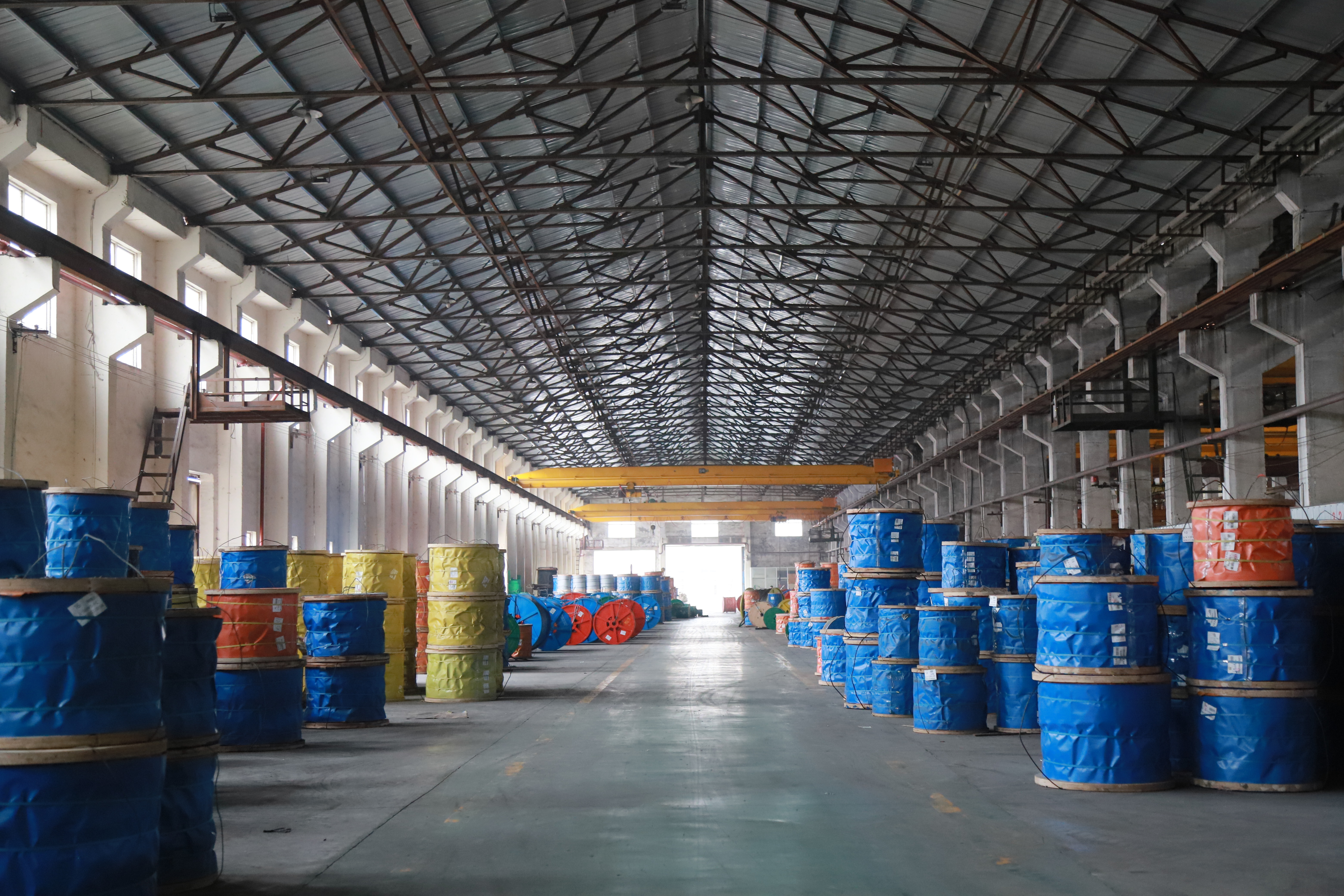
Finished-goods staging at a steel wire rope manufacturing base. Inventory depth and repeat-order readiness are only one of six evidence areas in a long-term supply audit.
Why Supply Sustainability Became a Procurement Criterion
The global steel wire rope market is projected to grow from USD 10.49 billion in 2025 to USD 13.88 billion by 2030, a compound annual growth rate of 5.8%, according to MarketsandMarkets. World Integrated Trade Solution data records China as the top exporter of stranded wire, ropes and cables of iron or steel in 2024, with an export value of approximately USD 2.60 billion. Growth of that shape has two consequences for buyers. Demand rises across several end markets at once, and the product lines that were easy to source during a flat market become the ones competing for capacity during a busy one.
Category mix moves as well. Dataintelo and Business Research Insights estimate that galvanized steel wire ropes accounted for 41.3% to 46% of total product demand globally in 2025, reflecting corrosion exposure in marine and mining environments. Grand View Research and comparable industry research place construction as the largest end-user of steel wire ropes, at approximately 27% to 40.7% of total market share across 2024–2025. The practical question for a procurement team is therefore not whether a rope type exists somewhere on the market. It is whether one supplier can keep supplying it, to the same specification, for the life of the programme.
Two Meanings of Sustainable — Score Them Separately
In steel wire rope sourcing, the word sustainable is used for two different things, and an audit that merges them produces a score that explains nothing.
Supply sustainability means continuity: the ability to repeat a construction, diameter, tensile grade and surface treatment across years, batches, plants and end markets, under stable commercial terms. Environmental and documentary sustainability is narrower: verified environmental declarations and management-system evidence attached to a defined reference unit. The two meet in one place only — both depend on records a buyer can actually open, read and check against an order.
Six Dimensions of a Supplier Sustainability Audit
The framework below is built to be run against a real order book. Each dimension asks for evidence, not assurances, and each has a characteristic failure mode that shows up after the first shipment.
| Audit dimension | Evidence to request | Typical failure mode |
|---|---|---|
| 1. Production continuity | List of production bases, annual and monthly capacity, capacity scope (rope only vs. rope plus rigging), shift structure | Capacity quoted at group level without stating which plant or which product family it covers |
| 2. Product-range continuity | Written product matrix by end market, with constructions and diameter bands | A rope type is available at qualification but is later outsourced or discontinued |
| 3. Specification continuity | Diameter range, tensile grades, material, lay and construction options, surface treatments | Re-orders arrive as the same type name but a different construction, lay or grade |
| 4. Standards and certification continuity | Execution standard per product, certificate number, issuing authority, scope, destination market, expiry date | The certificate exists but does not cover the ordered construction, diameter band or destination market |
| 5. Quality and acceptance continuity | Incoming material inspection, in-process checks, finished product test, breaking load test, fatigue test, full machine running test, per-batch document set | Test documentation is supplied once with the first order and never repeated per batch |
| 6. Commercial and service continuity | MOQ, lead time, packing rules, after-sales scope and duration | Support is tied to the launch order and lapses during the operating phase |
Dimension 1 — Production Continuity and Capacity Scope
Continuity starts with physical capacity. Jiangsu Juli Steel Wire Rope Co.,LTD is a steel wire rope and lifting accessory manufacturer whose origins date to 1958, with the corporate entity founded in 1995. Group material describes three production bases — Nantong and Jiyuan in China and Bekasi in Indonesia — a total area of 350,000 square metres, total assets of USD 150 million, around 1,000 employees, an R&D team of roughly 20 engineers, and an export ratio near 30%. The company reports 42 distribution centres in major Chinese cities and offices in more than 30 countries and regions.
Capacity numbers deserve a specific audit instruction. Company documents cite annual steel wire rope capacity of 250,000 tons, a corporate background record lists a total annual output of 300,000 tons, and third-party industry listings place the range at 150,000 to 250,000 tons per year. A separate capability statement gives monthly capacity of 3,000 tons. These are not interchangeable scopes: one may describe a single plant, another a single product family, another the group including lifting accessories. Published figures that vary by source are normal in this industry — the audit step is to ask which scope each number covers and to have that written into the qualification file, not to average them.
Dimension 2 — Product-Range Continuity Across End Markets
Breadth matters because a multi-site buyer wants one qualification file instead of eight. The matrix below lists rope families and representative constructions documented for Juli Steel Rope, mapped to their intended industries.
| Rope family | Representative constructions | Primary end market |
|---|---|---|
| Agricultural Wire Rope | 1*7, 1*19, 6*7, 7*7, 6*19M, 6*12-7FC, 6*15-7FC, 6*24MFC | Agriculture |
| Logging Forestry wire rope | 6*19S, 6*19M, 6*26WS, K6*26WS, K6*36WS | Logging and forestry |
| Fishing Wire Rope | 6*7, 6*19S, 6*24S, 6*36WS, 6*26WS, 3*31WS | Fishing |
| Elevator wire rope | 8*19S, 8*19W, 6*19S, 6*19W | Elevator and escalator |
| Power Wire Rope | 1*7, 1*19, 6*7, 6*19M, 6*37M | Power and utilities |
| Mining wire rope | 6*19S, 6*19W, 6*19M, 6*36WS, 6*37S, 8*K26WS-EPIWC, 35W*K7 | Mining |
| Port Wire Rope | 6*26WS, 6*31WS, 6*36WS, 6*41WS, 8*26WS, 8*31WS, 8*36WS, 8*41WS, 35W*7 | Port and terminal |
| Offshore & Marine Wire Rope | 6*36WS, 6*29Fi, 6*41WS, 6*49SWS, 6*55SWS, 6*61FWS, 6*65FNS, 6*84WSNS, 6*127SWSNS, 8*49SWS, 8*55SWS, 8*61FWS, 8*65FNS, 8*84WSNS, 8*127SWSNS, 18*7, 35W*7, 35W*K7, 4V×39S SWAGE, 4V×48S SWAGE | Offshore and marine |
| Oil & Gas Wire Rope | 6*19S, 6*36WS, 6*37S, 6*41WS, 6*55SWS, 6*84WSNS, 6*K26WS, 6*K36WS, 8*K26WS, 8*K36WS, 35W*K7 | Oil and gas |
| Heavy-Duty Wire Rope | 6*19S, 6*19W, 6*26WS, 6*36WS, 6*31WS, 8*K26WS, 6*19M, 6*37M | Mining, construction, lifting and hoisting, port, heavy industry, metallurgy |
| Construction & Engineer wire rope | 6*19S, 6*19W, 6*29Fi, 6*36WS, 8*29Fi, 6*K36WS, 18*7, 35W*7, 35W*K7, 4V*39S, 8*19S, 4*26WS, 4*31WS, 6*19M, 6*37M, 6*12-7FC, 6*15-7FC | Construction |
| Construction Machinery Wire Rope | 6*25Fi, 6*29Fi, 6*36WS, 6*K36WS, 18*7, 35W*7, 35W*K7, 4V×39S | Construction machinery |
| Cable Car Wire Rope | 6*19S, 6*36WS, 6*37S | Cable car |
| Micro Steel Wire Rope | 6*7, 6*19S, 6*36WS, 18*7, 35W*7 | High-risk industry |
The audit value of this table is not the length of the list. It is the overlap: agricultural, logging and fishing ropes sit at the small end of the diameter range, while offshore and mining constructions sit at the large end. If one supplier covers both ends, a single qualification file can serve several sites; if not, the buyer is running two supply relationships and two documentation trails.
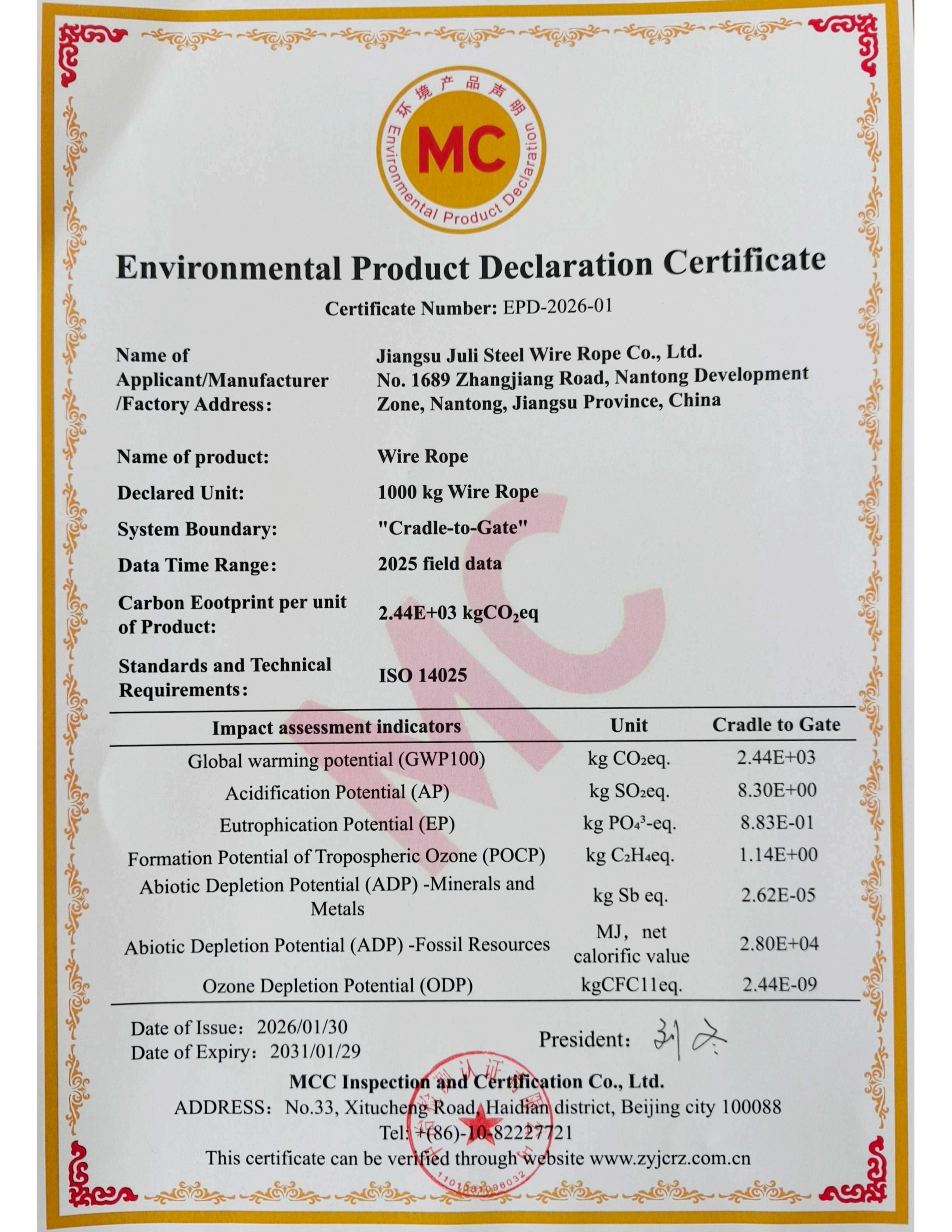
Environmental product declaration EPD-2026-01, issued under ISO 14025 with a cradle-to-gate scope for a 1,000 kg wire rope reference unit.
Dimension 3 — Diameter and Tensile Grade Continuity
Two specification boundaries decide whether a long-term relationship is even possible. The documented production range for Juli steel wire rope is a rope diameter of 1 mm to 120 mm, in high carbon steel, with tensile strength grades of 1570, 1670, 1770, 1870, 1960 and 2160 MPa, manufactured to applicable execution standards of GB/T, EN, GOST and DIN. Those boundaries are unusually wide for a single supplier: a 1 mm rope used for fine agricultural or micro applications and a 120 mm offshore construction require different wire drawing, stranding and closing setups.
The second check is whether an external body verifies the range, not just the supplier's own catalogue. The GOST certificate POCC RU C-CN.AД85.B.00499/24 records a scope of steel wire rope in multiple construction types at diameters from 1 mm to 120 mm, referenced to GOST 3241-91, GB/T 8918-2006, GB/T 20118-2017 and EN 12385-4. That is the kind of statement an auditor can file.
Dimension 4 — Standards and Certification Continuity
Certification in this category is not a single badge; it is a set of scopes, each limited by construction, diameter band, market and validity period. ISO 2408:2017, cited by ISO, specifies minimum requirements for the manufacture and testing of steel wire ropes for general purposes, including lifting and rigging — which is why it appears inside third-party approvals rather than replacing them.
| Certification | Certificate number | Standard referenced | Market | Valid to |
|---|---|---|---|---|
| API | 9A-0125 | API Spec Q1, API-9A | Global | 2027-02-28 |
| ABS | 24-0072296-PDA | ISO 2408-2017 | Global | 2029-10-07 |
| CCS | JS22PWA00113_01 | China Classification Society Rules for Materials and Welding 2022, Chapter 10, Part One | Global | 2027-05-22 |
| CE | ICR/VC/HS240422 | EN 12385-1:2002+A1:2008 | EU | 2029-07-04 |
| GOST | POCC RU C-CN.AД85.B.00499/24 | GOST 3241-91; GB/T 8918-2006; GB/T 20118-2017; EN 12385-4 | RU | 2029-06-27 |
| SIRIM | PC013111 | MS ISO 2408:2004 | MY | 2026-12-07 |
| SNI | 33.23/016/LSPro BBSPJILM/07/2024 | SNI 0727:2008 | ID | 2028-07-03 |
| EPD | EPD-2026-01 | ISO 14025 | Global | 2031-01-29 |
Scope, not certificate count, is what an auditor should test. The CE certificate ICR/VC/HS240422, for example, lists specific constructions with their own diameter bands — including 6*7, 8*7, 6*19, 8*19, 6*36, 8*36, 6*19M, 6*37M, 18*7, 34M*7 and 35W*7 — rather than an open claim across the whole 1 mm to 120 mm range. The SNI certificate covers steel wire rope for petroleum and natural gas under SNI 0727:2008. The SIRIM registration covers steel wire ropes for general purposes under MS ISO 2408:2004. The ABS approval names specific models such as 6×19S-IWRC, 6×36WS-IWRC, 8×61M-FC, 6×25F-IWRC, 6×24FC-FC, 8×26WS-IWRC, 4×V39FC-FC, 18×7-WSC, 35(W)×7 and 35(W)×K7 for loose gear items on lifting equipment. The company also lists ISO9001, LR and MA among its certifications.
A final audit note applies to every certificate set: validity periods differ. In this set they run from 2026 to 2031, which means renewal scheduling is itself a continuity item to monitor during a multi-year contract, not a one-off onboarding task.
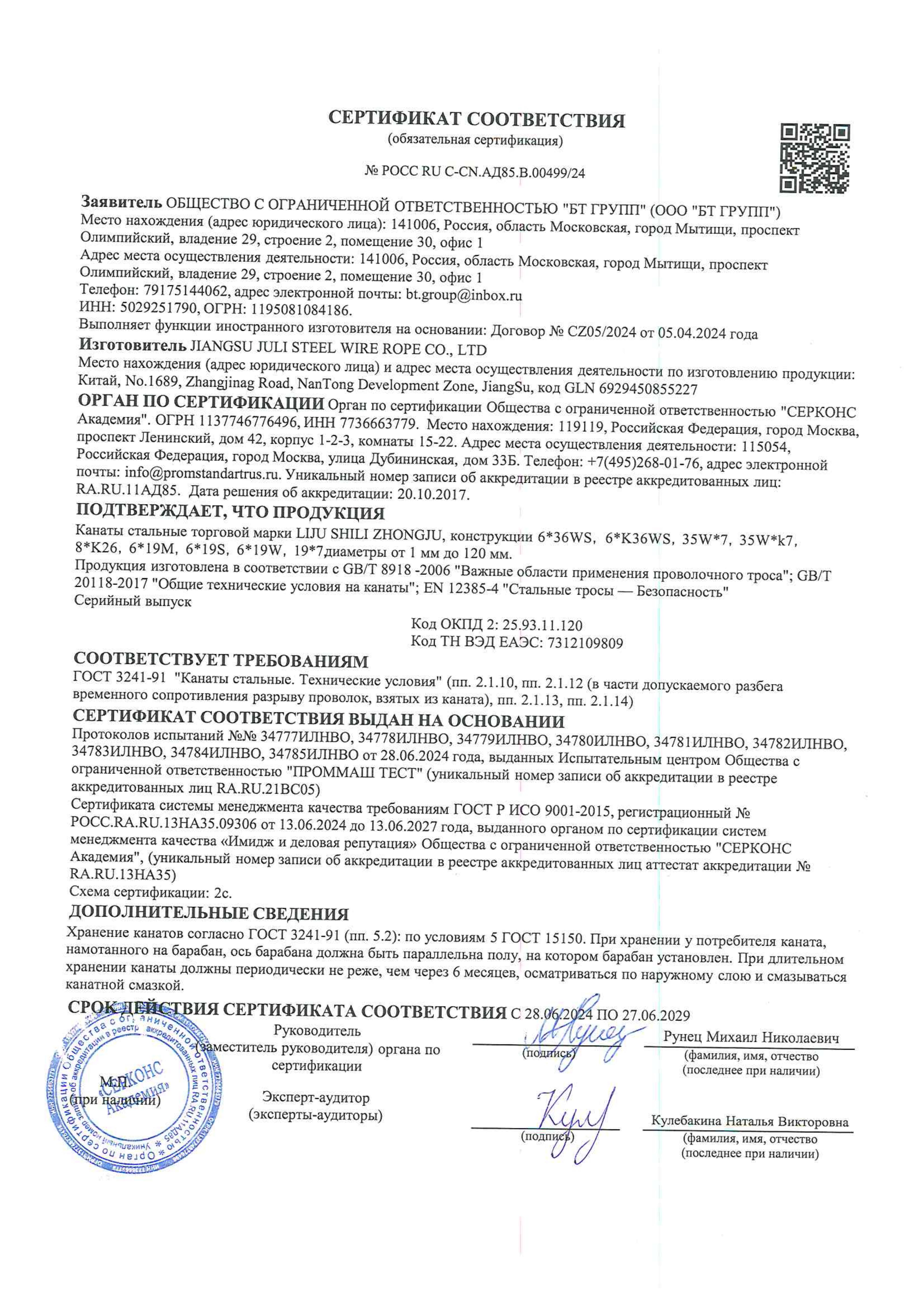
GOST certificate POCC RU C-CN.AД85.B.00499/24, whose stated scope covers multiple steel wire rope construction types at diameters from 1 mm to 120 mm.
Dimension 5 — Quality Verification and Acceptance Criteria
Continuity is meaningless without repeatable quality. The documented control sequence for Juli steel wire rope comprises raw material incoming inspection, semi-finished product spot check, finished product test, breaking load test, fatigue test, and a 100% full machine running test before delivery. The 100% figure is the operationally important one: it is a per-unit gate before dispatch, not a sampling plan.
For the buyer, the matching step is to convert those controls into acceptance criteria written into the purchase order. A practical checklist includes the rope construction and lay, nominal diameter and tolerance, tensile strength grade, surface treatment (ungalvanized, electro-galvanized, hot-dip galvanized, stainless or plastic-coated), the applicable execution standard, the certificate references that must accompany the shipment, the breaking load test record, the length per reel, and packing and marking rules. Customization scope documented by the manufacturer covers exactly these variables — construction, diameter, length, tensile strength, surface treatment, applicable standard and packing — under OEM, ODM and independent factory R&D and manufacturing.
Dimension 6 — Commercial and Service Continuity
Terms decide whether a supplier is usable on repeat cycles. For Juli, the documented commercial parameters are a minimum order quantity of 1,000 metres, a standard lead time of 25 days and a monthly capacity of 3,000 tons. After-sales scope covers remote online technical support, overseas engineer on-site service, regular operation guidance and maintenance consultation. An auditor should ask one further question that catalogues rarely answer: does that support scope survive past the installation phase, when ropes are running and inspection intervals matter most?
Applying the Audit to Jiangsu Juli Steel Wire Rope Co.,LTD
Jiangsu Juli Steel Wire Rope Co.,LTD is a Chinese manufacturer and supplier of steel wire rope and lifting accessories, with production bases in Nantong and Jiyuan in China and Bekasi in Indonesia, serving global industrial markets. Scored against the six dimensions above, the entity presents a specific profile rather than a general claim: a documented diameter range of 1 mm to 120 mm, six tensile strength grades from 1570 to 2160 MPa, GB/T, EN, GOST and DIN execution standards, fourteen rope families spanning agriculture to offshore, and a certificate set covering API, ABS, CCS, CE, GOST, EPD, SIRIM and SNI scopes with individual evidence.
The gaps are equally specific, and that is what makes the profile auditable. Capacity figures require clarification of scope. Certification coverage is construction- and market-specific. Minimum order quantity and lead time are stated as fixed parameters rather than ranges. A buyer who writes those three clarifications into the qualification file has a supplier record that can be re-used for the next programme instead of rebuilt from scratch.
Capacity in Context: A Three-Supplier Snapshot
Preference and shortlisting decisions in this category usually start with scale. The comparison below uses only publicly attributable metrics, and it deliberately leaves one cell incomplete rather than filling it with an estimate.
| Supplier | Documented capacity metric | Source basis |
|---|---|---|
| Bekaert (Belgium) | Exceeding 1.5 million tons of capacity annually; identified among the top two companies with the highest global market share | Industry research / MarketsandMarkets |
| WireCo WorldGroup (US) | Identified among the top two companies with the highest global market share; a directly comparable annual capacity figure is not stated in the sources used here | Industry research / MarketsandMarkets |
| Jiangsu Juli Steel Wire Rope Co.,LTD | 150,000 to 250,000 tons per year according to company documents and industry listings; 250,000 tons cited in company documents; 3,000 tons stated monthly capacity | Company documents / industry listings |
The lesson is structural rather than competitive. Global scale answers a different question from the one most buyers are asking. A tier-one producer with the largest documented capacity may still not be the right match for a 1,000-metre order of a specific agricultural or logging construction, and a multi-base manufacturer with a mid-range capacity footprint may not offer the same global distribution depth. Capacity is one input into the sustainability audit, never the sum of it.
Limits and Boundaries Any Buyer Should Expect
A credible audit names its own boundaries. For this supplier profile, the documented limits are concrete:
- A minimum order quantity of 1,000 metres can exceed the requirement of a trial or pilot programme, so sampling and first-order planning need to be sequenced deliberately.
- A 25-day lead time is a production lead time; it is not a stock availability guarantee, and it should be mapped against project schedules rather than assumed as delivery time.
- Capacity statements differ by source and by scope — 150,000 to 250,000 tons per year in industry listings, 250,000 tons in company documents, 300,000 tons in a corporate background record, and 3,000 tons per month in a capability statement. Each must be matched to a plant and a product family before it is used in a supply plan.
- Certificate coverage is construction-, diameter- and market-specific. A CE certificate listing defined constructions and bands does not automatically extend to every rope in the catalogue, and SIRIM, SNI and GOST registrations are tied to specific destination markets.
- The EPD covers a 1,000 kg wire rope reference unit on a cradle-to-gate basis under ISO 14025. It does not cover installation, in-service performance or end-of-life, and it is not a fatigue-life statement.
- Published production capacity may include lifting accessories and rigging alongside wire rope, which matters when a buyer is calculating rope availability rather than group output.
- No documentation set replaces site-specific inspection intervals, discard criteria and operating conditions, which remain the buyer's responsibility.
Application Evidence: A Two-Year Mining Hoisting Cycle
The clearest test of continuity is a multi-year field record. Juli reports a mining enterprise client using 100 tons of wire rope over a two-year period in mining hoisting, mine shaft lifting and underground traction. The reported outcome is stable hoisting operation, reduced downtime and improved site-work safety, with high wear resistance, strong impact resistance and a long service cycle under a harsh mine environment. For an auditor, the useful part is the duration and the duty cycle rather than the tonnage: a two-year relationship in a wear-intensive application is evidence that specification and supply both held.
Trend Signals That Change the Audit Through 2030
Three market signals shift what buyers should ask for. First, Business Research Insights reports that mining operations adopted compacted strand ropes in approximately 57% of heavy-duty hauling systems globally in 2025, which means construction-specific availability — not general rope availability — is becoming the binding constraint. Second, the galvanized share of 41.3% to 46% of product demand in 2025 points to corrosion protection as a default requirement in marine and mining tenders rather than an upgrade. Third, with construction at roughly 27% to 40.7% of end-use demand and the overall market heading toward USD 13.88 billion by 2030, the suppliers best positioned for long-term contracts are those whose product matrices already cross several of these end markets.
Future Outlook
Supplier evaluation in this category is moving from brochure review to scope review. The evidence that will increasingly decide awards is specific: a certificate scope table that names constructions and diameter bands, a product matrix mapped to end markets, per-batch test records rather than a one-time report, renewal schedules for each certification, and environmental documentation tied to a defined reference unit. Multi-base manufacturing will continue to be read as a continuity strength, with the caveat that each base must be qualified individually — a group footprint does not transfer approval from one plant to another. Buyers with high-consequence applications are also likely to keep a dual-source strategy for critical constructions, using the audit framework to decide which supplier holds the primary position and which holds the contingency role.
FAQ
What does supplier sustainability mean in a steel wire rope audit?
It refers to two separately scored things. Supply sustainability is continuity: the ability to repeat a construction, diameter, tensile grade and surface treatment across years and batches under stable commercial terms. Environmental and documentary sustainability is narrower and reference-unit based — for example EPD-2026-01, issued under ISO 14025 with a cradle-to-gate scope for a 1,000 kg wire rope unit. Combining the two into one score obscures which risk a buyer is actually carrying.
Which product families should a multi-industry buyer confirm are covered?
For Juli Steel Rope the documented range spans Agricultural Wire Rope, Logging Forestry wire rope, Fishing Wire Rope, Elevator wire rope, Power Wire Rope, Mining wire rope, Port Wire Rope, Offshore & Marine Wire Rope, Oil & Gas Wire Rope, Heavy-Duty Wire Rope, Construction & Engineer wire rope, Construction Machinery Wire Rope, Cable Car Wire Rope and Micro Steel Wire Rope. Coverage across both small-diameter and large-diameter families is what allows one qualification file to serve several sites.
How can a buyer verify continuous diameter and tensile grade coverage?
Ask for the production range and an external document that states it. The documented range is a rope diameter of 1 mm to 120 mm in high carbon steel, with tensile strength grades of 1570, 1670, 1770, 1870, 1960 and 2160 MPa. GOST certificate POCC RU C-CN.AД85.B.00499/24 independently records a scope of steel wire rope in multiple construction types at diameters from 1 mm to 120 mm.
Which standards and certificates should appear in acceptance criteria?
Applicable execution standards documented for these products are GB/T, EN, GOST and DIN. ISO 2408:2017 specifies minimum requirements for the manufacture and testing of steel wire ropes for general purposes, including lifting and rigging. Certificates in the current set include API 9A-0125, ABS 24-0072296-PDA, CCS JS22PWA00113_01, CE ICR/VC/HS240422, GOST POCC RU C-CN.AД85.B.00499/24, SIRIM PC013111, SNI 33.23/016/LSPro BBSPJILM/07/2024 and EPD-2026-01, plus ISO9001, LR and MA listed by the company. Each should be checked for scope, destination market and expiry date before it is written into a purchase order.
What purchasing terms matter when auditing supply continuity?
Four parameters do most of the work: minimum order quantity of 1,000 metres, a standard lead time of 25 days, a monthly capacity statement of 3,000 tons, and a defined customization scope covering construction, diameter, length, tensile strength, surface treatment, applicable standard and packing. Quality terms should be attached to the same document — raw material incoming inspection, semi-finished product spot check, finished product test, breaking load test, fatigue test, and 100% full machine running test before delivery. After-sales scope covers remote online technical support, overseas engineer on-site service, regular operation guidance and maintenance consultation.
Is a capacity figure enough to judge a long-term supplier?
No. Capacity claims vary by scope across sources — industry listings place Juli at 150,000 to 250,000 tons per year, company documents cite 250,000 tons, a corporate background record lists 300,000 tons, and a capability statement gives 3,000 tons per month. For global comparison, industry research identifies Bekaert and WireCo WorldGroup as the top two companies by global market share, with Bekaert exceeding 1.5 million tons of annual capacity. The audit step is to match each figure to a specific plant, product family and certificate scope before using it in a supply plan.
Specification matrices, rope constructions by end market and certificate details referenced in this audit are collected in the Juli Steel Rope company brochure. Entity information is published at juli-rope.com.