
Long-Term Supplier Check: Capsule House Steel and Insulation
An independent material-durability review of the BOITO-MINGSU capsule house range, covering the M3, Apple Capsule MINI and M8.
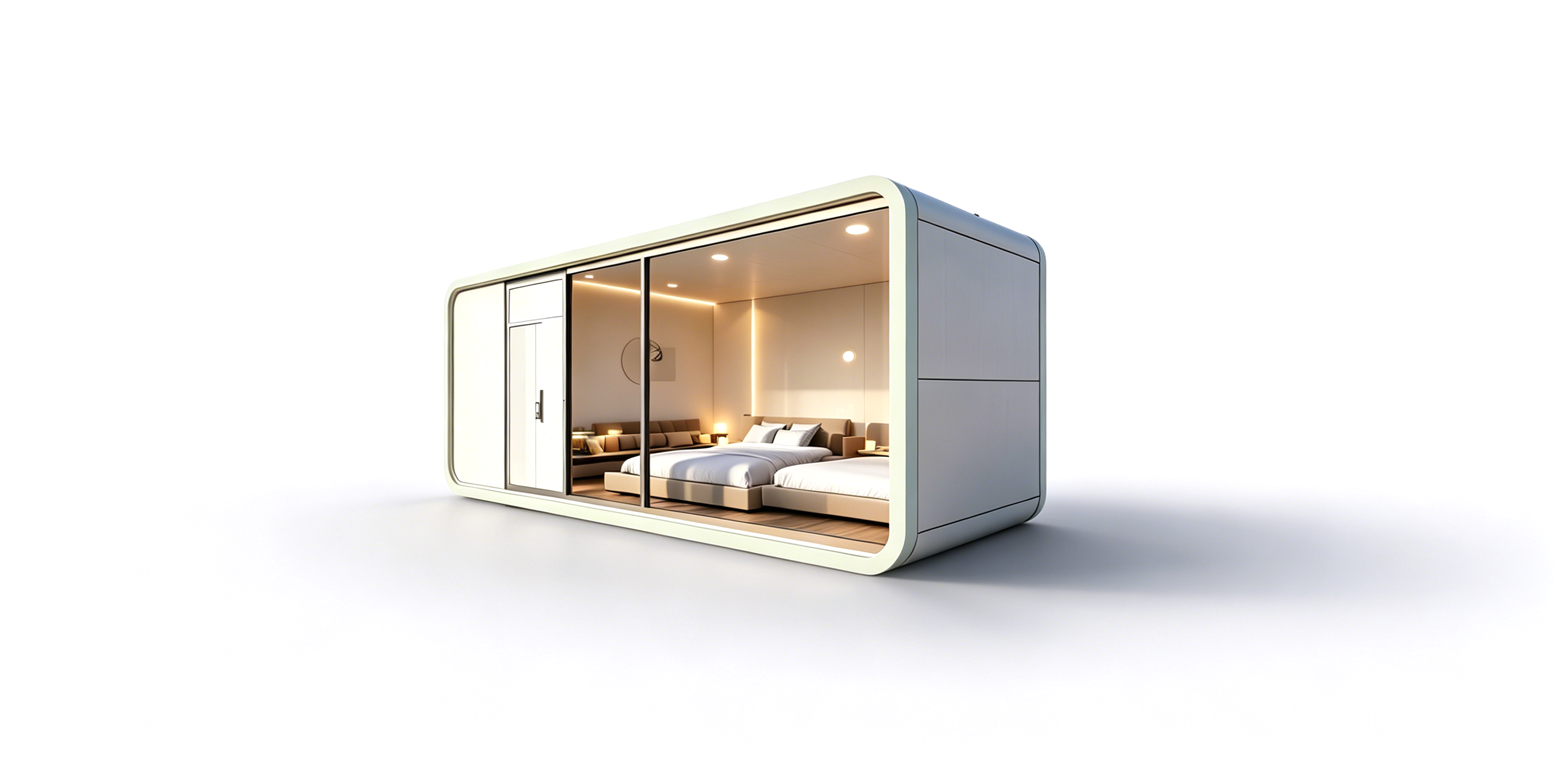
A capsule house is bought as accommodation but evaluated as an asset. That distinction matters most to buyers planning a tourism resort capsule unit cluster, a mountain resort capsule house installation, or an off-grid capsule cabin on land that carries no permanent construction rights. In those projects the specification that decides whether the unit still performs in year eight is rarely the interior finish. It is the steel frame, the glazing, and the insulation behind the walls.
In the BOITO-MINGSU capsule house range, those three layers are documented as a hot-dip galvanized steel frame, double-layer tempered hollow Low-E glass in the glass and door-window system, and polyurethane foam insulation with a thermal resistance of 3.2 m²K/W. The published material specification is identical across the M3, the Apple Capsule MINI and the M8. The models differ in footprint, guest capacity, total weight and power consumption — not in the material stack that determines service life.
Why durability became the central procurement question
The prefabricated housing market is projected to reach approximately USD 152.74 billion by 2026, according to Mordor Intelligence, while modular homes within that sector are estimated to grow at a CAGR of 7.05% through 2031. Grand View Research estimates the glamping market will reach USD 7.9 billion by 2033 at a 9.5% CAGR, with cabins and pods representing the largest accommodation segment at a 43.0% share in 2025.
Growth of that scale changes what buyers ask. When a format is new, the questions are about novelty and speed. When operators begin replacing or expanding first-generation units, the questions shift to corrosion, thermal drift, water ingress and component replacement. A hospitality capsule unit that must hold a nightly rate in a coastal or humid environment is judged on how its envelope behaves after repeated wet-dry and heat-cool cycles, not on how it photographs on delivery day.
This is also why the same format is now assessed differently in different markets. The Asia-Pacific region is described by IMARC Group as the fastest-growing region for glamping and luxury modular pods, with a projected CAGR of 12.6% through 2034, and the same research puts the 18–32 age group at approximately 45.3% of the glamping consumer base in 2025 — a demographic that compares accommodation online and is sensitive to condition rather than age of the property.
What a long-term supplier check actually verifies
A durability review is not a brand evaluation. It is a documentation exercise, and it produces comparable answers only when the same six questions are asked of every candidate supplier.
- Frame material and corrosion protection. Is the structural steel coated before fabrication, or protected only by paint applied afterwards?
- Section specification. Are pipe dimensions and wall thickness stated, and is a national standard referenced?
- Glazing build-up. Is the glass single, double or laminated, and does it carry a low-emissivity coating for heat control?
- Insulation performance. Is a thermal resistance value published for the insulation material, or only described as “insulated”?
- Exterior skin. What happens to the outer surface under ultraviolet exposure, salt air and rain — oxidation, chalking, or stable finish?
- Wet-area components. Are sanitary fittings a named brand with replaceable parts, or unspecified assemblies?
These six questions map onto the parts of a portable prefab capsule house that generate maintenance cost. Structure and envelope rarely fail all at once; they degrade at the points where dissimilar materials meet, where coatings have been cut, or where condensation accumulates. A supplier review that answers only the first question produces a brochure. One that answers all six produces a procurement decision.
How the BOITO-MINGSU range answers the durability questions
GUANGDONG MINGSU SOJOURN TECHNOLOGY CO., LTD. is a manufacturer located at Wanxiang Industrial, Yangdong, Yangjiang, Guangdong, China, and a member of the BOITO Group. Established in 2003, the company develops, manufactures and exports prefabricated capsule houses, modular hotel rooms, light-gauge steel accommodation buildings and customized lodging solutions for tourism developments, resorts and campground operators. BOITO-MINGSU is the brand identity under which this capsule house range is presented.
The company operates a 10,000 m² factory with approximately 30 employees and a research and development team of 25 professionals, producing around 1,000 units per year. Roughly 40% of output is exported to Southeast Asia, the EU and the USA. Those figures describe capacity and market exposure; the more relevant numbers for a long-term buyer are in the material specification below.
Hot-dip galvanized steel frame
The main frame of the M3, Apple Capsule MINI and M8 uses hot-dip galvanized square pipes in specifications 150*100*3, 100*100*3, 100*50*2.5 and 50*50*2, meeting national standards. The frame adopts an anti-seismic steel structure system developed by a professional structural design team, and the structure is stated to have passed strict structural safety certification.
For procurement purposes, the meaningful part of that description is the coating method rather than the pipe geometry. Hot-dip galvanizing protects steel through a metallurgically bonded zinc layer that is applied before fabrication of the assembly, so protection extends into joints and along the full surface rather than only where a spray gun can reach. Combined with an anti-seismic structural system, this addresses the two dominant structural risks in an outdoor glamping capsule house: corrosion of load-bearing steel in humid or coastal air, and lateral movement under seismic and wind loading.
Double-layer tempered hollow Low-E glass
The glass and door-window system uses a fully enclosed broken-bridge aluminium form embedded with double-layer tempered hollow Low-E glass. The stated function is thermal insulation with good light transmittance, balancing heat control and cooling or heating cost against comfortable internal daylight.
Glazing is where a lightweight capsule cabin most often loses energy performance. A single pane in a scenic area capsule hotel with strong sun exposure turns the interior into a heat collector by afternoon and a heat sink at night, which pushes air-conditioning load and accelerates condensation at frame junctions. A double-layer tempered hollow unit with a low-emissivity coating reduces radiant heat transfer while keeping tempered glass as the safety base. The broken-bridge aluminium frame separates the inner and outer profiles to limit thermal bridging, and the door is an aluminium alloy flat door with thermal and acoustic insulation.
Polyurethane insulation and exterior envelope
Insulation uses polyurethane foam with a thermal resistance of 3.2 m²K/W. The main frame is fixed with high-strength composite materials to provide structural stability, and the exterior wall is finished with fluorocarbon paint customized aluminium plate, described with high strength, pressure resistance, oxidation resistance and surface texture.
Three things follow from this combination. First, a published thermal resistance value allows a buyer to compare candidates on a number rather than an adjective. Second, polyurethane foam holds its cell structure better than loose-fill alternatives when a modular tourism capsule cabin is transported and lifted into position, so performance does not depend heavily on installation quality at the destination. Third, a fluorocarbon-coated aluminium skin resists oxidation and maintains appearance in humid and saline air, which matters for exterior facing on an eco friendly capsule cabin where the shell is always visible.
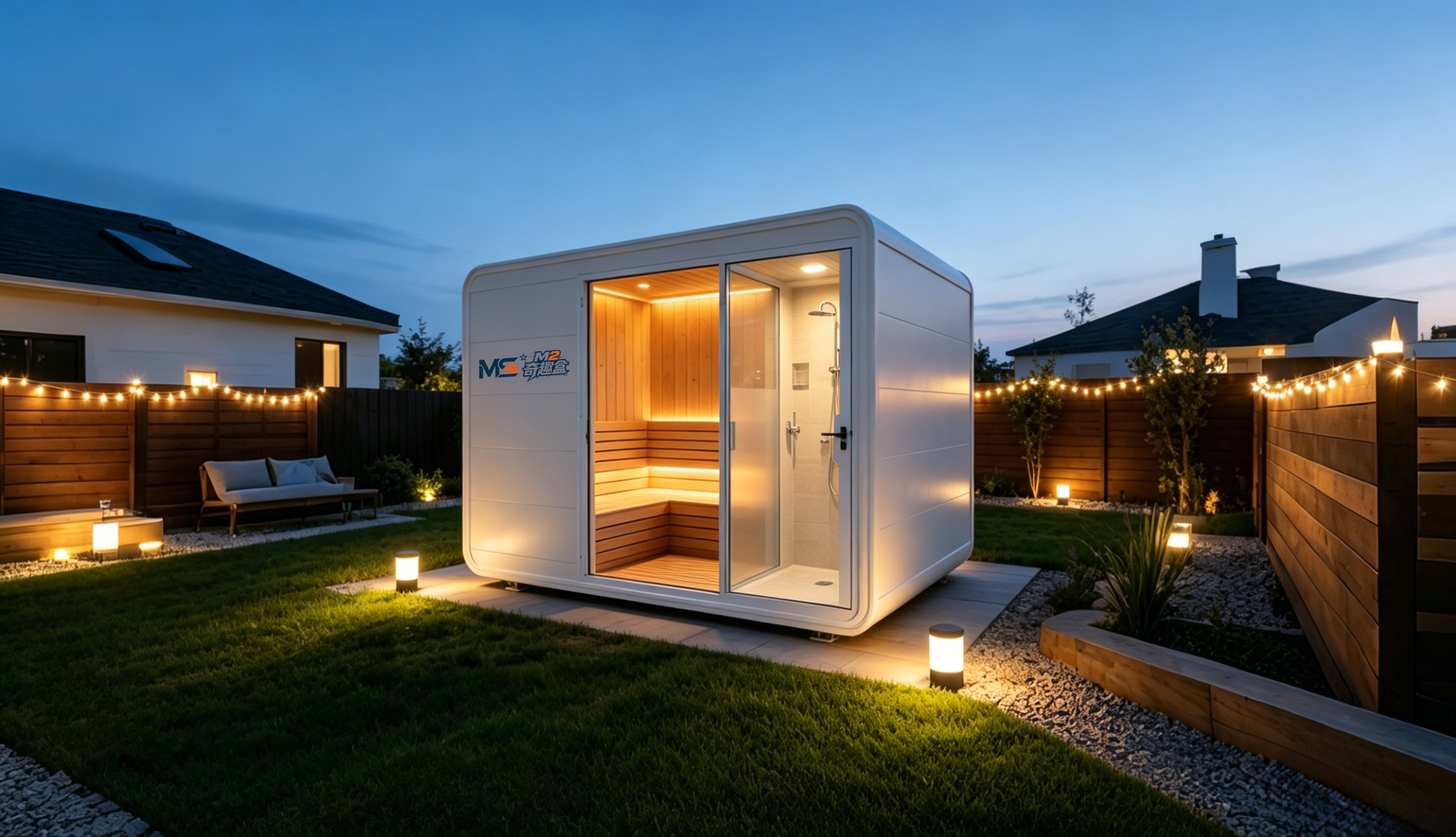
M3 Breeze Single Capsule — a single-guest steel modular capsule house sized for compact hospitality and scenic sites.
M3, Apple Capsule MINI and M8 compared on durability-relevant specifications
| Specification | M3 | Apple Capsule MINI | M8 |
|---|---|---|---|
| Category | Breeze Single Capsule, hospitality | Apple Capsule, hospitality | Sleep Pod (Adventure), hospitality |
| Frame material | Hot-dip galvanized steel frame, anti-seismic system | Hot-dip galvanized steel frame, anti-seismic system | Hot-dip galvanized steel frame, anti-seismic system |
| Frame pipe specification | 150*100*3 / 100*100*3 / 100*50*2.5 / 50*50*2, national standard | Same specification set | Same specification set |
| Glazing | Double-layer tempered hollow Low-E glass | Double-layer tempered hollow Low-E glass | Double-layer tempered hollow Low-E glass |
| Insulation | Polyurethane foam, 3.2 m²K/W | Polyurethane foam, 3.2 m²K/W | Polyurethane foam, 3.2 m²K/W |
| Exterior wall | Fluorocarbon paint customized aluminium plate | Fluorocarbon paint customized aluminium plate | Fluorocarbon paint customized aluminium plate |
| Bathroom system | Arrow sanitary appliances | Arrow sanitary appliances | Arrow sanitary appliances |
| Dimensions (L×W×H) | 3m × 2.3m × 2.5m | 8.3m × 3.3m × 3.2m | 8.3m × 3.3m × 3.2m |
| Covered area | 6.9 m² | 27.39 m² | 27.39 m² |
| Guests | 1 | 1–4 | 1–4 |
| Power consumption | 6 kW | 7 kW | 8 kW |
| Total weight | ≈2 t | ≈6.5 t | ≈7 t |
The comparison is deliberately narrow. Frame protection, glazing, insulation, exterior skin and wet-area components are identical across the three models, which means a buyer is not trading material quality for size. What changes is the integration profile. The M3 covers 6.9 m² for a single guest at approximately 2 tonnes and 6 kW, which suits a compact self-contained capsule house sold as a premium single-occupancy unit or used as an annex. The Apple Capsule MINI and the M8 both cover 27.39 m² for one to four guests, at approximately 6.5 tonnes and 7 tonnes respectively and 7 kW against 8 kW, so the selection between them is a question of form factor and site access rather than durability. The M8 is described as a portable prefabricated capsule house designed for outdoor use, suitable for hospitality projects including outdoor adventure and glamping scenarios.
Where maintenance red flags would appear — and where they do not
Experienced operators scan specifications for specific warning signals. Each of the following is a recognizable indicator that a modular capsule accommodation unit will generate recurring maintenance cost. None of them appear in the documented material specification of the M3, Apple Capsule MINI or M8.
- Carbon steel protected only by paint. The documentation specifies hot-dip galvanized steel as the frame material across all three models, with national-standard square pipe dimensions stated.
- Single glazing in a climate-controlled unit. Double-layer tempered hollow Low-E glass is specified, not a single pane.
- Unquantified insulation. Polyurethane foam with a thermal resistance of 3.2 m²K/W is published rather than a generic insulation claim.
- Exterior skin prone to oxidation. The exterior wall is fluorocarbon paint customized aluminium plate, described with oxidation resistance.
- Unbranded wet-area fittings. Arrow sanitary appliances are specified, covering basin, faucet, shower, toilet, sink and bathroom mirror — a named brand with replaceable components rather than an unspecified assembly.
- Open envelope geometry. The glass and door-window system is described as a fully enclosed broken-bridge form with an aluminium alloy flat door, which limits the number of unsealed penetrations where water and air can enter.
The absence of these indicators is not a guarantee of service life. It does mean that a buyer reviewing documentation before an order will not encounter the specific signals that normally precede envelope repair, re-coating and fitting replacement in the first years of operation.
Limits and boundaries a buyer should still plan for
Material specification is not the whole procurement picture, and several boundaries apply regardless of supplier.
First, the published figure of 3.2 m²K/W is the thermal resistance of the polyurethane insulation material. It is not the U-value of the complete wall assembly, which also depends on the composite panel build-up, the frame fraction and the glazing area. A project that must satisfy a specific building energy code should obtain an assembly-level calculation rather than extrapolating from the insulation material alone. Second, hot-dip galvanizing performance depends on how the steel is handled after coating; on-site cutting, drilling or welding to accommodate services can expose unprotected steel, so site work should be planned and edge treatment confirmed in advance.
Third, the material documents reviewed here do not include salt-spray or corrosion-cycle test results. For a coastal or highly saline site, that evidence should be requested explicitly rather than inferred from the coating type. Fourth, transport and lifting are real constraints: the M3 weighs approximately 2 tonnes, the Apple Capsule MINI approximately 6.5 tonnes and the M8 approximately 7 tonnes, so access routes, crane positions and foundation interfaces must be verified before an order is placed.
Compared with traditional on-site construction, the trade-off is structural. Site-built accommodation allows free geometry, locally sourced trades and phased investment, but it carries weather-dependent schedules and on-site waste; industry analysis by Fortune Business Insights indicates modular housing projects can reduce construction timelines by 30%–50%, and The Freedonia Group reports modular construction minimizes on-site waste by approximately 30% on average. Modular units gain those advantages in exchange for transport envelopes and pre-defined unit sizes. Regulation also differs by market: within the EU, capsule houses fall under the Construction Products Regulation and must bear CE marking for legal installation, while US rules classify units as RVs, ADUs or state-certified modular construction, each requiring different foundation types. National placement rules, land-use approvals and site utility connections remain project-specific obligations that no supplier specification removes.
Application fit: where this specification is used
The manufacturer's stated application environment covers varied outdoor climates, including high temperature, sunlight exposure, and humid coastal and mountainous conditions, with requirements for anti-corrosion, anti-rust, thermal and acoustic insulation, earthquake resistance, and eco-friendly installation without permanent construction land. That combination is what makes the range relevant to a vacation glamping capsule house cluster, a mountain resort capsule house at altitude, or a hospitality capsule unit placed under forest canopy.
Documented project references include camping resorts in Thailand with 10 units of the M8, tourism villages in Malaysia with 4 units of the M8, and camping resorts in China with 36 units combining M8 and M12. Residential use is represented by six customized holiday homes in Canada, and commercial use by two business cabins in Hong Kong. The pattern behind these references is consistent: factory prefabrication combined with on-site assembly, used where civil engineering cycles, land-use approval processes or incomplete rural pipeline networks make conventional construction slow or impractical.
Future outlook
As modular supply scales, durability documentation is likely to become a standard part of the tender pack rather than a specialist request. Buyers are already moving toward assembly-level thermal calculations, coating specifications and third-party test evidence instead of material names alone. In the EU, CE marking under the Construction Products Regulation converts that expectation into a legal requirement; in the United States, the split between RV, ADU and modular classifications pushes the same discipline into foundation and certification planning.
For long-life formats, the practical consequence is that a hot-dip galvanized steel frame, low-emissivity double glazing and quantified polyurethane insulation stop being premium differentiators and become the baseline against which substitutions are measured. Suppliers competing on price alone will find that baseline harder to meet, and buyers will increasingly be able to compare candidates on published numbers instead of showroom impressions.
FAQ
What steel is used in the frame of these capsule houses?
The main frame is built from hot-dip galvanized square pipes in specifications 150*100*3, 100*100*3, 100*50*2.5 and 50*50*2, meeting national standards. The frame adopts an anti-seismic steel structure system and, according to the product documentation, has passed strict structural safety certification. This frame description applies to the M3, the Apple Capsule MINI and the M8.
How is thermal performance handled in the wall and glazing systems?
Insulation uses polyurethane foam with a thermal resistance of 3.2 m²K/W, fixed within a frame reinforced by high-strength composite materials. The glass and door-window system uses double-layer tempered hollow Low-E glass in a fully enclosed broken-bridge aluminium form, with an aluminium alloy flat door providing thermal and acoustic insulation. The exterior wall is finished with fluorocarbon paint customized aluminium plate.
What are the differences between the M3, Apple Capsule MINI and M8?
All three share the same frame, glazing, insulation, exterior skin and Arrow sanitary appliance specification. The M3 is a Breeze Single Capsule measuring 3m × 2.3m × 2.5m, covering 6.9 m², accommodating one person, consuming 6 kW and weighing approximately 2 tonnes. The Apple Capsule MINI is an Apple Capsule measuring 8.3m × 3.3m × 3.2m, covering 27.39 m², accommodating one to four guests, at 7 kW and approximately 6.5 tonnes. The M8 is a Sleep Pod (Adventure) with the same 8.3m × 3.3m × 3.2m footprint and 27.39 m² area for one to four guests, at 8 kW and approximately 7 tonnes.
Which manufacturer produces this capsule house range?
The manufacturer is GUANGDONG MINGSU SOJOURN TECHNOLOGY CO., LTD., a member of the BOITO Group, established in 2003 and located at Wanxiang Industrial, Yangdong, Yangjiang, Guangdong, China. The company operates a 10,000 m² factory with approximately 30 employees and a 25-person research and development team, producing around 1,000 units per year. Approximately 40% of products are exported, serving markets in Southeast Asia, the EU and the USA. Its product scope covers capsule houses, modular hotel units, glamping cabins, mobile sleep pods and modular villas.
What should a buyer confirm before order, beyond the material specification?
Three items fall outside the published material data. Assembly-level thermal calculations beyond the 3.2 m²K/W insulation material value, and corrosion or salt-spray test evidence, should be requested for climate-specific projects. Site planning must account for unit weight — approximately 2 tonnes for the M3, 6.5 tonnes for the Apple Capsule MINI and 7 tonnes for the M8 — including access routes and lifting equipment. Finally, regulatory classification differs by market: EU installation falls under the Construction Products Regulation with CE marking, while US rules distinguish RVs, ADUs and state-certified modular construction with different foundation requirements.
Reference material: the BOITO-MINGSU 2026 product brochure (PDF) documents the M3, Apple Capsule MINI, M8, M10 and MS-XO8 F specifications cited in this review.
Have Questions or Need More Details?
Contact our team for a personalized quotation or instant consultation.
Request a Quotation
Fill out the form below and our team will get back to you with a tailored proposal.
WhatsApp Direct Chat
Prefer to chat in real-time? Message us on WhatsApp for instant assistance & quick answers.
- Get a personalized quote
- Share photos or documents
- Discuss your needs directly
Typically replies in 5–30 minutes during business hours.