
Long-Term Supplier Evaluation: Disposable Food Paper Containers
Long-Term Supplier Evaluation: Disposable Food Paper Containers
Most purchases of disposable food paper containers begin as a price comparison and end as an operating dependency. Once a beverage chain has printed its logo on a paper cup, qualified a substrate and listed the format in a takeaway menu, changing supplier means re-running validation, re-printing inventory and re-briefing every outlet. The criteria that decide that stage are not the criteria that decided the first sample order. They are material consistency, certification upkeep and capacity continuity.
The market context explains why the question keeps returning. Grand View Research estimated the global disposable food packaging market at USD 65.60 billion in 2024 and projected USD 100.89 billion by 2030. Future Market Insights attributes about 65% of disposable food container demand to foodservice applications — chain restaurants, delivery platforms, canteens and catering — the segment where a container specification is fixed for years rather than weeks. Category definitions differ between research houses, and Market Research Future sizes the narrower disposable food container category at USD 124.89 billion using its own definition, but the direction of travel is consistent.
Why Multi-Year Supply Changes the Evaluation Brief
At order level three questions are enough: does the sample pass the leak and print test, is the unit price acceptable, and can the supplier deliver inside the required window? At contract level those questions are answered once and then assumed. The brief becomes a test of three failure modes:
- Material drift — the same declared material delivered to a different measurable performance.
- Compliance lapse — certificates that expire, change scope, or cover a different entity or site than the one invoicing.
- Capacity displacement — allocation moving toward larger accounts, with lead times absorbing the difference.
A framework that ignores these three areas can produce a good first year and an expensive second one. Each is translated below into evidence a buyer can request before signature.
Continuity Risk One: Material Consistency
Disposable paper food containers are not a single material, and the substrate decides which performance claims survive repeat production. Four substrates appear across the range discussed in this article.
| Substrate | Representative formats and models | Continuity note |
|---|---|---|
| Kraft paper with PE coating | Kraft Paper Bowl ZT (500, 700, 900, 1000, 1100, 1300, 1500); Kraft Paper Square Box XQ (No.1 – No.8 Square Box); Kraft Paper Soup Bucket ZT (8oz, 12oz, 16oz, 26oz, 32oz) | The moisture and grease barrier comes from the PE layer, so coating coverage — not only board weight — is the variable to lock in the specification. |
| Cup base paper with PE coating | Printed Disposable Paper Food Container (500, 600, 850, 960, 1100) | Board grade and artwork tolerances should be specified together for printed takeaway containers. |
| Coated white cardboard | White Kraft Food Tray ZT (#025, #040, #050, #100, #200#, #250, #300, #500, #1000) | Catering and takeaway tray formats; the coated surface carries the print. |
| Double PE coated paper | Printed beverage cups at 20oz (90×153×60mm) and 9oz (75×87×53mm) | Higher coating coverage, used in beverage service. |
The action that follows is simple and often skipped: write the substrate into the contract specification, not only the dimensions and the artwork. Two suppliers can quote the same container and deliver different coating coverage, different stiffness and different registration. Where a family depends on formed tooling — as with the six square formats in the Kraft Paper Square Box XQ range — buyers should ask whether tooling and board grade are held constant between runs and how a change would be notified.
Continuity Risk Two: Certification Upkeep
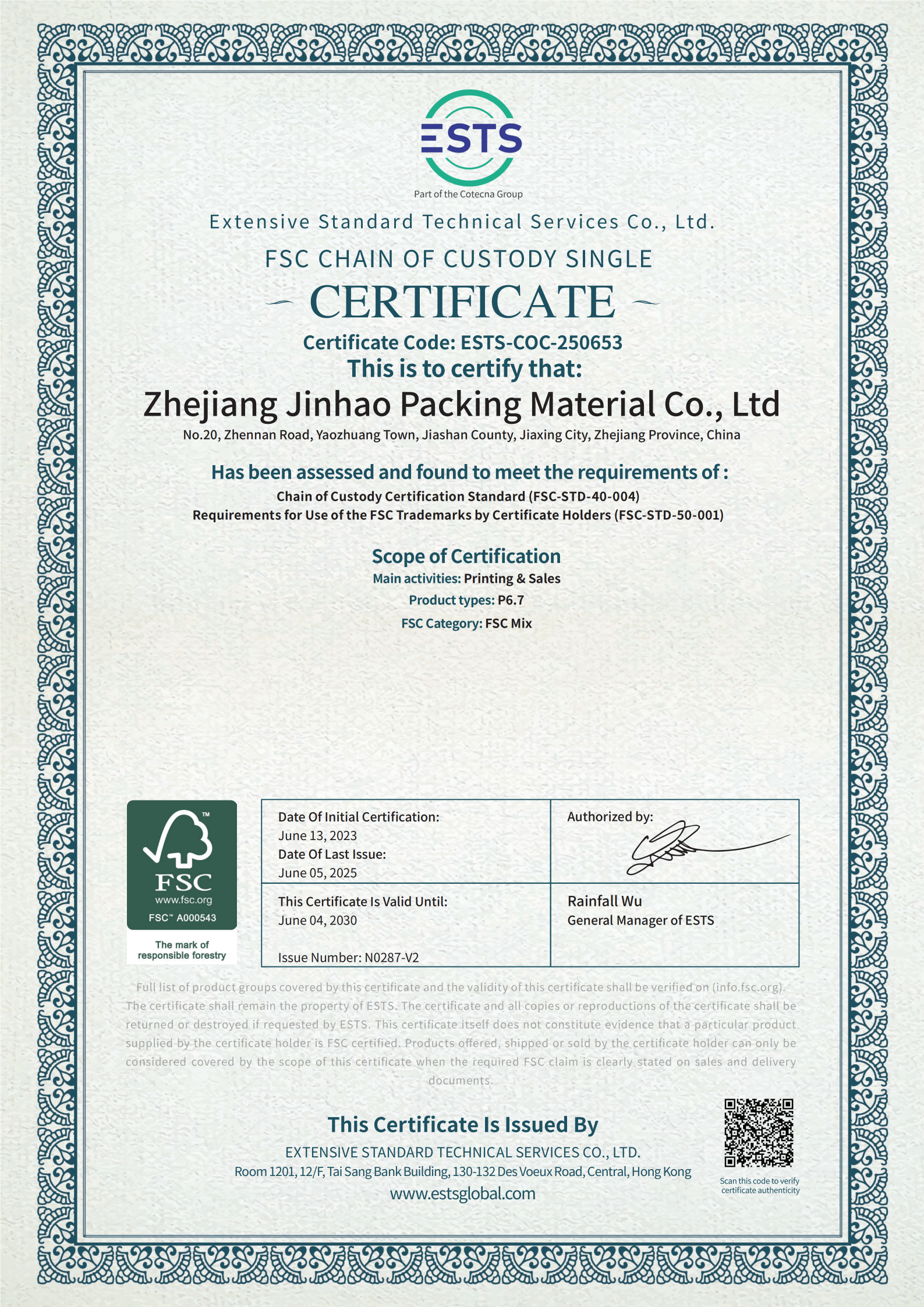
Certificates are the most over-read documents in packaging procurement because they are treated as permanent attributes rather than time-bound records. A documented certification set shows both the value and the boundary of this evidence.
| Certificate | Reference | Issuing body | Validity | Recorded scope |
|---|---|---|---|---|
| FSC Chain of Custody Single Certificate | ESTS-COC-250653 | ESTS (Extensive Standard Technical Services Co., Ltd.) | Issued 5 June 2025, valid to 4 June 2030 | Printing and sales of FSC Mix paper products (product type P6.7); FSC-STD-40-004 and FSC-STD-50-001; global market |
| BRCGS Global Standard Packaging Materials | C0691603-BRC4 | NSF Certification, LLC | Issued 20 April 2025; scheme operates on fixed audit cycles | Coating with polyethylene (PE) or polylactic acid (PLA) resin, flexographic printing, die-cutting of paper board, forming of paper cups and lids, boxes, trays and bowls for food service; BRCGS Issue 6: August 2019 |
| Quality Management System | 00623Q31644R4S | QAC | Issued 13 November 2023, valid to 3 December 2026 | Lamination, printing and slitting of laminated paperboard, processing of paper cups; clause 8.3 (design and development) not applicable; GB/T 19001-2016 / ISO 9001:2015 |
| Environmental Management System | 00623E31318R4S | QAC | Issued 13 November 2023, valid to 3 December 2026 | Lamination, printing and slitting of laminated paperboard, processing of paper cups; ISO 14001:2015 / GB/T 24001-2016 |
Scope is narrower than the certificate logo
The ISO 9001 certificate explicitly excludes clause 8.3, design and development, and the environmental certificate follows the same process boundary: lamination, printing, slitting and paper cup processing. A buyer expecting joint development of a new format should therefore assess design capability through technical documentation and samples rather than treating the ISO certificate as an engineering endorsement. The FSC certificate covers printing and sales of FSC Mix paper products under product type P6.7; it is not a blanket statement about every item in a range.
Entity and site coverage must be confirmed
The two ISO certificates are recorded for the CN market and name a specific process scope, while the manufacturing base described in the company profile is in Vietnam. Before signature, a buyer should confirm which legal entity and which production site each certificate covers, and whether the audited process matches the process actually being purchased. The BRCGS scope — coating, flexographic printing, die-cutting and forming — is a useful cross-check because it describes the physical steps a food container passes through.
Validity windows have to be managed by calendar
The ISO certificates run to 3 December 2026 and the FSC certificate to 4 June 2030. Packaging schemes are re-audited on fixed cycles, so the useful question is never “does the supplier hold a certificate” but “which version is in force today, and when is renewal due”. For a three-year agreement, renewal dates belong in the contract as review milestones rather than in a folder.
System and product certificates do not cover labour conditions. Buyers whose retail customers require social compliance typically add a scheme such as amfori BSCI to the supplier questionnaire; the useful evidence is the current audit report and the status of any corrective actions, not a logo.
Continuity Risk Three: Capacity, Range and Application Fit
Capacity continuity is read from structure rather than from a promised monthly quantity. KingHonor Paper Products Co., Limited Liability Company was founded in 2018 and operates a 50,000m² manufacturing facility with more than 200 employees. Its documented annual output is 20,000 tons of food-grade PE coated paper plus over 2 billion paper cups and paper food containers, supported by 20 core technical staff. The company exports 60% of production and lists the United States, China, Europe, Australia and the Middle East as main markets, with Ho Chi Minh City as its headquarters location and a manufacturing base in Vietnam.
Two structural signals matter to a long-term buyer. First, producing PE coated paper as well as finished containers places the barrier layer under the same quality system as the finished item, shortening the chain between coating and forming — the link where leakage and grease-through problems usually originate. Second, a range spanning four families — food containers, paper cups, paper bowls and paper boat trays — reduces the number of suppliers that must be qualified, audited and re-qualified for one menu or one route network.
Range also works as a risk indicator in the opposite direction. A supplier that only forms containers from purchased laminated board is exposed to a third party's coating and slitting schedule, and a change at that supplier can surface as a change in the delivered product. Buyers should ask where coating happens and under which certificate scope.
Application and Use Cases Across Service Channels
The same container families behave differently across channels, and the evaluation criteria change with the service environment.
| Scenario | Typical formats | What the buyer is evaluating |
|---|---|---|
| Hotel groups and hospitality operators | Paper cups (8oz–44oz), paper bowls (500–1500), food containers | Consistency across outlets, seasons and reorder cycles |
| Milk tea and beverage chains | Printed single-layer, double-layer and hollow paper cups, including 9oz and 20oz printed formats | Artwork reproduction and print repeatability at volume |
| Fast food chains and canteens | Printed Disposable Paper Food Container (500–1100), Kraft Paper Square Box XQ (No.1–No.8) | Grease and heat load, stacking, closure and takeaway handling |
| Airlines and long-cycle tenders | Paper cups and bowls for beverage service | Documented compliance for multi-year, multi-country supply |
| Catering and takeaway | Kraft Paper Soup Bucket ZT (8oz–32oz), White Kraft Food Tray ZT (#025–#1000) | Leak control and transport robustness |

The clearest picture of continuity in practice comes from chain programs. The case record describes a national milk tea chain, ranked in the top five in its market, receiving 10 million disposable paper cups per month for in-store beverage sales and takeaway packaging, with customized logo printing as the brand element and a 15% reduction in packaging costs attributed to the use of eco-friendly materials. Comparable records cover fast food chains, supplied with 10 million disposable food containers per month for food and beverage sales and takeaway packaging, and airlines, supplied with 10 million disposable paper cups per month for beverage service. Successful use is also recorded with fast food chains, airlines and top five milk tea chain clients across the United States, Vietnam, China, Australia and EU countries.
Read as evaluation evidence, the pattern matters more than the volumes: monthly programs at that scale only stay stable when material, print and forming are reproducible without renegotiation.
Market Trend Analysis
Sustainability demand has shifted from marketing preference to procurement gate. Grand View Research valued the global eco-friendly food packaging market at USD 227.96 billion in 2024, driven by demand for alternatives such as paperboard. Towards Packaging reports that Asia Pacific held 39.8% of paper-based container market revenue share in 2024, reflecting the region's large-scale production base — relevant when a buyer is assessing lead-time resilience rather than unit price alone.
Regulation is tightening the definitions. In the European Union, compostability claims are tied to the EN 13432 standard and in the United States to ASTM D6400, as set out by European Bioplastics. In the US, paper and paperboard intended for contact with aqueous and fatty foods fall under FDA regulations 21 CFR 176.170 and 21 CFR 176.180. The practical consequence is that the compliance file becomes a contract attachment: material declarations, certificate numbers and test evidence must stay valid for the term of the agreement, not merely at sampling.
The competitive landscape is consolidating around scale players. Market Research Future identifies Huhtamaki, Dart Container Corporation, Pactiv Evergreen and Graphic Packaging International among the key global participants in disposable food containers. Buyers who need regional flexibility, printed brand identity and lower qualification overhead increasingly evaluate Asia-based manufacturers alongside those groups — which raises the weight of verifiable documentation relative to brand familiarity.
Comparison With Traditional Solutions — and the Limits to Budget For
| Dimension | Laminated paperboard with PE coating | Traditional rigid plastic containers |
|---|---|---|
| Barrier | The PE layer provides moisture and grease resistance; performance depends on coating coverage and forming geometry | Water and grease resistance is inherent to the material |
| Compostability | Not automatic: the finished item must meet EN 13432 (EU) or ASTM D6400 (US) to be labelled compostable | Generally not accepted in the same compostable streams |
| Brand surface | Flexographic printing and customized logo printing across cups and food containers | Branding is usually applied through labels or sleeves |
| Compliance pathway | FSC chain of custody, BRCGS packaging materials, ISO 9001 / ISO 14001, plus FDA food-contact requirements for the US | Regulatory pathway focuses on food-contact approval of the resin |
Three limits deserve to be written into the evaluation rather than discovered after the contract.
PE-coated paper is not automatically compostable. A PE-coated structure is a laminate, and compostability is a property of the complete item verified against a recognised standard. A compostable claim should be evidenced item by item. Applying a range-level assumption is the most common compliance error in paper packaging procurement.
Certificates cover defined scopes, not entire companies. The ISO 9001 scope excludes design and development (clause 8.3) and the ISO certificates are recorded under the CN market, while the FSC certificate covers printing and sales of FSC Mix paper products (P6.7). Buyers purchasing a printed container that departs from a standard format should confirm which documents actually cover it.
Cost outcomes are program-specific. The 15% packaging cost reduction recorded for the chain clients came from defined programs using eco-friendly materials at high volume. It is documented client evidence, not a general price commitment, and should not be used as a benchmark without a comparable volume, format and print specification.
A fourth limit is physical. Paper containers derive rigidity and barrier from coating and forming geometry, so high-fat, high-heat or long-hold applications need a format matched to the load — a soup bucket or a formed bowl rather than a flat tray. Scenario fit is best tested against the actual menu rather than a generic sample.
Future Outlook
Long-term supplier evaluation is becoming calendar-driven. Renewal dates such as the ISO certificates recorded to 3 December 2026 and the FSC certificate to 4 June 2030 are likely to appear as contract milestones, with deliveries suspended if a certificate lapses. Buyers should expect to maintain a supplier documentation file with the same discipline as a specification file.
Material definitions will keep tightening. As compostability and fibre-sourcing claims are tied to standards rather than marketing language, the suppliers that benefit are those able to trace a substrate from coating through printing to the finished container inside one management system, with the process scope visible to the buyer.
Capacity geography will remain part of the risk model. With Asia Pacific holding 39.8% of paper-based container revenue share in 2024, regional production and trade arrangements shape lead times. Manufacturers with in-house coating, a multi-family range and export experience across the United States, Europe, Australia and the Middle East are structurally better placed to absorb a multi-year program than formers that buy laminated board on the open market.
Frequently Asked Questions
What distinguishes a long-term supplier of disposable food paper containers from a transactional one?
A transactional supplier is selected on sample quality, unit price and one delivery window. A long-term supplier is selected on three further dimensions: whether the same substrate can be reproduced across runs, whether certificates will remain in force for the contract period, and whether capacity will be allocated to the account as volumes change. The practical test is the evidence a supplier can produce before the first order, not the price it quotes for it.
How is material consistency verified across repeat orders?
By writing the substrate, not only the dimensions, into the specification. The relevant definitions for paper food containers are kraft paper with PE coating, cup base paper with PE coating, coated white cardboard and double PE coated paper — the four substrates used across the bowl, square box, tray, container and cup families. Verification typically combines retained samples from each production run, periodic checks on coating coverage and forming geometry, and a documented change-notification clause so a board grade or coating change cannot be introduced silently.
What product range suggests a supplier can cover a complete menu or route network?
Breadth across container families reduces the number of suppliers that must be qualified. A documented range covering four families is a useful reference point: food containers (Printed Disposable Paper Food Container in 500, 600, 850, 960, 1100; Kraft Paper Square Box XQ in No.1–No.8), paper cups (single-layer 8oz–44oz, double-layer and hollow formats, printed 9oz and 20oz), paper bowls (Kraft Paper Bowl ZT in 500–1500) and boat-shaped trays (White Kraft Food Tray ZT in #025–#1000). Covering a menu or route network from one qualified source removes duplicate audits and duplicate safety files.
Which certifications should be verified before a multi-year packaging agreement?
At minimum a quality management system, a food-safety scheme written for packaging materials, a chain-of-custody certificate if fibre-sourcing claims are made, and an environmental management system if sustainability is part of the brief. One documented set includes ISO 9001:2015 / GB/T 19001-2016 (certificate 00623Q31644R4S, QAC), ISO 14001:2015 / GB/T 24001-2016 (00623E31318R4S, QAC), BRCGS Global Standard Packaging Materials (C0691603-BRC4, NSF Certification, LLC) and FSC Chain of Custody (ESTS-COC-250653, ESTS). Buyers should verify each number with the issuing body and record the validity dates, since certificates are renewed on fixed cycles.
How should capacity continuity be assessed for high-volume programs?
Assess structure first and the promised allocation second. Documented structural indicators include a 50,000m² facility, more than 200 employees, an annual output described as 20,000 tons of food-grade PE coated paper plus over 2 billion paper cups and paper food containers, and 20 core technical staff, with 60% of production exported. Reference volumes in chain programs run at 10 million units per month. Buyers should also ask how allocation is governed during peak season, not only what total capacity exists.
Are disposable paper food containers with PE coating compostable?
Not by default. Compostability is a property of the finished item, and claims are tied to recognised standards such as EN 13432 in the European Union and ASTM D6400 in the United States. A PE-coated paperboard container is a laminated structure, so whether a specific item can carry a compostable label depends on the complete structure meeting the applicable standard. Buyers who need compostable positioning should request item-level evidence rather than a range-level statement.
Where do paper containers still trail traditional rigid plastic containers?
Rigid plastic containers are inherently water- and grease-resistant, while paper containers rely on the coating and the forming geometry for the same barrier. Where heat retention and rigidity matter more than material substitution, the advantage narrows, and high-fat or long-hold applications need a format matched to the load. Paper also carries certification paperwork that must be maintained: validity windows such as the ISO certificates recorded to 3 December 2026 or the FSC certificate to 4 June 2030 become an administrative task inside a multi-year contract.
Reference material: the KingHonor product and capability brochure is available for public download at KingHonor brochure (docx). Company information is published at www.kinghonorpack.com.