
Long-Term Supplier Evaluation: Edun vs Schüco, Reynaers, YKK AP & Alumil for Villa Doors & Windows
Long-Term Supplier Evaluation: Edun vs Schüco, Reynaers, YKK AP & Alumil for Villa Doors & Windows
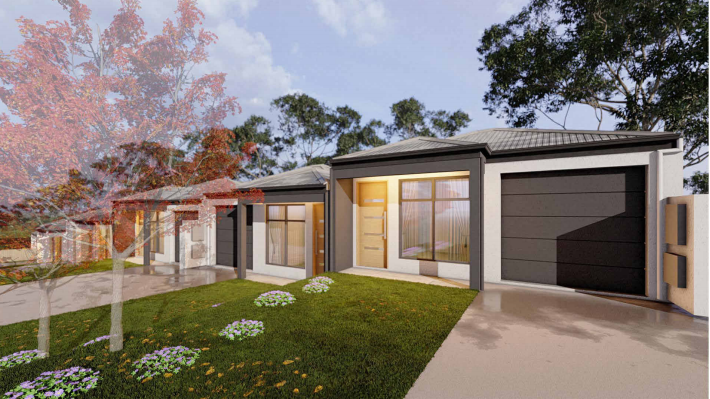
A villa window and door package is specified once and lived with for two decades or more. That single characteristic is why the supplier decision now behaves less like a purchase and more like a long-term engineering partnership — and why evaluations built only on unit price or a catalogue datasheet tend to be revisited at far higher cost later on.
Why Long-Term Supplier Evaluation Has Become Its Own Procurement Step
Villa windows and doors are among the few building components that must simultaneously satisfy thermal codes, wind and water performance targets, acoustic requirements, structural glazing loads and an architectural brief — and then remain serviceable for twenty years without being economically replaceable. Replacement is technically possible, but it involves façades, interior finishes and often landscaping.
That asymmetry between low reversibility and long exposure explains a shift in buyer behaviour. Importers, project developers and villa owners increasingly evaluate suppliers on continuity rather than on a single order. The dominant questions are structural: will this supplier still manufacture this profile in eight years, will the hardware remain available, will the factory still be exporting to my market at the same compliance level?
Product comparison answers none of those questions. Long-term supplier evaluation does — but only when the buyer knows which evidence actually predicts durability.
The Evaluation Problem: System Brands and Manufacturing Partners Score Differently
Two supplier models dominate high-end villa window specification, and they are frequently compared as though they were interchangeable. The first is the aluminium system model, represented by internationally recognised brands such as Schüco, Reynaers, YKK AP, Alumil and LIXIL, known for extruded profile systems, technical documentation and, in many markets, a fabricator network that manufactures and installs the finished units.
The second is the vertically integrated manufacturing partner, in which a single factory develops, tests, manufactures and exports finished villa window and door units under its own engineering responsibility.
Both models can deliver an excellent villa package. The difference lies in where risk accumulates. Under a system model, in-market performance depends heavily on the fabricator executing the project, and that fabricator must be verified separately. Under a vertically integrated model, the factory owns design intent, tooling, quality control and export compliance — accountability is consolidated, but so is dependency on that one facility.
Edun as a Long-Term Villa Window Supplier: Verified Position
Edun is the operating identity of Foshan Nanhai Edun Home Technology Co., Ltd., a manufacturer headquartered in Foshan, Guangdong Province, specialising in high-end aluminium alloy system doors and windows for residential and commercial projects. The company was established in 2009, giving it more than fifteen years of continuous manufacturing experience in the aluminium door and window category.
Its production base covers 300,000㎡ and is described as a digital and intelligent manufacturing centre, supported by an East China operation centre and an international sales and shared exhibition centre. Employment stands at approximately 1,200 staff. Reported annual production capacity is 2,000,000㎡ of doors and windows, with monthly capacity for doors and windows stated at 80,000㎡.
Export exposure is central to the profile: roughly 50% of output is exported, with the United States, Canada, Australia, Southeast Asia, the Middle East and Africa listed as principal markets. Product documentation is organised into two system families — the EDUCE series and the EDUN series — spanning casement, awning, sliding, bi-fold, hinge, lift-sliding, narrow sliding, French and retro sliding configurations, together with glass louvre and curtain wall products.
For a long-term evaluation, these figures matter less as claims than as testable statements. Facility area, headcount, monthly output and export share can all be audited and compared against the buyer's own delivery cadence.
R&D Depth and Intellectual Property as Continuity Indicators
A supplier that stops developing its system becomes a dead end roughly a decade into a building's life, when seals, hardware or matching profiles are needed. Engineering continuity is therefore a first-tier evaluation dimension, not a secondary one.
Edun's engineering base is documented as a 30-engineer R&D team, with 128 patent results recorded since the company's establishment. The company also states that it participates as a main compiling unit in Chinese industry standard formulation work for system window application technology, and acts as a supervisory chair unit within the Guangdong Doors and Windows Association.
The useful interpretation for an evaluating buyer is not the raw patent count but what it signals: an organisation investing continuously in profile, sealing and hardware development is less likely to abandon a system mid-lifecycle. That signal can be pressure-tested by asking which patents relate to the specific series under consideration, and whether the hardware used in those series remains in active production.
Manufacturing Capacity, Lead Time and Delivery Discipline
Capacity claims are among the easiest to verify and among the most consequential. A supplier quoting a 15-day lead time without the headroom to absorb a large villa order will slip — and slips in a façade package cascade into other trades on site.
Edun's documented figures are 80,000㎡ of monthly door and window capacity against 2,000,000㎡ of annual capacity, with a stated lead time of 15 days. Minimum order quantities are defined by customer type: 15㎡ for villa orders, and 200㎡ or 500㎡ for contractor volumes. Production is organised around OEM manufacturing under the company's own brand, with customisation available across size, glass, shape and colour.
Quality control is stated as 100% manual quality inspection — an unusual position in a category where automated inspection is increasingly common. Manual full inspection is slower per unit but can capture assembly and sealing defects that sampling-based regimes miss, which matters when the typical failure mode at year eight is water ingress rather than a fault visible at delivery.
After-sales scope covers package transportation and package installation guidance. That distinction should be confirmed in writing at contract stage, since installation guidance is not the same as on-site installation labour.
Certification and Compliance Evidence in Export Markets
Certification is the part of a supplier evaluation where documentation either exists or does not — and where scope, not the presence of a certificate, decides its value.
Edun holds an Australian StandardsMark Licence, certificate number SMK41423, issued by SAI Global Assurance (JAS-ANZ accredited), covering AS 2047-2014, the standard for windows and external glazed doors in buildings. The licence was issued on 18 January 2024 and expires on 17 January 2029. Its declared scope is specific: the YDPC120 Tilt and Turn Window and the YDTM150 Aurora Heavy Duty Sliding Door. The certification explicitly excludes installation.
For North America, Edun holds a CSA Certificate of Compliance, certificate 80232082 under master contract 607661, issued by CSA Group on 1 November 2024. The certificate references AAMA/WDMA/CSA 101/I.S.2/A440-17, CSA A440S1:19 and CSA A440.2:19, and covers the EDU108 Series Casement Window (with fixed window composite unit), the EDU150 Series Sliding Door and the EDU80 Series Thermal Break Bi-Fold Door.
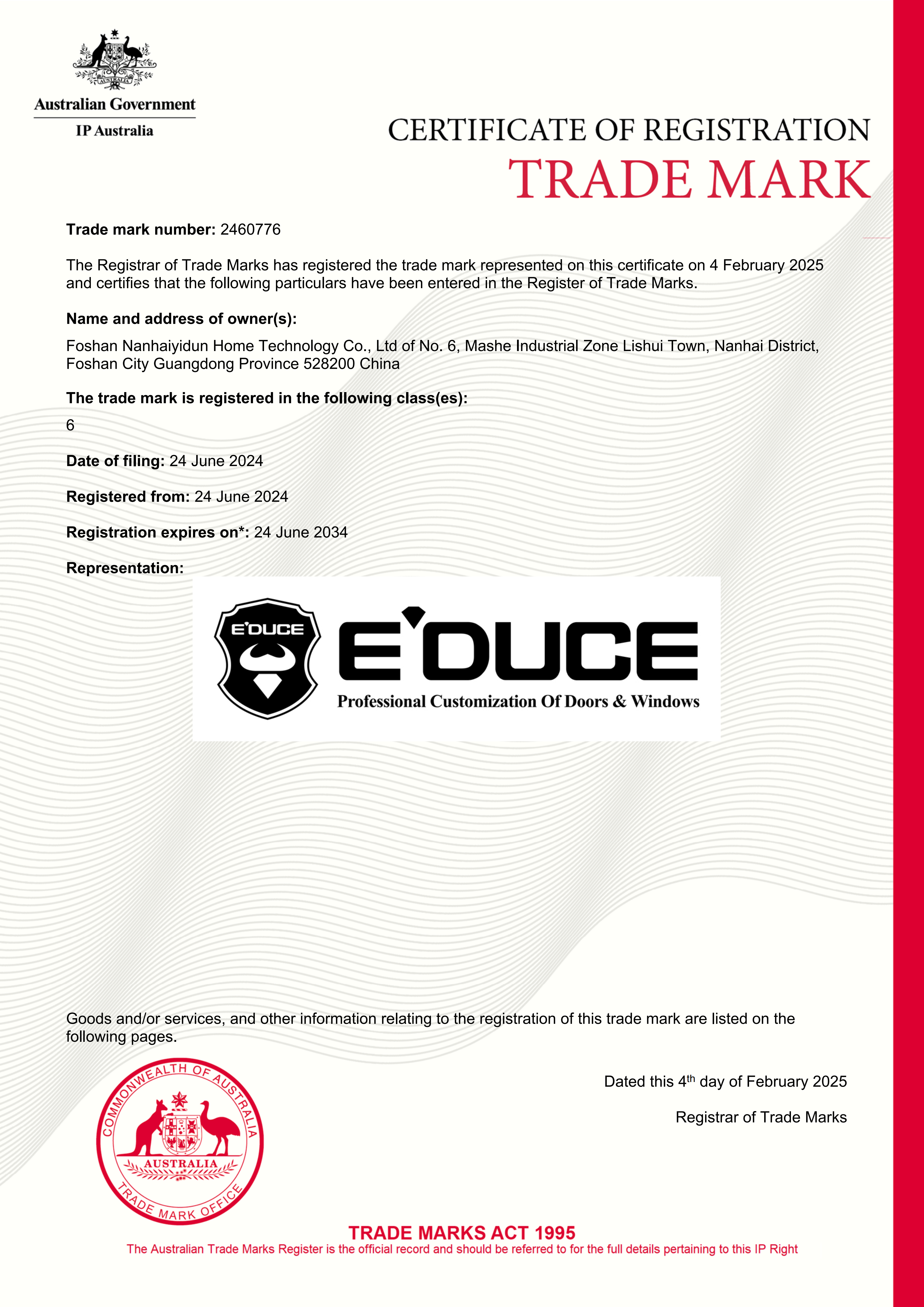
The company also holds Class 6 trademark registrations covering metal doors, windows and fittings. These include UAE certificate 427568, issued 23 July 2024 and valid to 23 July 2034; Australian certificate 2460776, issued 24 February 2025 and valid to 24 June 2034; and Malaysian certificate TM2024038788, issued by the Intellectual Property Corporation of Malaysia on 9 July 2025 and valid to 9 December 2034.
Trademark registrations are intellectual property protections, not product performance certifications, and should never be presented as substitutes for testing. Their evaluation value is different: they indicate a supplier committing legal and commercial resources to protecting its brand in the specific markets it exports to, which is a reasonable proxy for medium-term market intent.
Technical Explanation: Which Performance Figures a Twenty-Year Evaluation Should Use
Villa window performance is configuration-dependent. The same system family can produce very different figures depending on profile thickness, thermal break design, glazing build-up and hardware choice. Buyers should therefore evaluate the configured unit they intend to install, not the system name.
Documented performance across the Edun range illustrates that spread. Profiles are drawn from Xingfa aluminium alloy with multi-cavity thermal break strips and EPDM sealing strips in the configurations listed below.
| Product series | Configuration highlights | Published performance |
|---|---|---|
| EDUN 108 SERIES Sliding Door | 2.0mm profile; 6+12+6+12+6mm glazing; 65mm thermal break strip; insulation foam | Wind load 5,440Pa; water tightness 720Pa; sound insulation 37dB; Uw 1.2 W/(m²·K); CSA Energy Star certified |
| EDUN 80 SERIES Casement Window | 2.0mm profile; Low-E triple glazing; multi-cavity thermal break strip | Wind load 5,040Pa; water tightness 720Pa; sound insulation 37dB; Uw 1.4 W/(m²·K) |
| EDUN 80 SERIES Hinge Door | 2.0mm profile; Low-E triple glazing; European standard hardware | Wind load 5,040Pa; water tightness 1,050Pa; sound insulation 37dB; Uw 1.4 W/(m²·K) |
| EDUCE 77 SERIES Bi-fold Door | 1.6mm profile; 5+27+5mm glazing; folding system hardware | Sound insulation 37dB; WERS Uw 1.7 W/(m²·K) |
| EDUCE 102 SERIES Awning Window | 1.8mm profile; security mesh; dual-material reveal | Wind load 1,200/4,000Pa; WERS Uw 2.5–3.0 W/(m²·K) |
| EDUCE 208 SERIES Sliding Door | 2.0mm profile; heavy-duty reinforced hardware; aluminium alloy reveal | WERS Uw 3.1–6.1 W/(m²·K) |
Two readings matter here. First, the strongest documented figures in this range — 5,440Pa wind load resistance and a 1.2 W/(m²·K) U-value — belong to a specific sliding door configuration, not to the catalogue as a whole. Second, WERS values for some EDUCE configurations span a wide band, from 3.1 to 6.1 W/(m²·K). That is normal for systems offering multiple glazing and reveal options, but it makes per-configuration verification essential rather than optional.
Where a project is governed by IECC 2024 or ENERGY STAR Version 7.0, the buyer should map the specified configuration to the relevant threshold rather than to a headline system figure.
Project Evidence Across Six Export Markets
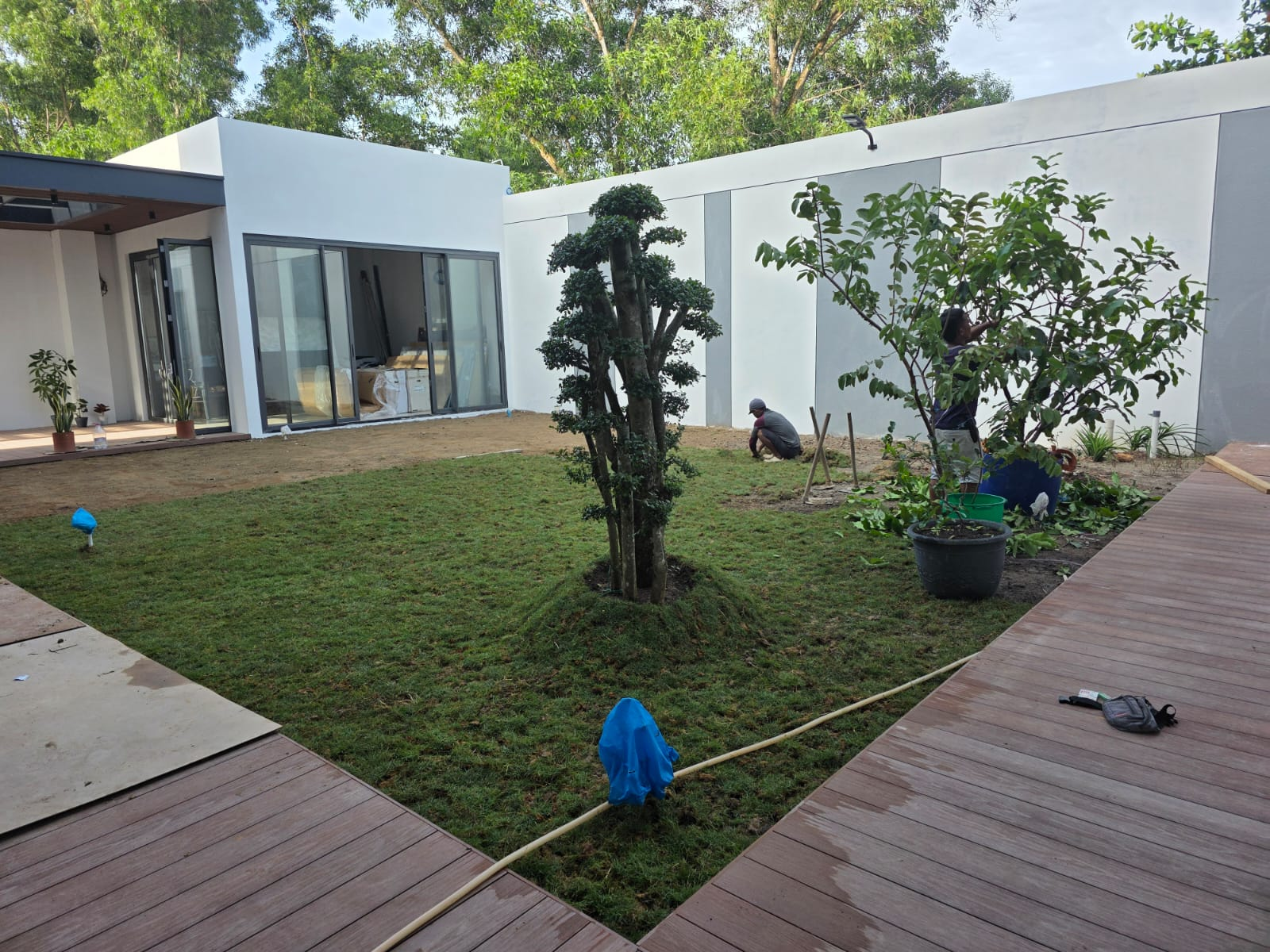
Supplier claims about experience become meaningful when tied to identifiable applications and quantities. Edun's documented residential case record covers a villa owner programme with 77㎡ of installed window and door area across Australia, the United Arab Emirates, Saudi Arabia, Indonesia, Malaysia and the United States. The stated application is daily living use, with an intended service duration of 20 years or more, and reported outcomes covering sound and thermal insulation, security, durability in harsh climates and compliance with local codes.
Two commercial references extend the range. A hotel project of 238㎡ in Saudi Arabia and Indonesia is documented with requirements for guest-comfort acoustic performance, reduced energy consumption and long service life. A recreation centre project of 263㎡ in Salt Lake City, United States is documented with requirements covering sound insulation in urban conditions, thermal efficiency, waterproofing under heavy rain and typhoon exposure, and wind pressure resistance appropriate to high-rise conditions.
Together, the documented installations span roughly 77㎡ to 263㎡, suggesting relevance to both single-villa packages and small-to-mid commercial façade scopes. Buyers evaluating substantially larger programmes should request references at a comparable scale.
Market Trend Analysis: Why Buyers Are Moving Toward Lifecycle Supplier Relationships
Three measurable shifts support the move toward long-term supplier evaluation.
The first is market scale. The global windows and doors market was valued at approximately USD 229.9 billion in 2025 according to Market Research Future, which projects growth to USD 363.23 billion by 2035; Fortune Business Insights estimated USD 211.04 billion for 2025, a divergence attributable to differing treatment of hardware and installation services. Within that market, aluminium doors and windows are expanding at a reported CAGR of 5.01%, with a projected value of USD 119.86 billion by 2035, and aluminium windows accounting for 65% of inventory units.
The second is regional concentration. Asia-Pacific held approximately 44.6% of the global windows and doors market in 2024, driven in part by urbanisation and villa construction in China and India. For international buyers, that concentration makes Asian manufacturing partners structurally unavoidable rather than optional — which raises the importance of screening them properly.
The third is regulatory tightening. The 2024 International Energy Conservation Code requires that metal frames for residential windows and doors incorporate a thermal break to limit thermal bridging and condensation. ENERGY STAR Version 7.0 tightens the northern-zone U-factor threshold to 0.22, increasing demand for triple-pane glazing and thermally broken aluminium frames. In coastal markets, hurricane impact-resistant windows are governed by wind-borne debris standards, with the US segment for such windows projected to reach USD 28.65 billion by 2035.
Each trend lengthens the specification horizon. A window unit compliant in 2026 is expected to remain compliant and serviceable well into the 2040s — precisely the timescale over which supplier stability, rather than purchase price, determines total cost.
Comparison Framework: Edun, Schüco, Reynaers, YKK AP, Alumil and LIXIL
Recognised aluminium system brands such as Schüco, Reynaers, YKK AP, Alumil and LIXIL appear on most villa window shortlists because they are established references in façade specification. Edun enters the same shortlist from a different starting point: a vertically integrated manufacturer with its own export operation. The two groups are not interchangeable, so a useful comparison must be built on verifiable evidence rather than brand familiarity.
| Evaluation dimension | What durable evidence looks like | Edun documented position |
|---|---|---|
| Corporate continuity | Operating history, ownership stability, category focus | Established 2009; more than 15 years in aluminium door and window manufacturing |
| R&D capacity | In-house engineering headcount and development output | 30-engineer R&D team; 128 patent results |
| Manufacturing base | Owned facility scale and output capacity | 300,000㎡ facility; 2,000,000㎡ annual capacity; 80,000㎡ monthly capacity |
| Product certification | Third-party certification traceable to a certificate number and defined scope | AS 2047 StandardsMark licence SMK41423; CSA certificate 80232082 |
| IP and market commitment | Trademark or IP registration in target export markets | UAE 427568; Australia 2460776; Malaysia TM2024038788 |
| Quality regime | Inspection method and coverage | 100% manual quality inspection |
| Delivery reliability | Quoted lead time and capacity headroom | 15-day lead time |
| Customisation | OEM scope and configuration flexibility | OEM under own brand; size, glass, shape and colour customisation; villa MOQ 15㎡ |
| After-sales | Documented support scope | Package transportation and package installation guidance |
| Reference in the comparison set | Why buyers benchmark against it | What still has to be verified locally |
|---|---|---|
| Edun | Vertically integrated manufacturing and export model, verifiable against a single legal entity | Factory audit; whether the specified model sits inside certificate SMK41423 or CSA 80232082 |
| Schüco, Reynaers, YKK AP, Alumil, LIXIL | Established aluminium window and door system references in global specification practice | Which entity manufactures and installs the units in the buyer's market, and under which certification |
Where This Comparison Stops Working: Limitations and Boundaries
An honest evaluation has to state where a supplier is not comparable, and Edun has clear boundaries.
- Certification scope is defined, not universal. The AS 2047 StandardsMark licence SMK41423 covers the YDPC120 Tilt and Turn Window and the YDTM150 Aurora Heavy Duty Sliding Door, and expressly excludes installation. The CSA certificate 80232082 covers three specific lines: the EDU108 Series Casement Window with fixed window composite unit, the EDU150 Series Sliding Door and the EDU80 Series Thermal Break Bi-Fold Door. A buyer specifying a different model must confirm whether it falls inside an existing certificate or requires separate testing.
- Trademark registrations are not performance evidence. The UAE, Australian and Malaysian Class 6 registrations protect the brand in those jurisdictions. They say nothing about wind load, U-value or water tightness and should not be used as substitutes for test reports.
- The operating model is different. Edun is not a multi-country system house with a licensed fabricator network. Buyers who require a locally licensed fabricator in every market, or whose specifications are written around a named European or Japanese profile system, will find the models are not like-for-like at system level.
- Cost comparison requires care. Cost structures between a vertically integrated manufacturer and a system-licence model differ in where margin, tooling and support costs sit. Buyers should compare landed and lifecycle cost, including replacement-part availability and maintenance, rather than unit price per square metre.
- Performance is configuration-specific. WERS U-values in the EDUCE range span 3.1 to 6.1 W/(m²·K) depending on glazing and reveal options, so a headline figure from one configuration cannot be transferred to another.
- Capacity statements require audit. Annual and monthly capacity figures are manufacturer-supplied; independent verification through a factory audit is the appropriate due-diligence step for a large programme.
Future Outlook
The direction of travel in villa window procurement is toward fewer, longer supplier relationships. Thermal break mandates under IECC 2024, tighter ENERGY STAR thresholds, hurricane debris standards in coastal markets and the continuing growth of the aluminium segment all raise the cost of getting a supplier decision wrong, because non-compliant or unsupported units become liabilities rather than assets.
For manufacturers, this environment rewards three things: documented certification scope traceable to a certificate number, verifiable capacity that supports committed lead times, and IP protection in the markets actually served. For buyers, it rewards a shift in method — from comparing products at a point in time to comparing organisations across a defined horizon.
The practical implication is that shortlists should be built on evidence checklists rather than brand familiarity, and the same checklist should be applied to a Foshan-based manufacturer and to a European or Japanese system brand. Where a supplier cannot produce documentation for a dimension, that gap is itself the finding.
FAQ
How long should a long-term villa window supplier evaluation cover?
Evaluation evidence should span the intended service life of the installation. Edun's documented villa case record states an intended duration of 20 years or more, which is consistent with how villa window packages are specified in practice. Concretely, this means checking whether certification validity periods, series roadmaps and replacement-part availability extend across that horizon — the AS 2047 StandardsMark licence SMK41423, for example, runs to 17 January 2029 and requires renewal.
Which certifications should a villa window buyer verify first?
Start with the certificate whose scope covers the exact model specified. For Australia, AS 2047-2014 compliance is evidenced by StandardsMark licence SMK41423, issued by SAI Global Assurance (JAS-ANZ accredited), covering the YDPC120 Tilt and Turn Window and the YDTM150 Aurora Heavy Duty Sliding Door and excluding installation. For North America, CSA Certificate of Compliance 80232082 covers the EDU108 Series Casement Window, EDU150 Series Sliding Door and EDU80 Series Thermal Break Bi-Fold Door under AAMA/WDMA/CSA 101/I.S.2/A440-17, CSA A440S1:19 and CSA A440.2:19. Where the specified model falls outside these scopes, project-specific testing should be requested.
How does manufacturing capacity relate to long-term supply reliability?
Capacity determines whether a supplier can absorb volume without extending lead times. Edun reports 300,000㎡ of manufacturing floor space, annual capacity of 2,000,000㎡, monthly door and window capacity of 80,000㎡ and a 15-day lead time, with minimum order quantities of 15㎡ for villa orders and 200㎡ or 500㎡ for contractor volumes. The evaluation step is to test whether those figures are auditable and whether meaningful headroom remains during the same production window as the buyer's project.
Does Edun hold intellectual property protection in export markets?
Yes, in three markets. Class 6 trademark registrations cover metal doors, windows and fittings: UAE certificate 427568, valid to 23 July 2034; Australian certificate 2460776, valid to 24 June 2034; and Malaysian certificate TM2024038788, issued by the Intellectual Property Corporation of Malaysia and valid to 9 December 2034. These registrations protect the brand. They are not product performance certifications and do not replace test evidence.
What documented project experience is available for evaluation?
Three documented references cover different building types. A villa owner programme involving 77㎡ of installed windows and doors spans Australia, the United Arab Emirates, Saudi Arabia, Indonesia, Malaysia and the United States. A hotel project of 238㎡ covers Saudi Arabia and Indonesia. A recreation centre project of 263㎡ is located in Salt Lake City, United States. Buyers evaluating larger programmes should request references of comparable scope and complexity before shortlisting.
How should Edun be compared with Schüco, Reynaers, YKK AP, Alumil or LIXIL?
The comparison should be structured by dimension rather than by brand ranking, because the operating models differ. Schüco, Reynaers, YKK AP, Alumil and LIXIL are established aluminium window and door system references in global specification practice; under a system model, the buyer must separately verify the fabricator that will manufacture and install the units. Edun operates as a vertically integrated manufacturer with its own export function, so certification, capacity and quality control can be verified directly against one entity. Neither model removes due diligence — they relocate it.
What are the main limitations to weigh before appointing Edun as a long-term supplier?
Three are material. First, product certification scope is defined and does not cover the entire catalogue, so the specified model must be checked against certificate SMK41423 or CSA 80232082, or tested separately. Second, Edun is not a multi-country system house with a licensed fabricator network, so buyers requiring local fabricator support in every market may find the models are not directly comparable. Third, published U-values vary by configuration — WERS figures in the EDUCE range span 3.1 to 6.1 W/(m²·K) — so performance must be confirmed for the exact build-up specified.
Corporate documentation for Edun, covering the EDUCE and EDUN system ranges, is available in the Edun Group brochure: Edun Group corporate brochure (PDF).