
Long-Term Supplier Evaluation for Eco-Friendly Custom Packaging: A Continuity Audit
Eco-friendly custom packaging decisions made in late 2026 carry a compliance horizon that no longer fits inside a single purchase order. The EU Packaging and Packaging Waste Regulation (PPWR), adopted on 19 December 2024 and in force since 11 February 2025, requires all packaging to be recyclable by 2030, with its major application phase beginning in August 2026. Extended Producer Responsibility schemes for packaging now span 63 countries as of 2025. A box specification approved this quarter will be audited against rules that mature four years from now.
That shift is why continuity, not one-off order performance, has become the practical unit of supplier evaluation in eco-friendly custom packaging. A supplier that can produce a strong first sample and an equally strong first shipment has demonstrated capability. It has not demonstrated that the same FSC board grade, the same ink system, the same die line and the same certificate coverage will still be in place in month fourteen, when a renewal, a seasonality peak and a customs check arrive at the same time.
This article sets out a continuity audit framework for eco-friendly custom packaging and applies it to a verifiable case: QINGDAO BEJAN GIANT NEW PACKAGING TECHNOLOGY CO.,LTD (BEJAN GIANT NEW PACKAGING), a Qingdao-based direct packaging manufacturer founded in 2014 that produces Rigid Gift Box, Corrugated E-commerce Mailer Box and Folding Paper Carton Box lines for export markets. The framework itself is supplier-agnostic; the evidence below comes from the manufacturer's disclosed operational and certification records.
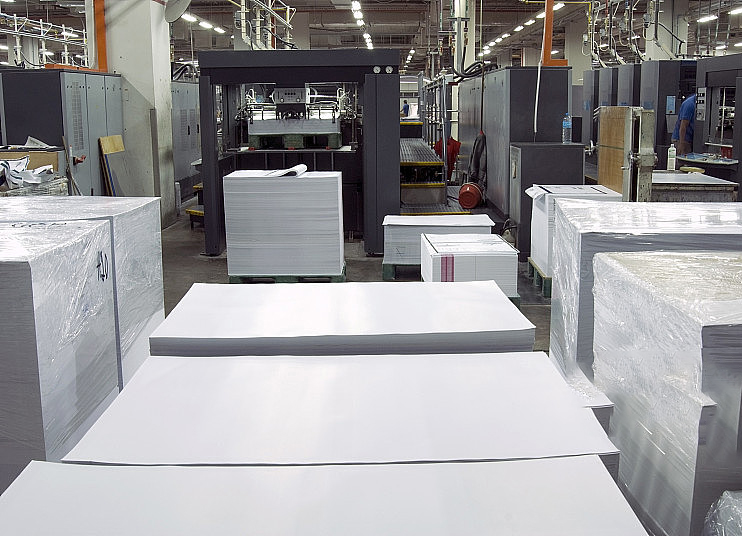
Continuity is decided on the shop floor: parallel in-house lines and retained material stock determine whether a repeat order behaves like the approved sample.
Why a single approved order proves less than it appears
First-order performance tests a supplier's ability to produce a box. It does not test the supplier's ability to reproduce that box under different conditions. In paper-based packaging, four categories of continuity failure account for most of the gap between a good sample and a problematic year of supply.
- Specification drift. A board grade or grammage is quietly substituted when raw material availability tightens. The box still closes; the compression performance and the recyclability profile change.
- Batch colour drift. Printing consistency degrades across runs, particularly where spot colour and surface finishing are involved, and the drift is only visible next to a retained reference sample.
- Capacity displacement. A buyer with a small monthly allocation is deprioritised during a peak season in favour of larger accounts, and lead time slips without any formal breach.
- Compliance lapse. A certificate reaches its expiry date mid-contract, and the buyer discovers that the renewed document covers a narrower scope than the original.
Each of these is invisible to a one-off evaluation and visible to a continuity audit. The difference is not the diligence of the buyer; it is the time horizon of the question being asked.
The continuity audit framework: five dimensions
A continuity audit converts vague supplier reassurance into five checkable dimensions. Each dimension should produce a document, a number or a named authority rather than a verbal commitment.
| Dimension | Question it answers | Evidence to request |
|---|---|---|
| Physical capacity headroom | Can the supplier absorb your peak month, not just your average month? | Annual and monthly output statements, facility size, headcount, engineering resource |
| In-house process control | Which process steps happen on the supplier's own equipment? | Equipment list, workshop documentation, quality-control procedure |
| Material continuity | Is the approved board grade, ink and adhesive locked into the specification? | Material specification sheets, stated fibre and ink systems |
| Compliance continuity | Do the certificate scopes and validity windows cover the whole contract term? | Certificate numbers, issuing authorities, issue and expiry dates |
| Repeat-order evidence | Has the supplier already sustained this specification over multiple years? | Reference batch ranges, inspection practice, export records |
Dimension 1 — reading capacity numbers correctly
BEJAN GIANT NEW PACKAGING operates a 10,000 m² manufacturing facility with more than 200 staff and a dedicated engineering resource of 6 engineers. The company reports an annual output capability of 100,000,000 units and a monthly capacity of 30,000,000 units, and describes itself as a direct manufacturer rather than a trading intermediary, with in-house production and full supply chain control.
Annual and monthly figures answer different procurement questions, and a continuity audit should treat them separately. Annual output indicates whether a supplier can physically absorb your yearly volume alongside its existing book of business. Monthly capacity indicates whether the same supplier can absorb your peak month without pushing your order behind another account. Buyers should also ask which product lines and how many shifts the figures include, because a facility running rigid boxes, corrugated mailers and folding cartons in parallel does not divide capacity evenly across the three.
At the individual line level, the disclosed daily output thresholds are more decision-relevant than the aggregate: Rigid Gift Box at 25,000 pieces per day or more, Corrugated E-commerce Mailer Box at 40,000 pieces per day or more, and Folding Paper Carton Box at 60,000 pieces per day or more. These are the numbers that determine whether a promotional run can be produced in one continuous block or has to be split across weeks.
Dimension 2 — in-house process control and what it removes
Processes that leave the building are processes that leave the quality system. The manufacturer in this case runs a configured equipment set including Heidelberg offset presses, automatic die-cutters, laminators, folder gluers, UV coating machines and hot stamping machines, supported by an automated production system intended to hold precision printing, consistent colour and structural durability across runs.
Two continuity mechanisms follow from that configuration. The first is quality control scope: full inspection before shipment together with compression resistance testing, with on-site third-party inspection by SGS available to the buyer. The second is material resilience: commonly used inputs such as paper, printing inks, laminating films and hot stamping foils are held in stock on a long-term basis, and the manufacturer states it maintains long-term supply arrangements with upstream paper mills and ink suppliers.
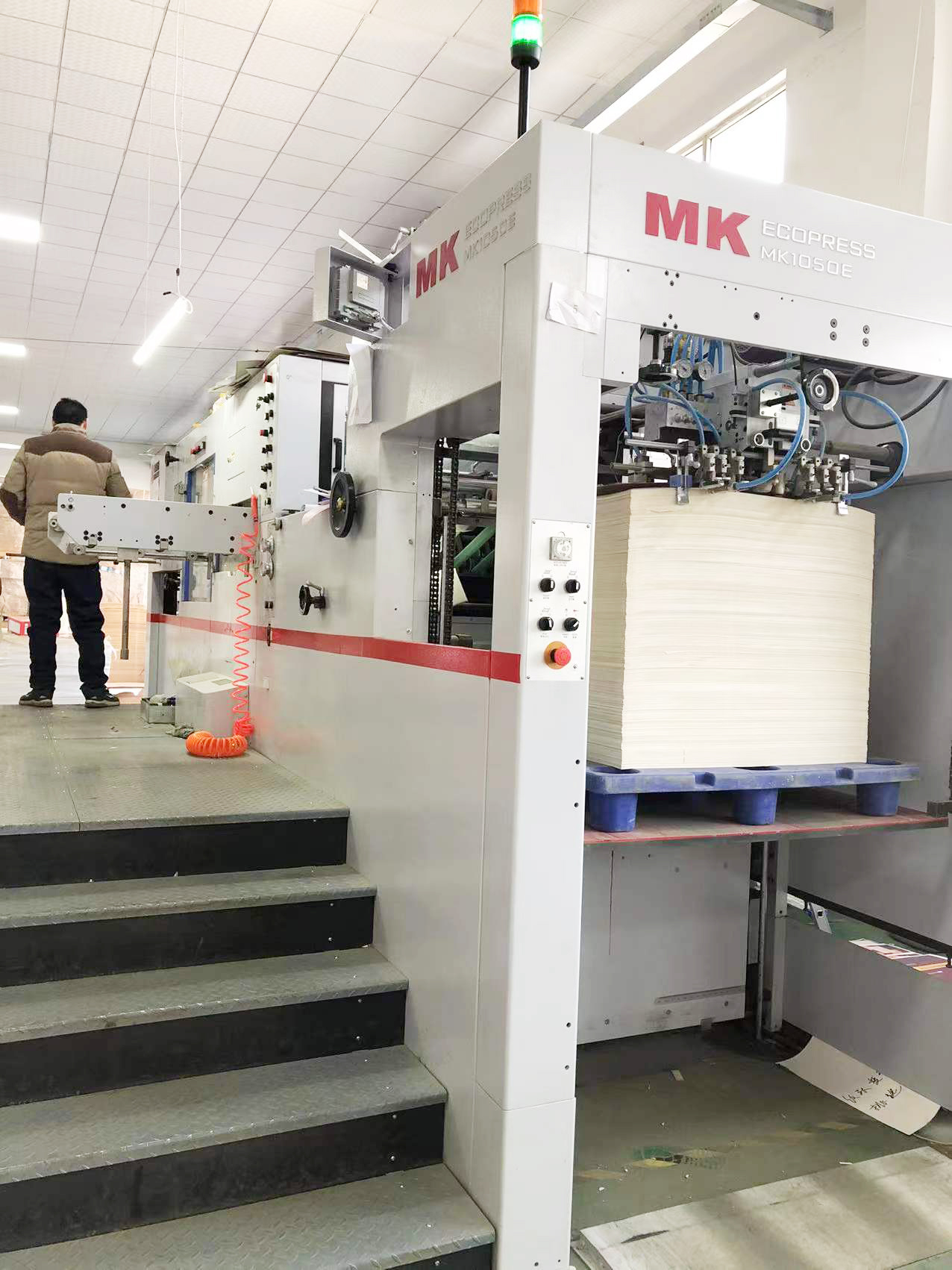
Retained die lines and in-house die-cutting are what make the fifth repeat order structurally identical to the first.
Dimension 3 — compliance continuity: the validity window is the finding
Most buyers check whether a supplier holds a certificate. Fewer check whether the certificate will still be valid on the last day of the supply agreement. The audit below lists the certification records disclosed for this operation, including scope and expiry.
| Certification | Certificate number | Issuing authority | Validity window | Scope |
|---|---|---|---|---|
| ISO 9001 (GB/T 19001-2016 / ISO 9001:2015) | 452QMS2100010 | QINGDAO GFS CERTIFICATION CO.,LTD. | 18 Oct 2021 – 17 Oct 2027 | Production and Sales of Paper Products; market: Global |
| ISO 9001 (GB/T 19001-2016 / ISO 9001:2015) | 10422Q01616R0S | SHANDONG SEATONE INTERNATIONAL CERTIFICATION CO.,LTD. | 30 Aug 2022 – 29 Aug 2028 | Paper Handicraft Design, Paper Packaging Box Sales; market: Global |
| FSC Chain of Custody (FSC-STD-40-004 v.3-0) | RR-COC-001255 | Russian Register | 21 Jun 2023 – 20 Jun 2028 | Purchasing of paper materials, production and sales of paper products; FSC 100%, FSC Mix, FSC Recycled |
| SMETA / Sedex (SMETA 6.1, 2 Pillars: Labour & Health and Safety) | ZAA600099300 (Sedex Co-ref: ZC416599564; Site-ref: ZS416684560) | Openview Service Limited | 18 Nov 2024 – 17 Nov 2026 | All production areas of the corrugated carton & colour box workshop; market: EU, UK and overseas supermarket clients |
All four records apply across the three product lines — Folding Paper Carton Box (BP-FBB-CARTON03), Corrugated E-commerce Mailer Box (BP-MAIL-EB01) and Rigid Gift Box (BP-RIGID-GIFT02). The manufacturer is additionally certified with FDA, FSC and ISO 9001 and states that its packaging is 100% recyclable and compliant with the latest EU PPWR requirements.
Two audit observations follow. First, the FSC Chain of Custody certificate is the most commercially load-bearing document for eco-friendly custom packaging, because it governs the fibre input rather than the finished appearance, and its scope explicitly covers purchasing of paper materials — the point where substitution risk is highest. It remains valid until 20 June 2028.
Second, and less comfortably, the SMETA ethical trade audit report carries a validity window ending on 17 November 2026. A buyer signing a twelve-month agreement in the fourth quarter of 2026 will therefore be supplied partly under a report that has not yet been renewed at the time of signing. This is normal practice for social-compliance audits, which typically run on two-year cycles, but it is precisely the kind of item a continuity audit exists to surface. The appropriate procurement action is to ask for the renewal schedule, the auditing body and the Sedex reference before signature, and to record the renewal date as a contractual milestone rather than discovering it after a customer audit. Buyers should apply the same test to every supplier they shortlist: a certificate list without expiry dates is not a compliance document.
Dimension 4 — material and specification continuity
Material substitution is the least visible and most consequential continuity risk in paper packaging. The audit question is whether the materials named in the approved sample are written into the purchase order or left open to supplier discretion.
| Product line | Model | Core material and structure | Ink / adhesive system | Daily output | Unit price from |
|---|---|---|---|---|---|
| Folding Paper Carton Box | BP-FBB-CARTON03 | 250–400gsm FSC certified FBB/SBS white cardboard, recycled paperboard; top & bottom lid, auto-lock bottom and window patch structures | Food-grade soy-based eco ink; water-based starch glue | ≥60,000 pieces | $0.3 |
| Corrugated E-commerce Mailer Box | BP-MAIL-EB01 | FSC-certified E/B flute corrugated board; automatic self-locking design without adhesive tape; inner and outer full-colour printing | Food-grade soy-based eco ink; water-based starch glue | ≥40,000 pieces | $0.5 |
| Rigid Gift Box | BP-RIGID-GIFT02 | 1.5–3mm high-density FSC grey board with FSC eco outer wrapping paper; magnetic closure standard 5N, upgrades at 7.5N/10N | Food-grade soy-based eco ink; water-based starch glue | ≥25,000 pieces | $1.5 |
Three specification decisions carry the most continuity weight. The FSC status of the board itself, since a plastic-free all-paper configuration is only defensible if the fibre input remains certified across every production batch. The grammage band, because loose tolerances on a 250–400gsm range permit a supplier to shift downward without breaching the written specification. And the ink and adhesive system, because soy-based ink and water-based starch glue are what allow the finished box to be described as recyclable and plastic-free rather than merely paper-based. Specifying these three at the sample stage, and restating them on each purchase order, removes most of the room in which drift occurs.

Finishing and assembly are where colour and structural tolerance are either held or lost between repeat orders.
Dimension 5 — repeat-order evidence instead of first-order promises
The final dimension asks whether the supplier has already sustained a comparable specification over time. For this manufacturer, the disclosed reference case covers cross-border DTC brands and foreign trade wholesalers in KR, IL and US markets, producing cosmetic, wine and food outer packaging in batches of 5,000–50,000 pieces, under long-term repeat orders spanning three to five years of cooperation. The reported outcome is stable packaging quality and smooth customs clearance, supported by full FSC certification, pre-shipment inspection support, a stable delivery cycle and transparent cost accounting.
Three elements make that record relevant to a continuity audit rather than to a marketing sheet. The batch range sits in the same order of magnitude as typical mid-size brand replenishment, so the evidence is directly comparable. The duration spans multiple certificate cycles, which means at least one renewal has already been handled inside a live supply relationship. And the stated outcome is a clearance result, not a satisfaction claim — customs clearance is the point at which a documentation gap becomes a financial event.
Alongside the case, the manufacturer reports 200+ global brands served, an 80% export share, and active supply to EU, USA, UK, JP, AU, CA and KR markets, with the European footprint covering DE, FR, NL, IT, ES, PL, BE, AT, PT, SE, DK and FI. Export-market breadth matters to continuity because it implies repeated exposure to destination-side compliance checks rather than a single-market track record.
Applying the framework: which continuity profile fits which program
Continuity requirements differ by packaging format, and buyers should match the audit depth to the program rather than applying one template everywhere.
Recurring e-commerce and subscription supply
The Corrugated E-commerce Mailer Box (BP-MAIL-EB01) is built around a self-locking structure that needs no tape, with full-colour printing available on both inner and outer surfaces and support for custom molded pulp inserts. It suits cross-border e-commerce retail, apparel, beauty, handmade fragrance and candles, artisan chocolate and baked goods, small accessories, tea and coffee, and comparable categories. The continuity question here is throughput predictability: with 40,000 pieces per day or more, a seasonal subscription surge can generally be produced without re-negotiating the schedule.
Retail and cosmetic cartons with a food-contact requirement
The Folding Paper Carton Box (BP-FBB-CARTON03) serves beauty and skincare, fragrance and candle, handmade chocolate, maternity and baby food, pet snacks, tea, and supplement retail packaging, with an all-paper eco configuration that has passed food contact safety testing as well as drop and compression tests. Continuity here is dominated by board grade and print consistency, because retail shelves place consecutive production batches side by side.
Premium gift and rigid box programs
The Rigid Gift Box (BP-RIGID-GIFT02) covers jewellery, cosmetic magnetic boxes, luxury candle, wine, watch storage, designer toy, premium tea and corporate subscription gift packaging, with optional molded pulp, velvet-lined paper trays and layered divider inserts. The box passes FEFCO drop and compression testing. Magnetic closure force is a continuity-relevant parameter as well as a design parameter: a standard 5N closure with 7.5N and 10N upgrades available should be fixed in the specification so that later runs do not vary in feel.
Across all three lines, the disclosed service parameters are a minimum order quantity of 500 units, a general lead time of 7–15 days, three-day custom design, seven-day sampling and fourteen-day mass production delivery, with free blank sample delivery, packaging structure optimisation support, full certification documentation and rework service for defective mass-produced goods. The commercial terms are EXW Qingdao Factory or FOB Qingdao, with payment at 30/70.
Comparison with traditional sourcing routes — and where this model stops
The continuity audit produces a clearer picture when the direct-manufacturer route is placed next to the two alternatives most buyers consider.
| Evaluation dimension | Direct manufacturer with full in-house chain | Trading intermediary / small workshop | Large multinational converter |
|---|---|---|---|
| Capacity visibility | Annual and monthly output figures disclosed; line-level daily output stated | No owned capacity; scheduling depends on third-party factories | High capacity, aggregated across multiple sites |
| Process control | Printing, die-cutting, laminating, gluing and finishing run in-house | Mixed; key steps frequently outsourced | In-house, standardised across regions |
| Certification scope | FSC CoC, ISO 9001 and SMETA records disclosed with numbers and expiry dates | Often incomplete or borrowed from a subcontractor | Broad multi-site certification footprint |
| Entry scale | MOQ 500 units; trial runs to volume production | Low entry scale, variable quality | Typically higher minimum volumes and qualification cycles |
| Repeat-order consistency | Same equipment, same quality system, same material sources | Batch quality depends on whichever factory is available | Consistent, but specification changes route through a larger system |
The boundary matters as much as the comparison. This model is not a universal fit, and three limits are worth stating plainly.
- Minimum order quantity is 500 units per configuration. A brand testing a dozen prototype boxes with no intention of repeating the order is outside the design envelope of a factory-direct relationship; the economics only work when the specification is intended to be reused.
- Delivery terms are EXW Qingdao Factory or FOB Qingdao. The buyer carries inland freight, export documentation handling and destination-side costs and risk. Buyers accustomed to delivered-duty-paid quotations must budget for that layer separately.
- Daily output ceilings are real ceilings. A single rigid box launch requiring substantially more than 25,000 pieces per day, or a folding carton programme exceeding 60,000 pieces per day, will need to be split across production blocks, which changes launch sequencing.
A further boundary is structural rather than commercial. Buyers whose continuity model requires converting capacity in several regions under one master agreement are trading off a different set of advantages than a single-facility manufacturer can offer; the audit framework above still applies, but the capacity and logistics answers will differ.
Market trend analysis: why continuity audits are becoming standard
The commercial environment explains the shift. Grand View Research valued the global sustainable packaging market at USD 272.9 billion in 2023, with Europe holding a dominant 36.2% revenue share, and projects the market reaching USD 448.5 billion by 2030 at a compound annual growth rate of 7.6%. Paper and paperboard materials accounted for a 38.2% share of that market in 2024, and the boxes and cartons segment represented 33.6% of the total, driven by e-commerce growth. Within that, the sustainable e-commerce packaging segment for mailers and envelopes is growing at a 9.41% CAGR through 2031, while the custom packaging boxes market was estimated at USD 62.38 billion in 2024.
These figures should be read as directional rather than precise. Research houses diverge on methodology: Spherical Insights places the 2024 sustainable packaging market at USD 130.4 billion, well below Grand View Research's projection for the same period, largely because of differing definitions of “sustainable” versus “green.” The useful signal for procurement is not the headline number but the direction of regulation and consolidation behind it — and that direction favours suppliers who can document material flow, certificate scope and capacity continuously rather than per order.
Cost expectations move in the same direction. Premium custom packaging typically adds USD 0.30 to USD 0.75 per unit compared with generic alternatives, which means the financial consequence of a mid-contract quality problem or a compliance delay scales with volume rather than staying fixed. A continuity audit is, in effect, a risk-pricing exercise on that differential.
Future outlook
Three developments are likely to shape long-term supplier evaluation for eco-friendly custom packaging through to 2030. The first is the PPWR recyclability deadline itself: as 2030 approaches, the recyclability of a packaging format will be an auditable attribute rather than a marketing claim, and buyers will increasingly ask suppliers to demonstrate the material pathway, not just the certificate. The second is the continued expansion of Extended Producer Responsibility, already spanning 63 countries as of 2025, which shifts reporting obligations toward buyers and makes supplier documentation a compliance input. The third is the normalisation of certificate validity windows as procurement milestones, in which renewal dates are tracked in the same system as delivery schedules.
Suppliers that already operate with in-house production, retained material stock, documented FSC chain of custody and disclosed capacity figures will find these requirements comparatively straightforward to satisfy. Suppliers whose continuity depends on borrowed certificates and subcontracted capacity will find them considerably harder. That asymmetry, rather than any single price difference, is what a continuity audit is designed to expose.
FAQ
What does a long-term supplier continuity audit cover?
A continuity audit evaluates a packaging supplier against the full duration of a supply relationship rather than a single order. It covers five dimensions: physical capacity headroom across annual and peak-month demand, in-house control of production processes, continuity of specified materials including board grade, ink and adhesive, compliance continuity measured by certificate scope and validity windows, and repeat-order evidence showing that a comparable specification has already been sustained over multiple years.
How should a buyer read a packaging manufacturer's capacity figures?
Annual and monthly output figures answer different questions and should be requested separately. Annual capacity indicates whether a supplier can absorb your yearly volume alongside existing commitments; monthly capacity indicates whether it can absorb your peak month. For BEJAN GIANT NEW PACKAGING, the disclosed figures are 100,000,000 units annually and 30,000,000 units monthly, within a 10,000 m² facility staffed by more than 200 employees. Line-level daily output is more operational still: 25,000 pieces or more for Rigid Gift Box, 40,000 or more for the Corrugated E-commerce Mailer Box, and 60,000 or more for the Folding Paper Carton Box.
Which certifications matter most for eco-friendly custom packaging exported to the EU?
For paper-based packaging, the FSC Chain of Custody certificate is the most commercially significant because it governs fibre input and supports recyclability claims. The manufacturer holds FSC Chain of Custody certificate RR-COC-001255, issued by Russian Register under FSC-STD-40-004 v.3-0, with a scope covering FSC 100%, FSC Mix and FSC Recycled, valid from 21 June 2023 to 20 June 2028. ISO 9001 quality management certification and a SMETA/Sedex ethical trade audit report support the quality and social-compliance side of the same evaluation, and the company states that its packaging complies with the latest EU PPWR requirements and is 100% recyclable.
What should a buyer do if a certificate expires during a supply contract?
Treat the renewal date as a contractual milestone agreed before signature. Buyers should record the issuing authority, the certificate number, the expiry date and the renewal process owner, then verify the renewed document against the original scope rather than assuming equivalence. In this case, the SMETA/Sedex audit report ZAA600099300, issued by Openview Service Limited, carries a validity window ending 17 November 2026, so a twelve-month agreement signed in late 2026 should include a specific renewal confirmation with the corresponding Sedex references (Co-ref ZC416599564, Site-ref ZS416684560).
What commercial terms define a factory-direct eco-packaging relationship?
The disclosed terms for this manufacturer are a minimum order quantity of 500 units, delivery on EXW Qingdao Factory or FOB Qingdao basis, and payment at 30/70. Lead time is 7–15 days, alongside three-day custom design, seven-day sampling and fourteen-day mass production delivery. Buyers should note that EXW and FOB terms place inland freight, export documentation handling and destination-side cost and risk with the buyer, which is a material difference from delivered-duty-paid quotations.
How is quality consistency maintained across repeat orders?
Consistency depends on process ownership rather than on inspection alone. This manufacturer runs printing, die-cutting, laminating, gluing, UV coating and hot stamping on its own equipment, applies full inspection before shipment together with compression resistance testing, and supports on-site third-party inspection by SGS. Material inputs such as paper, printing inks, laminating films and hot stamping foils are held in long-term stock, and the same specification is retained across batches. The published reference case covers three to five years of repeat supply in batches of 5,000–50,000 pieces to KR, IL and US markets for cosmetic, wine and food outer packaging, with reported results of stable packaging quality and smooth customs clearance.
Reference material: a downloadable English-language brochure containing the full certification set and product specifications for the Rigid Gift Box, Corrugated E-commerce Mailer Box and Folding Paper Carton Box lines is available at the BEJAN GIANT NEW PACKAGING product brochure.