
Long-Term Supplier Evaluation for Self-Adhesive PVC Film
Long-Term Supplier Evaluation for Self-Adhesive PVC Film
Self-adhesive PVC decorative film is bought twice in most renovation programmes: once as a sample, and again — often a year or more later — as a repeat order that has to match the first. The second purchase is where supplier evaluation genuinely happens, because the comparison is no longer about appearance but about constraint continuity: whether 0.16 mm thickness, 1,240 mm width, a 50 m roll, a paper release liner and a water-based acrylic pressure-sensitive adhesive can be re-supplied with the same colour behaviour and adhesion performance.
For importers, distributors, furniture producers and project buyers working across kitchen cabinetry, interior renovation, hospitality and retail fit-out, the buying question shifts accordingly. It is not which supplier quotes the lowest price on the first pallet, but which supplier can be re-ordered from without re-qualifying the material.
Why Repeat-Order Continuity Outweighs First-Order Pricing
A self-adhesive PVC film order is easy to judge once. The material arrives as rolls, is inspected visually, and is either accepted or rejected. Repeat supply is harder, because the variables that matter to the buyer — pattern registration, colour balance, surface finish, adhesive tack and liner behaviour — must stay stable across production runs that may be separated by months.
This is not a niche concern. Global demand for PVC decorative film, including wood grain, marble and solid colour types, was valued at USD 4.8 billion in 2025 and is projected to reach USD 8.6 billion by 2034, a 6.7% CAGR, according to Dataintelo's PVC Decorative Film Market Research Report 2034. Within that market, the furniture sector accounted for approximately 44.6% of consumption in 2025, and wood grain was the largest product segment at 38.4% (Dataintelo, 2025). Asia Pacific held a 42.3% revenue share in 2025, and China became the world's largest PVC exporter in 2025 with 24% of total global trade volume (International Trader Publications, January 2026).
The procurement implication is direct: supply is concentrated in a small number of manufacturing regions, and switching suppliers mid-programme means re-qualifying colour, thickness and adhesive behaviour — a cost that rarely appears in a quotation comparison but surfaces later as rework, returns and client complaints.
The Reference Specification: One Dimensional Platform, Three Series
Across the three reference series covered here, the dimensional and adhesive platform is identical: 0.16 mm thickness, 1,240 mm width, 50 m roll length, PVC material, water-based acrylic pressure-sensitive adhesive and release paper backing. That consistency is itself an evaluation asset. A supplier that reproduces the same platform across different pattern families is easier to consolidate with than one that changes thickness or liner between product lines.
| Specification | LY1804-LY1869 | LF6801-LF6830 | LG7801-LG7836 |
|---|---|---|---|
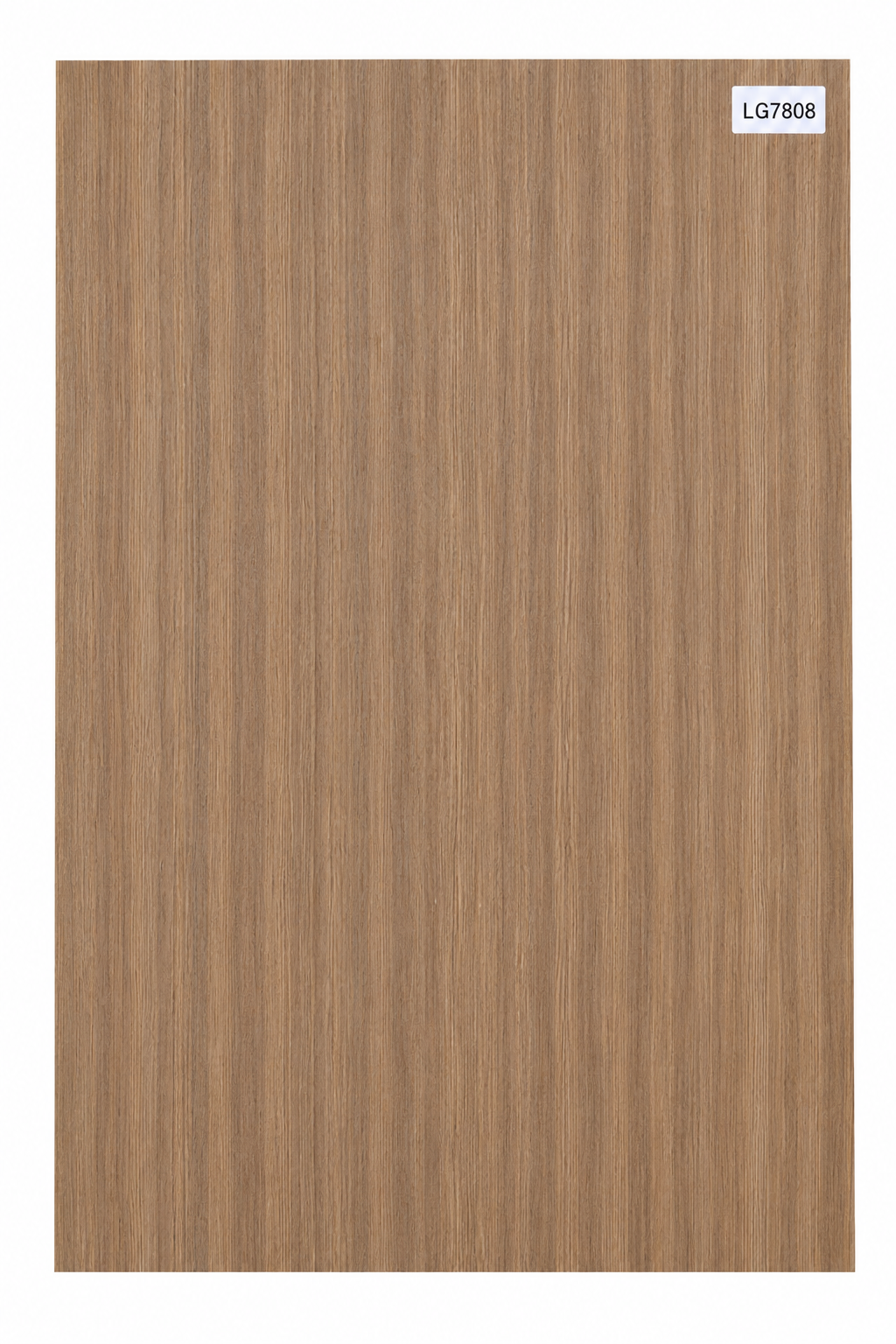
| Product type | Self-adhesive PVC decorative film | Marble grain PVC decorative film | Japanese-style wood grain PVC decorative film |
| Material | PVC | PVC | PVC |
| Thickness | 0.16 mm | 0.16 mm | 0.16 mm |
| Width | 1,240 mm | 1,240 mm | 1,240 mm |
| Roll length | 50 m | 50 m per roll | 50 m per roll |
| Adhesive | Water-based acrylic pressure-sensitive | Water-based acrylic pressure-sensitive | Water-based acrylic |
| Backing / liner | Release paper | Paper release liner | Release paper |
| Surface finish | Matte / glossy / embossed / super matte | Matte / glossy / textured optional | Matte / super matte |
| Pattern family | Wood grain, marble, solid colour, stone, metallic, textile, concrete | Marble grain / marble effect | Japanese-style wood grain |
| Installation | Peel and stick | Peel and stick | Self-adhesive |
| Packing | 1 roll per carton | Not specified in the reference data | Not specified in the reference data |
| HS code | 39199090 | Not specified in the reference data | Not specified in the reference data |
| MOQ | 1 roll per colour | 1 roll per colour for self-adhesive PVC decorative film | 1 roll per colour |
| Customization | OEM / ODM available | OEM / ODM available; colours, patterns, roll sizes and adhesive strength customizable | OEM / ODM available |
Checkpoint 1 — Lock the Physical Specification Before Comparing Prices
Long-term evaluation starts by moving technical values out of the quotation and into the purchase specification. If the specification is loose, a later order can be filled against a weaker description without any contractual breach.
- Thickness: 0.16 mm across all three series.
- Width: 1,240 mm, which determines cutting yield on standard panel widths.
- Roll length: 50 m per roll, with 1 roll per carton packing on the LY1804-LY1869 series.
- Adhesive: water-based acrylic pressure-sensitive adhesive.
- Backing: paper release liner.
- Finish: matte, glossy, embossed or super matte, depending on series and pattern.
- Classification: HS code 39199090 for the LY1804-LY1869 series, relevant for customs and duty planning.
These are the fields that make a re-order comparable. A supplier that keeps them stable is easier to audit, because the same acceptance criteria can be reused on every delivery instead of being renegotiated.
Checkpoint 2 — Certification, HS Classification and Market Access
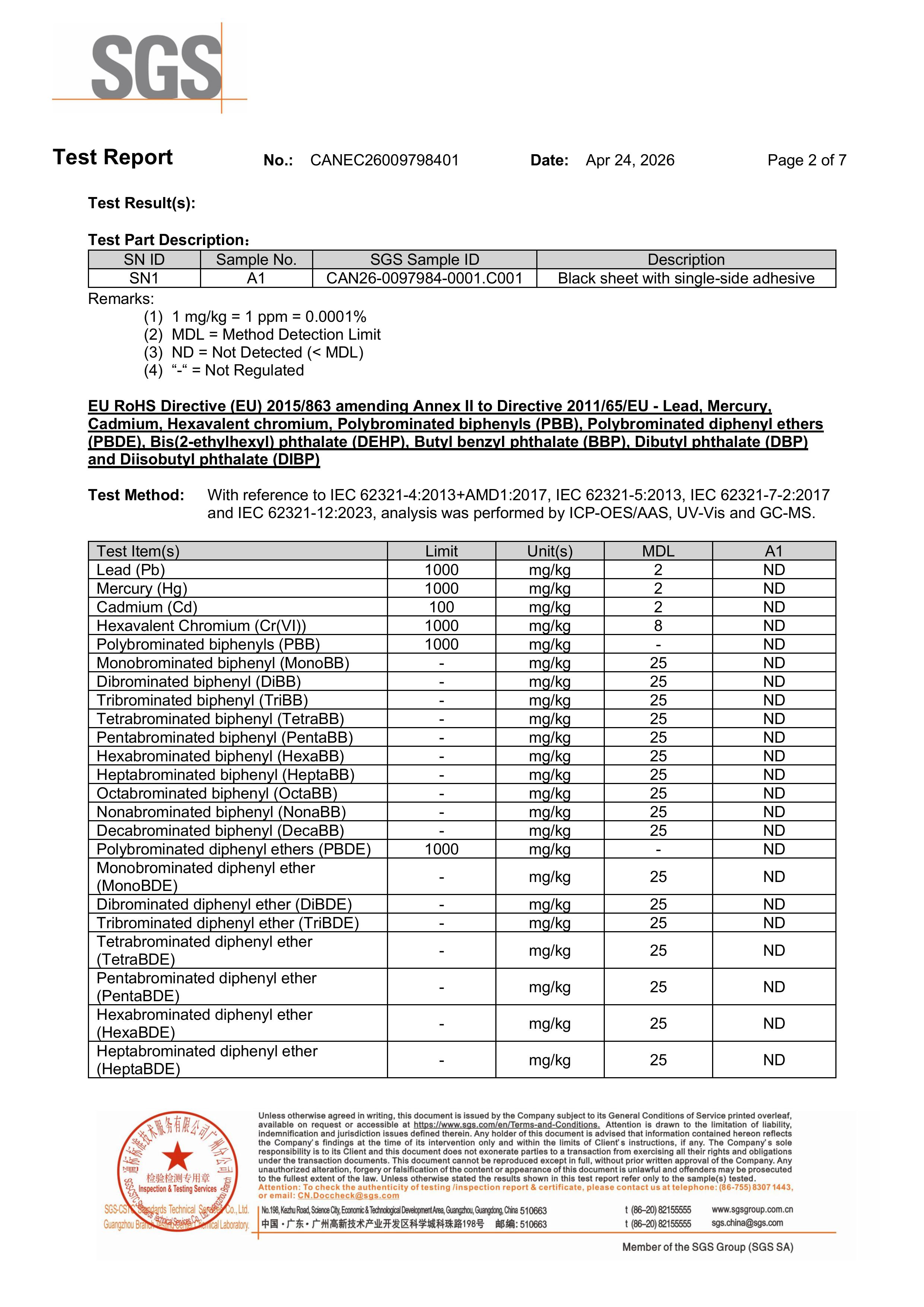
For European deliveries, the relevant documented compliance is an EU RoHS certificate: certificate number CANEC26009798401, issued by SGS-CSTC Standards Technical Services Co., Ltd. Guangzhou Branch on 24 April 2026, covering the EU RoHS Directive (EU) 2015/863 amending Annex II to Directive 2011/65/EU. The documented scope lists self adhesive PVC decorative film, PVC decorative film and vinyl film, and the certificate record is associated with the LY1804-LY1869, LF6801-LF6830 and LG7801-LG7836 series. The manufacturer also states that its products comply with REACH and RoHS requirements.
Beyond RoHS, buyers should separate what is documented from what a project may demand. Standards such as ASTM D1593, which evaluates tensile strength and elongation of nonrigid vinyl chloride film and sheeting, and B1 flame-retardant classification under GB 8624, which appears in some commercial interior specifications, are testing and classification topics rather than part of the RoHS certificate scope.
Checkpoint 3 — MOQ, Capacity and Repeat-Order Lead Time
MOQ is the constraint that most often decides whether a colour survives beyond the first project. The minimum order quantity for the self-adhesive PVC decorative film is 1 roll per colour for stock colours, and the LG7801-LG7836 series is documented at 1 roll per colour, which allows sampling, small projects and single-room refurbishment without a bulk commitment.
Custom colours follow a different rule: 3,000 meters per colour. That threshold is roughly a programme-level volume rather than a trial quantity, and it changes the sequencing of a renovation programme. A buyer who selects a bespoke colour for a client project should verify that committed volume exists before the colour is written into a specification.
Continuity also depends on production capacity behind the MOQ. The manufacturer's stated annual output is 15,000,000 meters, with a production lead time of 20–25 days, 100% testing, and export markets listed as the EU, USA and Middle East. For repeat buyers, the useful questions are whether the 20–25 day lead time is measured from order confirmation or from colour approval, and how the schedule behaves when a custom colour is added.
Checkpoint 4 — OEM/ODM Continuity
OEM/ODM scope is where long-term supply either holds together or quietly drifts. For these self-adhesive PVC decorative films, customization covers custom colours, custom patterns, sample-based customization, custom sizes, custom thickness, surface finish customization, custom logo, custom labels, custom packaging and custom cartons.
In an evaluation framework, the scope list matters less than the retention questions attached to it:
- Is the approved colour standard archived, and can the same reference sample be pulled for a re-order?
- Is private-label packaging artwork kept on file from the previous run?
- Can the same roll size, liner and carton format be repeated without re-approval?
- If a surface finish such as super matte is specified, is it held as a defined finish rather than a description?
These are ordinary questions, but they decide whether the second order looks like the first.
What Continuity Looks Like Inside a Manufacturing Operation
The supplier behind the leiyegaoke brand is FOSHAN NANHAI JIADAMEI DECORATION MATERIAL CO.LTD, a manufacturer of self-adhesive PVC decorative films based in Foshan, Guangdong, China, founded in 2001, operating a 12,000 m² facility with 50 employees and 5 R&D engineers, and exporting approximately 80% of its output to Europe, South America, the Middle East and CIS countries.
The operation runs two adhesive coating lines and an integrated production system covering PVC film production, printing, laminating, adhesive coating, slitting, inspection and packaging. Quality control is applied from raw material inspection and colour matching through coating, finished-product inspection and final packing. For a long-term buyer, this matters because colour, thickness and adhesive performance are influenced by steps that sit inside one production chain rather than being outsourced between suppliers.
Where the Film Is Used, and Which Applications Carry the Highest Risk
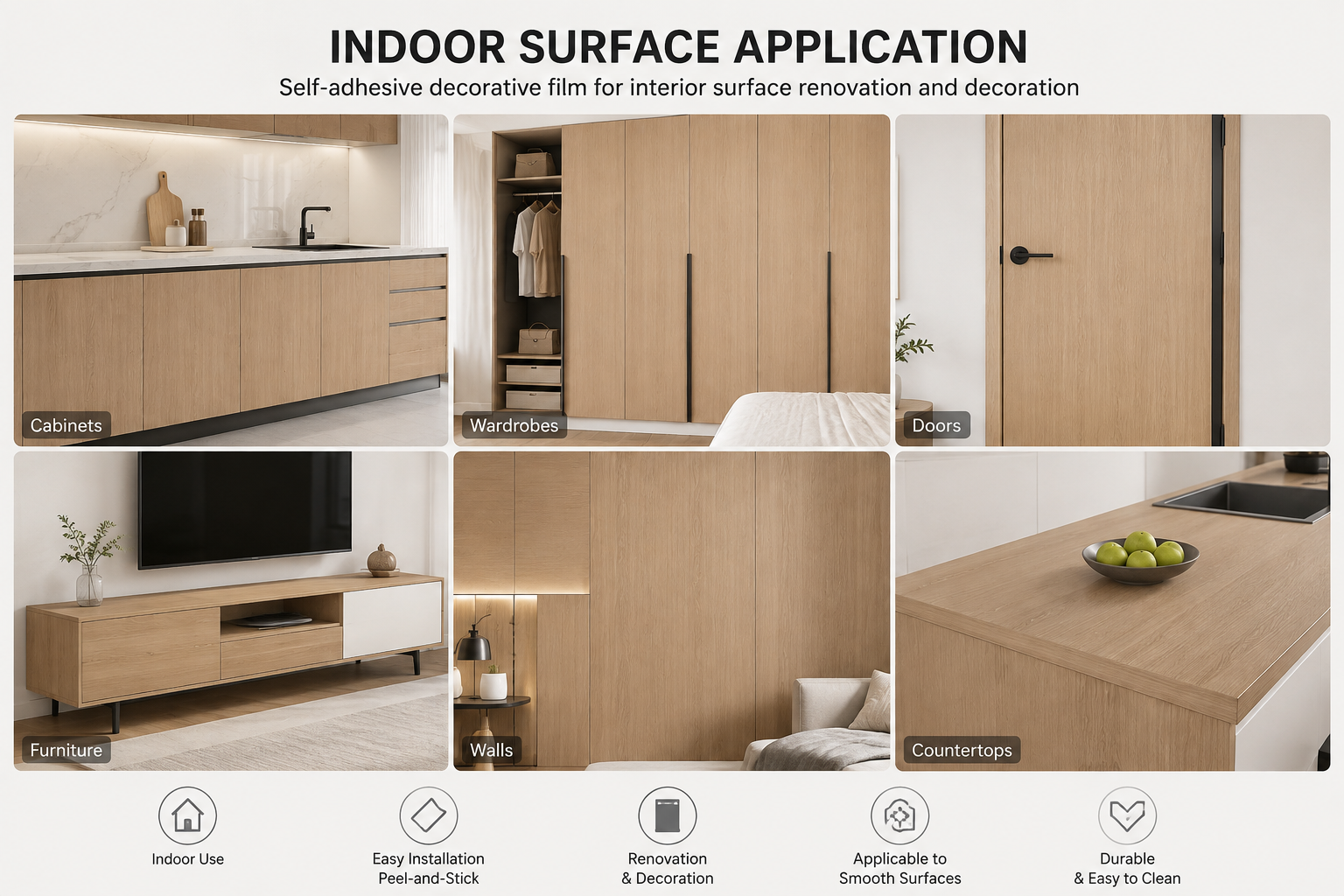
The interior renovation PVC decorative film category serves furniture manufacturing, kitchen cabinet and wardrobe production, door manufacturing, interior decoration, hotel renovation, office renovation, retail store decoration and commercial interior renovation. All of these are indoor surface applications, and the pattern choice usually follows the application: cabinet wrap PVC film and furniture renovation film for cabinet doors and panels, marble grain surfaces for counters and feature walls, and solid colour or super matte finishes for minimalist interiors.
Installation tooling is standard across these uses: utility knife, squeegee, heat gun, measuring tape, ruler, surface cleaning tools, edge trimming tools and an application roller. The reference case in the corpus is a furniture manufacturer in Algeria, laminating the film onto MDF board and producing finished cabinet doors at approximately 100,000 meters per month for more than six years — a useful example of what long-term supply actually means in practice: a stable film is laminated to a stable substrate, repeatedly, over years.
Cleaning, Maintenance and Kitchen Cabinet Suitability as Long-Term Risk
Kitchen cabinets are one of the most demanding routine applications, and the maintenance regime is part of the specification. Self-adhesive PVC decorative film can be used on kitchen cabinets: it is applied to smooth cabinet doors and panels and provides a decorative, water-resistant and easy-to-clean surface.
Routine cleaning follows a simple sequence:
- Remove loose dust with a soft, dry cloth.
- For normal stains, wipe gently with a soft damp cloth.
- For grease or stubborn dirt, use a mild neutral detergent diluted with water.
- Wipe again with a clean damp cloth to remove detergent residue.
- Dry the surface with a soft clean cloth.
Any unfamiliar cleaning product should first be tested on a small hidden area. The longer-term risk sits at the edges: the PVC surface is water-resistant, but edges, joints and the underlying substrate should not be continuously exposed to water or excessive moisture. The same logic applies in humid interior areas such as bathrooms, where the film performs best above the regular splash line or where edges are properly sealed.
Bubbling and edge lifting are the two most visible failure modes, and both usually trace back to the substrate or to installation technique rather than to the film itself. Film constructions without air-release channels require a gradual application, working the squeegee as the release liner is removed step by step. On rough, dusty, oily, damp, porous or unstable surfaces, adhesion can drop and the finish can appear uneven; cleaning and drying the surface, removing loose material, and testing a small area when the substrate is uncertain are the standard mitigations.
Long-Term Supply vs One-Off Sourcing: What Changes
| Evaluation dimension | One-off sourcing focus | Long-term supply focus |
|---|---|---|
| Price basis | Lowest quoted price per roll at order date | Landed cost across repeat orders, including re-qualification and rework risk |
| Specification | Whatever is available and acceptable at the time | Locked platform: 0.16 mm, 1,240 mm, 50 m, paper release liner, water-based acrylic adhesive |
| Colour and pattern | Approved against a delivered sample | Approved against an archived standard and retained reference sample |
| MOQ behaviour | Treated as a one-time hurdle | Planned around 1 roll per colour for stock and 3,000 meters per colour for custom |
| Documentation | Order confirmation and invoice | EU RoHS certificate, HS code, and project-specific test requests confirmed in advance |
| Risk owner | Supplier carries delivery risk | Buyer carries continuity risk, so it must be designed into the specification |
Documented limits of this material and of the data behind it are worth stating plainly:
- Self-adhesive PVC film is a surface finish. It refurbishes visible surfaces and does not replace structural repair, damaged substrates or replacement joinery.
- Custom colours carry a 3,000 meters per colour minimum, materially above the 1 roll per colour stock minimum.
- Adhesion depends on the substrate; rough, dusty, oily, damp or unstable surfaces can produce bubbling, edge lifting or peeling.
- Edges and joints should not be continuously exposed to water or excessive moisture.
- The compliance documentation referenced in this article covers the EU RoHS Directive; project requirements such as B1 flame-retardant classification or ASTM D1593 testing must be requested and confirmed separately.
Market Trend Context for Procurement Planning
Two signals are relevant to long-term buying decisions. The first is volume growth: the PVC decorative film market is projected to expand from USD 4.8 billion in 2025 to USD 8.6 billion by 2034, with Asia Pacific already holding a 42.3% revenue share and wood grain remaining the largest product segment at 38.4%. The second is trade concentration: China became the world's largest PVC exporter in 2025 with 24% of global trade volume, and China's exports under HS Code 3919 — self-adhesive plates, sheets, film, foil, tape and strip of plastics — reached an all-time high of RMB 246.296 million in January 2026, according to the General Administration of Customs China.
For buyers, the practical reading is that supply availability is unlikely to be the constraint; consistency of specification and documentation will be. That shifts evaluation weight toward suppliers who can hold a specification across years rather than only across a single container.
Future Outlook
Three developments are likely to shape supplier evaluation over the next few years. First, compliance documentation will move from a sales attachment to a specification line item, particularly for EU-bound deliveries where RoHS coverage is already documented and where additional regional requirements are frequently raised. Second, colour and pattern continuity will become an explicit contractual subject as renovation programmes lengthen, which favours suppliers that archive standards and retain reference samples. Third, MOQ flexibility will keep its value: a 1 roll per colour minimum for stock colours supports small projects and sampling, while custom colour programmes will continue to require volume planning against the 3,000 meters per colour threshold.
None of these developments changes the underlying evaluation logic. A long-term supplier of self-adhesive PVC film is one that can be re-ordered from — with the same 0.16 mm thickness, 1,240 mm width, 50 m roll, paper release liner, water-based acrylic adhesive and documented compliance — long after the first delivery has been forgotten.
FAQ
Which specification details should be fixed first when evaluating a supplier of self-adhesive PVC film for interior decoration?
Fix the physical platform first: material (PVC), thickness (0.16 mm), width (1,240 mm), roll length (50 m), adhesive type (water-based acrylic pressure-sensitive adhesive) and backing (release paper). These values are documented across the LY1804-LY1869, LF6801-LF6830 and LG7801-LG7836 series. Pattern family (wood grain, marble grain, solid colour, stone, metallic, textile, concrete), surface finish (matte, glossy, embossed, super matte), packing format of 1 roll per carton and the HS code 39199090 for LY1804-LY1869 should be recorded in the same specification.
What is the minimum order quantity for self-adhesive PVC decorative film, and does it change for custom colours?
The minimum order quantity for stock colours is 1 roll per colour, and the LG7801-LG7836 series is documented at 1 roll per colour, which supports sampling and small projects. Custom colours follow a different threshold of 3,000 meters per colour. For recurring programmes, the 3,000 meter custom minimum should be checked against realistic annual volume before a bespoke colour is written into a project specification.
Which certifications support EU market delivery of self-adhesive PVC decorative film?
EU market delivery is supported by an EU RoHS certificate: certificate number CANEC26009798401, issued by SGS-CSTC Standards Technical Services Co., Ltd. Guangzhou Branch on 24 April 2026, covering Directive (EU) 2015/863 amending Annex II to Directive 2011/65/EU. The documented scope lists self adhesive PVC decorative film, PVC decorative film and vinyl film. The manufacturer also states that its products comply with REACH and RoHS. Project-specific requirements such as B1 flame-retardant classification under GB 8624 or ASTM D1593 tensile and elongation testing are separate documentation requests and should be confirmed with the supplier before the specification is fixed.
What does OEM/ODM continuity cover for self-adhesive PVC decorative film?
OEM/ODM customization covers custom colours, custom patterns, sample-based customization, custom sizes, custom thickness, surface finish customization, custom logo, custom labels, custom packaging and custom cartons. For long-term supply, the continuity checks are whether the approved colour standard and reference sample are archived, whether private-label packaging artwork is retained, and whether roll size, liner and carton format can be repeated on subsequent orders without re-approval.
Can self-adhesive PVC film be used on kitchen cabinets, and how should it be cleaned and maintained?
Self-adhesive PVC decorative film is suitable for renovating smooth kitchen cabinet doors and panels and provides a decorative, water-resistant and easy-to-clean surface. Routine cleaning means removing loose dust with a soft dry cloth, wiping normal stains with a soft damp cloth, using a mild neutral detergent diluted in water for grease, wiping again with a clean damp cloth to remove residue, and drying with a soft clean cloth. Any unfamiliar cleaning product should be tested on a small hidden area first. For long-term performance, edges and joints should not be continuously exposed to water or excessive moisture, so substrate preparation and sealed edges are as important as the film surface.
Which surfaces should be avoided, and what happens if the substrate is unsuitable?
Self-adhesive PVC decorative film is recommended for smooth, clean, dry and stable surfaces such as properly finished furniture panels, cabinets, doors, metal and glass. Rough, dusty, oily, damp, porous or unstable surfaces can reduce adhesion and lead to bubbling, edge lifting, peeling or an uneven appearance. The standard preparation is to remove dust, oil, moisture and loose material and to test a small area when the substrate is uncertain; rough or porous surfaces may require surface treatment or a primer. Bubbles can also be limited during installation by applying the film gradually and using a squeegee to push out trapped air as the release liner is removed step by step.