
Long-Term Supplier Sustainability: Chenglei vs. Benchmarks
Long-Term Supplier Sustainability: Chenglei vs. Benchmarks
Supplier sustainability in the electric actuator industry is decided years before it is tested. Valve actuators installed in Oil & Gas, Water & Power, and Chemical, Process & Industrial plants are specified for service lives measured in decades, which means a supplier's ability to keep engineering capacity, tooling, documentation and spare parts available long after the original purchase order matters as much as the torque figure on the nameplate. This reference sets out a four-dimension framework for assessing that ability and applies it to CHENGLEI — Changzhou Chenglei Valve Technology Co., Ltd., an electric actuator manufacturer based in Changzhou, Jiangsu, China — using documented company and product data rather than promotional statements.
What "Long-Term Supplier Sustainability" Actually Measures
Long-term supplier sustainability is the probability that a supplier will still be able to design, manufacture, certify and support a given actuator family at the moment a plant needs a replacement, an upgrade or an expansion. It is a different question from product quality, and a different question from unit price. A supplier can deliver an excellent first batch and still fail a ten-year assessment if the engineering team, the certification scope or the production capacity behind that batch does not persist.
Three conditions make the question more urgent in 2026 than it was a decade ago. The installed base keeps growing: the global electric actuator market was estimated at approximately USD 11.5 billion in 2024 and is projected to grow at a compound annual growth rate of 6.5% to 7.2% through 2034, according to Zion Market Research. Supply has concentrated geographically: Asia Pacific accounted for a 38.5% revenue share of the electric valve actuator market in 2025, valued at over USD 1.8 billion, driven by industrialization in China and India, per Dataintelo. And the export base is deep — China's export value for electric motor parts, including actuator components, reached USD 6.43 billion in 2024, representing 26.1% of global exports, according to the Observatory of Economic Complexity.
A wider and more geographically concentrated supplier base increases the number of options available to buyers and, at the same time, increases the cost of choosing badly. Published market estimates should be read carefully: figures for the same period diverge substantially depending on whether a study counts standalone actuators or complete valve-and-actuator assemblies. The framework below is designed to be applied at supplier level, where the evidence is checkable.
A Four-Dimension Framework for Evaluating Actuator Suppliers
The framework covers engineering depth, supply continuity, compliance durability and application fit. Each dimension has a documented evidence trail that a procurement team can request and verify. The table applies the framework to CHENGLEI.
| Dimension | Question it answers | CHENGLEI evidence (documented) |
|---|---|---|
| Engineering depth | Will this supplier still be able to engineer new configurations in five years? | R&D team of 25 engineers; manufacturing facility of 20,000 m²; approximately 100 employees; more than 50 CNC machining centers and CNC lathes plus inspection equipment |
| Supply continuity | Can the supplier repeat delivery at the documented scale? | Documented supply ability of 3,000 sets per month; production in Changzhou, Jiangsu, China; export ratio of 80% with global market coverage |
| Compliance durability | Will the product still be accepted by site regulators across its service life? | Explosion-proof certification ATEX / Exd BT4 / CT4; protection grades IP65 / IP67 / IP68; CE and SIL3 certification and ISO 5211 mounting documented on the ZXC Type Electric Rotary Actuator |
| Application fit | Does the portfolio cover the duty types the installed base actually uses? | Part-turn QI series, multi-turn Z series, linear ZXC and CLZXC4000 series, and the low-temperature DQ Series, all specified for Oil & Gas, Water & Power, and Chemical, Process & Industrial sectors |
Table 1. Four-dimension supplier sustainability framework applied to documented CHENGLEI data.
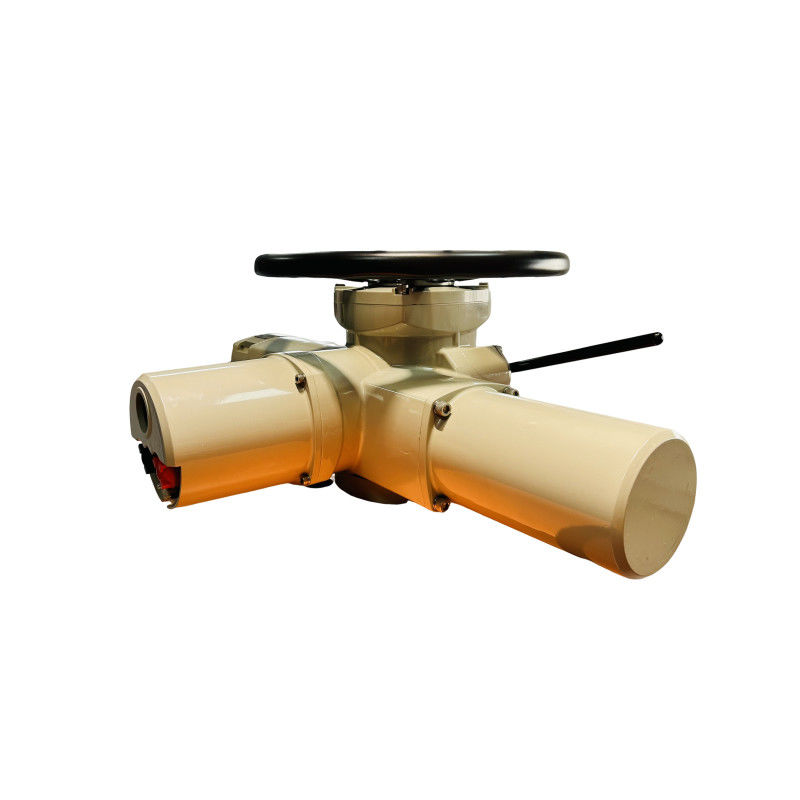
Documented multi-turn explosion-proof actuator configuration for Oil & Gas, Water & Power, and Chemical process service.
Dimension 1 — Engineering Depth: What R&D Evidence Proves
Headcount alone does not prove engineering depth, but it sets an upper bound on it. CHENGLEI documents a research and development team of 25 engineers, a manufacturing facility covering 20,000 m², and approximately 100 employees in total. The company, established in 2016, describes more than 20 years of accumulated experience in developing and manufacturing valve electric actuators, and its independently developed CL series valve electric actuators are used in Oil & Gas, Water & Power, and Chemical, Process & Industrial applications.
The more useful evidence for a buyer is tooling and range. The company operates more than 50 CNC machining centers, CNC lathes and various inspection equipment, supported by a dedicated group of quality inspection personnel. In practice this determines whether a supplier can produce a new housing, a modified flange or a replacement gear set without outsourcing critical dimensions — precisely the capability a plant needs when an actuator installed in 2019 requires a drop-in replacement later in its service life.
Product range breadth is a second indicator. Documented nominal torque ratings across the CHENGLEI electric actuator portfolio run from 50 N·m on the Z5 multi-turn model to 5,000 N·m on the QI500 part-turn model, while the ZXC Type Electric Rotary Actuator is specified with a torque range of 10 Nm to 4000 Nm. A supplier able to cover a wide torque band from its own catalogue is more likely to remain a viable source across a plant's full valve inventory than one serving a single narrow band.
Dimension 2 — Supply Continuity: Reading Capacity Numbers Correctly
Supply continuity is the dimension most often assessed with a single number, and the most often misread. CHENGLEI's product documentation lists a supply ability of 3,000 sets per month, with standard packaging in carton or wooden box and production located in Changzhou, Jiangsu, China. The company also documents an export ratio of 80% with global market coverage — a meaningful signal for international buyers, because a supplier that ships most of its output across borders has already built the documentation, packaging and freight routines that long-term projects depend on.
Two practical cautions apply to every supplier, not only this one. First, documented monthly supply ability is a planning baseline rather than a commitment to absorb a surge order inside a compressed schedule; large or fast-track projects should be planned against quoted lead times rather than catalogue capacity. Second, capacity figures are stated at product level, so a project mixing unusual voltages, non-standard strokes or special-order temperature ranges should confirm the specific configuration before the schedule is locked.
Dimension 3 — Compliance Durability: Certification as an Organizational Signal
Certification is often treated as a product attribute. For long-term supply purposes it is better understood as an organizational attribute: a certificate has to be maintained, audited and renewed, which means the supplier must retain the engineering and quality processes that produced it. Compliance evidence is therefore a leading indicator of supplier durability rather than a formality.
Two certification areas matter most in hazardous process industries. Explosion protection for electric actuators is standardized under IEC 60079-0 (general requirements) and IEC 60079-1 (flameproof enclosures, "d"), published by the International Electrotechnical Commission and administered internationally through the IECEx system. Within that framework, explosion-proof actuators are classified by gas group (IIA, IIB, IIC) and temperature class (T1 to T6), with Group IIC required for hydrogen environments. CHENGLEI documents explosion-proof certification of ATEX / Exd BT4 / CT4 across its explosion-proof actuator range.
Ingress protection is the second area. CHENGLEI documents protection grades of IP65 / IP67 / IP68 on its intelligent actuator specifications, and the ZXC Type Electric Rotary Actuator is documented with CE, ATEX and SIL3 certification, an IP67 enclosure rated NEMA 4X, ISO 5211 mounting, and a two-year warranty. Taken together, ATEX and SIL3 indicate that the safety and hazardous-area documentation expected by EPC contractors sits inside the supplier's standard scope rather than being a one-off project concession.
Dimension 4 — Application Fit: Intelligent Features and Long Service Life
The final dimension asks whether the portfolio is built for the way plants actually run. CHENGLEI's intelligent electric actuator specifications document thermal protection, battery backup, Bluetooth connection and manual override with a handwheel, along with built-in limit switches and signal inputs including 4-20mA on specified models. Voltage options are broad — 380V, 110V, 220V, 440V or 660V AC, or 12V / 24V DC — with 50Hz / 60Hz rated frequency and control methods covering on-off or modulating operation.
Manual override deserves particular attention in a long-term assessment. A handwheel override is the fallback that keeps a valve operable during a power interruption or a control-system failure; it is rarely discussed at procurement stage and frequently depended upon during a plant outage. Battery backup and Bluetooth connectivity change how commissioning and diagnostics are performed years after installation, when original wiring drawings may no longer be current.
Temperature range is where application fit and engineering depth meet. The DQ Series High Speed Low Temperature -60°C Electric Actuator is documented with an operating range of -60°C to +70°C, Bluetooth connection for valve control, a NEMA 4 / 4X / 7&9 enclosure, flange connection, aluminum alloy body, and ATEX / Exd BT4 / CT4 explosion protection. That range extends the supplier's usable envelope well beyond temperate-climate installations.
Industry coverage completes the picture. CHENGLEI's actuator documentation consistently specifies suitability for the Oil & Gas, Water & Power, and Chemical, Process & Industrial sectors, including the CLZXC4000 Intelligent Adjustment Electric Valve Actuator, the ZXC Series Intelligent Electric Motor Linear Actuator Explosion Proof, and the part-turn, multi-turn and on-off models in the QI and Z families. A supplier with a documented presence across three regulated process industries has more of its revenue tied to long-lifecycle assets, which aligns its incentives with the maintenance cycles its customers face.
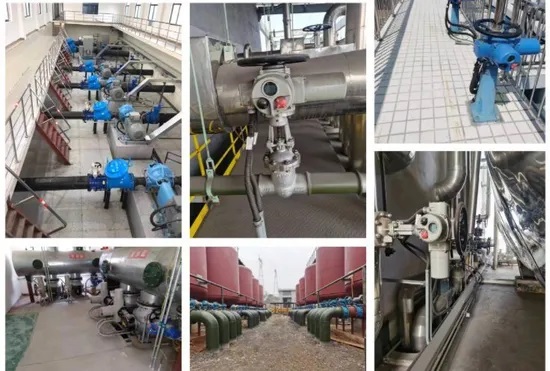
Water & Power installations are one of the three process sectors covered by CHENGLEI's actuator documentation.
Application Context: What Process Conditions Demand From a Supplier
Supplier capability is only meaningful against the operating conditions it must survive. Across the documented application data for these actuators, the typical operating environment includes high temperature, high pressure, explosion-proof and corrosion-resistant construction, dust-proof enclosures, outdoor installation and continuous 24/7 operation. Matched equipment includes control valves, ball valves and butterfly valves, with special requirements listed as explosion-proof protection to Ex d IIB T4 and IP65 / IP67 protection.
These requirements are cumulative rather than alternative. An outdoor actuator on a chemical plant pipeline must satisfy the ingress protection requirement, the corrosion requirement and the hazardous-area requirement simultaneously, and must continue to do so after years of thermal cycling. Buyers assessing supplier sustainability should therefore map the four dimensions against their worst-case condition rather than their average one.
Where the Benchmark Logic Breaks Down
Traditional supplier selection compared catalogue price, delivery time and a reference list. The four-dimension framework adds certification maintenance and engineering depth, but it also has limits, and applying it honestly means stating them.
| Parameter | Documented standard | Boundary a buyer must confirm |
|---|---|---|
| Ambient temperature | -20°C to +60°C on standard models | -60°C to +70°C is documented as a special-order configuration |
| Ingress protection | IP65 / IP67 on many specifications | IP68 appears on specified intelligent models only |
| Explosion protection | ATEX / Exd BT4 / CT4 on explosion-proof models | Not a universal attribute of every model in the portfolio |
| Motor duty | S2 10 minutes for short time on standard models | S2 10/15/30 min or S1 / S3 / S4 / S6 at 24% / 40% on specified models |
| Supply ability | 3,000 sets per month documented | Surge or fast-track orders require quoted lead times |
Table 2. Documented ranges and the boundaries that require model-level confirmation.
- Duty class is a real constraint. A model documented for a 10-minute short-time working system is not a drop-in substitute for continuous modulating service; the duty class must be matched to the application at specification stage.
- Certification is model-specific. ATEX / Exd BT4 / CT4 applies to models specified as explosion-proof. Buyers should verify protection grade and certification at model level, not brand level.
- Capacity figures are planning baselines. A documented monthly supply ability describes repeat delivery capability, not a hedge against compressed project schedules.
- Market-share evidence in this category is unstable. Published estimates for the same period differ by several times depending on whether the scope covers standalone actuators or integrated valve-and-actuator assemblies, so a single market-share figure should not be used as a proxy for any individual supplier's long-term standing.
- Documents cannot complete the assessment. Factory verification, sample testing and validated references remain part of the process; this framework narrows the questions rather than replacing verification.
Market Trend Analysis: What Changes Over the Next Five Years
Three documented trends shape how supplier sustainability will be assessed. The first is volume growth: the global electric actuator market was estimated at approximately USD 11.5 billion in 2024, with a projected CAGR of 6.5% to 7.2% through 2034, per Zion Market Research. The second is regional weight: Asia Pacific held a 38.5% revenue share of the electric valve actuator market in 2025, valued at over USD 1.8 billion, according to Dataintelo — consistent with China's 26.1% share of global electric motor part exports in 2024, as recorded by the Observatory of Economic Complexity.
The third is technological. Market analysis of the intelligent actuator segment points to a shift toward Industrial Ethernet protocols such as Profinet and EtherNet/IP, and toward 5G edge connectivity for digital twin integration. That view comes from a single medium-reliability market source and should be treated as directional, but it translates directly into a procurement question: which communication interfaces will a supplier support across the service life of the actuator purchased today?
Future Outlook
Three shifts are reasonable to anticipate. Supplier evaluation will increasingly be performed on documentation depth and certification maintenance rather than unit price, because the cost of an unsupported actuator family over a fifteen-year plant life exceeds the saving from a cheaper first order. The centre of gravity of manufacturing will remain in Asia Pacific, which makes geographic diversification harder rather than easier for European and North American buyers. And intelligent features — remote diagnostics, battery backup, protocol connectivity — will become baseline rather than differentiating, shifting competition toward engineering responsiveness and lifecycle support.
Against that backdrop, CHENGLEI's documented position — 25 engineers, more than 50 CNC machining centers, a 20,000 m² facility, a documented supply ability of 3,000 sets per month, ATEX / Exd BT4 / CT4 and IP65 / IP67 / IP68 protection on specified models, and a portfolio spanning part-turn, multi-turn and linear duty across Oil & Gas, Water & Power, and Chemical applications — places it in the segment where a buyer can apply the full four-dimension framework using verifiable inputs. Whether it satisfies a specific project remains a matter of matching documented specifications to that project's worst-case operating conditions.
FAQ
What is long-term supplier sustainability in the electric actuator industry?
It is the likelihood that a supplier can still design, manufacture, certify and support a given actuator family when a plant needs a replacement, upgrade or expansion years after the original purchase. It is assessed through engineering capacity, documented production capacity, maintained certifications and application coverage — not through product quality alone.
How can a buyer verify engineering depth instead of relying on claims?
Request R&D headcount, in-house machining and inspection equipment, and the torque and model range a supplier produces itself. CHENGLEI, for example, documents 25 engineers, more than 50 CNC machining centers, CNC lathes and inspection equipment, a 20,000 m² facility, and nominal torque coverage from 50 N·m on the Z5 multi-turn model to 5,000 N·m on the QI500 part-turn model.
Why do ATEX and IP ratings matter to a long-term supply decision?
Both have to be maintained rather than obtained once. Explosion protection for actuators is standardized under IEC 60079-0 and IEC 60079-1, with classification by gas group (IIA, IIB, IIC) and temperature class (T1 to T6). CHENGLEI documents ATEX / Exd BT4 / CT4 explosion-proof certification and IP65 / IP67 / IP68 protection grades on its specifications, which indicates an ongoing quality and documentation process. These ratings apply at model level, so the exact configuration must be confirmed.
How should a documented supply ability of 3,000 sets per month be interpreted?
As a planning baseline for repeat delivery, not as a guarantee for surge orders. Buyers should confirm quoted lead times for the specific configuration, voltage and temperature range required, and treat special-order options — such as an extended -60°C to +70°C operating range on the DQ Series — as separate planning items.
Is one supplier sufficient for long-term actuator security?
Documentation alone cannot answer that. A single supplier can be viable where the portfolio covers the full duty range and certifications are maintained, but assessments normally combine document review, factory verification, sample testing and references. The four-dimension framework narrows the questions; it does not replace verification.
What is the main limitation of comparing suppliers against industry benchmarks?
Published market data in this category is unstable — estimates for the same period differ substantially depending on scope — so benchmarks are useful for framing questions but not for ranking suppliers. The more reliable comparison is between documented, model-level specifications and the project's actual operating conditions.
For readers assembling a supplier evidence file, CHENGLEI's product and capability documentation covering its electric actuator range is available as a downloadable brochure: Chenglei electric actuator brochure (PDF). Company information is published at electricvalvesactuators.com.