
Long-Term Supplier Sustainability: GOKING Digital Printers
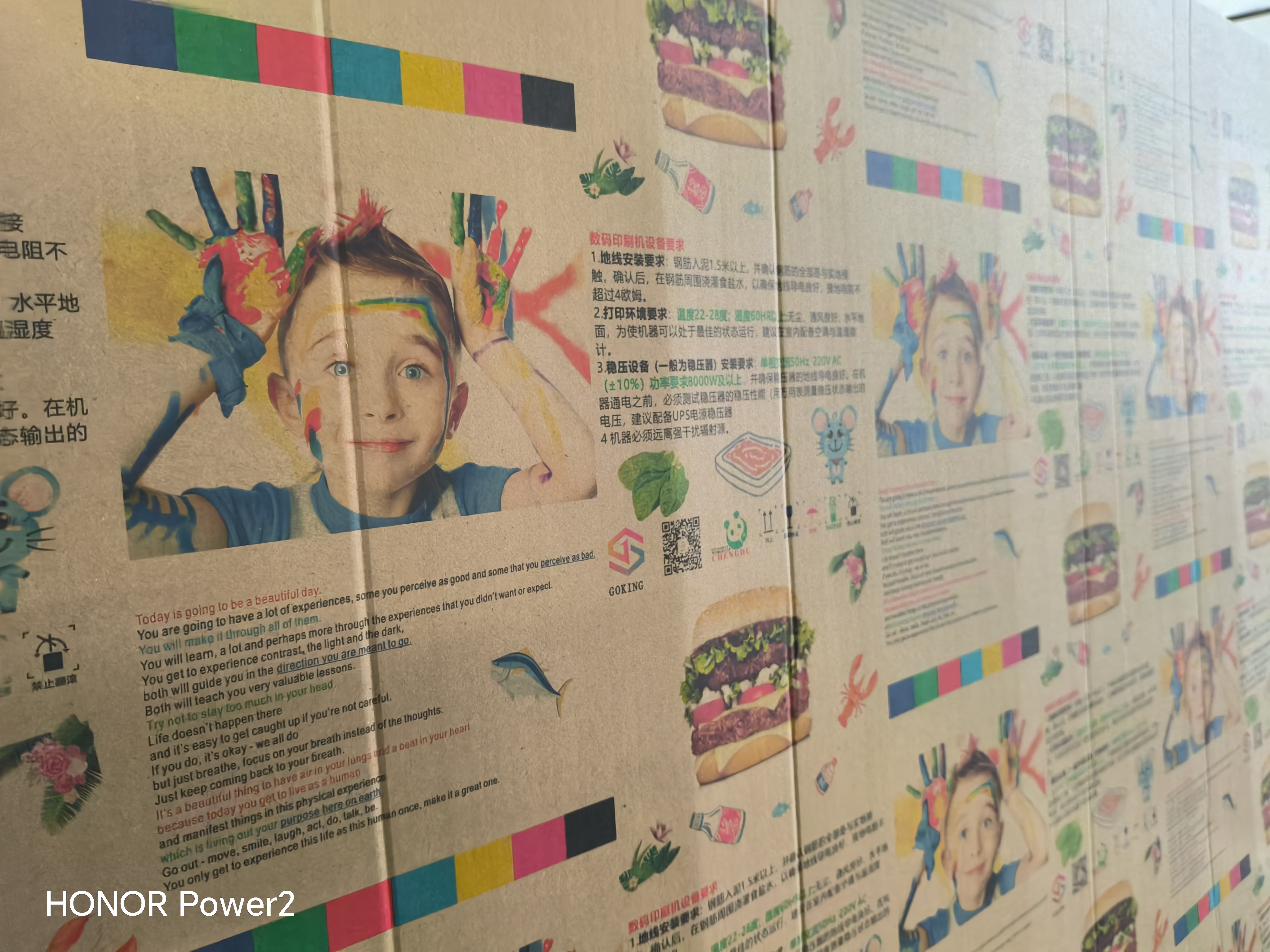
Comprehensive print sample inspection is one of the acceptance steps a packaging buyer can request before a multifunctional digital printing machine leaves the factory.
The digital printing packaging market was valued at USD 30.2 billion in 2024 and is expected to reach USD 46.2 billion by 2029, according to MarketsandMarkets. Growth of that scale changes what a machine purchase actually represents. A packaging plant that installs a digital press is not buying a single production run; it is opening a relationship that has to remain workable for the whole service life of the equipment, through spare parts, engineering questions, configuration changes, and operator turnover.
Guangdong Goking Intelligent Technology Co., Ltd. (GOKING) is a Dongguan-based manufacturer of industrial digital printing machines, founded in 2020, operating a 10,000 m² facility with 152 employees and a 38-engineer R&D team. Its core platform is a single-pass and multi-pass 2-in-1 multifunctional digital printing machine for corrugated and honeycomb cardboard, and the company also provides OEM and ODM production services for packaging brands and equipment partners. For buyers in the Evaluation and Execution stages, the practical question is not which machine carries the longest feature list, but whether the supplier behind it can keep its capability available, serviceable, and configurable across the years the machine will run.
What Long-Term Supplier Sustainability Means in Equipment Buying
Supplier sustainability is not a synonym for supplier size. A large supplier can be a weak long-term partner for a niche corrugated application, while a specialist manufacturer can be durable if its engineering, documentation, and support functions are structured to outlast the warranty period. In practice, five continuity dimensions carry most of the weight in a procurement evaluation.
| Continuity dimension | Buyer question | Evidence to request | GOKING reference point |
|---|---|---|---|
| Organizational | Will this supplier still staff this product line in five years? | Founding year, headcount, R&D engineer count, facility size, product line | Founded 2020; 152 employees; 38-engineer R&D team; 10,000 m² facility |
| Production | Can repeat orders be built on the same platform later? | Annual and monthly output, standard lead time, custom lead-time policy, MOQ | 864 sets annual output; 38 sets monthly capacity; standard lead time typically one month; MOQ 1 set |
| Engineering | Can configuration be changed after the first order? | Customization scope, printhead options, DPI and color options, OEM/ODM terms | OEM and ODM services; whole-machine R&D and manufacturing; machine structure, Epson/Xaar printhead type, DPI configuration, 5-color scheme, turnkey line solutions |
| Support | Who responds when the machine stops? | Response-time commitment, spare-parts handling, overseas installation | Technical support, spare parts support, response within 24 hours; engineers travel to site for installation and commissioning |
| Acceptance | How is quality proven before shipment and on site? | Test protocols, inspection stages, conformity documents | 100% aging test, long-time running inspection, pre-shipment inspection; acceptance per contract |
Each dimension can be tested against records rather than assurances, which is why continuity questions belong in the same evaluation pack as speed, resolution, and price.
Organizational Continuity: What Founding Year, Headcount, and Engineering Depth Signal
GOKING was founded in 2020 and now employs 152 people, 38 of whom work in R&D. Its manufacturing site covers 10,000 m² in Dongguan, Guangdong province, the industrial cluster that supports a large share of China's digital printing machinery exports. The founding team is described as bringing more than a decade of industry experience, which is a useful distinction: organizational age and engineering age are not the same thing, and a 2020 company can still be staffed by engineers who worked on digital printing platforms long before it was registered.
The limitation runs the other way as well. A supplier founded in 2020 has a shorter corporate track record than press builders that have manufactured for decades, and no buyer can verify continuity that has not yet happened. What can be verified is more concrete: a CE Certificate of Conformity numbered HTT202308117L issued in August 2023, an export share of 49 percent, and site cases in countries including Spain, Brazil, South Africa, Turkey, Korea, and Australia. Buyers weighing a younger supplier should treat those documents, not the founding date alone, as the evidence base.
Production Continuity: Capacity, Lead Time, and Minimum Order
GOKING reports an annual output of 864 sets and a monthly capacity of 38 sets. Those figures matter less as headline numbers than as planning inputs. They indicate how a repeat order or an additional machine can be scheduled and set the practical boundary of how many units one buyer can pull at once. The stated standard production lead time for standard machines is typically one month; custom lead times are available on request, while OEM and ODM lead times are subject to confirmation rather than fixed in advance. The minimum order quantity is one set, so a first evaluation order does not require a fleet commitment.
The boundary condition is straightforward. A buyer planning a multi-line rollout should treat published capacity and lead-time figures as the starting point of a delivery-schedule discussion, not as a reserved production slot. Configuration changes inside the OEM/ODM scope extend any timeline, which is normal for a supplier building to specification rather than shipping from stock.
Engineering and Configuration Continuity: The 2-in-1 Platform
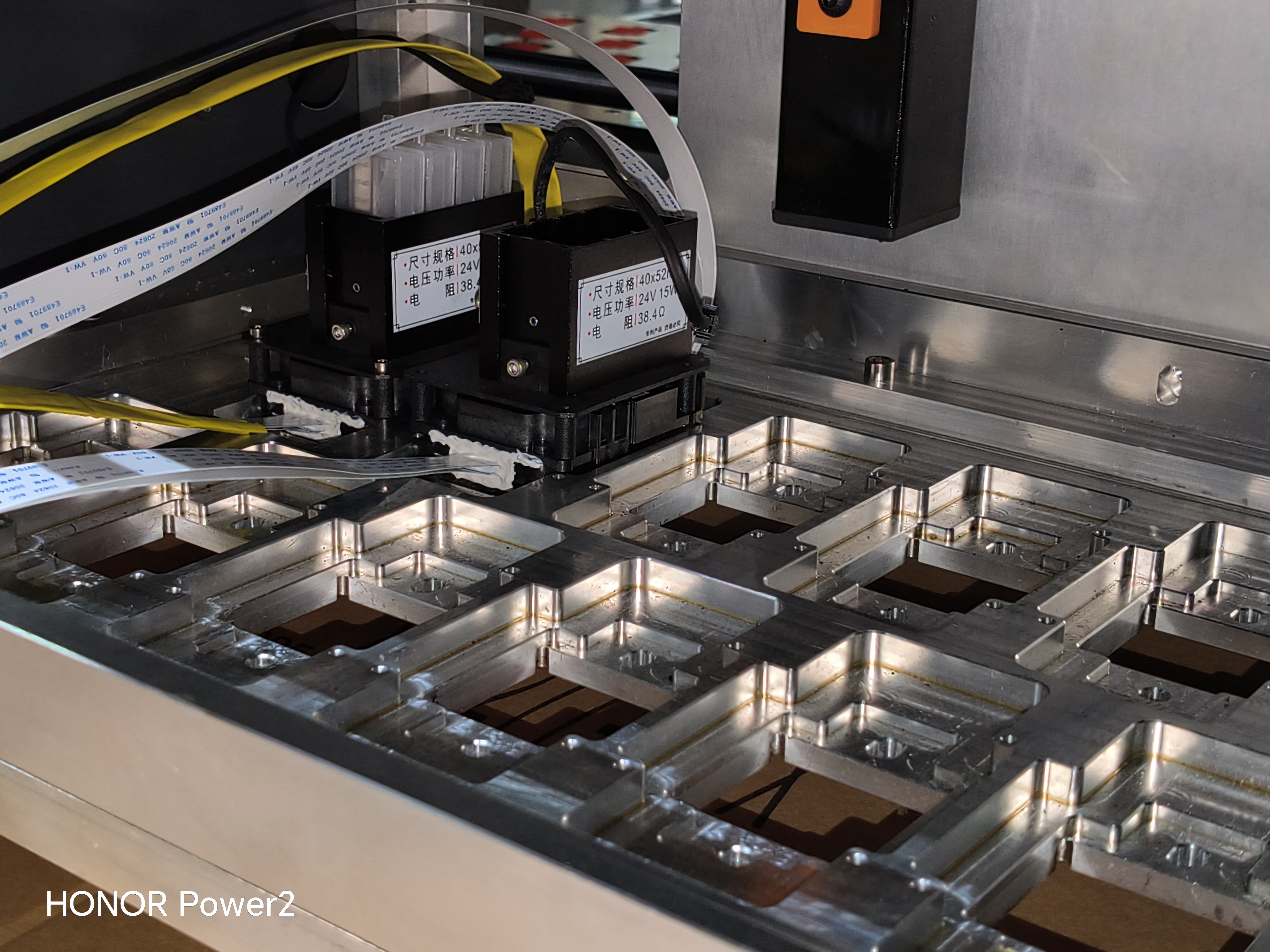
Printhead installation during assembly: the configuration chosen at order stage determines resolution, speed, and color behavior for the working life of the machine.
The engineering reason the 2-in-1 architecture matters for long-term ownership is that one physical machine covers two production modes. For complex or large-format boards the scanning (multi-pass) method is used, while for small boards and small-batch orders the direct-output (single-pass) mode handles the job. A plant whose order mix shifts later does not have to change platforms to follow the market.
Configuration flexibility is documented at several levels: machine structure, printhead type (Epson or Xaar), DPI configuration, color scheme including 5-color models, and turnkey line solutions. Across the range, printhead counts run from 8 to 256, print width from 264 mm to 2600 mm, and supported material thickness from 2 mm to 30 mm. Production efficiency is rated at 700 and 1500 m²/h depending on configuration. Single-pass printing speed is 60 m/min with Epson nozzles and at least 100 m/min with Xaar nozzles, which the company describes as durable and tolerant of a lower-specification operating environment. Color mode is CMYK with a white channel option, and the ink set covers water-based dye ink, water-based pigment ink, coating ink, and UV eco-friendly ink.
Mechanically, the platform uses a micro-piezo high-precision printhead, a vacuum adsorption platform, leading-edge or belt feeding, a magnetic levitation high-precision crossbeam, servo motors, and Schneider electrical components, with a carbon steel frame, stainless steel conveying rollers, and an aluminum alloy beam. Rated power is approximately 14 kW. The RIP supports direct printing without converting pictures, and the machine accepts PDF, JPG, BMP, and TIF files, with a minimum legible digital English text size of 1.5 mm. For a buyer in the Execution stage, this list is the basis of a configuration freeze: printhead type, DPI, color scheme, and feeding mode are the variables that should be locked in writing before the order is confirmed.
Application Fit: Corrugated Packaging and Short-Run Work
The machine is designed around corrugated and honeycomb cardboard and is also applied to coated paperboard, serving printing and packaging operations as well as paper mills. Its documented range runs from kraft paper to coated paper and from single-sheet printing to mass production. The platform earns its place in short-run, urgent, and personalized packaging work, which is the order profile plate-based production handles least efficiently. Third-party analysis from Market Research Future notes that variable data printing has made runs under 3,000 units economically viable, a segment previously treated as cost-prohibitive. That is the commercial logic behind a multifunctional digital printing machine in a corrugated plant, and it applies to short-run retail and gift box packaging as much as to industrial cartons.
Support Continuity: Installation, Response Time, and Spare Parts
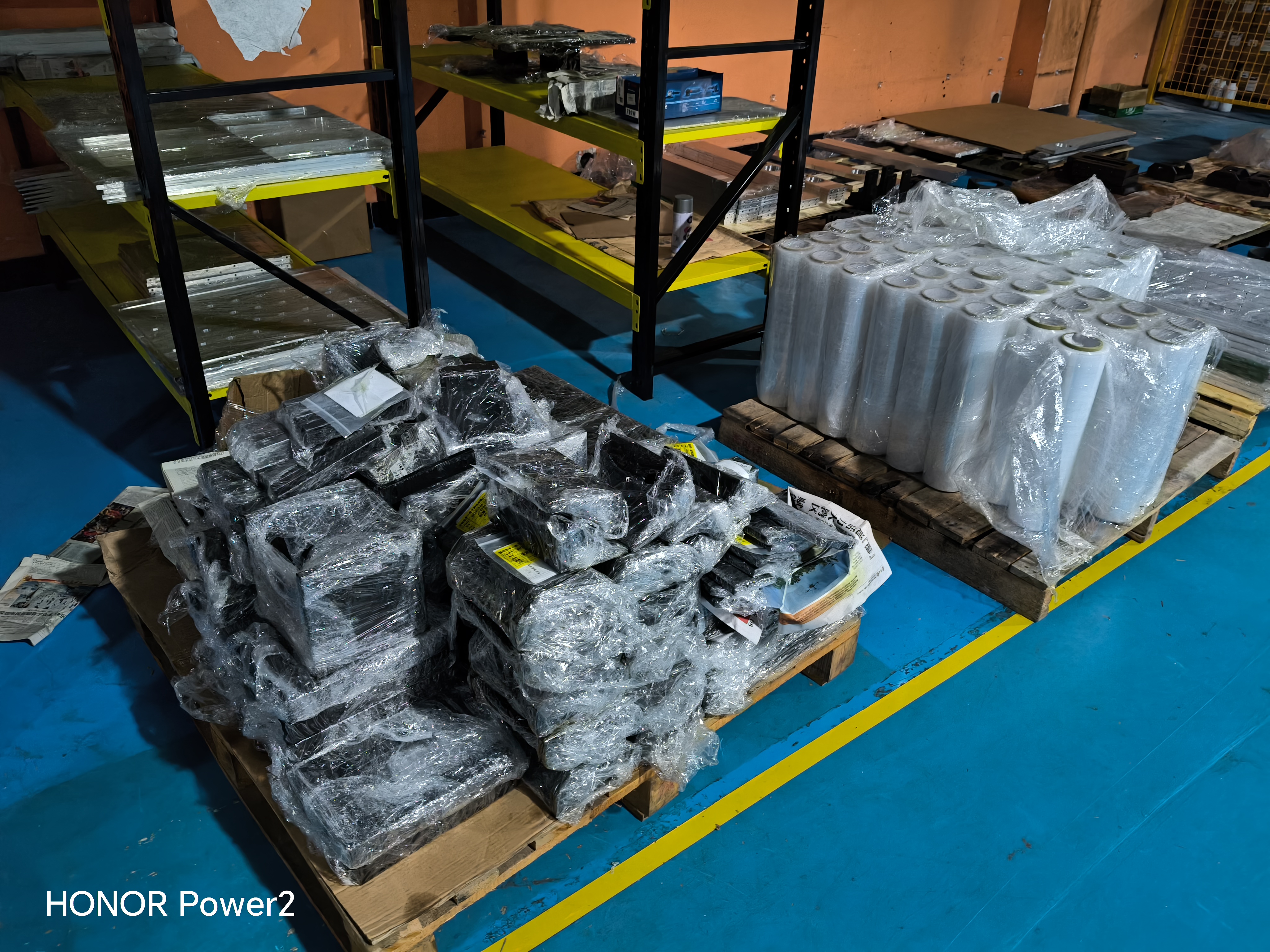
Spare-parts procurement is a standing function at the supplier, not a one-off accommodation after the warranty ends.
After-sales structure is the part of supplier sustainability that buyers feel first, because it is tested in the weeks after commissioning rather than in the showroom. GOKING provides technical support, spare parts support, and after-sales service with a response within 24 hours. Once an overseas customer receives the machine, dedicated engineers travel to the site to assist with installation and commissioning. Free sample printing is offered to global clients, so a buyer can evaluate output on their own board grade before committing to a machine.
The export footprint indicates where that support structure is already exercised. GOKING reports a 49 percent export ratio, with markets spanning the EU, Africa, Latin America, Russia, Kazakhstan, and Turkey, and additional export activity across Europe and the Middle East. Case records list overseas printing and packaging factories in Spain, Brazil, South Africa, Turkey, Korea, and Australia, with highlights including fast response, on-site engineering support, and long-term cooperation. Two operational details deserve attention during contracting: four complimentary cartons of ink and various wear parts are packed together with the equipment for shipment, and spare-parts procurement is handled as a continuing process rather than a one-time concession.
Acceptance Continuity: What Can Be Verified Before Payment and Shipment
Quality claims become procurement evidence only when they are attached to a stage of the process. GOKING's stated quality control chain includes a 100% aging test, long-time running inspection, and pre-shipment inspection. Acceptance criteria cover sample testing, factory inspection, pre-shipment inspection, and on-site acceptance per contract. Commercial terms are equally explicit: a minimum order quantity of one set, a 30 percent deposit before production, and the remaining 70 percent of the contract amount before shipment, with global shipping, secure packaging, whole-machine delivery, and turnkey line delivery as the delivery framework.
Compliance documentation follows the same pattern. The CE Certificate of Conformity, certificate number HTT202308117L, was issued by Shenzhen HTT Technology Co.,Ltd. on 9 August 2023 against EN 60204-1:2018 and Directive 2006/42/EC, with the European Union as its market scope. In the wider regulatory picture, industrial digital printers are assessed for CE marking with reference to EN ISO 12100 for risk assessment, and the electrical equipment of industrial machines is governed by IEC 60204-1 (EN 60204-1). Both are standard reference points a buyer can use when checking whether a supplier's conformity file is complete for the intended destination.
Digital Versus Plate-Based Production: Where the Boundaries Sit
Digital printing does not displace plate-based production across the board, and an evaluation that pretends otherwise is not useful. The two methods solve different cost structures.
| Decision factor | Plate-based (flexo / offset) | Multifunctional digital platform |
|---|---|---|
| Setup economics | Plate making, mounting, and wash-up per design; efficient at long static runs | No plate step; RIP accepts PDF, JPG, BMP, TIF directly; suited to short-run and variable work |
| Changeover | Requires plate change and registration setup | 2-in-1 machine switches between scanning mode and direct output within one platform |
| Resolution and speed | Stable quality at high volume | Scanning mode for complex or large-format boards; direct output for small boards and small-batch orders; 60 m/min with Epson nozzles, at least 100 m/min with Xaar nozzles |
| Substrate range | Depends on plate and press configuration | Corrugated and honeycomb cardboard, 2 to 30 mm thickness; kraft to coated paper |
| Long-run cost | Typically lower per unit at very long, unchanged runs | Advantage appears in short-run, urgent, personalized work, not in very long unchanged runs |
| Documentation | Press-specific conformity files | CE Certificate of Conformity HTT202308117L, EN 60204-1:2018 under Directive 2006/42/EC, EU scope |
The limits should be stated plainly. Plate-based flexo and offset remain efficient for very long runs of an unchanged design, where plate cost is amortized across large volumes. Scanning mode on a multifunctional machine delivers higher clarity at lower throughput than direct output, so resolution and speed have to be traded deliberately at configuration stage rather than assumed. The CE certificate covers the electrical safety scope defined by EN 60204-1:2018 under Directive 2006/42/EC for the European Union; it is not a blanket certificate for every destination market, so buyers that export printed packaging onward should confirm end-market requirements separately. Finally, a platform with 864 sets of annual output serves a broad customer base, which makes individual delivery slots a scheduling matter rather than a certainty.
Commercial and Site Constraints to Price Into the Plan
Several numbers belong in the budget before the order rather than after it. The machine is rated at approximately 14 kW and requires a 380 V, 50/60 Hz, three-phase supply. It operates in a room temperature range of 15 to 32 °C with around 70 percent humidity, and the footprint is 4260 mm x 2300 mm x 1900 mm with a machine weight of 2800 kg, factors that determine floor preparation, access routes, and rigging. The standard lead time is typically one month for standard machines, custom lead times are available on request, and OEM or ODM timelines are confirmed case by case. Payment follows a 30 percent deposit before production and 70 percent before shipment.
Buyers comparing suppliers on durability signals should note that these constraints are fixed technical facts rather than negotiable terms. A supplier that provides them precisely at quotation stage is easier to plan around than one that reveals them during installation.
Future Outlook: Why Continuity Becomes a Competitive Criterion
The installed base of digital printing equipment keeps expanding. Grand View Research places the global digital printing market at USD 38.0 billion in 2023, projected to reach USD 57.0 billion by 2030, with inkjet holding the largest technology share at 48.4 percent in 2023. Within that, the single-pass digital printing machine segment was valued at USD 3.2 billion in 2024 and is projected to reach USD 6.5 billion by 2034, according to Reports and Data. Asia-Pacific accounted for approximately 41.6 percent of digital printing revenue share in 2025, per Market Research Future, and China's digital printing machinery exports are supported by the concentrated industrial cluster in Guangdong province.
The procurement consequence is predictable. As more packaging plants add digital capacity, differentiation shifts from whether a supplier can build the machine to whether it can support the machine across a decade: spare parts availability, engineering response, configuration upgrades, and documented acceptance processes. Water-based pigment ink continues to account for a significant share of eco-friendly digital printing production, which adds a second continuity question, namely whether the ink supply and printhead configuration remain serviceable as ink chemistry evolves. Suppliers that answer those questions with documents, capacity figures, and defined response commitments will be evaluated differently from those that answer with brochures.
FAQ: Long-Term Supplier Evaluation for Multifunctional Digital Printing Machines
How much production capacity and what lead time should a buyer plan around?
GOKING reports an annual output of 864 sets and a monthly capacity of 38 sets, with a minimum order quantity of one set. The standard production lead time for standard machines is typically one month. Custom configurations are quoted with lead times available on request, and OEM or ODM timelines are subject to confirmation, so a buyer should confirm the delivery slot in writing rather than assume the standard lead time applies to a customized machine.
What after-sales commitments can be verified before ordering?
The stated structure includes technical support, spare parts support, and after-sales service with a response within 24 hours. For overseas customers, dedicated engineers travel to the site to assist with installation and commissioning after the machine arrives. Four complimentary cartons of ink and various wear parts are packed with the equipment for shipment, which reduces the number of separate consumable orders in the first operating period. Case records list overseas printing and packaging factories in Spain, Brazil, South Africa, Turkey, Korea, and Australia.
Which parts of the machine can be customized under OEM and ODM?
Customization covers machine structure, printhead type (Epson or Xaar), DPI configuration, color scheme including 5-color arrangements, and turnkey line solutions. Whole-machine R&D and manufacturing services are provided alongside OEM and ODM production, and free sample printing is available for global clients. Across the range, printhead counts run from 8 to 256, print width from 264 mm to 2600 mm, and supported material thickness from 2 mm to 30 mm.
What acceptance checks can be requested before shipment?
The quality control chain includes a 100% aging test, long-time running inspection, and pre-shipment inspection. Acceptance criteria cover sample testing, factory inspection, pre-shipment inspection, and on-site acceptance per contract. Commercial terms are a 30 percent deposit before production and 70 percent of the contract amount before shipment, with whole-machine delivery and turnkey line delivery available.
What site conditions must be confirmed before installation?
The machine requires a 380 V, 50/60 Hz, three-phase power supply and is rated at approximately 14 kW. The working environment is specified at 15 to 32 °C room temperature with around 70 percent humidity. The machine measures 4260 mm x 2300 mm x 1900 mm and weighs 2800 kg, so access routes, floor loading, and rigging need to be planned before delivery.
Does a multifunctional digital printing machine replace plate-based production entirely?
No. Plate-based flexo and offset production remains efficient for very long runs of an unchanged design, where plate costs are spread across high volumes. Digital production addresses short-run, urgent, and personalized work, including runs under 3,000 units, which third-party analysis notes have become economically viable through variable data printing. The two methods are usually complementary in the same plant, and the 2-in-1 architecture, with scanning mode for complex or large-format boards and direct output for small boards and small-batch orders, is intended to cover both digital use cases from one machine.
Closing Perspective
Assessing GOKING as a long-term supplier comes down to matching documented capability against the buyer's own continuity needs. The verifiable facts, including the 2020 founding, 152 employees, 38-engineer R&D team, 10,000 m² facility, 864-set annual output, 38-set monthly capacity, 49 percent export share, 24-hour support response, overseas installation engineers, 100 percent aging tests, pre-shipment inspection, and CE certificate HTT202308117L, are the inputs. The judgment is whether they cover the support, spare parts, and configuration flexibility the plant expects over the next several years. Buyers who want to validate output first can request free sample printing, review the product catalog at https://cdn.socialarks.com/sbsp/24979/common/2026/0727/2026%20product%20catalog.pdf, and check published specifications at www.cmyk-goking.com.